
THERMAL REMOTE SENSING
AND ITS APPLICATIONS
VIDYASAGAR UNIVERSITY
GEOGRAPHY AND ENVIRONMENTAL MANAGEMENT
PRESENTED BY- CHANDAN ROY
©Copyright
All rights are reserved
11/8/2018 Chandan Roy,VU,Geo&EM 1
 CONTENTS:-
 Introduction
 Definition Of Thermal Remote Sensing
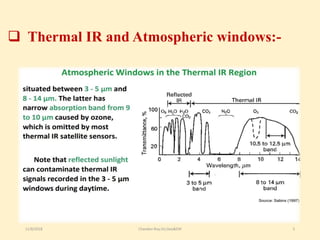
 Thermal IR and Atmospheric Window
 Fundamentals of Radiation law
 Atmospheric effect
 Thermal Data Acquisition
 Different types of thermal sensors
 Applications of thermal remote sensing
 Advantages and Disadvantages of ‘TIRS’
©Copyright
All rights are reserved
11/8/2018 Chandan Roy,VU,Geo&EM 2
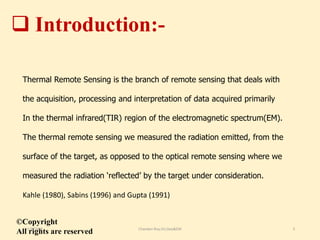
 Introduction:-
Thermal Remote Sensing is the branch of remote sensing that deals with
the acquisition, processing and interpretation of data acquired primarily
In the thermal infrared(TIR) region of the electromagnetic spectrum(EM).
The thermal remote sensing we measured the radiation emitted, from the
surface of the target, as opposed to the optical remote sensing where we
measured the radiation ‘reflected’ by the target under consideration.
Kahle (1980), Sabins (1996) and Gupta (1991)
©Copyright
All rights are reserved11/8/2018 Chandan Roy,VU,Geo&EM 3
 Definition of Thermal Remote Sensing(TRS):-
Thermal remote sensing is a type of passive remote sensing since it
detects naturally emitted radiation. Most thermal remote sensing in
conducted in the 3-5 μm and 8-14 μm wavelengths. This module reviews the
basics of thermal radiation, emissivity and thermal imaging systems.
©Copyright
All rights are reserved
11/8/2018 Chandan Roy,VU,Geo&EM 4
 Thermal IR and Atmospheric windows:-
11/8/2018 Chandan Roy,VU,Geo&EM 5
 Electromagnetic Spectrum of Thermal Infared :-
11/8/2018 Chandan Roy,VU,Geo&EM 6
 Fundamentals of Radiation laws:-
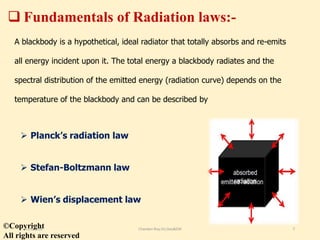
A blackbody is a hypothetical, ideal radiator that totally absorbs and re-emits
all energy incident upon it. The total energy a blackbody radiates and the
spectral distribution of the emitted energy (radiation curve) depends on the
temperature of the blackbody and can be described by
 Planck’s radiation law
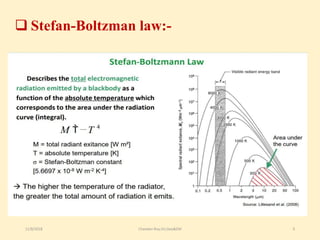
 Stefan-Boltzmann law
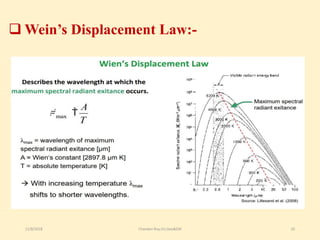
 Wien’s displacement law
©Copyright
All rights are reserved
11/8/2018 Chandan Roy,VU,Geo&EM 7
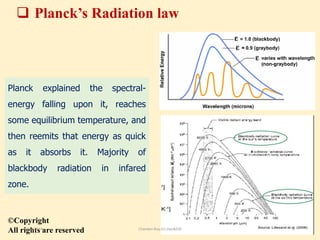
 Planck’s Radiation law
Planck explained the spectral-
energy falling upon it, reaches
some equilibrium temperature, and
then reemits that energy as quick
as it absorbs it. Majority of
blackbody radiation in infared
zone.
©Copyright
All rights are reserved11/8/2018 Chandan Roy,VU,Geo&EM 8
 Stefan-Boltzman law:-
11/8/2018 Chandan Roy,VU,Geo&EM 9
 Wein’s Displacement Law:-
11/8/2018 Chandan Roy,VU,Geo&EM 10
 What is Emissivity:-
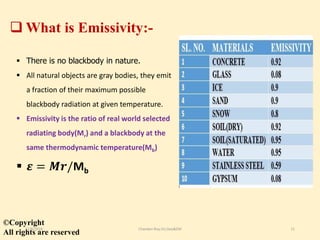
 There is no blackbody in nature.
 All natural objects are gray bodies, they emit
a fraction of their maximum possible
blackbody radiation at given temperature.
 Emissivity is the ratio of real world selected
radiating body(Mr) and a blackbody at the
same thermodynamic temperature(Mb)
 𝜺 = 𝑴𝒓/Mb
©Copyright
All rights are reserved
11/8/2018 Chandan Roy,VU,Geo&EM 11
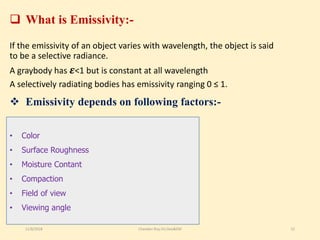
 Emissivity depends on following factors:-
If the emissivity of an object varies with wavelength, the object is said
to be a selective radiance.
A graybody has 𝜺<1 but is constant at all wavelength
A selectively radiating bodies has emissivity ranging 0 ≤ 1.
• Color
• Surface Roughness
• Moisture Contant
• Compaction
• Field of view
• Viewing angle
 What is Emissivity:-
11/8/2018 Chandan Roy,VU,Geo&EM 12
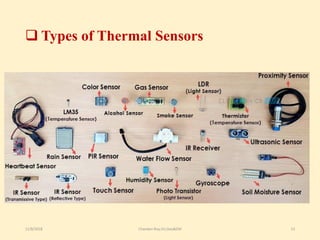
 Types of Thermal Sensors
11/8/2018 Chandan Roy,VU,Geo&EM 13
 Applications of Thermal Remote Sensing:-
• Forest fires
• Volcanology
• Intelligence / military applications
• Heat loss from buildings(UHI)
• Identification of geological units and structures
• Soil moisture studies
• Hydrology
• Coastal zones
• Coal fires
• Meteorology
• Medical sciences
• Others
©Copyright
All rights are reserved
11/8/2018
Chandan Roy,VU,Geo&EM 14
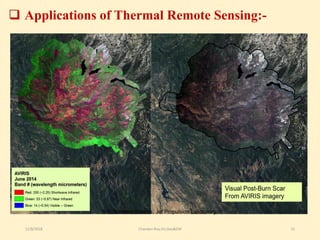
 Applications of Thermal Remote Sensing:-
11/8/2018 Chandan Roy,VU,Geo&EM 15
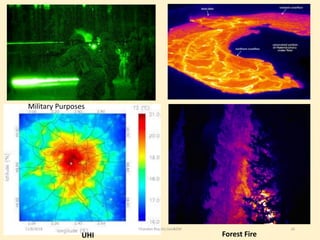
UHI
Military Purposes
Forest Fire
11/8/2018 Chandan Roy,VU,Geo&EM 16
 Applications of Thermal Remote Sensing:-
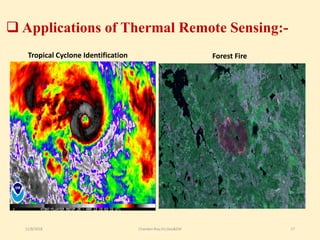
Tropical Cyclone Identification Forest Fire
11/8/2018 Chandan Roy,VU,Geo&EM 17
Advantages and Disadvantages of ‘TIRS’
Advantage
• We can detect true temperature
of an objects.
• Feature can’t be detected by
optical ‘RS’ may be detected
with thermal ‘IR’
Disadvantages
• It is pretty difficult to maintain
the sensors at required temp.
• Image Interpretation of thermal
is difficult.
11/8/2018 Chandan Roy,VU,Geo&EM 18
THANK YOU!
11/8/2018 Chandan Roy,VU,Geo&EM 19

Thermal remote sensing and its applications

  • 1.
    THERMAL REMOTE SENSING ANDITS APPLICATIONS VIDYASAGAR UNIVERSITY GEOGRAPHY AND ENVIRONMENTAL MANAGEMENT PRESENTED BY- CHANDAN ROY ©Copyright All rights are reserved 11/8/2018 Chandan Roy,VU,Geo&EM 1
  • 2.
     CONTENTS:-  Introduction Definition Of Thermal Remote Sensing  Thermal IR and Atmospheric Window  Fundamentals of Radiation law  Atmospheric effect  Thermal Data Acquisition  Different types of thermal sensors  Applications of thermal remote sensing  Advantages and Disadvantages of ‘TIRS’ ©Copyright All rights are reserved 11/8/2018 Chandan Roy,VU,Geo&EM 2
  • 3.
     Introduction:- Thermal RemoteSensing is the branch of remote sensing that deals with the acquisition, processing and interpretation of data acquired primarily In the thermal infrared(TIR) region of the electromagnetic spectrum(EM). The thermal remote sensing we measured the radiation emitted, from the surface of the target, as opposed to the optical remote sensing where we measured the radiation ‘reflected’ by the target under consideration. Kahle (1980), Sabins (1996) and Gupta (1991) ©Copyright All rights are reserved11/8/2018 Chandan Roy,VU,Geo&EM 3
  • 4.
     Definition ofThermal Remote Sensing(TRS):- Thermal remote sensing is a type of passive remote sensing since it detects naturally emitted radiation. Most thermal remote sensing in conducted in the 3-5 μm and 8-14 μm wavelengths. This module reviews the basics of thermal radiation, emissivity and thermal imaging systems. ©Copyright All rights are reserved 11/8/2018 Chandan Roy,VU,Geo&EM 4
  • 5.
     Thermal IRand Atmospheric windows:- 11/8/2018 Chandan Roy,VU,Geo&EM 5
  • 6.
     Electromagnetic Spectrumof Thermal Infared :- 11/8/2018 Chandan Roy,VU,Geo&EM 6
  • 7.
     Fundamentals ofRadiation laws:- A blackbody is a hypothetical, ideal radiator that totally absorbs and re-emits all energy incident upon it. The total energy a blackbody radiates and the spectral distribution of the emitted energy (radiation curve) depends on the temperature of the blackbody and can be described by  Planck’s radiation law  Stefan-Boltzmann law  Wien’s displacement law ©Copyright All rights are reserved 11/8/2018 Chandan Roy,VU,Geo&EM 7
  • 8.
     Planck’s Radiationlaw Planck explained the spectral- energy falling upon it, reaches some equilibrium temperature, and then reemits that energy as quick as it absorbs it. Majority of blackbody radiation in infared zone. ©Copyright All rights are reserved11/8/2018 Chandan Roy,VU,Geo&EM 8
  • 9.
     Stefan-Boltzman law:- 11/8/2018Chandan Roy,VU,Geo&EM 9
  • 10.
     Wein’s DisplacementLaw:- 11/8/2018 Chandan Roy,VU,Geo&EM 10
  • 11.
     What isEmissivity:-  There is no blackbody in nature.  All natural objects are gray bodies, they emit a fraction of their maximum possible blackbody radiation at given temperature.  Emissivity is the ratio of real world selected radiating body(Mr) and a blackbody at the same thermodynamic temperature(Mb)  𝜺 = 𝑴𝒓/Mb ©Copyright All rights are reserved 11/8/2018 Chandan Roy,VU,Geo&EM 11
  • 12.
     Emissivity dependson following factors:- If the emissivity of an object varies with wavelength, the object is said to be a selective radiance. A graybody has 𝜺<1 but is constant at all wavelength A selectively radiating bodies has emissivity ranging 0 ≤ 1. • Color • Surface Roughness • Moisture Contant • Compaction • Field of view • Viewing angle  What is Emissivity:- 11/8/2018 Chandan Roy,VU,Geo&EM 12
  • 13.
     Types ofThermal Sensors 11/8/2018 Chandan Roy,VU,Geo&EM 13
  • 14.
     Applications ofThermal Remote Sensing:- • Forest fires • Volcanology • Intelligence / military applications • Heat loss from buildings(UHI) • Identification of geological units and structures • Soil moisture studies • Hydrology • Coastal zones • Coal fires • Meteorology • Medical sciences • Others ©Copyright All rights are reserved 11/8/2018 Chandan Roy,VU,Geo&EM 14
  • 15.
     Applications ofThermal Remote Sensing:- 11/8/2018 Chandan Roy,VU,Geo&EM 15
  • 16.
  • 17.
     Applications ofThermal Remote Sensing:- Tropical Cyclone Identification Forest Fire 11/8/2018 Chandan Roy,VU,Geo&EM 17
  • 18.
    Advantages and Disadvantagesof ‘TIRS’ Advantage • We can detect true temperature of an objects. • Feature can’t be detected by optical ‘RS’ may be detected with thermal ‘IR’ Disadvantages • It is pretty difficult to maintain the sensors at required temp. • Image Interpretation of thermal is difficult. 11/8/2018 Chandan Roy,VU,Geo&EM 18
  • 19.