

@
National Aeronautics and
Space Administration
ARSET
Applied Remote Sensing Training
http://arset.gsfc.nasa.gov
NASAARSET
Fundamentals of Aquatic Remote Sensing
Sherry L. Palacios, Ph.D.
www.nasa.gov
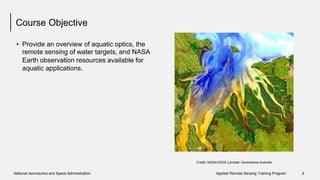
Course Objective
• Provide an overview of aquatic optics, the
remote sensing of water targets, and NASA
Earth observation resources available for
aquatic applications.
Credit: NASA/USGS Landsat; Geoscience Australis
National Aeronautics and Space Administration Applied Remote Sensing Training Program 2
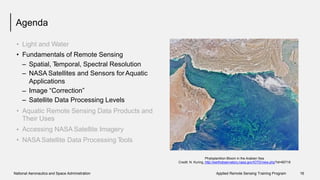
Agenda
•
•
•
Light and Water
Fundamentals of Remote Sensing
Aquatic Remote Sensing Data Products
Their Uses
Accessing NASA Satellite Imagery
and
•
• NASA Satellite Data Processing Tools
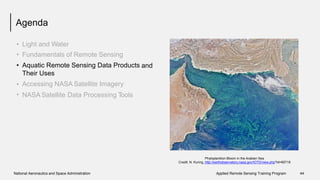
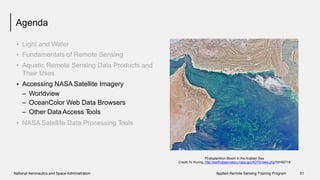
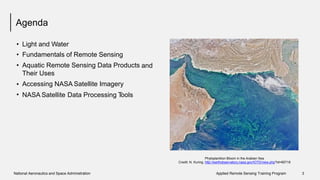
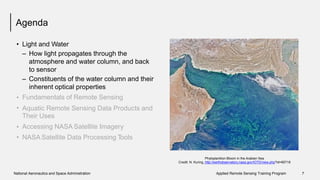
Phytoplankton Bloom in the Arabian Sea
Credit: N. Kuring, http://earthobservatory.nasa.gov/IOTD/view.php?id=85718
National Aeronautics and Space Administration Applied Remote Sensing Training Program 3
Why Do We Observe from Space?
To Understand Earth’s Processes on a Global Scale
SeaWiFS Chlorophyll
Credit: OBPG, NASA Goddard
National Aeronautics and Space Administration Applied Remote Sensing Training Program 4
Advantages of Remote Sensing of Aquatic Environments
•
•
•
Synoptic coverage
Temporal frequency needed to capture dynamic aquatic processes
Observations of remote ocean locations, infrequently accessed by sea-based platforms
National Aeronautics and Space Administration Applied Remote Sensing Training Program 5
Light and Water
Agenda
• Light and Water
– How light propagates through the
atmosphere and water column, and back
to sensor
– Constituents of the water column and their
inherent optical properties
Fundamentals of Remote Sensing•
• Aquatic Remote Sensing Data Products
Their Uses
Accessing NASA Satellite Imagery
NASA Satellite Data Processing Tools
and
•
•
Phytoplankton Bloom in the Arabian Sea
Credit: N. Kuring, http://earthobservatory.nasa.gov/IOTD/view.php?id=85718
National Aeronautics and Space Administration Applied Remote Sensing Training Program 7
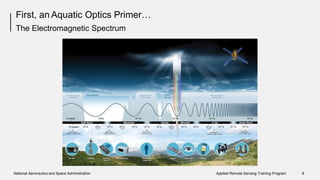
First, an Aquatic Optics Primer…
The Electromagnetic Spectrum
National Aeronautics and Space Administration Applied Remote Sensing Training Program 8
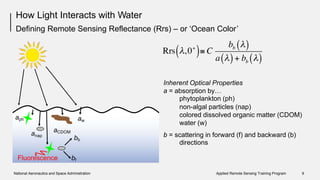
How Light Interacts with Water
Defining Remote Sensing Reflectance (Rrs) – or ‘Ocean Color’
Inherent Optical Properties
a = absorption by…
phytoplankton (ph)
non-algal particles (nap)
colored dissolved organic
water (w)
matter (CDOM)aph aw
aCDOM
a b = scattering in forward (f) and backward (b)
directions
nap
bb
bfFluorescence
National Aeronautics and Space Administration Applied Remote Sensing Training Program 9
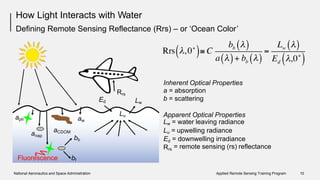
How Light Interacts with Water
Defining Remote Sensing Reflectance (Rrs) – or ‘Ocean Color’
Inherent Optical Properties
a = absorption
b = scattering
Rrs
Ed Lw
Lu Apparent Optical Properties
Lw = water leaving radiance
Lu = upwelling radiance
aph aw
aCDOM
anap
bb E = downwelling irradiance
= remote sensing (rs) reflectance
d
Rrs
bfFluorescence
National Aeronautics and Space Administration Applied Remote Sensing Training Program 10
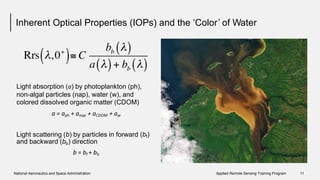
Inherent Optical Properties (IOPs) and the ‘Color’ of Water
Light absorption (a) by photoplankton (ph),
non-algal particles (nap), water (w), and
colored dissolved organic matter (CDOM)
a = aph + anap + aCDOM + aw
Light scattering (b) by particles in forward
and backward (bb) direction
b = bf + bb
(bf)
National Aeronautics and Space Administration Applied Remote Sensing Training Program 11
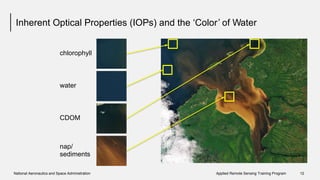
Inherent Optical Properties (IOPs) and the ‘Color’ of Water
chlorophyll
water
CDOM
nap/
sediments
National Aeronautics and Space Administration Applied Remote Sensing Training Program 12
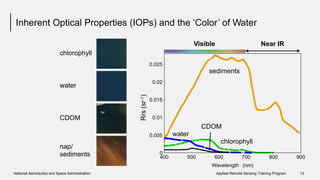
Inherent Optical Properties (IOPs) and the ‘Color’ of Water
Visible Near IR
chlorophyll
0.025
sediments
0.02
water
0.015
CDOM 0.01
CDOM
water0.005
nap/
sediments 0
400 500 600
Wavelength
700
(nm)
800 900
National Aeronautics and Space Administration Applied Remote Sensing Training Program 13
Rrs(sr-1) chlorophyll
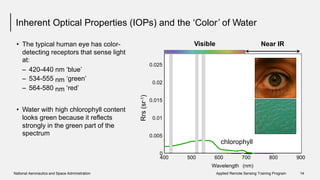
Inherent Optical Properties (IOPs) and the ‘Color’ of Water
Visible Near IR• The typical human eye has color-
detecting receptors that
at:
sense light
0.025
–
–
–
420-440
534-555
564-580
nm
nm
nm
‘blue’
‘green’
‘red’
0.02
0.015
• Water with high chlorophyll content
looks green because it reflects 0.01
strongly in the green part
spectrum
of the
0.005
0
400 500 600
Wavelength
700
(nm)
800 900
National Aeronautics and Space Administration Applied Remote Sensing Training Program 14
Rrs(sr-1) chlorophyll
Fundamentals of Remote Sensing
Agenda
•
•
Light and Water
Fundamentals of Remote Sensing
–
–
Spatial, Temporal, Spectral Resolution
NASA Satellites and Sensors for Aquatic
Applications
Image “Correction”
Satellite Data Processing Levels
–
–
• Aquatic Remote Sensing Data Products
Their Uses
Accessing NASA Satellite Imagery
NASA Satellite Data Processing Tools
and
•
•
Phytoplankton Bloom in the Arabian Sea
Credit: N. Kuring, http://earthobservatory.nasa.gov/IOTD/view.php?id=85718
National Aeronautics and Space Administration Applied Remote Sensing Training Program 16
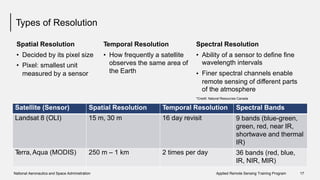
Types of Resolution
Spatial Resolution Temporal Resolution Spectral Resolution
•
•
Decided by its pixel
Pixel: smallest unit
size • How frequently a satellite • Ability of a sensor to define fine
wavelength intervals
Finer spectral channels enable
observes the same area of
the Earthmeasured by a sensor •
remote sensing of different
of the atmosphere
*Credit: Natural Resources Canada
parts
National Aeronautics and Space Administration Applied Remote Sensing Training Program 17
Satellite (Sensor) Spatial Resolution Temporal Resolution Spectral Bands
Landsat 8 (OLI) 15 m, 30 m 16 day revisit 9 bands (blue-green,
green, red, near IR,
shortwave and thermal
IR)
Terra,Aqua (MODIS) 250 m – 1 km 2 times per day 36 bands (red, blue,
IR, NIR, MIR)
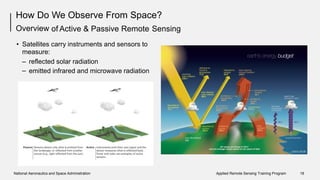
How Do
Overview
We Observe From Space?
of Active & Passive Remote Sensing
• Satellites
measure:
carry instruments and sensors to
–
–
reflected solar radiation
emitted infrared and microwave radiation
National Aeronautics and Space Administration Applied Remote Sensing Training Program 18
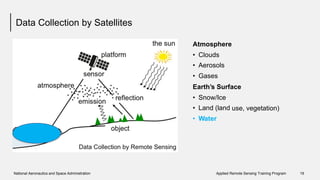
Data Collection by Satellites
Atmosphere
•
•
•
Clouds
Aerosols
Gases
Earth’s Surface
•
•
•
Snow/Ice
Land (land
Water
use, vegetation)
National Aeronautics and Space Administration Applied Remote Sensing Training Program 19
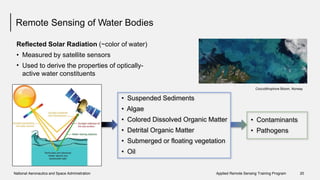
Remote Sensing of Water Bodies
Reflected Solar Radiation (~color of water)
•
•
Measured by satellite sensors
Used to derive the properties of optically-
active water constituents
Coccolithophore Bloom, Norway
National Aeronautics and Space Administration Applied Remote Sensing Training Program 20
• Contaminants
• Pathogens
• Suspended Sediments
• Algae
• Colored Dissolved Organic Matter
• Detrital Organic Matter
• Submerged or floating vegetation
• Oil
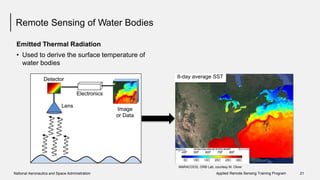
Remote Sensing of Water Bodies
Emitted Thermal Radiation
• Used to derive the surface temperature of
water bodies
MARACOOS, ORB Lab, courtesy M. Oliver
Applied Remote Sensing Training ProgramNational Aeronautics and Space Administration 21
8-day average SST
NASA Satellites and Sensors
for Aquatic Applications
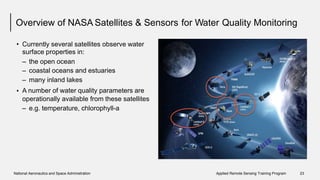
Overview of NASA Satellites & Sensors for Water Quality Monitoring
• Currently several satellites observe water
surface properties in:
–
–
–
A
the open ocean
coastal oceans and estuaries
many inland lakes
number of water quality parameters are•
operationally available from these satellites
– e.g. temperature, chlorophyll-a
National Aeronautics and Space Administration Applied Remote Sensing Training Program 23
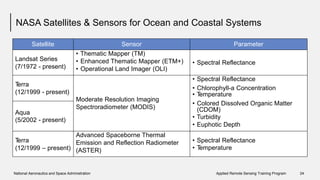
NASA Satellites & Sensors for Ocean and Coastal Systems
• Chlorophyll-a Concentration
• Colored Dissolved Organic Matter
(5/2002 - present)
• Temperature
National Aeronautics and Space Administration Applied Remote Sensing Training Program 24
Satellite Sensor Parameter
Landsat Series
(7/1972 - present)
• Thematic Mapper (TM)
• Enhanced Thematic Mapper (ETM+)
• Operational Land Imager (OLI)
• Spectral Reflectance
Terra
(12/1999 - present)
Moderate Resolution Imaging
Spectroradiometer (MODIS)
• Spectral Reflectance
• Temperature
(CDOM)
• Turbidity
• Euphotic Depth
Aqua
Terra
(12/1999 – present)
Advanced Spaceborne Thermal
Emission and Reflection Radiometer
(ASTER)
• Spectral Reflectance
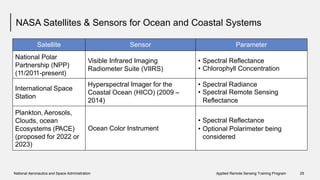
NASA Satellites & Sensors for Ocean and Coastal Systems
• Chlorophyll Concentration
• Spectral Remote Sensing
National Aeronautics and Space Administration Applied Remote Sensing Training Program 25
Satellite Sensor Parameter
National Polar
Partnership (NPP)
(11/2011-present)
Visible Infrared Imaging
Radiometer Suite (VIIRS)
• Spectral Reflectance
International Space
Station
Hyperspectral Imager for the
Coastal Ocean (HICO) (2009 –
2014)
• Spectral Radiance
Reflectance
Plankton, Aerosols,
Clouds, ocean
Ecosystems (PACE)
(proposed for 2022 or
2023)
Ocean Color Instrument
• Spectral Reflectance
• Optional Polarimeter being
considered
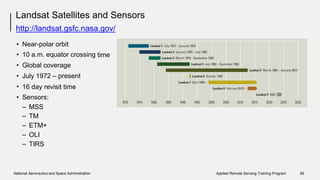
Landsat Satellites and Sensors
http://landsat.gsfc.nasa.gov/
•
•
•
•
•
•
Near-polar orbit
10 a.m. equator crossing
Global coverage
July 1972 – present
time
16 day revisit
Sensors:
time
–
–
–
–
–
MSS
TM
ETM+
OLI
TIRS
National Aeronautics and Space Administration Applied Remote Sensing Training Program 26
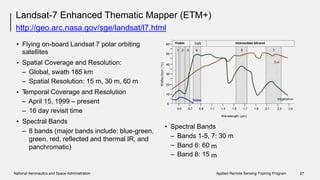
Landsat-7 Enhanced Thematic Mapper
http://geo.arc.nasa.gov/sge/landsat/l7.html
(ETM+)
• Flying on-board Landsat 7 polar orbiting
satellites
Spatial Coverage and Resolution:
– Global, swath 185 km
– Spatial Resolution: 15 m, 30 m, 60 m
Temporal Coverage and Resolution
– April 15, 1999 – present
– 16 day revisit time
Spectral Bands
– 8 bands (major bands include: blue-green,
green, red, reflected and thermal IR, and
panchromatic)
•
•
•
• Spectral Bands
–
–
–
Bands 1-5, 7:
m
m
30 m
Band
Band
6:
8:
60
15
National Aeronautics and Space Administration Applied Remote Sensing Training Program 27
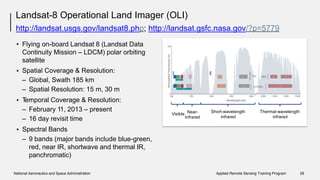
• Spectral Bands
– Bands 1-7, 9: 30m
– Band 8: 15m
Landsat-8 Operational Land Imager (OLI)
http://landsat.usgs.gov/landsat8.php; http://landsat.gsfc.nasa.gov/?p=5779
• Flying on-board Landsat 8 (Landsat Data
Continuity Mission – LDCM) polar orbiting
satellite
Spatial Coverage & Resolution:
– Global, Swath 185 km
– Spatial Resolution: 15 m, 30 m
Temporal Coverage & Resolution:
– February 11, 2013 – present
– 16 day revisit time
Spectral Bands
– 9 bands (major bands include blue-green,
red, near IR, shortwave and thermal IR,
panchromatic)
•
•
•
National Aeronautics and Space Administration Applied Remote Sensing Training Program 28
Visible Near- Short-wavelength Thermal-wavelength
Infrared infrared infrared
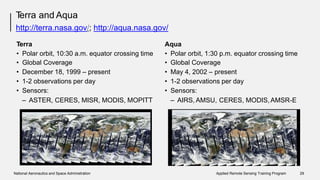
Terra and Aqua
http://terra.nasa.gov/; http://aqua.nasa.gov/
Terra Aqua
•
•
•
•
•
Polar orbit, 10:30 a.m. equator
Global Coverage
December 18, 1999 – present
1-2 observations per day
Sensors:
crossing time •
•
•
•
•
Polar orbit, 1:30 p.m. equator crossing time
Global Coverage
May 4, 2002 – present
1-2 observations per day
Sensors:
– ASTER, CERES, MISR, MODIS, MOPITT – AIRS, AMSU, CERES, MODIS,AMSR-E
National Aeronautics and Space Administration Applied Remote Sensing Training Program 29
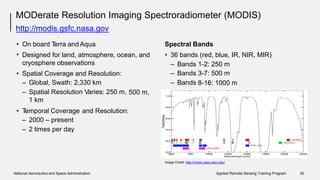
MODerate Resolution Imaging Spectroradiometer (MODIS)
http://modis.gsfc.nasa.gov
•
•
On board Terra and Aqua
Designed for land, atmosphere,
cryosphere observations
Spectral Bands
ocean, and • 36 bands (red, blue, IR, NIR, MIR)
–
–
–
Bands
Bands
Bands
1-2: 250 m
3-7: 500 m• Spatial Coverage and Resolution:
– Global, Swath: 2,330 km
– Spatial Resolution Varies: 250 m,
1 km
8-16: 1000 m
500 m,
• Temporal Coverage
– 2000 – present
– 2 times per day
and Resolution:
Image Credit: http://cimss.ssec.wisc.edu/
National Aeronautics and Space Administration Applied Remote Sensing Training Program 30
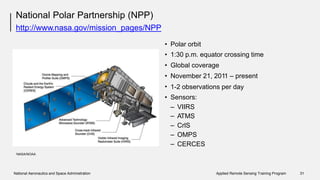
National Polar Partnership (NPP)
http://www.nasa.gov/mission_pages/NPP
•
•
•
•
•
•
Polar orbit
1:30 p.m. equator crossing time
Global coverage
November 21, 2011 – present
1-2 observations
Sensors:
per day
–
–
–
–
–
VIIRS
ATMS
CrlS
OMPS
CERCES
NASA/NOAA
National Aeronautics and Space Administration Applied Remote Sensing Training Program 31
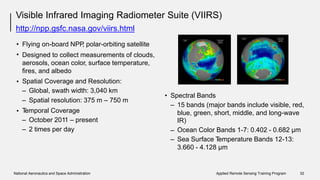
Visible Infrared Imaging Radiometer
http://npp.gsfc.nasa.gov/viirs.html
Suite (VIIRS)
•
•
Flying on-board NPP, polar-orbiting satellite
Designed to collect measurements of clouds,
aerosols, ocean color, surface temperature,
fires, and albedo
Spatial Coverage and Resolution:
– Global, swath width: 3,040 km
•
• Spectral Bands
– Spatial resolution: 375 m
Temporal Coverage
– October 2011 – present
– 2 times per day
– 750 m
– 15 bands (major bands include visible, red,
• blue, green, short, middle, and long-wave
IR)
Ocean Color Bands 1-7: 0.402 - 0.682 μm
Sea Surface Temperature Bands 12-13:
3.660 - 4.128 μm
–
–
National Aeronautics and Space Administration Applied Remote Sensing Training Program 32
Hyperspectral Imager for the Coastal Ocean (HICO)
http://hico.coas.oregonstate.edu/; http://oceancolor.gsfc.nasa.gov/cms/data/hico
• Partnership with U.S. Naval Research Lab, Office of Naval Research,
and NASA
Oregon State University,
•
•
•
•
Active 2009 – 2014 aboard the International Space Station (ISS)
380 nm to 960 nm at 5.7 nm spectral resolution
m290 spatial resolution
Targeted data collection
Davis, C. O. (n.d.). The Hyperspectral
Imager for the Coastal Ocean (HICO):
Sensor and Data Processing
Overview [PDF]. International Ocean
Colour Coordinating Group.
National Aeronautics and Space Administration Applied Remote Sensing Training Program 33
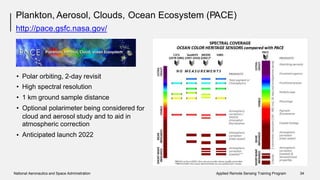
Plankton, Aerosol, Clouds,
http://pace.gsfc.nasa.gov/
Ocean Ecosystem (PACE)
•
•
•
•
Polar orbiting, 2-day revisit
High spectral resolution
1 km ground sample distance
Optional polarimeter being considered for
cloud and aerosol study and
atmospheric correction
Anticipated launch 2022
to aid in
•
National Aeronautics and Space Administration Applied Remote Sensing Training Program 34
Image “Correction”
National Aeronautics and Space Administration Applied Remote Sensing Training Program 36
0
400 800 90
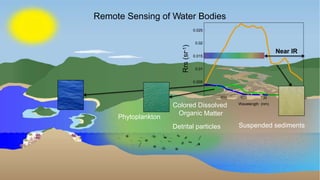
Remote Sensing of Water Bodies
0.025
0.02
Near IR
0.015
0.01
0.005
500 600 700 0
Colored Dissolved Wavelength (nm)
Organic
Phytoplankton
Suspended sedimentsDetrital particles
Rrs(sr-1)
Matter
National Aeronautics and Space Administration Applied Remote Sensing Training Program 37
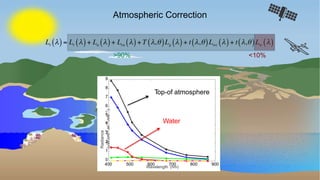
L (λ)
t
L (λ)
r
L (λ)
a
t(λ,θ).L (λ)
w
t(λ,θ).L (λ)
wc
T(λ,θ)(λ).L (λ)
g
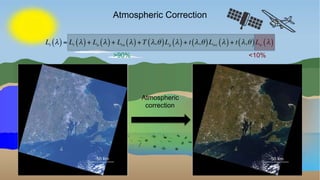
Atmospheric Correction
>90% <10%
400 500 600 700 800 900
Radiance
(µW.cm−2
.sr−1
.nm−1
)
Top-of atmosphere
9
8
7
6
5
4 Water
3
2
1
0
Wavelength (nm)
National Aeronautics and Space Administration Applied Remote Sensing Training Program 38
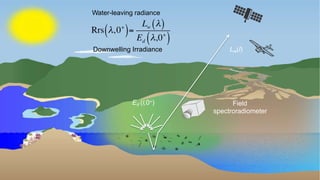
Water-leaving radiance
Downwelling Irradiance Lw(l)
Ed (l,0+) Field
spectroradiometer
@
National Aeronautics and
Space Administration
ARSET
Applied Remote Sensing Training
http://arset.gsfc.nasa.gov
NASAARSET
www.nasa.gov
Top-of atmosphere Water
Atmospheric Correction
>90% <10%
Atmospheric
correction
Satellite Data Processing Levels
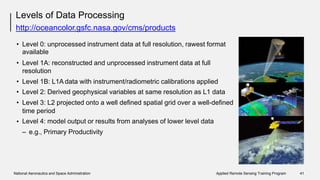
Levels of Data Processing
http://oceancolor.gsfc.nasa.gov/cms/products
• Level 0: unprocessed instrument data at full resolution, rawest format
available
Level 1A: reconstructed and unprocessed instrument data at full
resolution
•
•
•
•
Level
Level
Level
1B: L1A data with instrument/radiometric calibrations applied
2: Derived geophysical variables at same resolution as L1 data
3: L2 projected onto a well defined spatial grid over a well-defined
time period
Level 4: model output or results from analyses of lower level data
– e.g., Primary Productivity
•
National Aeronautics and Space Administration Applied Remote Sensing Training Program 41
1: d
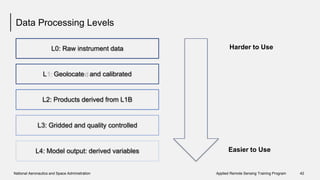
Data Processing Levels
Harder to Use
Easier to Use
National Aeronautics and Space Administration Applied Remote Sensing Training Program 42
L4: Model output: derived variables
L3: Gridded and quality controlled
L2: Products derived from L1B
L Geolocate and calibrated
L0: Raw instrument data
Aquatic Remote Sensing
Data Products and Their Uses
Agenda
•
•
•
Light and Water
Fundamentals of Remote Sensing
Aquatic Remote Sensing Data Products
Their Uses
Accessing NASA Satellite Imagery
and
•
• NASA Satellite Data Processing Tools
Phytoplankton Bloom in the Arabian Sea
Credit: N. Kuring, http://earthobservatory.nasa.gov/IOTD/view.php?id=85718
National Aeronautics and Space Administration Applied Remote Sensing Training Program 44
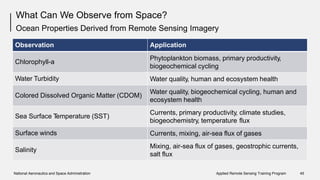
What Can We Observe from Space?
Ocean Properties Derived from Remote Sensing Imagery
biogeochemical cycling
ecosystem health
biogeochemistry, temperature flux
salt flux
National Aeronautics and Space Administration Applied Remote Sensing Training Program 45
Observation Application
Chlorophyll-a
Phytoplankton biomass, primary productivity,
Water Turbidity Water quality, human and ecosystem health
Colored Dissolved Organic Matter (CDOM)
Water quality, biogeochemical cycling, human and
Sea Surface Temperature (SST)
Currents, primary productivity, climate studies,
Surface winds Currents, mixing, air-sea flux of gases
Salinity
Mixing, air-sea flux of gases, geostrophic currents,
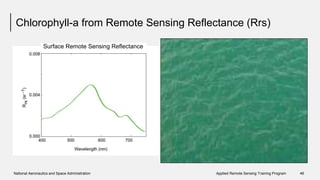
Chlorophyll-a from Remote Sensing Reflectance (Rrs)
National Aeronautics and Space Administration Applied Remote Sensing Training Program 46
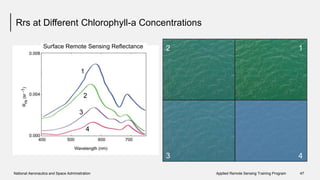
Surface Remote Sensing Reflectance
Rrs at Different Chlorophyll-a Concentrations
1
2
3
4
National Aeronautics and Space Administration Applied Remote Sensing Training Program 47
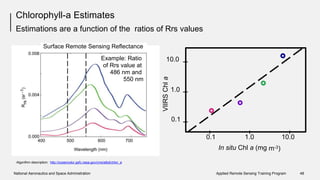
Surface Remote Sensing Reflectance
Chlorophyll-a Estimates
Estimations are a function of the ratios of Rrs values
Example: Ratio 10.0
of Rrs value at
486 nm and
550 nm
1.0
0.1
0.1 1.0
In situ Chl a (mg
10.0
m-3)
Algorithm description: http://oceancolor.gsfc.nasa.gov/cms/atbd/chlor_a
National Aeronautics and Space Administration Applied Remote Sensing Training Program 48
VIIRSChla
Surface Remote Sensing Reflectance
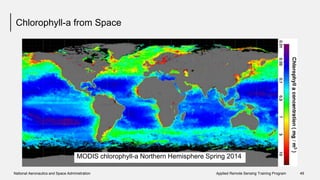
Chlorophyll-a from Space
National Aeronautics and Space Administration Applied Remote Sensing Training Program 49
MODIS chlorophyll-a Northern Hemisphere Spring 2014
Accessing NASA Satellite Imagery
Agenda
•
•
•
Light and Water
Fundamentals of Remote Sensing
Aquatic Remote Sensing Data Products
Their Uses
Accessing NASA Satellite Imagery
and
•
–
–
–
Worldview
OceanColor Web Data Browsers
Other Data Access Tools
• NASA Satellite Data Processing Tools
Phytoplankton Bloom in the Arabian Sea
Credit: N. Kuring, http://earthobservatory.nasa.gov/IOTD/view.php?id=85718
National Aeronautics and Space Administration Applied Remote Sensing Training Program 51
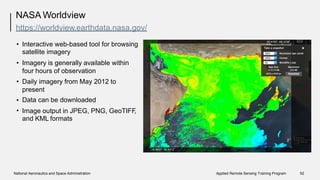
NASA Worldview
https://worldview.earthdata.nasa.gov/
• Interactive web-based tool for browsing
satellite imagery
Imagery is generally available within
four hours of observation
Daily imagery from May 2012 to
present
Data can be downloaded
•
•
•
• Image output in JPEG, PNG,
and KML formats
GeoTIFF,
National Aeronautics and Space Administration Applied Remote Sensing Training Program 52
ov/cms/dataaccess
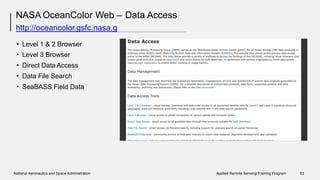
NASA OceanColor Web –
http://oceancolor.gsfc.nasa.g
Data Access
•
•
•
•
•
Level 1 & 2 Browser
Level 3 Browser
Direct Data Access
Data File Search
SeaBASS Field Data
National Aeronautics and Space Administration Applied Remote Sensing Training Program 53
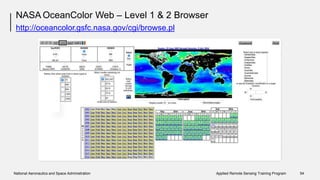
NASA OceanColor Web – Level 1 & 2 Browser
http://oceancolor.gsfc.nasa.gov/cgi/browse.pl
National Aeronautics and Space Administration Applied Remote Sensing Training Program 54
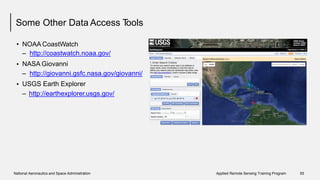
Some Other Data Access Tools
• NOAA CoastWatch
– http://coastwatch.noaa.gov/
NASA Giovanni
– http://giovanni.gsfc.nasa.gov/giovanni/
USGS Earth Explorer
•
•
– http://earthexplorer.usgs.gov/
National Aeronautics and Space Administration Applied Remote Sensing Training Program 55
NASA Satellite Data Processing Tools
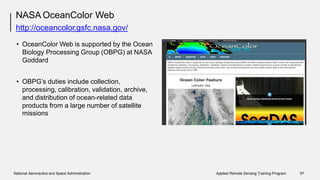
NASA OceanColor Web
http://oceancolor.gsfc.nasa.gov/
• OceanColor Web is supported by the Ocean
Biology Processing Group (OBPG) at NASA
Goddard
• OBPG’s duties include collection,
processing, calibration, validation, archive,
and distribution of ocean-related data
products from
missions
a large number of satellite
National Aeronautics and Space Administration Applied Remote Sensing Training Program 57
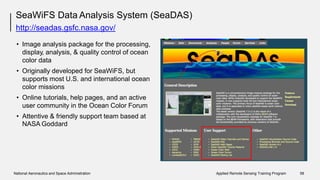
SeaWiFS Data Analysis System (SeaDAS)
http://seadas.gsfc.nasa.gov/
• Image analysis package for the processing,
display, analysis, & quality control of ocean
color data
Originally developed for SeaWiFS, but
supports most U.S. and international ocean
color missions
Online tutorials, help pages, and an active
user community in the Ocean Color Forum
•
•
• Attentive & friendly support
NASA Goddard
team based at
National Aeronautics and Space Administration Applied Remote Sensing Training Program 58
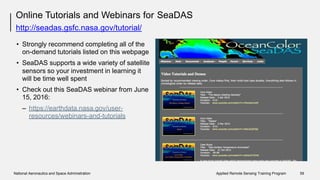
Online Tutorials and Webinars for
http://seadas.gsfc.nasa.gov/tutorial/
SeaDAS
• Strongly recommend completing all of the
on-demand tutorials listed on this webpage
SeaDAS supports a wide variety of satellite
sensors so your investment in learning it
will be time well spent
•
• Check out this SeaDAS webinar from
15, 2016:
June
– https://earthdata.nasa.gov/user-
resources/webinars-and-tutorials
National Aeronautics and Space Administration Applied Remote Sensing Training Program 59
Interested in a More In-Depth Understanding of Aquatic Optics
Remote Sensing Imagery?
and
• For a more solid foundation in aquatic optics:
– Ocean Optics Web Book: http://www.oceanopticsbook.info/
– IOCCG Summer Lecture Series, 2016: http://ioccg.org/what-we-do/training-and-
education/ioccg-summer-lecture-series-2016/#lectures
• For remote sensing imagery information, data access, and processing tools:
– NASA’s OceanColor Web: http://oceancolor.gsfc.nasa.gov/cms
National Aeronautics and Space Administration Applied Remote Sensing Training Program 60
Summary
• Light and Water
– How light propagates through the
atmosphere and water column, and back
to sensor
• Aquatic Remote Sensing Data Products
Their Uses
Accessing NASA Satellite Imagery
and
•
–
–
–
Worldview
OceanColor Web
Other Data Access Tools
– Constituents of the water column
inherent optical properties
Fundamentals of Remote Sensing
and their
•
• NASA Satellite Data Processing Tools
–
–
Spatial, Temporal, Spectral Resolution
NASA Satellites and Sensors for Aquatic
Applications
Image “Correction”
Satellite Data Processing Levels
– SeaDAS
–
–
National Aeronautics and Space Administration Applied Remote Sensing Training Program 61
@
National Aeronautics and
Space Administration
ARSET
Applied Remote Sensing Training
http://arset.gsfc.nasa.gov
NASAARSET
Thank you!
http://arset.gsfc.nasa.gov/webinars/fundamentals-remote-sensing
www.nasa.gov

Fundamentals aquatic-web

  • 1.
    @ National Aeronautics and SpaceAdministration ARSET Applied Remote Sensing Training http://arset.gsfc.nasa.gov NASAARSET Fundamentals of Aquatic Remote Sensing Sherry L. Palacios, Ph.D. www.nasa.gov
  • 2.
    Course Objective • Providean overview of aquatic optics, the remote sensing of water targets, and NASA Earth observation resources available for aquatic applications. Credit: NASA/USGS Landsat; Geoscience Australis National Aeronautics and Space Administration Applied Remote Sensing Training Program 2
  • 3.
    Agenda • • • Light and Water Fundamentalsof Remote Sensing Aquatic Remote Sensing Data Products Their Uses Accessing NASA Satellite Imagery and • • NASA Satellite Data Processing Tools Phytoplankton Bloom in the Arabian Sea Credit: N. Kuring, http://earthobservatory.nasa.gov/IOTD/view.php?id=85718 National Aeronautics and Space Administration Applied Remote Sensing Training Program 3
  • 4.
    Why Do WeObserve from Space? To Understand Earth’s Processes on a Global Scale SeaWiFS Chlorophyll Credit: OBPG, NASA Goddard National Aeronautics and Space Administration Applied Remote Sensing Training Program 4
  • 5.
    Advantages of RemoteSensing of Aquatic Environments • • • Synoptic coverage Temporal frequency needed to capture dynamic aquatic processes Observations of remote ocean locations, infrequently accessed by sea-based platforms National Aeronautics and Space Administration Applied Remote Sensing Training Program 5
  • 6.
  • 7.
    Agenda • Light andWater – How light propagates through the atmosphere and water column, and back to sensor – Constituents of the water column and their inherent optical properties Fundamentals of Remote Sensing• • Aquatic Remote Sensing Data Products Their Uses Accessing NASA Satellite Imagery NASA Satellite Data Processing Tools and • • Phytoplankton Bloom in the Arabian Sea Credit: N. Kuring, http://earthobservatory.nasa.gov/IOTD/view.php?id=85718 National Aeronautics and Space Administration Applied Remote Sensing Training Program 7
  • 8.
    First, an AquaticOptics Primer… The Electromagnetic Spectrum National Aeronautics and Space Administration Applied Remote Sensing Training Program 8
  • 9.
    How Light Interactswith Water Defining Remote Sensing Reflectance (Rrs) – or ‘Ocean Color’ Inherent Optical Properties a = absorption by… phytoplankton (ph) non-algal particles (nap) colored dissolved organic water (w) matter (CDOM)aph aw aCDOM a b = scattering in forward (f) and backward (b) directions nap bb bfFluorescence National Aeronautics and Space Administration Applied Remote Sensing Training Program 9
  • 10.
    How Light Interactswith Water Defining Remote Sensing Reflectance (Rrs) – or ‘Ocean Color’ Inherent Optical Properties a = absorption b = scattering Rrs Ed Lw Lu Apparent Optical Properties Lw = water leaving radiance Lu = upwelling radiance aph aw aCDOM anap bb E = downwelling irradiance = remote sensing (rs) reflectance d Rrs bfFluorescence National Aeronautics and Space Administration Applied Remote Sensing Training Program 10
  • 11.
    Inherent Optical Properties(IOPs) and the ‘Color’ of Water Light absorption (a) by photoplankton (ph), non-algal particles (nap), water (w), and colored dissolved organic matter (CDOM) a = aph + anap + aCDOM + aw Light scattering (b) by particles in forward and backward (bb) direction b = bf + bb (bf) National Aeronautics and Space Administration Applied Remote Sensing Training Program 11
  • 12.
    Inherent Optical Properties(IOPs) and the ‘Color’ of Water chlorophyll water CDOM nap/ sediments National Aeronautics and Space Administration Applied Remote Sensing Training Program 12
  • 13.
    Inherent Optical Properties(IOPs) and the ‘Color’ of Water Visible Near IR chlorophyll 0.025 sediments 0.02 water 0.015 CDOM 0.01 CDOM water0.005 nap/ sediments 0 400 500 600 Wavelength 700 (nm) 800 900 National Aeronautics and Space Administration Applied Remote Sensing Training Program 13 Rrs(sr-1) chlorophyll
  • 14.
    Inherent Optical Properties(IOPs) and the ‘Color’ of Water Visible Near IR• The typical human eye has color- detecting receptors that at: sense light 0.025 – – – 420-440 534-555 564-580 nm nm nm ‘blue’ ‘green’ ‘red’ 0.02 0.015 • Water with high chlorophyll content looks green because it reflects 0.01 strongly in the green part spectrum of the 0.005 0 400 500 600 Wavelength 700 (nm) 800 900 National Aeronautics and Space Administration Applied Remote Sensing Training Program 14 Rrs(sr-1) chlorophyll
  • 15.
  • 16.
    Agenda • • Light and Water Fundamentalsof Remote Sensing – – Spatial, Temporal, Spectral Resolution NASA Satellites and Sensors for Aquatic Applications Image “Correction” Satellite Data Processing Levels – – • Aquatic Remote Sensing Data Products Their Uses Accessing NASA Satellite Imagery NASA Satellite Data Processing Tools and • • Phytoplankton Bloom in the Arabian Sea Credit: N. Kuring, http://earthobservatory.nasa.gov/IOTD/view.php?id=85718 National Aeronautics and Space Administration Applied Remote Sensing Training Program 16
  • 17.
    Types of Resolution SpatialResolution Temporal Resolution Spectral Resolution • • Decided by its pixel Pixel: smallest unit size • How frequently a satellite • Ability of a sensor to define fine wavelength intervals Finer spectral channels enable observes the same area of the Earthmeasured by a sensor • remote sensing of different of the atmosphere *Credit: Natural Resources Canada parts National Aeronautics and Space Administration Applied Remote Sensing Training Program 17 Satellite (Sensor) Spatial Resolution Temporal Resolution Spectral Bands Landsat 8 (OLI) 15 m, 30 m 16 day revisit 9 bands (blue-green, green, red, near IR, shortwave and thermal IR) Terra,Aqua (MODIS) 250 m – 1 km 2 times per day 36 bands (red, blue, IR, NIR, MIR)
  • 18.
    How Do Overview We ObserveFrom Space? of Active & Passive Remote Sensing • Satellites measure: carry instruments and sensors to – – reflected solar radiation emitted infrared and microwave radiation National Aeronautics and Space Administration Applied Remote Sensing Training Program 18
  • 19.
    Data Collection bySatellites Atmosphere • • • Clouds Aerosols Gases Earth’s Surface • • • Snow/Ice Land (land Water use, vegetation) National Aeronautics and Space Administration Applied Remote Sensing Training Program 19
  • 20.
    Remote Sensing ofWater Bodies Reflected Solar Radiation (~color of water) • • Measured by satellite sensors Used to derive the properties of optically- active water constituents Coccolithophore Bloom, Norway National Aeronautics and Space Administration Applied Remote Sensing Training Program 20 • Contaminants • Pathogens • Suspended Sediments • Algae • Colored Dissolved Organic Matter • Detrital Organic Matter • Submerged or floating vegetation • Oil
  • 21.
    Remote Sensing ofWater Bodies Emitted Thermal Radiation • Used to derive the surface temperature of water bodies MARACOOS, ORB Lab, courtesy M. Oliver Applied Remote Sensing Training ProgramNational Aeronautics and Space Administration 21 8-day average SST
  • 22.
    NASA Satellites andSensors for Aquatic Applications
  • 23.
    Overview of NASASatellites & Sensors for Water Quality Monitoring • Currently several satellites observe water surface properties in: – – – A the open ocean coastal oceans and estuaries many inland lakes number of water quality parameters are• operationally available from these satellites – e.g. temperature, chlorophyll-a National Aeronautics and Space Administration Applied Remote Sensing Training Program 23
  • 24.
    NASA Satellites &Sensors for Ocean and Coastal Systems • Chlorophyll-a Concentration • Colored Dissolved Organic Matter (5/2002 - present) • Temperature National Aeronautics and Space Administration Applied Remote Sensing Training Program 24 Satellite Sensor Parameter Landsat Series (7/1972 - present) • Thematic Mapper (TM) • Enhanced Thematic Mapper (ETM+) • Operational Land Imager (OLI) • Spectral Reflectance Terra (12/1999 - present) Moderate Resolution Imaging Spectroradiometer (MODIS) • Spectral Reflectance • Temperature (CDOM) • Turbidity • Euphotic Depth Aqua Terra (12/1999 – present) Advanced Spaceborne Thermal Emission and Reflection Radiometer (ASTER) • Spectral Reflectance
  • 25.
    NASA Satellites &Sensors for Ocean and Coastal Systems • Chlorophyll Concentration • Spectral Remote Sensing National Aeronautics and Space Administration Applied Remote Sensing Training Program 25 Satellite Sensor Parameter National Polar Partnership (NPP) (11/2011-present) Visible Infrared Imaging Radiometer Suite (VIIRS) • Spectral Reflectance International Space Station Hyperspectral Imager for the Coastal Ocean (HICO) (2009 – 2014) • Spectral Radiance Reflectance Plankton, Aerosols, Clouds, ocean Ecosystems (PACE) (proposed for 2022 or 2023) Ocean Color Instrument • Spectral Reflectance • Optional Polarimeter being considered
  • 26.
    Landsat Satellites andSensors http://landsat.gsfc.nasa.gov/ • • • • • • Near-polar orbit 10 a.m. equator crossing Global coverage July 1972 – present time 16 day revisit Sensors: time – – – – – MSS TM ETM+ OLI TIRS National Aeronautics and Space Administration Applied Remote Sensing Training Program 26
  • 27.
    Landsat-7 Enhanced ThematicMapper http://geo.arc.nasa.gov/sge/landsat/l7.html (ETM+) • Flying on-board Landsat 7 polar orbiting satellites Spatial Coverage and Resolution: – Global, swath 185 km – Spatial Resolution: 15 m, 30 m, 60 m Temporal Coverage and Resolution – April 15, 1999 – present – 16 day revisit time Spectral Bands – 8 bands (major bands include: blue-green, green, red, reflected and thermal IR, and panchromatic) • • • • Spectral Bands – – – Bands 1-5, 7: m m 30 m Band Band 6: 8: 60 15 National Aeronautics and Space Administration Applied Remote Sensing Training Program 27
  • 28.
    • Spectral Bands –Bands 1-7, 9: 30m – Band 8: 15m Landsat-8 Operational Land Imager (OLI) http://landsat.usgs.gov/landsat8.php; http://landsat.gsfc.nasa.gov/?p=5779 • Flying on-board Landsat 8 (Landsat Data Continuity Mission – LDCM) polar orbiting satellite Spatial Coverage & Resolution: – Global, Swath 185 km – Spatial Resolution: 15 m, 30 m Temporal Coverage & Resolution: – February 11, 2013 – present – 16 day revisit time Spectral Bands – 9 bands (major bands include blue-green, red, near IR, shortwave and thermal IR, panchromatic) • • • National Aeronautics and Space Administration Applied Remote Sensing Training Program 28 Visible Near- Short-wavelength Thermal-wavelength Infrared infrared infrared
  • 29.
    Terra and Aqua http://terra.nasa.gov/;http://aqua.nasa.gov/ Terra Aqua • • • • • Polar orbit, 10:30 a.m. equator Global Coverage December 18, 1999 – present 1-2 observations per day Sensors: crossing time • • • • • Polar orbit, 1:30 p.m. equator crossing time Global Coverage May 4, 2002 – present 1-2 observations per day Sensors: – ASTER, CERES, MISR, MODIS, MOPITT – AIRS, AMSU, CERES, MODIS,AMSR-E National Aeronautics and Space Administration Applied Remote Sensing Training Program 29
  • 30.
    MODerate Resolution ImagingSpectroradiometer (MODIS) http://modis.gsfc.nasa.gov • • On board Terra and Aqua Designed for land, atmosphere, cryosphere observations Spectral Bands ocean, and • 36 bands (red, blue, IR, NIR, MIR) – – – Bands Bands Bands 1-2: 250 m 3-7: 500 m• Spatial Coverage and Resolution: – Global, Swath: 2,330 km – Spatial Resolution Varies: 250 m, 1 km 8-16: 1000 m 500 m, • Temporal Coverage – 2000 – present – 2 times per day and Resolution: Image Credit: http://cimss.ssec.wisc.edu/ National Aeronautics and Space Administration Applied Remote Sensing Training Program 30
  • 31.
    National Polar Partnership(NPP) http://www.nasa.gov/mission_pages/NPP • • • • • • Polar orbit 1:30 p.m. equator crossing time Global coverage November 21, 2011 – present 1-2 observations Sensors: per day – – – – – VIIRS ATMS CrlS OMPS CERCES NASA/NOAA National Aeronautics and Space Administration Applied Remote Sensing Training Program 31
  • 32.
    Visible Infrared ImagingRadiometer http://npp.gsfc.nasa.gov/viirs.html Suite (VIIRS) • • Flying on-board NPP, polar-orbiting satellite Designed to collect measurements of clouds, aerosols, ocean color, surface temperature, fires, and albedo Spatial Coverage and Resolution: – Global, swath width: 3,040 km • • Spectral Bands – Spatial resolution: 375 m Temporal Coverage – October 2011 – present – 2 times per day – 750 m – 15 bands (major bands include visible, red, • blue, green, short, middle, and long-wave IR) Ocean Color Bands 1-7: 0.402 - 0.682 μm Sea Surface Temperature Bands 12-13: 3.660 - 4.128 μm – – National Aeronautics and Space Administration Applied Remote Sensing Training Program 32
  • 33.
    Hyperspectral Imager forthe Coastal Ocean (HICO) http://hico.coas.oregonstate.edu/; http://oceancolor.gsfc.nasa.gov/cms/data/hico • Partnership with U.S. Naval Research Lab, Office of Naval Research, and NASA Oregon State University, • • • • Active 2009 – 2014 aboard the International Space Station (ISS) 380 nm to 960 nm at 5.7 nm spectral resolution m290 spatial resolution Targeted data collection Davis, C. O. (n.d.). The Hyperspectral Imager for the Coastal Ocean (HICO): Sensor and Data Processing Overview [PDF]. International Ocean Colour Coordinating Group. National Aeronautics and Space Administration Applied Remote Sensing Training Program 33
  • 34.
    Plankton, Aerosol, Clouds, http://pace.gsfc.nasa.gov/ OceanEcosystem (PACE) • • • • Polar orbiting, 2-day revisit High spectral resolution 1 km ground sample distance Optional polarimeter being considered for cloud and aerosol study and atmospheric correction Anticipated launch 2022 to aid in • National Aeronautics and Space Administration Applied Remote Sensing Training Program 34
  • 35.
  • 36.
    National Aeronautics andSpace Administration Applied Remote Sensing Training Program 36 0 400 800 90 Remote Sensing of Water Bodies 0.025 0.02 Near IR 0.015 0.01 0.005 500 600 700 0 Colored Dissolved Wavelength (nm) Organic Phytoplankton Suspended sedimentsDetrital particles Rrs(sr-1) Matter
  • 37.
    National Aeronautics andSpace Administration Applied Remote Sensing Training Program 37 L (λ) t L (λ) r L (λ) a t(λ,θ).L (λ) w t(λ,θ).L (λ) wc T(λ,θ)(λ).L (λ) g Atmospheric Correction >90% <10% 400 500 600 700 800 900 Radiance (µW.cm−2 .sr−1 .nm−1 ) Top-of atmosphere 9 8 7 6 5 4 Water 3 2 1 0 Wavelength (nm)
  • 38.
    National Aeronautics andSpace Administration Applied Remote Sensing Training Program 38 Water-leaving radiance Downwelling Irradiance Lw(l) Ed (l,0+) Field spectroradiometer
  • 39.
    @ National Aeronautics and SpaceAdministration ARSET Applied Remote Sensing Training http://arset.gsfc.nasa.gov NASAARSET www.nasa.gov Top-of atmosphere Water Atmospheric Correction >90% <10% Atmospheric correction
  • 40.
  • 41.
    Levels of DataProcessing http://oceancolor.gsfc.nasa.gov/cms/products • Level 0: unprocessed instrument data at full resolution, rawest format available Level 1A: reconstructed and unprocessed instrument data at full resolution • • • • Level Level Level 1B: L1A data with instrument/radiometric calibrations applied 2: Derived geophysical variables at same resolution as L1 data 3: L2 projected onto a well defined spatial grid over a well-defined time period Level 4: model output or results from analyses of lower level data – e.g., Primary Productivity • National Aeronautics and Space Administration Applied Remote Sensing Training Program 41
  • 42.
    1: d Data ProcessingLevels Harder to Use Easier to Use National Aeronautics and Space Administration Applied Remote Sensing Training Program 42 L4: Model output: derived variables L3: Gridded and quality controlled L2: Products derived from L1B L Geolocate and calibrated L0: Raw instrument data
  • 43.
    Aquatic Remote Sensing DataProducts and Their Uses
  • 44.
    Agenda • • • Light and Water Fundamentalsof Remote Sensing Aquatic Remote Sensing Data Products Their Uses Accessing NASA Satellite Imagery and • • NASA Satellite Data Processing Tools Phytoplankton Bloom in the Arabian Sea Credit: N. Kuring, http://earthobservatory.nasa.gov/IOTD/view.php?id=85718 National Aeronautics and Space Administration Applied Remote Sensing Training Program 44
  • 45.
    What Can WeObserve from Space? Ocean Properties Derived from Remote Sensing Imagery biogeochemical cycling ecosystem health biogeochemistry, temperature flux salt flux National Aeronautics and Space Administration Applied Remote Sensing Training Program 45 Observation Application Chlorophyll-a Phytoplankton biomass, primary productivity, Water Turbidity Water quality, human and ecosystem health Colored Dissolved Organic Matter (CDOM) Water quality, biogeochemical cycling, human and Sea Surface Temperature (SST) Currents, primary productivity, climate studies, Surface winds Currents, mixing, air-sea flux of gases Salinity Mixing, air-sea flux of gases, geostrophic currents,
  • 46.
    Chlorophyll-a from RemoteSensing Reflectance (Rrs) National Aeronautics and Space Administration Applied Remote Sensing Training Program 46 Surface Remote Sensing Reflectance
  • 47.
    Rrs at DifferentChlorophyll-a Concentrations 1 2 3 4 National Aeronautics and Space Administration Applied Remote Sensing Training Program 47 Surface Remote Sensing Reflectance
  • 48.
    Chlorophyll-a Estimates Estimations area function of the ratios of Rrs values Example: Ratio 10.0 of Rrs value at 486 nm and 550 nm 1.0 0.1 0.1 1.0 In situ Chl a (mg 10.0 m-3) Algorithm description: http://oceancolor.gsfc.nasa.gov/cms/atbd/chlor_a National Aeronautics and Space Administration Applied Remote Sensing Training Program 48 VIIRSChla Surface Remote Sensing Reflectance
  • 49.
    Chlorophyll-a from Space NationalAeronautics and Space Administration Applied Remote Sensing Training Program 49 MODIS chlorophyll-a Northern Hemisphere Spring 2014
  • 50.
  • 51.
    Agenda • • • Light and Water Fundamentalsof Remote Sensing Aquatic Remote Sensing Data Products Their Uses Accessing NASA Satellite Imagery and • – – – Worldview OceanColor Web Data Browsers Other Data Access Tools • NASA Satellite Data Processing Tools Phytoplankton Bloom in the Arabian Sea Credit: N. Kuring, http://earthobservatory.nasa.gov/IOTD/view.php?id=85718 National Aeronautics and Space Administration Applied Remote Sensing Training Program 51
  • 52.
    NASA Worldview https://worldview.earthdata.nasa.gov/ • Interactiveweb-based tool for browsing satellite imagery Imagery is generally available within four hours of observation Daily imagery from May 2012 to present Data can be downloaded • • • • Image output in JPEG, PNG, and KML formats GeoTIFF, National Aeronautics and Space Administration Applied Remote Sensing Training Program 52
  • 53.
    ov/cms/dataaccess NASA OceanColor Web– http://oceancolor.gsfc.nasa.g Data Access • • • • • Level 1 & 2 Browser Level 3 Browser Direct Data Access Data File Search SeaBASS Field Data National Aeronautics and Space Administration Applied Remote Sensing Training Program 53
  • 54.
    NASA OceanColor Web– Level 1 & 2 Browser http://oceancolor.gsfc.nasa.gov/cgi/browse.pl National Aeronautics and Space Administration Applied Remote Sensing Training Program 54
  • 55.
    Some Other DataAccess Tools • NOAA CoastWatch – http://coastwatch.noaa.gov/ NASA Giovanni – http://giovanni.gsfc.nasa.gov/giovanni/ USGS Earth Explorer • • – http://earthexplorer.usgs.gov/ National Aeronautics and Space Administration Applied Remote Sensing Training Program 55
  • 56.
    NASA Satellite DataProcessing Tools
  • 57.
    NASA OceanColor Web http://oceancolor.gsfc.nasa.gov/ •OceanColor Web is supported by the Ocean Biology Processing Group (OBPG) at NASA Goddard • OBPG’s duties include collection, processing, calibration, validation, archive, and distribution of ocean-related data products from missions a large number of satellite National Aeronautics and Space Administration Applied Remote Sensing Training Program 57
  • 58.
    SeaWiFS Data AnalysisSystem (SeaDAS) http://seadas.gsfc.nasa.gov/ • Image analysis package for the processing, display, analysis, & quality control of ocean color data Originally developed for SeaWiFS, but supports most U.S. and international ocean color missions Online tutorials, help pages, and an active user community in the Ocean Color Forum • • • Attentive & friendly support NASA Goddard team based at National Aeronautics and Space Administration Applied Remote Sensing Training Program 58
  • 59.
    Online Tutorials andWebinars for http://seadas.gsfc.nasa.gov/tutorial/ SeaDAS • Strongly recommend completing all of the on-demand tutorials listed on this webpage SeaDAS supports a wide variety of satellite sensors so your investment in learning it will be time well spent • • Check out this SeaDAS webinar from 15, 2016: June – https://earthdata.nasa.gov/user- resources/webinars-and-tutorials National Aeronautics and Space Administration Applied Remote Sensing Training Program 59
  • 60.
    Interested in aMore In-Depth Understanding of Aquatic Optics Remote Sensing Imagery? and • For a more solid foundation in aquatic optics: – Ocean Optics Web Book: http://www.oceanopticsbook.info/ – IOCCG Summer Lecture Series, 2016: http://ioccg.org/what-we-do/training-and- education/ioccg-summer-lecture-series-2016/#lectures • For remote sensing imagery information, data access, and processing tools: – NASA’s OceanColor Web: http://oceancolor.gsfc.nasa.gov/cms National Aeronautics and Space Administration Applied Remote Sensing Training Program 60
  • 61.
    Summary • Light andWater – How light propagates through the atmosphere and water column, and back to sensor • Aquatic Remote Sensing Data Products Their Uses Accessing NASA Satellite Imagery and • – – – Worldview OceanColor Web Other Data Access Tools – Constituents of the water column inherent optical properties Fundamentals of Remote Sensing and their • • NASA Satellite Data Processing Tools – – Spatial, Temporal, Spectral Resolution NASA Satellites and Sensors for Aquatic Applications Image “Correction” Satellite Data Processing Levels – SeaDAS – – National Aeronautics and Space Administration Applied Remote Sensing Training Program 61
  • 62.
    @ National Aeronautics and SpaceAdministration ARSET Applied Remote Sensing Training http://arset.gsfc.nasa.gov NASAARSET Thank you! http://arset.gsfc.nasa.gov/webinars/fundamentals-remote-sensing www.nasa.gov