References and citations
explained
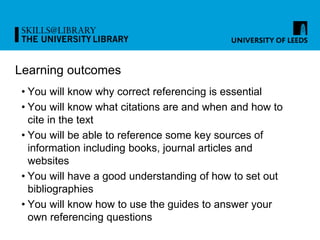
Learning outcomes
• You will know why correct referencing is essential
• You will know what citations are and when and how to
cite in the text
• You will be able to reference some key sources of
information including books, journal articles and
websites
• You will have a good understanding of how to set out
bibliographies
• You will know how to use the guides to answer your
own referencing questions
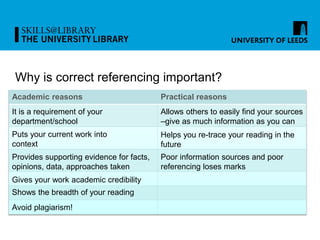
Why is correct referencing important?
Academic reasons Practical reasons
It is a requirement of your
department/school
Puts your current work into
context
Provides supporting evidence for facts,
opinions, data, approaches taken
Gives your work academic credibility
Shows the breadth of your reading
Avoid plagiarism!
Allows others to easily find your sources
–give as much information as you can
Helps you re-trace your reading in the
future
Poor information sources and poor
referencing loses marks
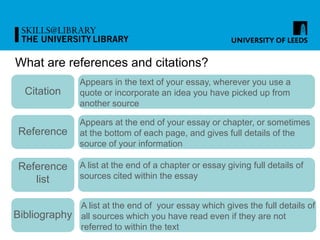
What are references and citations?
Citation
Reference
Reference
list
Bibliography
Appears in the text of your essay, wherever you use a
quote or incorporate an idea you have picked up from
another source
Appears at the end of your essay or chapter, or sometimes
at the bottom of each page, and gives full details of the
source of your information
A list at the end of a chapter or essay giving full details of
sources cited within the essay
A list at the end of your essay which gives the full details of
all sources which you have read even if they are not
referred to within the text
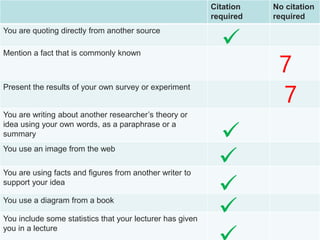
Citation
required
No citation
required
You are quoting directly from another source
Mention a fact that is commonly known
Present the results of your own survey or experiment
You are writing about another researcher’s theory or
idea using your own words, as a paraphrase or a
summary
You use an image from the web
You are using facts and figures from another writer to
support your idea
You use a diagram from a book
You include some statistics that your lecturer has given
you in a lecture





7
7
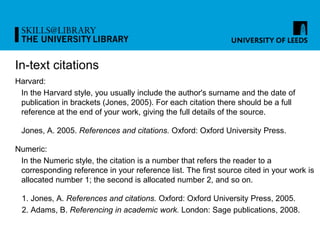
In-text citations
Harvard:
In the Harvard style, you usually include the author's surname and the date of
publication in brackets (Jones, 2005). For each citation there should be a full
reference at the end of your work, giving the full details of the source.
Jones, A. 2005. References and citations. Oxford: Oxford University Press.
Numeric:
In the Numeric style, the citation is a number that refers the reader to a
corresponding reference in your reference list. The first source cited in your work is
allocated number 1; the second is allocated number 2, and so on.
1. Jones, A. References and citations. Oxford: Oxford University Press, 2005.
2. Adams, B. Referencing in academic work. London: Sage publications, 2008.
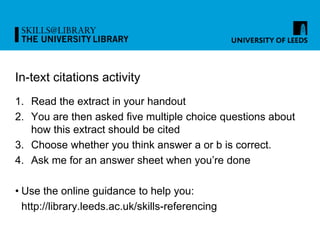
In-text citations activity
1. Read the extract in your handout
2. You are then asked five multiple choice questions about
how this extract should be cited
3. Choose whether you think answer a or b is correct.
4. Ask me for an answer sheet when you’re done
• Use the online guidance to help you:
http://library.leeds.ac.uk/skills-referencing
In-text citations: More tips
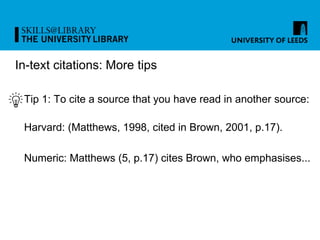
Tip 1: To cite a source that you have read in another source:
Harvard: (Matthews, 1998, cited in Brown, 2001, p.17).
Numeric: Matthews (5, p.17) cites Brown, who emphasises...
In-text citations: More tips
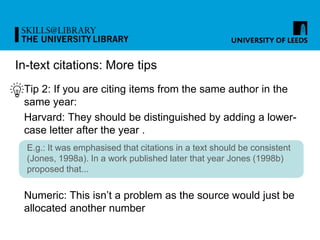
Tip 2: If you are citing items from the same author in the
same year:
Harvard: They should be distinguished by adding a lower-
case letter after the year .
Numeric: This isn’t a problem as the source would just be
allocated another number
E.g.: It was emphasised that citations in a text should be consistent
(Jones, 1998a). In a work published later that year Jones (1998b)
proposed that...
In-text citations: More tips
Tip 3: If there is no author:
Harvard: (Anon, 2011)
Numeric: Use Anon in your reference list
Tip 4: If there is no date:
Harvard: In-text citation: (Jones, no date) Bibliography: [no
date]
Numeric: In your reference list write [no date] where the year
would normally appear
References in your
bibliography or reference
list
Examples of Harvard and Numeric
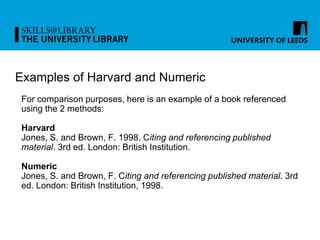
For comparison purposes, here is an example of a book referenced
using the 2 methods:
Harvard
Jones, S. and Brown, F. 1998. Citing and referencing published
material. 3rd ed. London: British Institution.
Numeric
Jones, S. and Brown, F. Citing and referencing published material. 3rd
ed. London: British Institution, 1998.
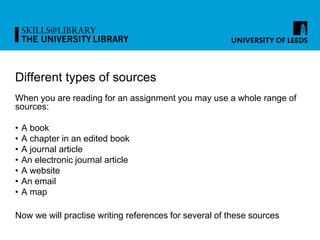
Different types of sources
When you are reading for an assignment you may use a whole range of
sources:
• A book
• A chapter in an edited book
• A journal article
• An electronic journal article
• A website
• An email
• A map
Now we will practise writing references for several of these sources
Practical referencing activity
• Reference:
–Book
–Chapter in an edited book
–Journal article
–E-journal article
–Website
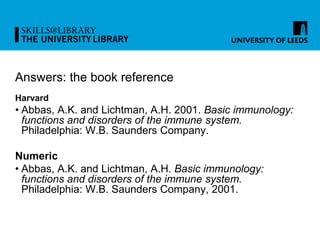
Answers: the book reference
Harvard
• Abbas, A.K. and Lichtman, A.H. 2001. Basic immunology:
functions and disorders of the immune system.
Philadelphia: W.B. Saunders Company.
Numeric
• Abbas, A.K. and Lichtman, A.H. Basic immunology:
functions and disorders of the immune system.
Philadelphia: W.B. Saunders Company, 2001.
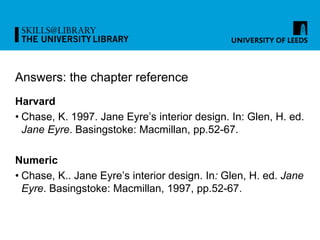
Answers: the chapter reference
Harvard
• Chase, K. 1997. Jane Eyre’s interior design. In: Glen, H. ed.
Jane Eyre. Basingstoke: Macmillan, pp.52-67.
Numeric
• Chase, K.. Jane Eyre’s interior design. In: Glen, H. ed. Jane
Eyre. Basingstoke: Macmillan, 1997, pp.52-67.
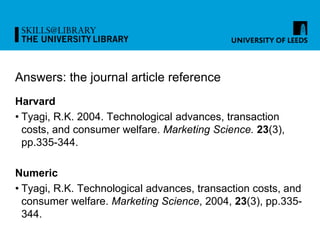
Answers: the journal article reference
Harvard
• Tyagi, R.K. 2004. Technological advances, transaction
costs, and consumer welfare. Marketing Science. 23(3),
pp.335-344.
Numeric
• Tyagi, R.K. Technological advances, transaction costs, and
consumer welfare. Marketing Science, 2004, 23(3), pp.335-
344.
Answers: the e-journal article reference
Harvard
• Vahey, D.C., Swan, B.A., Lang, N.M. and Mitchell, P.H. 2004.
Measuring and improving health care quality: nursing's contribution to
the state of science. Nursing Outlook. [Online]. 52(1), pp.6-10.
[Accessed 26 October 2004]. Available from: http://0-
www.sciencedirect.com.wam.leeds.ac.uk
Numeric
• Vahey, D.C., Swan, B.A., Lang, N.M. and Mitchell, P.H. 2004.
Measuring and improving health care quality: nursing's contribution to
the state of science. Nursing Outlook. [Online]. 2004, 52(1), pp.6-10.
[Accessed 26 October 2004]. Available from: http://0-
www.sciencedirect.com.wam.leeds.ac.uk
Setting out bibliographies: Harvard
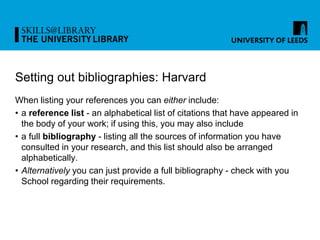
When listing your references you can either include:
• a reference list - an alphabetical list of citations that have appeared in
the body of your work; if using this, you may also include
• a full bibliography - listing all the sources of information you have
consulted in your research, and this list should also be arranged
alphabetically.
• Alternatively you can just provide a full bibliography - check with you
School regarding their requirements.
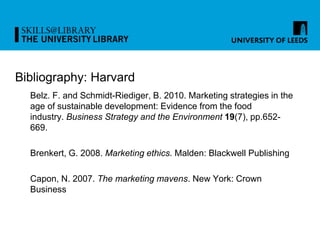
Bibliography: Harvard
Belz. F. and Schmidt-Riediger, B. 2010. Marketing strategies in the
age of sustainable development: Evidence from the food
industry. Business Strategy and the Environment 19(7), pp.652-
669.
Brenkert, G. 2008. Marketing ethics. Malden: Blackwell Publishing
Capon, N. 2007. The marketing mavens. New York: Crown
Business
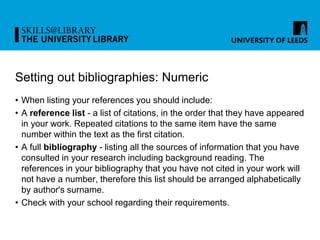
Setting out bibliographies: Numeric
• When listing your references you should include:
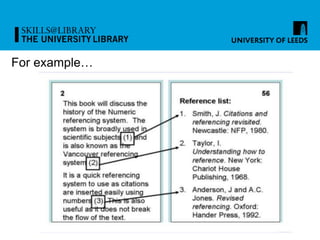
• A reference list - a list of citations, in the order that they have appeared
in your work. Repeated citations to the same item have the same
number within the text as the first citation.
• A full bibliography - listing all the sources of information that you have
consulted in your research including background reading. The
references in your bibliography that you have not cited in your work will
not have a number, therefore this list should be arranged alphabetically
by author's surname.
• Check with your school regarding their requirements.
For example…
To sum up:
• Use the style your school has selected. If it is Harvard or
Numeric use the Leeds University versions of these styles
• Remember a citation is a reference within the text, a
reference comes at the end of your text
• Gain marks by referencing correctly and consistently!
• Avoid plagiarism
Further help:
• Use the referencing guidance on the Library referencing
webpages:
http://library.leeds.ac.uk/skills-referencing

referencing_skills_workshop.ppt

  • 1.
  • 2.
    Learning outcomes • Youwill know why correct referencing is essential • You will know what citations are and when and how to cite in the text • You will be able to reference some key sources of information including books, journal articles and websites • You will have a good understanding of how to set out bibliographies • You will know how to use the guides to answer your own referencing questions
  • 3.
    Why is correctreferencing important? Academic reasons Practical reasons It is a requirement of your department/school Puts your current work into context Provides supporting evidence for facts, opinions, data, approaches taken Gives your work academic credibility Shows the breadth of your reading Avoid plagiarism! Allows others to easily find your sources –give as much information as you can Helps you re-trace your reading in the future Poor information sources and poor referencing loses marks
  • 4.
    What are referencesand citations? Citation Reference Reference list Bibliography Appears in the text of your essay, wherever you use a quote or incorporate an idea you have picked up from another source Appears at the end of your essay or chapter, or sometimes at the bottom of each page, and gives full details of the source of your information A list at the end of a chapter or essay giving full details of sources cited within the essay A list at the end of your essay which gives the full details of all sources which you have read even if they are not referred to within the text
  • 5.
    Citation required No citation required You arequoting directly from another source Mention a fact that is commonly known Present the results of your own survey or experiment You are writing about another researcher’s theory or idea using your own words, as a paraphrase or a summary You use an image from the web You are using facts and figures from another writer to support your idea You use a diagram from a book You include some statistics that your lecturer has given you in a lecture      7 7
  • 6.
    In-text citations Harvard: In theHarvard style, you usually include the author's surname and the date of publication in brackets (Jones, 2005). For each citation there should be a full reference at the end of your work, giving the full details of the source. Jones, A. 2005. References and citations. Oxford: Oxford University Press. Numeric: In the Numeric style, the citation is a number that refers the reader to a corresponding reference in your reference list. The first source cited in your work is allocated number 1; the second is allocated number 2, and so on. 1. Jones, A. References and citations. Oxford: Oxford University Press, 2005. 2. Adams, B. Referencing in academic work. London: Sage publications, 2008.
  • 7.
    In-text citations activity 1.Read the extract in your handout 2. You are then asked five multiple choice questions about how this extract should be cited 3. Choose whether you think answer a or b is correct. 4. Ask me for an answer sheet when you’re done • Use the online guidance to help you: http://library.leeds.ac.uk/skills-referencing
  • 8.
    In-text citations: Moretips Tip 1: To cite a source that you have read in another source: Harvard: (Matthews, 1998, cited in Brown, 2001, p.17). Numeric: Matthews (5, p.17) cites Brown, who emphasises...
  • 9.
    In-text citations: Moretips Tip 2: If you are citing items from the same author in the same year: Harvard: They should be distinguished by adding a lower- case letter after the year . Numeric: This isn’t a problem as the source would just be allocated another number E.g.: It was emphasised that citations in a text should be consistent (Jones, 1998a). In a work published later that year Jones (1998b) proposed that...
  • 10.
    In-text citations: Moretips Tip 3: If there is no author: Harvard: (Anon, 2011) Numeric: Use Anon in your reference list Tip 4: If there is no date: Harvard: In-text citation: (Jones, no date) Bibliography: [no date] Numeric: In your reference list write [no date] where the year would normally appear
  • 11.
  • 12.
    Examples of Harvardand Numeric For comparison purposes, here is an example of a book referenced using the 2 methods: Harvard Jones, S. and Brown, F. 1998. Citing and referencing published material. 3rd ed. London: British Institution. Numeric Jones, S. and Brown, F. Citing and referencing published material. 3rd ed. London: British Institution, 1998.
  • 13.
    Different types ofsources When you are reading for an assignment you may use a whole range of sources: • A book • A chapter in an edited book • A journal article • An electronic journal article • A website • An email • A map Now we will practise writing references for several of these sources
  • 14.
    Practical referencing activity •Reference: –Book –Chapter in an edited book –Journal article –E-journal article –Website
  • 15.
    Answers: the bookreference Harvard • Abbas, A.K. and Lichtman, A.H. 2001. Basic immunology: functions and disorders of the immune system. Philadelphia: W.B. Saunders Company. Numeric • Abbas, A.K. and Lichtman, A.H. Basic immunology: functions and disorders of the immune system. Philadelphia: W.B. Saunders Company, 2001.
  • 16.
    Answers: the chapterreference Harvard • Chase, K. 1997. Jane Eyre’s interior design. In: Glen, H. ed. Jane Eyre. Basingstoke: Macmillan, pp.52-67. Numeric • Chase, K.. Jane Eyre’s interior design. In: Glen, H. ed. Jane Eyre. Basingstoke: Macmillan, 1997, pp.52-67.
  • 17.
    Answers: the journalarticle reference Harvard • Tyagi, R.K. 2004. Technological advances, transaction costs, and consumer welfare. Marketing Science. 23(3), pp.335-344. Numeric • Tyagi, R.K. Technological advances, transaction costs, and consumer welfare. Marketing Science, 2004, 23(3), pp.335- 344.
  • 18.
    Answers: the e-journalarticle reference Harvard • Vahey, D.C., Swan, B.A., Lang, N.M. and Mitchell, P.H. 2004. Measuring and improving health care quality: nursing's contribution to the state of science. Nursing Outlook. [Online]. 52(1), pp.6-10. [Accessed 26 October 2004]. Available from: http://0- www.sciencedirect.com.wam.leeds.ac.uk Numeric • Vahey, D.C., Swan, B.A., Lang, N.M. and Mitchell, P.H. 2004. Measuring and improving health care quality: nursing's contribution to the state of science. Nursing Outlook. [Online]. 2004, 52(1), pp.6-10. [Accessed 26 October 2004]. Available from: http://0- www.sciencedirect.com.wam.leeds.ac.uk
  • 19.
    Setting out bibliographies:Harvard When listing your references you can either include: • a reference list - an alphabetical list of citations that have appeared in the body of your work; if using this, you may also include • a full bibliography - listing all the sources of information you have consulted in your research, and this list should also be arranged alphabetically. • Alternatively you can just provide a full bibliography - check with you School regarding their requirements.
  • 20.
    Bibliography: Harvard Belz. F.and Schmidt-Riediger, B. 2010. Marketing strategies in the age of sustainable development: Evidence from the food industry. Business Strategy and the Environment 19(7), pp.652- 669. Brenkert, G. 2008. Marketing ethics. Malden: Blackwell Publishing Capon, N. 2007. The marketing mavens. New York: Crown Business
  • 21.
    Setting out bibliographies:Numeric • When listing your references you should include: • A reference list - a list of citations, in the order that they have appeared in your work. Repeated citations to the same item have the same number within the text as the first citation. • A full bibliography - listing all the sources of information that you have consulted in your research including background reading. The references in your bibliography that you have not cited in your work will not have a number, therefore this list should be arranged alphabetically by author's surname. • Check with your school regarding their requirements.
  • 22.
  • 23.
    To sum up: •Use the style your school has selected. If it is Harvard or Numeric use the Leeds University versions of these styles • Remember a citation is a reference within the text, a reference comes at the end of your text • Gain marks by referencing correctly and consistently! • Avoid plagiarism
  • 24.
    Further help: • Usethe referencing guidance on the Library referencing webpages: http://library.leeds.ac.uk/skills-referencing

Editor's Notes

  • #2 1
  • #10 E.g.: It was emphasised that citations in a text should be consistent (Jones 1998a). In a work published later that year Jones (1998b) proposed that...
  • #13 Go through these 3 examples, pointing out the differences.
  • #24 Sum up by reminding them what we’ve covered in this session. Alert them to EndNote, and tell them we run workshops on it.