Referencing and its Styles
Lecture in Google Scholar Club @ VKP
Dr. Rohit Khokher
Outline
 Referencing/ Citation
 Referencing Styles
 Sources to be cited
 Reference style formats
Referencing/ Citation
 Referencing means citing different sources used in writing research paper/article/report.
 A citation is a way of giving credit to individuals for their creative and intellectual works that have
been used to support presented research. It can also be used to locate particular sources and
combat plagiarism.
 A citation style dictates the information necessary for a citation and how the information is ordered,
as well as punctuation and other formatting.
 In higher education whenever a fact or piece of information is used in an assignment or research
paper it should always include the source of information.
Referencing/ Citation
 Even if you 'just know it' - it has to have come from somewhere.
 This is because in higher education assignment or research paper writing you are not just being
tested on what you know, but rather what you are able to find out and what you think it means.
 A referencing style is a set of rules telling you how to acknowledge the thoughts, ideas and works of
others in a particular way.
 Referencing is a crucial part of successful academic writing, avoiding plagiarism and is key to
assignments and research.
Referencing Styles
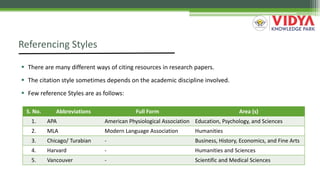
 There are many different ways of citing resources in research papers.
 The citation style sometimes depends on the academic discipline involved.
 Few reference Styles are as follows:
S. No. Abbreviations Full Form Area (s)
1. APA American Physiological Association Education, Psychology, and Sciences
2. MLA Modern Language Association Humanities
3. Chicago/ Turabian - Business, History, Economics, and Fine Arts
4. Harvard - Humanities and Sciences
5. Vancouver - Scientific and Medical Sciences
Referencing Styles
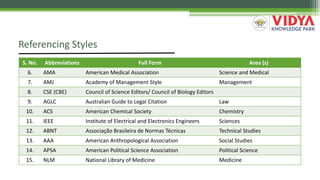
S. No. Abbreviations Full Form Area (s)
6. AMA American Medical Association Science and Medical
7. AMJ Academy of Management Style Management
8. CSE (CBE) Council of Science Editors/ Council of Biology Editors
9. AGLC Australian Guide to Legal Citation Law
10. ACS American Chemical Society Chemistry
11. IEEE Institute of Electrical and Electronics Engineers Sciences
12. ABNT Associação Brasileira de Normas Técnicas Technical Studies
13. AAA American Anthropological Association Social Studies
14. APSA American Political Science Association Political Science
15. NLM National Library of Medicine Medicine
Sources To Be Cited
» An article in a print journal » An article in a journal
without DOI
» An article in a journal with DOI
» A book in print » Websites-online government
publications
» Radio and TV episodes- from
website
» A book chapter, print version » Emails (cited in-text only) » Film clips from website
» An eBook » Mailing Lists (listerv) » Film
» Websites- professional or personal
sites
» Radio and TV episodes- from
library databases
» Photograph(from book, magazine
or webpage)
» Artwork- from library database » Artwork- from website » Dissertation
» Patent » News Paper » Software
Referencing Styles: Articles in Journals
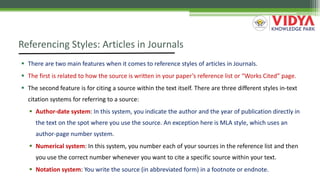
 There are two main features when it comes to reference styles of articles in Journals.
 The first is related to how the source is written in your paper’s reference list or “Works Cited” page.
 The second feature is for citing a source within the text itself. There are three different styles in-text
citation systems for referring to a source:
 Author-date system: In this system, you indicate the author and the year of publication directly in
the text on the spot where you use the source. An exception here is MLA style, which uses an
author-page number system.
 Numerical system: In this system, you number each of your sources in the reference list and then
you use the correct number whenever you want to cite a specific source within your text.
 Notation system: You write the source (in abbreviated form) in a footnote or endnote.
Referencing Styles: Articles in Journals
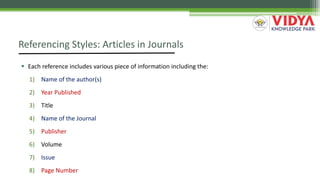
 Each reference includes various piece of information including the:
1) Name of the author(s)
2) Year Published
3) Title
4) Name of the Journal
5) Publisher
6) Volume
7) Issue
8) Page Number
Referencing Styles: Articles in Journals: APA Style
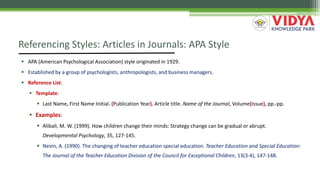
 APA (American Psychological Association) style originated in 1929.
 Established by a group of psychologists, anthropologists, and business managers.
 Reference List:
 Template:
 Last Name, First Name Initial. (Publication Year). Article title. Name of the Journal, Volume(Issue), pp.-pp.
 Examples:
 Alibali, M. W. (1999). How children change their minds: Strategy change can be gradual or abrupt.
Developmental Psychology, 35, 127-145.
 Nevin, A. (1990). The changing of teacher education special education. Teacher Education and Special Education:
The Journal of the Teacher Education Division of the Council for Exceptional Children, 13(3-4), 147-148.
Referencing Styles: Articles in Journals: APA Style
 In Text:
 Template:
 (Author Surname, Publication Year) (Up to 3 authors)
 (Author Surname et al., Publication Year) (More than 3 authors)
 (et alia Latin word for “and others”)
 Examples:
 (Westhues, Lafrance, & Schmidt, 2001).
 (Dietz et al., 2007).
Referencing Styles: Articles in Journals: Harvard Style
 Harvard style was introduced in 1881.
 First used by Edward Laurens Mark, Hersey Professor of anatomy and director of the zoological laboratory at
Harvard University.
 Reference List:
 Template:
 Last Name, First Initial. (Publication Year). Article title. Name of the Journal, Volume (Issue), Page(s).
 Examples:
 Ross, N. (2015). On Truth Content and False Consciousness in Adorno’s Aesthetic Theory. Philosophy Today, 59(2), pp.
269-290.
 Dismuke, C. and Egede, L. (2015). The Impact of Cognitive, Social and Physical Limitations on Income in Community
Dwelling Adults With Chronic Medical and Mental Disorders. Global Journal of Health Science, 7(5), pp. 183-195.
Referencing Styles: Articles in Journals: Harvard Style
 In Text:
 Template:
 (Author Surname, Publication Year) (Up to 3 authors)
 (Author Surname et al., Publication Year) (More than 3 authors)
 Examples:
 (Westhues, Lafrance and Schmidt, 2001).
 (Dietz et al., 2007).
 Dietz et al. (2007)
Referencing Styles: Articles in Journals: Chicago Style
 Chicago style originated in 1906.
 Established by the University of Chicago Press.
 Reference List:
 Template:
 Last Name, First initial Middle initial, and First Name Last Name. “Article”. Journal Name Volume,
Issue (Publication Year): Page(s).
 Examples:
 Altheide, D. L. “Ethnographic Content Analysis”. Qualitative Sociology 10, no. I (1987): 65-77.
 Pantelli, Niki and Robert Tucker. "Power and Trust in Global Virtual Teams." Communications of the
ACM 52, no. 12 (2009): 113-115.
Referencing Styles: Articles in Journals: Chicago Style
 In Text:
 Template:
 (Author Last Name Year of Publication, Page #) (Up to 3 authors)
 (Author Last Name et al. Publication Year, Page # ) (More than 3 authors)
 Examples:
 (Smith and Johnson 1998, 14).
 (Smith, Johnson, and White 2001, 42)
 (Dietz et al. 2007, 203).
Referencing Styles: Articles in Journals: MLA Style
 MLA (Modern Language Association) style originated in 1951 and revised in 1970.
 Established by the Modern Language Association of America.
 Reference List:
 Template:
 Last Name, First Name Middle Name initial, and First Name Middle Initial. Last Name. “Article”.
Journal Name Volume, Issue (Publication Year): Page(s). Print.
 Examples:
 Jacoby, William G. “Public Attitudes Toward Government Spending”. American Journal of Political
Science 38.2 (1994): 336-61. Print.
 Fearon, James D., and David D. Laitin. “Ethnicity, Insurgency, and Civil War”. American Political
Science Review 97.01 (2003): 75. Print.
Referencing Styles: Articles in Journals: MLA Style
 In Text:
 Template:
 (Author Last Name Page #) (Up to 3 authors)
 (Author Last Name et al. Page # ) (More than 3 authors)
 Examples:
 (Smith and Johnson 14).
 (Dietz et al. 203).
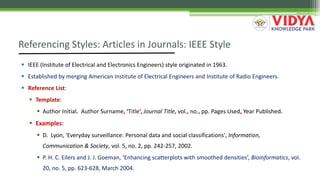
Referencing Styles: Articles in Journals: IEEE Style
 IEEE (Institute of Electrical and Electronics Engineers) style originated in 1963.
 Established by merging American Institute of Electrical Engineers and Institute of Radio Engineers.
 Reference List:
 Template:
 Author Initial. Author Surname, ‘Title’, Journal Title, vol., no., pp. Pages Used, Year Published.
 Examples:
 D. Lyon, 'Everyday surveillance: Personal data and social classifications', Information,
Communication & Society, vol. 5, no. 2, pp. 242-257, 2002.
 P. H. C. Eilers and J. J. Goeman, ‘Enhancing scatterplots with smoothed densities’, Bioinformatics, vol.
20, no. 5, pp. 623-628, March 2004.
Referencing Styles: Articles in Journals: IEEE Style
 In Text:
 Template:
 [Reference Number]
 Examples:
 [1].
 Some text from multiple references [1], [4], [9].
Thank You
Any Queries

Referencing and Its Styles

  • 1.
    Referencing and itsStyles Lecture in Google Scholar Club @ VKP Dr. Rohit Khokher
  • 2.
    Outline  Referencing/ Citation Referencing Styles  Sources to be cited  Reference style formats
  • 3.
    Referencing/ Citation  Referencingmeans citing different sources used in writing research paper/article/report.  A citation is a way of giving credit to individuals for their creative and intellectual works that have been used to support presented research. It can also be used to locate particular sources and combat plagiarism.  A citation style dictates the information necessary for a citation and how the information is ordered, as well as punctuation and other formatting.  In higher education whenever a fact or piece of information is used in an assignment or research paper it should always include the source of information.
  • 4.
    Referencing/ Citation  Evenif you 'just know it' - it has to have come from somewhere.  This is because in higher education assignment or research paper writing you are not just being tested on what you know, but rather what you are able to find out and what you think it means.  A referencing style is a set of rules telling you how to acknowledge the thoughts, ideas and works of others in a particular way.  Referencing is a crucial part of successful academic writing, avoiding plagiarism and is key to assignments and research.
  • 5.
    Referencing Styles  Thereare many different ways of citing resources in research papers.  The citation style sometimes depends on the academic discipline involved.  Few reference Styles are as follows: S. No. Abbreviations Full Form Area (s) 1. APA American Physiological Association Education, Psychology, and Sciences 2. MLA Modern Language Association Humanities 3. Chicago/ Turabian - Business, History, Economics, and Fine Arts 4. Harvard - Humanities and Sciences 5. Vancouver - Scientific and Medical Sciences
  • 6.
    Referencing Styles S. No.Abbreviations Full Form Area (s) 6. AMA American Medical Association Science and Medical 7. AMJ Academy of Management Style Management 8. CSE (CBE) Council of Science Editors/ Council of Biology Editors 9. AGLC Australian Guide to Legal Citation Law 10. ACS American Chemical Society Chemistry 11. IEEE Institute of Electrical and Electronics Engineers Sciences 12. ABNT Associação Brasileira de Normas Técnicas Technical Studies 13. AAA American Anthropological Association Social Studies 14. APSA American Political Science Association Political Science 15. NLM National Library of Medicine Medicine
  • 7.
    Sources To BeCited » An article in a print journal » An article in a journal without DOI » An article in a journal with DOI » A book in print » Websites-online government publications » Radio and TV episodes- from website » A book chapter, print version » Emails (cited in-text only) » Film clips from website » An eBook » Mailing Lists (listerv) » Film » Websites- professional or personal sites » Radio and TV episodes- from library databases » Photograph(from book, magazine or webpage) » Artwork- from library database » Artwork- from website » Dissertation » Patent » News Paper » Software
  • 8.
    Referencing Styles: Articlesin Journals  There are two main features when it comes to reference styles of articles in Journals.  The first is related to how the source is written in your paper’s reference list or “Works Cited” page.  The second feature is for citing a source within the text itself. There are three different styles in-text citation systems for referring to a source:  Author-date system: In this system, you indicate the author and the year of publication directly in the text on the spot where you use the source. An exception here is MLA style, which uses an author-page number system.  Numerical system: In this system, you number each of your sources in the reference list and then you use the correct number whenever you want to cite a specific source within your text.  Notation system: You write the source (in abbreviated form) in a footnote or endnote.
  • 9.
    Referencing Styles: Articlesin Journals  Each reference includes various piece of information including the: 1) Name of the author(s) 2) Year Published 3) Title 4) Name of the Journal 5) Publisher 6) Volume 7) Issue 8) Page Number
  • 10.
    Referencing Styles: Articlesin Journals: APA Style  APA (American Psychological Association) style originated in 1929.  Established by a group of psychologists, anthropologists, and business managers.  Reference List:  Template:  Last Name, First Name Initial. (Publication Year). Article title. Name of the Journal, Volume(Issue), pp.-pp.  Examples:  Alibali, M. W. (1999). How children change their minds: Strategy change can be gradual or abrupt. Developmental Psychology, 35, 127-145.  Nevin, A. (1990). The changing of teacher education special education. Teacher Education and Special Education: The Journal of the Teacher Education Division of the Council for Exceptional Children, 13(3-4), 147-148.
  • 11.
    Referencing Styles: Articlesin Journals: APA Style  In Text:  Template:  (Author Surname, Publication Year) (Up to 3 authors)  (Author Surname et al., Publication Year) (More than 3 authors)  (et alia Latin word for “and others”)  Examples:  (Westhues, Lafrance, & Schmidt, 2001).  (Dietz et al., 2007).
  • 12.
    Referencing Styles: Articlesin Journals: Harvard Style  Harvard style was introduced in 1881.  First used by Edward Laurens Mark, Hersey Professor of anatomy and director of the zoological laboratory at Harvard University.  Reference List:  Template:  Last Name, First Initial. (Publication Year). Article title. Name of the Journal, Volume (Issue), Page(s).  Examples:  Ross, N. (2015). On Truth Content and False Consciousness in Adorno’s Aesthetic Theory. Philosophy Today, 59(2), pp. 269-290.  Dismuke, C. and Egede, L. (2015). The Impact of Cognitive, Social and Physical Limitations on Income in Community Dwelling Adults With Chronic Medical and Mental Disorders. Global Journal of Health Science, 7(5), pp. 183-195.
  • 13.
    Referencing Styles: Articlesin Journals: Harvard Style  In Text:  Template:  (Author Surname, Publication Year) (Up to 3 authors)  (Author Surname et al., Publication Year) (More than 3 authors)  Examples:  (Westhues, Lafrance and Schmidt, 2001).  (Dietz et al., 2007).  Dietz et al. (2007)
  • 14.
    Referencing Styles: Articlesin Journals: Chicago Style  Chicago style originated in 1906.  Established by the University of Chicago Press.  Reference List:  Template:  Last Name, First initial Middle initial, and First Name Last Name. “Article”. Journal Name Volume, Issue (Publication Year): Page(s).  Examples:  Altheide, D. L. “Ethnographic Content Analysis”. Qualitative Sociology 10, no. I (1987): 65-77.  Pantelli, Niki and Robert Tucker. "Power and Trust in Global Virtual Teams." Communications of the ACM 52, no. 12 (2009): 113-115.
  • 15.
    Referencing Styles: Articlesin Journals: Chicago Style  In Text:  Template:  (Author Last Name Year of Publication, Page #) (Up to 3 authors)  (Author Last Name et al. Publication Year, Page # ) (More than 3 authors)  Examples:  (Smith and Johnson 1998, 14).  (Smith, Johnson, and White 2001, 42)  (Dietz et al. 2007, 203).
  • 16.
    Referencing Styles: Articlesin Journals: MLA Style  MLA (Modern Language Association) style originated in 1951 and revised in 1970.  Established by the Modern Language Association of America.  Reference List:  Template:  Last Name, First Name Middle Name initial, and First Name Middle Initial. Last Name. “Article”. Journal Name Volume, Issue (Publication Year): Page(s). Print.  Examples:  Jacoby, William G. “Public Attitudes Toward Government Spending”. American Journal of Political Science 38.2 (1994): 336-61. Print.  Fearon, James D., and David D. Laitin. “Ethnicity, Insurgency, and Civil War”. American Political Science Review 97.01 (2003): 75. Print.
  • 17.
    Referencing Styles: Articlesin Journals: MLA Style  In Text:  Template:  (Author Last Name Page #) (Up to 3 authors)  (Author Last Name et al. Page # ) (More than 3 authors)  Examples:  (Smith and Johnson 14).  (Dietz et al. 203).
  • 18.
    Referencing Styles: Articlesin Journals: IEEE Style  IEEE (Institute of Electrical and Electronics Engineers) style originated in 1963.  Established by merging American Institute of Electrical Engineers and Institute of Radio Engineers.  Reference List:  Template:  Author Initial. Author Surname, ‘Title’, Journal Title, vol., no., pp. Pages Used, Year Published.  Examples:  D. Lyon, 'Everyday surveillance: Personal data and social classifications', Information, Communication & Society, vol. 5, no. 2, pp. 242-257, 2002.  P. H. C. Eilers and J. J. Goeman, ‘Enhancing scatterplots with smoothed densities’, Bioinformatics, vol. 20, no. 5, pp. 623-628, March 2004.
  • 19.
    Referencing Styles: Articlesin Journals: IEEE Style  In Text:  Template:  [Reference Number]  Examples:  [1].  Some text from multiple references [1], [4], [9].
  • 20.

Editor's Notes

  • #3 How presentation will benefit audience: Adult learners are more interested in a subject if they know how or why it is important to them. Presenter’s level of expertise in the subject: Briefly state your credentials in this area, or explain why participants should listen to you.
  • #4 Lesson descriptions should be brief.
  • #5 Lesson descriptions should be brief.
  • #6 Example objectives At the end of this lesson, you will be able to: Save files to the team Web server. Move files to different locations on the team Web server. Share files on the team Web server.
  • #7 Example objectives At the end of this lesson, you will be able to: Save files to the team Web server. Move files to different locations on the team Web server. Share files on the team Web server.
  • #8 Lesson descriptions should be brief.
  • #9 Example objectives At the end of this lesson, you will be able to: Save files to the team Web server. Move files to different locations on the team Web server. Share files on the team Web server.
  • #10 Example objectives At the end of this lesson, you will be able to: Save files to the team Web server. Move files to different locations on the team Web server. Share files on the team Web server.
  • #11 Example objectives At the end of this lesson, you will be able to: Save files to the team Web server. Move files to different locations on the team Web server. Share files on the team Web server.
  • #12 Example objectives At the end of this lesson, you will be able to: Save files to the team Web server. Move files to different locations on the team Web server. Share files on the team Web server.
  • #13 Example objectives At the end of this lesson, you will be able to: Save files to the team Web server. Move files to different locations on the team Web server. Share files on the team Web server.
  • #14 Example objectives At the end of this lesson, you will be able to: Save files to the team Web server. Move files to different locations on the team Web server. Share files on the team Web server.
  • #15 Example objectives At the end of this lesson, you will be able to: Save files to the team Web server. Move files to different locations on the team Web server. Share files on the team Web server.
  • #16 Example objectives At the end of this lesson, you will be able to: Save files to the team Web server. Move files to different locations on the team Web server. Share files on the team Web server.
  • #17 Example objectives At the end of this lesson, you will be able to: Save files to the team Web server. Move files to different locations on the team Web server. Share files on the team Web server.
  • #18 Example objectives At the end of this lesson, you will be able to: Save files to the team Web server. Move files to different locations on the team Web server. Share files on the team Web server.
  • #19 Example objectives At the end of this lesson, you will be able to: Save files to the team Web server. Move files to different locations on the team Web server. Share files on the team Web server.
  • #20 Example objectives At the end of this lesson, you will be able to: Save files to the team Web server. Move files to different locations on the team Web server. Share files on the team Web server.