APA (6th ed) referencing
The reference list
Jenny Trevitt, Senior Librarian
The reference list
• Is not a bibliography [not an option in APA]
• Provides full publication details ONLY for sources
cited in the assignment.
• ALL in text citations require a matching reference in
the reference list.
• List references alphabetically.
Note: Check author and date details in the text citation
match details in the reference list.
Reference components
• “In general, a reference should contain the author
names, date of publication, title of the work, and
publication data” (American Psychological
Association, 2009, p. 183).
• For full details see the chapter “Reference List” in the
Publication Manual of the APA (American
Psychological Association, 2009, pp. 180-192).
Author component
• Author surname first, followed by initials.
• Edited book - editor’s surname replaces the author’s
surname and is followed by (Ed.) or (Eds.).
– Little, P. E.
– Jacobs, D. E. (Ed.).
– Australian Council for Educational Research.
Note: Do not abbreviate the name of a group author.
Date component
• Date of publication in parenthesis followed by a full
stop.
• For conference papers, magazines, newspapers,
newsletters give the year followed by a comma and
then any month or day.
(2014).
(2014, June 1).
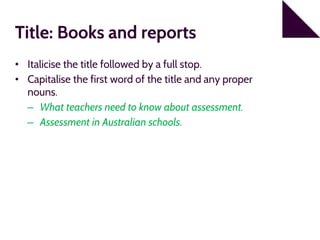
Title: Books and reports
• Italicise the title followed by a full stop.
• Capitalise the first word of the title and any proper
nouns.
– What teachers need to know about assessment.
– Assessment in Australian schools.
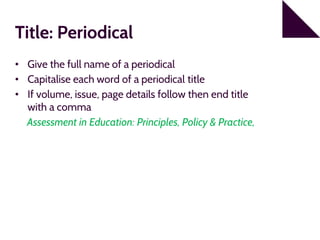
Title: Periodical
• Give the full name of a periodical
• Capitalise each word of a periodical title
• If volume, issue, page details follow then end title
with a comma
Assessment in Education: Principles, Policy & Practice,
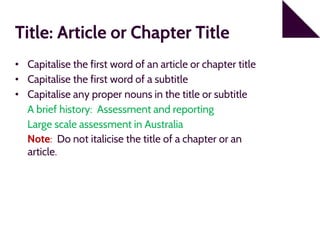
Title: Article or Chapter Title
• Capitalise the first word of an article or chapter title
• Capitalise the first word of a subtitle
• Capitalise any proper nouns in the title or subtitle
A brief history: Assessment and reporting
Large scale assessment in Australia
Note: Do not italicise the title of a chapter or an
article.
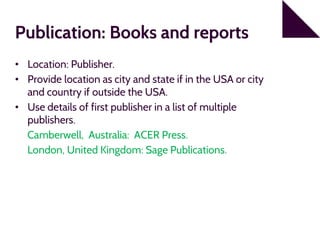
Publication: Books and reports
• Location: Publisher.
• Provide location as city and state if in the USA or city
and country if outside the USA.
• Use details of first publisher in a list of multiple
publishers.
Camberwell, Australia: ACER Press.
London, United Kingdom: Sage Publications.
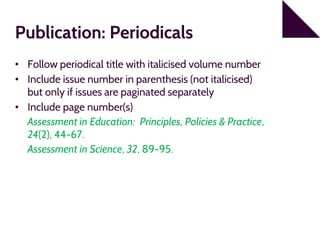
Publication: Periodicals
• Follow periodical title with italicised volume number
• Include issue number in parenthesis (not italicised)
but only if issues are paginated separately
• Include page number(s)
Assessment in Education: Principles, Policies & Practice,
24(2), 44-67.
Assessment in Science, 32, 89-95.
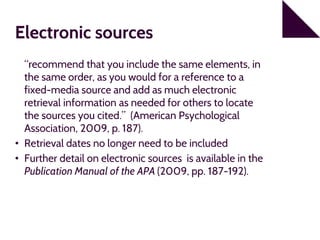
Electronic sources
“recommend that you include the same elements, in
the same order, as you would for a reference to a
fixed-media source and add as much electronic
retrieval information as needed for others to locate
the sources you cited.” (American Psychological
Association, 2009, p. 187).
• Retrieval dates no longer need to be included
• Further detail on electronic sources is available in the
Publication Manual of the APA (2009, pp. 187-192).
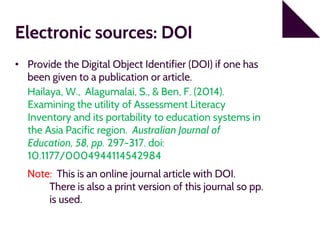
Electronic sources: DOI
• Provide the Digital Object Identifier (DOI) if one has
been given to a publication or article.
Hailaya, W., Alagumalai, S., & Ben, F. (2014).
Examining the utility of Assessment Literacy
Inventory and its portability to education systems in
the Asia Pacific region. Australian Journal of
Education, 58, pp. 297-317. doi:
10.1177/0004944114542984
Note: This is an online journal article with DOI.
There is also a print version of this journal so pp.
is used.
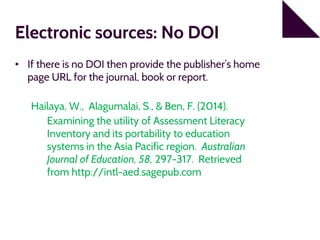
Electronic sources: No DOI
• If there is no DOI then provide the publisher’s home
page URL for the journal, book or report.
Hailaya, W., Alagumalai, S., & Ben, F. (2014).
Examining the utility of Assessment Literacy
Inventory and its portability to education
systems in the Asia Pacific region. Australian
Journal of Education, 58, 297-317. Retrieved
from http://intl-aed.sagepub.com
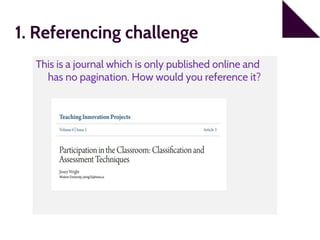
1. Referencing challenge
This is a journal which is only published online and
has no pagination. How would you reference it?
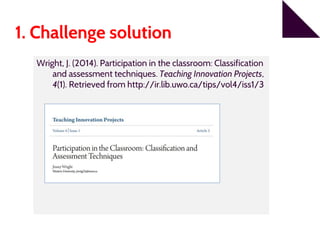
1. Challenge solution
Wright, J. (2014). Participation in the classroom: Classification
and assessment techniques. Teaching Innovation Projects,
4(1). Retrieved from http://ir.lib.uwo.ca/tips/vol4/iss1/3
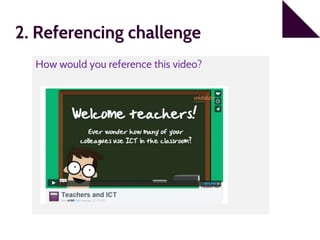
2. Referencing challenge
How would you reference this video?
2. Challenge solution
Australian Council for Educational Research
(Producer). (2014, November 21). Teachers and
ICT [Video/Infographic]. Teacher. Available from
http://teacher.acer.edu.au/article/teachers-and-
ict
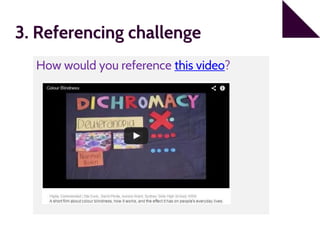
3. Referencing challenge
How would you reference this video?
3. Challenge solution
This is one possibility for referencing the video:
Curic, E., Pirola, S., & Ward A. (Producers). (2014). 2014 Sleek
Geeks Eureka Science School Prize: Colour blindness
[Video]. ABC Science: Dr. Karl. Retrieved from
http://www.abc.net.au/science/video/2014/colourblin
dness.html
Note: If you cannot find an exact match for your reference
in the manual for the APA Style, then chose an example
that could be adapted. The above is based on the video
style and a chapter in book style.
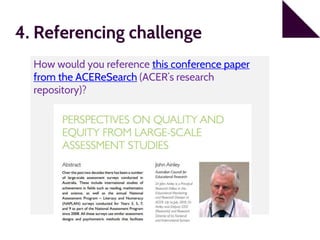
4. Referencing challenge
How would you reference this conference paper
from the ACEReSearch (ACER’s research
repository)?
4. Challenge Solution
Ainley, J., & Gebhardt, E. (2014, August 4). Perspectives on Quality
and Equity from Large-Scale Assessment Studies. Paper
presented at the Australian Council for Education Research
Conference 2014 on Quality and Equity: What Does the
Research Tell Us?, Adelaide, Australia. Retrieved from
http://research.acer.edu.au/research_conference/RC2014/
4august/6/
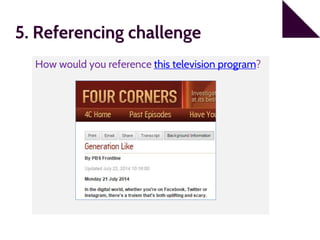
5. Referencing challenge
How would you reference this television program?
5. Challenge Solution
PBS Frontline (Program By), & O’Brien, K. (Presenter). (2014,
July 22). Generation Like [Television Series Episode]. In
D. Rushkoff and F. Koughan (Co-Producers), Four
Corners. Australia: ABC Television.
Online help
See the American Psychological Association
website:
• The Basics of APA Style - slides 13 to 25
• In-text citations
• Punctuating the Reference List Entry
• APA Style FAQs
• The APA Style Blog
Further Help
• American Psychological Association. (2009). Publication
Manual of the American Psychological Association (6th ed.).
Washington, DC: Author. Refer to chapters 6 & 7.
• American Psychological Association. (2010). Concise rules
of APA style (6th ed.). Washington, DC: Author. Refer to
chapters 7 & 8.
• Note: These books can be borrowed from the Library. Submit an
online request and items will be express posted to students
within Australia. Submit a Book Request.
Full details are set under services on the Library’s Student Portal
page.
Students are responsible for any cost to return borrowed items.
Reference List
American Psychological Association. (2009).
Publication Manual of the American Psychological
Association (6th ed.). Washington, DC: Author.

APA 6th edition referencing. Part 2: Reference list

  • 1.
    APA (6th ed)referencing The reference list Jenny Trevitt, Senior Librarian
  • 2.
    The reference list •Is not a bibliography [not an option in APA] • Provides full publication details ONLY for sources cited in the assignment. • ALL in text citations require a matching reference in the reference list. • List references alphabetically. Note: Check author and date details in the text citation match details in the reference list.
  • 3.
    Reference components • “Ingeneral, a reference should contain the author names, date of publication, title of the work, and publication data” (American Psychological Association, 2009, p. 183). • For full details see the chapter “Reference List” in the Publication Manual of the APA (American Psychological Association, 2009, pp. 180-192).
  • 4.
    Author component • Authorsurname first, followed by initials. • Edited book - editor’s surname replaces the author’s surname and is followed by (Ed.) or (Eds.). – Little, P. E. – Jacobs, D. E. (Ed.). – Australian Council for Educational Research. Note: Do not abbreviate the name of a group author.
  • 5.
    Date component • Dateof publication in parenthesis followed by a full stop. • For conference papers, magazines, newspapers, newsletters give the year followed by a comma and then any month or day. (2014). (2014, June 1).
  • 6.
    Title: Books andreports • Italicise the title followed by a full stop. • Capitalise the first word of the title and any proper nouns. – What teachers need to know about assessment. – Assessment in Australian schools.
  • 7.
    Title: Periodical • Givethe full name of a periodical • Capitalise each word of a periodical title • If volume, issue, page details follow then end title with a comma Assessment in Education: Principles, Policy & Practice,
  • 8.
    Title: Article orChapter Title • Capitalise the first word of an article or chapter title • Capitalise the first word of a subtitle • Capitalise any proper nouns in the title or subtitle A brief history: Assessment and reporting Large scale assessment in Australia Note: Do not italicise the title of a chapter or an article.
  • 9.
    Publication: Books andreports • Location: Publisher. • Provide location as city and state if in the USA or city and country if outside the USA. • Use details of first publisher in a list of multiple publishers. Camberwell, Australia: ACER Press. London, United Kingdom: Sage Publications.
  • 10.
    Publication: Periodicals • Followperiodical title with italicised volume number • Include issue number in parenthesis (not italicised) but only if issues are paginated separately • Include page number(s) Assessment in Education: Principles, Policies & Practice, 24(2), 44-67. Assessment in Science, 32, 89-95.
  • 11.
    Electronic sources “recommend thatyou include the same elements, in the same order, as you would for a reference to a fixed-media source and add as much electronic retrieval information as needed for others to locate the sources you cited.” (American Psychological Association, 2009, p. 187). • Retrieval dates no longer need to be included • Further detail on electronic sources is available in the Publication Manual of the APA (2009, pp. 187-192).
  • 12.
    Electronic sources: DOI •Provide the Digital Object Identifier (DOI) if one has been given to a publication or article. Hailaya, W., Alagumalai, S., & Ben, F. (2014). Examining the utility of Assessment Literacy Inventory and its portability to education systems in the Asia Pacific region. Australian Journal of Education, 58, pp. 297-317. doi: 10.1177/0004944114542984 Note: This is an online journal article with DOI. There is also a print version of this journal so pp. is used.
  • 13.
    Electronic sources: NoDOI • If there is no DOI then provide the publisher’s home page URL for the journal, book or report. Hailaya, W., Alagumalai, S., & Ben, F. (2014). Examining the utility of Assessment Literacy Inventory and its portability to education systems in the Asia Pacific region. Australian Journal of Education, 58, 297-317. Retrieved from http://intl-aed.sagepub.com
  • 14.
    1. Referencing challenge Thisis a journal which is only published online and has no pagination. How would you reference it?
  • 15.
    1. Challenge solution Wright,J. (2014). Participation in the classroom: Classification and assessment techniques. Teaching Innovation Projects, 4(1). Retrieved from http://ir.lib.uwo.ca/tips/vol4/iss1/3
  • 16.
    2. Referencing challenge Howwould you reference this video?
  • 17.
    2. Challenge solution AustralianCouncil for Educational Research (Producer). (2014, November 21). Teachers and ICT [Video/Infographic]. Teacher. Available from http://teacher.acer.edu.au/article/teachers-and- ict
  • 18.
    3. Referencing challenge Howwould you reference this video?
  • 19.
    3. Challenge solution Thisis one possibility for referencing the video: Curic, E., Pirola, S., & Ward A. (Producers). (2014). 2014 Sleek Geeks Eureka Science School Prize: Colour blindness [Video]. ABC Science: Dr. Karl. Retrieved from http://www.abc.net.au/science/video/2014/colourblin dness.html Note: If you cannot find an exact match for your reference in the manual for the APA Style, then chose an example that could be adapted. The above is based on the video style and a chapter in book style.
  • 20.
    4. Referencing challenge Howwould you reference this conference paper from the ACEReSearch (ACER’s research repository)?
  • 21.
    4. Challenge Solution Ainley,J., & Gebhardt, E. (2014, August 4). Perspectives on Quality and Equity from Large-Scale Assessment Studies. Paper presented at the Australian Council for Education Research Conference 2014 on Quality and Equity: What Does the Research Tell Us?, Adelaide, Australia. Retrieved from http://research.acer.edu.au/research_conference/RC2014/ 4august/6/
  • 22.
    5. Referencing challenge Howwould you reference this television program?
  • 23.
    5. Challenge Solution PBSFrontline (Program By), & O’Brien, K. (Presenter). (2014, July 22). Generation Like [Television Series Episode]. In D. Rushkoff and F. Koughan (Co-Producers), Four Corners. Australia: ABC Television.
  • 24.
    Online help See theAmerican Psychological Association website: • The Basics of APA Style - slides 13 to 25 • In-text citations • Punctuating the Reference List Entry • APA Style FAQs • The APA Style Blog
  • 25.
    Further Help • AmericanPsychological Association. (2009). Publication Manual of the American Psychological Association (6th ed.). Washington, DC: Author. Refer to chapters 6 & 7. • American Psychological Association. (2010). Concise rules of APA style (6th ed.). Washington, DC: Author. Refer to chapters 7 & 8. • Note: These books can be borrowed from the Library. Submit an online request and items will be express posted to students within Australia. Submit a Book Request. Full details are set under services on the Library’s Student Portal page. Students are responsible for any cost to return borrowed items.
  • 26.
    Reference List American PsychologicalAssociation. (2009). Publication Manual of the American Psychological Association (6th ed.). Washington, DC: Author.