APA BASICS Creating a References Page & Citing Sources in your Text
What is APA Style?Created by the American Psychological Association.Used in many technical and social sciences fields.Usually required for publication in those fields.Required for government publication.
Why use APA Style?Provides a uniform method of identifying sources used in a paper.Makes it easy for readers to refer directly to your sources if they need or want to.Required by your instructors.
Using a source in APARecord the required information for the reference page when you locate a source.Record the required information and page number (if available) as you take notes.These two pieces of information will work together to make your use of APA Style complete.
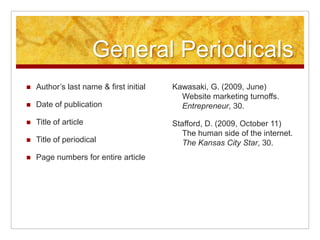
General PeriodicalsAuthor’s last name & first initial Date of publicationTitle of articleTitle of periodicalPage numbers for entire articleKawasaki, G. (2009, June) Website marketing turnoffs. Entrepreneur, 30.Stafford, D. (2009, October 11) The human side of the internet. The Kansas City Star, H1.
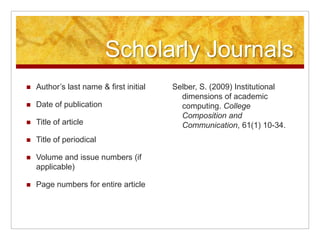
Scholarly JournalsAuthor’s last name & first initial Date of publicationTitle of articleTitle of periodicalVolume and issue numbersPage numbers for entire articleSelber, S. (2009) Institutional dimensions of academic computing. College Composition and Communication, 61(1) 10-34.
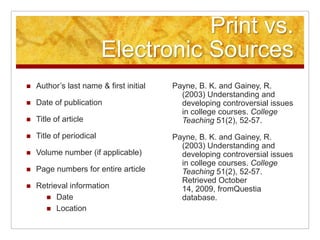
Print vs.Electronic SourcesAuthor’s last name & first initial Date of publicationTitle of articleTitle of periodicalVolume number (if applicable)Page numbers for entire articleRetrieval informationDateLocationPayne, B. K. and Gainey, R. (2003) Understanding and developing controversial issues in college courses. College Teaching 51(2), 52-57. Payne, B. K. and Gainey, R. (2003) Understanding and developing controversial issues in college courses. College Teaching 51(2), 52-57. Retrieved October 14, 2009, from Questia database.
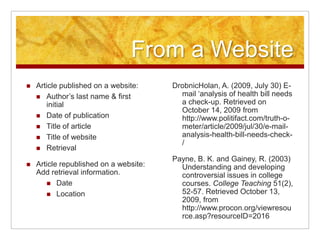
From a WebsiteArticle published on a website:Author’s last name & first initial Date of publicationTitle of articleTitle of websiteRetrievalArticle republished on a website: Add retrieval information.DateLocationDrobnicHolan, A. (2009, July 30) E-mail ‘analysis of health bill needs a check-up. Retrieved on October 14, 2009 from http://www.politifact.com/truth-o-meter/article/2009/jul/30/e-mail-analysis-health-bill-needs-check-/Payne, B. K. and Gainey, R. (2003) Understanding and developing controversial issues in college courses. College Teaching 51(2), 52-57. Retrieved October 13, 2009, from http://www.procon.org/viewresource.asp?resourceID=2016
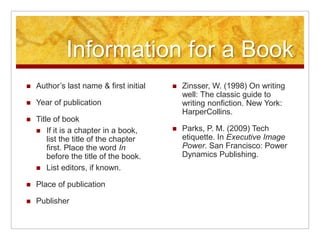
Information for a BookAuthor’s last name & first initialYear of publicationTitle of bookIf it is a chapter in a book, list the title of the chapter first. Place the word In before the title of the book.List editors, if known.Place of publicationPublisherZinsser, W. (1998) On writing well: The classic guide to writing nonfiction. New York: HarperCollins.Parks, P. M. (2009) Tech etiquette. In Executive Image Power. San Francisco: Power Dynamics Publishing.
Coordinating References with Notes and CitationsEvery in-text citation in your paper must coordinate with the alphabetized word at the beginning of a reference entry.
ReferencesDrobnicHolan, A. (2009, July 30) E-mail ‘analysis of health bill needs a check-up. 	Retrieved on October 14, 2009, from http://www.politifact.com/truth-o-		meter/article/2009/jul/30/e-mail-analysis-health-bill-needs-check-/Kawasaki, G. (2009, June) Website marketing turnoffs. Entrepreneur, 30.Selber, S. (2009) Institutional dimensions of academic computing. College 	Composition and Communication, 61(1) 10-34.Stafford, D. (2009, October 11) The human side of the internet. The Kansas City 	Star, H1.
Registration, AvoidToo many user names to keep track of. Make it easier by asking visitors to register for your site with their email addresses.	Kawasaki, 30
Registration, AvoidDon’t require a new user name:“I’m a member of hundreds of sites. I can’t remember my usernames, but I can remember my e-mail address. So why not let me use that?” 	Kawasaki, 30
Kawasaki, G. (2009, June) Website marketing  	turnoffs. Entrepreneur, 30.Registration, avoid		 	****
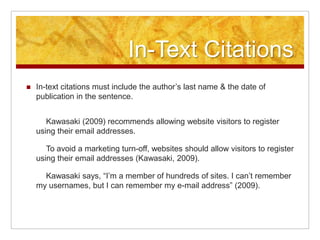
In-Text CitationsIn-text citations must include the author’s last name & the date of publication in the sentence.Without using a signal phrase:To avoid a marketing turn-off, websites should allow visitors to register using their email addresses (Kawasaki, 2009).Using a signal phrase:Kawasaki (2009) recommends allowing website visitors to register using their email addresses.Kawasaki says, “I’m a member of hundreds of sites. I can’t remember my usernames, but I can remember my e-mail address” (2009).
Help with APA Reference & Citation FormatAPA Section: Decisions textbookPurdue OWL Guide to APA Style"http://owl.english.purdue.edu/owl/resource/560/01/" target="_blank">The American Psychological Association:http://www.apastyle.org/www.bibme.comwww.easybib.comhttp://citationmachine.net/

APA References

  • 1.
    APA BASICS Creatinga References Page & Citing Sources in your Text
  • 2.
    What is APAStyle?Created by the American Psychological Association.Used in many technical and social sciences fields.Usually required for publication in those fields.Required for government publication.
  • 3.
    Why use APAStyle?Provides a uniform method of identifying sources used in a paper.Makes it easy for readers to refer directly to your sources if they need or want to.Required by your instructors.
  • 4.
    Using a sourcein APARecord the required information for the reference page when you locate a source.Record the required information and page number (if available) as you take notes.These two pieces of information will work together to make your use of APA Style complete.
  • 5.
    General PeriodicalsAuthor’s lastname & first initial Date of publicationTitle of articleTitle of periodicalPage numbers for entire articleKawasaki, G. (2009, June) Website marketing turnoffs. Entrepreneur, 30.Stafford, D. (2009, October 11) The human side of the internet. The Kansas City Star, H1.
  • 6.
    Scholarly JournalsAuthor’s lastname & first initial Date of publicationTitle of articleTitle of periodicalVolume and issue numbersPage numbers for entire articleSelber, S. (2009) Institutional dimensions of academic computing. College Composition and Communication, 61(1) 10-34.
  • 7.
    Print vs.Electronic SourcesAuthor’slast name & first initial Date of publicationTitle of articleTitle of periodicalVolume number (if applicable)Page numbers for entire articleRetrieval informationDateLocationPayne, B. K. and Gainey, R. (2003) Understanding and developing controversial issues in college courses. College Teaching 51(2), 52-57. Payne, B. K. and Gainey, R. (2003) Understanding and developing controversial issues in college courses. College Teaching 51(2), 52-57. Retrieved October 14, 2009, from Questia database.
  • 8.
    From a WebsiteArticlepublished on a website:Author’s last name & first initial Date of publicationTitle of articleTitle of websiteRetrievalArticle republished on a website: Add retrieval information.DateLocationDrobnicHolan, A. (2009, July 30) E-mail ‘analysis of health bill needs a check-up. Retrieved on October 14, 2009 from http://www.politifact.com/truth-o-meter/article/2009/jul/30/e-mail-analysis-health-bill-needs-check-/Payne, B. K. and Gainey, R. (2003) Understanding and developing controversial issues in college courses. College Teaching 51(2), 52-57. Retrieved October 13, 2009, from http://www.procon.org/viewresource.asp?resourceID=2016
  • 9.
    Information for aBookAuthor’s last name & first initialYear of publicationTitle of bookIf it is a chapter in a book, list the title of the chapter first. Place the word In before the title of the book.List editors, if known.Place of publicationPublisherZinsser, W. (1998) On writing well: The classic guide to writing nonfiction. New York: HarperCollins.Parks, P. M. (2009) Tech etiquette. In Executive Image Power. San Francisco: Power Dynamics Publishing.
  • 10.
    Coordinating References withNotes and CitationsEvery in-text citation in your paper must coordinate with the alphabetized word at the beginning of a reference entry.
  • 11.
    ReferencesDrobnicHolan, A. (2009,July 30) E-mail ‘analysis of health bill needs a check-up. Retrieved on October 14, 2009, from http://www.politifact.com/truth-o- meter/article/2009/jul/30/e-mail-analysis-health-bill-needs-check-/Kawasaki, G. (2009, June) Website marketing turnoffs. Entrepreneur, 30.Selber, S. (2009) Institutional dimensions of academic computing. College Composition and Communication, 61(1) 10-34.Stafford, D. (2009, October 11) The human side of the internet. The Kansas City Star, H1.
  • 12.
    Registration, AvoidToo manyuser names to keep track of. Make it easier by asking visitors to register for your site with their email addresses. Kawasaki, 30
  • 13.
    Registration, AvoidDon’t requirea new user name:“I’m a member of hundreds of sites. I can’t remember my usernames, but I can remember my e-mail address. So why not let me use that?” Kawasaki, 30
  • 14.
    Kawasaki, G. (2009,June) Website marketing turnoffs. Entrepreneur, 30.Registration, avoid ****
  • 15.
    In-Text CitationsIn-text citationsmust include the author’s last name & the date of publication in the sentence.Without using a signal phrase:To avoid a marketing turn-off, websites should allow visitors to register using their email addresses (Kawasaki, 2009).Using a signal phrase:Kawasaki (2009) recommends allowing website visitors to register using their email addresses.Kawasaki says, “I’m a member of hundreds of sites. I can’t remember my usernames, but I can remember my e-mail address” (2009).
  • 16.
    Help with APAReference & Citation FormatAPA Section: Decisions textbookPurdue OWL Guide to APA Style"http://owl.english.purdue.edu/owl/resource/560/01/" target="_blank">The American Psychological Association:http://www.apastyle.org/www.bibme.comwww.easybib.comhttp://citationmachine.net/