Advanced Higher History
The Dissertation
Referencing and the
bibliography
@mrmarrhistory
Referencing and the bibliography
As part of your dissertation, you must show where you found all
relevant pieces of information and historiography.
Referencing In your main text, you should include a
description of where you found each
relevant piece of information
Bibliography At the end of your dissertation you should
include a list of all the different sources that
you used
There are different ways to complete both of these tasks
Referencing and the bibliography
There are numerous options for referencing and bibliographies but
the two most commonly used are:
Oxford This involves using footnotes (small elevated
numbers next to each reference with details at
the foot of the page) and then a list of sources at
the end of the report
Harvard This uses in-text citations (naming the author and
published date in the main text body) before
giving a full list of all sources at the end
Advanced Higher History
The Dissertation
Oxford
referencing @mrmarrhistory
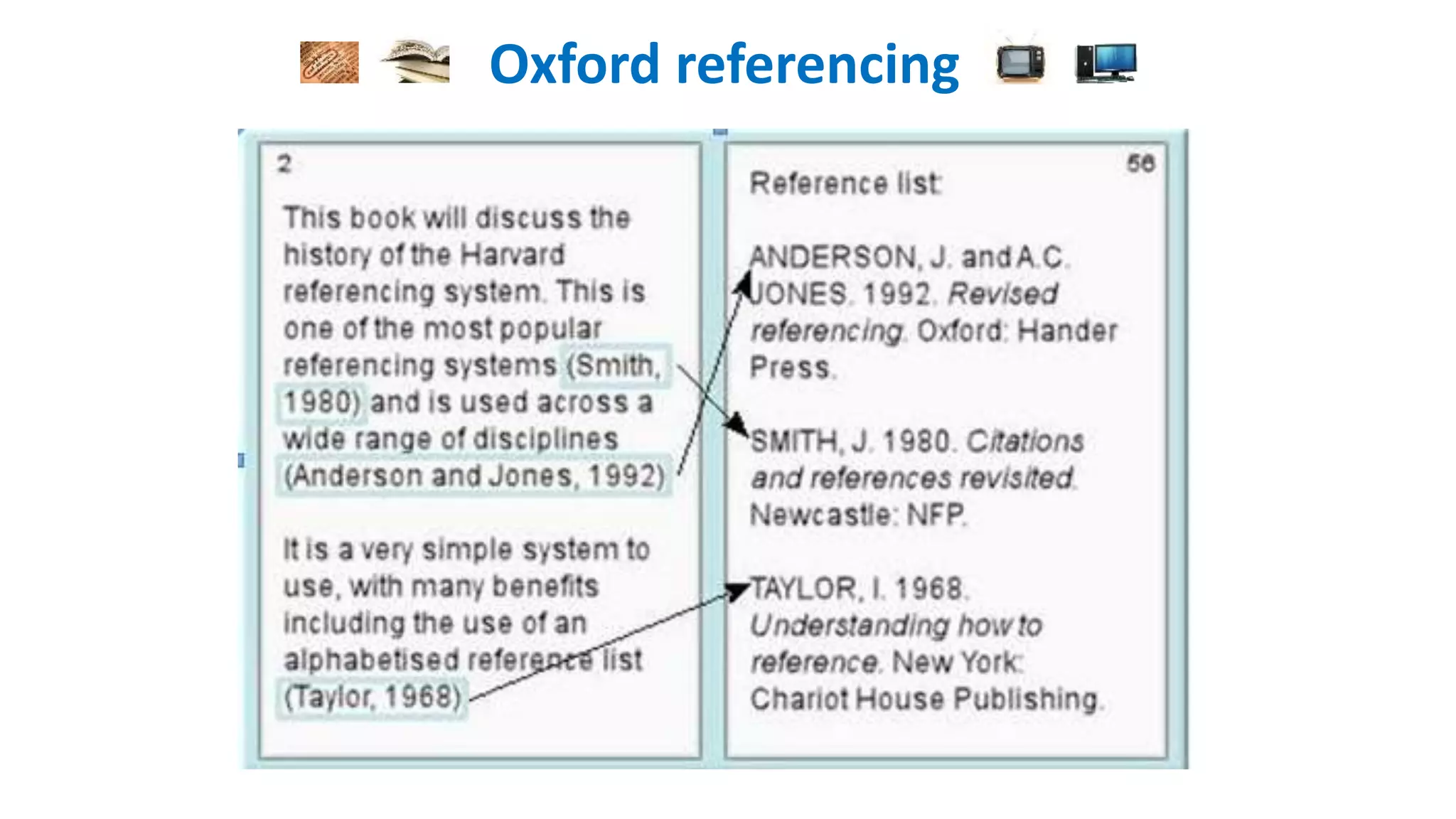
Oxford referencing
For Oxford referencing:
1. Next to the relevant fact, quotation, etc, place a small,
superscript (elevated) number
Go to ‘Add footnote’ in the References section of Microsoft Word.
2. At the bottom of the page, write out the full details of the
source e.g. author, title, publisher, year and page number
3. At the end of the entire dissertation, include an alphabetical list
of all sources used (no page numbers needed)
Oxford referencing
Oxford referencing
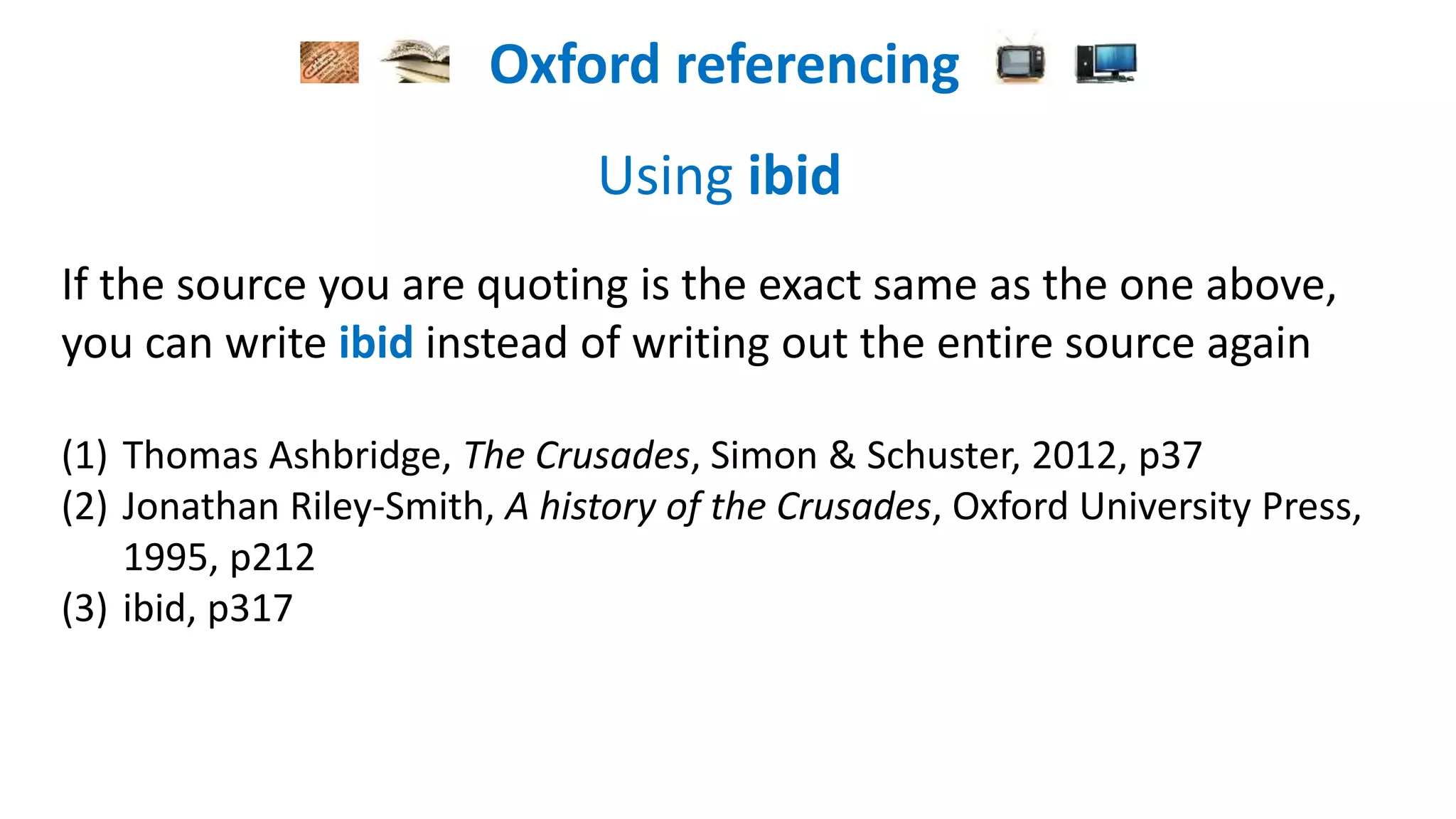
Using ibid
If the source you are quoting is the exact same as the one above,
you can write ibid instead of writing out the entire source again
(1) Thomas Asbridge, The Crusades, Simon & Schuster, 2012, p37
(2) Jonathan Riley-Smith, A history of the Crusades, Oxford University Press,
1995, p212
(3) ibid, p317
Oxford referencing
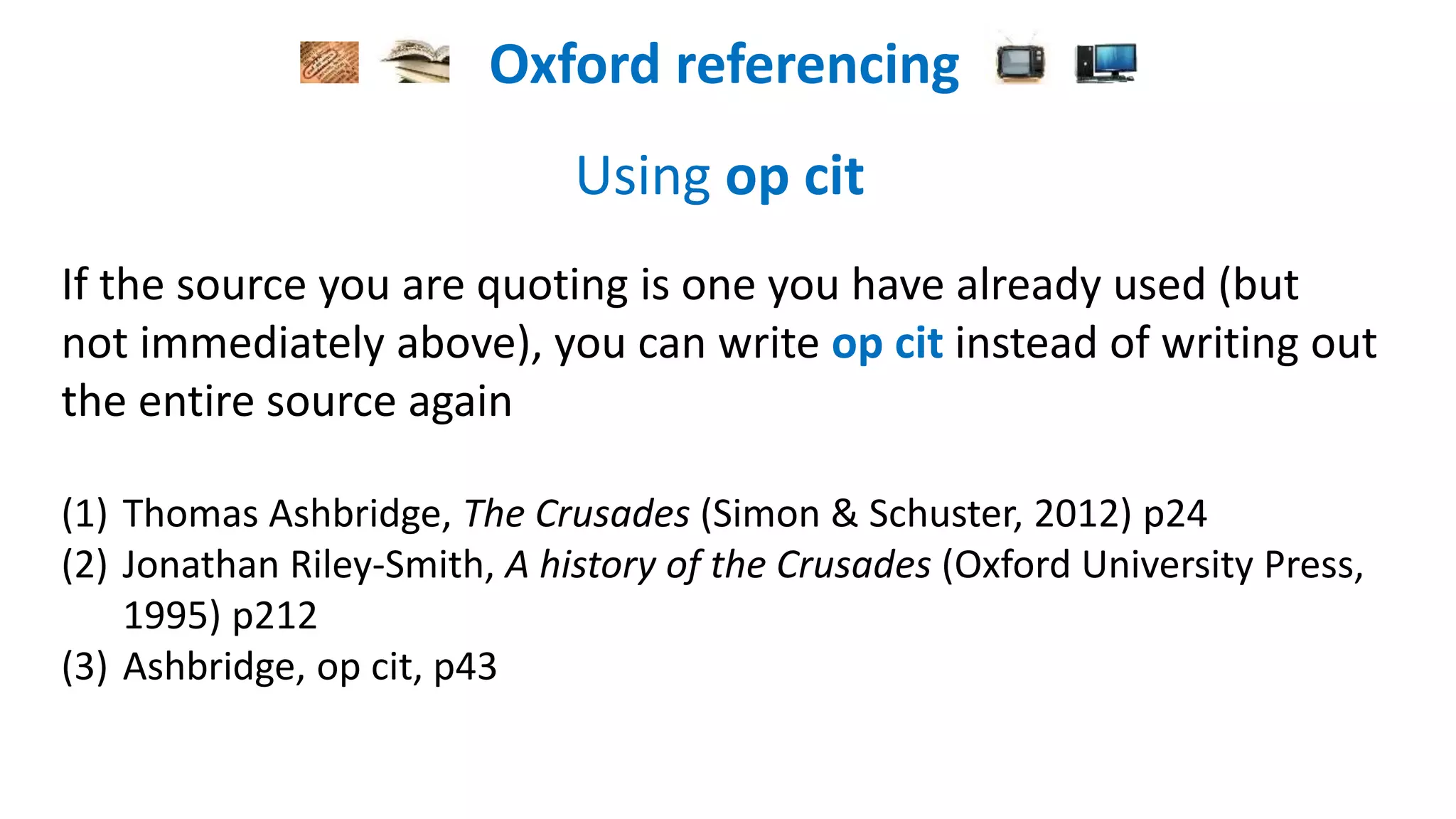
Using op cit
If the source you are quoting is one you have already used (but
not immediately above), you can write op cit instead of writing out
the entire source again
(1) Thomas Asbridge, The Crusades (Simon & Schuster, 2012) p24
(2) Jonathan Riley-Smith, A history of the Crusades (Oxford University Press,
1995) p212
(3) Asbridge, op cit, p43
Oxford referencing
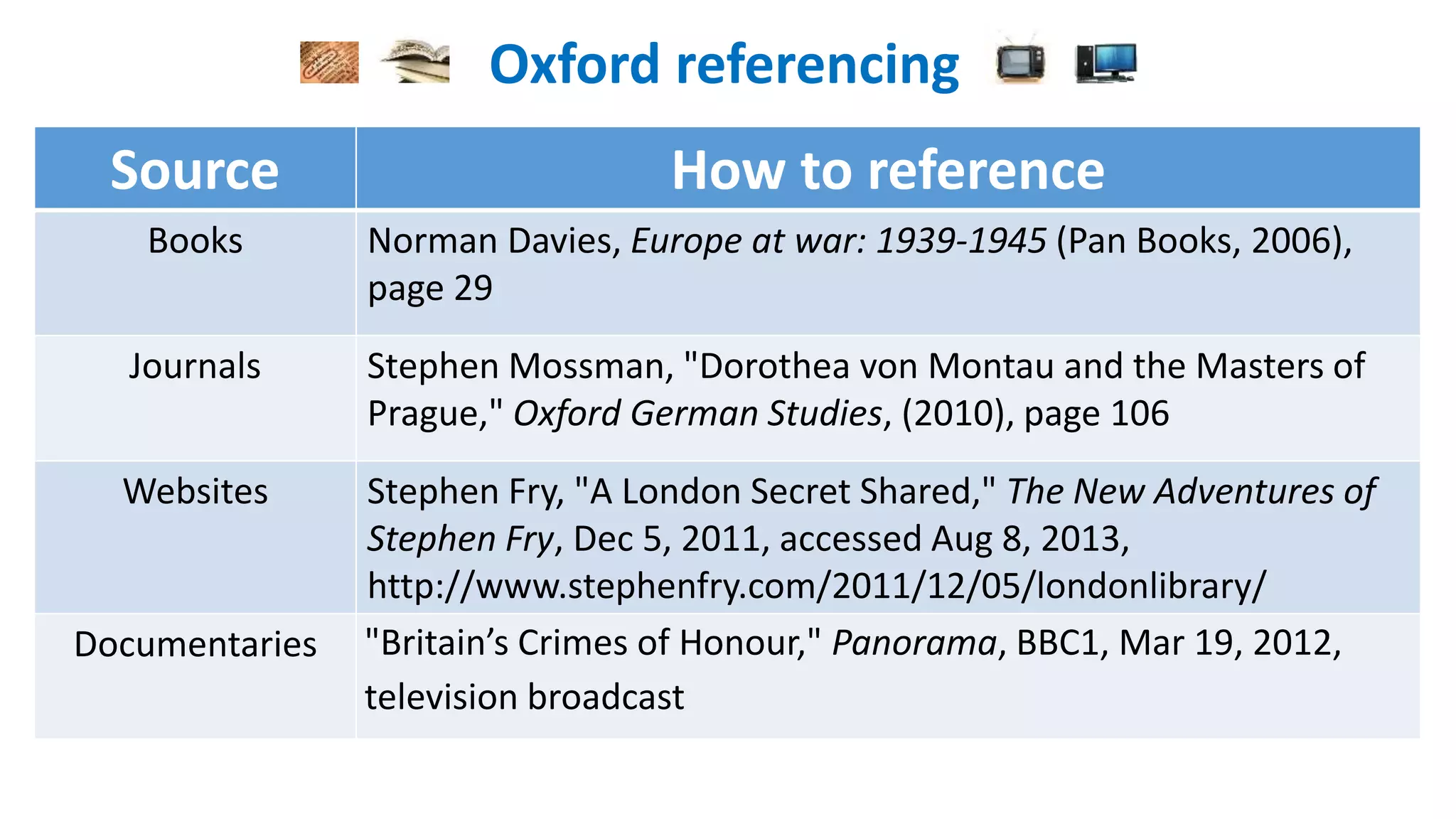
Source How to reference
Books Norman Davies, Europe at war: 1939-1945 (Pan Books, 2006),
page 29
Journals Stephen Mossman, "Dorothea von Montau and the Masters of
Prague," Oxford German Studies, (2010), page 106
Websites Stephen Fry, "A London Secret Shared," The New Adventures of
Stephen Fry, Dec 5, 2011, accessed Aug 8, 2013,
http://www.stephenfry.com/2011/12/05/londonlibrary/
Documentaries "Britain’s Crimes of Honour," Panorama, BBC1, Mar 19, 2012,
television broadcast
Oxford referencing
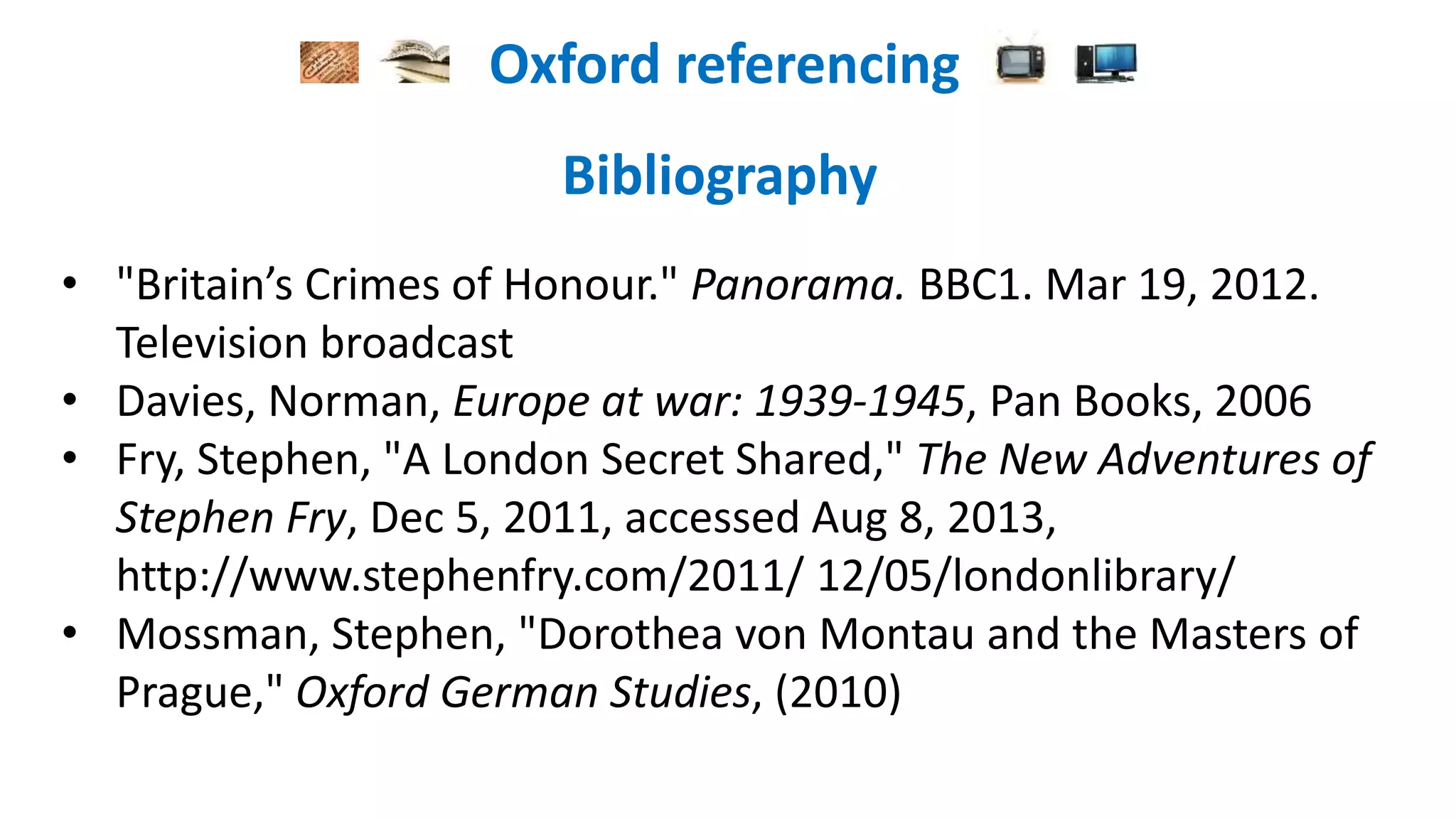
Bibliography
• "Britain’s Crimes of Honour." Panorama. BBC1. Mar 19, 2012.
Television broadcast
• Davies, Norman, Europe at war: 1939-1945, Pan Books, 2006
• Fry, Stephen, "A London Secret Shared," The New Adventures of
Stephen Fry, Dec 5, 2011, accessed Aug 8, 2013,
http://www.stephenfry.com/2011/ 12/05/londonlibrary/
• Mossman, Stephen, "Dorothea von Montau and the Masters of
Prague," Oxford German Studies, (2010)
Advanced Higher History
The Dissertation
Harvard
referencing @mrmarrhistory
Harvard referencing
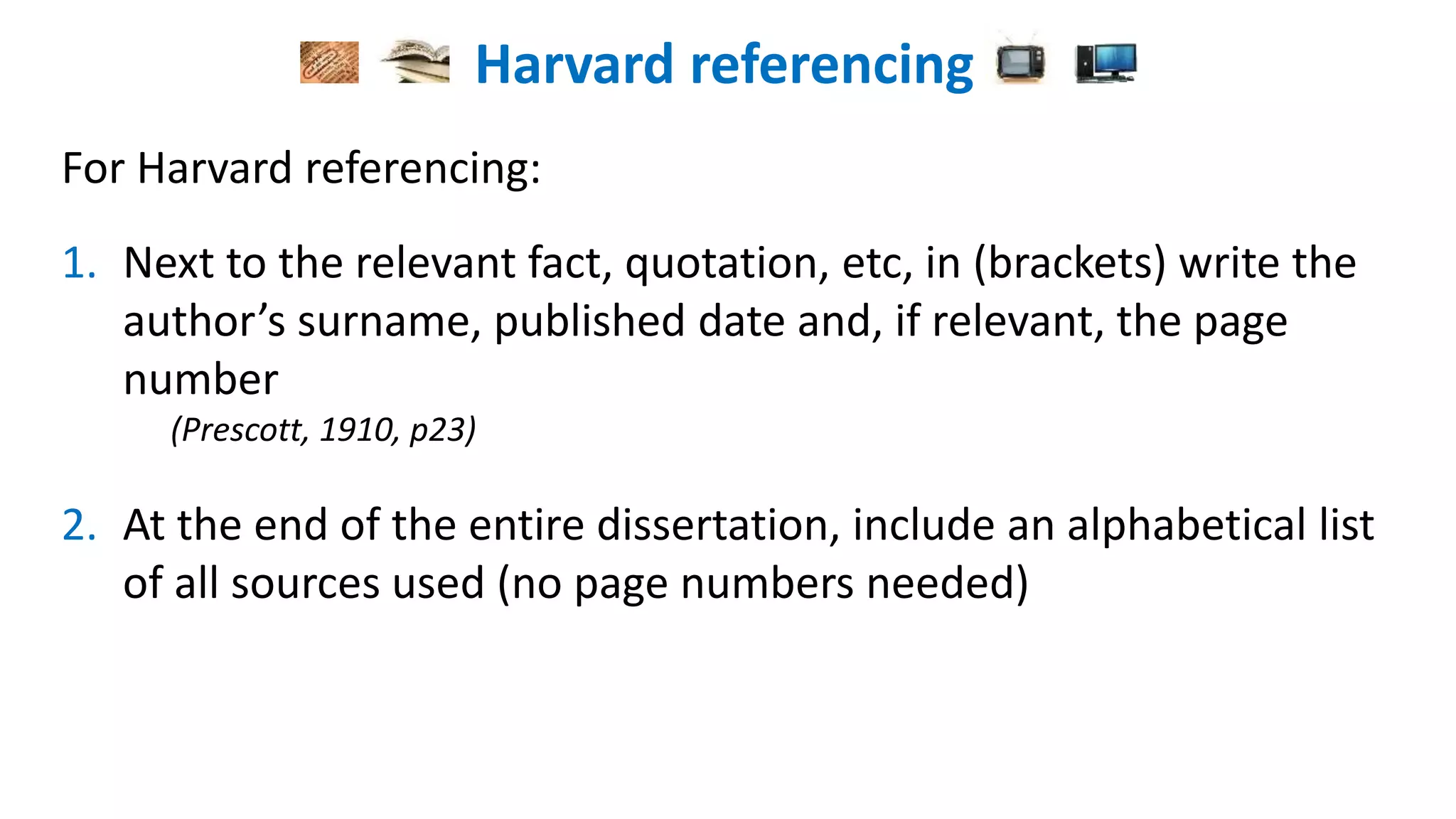
For Harvard referencing:
1. Next to the relevant fact, quotation, etc, in (brackets) write the
author’s surname, published date and, if relevant, the page
number
(Prescott, 1910, p23)
2. At the end of the entire dissertation, include an alphabetical list
of all sources used (no page numbers needed)
Oxford referencing
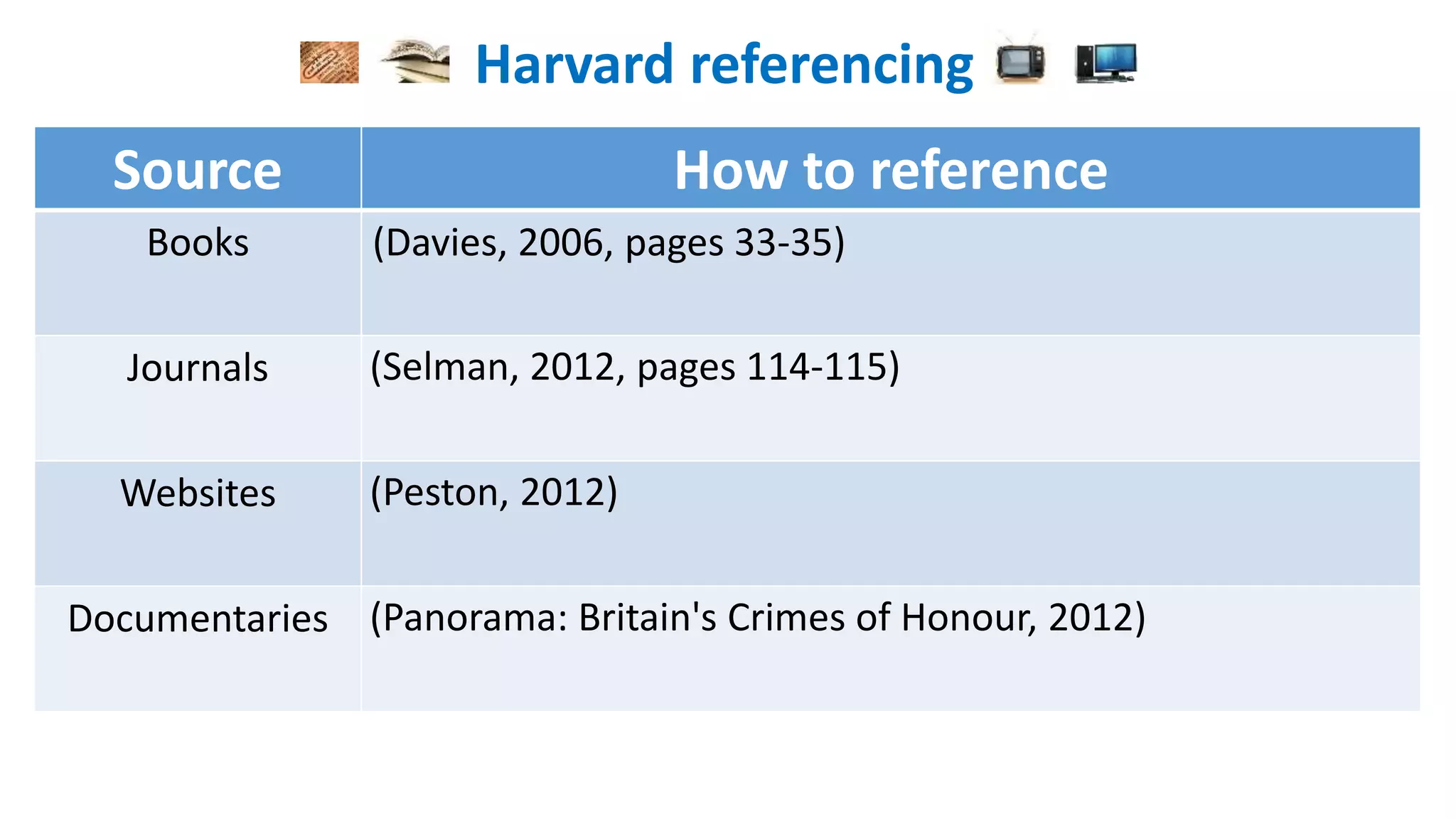
Harvard referencing
Source How to reference
Books (Davies, 2006, pages 33-35)
Websites (Peston, 2012)
Journals (Selman, 2012, pages 114-115)
Documentaries (Panorama: Britain's Crimes of Honour, 2012)
Harvard referencing
Bibliography
• Davies, Norman (2006). Europe at war 1939-1945. Pan Books
• Panorama. (2012). Britain’s crimes of honour. BBC1 television, 19
March 2012
• Peston, R. (2012). Can Tesco grow again in Britain? [Online] BBC
News. Last updated: 18 April 2012. Available at:
http://www.bbc.co.uk/news/ business-17748586 [Accessed 19 April
2012]
• Selman, P. (2012). The global decline of intercountry adoption: what
lies ahead? Social Policy and Society, 11(03)
Advanced Higher History
The Dissertation
Writing the
Bibliography @mrmarrhistory
Writing the Bibliography
• The Bibliography should be the final section of your report
• The Bibliography does not count towards your word limit
• The Bibliography must be in alphabetical order (either based on
all source types or split into sections e.g. books, websites)
• Make sure you use consistent referencing throughout
• The SQA recommend including a commentary on each source
Writing the Bibliography
One possible layout suggestion….
Source Comment
Geoff Layton, Weimar and the Rise of Nazi
Germany 1918-33, Hodder Murray, 2005
A good introductory text to the overall topic. It
included all main points although additional
sources were needed when researching specific
details about the main events
Finlay McKichan, Germany 1815-1939, Oliver &
Boyd, 1992
Similar to the Layton text, this is a good source for
gaining a background knowledge of the topic but
more in-depth sources were required to research
my specific issues
Spartacus Educational website, Nazi Germany
section, http://spartacus-
educational.com/GERnazigermany.htm
An excellent resource for primary sources. This
gave access to different primary views, split into
easily accessible sections, alongside a summary of
each event

Referencing and the bibliography

  • 1.
    Advanced Higher History TheDissertation Referencing and the bibliography @mrmarrhistory
  • 2.
    Referencing and thebibliography As part of your dissertation, you must show where you found all relevant pieces of information and historiography. Referencing In your main text, you should include a description of where you found each relevant piece of information Bibliography At the end of your dissertation you should include a list of all the different sources that you used There are different ways to complete both of these tasks
  • 3.
    Referencing and thebibliography There are numerous options for referencing and bibliographies but the two most commonly used are: Oxford This involves using footnotes (small elevated numbers next to each reference with details at the foot of the page) and then a list of sources at the end of the report Harvard This uses in-text citations (naming the author and published date in the main text body) before giving a full list of all sources at the end
  • 4.
    Advanced Higher History TheDissertation Oxford referencing @mrmarrhistory
  • 5.
    Oxford referencing For Oxfordreferencing: 1. Next to the relevant fact, quotation, etc, place a small, superscript (elevated) number Go to ‘Add footnote’ in the References section of Microsoft Word. 2. At the bottom of the page, write out the full details of the source e.g. author, title, publisher, year and page number 3. At the end of the entire dissertation, include an alphabetical list of all sources used (no page numbers needed)
  • 6.
  • 7.
    Oxford referencing Using ibid Ifthe source you are quoting is the exact same as the one above, you can write ibid instead of writing out the entire source again (1) Thomas Asbridge, The Crusades, Simon & Schuster, 2012, p37 (2) Jonathan Riley-Smith, A history of the Crusades, Oxford University Press, 1995, p212 (3) ibid, p317
  • 8.
    Oxford referencing Using opcit If the source you are quoting is one you have already used (but not immediately above), you can write op cit instead of writing out the entire source again (1) Thomas Asbridge, The Crusades (Simon & Schuster, 2012) p24 (2) Jonathan Riley-Smith, A history of the Crusades (Oxford University Press, 1995) p212 (3) Asbridge, op cit, p43
  • 9.
    Oxford referencing Source Howto reference Books Norman Davies, Europe at war: 1939-1945 (Pan Books, 2006), page 29 Journals Stephen Mossman, "Dorothea von Montau and the Masters of Prague," Oxford German Studies, (2010), page 106 Websites Stephen Fry, "A London Secret Shared," The New Adventures of Stephen Fry, Dec 5, 2011, accessed Aug 8, 2013, http://www.stephenfry.com/2011/12/05/londonlibrary/ Documentaries "Britain’s Crimes of Honour," Panorama, BBC1, Mar 19, 2012, television broadcast
  • 10.
    Oxford referencing Bibliography • "Britain’sCrimes of Honour." Panorama. BBC1. Mar 19, 2012. Television broadcast • Davies, Norman, Europe at war: 1939-1945, Pan Books, 2006 • Fry, Stephen, "A London Secret Shared," The New Adventures of Stephen Fry, Dec 5, 2011, accessed Aug 8, 2013, http://www.stephenfry.com/2011/ 12/05/londonlibrary/ • Mossman, Stephen, "Dorothea von Montau and the Masters of Prague," Oxford German Studies, (2010)
  • 11.
    Advanced Higher History TheDissertation Harvard referencing @mrmarrhistory
  • 12.
    Harvard referencing For Harvardreferencing: 1. Next to the relevant fact, quotation, etc, in (brackets) write the author’s surname, published date and, if relevant, the page number (Prescott, 1910, p23) 2. At the end of the entire dissertation, include an alphabetical list of all sources used (no page numbers needed)
  • 13.
  • 14.
    Harvard referencing Source Howto reference Books (Davies, 2006, pages 33-35) Websites (Peston, 2012) Journals (Selman, 2012, pages 114-115) Documentaries (Panorama: Britain's Crimes of Honour, 2012)
  • 15.
    Harvard referencing Bibliography • Davies,Norman (2006). Europe at war 1939-1945. Pan Books • Panorama. (2012). Britain’s crimes of honour. BBC1 television, 19 March 2012 • Peston, R. (2012). Can Tesco grow again in Britain? [Online] BBC News. Last updated: 18 April 2012. Available at: http://www.bbc.co.uk/news/ business-17748586 [Accessed 19 April 2012] • Selman, P. (2012). The global decline of intercountry adoption: what lies ahead? Social Policy and Society, 11(03)
  • 16.
    Advanced Higher History TheDissertation Writing the Bibliography @mrmarrhistory
  • 17.
    Writing the Bibliography •The Bibliography should be the final section of your report • The Bibliography does not count towards your word limit • The Bibliography must be in alphabetical order (either based on all source types or split into sections e.g. books, websites) • Make sure you use consistent referencing throughout • The SQA recommend including a commentary on each source
  • 18.
    Writing the Bibliography Onepossible layout suggestion…. Source Comment Geoff Layton, Weimar and the Rise of Nazi Germany 1918-33, Hodder Murray, 2005 A good introductory text to the overall topic. It included all main points although additional sources were needed when researching specific details about the main events Finlay McKichan, Germany 1815-1939, Oliver & Boyd, 1992 Similar to the Layton text, this is a good source for gaining a background knowledge of the topic but more in-depth sources were required to research my specific issues Spartacus Educational website, Nazi Germany section, http://spartacus- educational.com/GERnazigermany.htm An excellent resource for primary sources. This gave access to different primary views, split into easily accessible sections, alongside a summary of each event