Lo-2
Conduct a review of key
literature relating to a
research topic towards
improvements in care
practice
The literature review process
 The purpose of a literature review
 Providing up-to-date information of research in the area
 Identifying methods that can be used in any further
research
 Provides an understanding of similar findings,
inconsistencies, areas not previously identified, possible
further research ideas for evidence-based practice
The purpose of a literature review
 Conducting a
literature review is a means
of
 demonstrating the author's
knowledge about a
particular field of study,
 including vocabulary,
theories, key variables and
phenomena, and its
methods and history.
 gather all the available
sources related to your paper's
topic
 (the ones you have found in
process of conducting
your research) in one place
and
 to evaluate them.
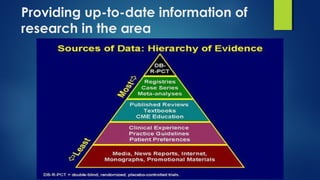
Providing up-to-date information of
research in the area
Identifying topic for research in health,
care or support service provision using
the Practice Themes as a framework
 Preliminary searches to determine feasibility of
conducting an evidence-based project in chosen area
Step 1: Research the Business Drivers. In
most cases, your project is being driven
by a problem in the business. ...
Step 2: Confirm the Alternative Solutions.
...
Step 3: Determine the Feasibility. ...
Step 4: Choose a Preferred Solution. ...
Step 5: Reassess at a lower level.
Conducting a literature review
using internet, books, journals,
reports, web sites and other
sources
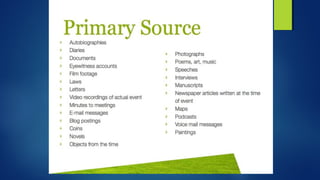
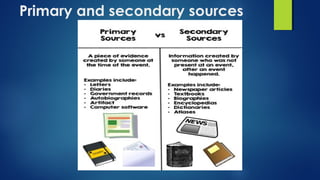
 Primary and secondary sources 
 Methods used for searching internet, e.g. use of Boolean searches,
key words, terms
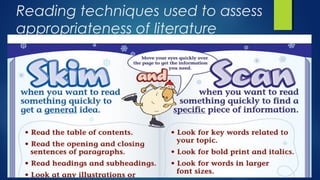
 Reading techniques used to assess appropriateness of literature,
e.g., scanning, skimming
Primary and secondary sources 
Methods used for searching internet,
 A web search engine is a software system that is designed to
search for information on the World Wide Web.
 The search results are generally presented in a line of results often
referred to as search engine results pages (SERPs).
 The information may be a mix of web pages, images, and other
types of files.
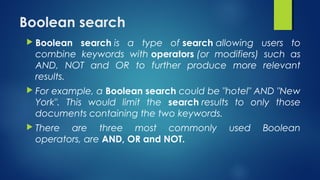
Boolean search 
 Boolean search is a type of search allowing users to
combine keywords with operators (or modifiers) such as
AND, NOT and OR to further produce more relevant
results.
 For example, a Boolean search could be "hotel" AND "New
York". This would limit the search results to only those
documents containing the two keywords.
 There are three most commonly used Boolean
operators, are AND, OR and NOT.
Reading techniques used to assess
appropriateness of literature
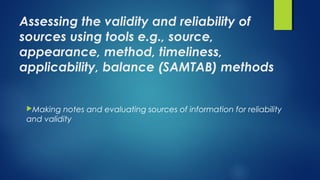
Assessing the validity and reliability of
sources using tools e.g., source,
appearance, method, timeliness,
applicability, balance (SAMTAB) methods
Making notes and evaluating sources of information for reliability
and validity
Examining results of literature
search and critically evaluating to
provide a summary of current
knowledge about the research
topic
  Presenting literature reviews using academic writing and use of
Harvard referencing system
Referencing and
the
bibliography
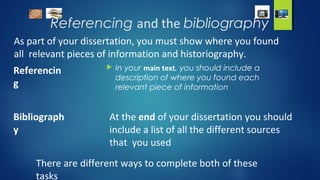
Referencing and the bibliography
As part of your dissertation, you must show where you found
all relevant pieces of information and historiography.
Referencin
g
 In your main text, you should include a
description of where you found each
relevant piece of information
Bibliograph
y
At the end of your dissertation you should
include a list of all the different sources
that you used
There are different ways to complete both of these
tasks
Referencing and the
bibliography
There are numerous options for referencing and bibliographies
but the two most commonly used are:
Oxford
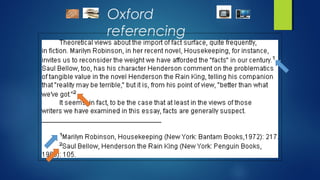
 This involves using footnotes (small elevated numbers
next to each reference with details at the foot of
the page) and then a list of sources at the end of
the report
Harvard This uses in-text citations (naming the author and
published date in the main text body) before
giving a full list of all sources at the end
Oxford
referencin
Oxford
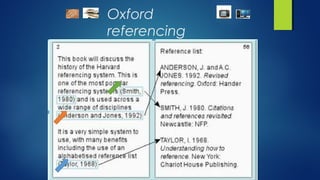
referencingFor Oxford referencing:
1.Next to the relevant fact, quotation, etc, place a small,
superscript (elevated) number
Go to ‘Add footnote’ in the References section of Microsoft Word.
2.At the bottom of the page, write out the full details of the
source e.g. author, title, publisher, year and page number
3.At the end of the entire dissertation, include an alphabetical list
of all sources used (no page numbers needed)
Oxford
referencing
Oxford
referencing
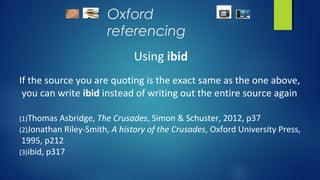
Using ibid
If the source you are quoting is the exact same as the one above,
you can write ibid instead of writing out the entire source again
(1)Thomas Asbridge, The Crusades, Simon & Schuster, 2012, p37
(2)Jonathan Riley-Smith, A history of the Crusades, Oxford University Press,
1995, p212
(3)ibid, p317
Oxford
referencing
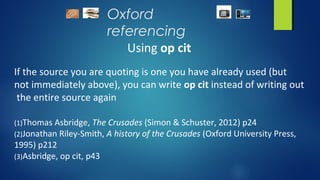
Using op cit
If the source you are quoting is one you have already used (but
not immediately above), you can write op cit instead of writing out
the entire source again
(1)Thomas Asbridge, The Crusades (Simon & Schuster, 2012) p24
(2)Jonathan Riley-Smith, A history of the Crusades (Oxford University Press,
1995) p212
(3)Asbridge, op cit, p43
Oxford
referencing
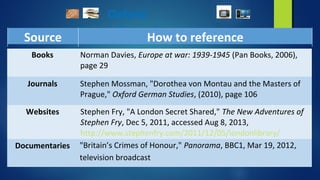
Source How to reference
Books Norman Davies, Europe at war: 1939-1945 (Pan Books, 2006),
page 29
Journals Stephen Mossman, "Dorothea von Montau and the Masters of
Prague," Oxford German Studies, (2010), page 106
Websites Stephen Fry, "A London Secret Shared," The New Adventures of
Stephen Fry, Dec 5, 2011, accessed Aug 8, 2013,
http://www.stephenfry.com/2011/12/05/londonlibrary/
Documentaries "Britain’s Crimes of Honour," Panorama, BBC1, Mar 19, 2012,
television broadcast
Oxford
referencing
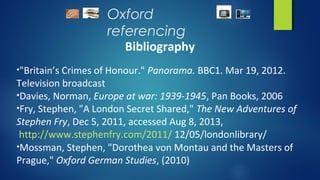
Bibliography
•"Britain’s Crimes of Honour." Panorama. BBC1. Mar 19, 2012.
Television broadcast
•Davies, Norman, Europe at war: 1939-1945, Pan Books, 2006
•Fry, Stephen, "A London Secret Shared," The New Adventures of
Stephen Fry, Dec 5, 2011, accessed Aug 8, 2013,
http://www.stephenfry.com/2011/ 12/05/londonlibrary/
•Mossman, Stephen, "Dorothea von Montau and the Masters of
Prague," Oxford German Studies, (2010)
Harvard
referencin
Harvard
referencing
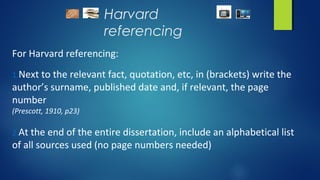
For Harvard referencing:
1.Next to the relevant fact, quotation, etc, in (brackets) write the
author’s surname, published date and, if relevant, the page
number
(Prescott, 1910, p23)
2.At the end of the entire dissertation, include an alphabetical list
of all sources used (no page numbers needed)
Oxford
referencing
Harvard
referencing
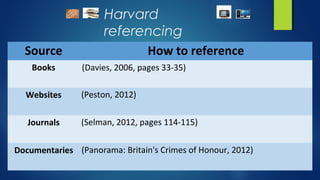
Source How to reference
Books (Davies, 2006, pages 33-35)
Websites (Peston, 2012)
Journals (Selman, 2012, pages 114-115)
Documentaries (Panorama: Britain's Crimes of Honour, 2012)
Harvard
referencing
Bibliography
•Davies, Norman (2006). Europe at war 1939-1945. Pan Books
•Panorama. (2012). Britain’s crimes of honour. BBC1 television, 19
March 2012
•Peston, R. (2012). Can Tesco grow again in Britain? [Online] BBC
News. Last updated: 18 April 2012. Available at:
http://www.bbc.co.uk/news/ business-17748586 [Accessed 19 April
2012]
•Selman, P. (2012). The global decline of intercountry adoption: what
lies ahead? Social Policy and Society, 11(03)
Writing the
Bibliograph
Writing the
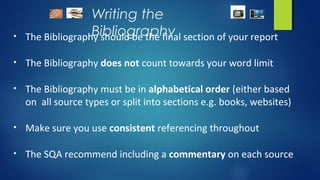
Bibliography• The Bibliography should be the final section of your report
• The Bibliography does not count towards your word limit
• The Bibliography must be in alphabetical order (either based
on all source types or split into sections e.g. books, websites)
• Make sure you use consistent referencing throughout
• The SQA recommend including a commentary on each source
Writing the
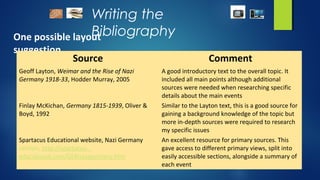
BibliographyOne possible layout
suggestion….
Source Comment
Geoff Layton, Weimar and the Rise of Nazi
Germany 1918-33, Hodder Murray, 2005
A good introductory text to the overall topic. It
included all main points although additional
sources were needed when researching specific
details about the main events
Finlay McKichan, Germany 1815-1939, Oliver &
Boyd, 1992
Similar to the Layton text, this is a good source for
gaining a background knowledge of the topic but
more in-depth sources were required to research
my specific issues
Spartacus Educational website, Nazi Germany
section, http://spartacus-
educational.com/GERnazigermany.htm
An excellent resource for primary sources. This
gave access to different primary views, split into
easily accessible sections, alongside a summary of
each event

Literature review and refering system

  • 1.
    Lo-2 Conduct a reviewof key literature relating to a research topic towards improvements in care practice
  • 2.
    The literature reviewprocess  The purpose of a literature review  Providing up-to-date information of research in the area  Identifying methods that can be used in any further research  Provides an understanding of similar findings, inconsistencies, areas not previously identified, possible further research ideas for evidence-based practice
  • 3.
    The purpose ofa literature review  Conducting a literature review is a means of  demonstrating the author's knowledge about a particular field of study,  including vocabulary, theories, key variables and phenomena, and its methods and history.  gather all the available sources related to your paper's topic  (the ones you have found in process of conducting your research) in one place and  to evaluate them.
  • 4.
    Providing up-to-date informationof research in the area
  • 5.
    Identifying topic forresearch in health, care or support service provision using the Practice Themes as a framework  Preliminary searches to determine feasibility of conducting an evidence-based project in chosen area Step 1: Research the Business Drivers. In most cases, your project is being driven by a problem in the business. ... Step 2: Confirm the Alternative Solutions. ... Step 3: Determine the Feasibility. ... Step 4: Choose a Preferred Solution. ... Step 5: Reassess at a lower level.
  • 6.
    Conducting a literaturereview using internet, books, journals, reports, web sites and other sources  Primary and secondary sources   Methods used for searching internet, e.g. use of Boolean searches, key words, terms  Reading techniques used to assess appropriateness of literature, e.g., scanning, skimming
  • 9.
  • 10.
    Methods used forsearching internet,  A web search engine is a software system that is designed to search for information on the World Wide Web.  The search results are generally presented in a line of results often referred to as search engine results pages (SERPs).  The information may be a mix of web pages, images, and other types of files.
  • 11.
    Boolean search   Booleansearch is a type of search allowing users to combine keywords with operators (or modifiers) such as AND, NOT and OR to further produce more relevant results.  For example, a Boolean search could be "hotel" AND "New York". This would limit the search results to only those documents containing the two keywords.  There are three most commonly used Boolean operators, are AND, OR and NOT.
  • 12.
    Reading techniques usedto assess appropriateness of literature
  • 13.
    Assessing the validityand reliability of sources using tools e.g., source, appearance, method, timeliness, applicability, balance (SAMTAB) methods Making notes and evaluating sources of information for reliability and validity
  • 14.
    Examining results ofliterature search and critically evaluating to provide a summary of current knowledge about the research topic   Presenting literature reviews using academic writing and use of Harvard referencing system
  • 15.
  • 16.
    Referencing and thebibliography As part of your dissertation, you must show where you found all relevant pieces of information and historiography. Referencin g  In your main text, you should include a description of where you found each relevant piece of information Bibliograph y At the end of your dissertation you should include a list of all the different sources that you used There are different ways to complete both of these tasks
  • 17.
    Referencing and the bibliography Thereare numerous options for referencing and bibliographies but the two most commonly used are: Oxford  This involves using footnotes (small elevated numbers next to each reference with details at the foot of the page) and then a list of sources at the end of the report Harvard This uses in-text citations (naming the author and published date in the main text body) before giving a full list of all sources at the end
  • 18.
  • 19.
    Oxford referencingFor Oxford referencing: 1.Nextto the relevant fact, quotation, etc, place a small, superscript (elevated) number Go to ‘Add footnote’ in the References section of Microsoft Word. 2.At the bottom of the page, write out the full details of the source e.g. author, title, publisher, year and page number 3.At the end of the entire dissertation, include an alphabetical list of all sources used (no page numbers needed)
  • 20.
  • 21.
    Oxford referencing Using ibid If thesource you are quoting is the exact same as the one above, you can write ibid instead of writing out the entire source again (1)Thomas Asbridge, The Crusades, Simon & Schuster, 2012, p37 (2)Jonathan Riley-Smith, A history of the Crusades, Oxford University Press, 1995, p212 (3)ibid, p317
  • 22.
    Oxford referencing Using op cit Ifthe source you are quoting is one you have already used (but not immediately above), you can write op cit instead of writing out the entire source again (1)Thomas Asbridge, The Crusades (Simon & Schuster, 2012) p24 (2)Jonathan Riley-Smith, A history of the Crusades (Oxford University Press, 1995) p212 (3)Asbridge, op cit, p43
  • 23.
    Oxford referencing Source How toreference Books Norman Davies, Europe at war: 1939-1945 (Pan Books, 2006), page 29 Journals Stephen Mossman, "Dorothea von Montau and the Masters of Prague," Oxford German Studies, (2010), page 106 Websites Stephen Fry, "A London Secret Shared," The New Adventures of Stephen Fry, Dec 5, 2011, accessed Aug 8, 2013, http://www.stephenfry.com/2011/12/05/londonlibrary/ Documentaries "Britain’s Crimes of Honour," Panorama, BBC1, Mar 19, 2012, television broadcast
  • 24.
    Oxford referencing Bibliography •"Britain’s Crimes ofHonour." Panorama. BBC1. Mar 19, 2012. Television broadcast •Davies, Norman, Europe at war: 1939-1945, Pan Books, 2006 •Fry, Stephen, "A London Secret Shared," The New Adventures of Stephen Fry, Dec 5, 2011, accessed Aug 8, 2013, http://www.stephenfry.com/2011/ 12/05/londonlibrary/ •Mossman, Stephen, "Dorothea von Montau and the Masters of Prague," Oxford German Studies, (2010)
  • 25.
  • 26.
    Harvard referencing For Harvard referencing: 1.Nextto the relevant fact, quotation, etc, in (brackets) write the author’s surname, published date and, if relevant, the page number (Prescott, 1910, p23) 2.At the end of the entire dissertation, include an alphabetical list of all sources used (no page numbers needed)
  • 27.
  • 28.
    Harvard referencing Source How toreference Books (Davies, 2006, pages 33-35) Websites (Peston, 2012) Journals (Selman, 2012, pages 114-115) Documentaries (Panorama: Britain's Crimes of Honour, 2012)
  • 29.
    Harvard referencing Bibliography •Davies, Norman (2006).Europe at war 1939-1945. Pan Books •Panorama. (2012). Britain’s crimes of honour. BBC1 television, 19 March 2012 •Peston, R. (2012). Can Tesco grow again in Britain? [Online] BBC News. Last updated: 18 April 2012. Available at: http://www.bbc.co.uk/news/ business-17748586 [Accessed 19 April 2012] •Selman, P. (2012). The global decline of intercountry adoption: what lies ahead? Social Policy and Society, 11(03)
  • 30.
  • 31.
    Writing the Bibliography• TheBibliography should be the final section of your report • The Bibliography does not count towards your word limit • The Bibliography must be in alphabetical order (either based on all source types or split into sections e.g. books, websites) • Make sure you use consistent referencing throughout • The SQA recommend including a commentary on each source
  • 32.
    Writing the BibliographyOne possiblelayout suggestion…. Source Comment Geoff Layton, Weimar and the Rise of Nazi Germany 1918-33, Hodder Murray, 2005 A good introductory text to the overall topic. It included all main points although additional sources were needed when researching specific details about the main events Finlay McKichan, Germany 1815-1939, Oliver & Boyd, 1992 Similar to the Layton text, this is a good source for gaining a background knowledge of the topic but more in-depth sources were required to research my specific issues Spartacus Educational website, Nazi Germany section, http://spartacus- educational.com/GERnazigermany.htm An excellent resource for primary sources. This gave access to different primary views, split into easily accessible sections, alongside a summary of each event

Editor's Notes

  • #6 Completing a Feasibility Study A Feasibility Study needs to be completed as early in the Project Life Cycle as possible. The best time to complete it is when you have identified a range of different alternative solutions and you need to know which solution is the most feasible to implement. Here’s how to do it… Step 1: Research the Business Drivers In most cases, your project is being driven by a problem in the business. These problems are called “business drivers” and you need to have a clear understanding of what they are, as part of your Feasibility Study. For instance, the business driver might be that an IT system is outdated and is causing customer complaints, or that two businesses need to merge because of an acquisition. Regardless of the business driver, you need to get to the bottom of it so you fully understand the reasons why the project has been kicked off. Find out why the business driver is important to the business, and why it’s critical that the project delivers a solution to it within a specified timeframe. Then find out what the impact will be to the business, if the project slips. Step 2: Confirm the Alternative Solutions Now you have a clear understanding of the business problem that the project addresses, you need to understand the alternative solutions available. If it’s an IT system that is outdated, then your alternative solutions might include redeveloping the existing system, replacing it or merging it with another system. Only with a clear understanding of the alternative solutions to the business problem, can you progress with the Feasibility Study. Step 3: Determine the Feasibility You now need to identify the feasibility of each solution. The question to ask of each alternative solution is “can we deliver it on time and under budget?” To answer this question, you need to use a variety of methods to assess the feasibility of each solution. Here are some examples of ways you can assess feasibility: Research: Perform online research to see if other companies have implemented the same solutions and how they got on. Prototyping: Identify the part of the solution that has the highest risk, and then build a sample of it to see if it’s possible to create. Time-boxing: Complete some of the tasks in your project plan and measure how long it took vs. planned. If you delivered it on time, then you know that your planning is quite accurate. Step 4: Choose a Preferred Solution With the feasibility of each alternative solution known, the next step is to select a preferred solution to be delivered by your project. Choose the solution that; is most feasible to implement, has the lowest risk, and you have the highest confidence of delivering. You’ve now chosen a solution to a known business problem, and you have a high degree of confidence that you can deliver that solution on time and under budget, as part of the project. Step 5: Reassess at a lower level It’s now time to take your chosen solution and reassess its feasibility at a lower level. List all of the tasks that are needed to complete the solution. Then run those tasks by your team to see how long they think it will take to complete them. Add all of the tasks and timeframes to a project plan to see if you can do it all within the project deadline. Then ask your team to identify the highest risk tasks and get them to investigate them further to check that they are achievable. Use the techniques in Step 3 to give you a very high degree of confidence that it’s practically achievable. Then document all of the results in a Feasibility Study report.
  • #13 Skimming is reading a text quickly to get a general idea of meaning. It can be contrasted with scanning, which is reading in order to find specific information, e.g. figures or names. Skimming and scanning are two different reading skills. Skimming means looking at a text or chapter quickly in order to have a general idea of the contents. Scanning means looking at a text to find some particular information. Skimming And Scanning: Two Important Strategies For Speeding Up Your Reading. Skimming and scanning are two very different strategies for speed reading. They are each used for different purposes, and they are not meant to be used all the time.