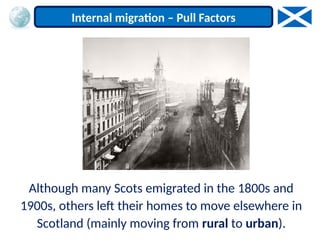
Although many Scotsemigrated in the 1800s and
1900s, others left their homes to move elsewhere in
Scotland (mainly moving from rural to urban).
Internal migration – Pull Factors
3.
Pull factors encourage
peopleand their families
to move elsewhere in the
hope of getting a better
life in their new homes.
Scots internally migrated
due to issues like jobs,
higher wages,
entertainment, family,
schooling and housing.
Internal migration – Pull Factors
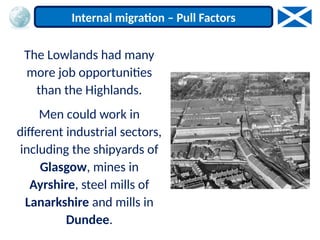
The Lowlands hadmany
more job opportunities
than the Highlands.
Men could work in
different industrial sectors,
including the shipyards of
Glasgow, mines in
Ayrshire, steel mills of
Lanarkshire and mills in
Dundee.
Internal migration – Pull Factors
6.
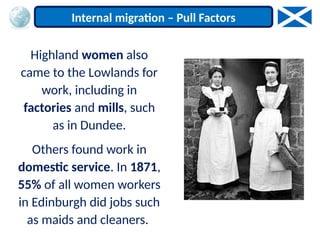
Highland women also
cameto the Lowlands for
work, including in
factories and mills, such
as in Dundee.
Others found work in
domestic service. In 1871,
55% of all women workers
in Edinburgh did jobs such
as maids and cleaners.
Internal migration – Pull Factors
7.
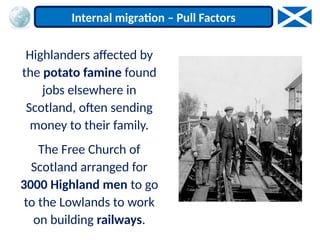
Highlanders affected by
thepotato famine found
jobs elsewhere in
Scotland, often sending
money to their family.
The Free Church of
Scotland arranged for
3000 Highland men to go
to the Lowlands to work
on building railways.
Internal migration – Pull Factors
On average, jobsin the
Lowlands paid more
money than jobs in the
Highlands and other rural
areas.
This meant that families
could earn more and have
a better standard of living
(such as food, housing or
entertainment).
Internal migration – Pull Factors
10.
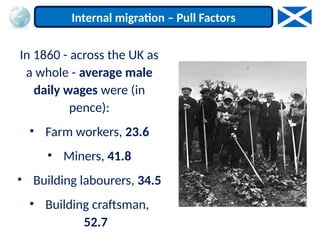
In 1860 -across the UK as
a whole - average male
daily wages were (in
pence):
• Farm workers, 23.6
• Miners, 41.8
• Building labourers, 34.5
• Building craftsman,
52.7
Internal migration – Pull Factors
11.
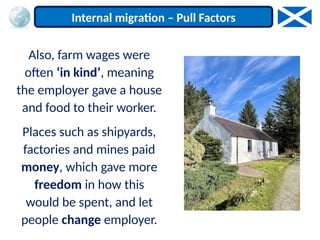
Also, farm wageswere
often ‘in kind’, meaning
the employer gave a house
and food to their worker.
Places such as shipyards,
factories and mines paid
money, which gave more
freedom in how this
would be spent, and let
people change employer.
Internal migration – Pull Factors
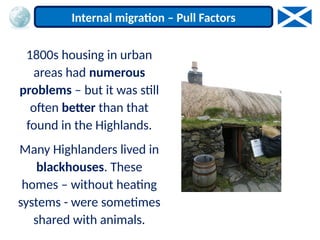
1800s housing inurban
areas had numerous
problems – but it was still
often better than that
found in the Highlands.
Many Highlanders lived in
blackhouses. These
homes – without heating
systems - were sometimes
shared with animals.
Internal migration – Pull Factors
14.
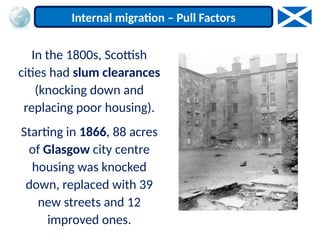
In the 1800s,Scottish
cities had slum clearances
(knocking down and
replacing poor housing).
Starting in 1866, 88 acres
of Glasgow city centre
housing was knocked
down, replaced with 39
new streets and 12
improved ones.
Internal migration – Pull Factors
15.
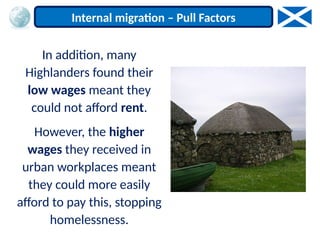
In addition, many
Highlandersfound their
low wages meant they
could not afford rent.
However, the higher
wages they received in
urban workplaces meant
they could more easily
afford to pay this, stopping
homelessness.
Internal migration – Pull Factors
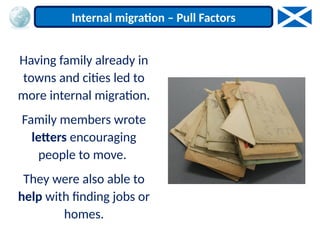
Having family alreadyin
towns and cities led to
more internal migration.
Family members wrote
letters encouraging
people to move.
They were also able to
help with finding jobs or
homes.
Internal migration – Pull Factors
18.
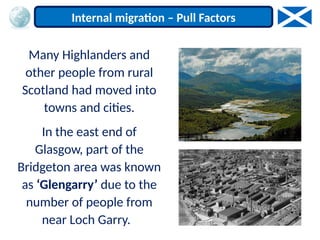
Many Highlanders and
otherpeople from rural
Scotland had moved into
towns and cities.
In the east end of
Glasgow, part of the
Bridgeton area was known
as ‘Glengarry’ due to the
number of people from
near Loch Garry.
Internal migration – Pull Factors
19.
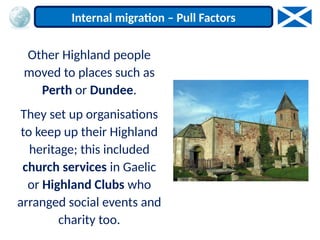
Other Highland people
movedto places such as
Perth or Dundee.
They set up organisations
to keep up their Highland
heritage; this included
church services in Gaelic
or Highland Clubs who
arranged social events and
charity too.
Internal migration – Pull Factors
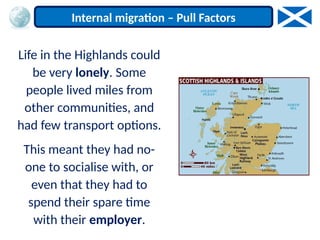
Life in theHighlands could
be very lonely. Some
people lived miles from
other communities, and
had few transport options.
This meant they had no-
one to socialise with, or
even that they had to
spend their spare time
with their employer.
Internal migration – Pull Factors
22.
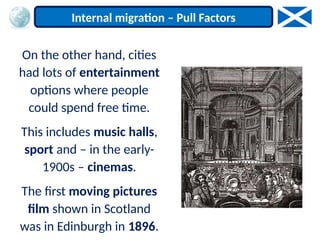
On the otherhand, cities
had lots of entertainment
options where people
could spend free time.
This includes music halls,
sport and – in the early-
1900s – cinemas.
The first moving pictures
film shown in Scotland
was in Edinburgh in 1896.
Internal migration – Pull Factors
23.
Football also attracted
thousandsof fans. Women
were even given free
entry. Clubs that were set
up include:
• Queen’s Park (1867)
• Kilmarnock (1869)
• Rangers (1872)
• Celtic (1887)
Internal migration – Pull Factors
Until 1948, therewas no
NHS. In the Highlands, this
was an especially big
problem.
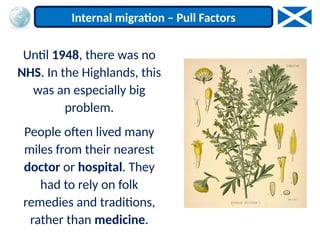
People often lived many
miles from their nearest
doctor or hospital. They
had to rely on folk
remedies and traditions,
rather than medicine.
Internal migration – Pull Factors
26.
It could beexpensive to go
to a doctor or get hospital
treatment, but there were
more of these services in
towns and cities.
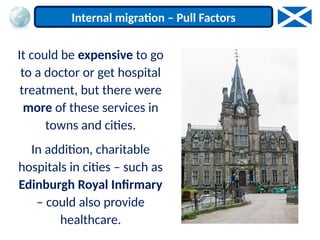
In addition, charitable
hospitals in cities – such as
Edinburgh Royal Infirmary
– could also provide
healthcare.
Internal migration – Pull Factors
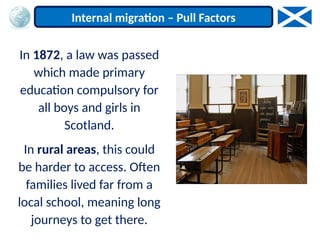
In 1872, alaw was passed
which made primary
education compulsory for
all boys and girls in
Scotland.
In rural areas, this could
be harder to access. Often
families lived far from a
local school, meaning long
journeys to get there.
Internal migration – Pull Factors
29.
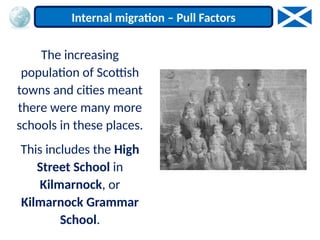
The increasing
population ofScottish
towns and cities meant
there were many more
schools in these places.
This includes the High
Street School in
Kilmarnock, or
Kilmarnock Grammar
School.
Internal migration – Pull Factors
30.
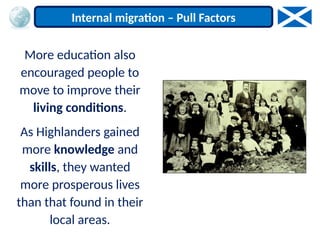
More education also
encouragedpeople to
move to improve their
living conditions.
As Highlanders gained
more knowledge and
skills, they wanted
more prosperous lives
than that found in their
local areas.
Internal migration – Pull Factors
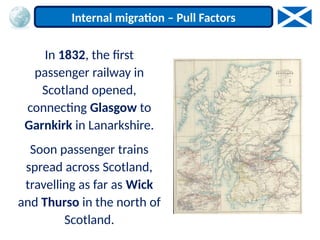
In 1832, thefirst
passenger railway in
Scotland opened,
connecting Glasgow to
Garnkirk in Lanarkshire.
Soon passenger trains
spread across Scotland,
travelling as far as Wick
and Thurso in the north of
Scotland.
Internal migration – Pull Factors
33.
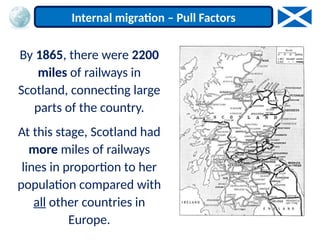
By 1865, therewere 2200
miles of railways in
Scotland, connecting large
parts of the country.
At this stage, Scotland had
more miles of railways
lines in proportion to her
population compared with
all other countries in
Europe.
Internal migration – Pull Factors
34.
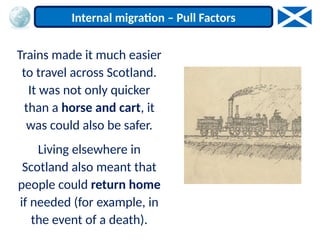
Trains made itmuch easier
to travel across Scotland.
It was not only quicker
than a horse and cart, it
was could also be safer.
Living elsewhere in
Scotland also meant that
people could return home
if needed (for example, in
the event of a death).
Internal migration – Pull Factors
35.
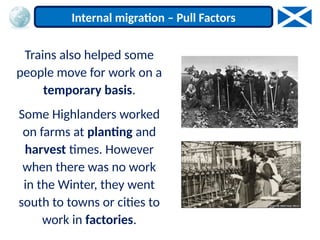
Trains also helpedsome
people move for work on a
temporary basis.
Some Highlanders worked
on farms at planting and
harvest times. However
when there was no work
in the Winter, they went
south to towns or cities to
work in factories.
Internal migration – Pull Factors