Introduction to referencing
Aim To provide an understanding of what referencing is and why you should do it
Outcomes At the end of this session you will be able to:  Recognise when to include citations in your work Identify the essentials of a complete reference Cite references using the Harvard style of referencing
What is a reference?  reference,  n .      5. a.  A direction to a book, passage, etc., where certain information may be found; an indication of the author, work, page, etc., to be looked at or consulted (OED, 2008)
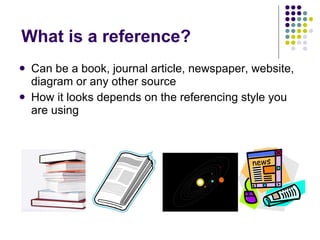
What is a reference?  Can be a book, journal article, newspaper, website, diagram or any other source How it looks depends on the referencing style you are using
Types of referencing  Author-Date  Author and year of publication inserted in brackets after the quote or paraphrase  Reference list at the end of your essay arranged alphabetically by author  Numerical  Number each quote or paraphrase in the text Reference list at the end of the essay with references in numerical order
Why reference  To inform the reader of sources of direct quotations, data, diagrams etc When paraphrasing another author’s ideas When describing a theory or model associated with a particular author To give weight and credibility to your argument To avoid charges of plagiarism
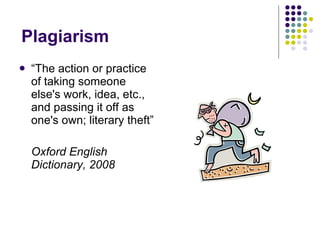
Plagiarism  “ The action or practice of taking someone else's work, idea, etc., and passing it off as one's own; literary theft” Oxford English Dictionary, 2008
You don’t have to reference…  Your own ideas and observations Common knowledge  Historical overviews  Conclusions
Exercise  Look at case scenarios given and say whether or not you would reference them  You can use the examples handout as a guide
Any questions? Steve McIndoe  [email_address] 0161 275 8730

Citations And Referencing

  • 1.
  • 2.
    Aim To providean understanding of what referencing is and why you should do it
  • 3.
    Outcomes At theend of this session you will be able to: Recognise when to include citations in your work Identify the essentials of a complete reference Cite references using the Harvard style of referencing
  • 4.
    What is areference? reference, n .      5. a. A direction to a book, passage, etc., where certain information may be found; an indication of the author, work, page, etc., to be looked at or consulted (OED, 2008)
  • 5.
    What is areference? Can be a book, journal article, newspaper, website, diagram or any other source How it looks depends on the referencing style you are using
  • 6.
    Types of referencing Author-Date Author and year of publication inserted in brackets after the quote or paraphrase Reference list at the end of your essay arranged alphabetically by author Numerical Number each quote or paraphrase in the text Reference list at the end of the essay with references in numerical order
  • 7.
    Why reference To inform the reader of sources of direct quotations, data, diagrams etc When paraphrasing another author’s ideas When describing a theory or model associated with a particular author To give weight and credibility to your argument To avoid charges of plagiarism
  • 8.
    Plagiarism “The action or practice of taking someone else's work, idea, etc., and passing it off as one's own; literary theft” Oxford English Dictionary, 2008
  • 9.
    You don’t haveto reference… Your own ideas and observations Common knowledge Historical overviews Conclusions
  • 10.
    Exercise Lookat case scenarios given and say whether or not you would reference them You can use the examples handout as a guide
  • 11.
    Any questions? SteveMcIndoe [email_address] 0161 275 8730