Referencing
with Special Emphasis on
Vancouver Referencing
Technique
Prof. Abdulsalam Y Taha
College of Medicine/University of
Sulaimania/Sulaimania/Kurdistan/Iraq
2019
In this Lecture
• Reference vs. Referee
• Author vs. Editor vs. Publisher vs. Librarian
• Types of references.
• Reference List vs. Bibliography
• In-text citation (Arabic numbers between round or
square brackets or superscript numbers).
• Bibliographic elements.
• Punctuation marks.
• Vancouver Style vs. Harvard Style
• Plagiarism
• The EndNote Referencing Style Software
Prof. A Y Taha/ Referencing7/10/2019 2
Terms…
• Reference is to use a source of information to ascertain
something.
• Referee is a person chosen to examine and assess a
scientific or other academic work for publication.
• Author is a writer of a book, article or a report.
• Editor is a person who is in charge of determining the
final content of a text, particularly a newspaper or
magazine.
• Publisher is a person or company that prepares and
issues books, journals, music, or other works for sale.
• Plagiarism is the practice of taking someone else's
work or ideas and passing them off as one's own. All
academics know its serious consequences.
Prof. A Y Taha/ Referencing7/10/2019 3
Referencing
Why?
• Acknowledge debts to other writers.
• Demonstrate the body of knowledge
upon which your assignment is based.
• Enable the reader(s) to locate your
sources easily.
• Referencing is important to avoid
plagiarism.
Prof. A Y Taha/ Referencing7/10/2019 4
Types of References
• Book
• Dictionary or Encyclopedia
• Journal Article
• Conference Papers
• Newspaper and Magazine Article
• Reports and other Government
Publications
• Thesis
• Web Pages
• Other Internet Sources
• Personal Communication (verbal,
written and e mail)
Prof. A Y Taha/ Referencing7/10/2019 5
Types of References…
• Pamphlet
• Package Inserts
• Lecture Notes
• Video or DVD
• Film or Broadcast
• Tables
• Figures
• Images or Appendices.
• In this lecture, we are going to study how
to refer to journal articles and books. For
other types of references, we need to
read the original Vancouver document.
Prof. A Y Taha/ Referencing7/10/2019 6
Vancouver Group
• In 1978, a group of editors met in
Vancouver, British Colombia, Canada.
• The group called itself the International
Steering Committee, a name that was later
changed to the International Committee of
Medical Journal Editors (ICMJE).
• Because of its original meeting place,
however, the ICMJE has often been called
“the Vancouver group”.
• The main topic at the 1978 meeting was
formats for references.
Prof. A Y Taha/ Referencing7/10/2019 7
What is the Vancouver Referencing
Technique?
• A uniform set of requirements for
bibliographic references.
• Also known as: Uniform Requirements
for Manuscripts Submitted to Biomedical
Journals.
• It follows rules established by the
International Committee of Medical
Journal Editors.
• It is a "numbered" style.
Prof. A Y Taha/ Referencing7/10/2019 8
Vancouver Style
• The commonly used style in medical and scientific
journals.
• Reference list identifies references cited in sufficient
detail so that others may locate and consult them.
• The reference list appears at the end of the
essay/report with the entries listed numerically and
in the same order that they have been cited in the
text.
• If you have cited sources from the Internet, these
should also be in your reference list.
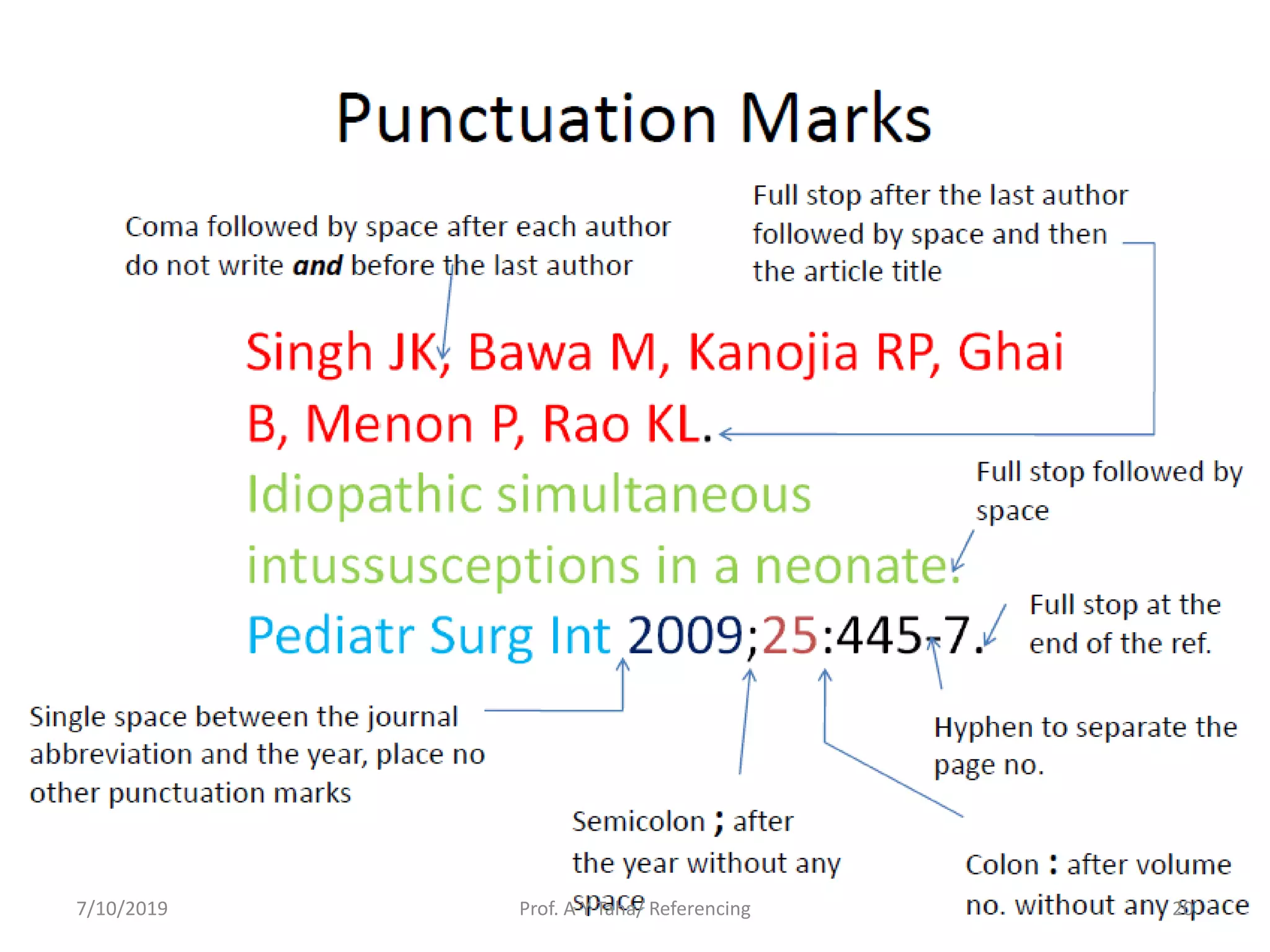
• Punctuation marks and spaces in the reference list
and citations are very important. Follow the
punctuation and spacing exactly as in the following
examples.
Prof. A Y Taha/ Referencing7/10/2019 9
Citation
•The way that you (the writer)
refer to texts that you wish to
include in your work.
•It is in the form of a number that
correlates with a source in your
reference list. If the source is
referred to again, the same
number is used.
•Citation (Extract) also refers to
the information retrieved from a
bibliographical database search.
Prof. A Y Taha/ Referencing7/10/2019 10
Look at this Paragraph…
• Foreign body aspiration is common [1]. It is
a life-threatening condition (2). Children
under the age of 5 years are the usual
sufferers.3 Family negligence is to be blamed
[1,3,4] particularly in low socioeconomic
class population [1-5]. The event of
aspiration is characterized by chocking
while eating, laughing or crying [1]-[4].
Death may occur due to suffocation with a
big foreign body blocking the larynx.1,6
Strider may result from inhalation of a
foreign body that resides within the larynx
or trachea.2,4,6-8 It is vital to educate parents
to take care of their children to prevent this
potentially fatal problem [1p32] [3].
Prof. A Y Taha/ Referencing7/10/2019 11
Look at this Paragraph…
• John et al [9] as well as other authors 10,11
believe that the incidence of foreign body
aspiration can be greatly reduced by
increasing the awareness of people. William
[cited in 5] states that unresolved cough in a
child should be looked at seriously as it may
indicate a foreign body aspiration. Ali et al
quoted Ahmed in their article [12] who
recommends bronchoscopy for children
with unresolved cough to exclude foreign
body aspiration.
• As one can see, there are different methods of in-text citation.
Journals may differ in their preferred citation style. This is
usually explained in the “Instruction to Authors” posted in the
web site of each journal.
Prof. A Y Taha/ Referencing7/10/2019 12
• In the Vancouver Style, in-text
citations are identified by Arabic
numbers in round brackets.
When multiple references are
cited at a given place in the text,
use a hyphen to join the first and
last numbers that are inclusive.
Use commas (without spaces) to
separate non-inclusive numbers
in a multiple citation e.g.
(2,3,4,5,7,10) is abbreviated to
(2-5,7,10).
Prof. A Y Taha/ Referencing7/10/2019 13
Journal Articles
• Russell FD, Coppell AL, Davenport AP. In vitro
enzymatic processing of radio-labled big ET-1
in human kidney as a food ingredient. Biochem
Pharmacol 1998;55:697-701.
• Note:
• Author(s) name: Surname followed by
2 initials separated by comma. Do not
use ‛and’ before the last name.
• All author names should be written.
However, some journals require to
write ‛et al’ after the 3rd or 6th author's
name in the list of references.
Prof. A Y Taha/ Referencing7/10/2019 14
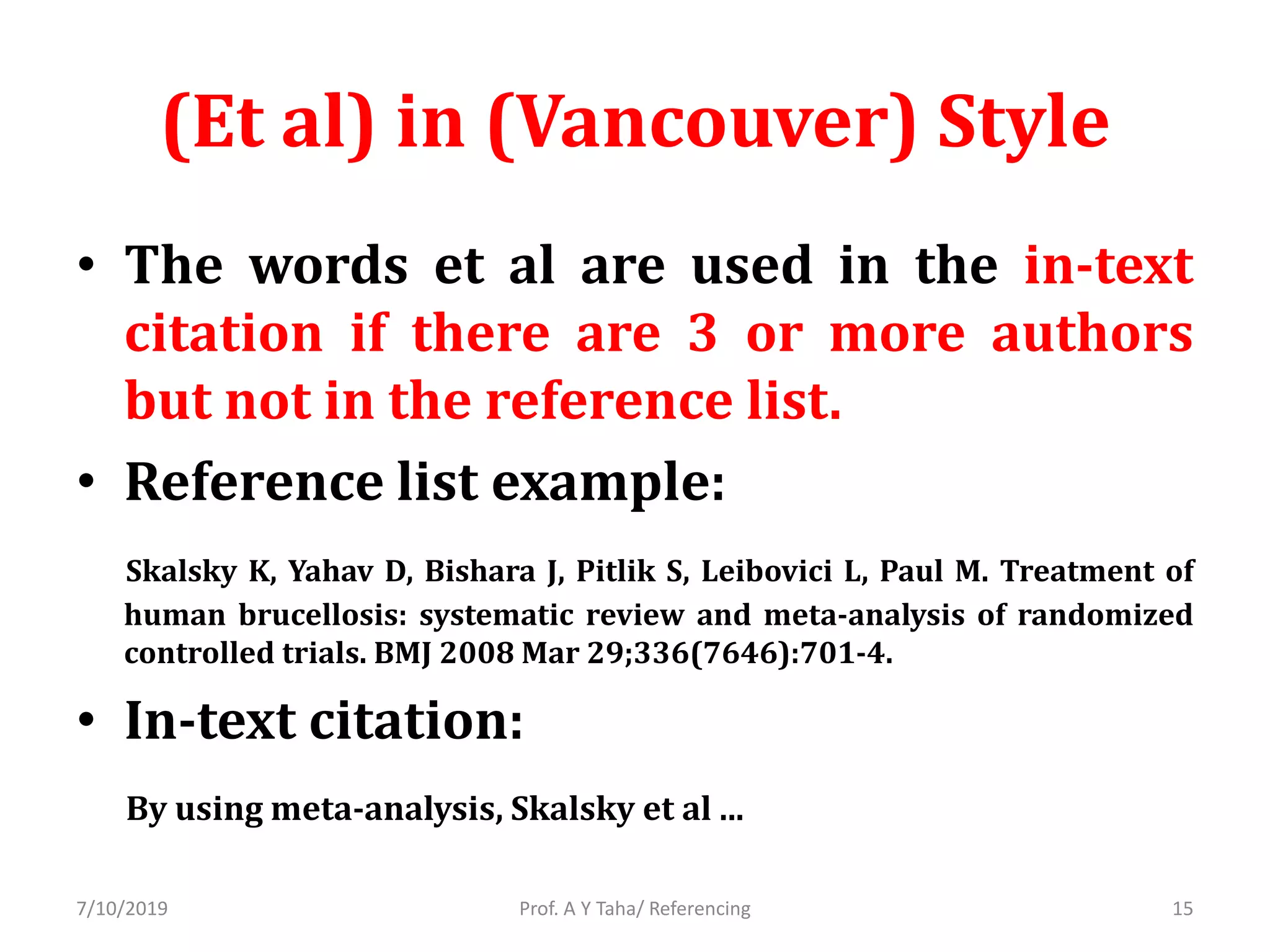
(Et al) in (Vancouver) Style
• The words et al are used in the in-text
citation if there are 3 or more authors
but not in the reference list.
• Reference list example:
Skalsky K, Yahav D, Bishara J, Pitlik S, Leibovici L, Paul M. Treatment of
human brucellosis: systematic review and meta-analysis of randomized
controlled trials. BMJ 2008 Mar 29;336(7646):701-4.
• In-text citation:
By using meta-analysis, Skalsky et al ...
Prof. A Y Taha/ Referencing7/10/2019 15
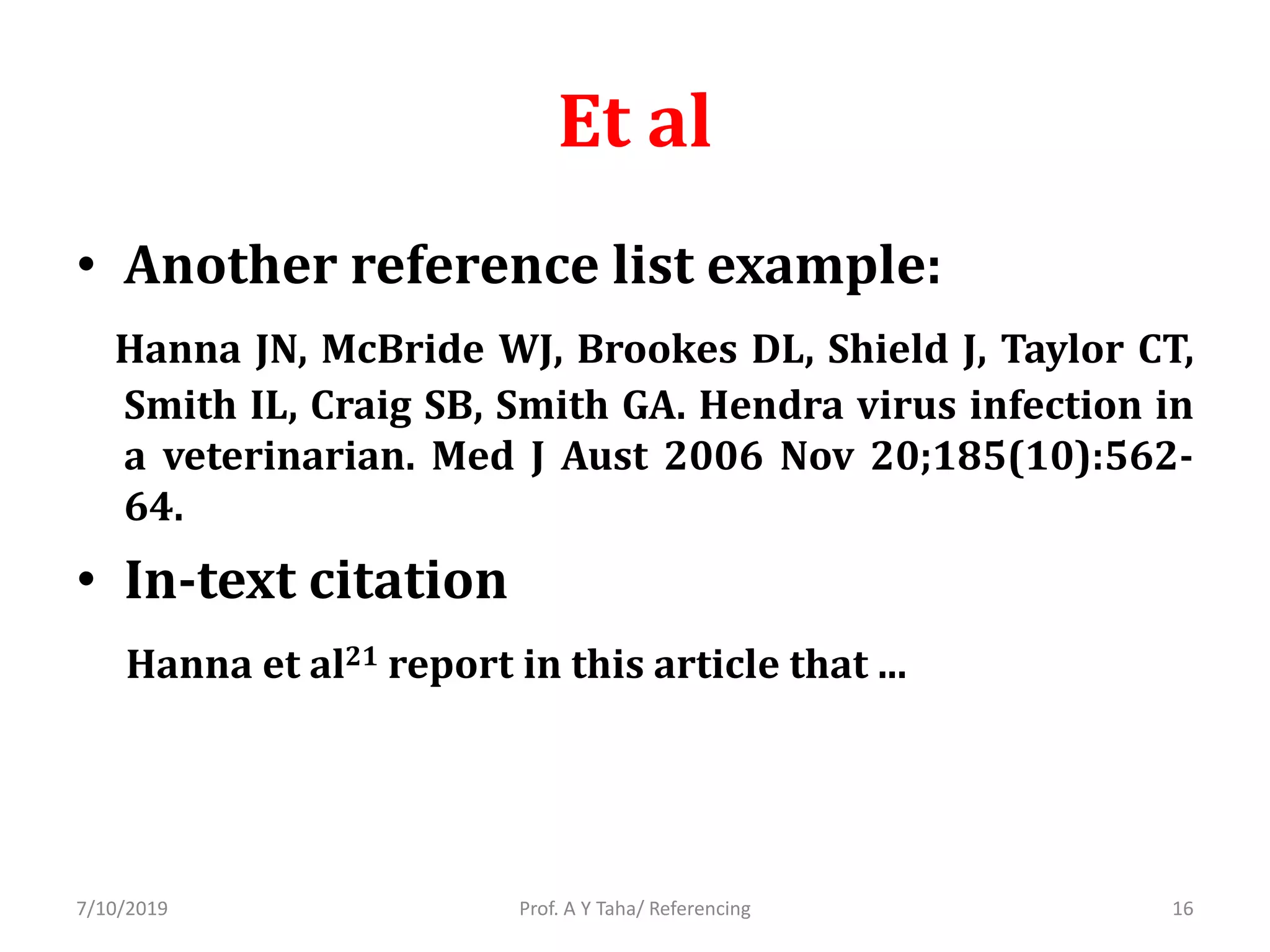
Et al
• Another reference list example:
Hanna JN, McBride WJ, Brookes DL, Shield J, Taylor CT,
Smith IL, Craig SB, Smith GA. Hendra virus infection in
a veterinarian. Med J Aust 2006 Nov 20;185(10):562-
64.
• In-text citation
Hanna et al21 report in this article that ...
Prof. A Y Taha/ Referencing7/10/2019 16
Editorial in a Journal
Coffee drinking and cancer of the pancreas [editorial].
BMJ 1981;283:628.
• A piece of writing, displayed in a prominent position,
that expresses a strong view on a matter of importance
to a publication’s readers. They are also called leading
articles or leaders.
• The name of the journal should be in standard PubMed
abbreviations, full journal name should not be written.
BMJ stands for British Medical Journal.
● So, for editorial, no author is given as it represents the
opinion of the journal as a whole rather than a person.
● Nevertheless, sometimes, there is a “signed editorial”
written by a personal author.
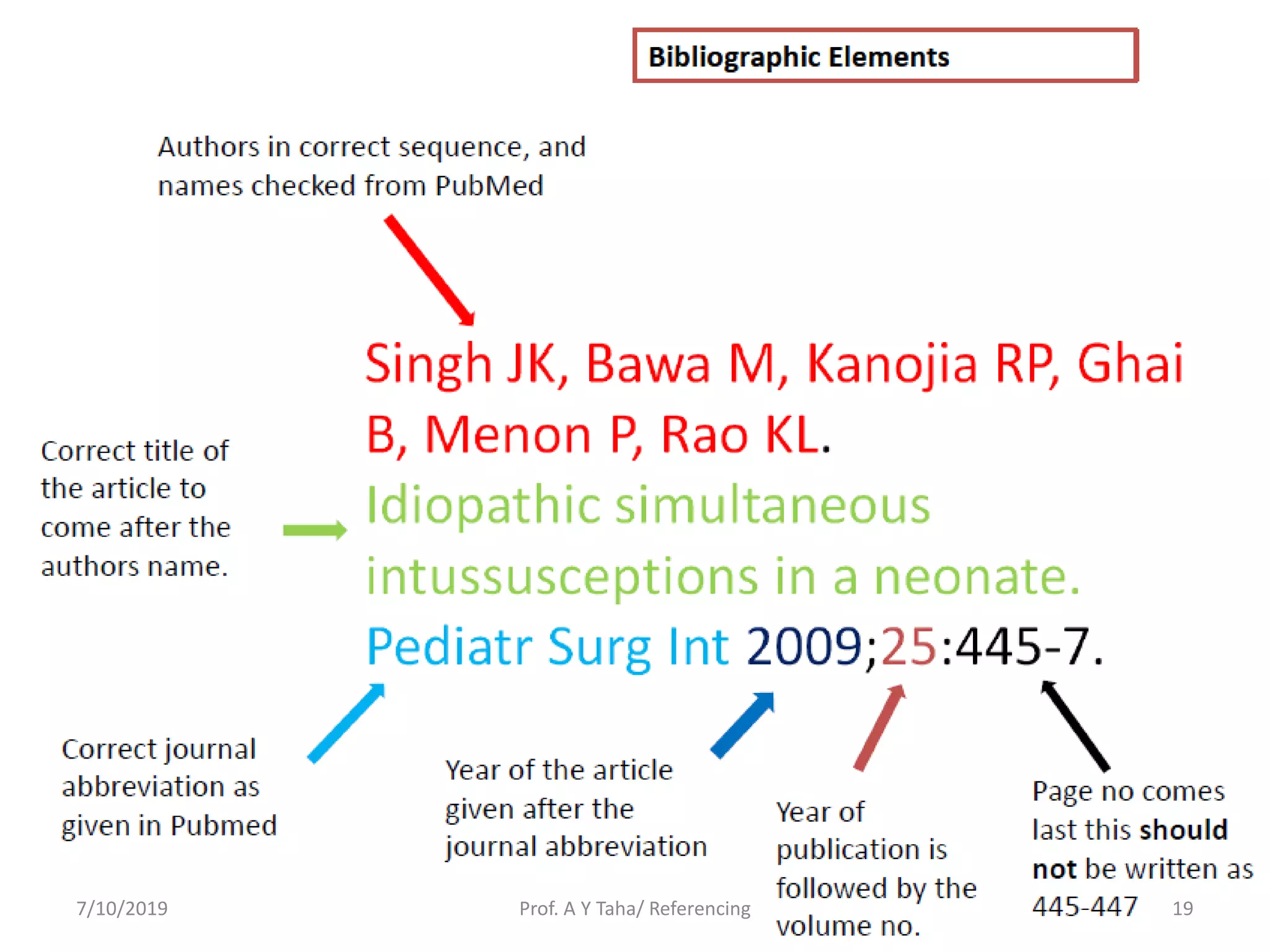
● So, the essential elements for referencing journals are:
author, title of article, journal title, date, volume
number, issue number, page numbers.
Prof. A Y Taha/ Referencing7/10/2019 17
Electronic Articles
● Fletcher D, Wagstaff CRD. Organisational
psychology in elite sport: its emergence,
application and future. Psychol Sport Exerc
2009;10(4):427-34.
doi:10.1016/j.psychsport.2009.03.009.
● Lemanek K. Adherence issues in the medical
management of asthma. J Pediatr Psychol [
Internet]. 1990 [cited 2010 Apr 22];15(4):437-
58. Available from:
http://jpepsy.oxfordjournals.org/cgi/reprint/
15/4/437
Prof. A Y Taha/ Referencing7/10/2019 18
Prof. A Y Taha/ Referencing7/10/2019 19
Prof. A Y Taha/ Referencing7/10/2019 20
Books with a Personal Author(s) but
without Editor
• Getzen TE. Health economics: fundamentals
and flow of funds. New York (NY): John
Wiley & Sons; 1997.
• Note:
1. Getzen TE: author's name. It should be exact as
existing.
2. Health economics: fundamentals and flow of funds:
book's title.
3. New York (NY): place of publication.
4. John Wiley & Sons: publishers.
5. 1997: year of publication.
In-text citation: Getzen [1] believes that…
● so, the essential elements for referencing books are:
author, title, edition, place of publication, publisher,
date (year).
Prof. A Y Taha/ Referencing7/10/2019 21
Books with Editor but without
author(s)
• Millares M, editor. Applied drug
information: strategies for information
management. Vancouver,WA: Applied
Therapeutics, Inc.; 1998.
• Electronic Book:
Bartlett A. Breastwork: Rethinking
breastfeeding [monograph online]. Sydney,
NSW: University of New South Wales Press;
2005 [cited 2009 Nov 10]. Available from:
NetLibrary
Prof. A Y Taha/ Referencing7/10/2019 22
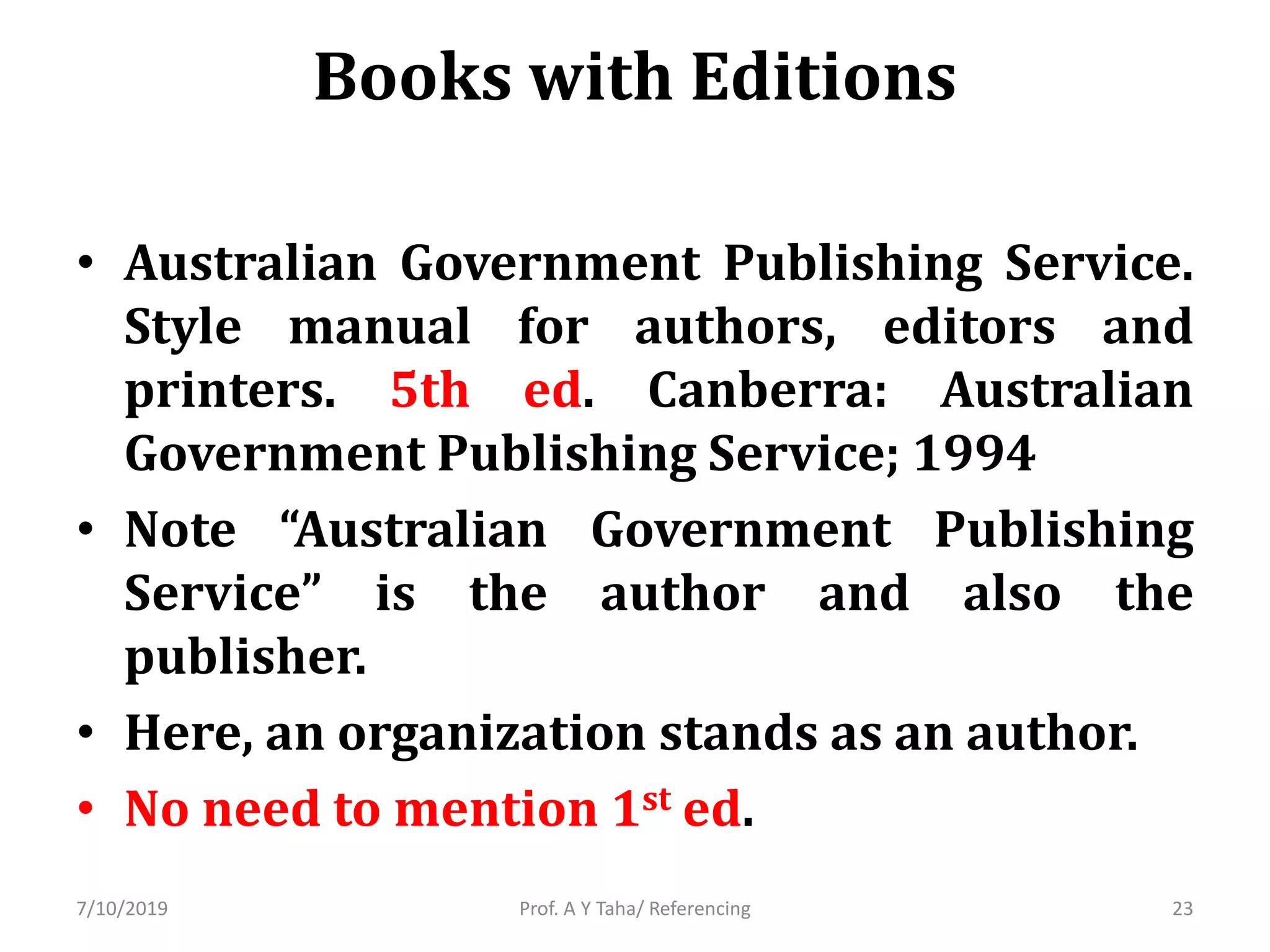
Books with Editions
• Australian Government Publishing Service.
Style manual for authors, editors and
printers. 5th ed. Canberra: Australian
Government Publishing Service; 1994
• Note “Australian Government Publishing
Service” is the author and also the
publisher.
• Here, an organization stands as an author.
• No need to mention 1st ed.
Prof. A Y Taha/ Referencing7/10/2019 23
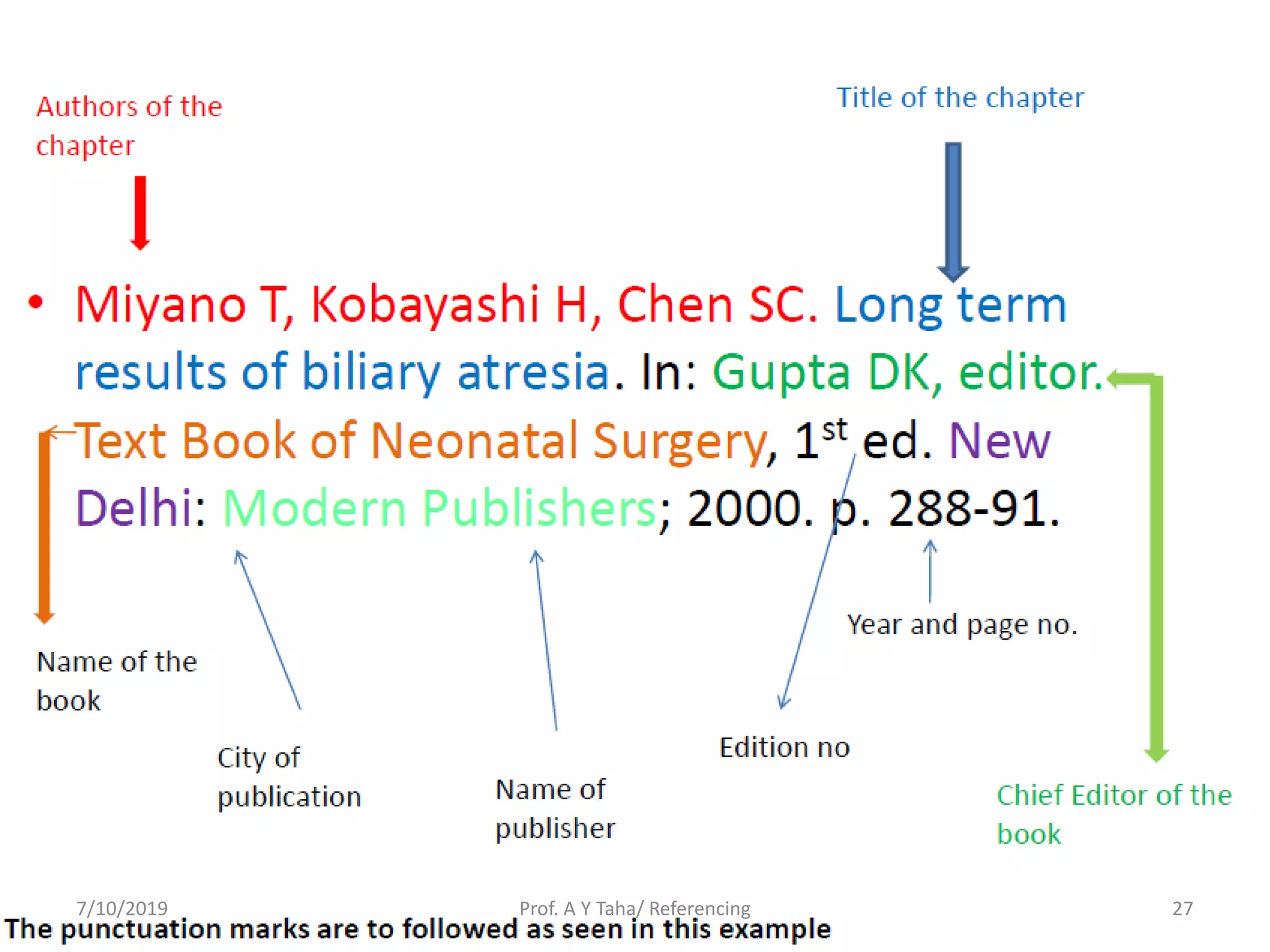
Book Chapters [with edition] and a Series
• Bennett GL, Horuk R. Iodination of chemokines
for use in receptor binding analysis. In: Horuk
R, editor. Chemokine receptors. New York (NY):
Academic Press; 1997. p. 134-48. (Methods in
enzymology; vol 288).
• Note:
1. Bennett GL, Horuk R: authors of the chapter.
2. Iodination of chemokines for use in receptor
binding analysis: title of the chapter.
3. Chemokine receptors: the title of the book.
4. Methods in enzymology: the title of the series.
In-text citation: Bennett and Horuk [1] believe
that…
Up to 6 authors, mention all names in the reference list.
Prof. A Y Taha/ Referencing7/10/2019 24
Book with 6 or more Authors
• In the list of references:
Hofmeyr GJ, Neilson JP, Alfirevic Z, Crowther CA,
Gulmezoglu AM, Hodnett ED et al. A Cochrane
pocketbook: Pregnancy and childbirth. Chichester,
West Sussex, England: John Wiley & Sons Ltd; 2008.
• In-text citation:
Professionals in collaboration [1] mentioned…
Prof. A Y Taha/ Referencing7/10/2019 25
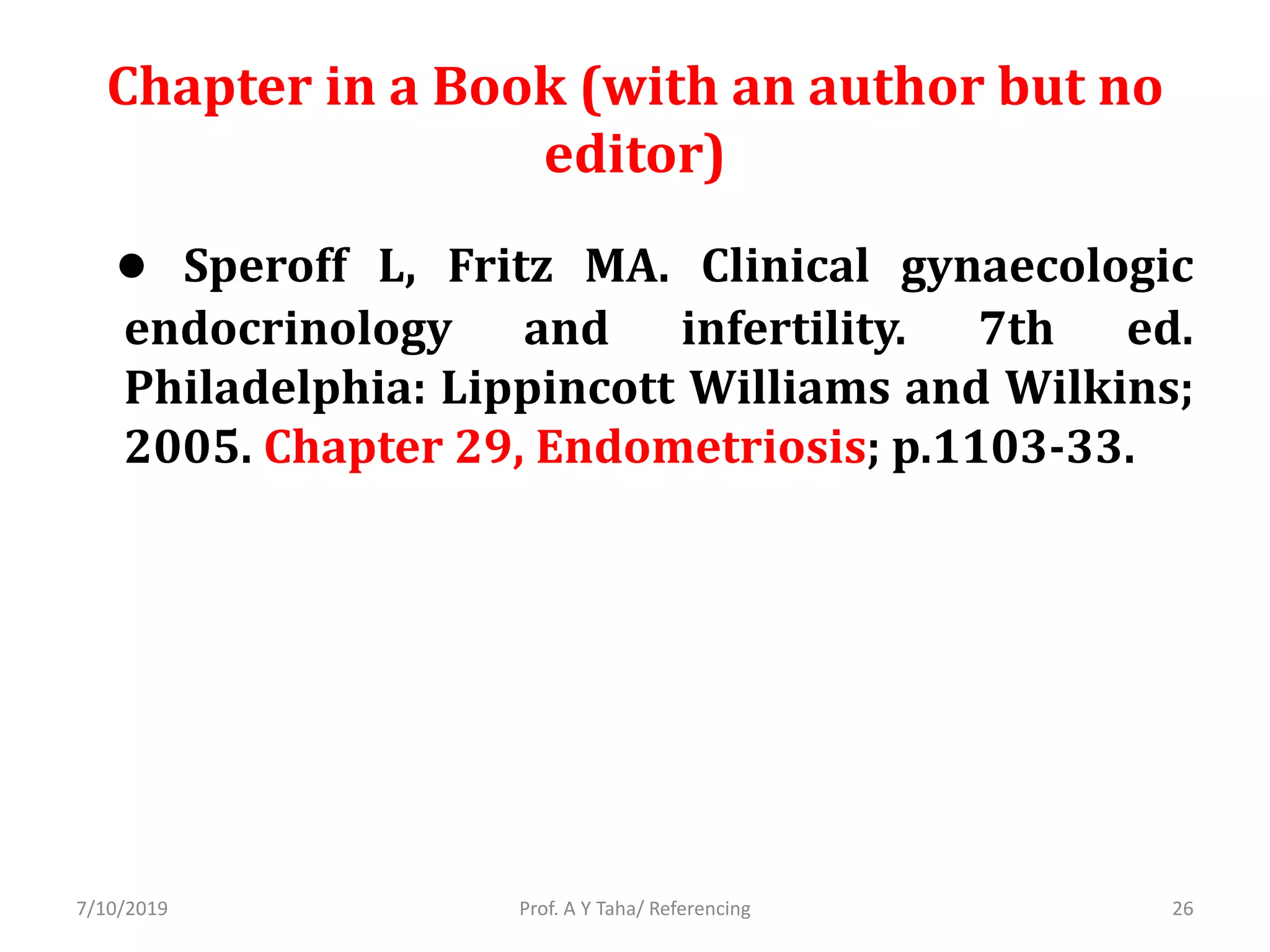
Chapter in a Book (with an author but no
editor)
● Speroff L, Fritz MA. Clinical gynaecologic
endocrinology and infertility. 7th ed.
Philadelphia: Lippincott Williams and Wilkins;
2005. Chapter 29, Endometriosis; p.1103-33.
Prof. A Y Taha/ Referencing7/10/2019 26
Prof. A Y Taha/ Referencing7/10/2019 27
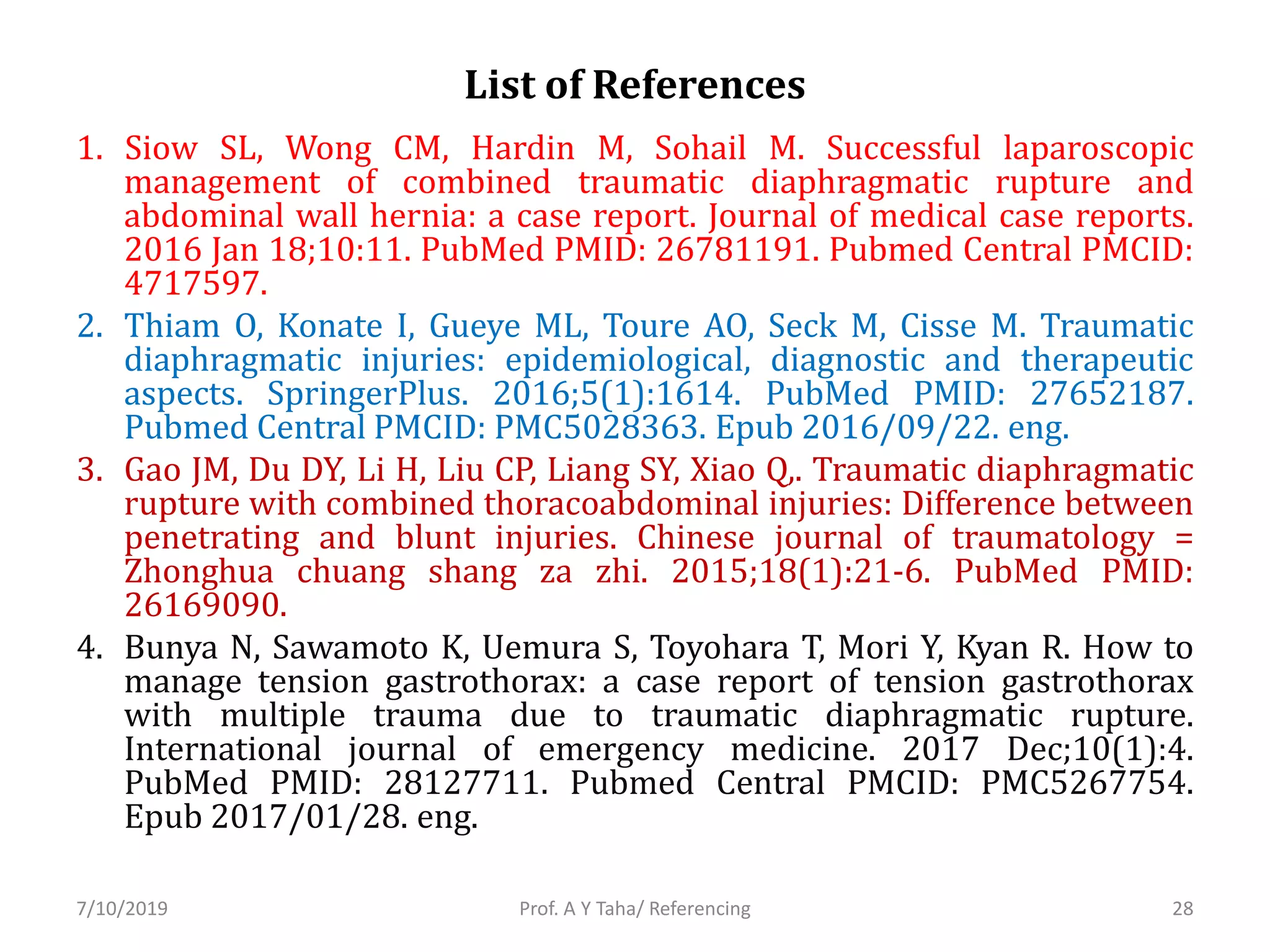
List of References
1. Siow SL, Wong CM, Hardin M, Sohail M. Successful laparoscopic
management of combined traumatic diaphragmatic rupture and
abdominal wall hernia: a case report. Journal of medical case reports.
2016 Jan 18;10:11. PubMed PMID: 26781191. Pubmed Central PMCID:
4717597.
2. Thiam O, Konate I, Gueye ML, Toure AO, Seck M, Cisse M. Traumatic
diaphragmatic injuries: epidemiological, diagnostic and therapeutic
aspects. SpringerPlus. 2016;5(1):1614. PubMed PMID: 27652187.
Pubmed Central PMCID: PMC5028363. Epub 2016/09/22. eng.
3. Gao JM, Du DY, Li H, Liu CP, Liang SY, Xiao Q,. Traumatic diaphragmatic
rupture with combined thoracoabdominal injuries: Difference between
penetrating and blunt injuries. Chinese journal of traumatology =
Zhonghua chuang shang za zhi. 2015;18(1):21-6. PubMed PMID:
26169090.
4. Bunya N, Sawamoto K, Uemura S, Toyohara T, Mori Y, Kyan R. How to
manage tension gastrothorax: a case report of tension gastrothorax
with multiple trauma due to traumatic diaphragmatic rupture.
International journal of emergency medicine. 2017 Dec;10(1):4.
PubMed PMID: 28127711. Pubmed Central PMCID: PMC5267754.
Epub 2017/01/28. eng.
Prof. A Y Taha/ Referencing7/10/2019 28
Vancouver: Librarian's System
Why?
● Librarian is a person, typically with a
degree in library science, who
administers or assists in a library.
● For a librarian, each written work is just
a number, whether done by the most
brilliant scientist or the most ordinary
writer.
● He works by giving each work a number
(tag).
Prof. A Y Taha/ Referencing7/10/2019 29
Harvard Style
• “Harvard Style” is a generic term for any
referencing style which uses in-text
references such as (Smith, 1999) and a
reference list at the end of the document
organized by author name and year of
publication.
• Huffman, L. M. (1996). Processing whey
protein for use as a food ingredient. Food
Technology, 50 (2), 49-52.
Prof. A Y Taha/ Referencing7/10/2019 30
Vancouver vs. Harvard
• Both systems have advantages.
• Vancouver is good for categorizing and
indexing.
• Harvard is good for research and
reading.
• Vancouver can incorporate good points
of Harvard and become the prime
referencing system.
Prof. A Y Taha/ Referencing7/10/2019 31
Bibliography
• The bibliography is a separate list from
the reference list and should be arranged
alphabetically by author or title.
• A bibliography lists sources not cited in
the text but which are relevant to the
subject and were used for background
reading.
• A list of material you have used for
information or inspiration but have not
referred to directly in the text.
Prof. A Y Taha/ Referencing7/10/2019 32
The EndNote Referencing Style Software
• EndNote is a software program that assists in creating
reference list. It can be downloaded from the internet.
• It can be used to import references from online database,
using Pubmed as an example.
• It can be used to create a custom group and add a reference
to it.
• It can be used to find full text to download PDFs for
references.
• It can be used to insert a reference in a Word document.
• It can be used to format a bibliography, using the Vancouver
style as an example.
• It can be used to add page numbers to a citation.
• And even more…
Prof. A Y Taha/ Referencing7/10/2019 33
Take Home Messages
• Good academic work should be well
referenced.
• Overall, recent articles from high quality
specialist journals are preferred as
references. Avoid citing articles from
predatory journals.
• The academic writer should master
referencing techniques and be capable of
proper in-text citation and creating lists
of references.
Prof. A Y Taha/ Referencing7/10/2019 34
Take Home Messages…
• Referencing Software Programs are available.
They are very useful for the academic writer to
facilitate citing while writing as well as
importing references from websites, inserting
citation, creating and formatting reference
lists…etc.
• The time-consuming and tedious process of
referencing that is used be done manually and
liable for making mistakes can be replaced by
this precise quick computer job just like many
things in our digital world.
• Nevertheless, EndNote should not be our
‟Start” in studying Referencing!!
Prof. A Y Taha/ Referencing7/10/2019 35

Referencing

  • 1.
    Referencing with Special Emphasison Vancouver Referencing Technique Prof. Abdulsalam Y Taha College of Medicine/University of Sulaimania/Sulaimania/Kurdistan/Iraq 2019
  • 2.
    In this Lecture •Reference vs. Referee • Author vs. Editor vs. Publisher vs. Librarian • Types of references. • Reference List vs. Bibliography • In-text citation (Arabic numbers between round or square brackets or superscript numbers). • Bibliographic elements. • Punctuation marks. • Vancouver Style vs. Harvard Style • Plagiarism • The EndNote Referencing Style Software Prof. A Y Taha/ Referencing7/10/2019 2
  • 3.
    Terms… • Reference isto use a source of information to ascertain something. • Referee is a person chosen to examine and assess a scientific or other academic work for publication. • Author is a writer of a book, article or a report. • Editor is a person who is in charge of determining the final content of a text, particularly a newspaper or magazine. • Publisher is a person or company that prepares and issues books, journals, music, or other works for sale. • Plagiarism is the practice of taking someone else's work or ideas and passing them off as one's own. All academics know its serious consequences. Prof. A Y Taha/ Referencing7/10/2019 3
  • 4.
    Referencing Why? • Acknowledge debtsto other writers. • Demonstrate the body of knowledge upon which your assignment is based. • Enable the reader(s) to locate your sources easily. • Referencing is important to avoid plagiarism. Prof. A Y Taha/ Referencing7/10/2019 4
  • 5.
    Types of References •Book • Dictionary or Encyclopedia • Journal Article • Conference Papers • Newspaper and Magazine Article • Reports and other Government Publications • Thesis • Web Pages • Other Internet Sources • Personal Communication (verbal, written and e mail) Prof. A Y Taha/ Referencing7/10/2019 5
  • 6.
    Types of References… •Pamphlet • Package Inserts • Lecture Notes • Video or DVD • Film or Broadcast • Tables • Figures • Images or Appendices. • In this lecture, we are going to study how to refer to journal articles and books. For other types of references, we need to read the original Vancouver document. Prof. A Y Taha/ Referencing7/10/2019 6
  • 7.
    Vancouver Group • In1978, a group of editors met in Vancouver, British Colombia, Canada. • The group called itself the International Steering Committee, a name that was later changed to the International Committee of Medical Journal Editors (ICMJE). • Because of its original meeting place, however, the ICMJE has often been called “the Vancouver group”. • The main topic at the 1978 meeting was formats for references. Prof. A Y Taha/ Referencing7/10/2019 7
  • 8.
    What is theVancouver Referencing Technique? • A uniform set of requirements for bibliographic references. • Also known as: Uniform Requirements for Manuscripts Submitted to Biomedical Journals. • It follows rules established by the International Committee of Medical Journal Editors. • It is a "numbered" style. Prof. A Y Taha/ Referencing7/10/2019 8
  • 9.
    Vancouver Style • Thecommonly used style in medical and scientific journals. • Reference list identifies references cited in sufficient detail so that others may locate and consult them. • The reference list appears at the end of the essay/report with the entries listed numerically and in the same order that they have been cited in the text. • If you have cited sources from the Internet, these should also be in your reference list. • Punctuation marks and spaces in the reference list and citations are very important. Follow the punctuation and spacing exactly as in the following examples. Prof. A Y Taha/ Referencing7/10/2019 9
  • 10.
    Citation •The way thatyou (the writer) refer to texts that you wish to include in your work. •It is in the form of a number that correlates with a source in your reference list. If the source is referred to again, the same number is used. •Citation (Extract) also refers to the information retrieved from a bibliographical database search. Prof. A Y Taha/ Referencing7/10/2019 10
  • 11.
    Look at thisParagraph… • Foreign body aspiration is common [1]. It is a life-threatening condition (2). Children under the age of 5 years are the usual sufferers.3 Family negligence is to be blamed [1,3,4] particularly in low socioeconomic class population [1-5]. The event of aspiration is characterized by chocking while eating, laughing or crying [1]-[4]. Death may occur due to suffocation with a big foreign body blocking the larynx.1,6 Strider may result from inhalation of a foreign body that resides within the larynx or trachea.2,4,6-8 It is vital to educate parents to take care of their children to prevent this potentially fatal problem [1p32] [3]. Prof. A Y Taha/ Referencing7/10/2019 11
  • 12.
    Look at thisParagraph… • John et al [9] as well as other authors 10,11 believe that the incidence of foreign body aspiration can be greatly reduced by increasing the awareness of people. William [cited in 5] states that unresolved cough in a child should be looked at seriously as it may indicate a foreign body aspiration. Ali et al quoted Ahmed in their article [12] who recommends bronchoscopy for children with unresolved cough to exclude foreign body aspiration. • As one can see, there are different methods of in-text citation. Journals may differ in their preferred citation style. This is usually explained in the “Instruction to Authors” posted in the web site of each journal. Prof. A Y Taha/ Referencing7/10/2019 12
  • 13.
    • In theVancouver Style, in-text citations are identified by Arabic numbers in round brackets. When multiple references are cited at a given place in the text, use a hyphen to join the first and last numbers that are inclusive. Use commas (without spaces) to separate non-inclusive numbers in a multiple citation e.g. (2,3,4,5,7,10) is abbreviated to (2-5,7,10). Prof. A Y Taha/ Referencing7/10/2019 13
  • 14.
    Journal Articles • RussellFD, Coppell AL, Davenport AP. In vitro enzymatic processing of radio-labled big ET-1 in human kidney as a food ingredient. Biochem Pharmacol 1998;55:697-701. • Note: • Author(s) name: Surname followed by 2 initials separated by comma. Do not use ‛and’ before the last name. • All author names should be written. However, some journals require to write ‛et al’ after the 3rd or 6th author's name in the list of references. Prof. A Y Taha/ Referencing7/10/2019 14
  • 15.
    (Et al) in(Vancouver) Style • The words et al are used in the in-text citation if there are 3 or more authors but not in the reference list. • Reference list example: Skalsky K, Yahav D, Bishara J, Pitlik S, Leibovici L, Paul M. Treatment of human brucellosis: systematic review and meta-analysis of randomized controlled trials. BMJ 2008 Mar 29;336(7646):701-4. • In-text citation: By using meta-analysis, Skalsky et al ... Prof. A Y Taha/ Referencing7/10/2019 15
  • 16.
    Et al • Anotherreference list example: Hanna JN, McBride WJ, Brookes DL, Shield J, Taylor CT, Smith IL, Craig SB, Smith GA. Hendra virus infection in a veterinarian. Med J Aust 2006 Nov 20;185(10):562- 64. • In-text citation Hanna et al21 report in this article that ... Prof. A Y Taha/ Referencing7/10/2019 16
  • 17.
    Editorial in aJournal Coffee drinking and cancer of the pancreas [editorial]. BMJ 1981;283:628. • A piece of writing, displayed in a prominent position, that expresses a strong view on a matter of importance to a publication’s readers. They are also called leading articles or leaders. • The name of the journal should be in standard PubMed abbreviations, full journal name should not be written. BMJ stands for British Medical Journal. ● So, for editorial, no author is given as it represents the opinion of the journal as a whole rather than a person. ● Nevertheless, sometimes, there is a “signed editorial” written by a personal author. ● So, the essential elements for referencing journals are: author, title of article, journal title, date, volume number, issue number, page numbers. Prof. A Y Taha/ Referencing7/10/2019 17
  • 18.
    Electronic Articles ● FletcherD, Wagstaff CRD. Organisational psychology in elite sport: its emergence, application and future. Psychol Sport Exerc 2009;10(4):427-34. doi:10.1016/j.psychsport.2009.03.009. ● Lemanek K. Adherence issues in the medical management of asthma. J Pediatr Psychol [ Internet]. 1990 [cited 2010 Apr 22];15(4):437- 58. Available from: http://jpepsy.oxfordjournals.org/cgi/reprint/ 15/4/437 Prof. A Y Taha/ Referencing7/10/2019 18
  • 19.
    Prof. A YTaha/ Referencing7/10/2019 19
  • 20.
    Prof. A YTaha/ Referencing7/10/2019 20
  • 21.
    Books with aPersonal Author(s) but without Editor • Getzen TE. Health economics: fundamentals and flow of funds. New York (NY): John Wiley & Sons; 1997. • Note: 1. Getzen TE: author's name. It should be exact as existing. 2. Health economics: fundamentals and flow of funds: book's title. 3. New York (NY): place of publication. 4. John Wiley & Sons: publishers. 5. 1997: year of publication. In-text citation: Getzen [1] believes that… ● so, the essential elements for referencing books are: author, title, edition, place of publication, publisher, date (year). Prof. A Y Taha/ Referencing7/10/2019 21
  • 22.
    Books with Editorbut without author(s) • Millares M, editor. Applied drug information: strategies for information management. Vancouver,WA: Applied Therapeutics, Inc.; 1998. • Electronic Book: Bartlett A. Breastwork: Rethinking breastfeeding [monograph online]. Sydney, NSW: University of New South Wales Press; 2005 [cited 2009 Nov 10]. Available from: NetLibrary Prof. A Y Taha/ Referencing7/10/2019 22
  • 23.
    Books with Editions •Australian Government Publishing Service. Style manual for authors, editors and printers. 5th ed. Canberra: Australian Government Publishing Service; 1994 • Note “Australian Government Publishing Service” is the author and also the publisher. • Here, an organization stands as an author. • No need to mention 1st ed. Prof. A Y Taha/ Referencing7/10/2019 23
  • 24.
    Book Chapters [withedition] and a Series • Bennett GL, Horuk R. Iodination of chemokines for use in receptor binding analysis. In: Horuk R, editor. Chemokine receptors. New York (NY): Academic Press; 1997. p. 134-48. (Methods in enzymology; vol 288). • Note: 1. Bennett GL, Horuk R: authors of the chapter. 2. Iodination of chemokines for use in receptor binding analysis: title of the chapter. 3. Chemokine receptors: the title of the book. 4. Methods in enzymology: the title of the series. In-text citation: Bennett and Horuk [1] believe that… Up to 6 authors, mention all names in the reference list. Prof. A Y Taha/ Referencing7/10/2019 24
  • 25.
    Book with 6or more Authors • In the list of references: Hofmeyr GJ, Neilson JP, Alfirevic Z, Crowther CA, Gulmezoglu AM, Hodnett ED et al. A Cochrane pocketbook: Pregnancy and childbirth. Chichester, West Sussex, England: John Wiley & Sons Ltd; 2008. • In-text citation: Professionals in collaboration [1] mentioned… Prof. A Y Taha/ Referencing7/10/2019 25
  • 26.
    Chapter in aBook (with an author but no editor) ● Speroff L, Fritz MA. Clinical gynaecologic endocrinology and infertility. 7th ed. Philadelphia: Lippincott Williams and Wilkins; 2005. Chapter 29, Endometriosis; p.1103-33. Prof. A Y Taha/ Referencing7/10/2019 26
  • 27.
    Prof. A YTaha/ Referencing7/10/2019 27
  • 28.
    List of References 1.Siow SL, Wong CM, Hardin M, Sohail M. Successful laparoscopic management of combined traumatic diaphragmatic rupture and abdominal wall hernia: a case report. Journal of medical case reports. 2016 Jan 18;10:11. PubMed PMID: 26781191. Pubmed Central PMCID: 4717597. 2. Thiam O, Konate I, Gueye ML, Toure AO, Seck M, Cisse M. Traumatic diaphragmatic injuries: epidemiological, diagnostic and therapeutic aspects. SpringerPlus. 2016;5(1):1614. PubMed PMID: 27652187. Pubmed Central PMCID: PMC5028363. Epub 2016/09/22. eng. 3. Gao JM, Du DY, Li H, Liu CP, Liang SY, Xiao Q,. Traumatic diaphragmatic rupture with combined thoracoabdominal injuries: Difference between penetrating and blunt injuries. Chinese journal of traumatology = Zhonghua chuang shang za zhi. 2015;18(1):21-6. PubMed PMID: 26169090. 4. Bunya N, Sawamoto K, Uemura S, Toyohara T, Mori Y, Kyan R. How to manage tension gastrothorax: a case report of tension gastrothorax with multiple trauma due to traumatic diaphragmatic rupture. International journal of emergency medicine. 2017 Dec;10(1):4. PubMed PMID: 28127711. Pubmed Central PMCID: PMC5267754. Epub 2017/01/28. eng. Prof. A Y Taha/ Referencing7/10/2019 28
  • 29.
    Vancouver: Librarian's System Why? ●Librarian is a person, typically with a degree in library science, who administers or assists in a library. ● For a librarian, each written work is just a number, whether done by the most brilliant scientist or the most ordinary writer. ● He works by giving each work a number (tag). Prof. A Y Taha/ Referencing7/10/2019 29
  • 30.
    Harvard Style • “HarvardStyle” is a generic term for any referencing style which uses in-text references such as (Smith, 1999) and a reference list at the end of the document organized by author name and year of publication. • Huffman, L. M. (1996). Processing whey protein for use as a food ingredient. Food Technology, 50 (2), 49-52. Prof. A Y Taha/ Referencing7/10/2019 30
  • 31.
    Vancouver vs. Harvard •Both systems have advantages. • Vancouver is good for categorizing and indexing. • Harvard is good for research and reading. • Vancouver can incorporate good points of Harvard and become the prime referencing system. Prof. A Y Taha/ Referencing7/10/2019 31
  • 32.
    Bibliography • The bibliographyis a separate list from the reference list and should be arranged alphabetically by author or title. • A bibliography lists sources not cited in the text but which are relevant to the subject and were used for background reading. • A list of material you have used for information or inspiration but have not referred to directly in the text. Prof. A Y Taha/ Referencing7/10/2019 32
  • 33.
    The EndNote ReferencingStyle Software • EndNote is a software program that assists in creating reference list. It can be downloaded from the internet. • It can be used to import references from online database, using Pubmed as an example. • It can be used to create a custom group and add a reference to it. • It can be used to find full text to download PDFs for references. • It can be used to insert a reference in a Word document. • It can be used to format a bibliography, using the Vancouver style as an example. • It can be used to add page numbers to a citation. • And even more… Prof. A Y Taha/ Referencing7/10/2019 33
  • 34.
    Take Home Messages •Good academic work should be well referenced. • Overall, recent articles from high quality specialist journals are preferred as references. Avoid citing articles from predatory journals. • The academic writer should master referencing techniques and be capable of proper in-text citation and creating lists of references. Prof. A Y Taha/ Referencing7/10/2019 34
  • 35.
    Take Home Messages… •Referencing Software Programs are available. They are very useful for the academic writer to facilitate citing while writing as well as importing references from websites, inserting citation, creating and formatting reference lists…etc. • The time-consuming and tedious process of referencing that is used be done manually and liable for making mistakes can be replaced by this precise quick computer job just like many things in our digital world. • Nevertheless, EndNote should not be our ‟Start” in studying Referencing!! Prof. A Y Taha/ Referencing7/10/2019 35