Instructions for writing a paper
Content
Organize your paper into sections with headings. For a term
paper the sections might be:
Topic
Introduction
Main point #1
Main point #2
Main point #3
Summary
References
(Figures – if not embedded in text)
· Length (7-8 pages).
· Make sure that when you turn in your paper, you have read
through it in its final form. This may prove difficult to do after
the many editing sessions that you have already enjoyed with
it. It is often very helpful to have a friend read it through as
well as this lends a fresh perspective.
Format
· Please double-space all your text. That way it is much easier
for the instructor to annotate your work.
· Use 1” margins all round. Use 12 pt font. (or 14 font with 1.5
space).Number your pages.
· The final copy should be clean and neat.
Style
· Try to write in the third person whenever possible. For the
most part you will be presenting facts. Although, for debate
papers you will be arguing a certain point of view and it may
therefore be appropriate to use “I” now and then, avoid repeated
use of the first person.
· Avoid clichés. (“the bottom line”, “at the end of the day”, “all
in all” etc.)
· Avoid slang and informal terms of expression. (“Well, …”,
“It was like, we went…”)
· Avoid rhetoric. (“How should I interpret these results?”, “I
asked myself - What do people think about global warming?”)
· When you use equations in your paper, make sure that every
symbol in the equation is explained. Number equations
sequentially for easy referencing.
Grammar and spelling
· Don’t rely on the spelling checker to find all your spelling
errors. You must also read through you document to check that
“their”, “there” and “they’re”, for example, are correctly used.
· Read and re-read your manuscript. Edit it more than once or
twice. Avoid the repetitious use of the same word in a sentence
or a paragraph. Edit away all redundancies. I do not want to
read the same information over and over again, simply
expressed in a slightly different way each time. Remove
unnecessary words. Be clear and succinct.
References
· Cite articles by author(s) and year within your text. If there is
a single author, the last name and year will suffice – e.g.
(Hutchinson, 1995). If there are two authors, include both
names and the year of the publication – e.g. (Hutchinson and
Osborne, 1978). For more than two authors, use the first author
with et al. – e.g. (Hutchinson et al., 1984).
· Include the list of references at the end of your paper. Do not
include references you have read but not cited. List the
references alphabetically by the first author’s last name.
Apply Semiotics (class terms):
The Saussurean model
- Signifier
- Signified concept
- The relational system
The Peircean model
- symbolic mode
- iconic mode
- indexical mode
- denotation and connotation
-intertextuality – intratextuality
(The book “The Basic Semiotics” .
Apply Ethical Theories: ( 3 main theories and 3-4 Subtheories
out of 12. The book “Controversies in Media Ethics, Chapter 1.
Deontological
Teleological
Personalist
Subtheories:
Machiavellian
Cultural Relativism
Utilitarian
Religious and etc.
How to Write a Good Research Paper
Research paper presents and argues a thesis, the writer's
proposition or opinion.
It is an analytical or persuasive essay that evaluates a position.
As such, a research paper tries to convince readers that the
writer's argument is valid or at least deserves serious
consideration.
As a result, a research paper requires the writer to be creative in
using facts, details, examples, and opinions to support a point.
The writer has to be original and inventive in deciding which
facts best support the thesis and which ones are superfluous.
When you write a research paper, you have to read what
authorities have written about the topic and then write an essay
in which you draw your own conclusions about the topic.
Since your thesis is fresh and original, you can't merely
summarize what someone else has written. Instead, you have to
synthesize information from many different sources to create
something that is your own.
A term paper, in contrast, is a collection of facts. It does not
argue a point;
it does not try to persuade readers to think or act a certain way.
Since a term paper is a summary of information from one or
more sources, you are merely reporting what others have said.
This is not to say that a term paper doesn't have many valid
uses. For example, it is very helpful for people who need a great
deal of data in a condensed, easy to read form. Government
workers are often asked to prepare term papers with information
on weather, transportation, economics, and so forth.
Research PaperTerm Paper
Argues a point
Present data
Formulates a thesis
Reports what others said
Is Argumentative/Persuasive
Descriptive
Evaluates
Summarizes
What Are the Qualities of a Good Research Paper?
No matter what its topic or length, an effective research paper
meets the following ten criteria:
1. The paper has a clear thesis.
2. The writer shows a strong understanding of the topic and
source material used.
3. There is evidence that the writer has read widely on the topic,
including the recognized authorities in the field.
4. The paper acknowledges the opposition but shows why the
point being argued is more valid.
5. The points are organized in a clear and logical way.
6. Each point is supported by solid, persuasive facts and
examples.
7. Every outside source is carefully documented.
8. All supporting material can be verified.
9. The paper follows the standard conventions of the genre,
including the use of correct documentation and a Works Cited
page.
10. The paper uses standard written English. This is the level of
diction and usage expected of educated people in high schools,
colleges, universities, and work setting.
APA (American Psychological Assoc.)
Rozakis, L. (1999). Schaum's Quick Guide to Writing Great
Research Papers. New York: McGraw-Hill Professional.
MLA (Modern Language Assoc.)
Rozakis, Laurie. Schaum's Quick Guide to Writing Great
Research Papers. McGraw-Hill Professional, 1999. Schaum's
Quick Guide Series. EBSCOhost.
Controversies in Media Ethics
Third Edition
Controversies in Media Ethics offers students, instructors and
professionals multiple
perspectives on media ethics issues presenting vast “gray areas”
and few, if any, easy
answers. This third edition includes a wide range of subjects,
and demonstrates a willingness
to tackle the problems raised by new technologies, new media,
new politics and new
economics. The core of the text is formed by 14 chapters, each
of which deals with a
particular problem or likelihood of ethical dilemma, presented
as different points of view
on the topic in question, as argued by two or more contributing
authors. Chapter 15 is a
collection of “mini-chapters,” allowing students to discern first-
hand how to deal with
ethical problems.
This edition has been thoroughly updated to provide:
• Discussions of issues reflecting the breadth and depth of the
media spectrum
• Numerous real-world examples
• Broad discussion of confidentiality and other timely topics
• A companion Web site supplies additional resources for both
students and instructors.
Developed for use in media ethics courses, Controversies in
Media Ethics provides up-to-
date discussions and analysis of ethical situations across a
variety of media, including issues
dealing with the Internet and new media. It provides a unique
consideration of ethical
concerns, and serves as provocative reading for all media
students.
A. David Gordon retired from the University of Wisconsin-Eau
Claire in 2002, where he
taught mass media ethics and law as well as journalism and
media/society courses.
John Michael Kittross is editor of Media Ethics magazine. He
retired from Emerson
College, where he served as provost and vice president for
academic affairs. He is managing
director of KEG Associates, an academic consulting group.
John C. Merrill is professor emeritus of journalism at the
University of Missouri.
William A. Babcock is senior ethics professor at Southern
Illinois University, Carbondale.
Michael Dorsher teaches mass media ethics at the University of
Wisconsin-Eau Claire.
Third Edition
Controversies
in Media
Ethics
A. David Gordon
John Michael Kittross
John C. Merrill
William A. Babcock
Michael Dorsher
with contributions by
John A. Armstrong
Peter J. Gade
Julianne H. Newton
Kim Sheehan
Jane B. Singer
Second edition published 1999
by Addison-Wesley Longman
This edition published 2011
by Routledge
711 Third Avenue, New York, NY 10017
Simultaneously published in the UK
by Routledge
2 Park Square, Milton Park, Abingdon, Oxon OX14 4RN
Routledge is an imprint of the Taylor & Francis Group, an
informa business
© 2011 Routledge, Taylor & Francis
The right of A. David Gordon and John Michael Kittross to be
identified as authors
of this work has been asserted by them in accordance with
sections 77 and 78
of the Copyright, Designs and Patents Act 1988.
All rights reserved. No part of this book may be reprinted or
reproduced or utilized
in any form or by any electronic, mechanical, or other means,
now known or hereafter
invented, including photocopying and recording, or in any
information storage or
retrieval system, without permission in writing from the
publishers.
Trademark notice: Product or corporate names may be
trademarks or registered
trademarks, and are used only for identification and explanation
without intent
to infringe.
Library of Congress Cataloging in Publication Data
Controversies in media ethics / A. David Gordon ... [et al.]. —
3rd ed.
p. cm.
1. Mass media—Moral and ethical aspects. I. Gordon, David,
1935–
P94.C585 2011
175—dc22 2010050712
ISBN 13: 978–0–415–99247–3 (hbk)
ISBN 13: 978–0–415–96332–9 (pbk)
ISBN 13: 978–0–203–82991–2 (ebk)
Typeset in Times New Roman and Futura
by Keystroke, Station Road, Codsall, Wolverhampton
Printed and bound in the United States of America on acid-free
paper
by Edwards Brothers, Inc
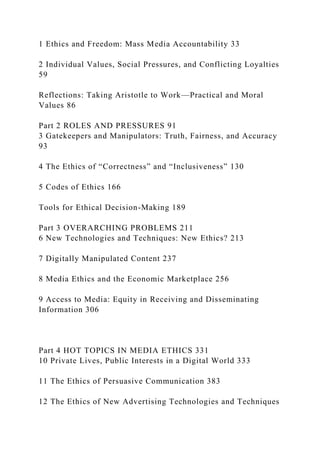
Contents in Brief
Preface xiii
Acknowledgements xix
About the Authors xxiii
Part 1 THE BASICS 1
Overview: Theoretical Foundations for Media Ethics 3
1 Ethics and Freedom: Mass Media Accountability 33
2 Individual Values, Social Pressures, and Conflicting Loyalties
59
Reflections: Taking Aristotle to Work—Practical and Moral
Values 86
Part 2 ROLES AND PRESSURES 91
3 Gatekeepers and Manipulators: Truth, Fairness, and Accuracy
93
4 The Ethics of “Correctness” and “Inclusiveness” 130
5 Codes of Ethics 166
Tools for Ethical Decision-Making 189
Part 3 OVERARCHING PROBLEMS 211
6 New Technologies and Techniques: New Ethics? 213
7 Digitally Manipulated Content 237
8 Media Ethics and the Economic Marketplace 256
9 Access to Media: Equity in Receiving and Disseminating
Information 306
Part 4 HOT TOPICS IN MEDIA ETHICS 331
10 Private Lives, Public Interests in a Digital World 333
11 The Ethics of Persuasive Communication 383
12 The Ethics of New Advertising Technologies and Techniques
410
13 Infotainment, Sensationalism, and “Reality” 432
14 Violence and Sexuality 461
15 More Topics in the Ethical Debate 489
Postscript: Some Questions without Answers and Answers
without
Questions 532
Glossary 536
Bibliography 555
Index 564
vi Contents in Brief
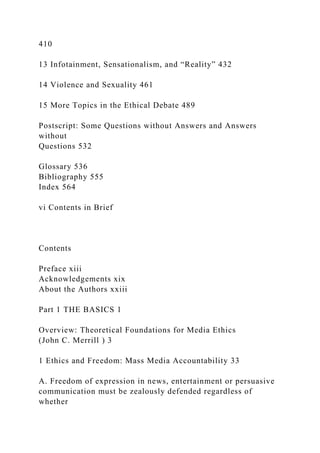
Contents
Preface xiii
Acknowledgements xix
About the Authors xxiii
Part 1 THE BASICS 1
Overview: Theoretical Foundations for Media Ethics
(John C. Merrill ) 3
1 Ethics and Freedom: Mass Media Accountability 33
A. Freedom of expression in news, entertainment or persuasive
communication must be zealously defended regardless of
whether
it is exercised ethically. (A. David Gordon) 34
B. Freedom of expression cannot be allowed to become an
excuse for
irresponsible media conduct—in news, entertainment, public
relations
or advertising. (Julianne H. Newton) 44
Commentary (Merrill ) 55
2 Individual Values, Social Pressures, and Conflicting Loyalties
59
A. Stick to your personal values in making ethical decisions,
despite the
various pressures that you encounter in the workplace, such as
those from
media owners, government or advertisers. (John Michael
Kittross) 60
B. Sticking to your personal values is a worthy but unattainable
ideal, in
view of the social, economic, and political forces that often run
counter to
individuals’ ethics. (Gordon) 73
Commentary (Merrill ) 81
Reflections: Taking Aristotle to Work—Practical and Moral
Values (John A. Armstrong) 86
Part 2 ROLES AND PRESSURES 91
3 Gatekeepers and Manipulators: Truth, Fairness, and Accuracy
93
A. Mass media are inevitable targets for those seeking to
manipulate
how content is presented, but truth and the need for exposure to
new
ideas remain as key principles. (Gordon) 94
B. Social values of mass communication require practices
reflecting
ethical considerations extending beyond truth to include both
fairness
and accuracy. (Kittross) 109
Commentary (Merrill ) 124
4 The Ethics of “Correctness” and “Inclusiveness” 130
A. Mass media must make special efforts to deal with race,
gender,
culture, and ethnicity in their personnel, news, advertising, and
entertainment functions. (Gordon) 131
B. No special efforts are required on the part of the mass media
to deal
“correctly” with race, gender, sexual orientation, culture,
religion, age,
and ethnicity. (Kittross) 145
Commentary (Merrill ) 160
5 Codes of Ethics 166
A. Codes of ethics are useful and necessary, both for the news
media
and in public relations and advertising, because these codes
benefit
society. (Gordon) 167
B. Ethics codes are too general to apply to many real situations,
too
black-and-white, and too idealistic in the cases of public
relations and
advertising. (Michael Dorsher) 179
Commentary (Merrill ) 185
Tools for Ethical Decision-Making (William A. Babcock,
Gordon, and Kittross) 189
Part 3 OVERARCHING PROBLEMS 211
6 New Technologies and Techniques: New Ethics? 213
A. An interactive network, to which anyone can contribute and
in which
information is exchanged rather than simply delivered, creates
ethical
viii Contents
issues that go beyond those faced by professionals working in
traditional media environments. (Jane B. Singer) 216
B. Ethics transcends media technologies and methods, so
developments
such as convergence journalism, citizen journalism, blogs, and
multimedia
mobile phones require little if any rethinking of long-standing
ethical
principles or guidelines. (Dorsher) 227
Commentary (Merrill ) 233
7 Digitally Manipulated Content 237
A. There is no ethical mandate to authenticate digital material,
especially
in the persuasive and entertainment realms, and news operations
can
rely on corrections if they find they have disseminated
erroneous material.
(Babcock and Gordon) 238
B. The ability to “doctor” visual images and audio content
digitally and
undetectably will not go away so we must live with it, and
newsrooms
should verify digital materials even at the risk of not being
“first.”
(Kittross) 245
Commentary (Merrill ) 252
8 Media Ethics and the Economic Marketplace 256
A. The economic marketplace is at best irrelevant, and at worst
counterproductive ethics and the marketplace of ideas.
(Kittross) 257
B. The evolving economic marketplace can still help to hold the
media
responsible for their actions, with help from nonprofit
organizations,
knowledgeable media consumers, and farsighted privately
owned
media companies. (Gordon) 280
Commentary (Merrill ) 299
9 Access to Media: Equity in Receiving and Disseminating
Information 306
A. Mass media must guard against practices that isolate some
groups
in society from access to information they need. (Gordon) 308
B. Market forces are sufficient safeguards against any groups in
society
being deprived of access to necessary information, or of
expressing
themselves. (Babcock) 318
Commentary (Merrill ) 325
ixContents
Part 4 HOT TOPICS IN MEDIA ETHICS 331
10 Private Lives, Public Interests in a Digital World 333
A. News and entertainment media cannot be the sole judges of
the
privacy boundary between appropriate and excessive coverage,
even
for public figures. (Gordon) 336
B. News and entertainment media should be the sole judges of
how
their activities impinge on individuals’ privacy rights.
Furthermore, the
mass media need not be concerned about using personal
information
from private or government databases, but we all should be
concerned
about its collection and use by others. (Kittross) 346
C. News, entertainment, and persuasion media, as well as other
businesses
and the government, must respect privacy concerns in collecting
and
using personal information in their databases. (Newton) 365
Commentary (Merrill ) 376
11 The Ethics of Persuasive Communication 383
A. Advertising and public relations, no less than news, should
be held to
standards of truthfulness, which is to say they should not be
intentionally
deceitful. (Peter J. Gade) 384
B. Because the function of persuasive communication is to sell
products,
services, and ideas, there is no need for persuaders always to
adhere to
absolute standards of truth—but transparency is needed.
(Gordon) 394
Commentary (Merrill ) 405
12 The Ethics of New Advertising Technologies and Techniques
410
A. Product placement, spam, “pop-ups,” and similar techniques
are
ethical tools for advertisers and their clients to use, as long as
they are
legal and can sell a product. (Kim Sheehan) 412
B. The “anything goes” philosophy regarding the use of new
advertising
techniques is not only unethical but also counterproductive, and
will
destroy the credibility of the advertising industry. (Dorsher)
422
Commentary (Merrill ) 429
13 Infotainment, Sensationalism, and “Reality” 432
A. News and entertainment content are both valid avenues for
delivering
useful information and ideas to citizens of a democracy, thus
helping
them make informed choices. (Gordon) 435
x Contents
B. Tabloid news publications and programs, “reality” and talk
shows,
and other forms of infotainment confuse the public and offer
“fluff” at
the expense of more important content. (Babcock) 447
Commentary (Merrill ) 455
14 Violence and Sexuality 461
A. Violence and pornography in the media, however regrettable,
are merely reflections of the world, and government or group
measures
to control them would create a “cure” that is worse than the
disease.
(Kittross) 462
B. There is far more violence in today’s mass media than is
good for
society, and that violent content must somehow be controlled.
(Gordon) 474
Commentary (Merrill ) 485
15 More Topics in the Ethical Debates 489
15-A Objectivity? 491
15-B Checkbook Journalism: The Final Marketplace 493
15-C Citizen Journalism 497
15-D Source Confidentiality 503
15-E Arrogance 509
15-F Civility, “Dirty” Language, and Religion 512
15-G Honesty in Reporting 518
15-H Pack Journalism 522
15-I Interviews 527
15-J Co-option 529
Postscript: Some Questions without Answers and Answers
without Questions (Merrill ) 532
Glossary (Armstrong) 536
Bibliography 555
Index 564
xiContents
I do not Twitter—yet—because I have never believed that my
first thought on a
subject is always my best thought.
—E. J. Dionne, columnist for The Washington Post, at the Ann
Devroy
Memorial Forum, University of Wisconsin-Eau Claire, May 4,
2011
Preface
T H I S book is about questions, which we hope will enable you
to work on the answers with
increasing confidence. What it doesn’t deal with might be easier
to consider than what it
does—or tries—to do.
Media ethics isn’t an oxymoron—a contradiction in terms—nor
is it a fixed set of rules
or laws, as in medicine or theology. Neither is it a clear list of
“do’s and don’ts” or “blacks
and whites.” Instead, we believe that media ethics is an
essential process that evolves with
the world in which media operate, and on which the media
report—a seemingly endless
array of gray areas, where issues and appropriate courses of
action aren’t always obvious.
In other words—and it would be a lot easier not to have to tell
you this—there are no
fixed “right answers” in media ethics. Sometimes it is even hard
to compose the questions!
As philosophers Thomas Cathcart and Daniel Klein (2006) said
in their popular Plato and
a Platypus Walk into a Bar . . . (New York: Abrams Image,
2006, p. 4), “Questions beget
questions, and those questions beget another whole generation
of questions.” And because
ethical decision-making is a process without firm rules, it also
is the subject of continual
discussions—sometimes heated arguments—among media
ethicists and practitioners, and
media users, about what will make media content of all kinds—
information, persuasion or
entertainment—better and more valuable. The purpose of this
book is to help with that
process.
Because there are a wide variety of ethical dilemmas and
conflicts of values, there are
no answers that are consistently correct. Some alternatives,
though, are always better than
others and we can often find them by following principles and
guidelines that have been
developed by media ethicists to assist practitioners (and their
audiences) come to grips with
moral and ethical problems that confront them every day.
Finding the better alternatives,
though, is not an easy process and may become uncomfortable
at times. But as John C.
Merrill writes in his commentary for Chapter 11, “there is
simply no clear and completely
satisfying answer. But there is no reason for us to discontinue
the search” (p. 407).
Even in this free-form environment, and sometimes even
without its inhabitants
knowing, media ethics tends to follow—or can be explained
by—a number of traditional
philosophical concepts: Aristotle’s Golden Mean; Bentham’s
and Mill’s utilitarian principle
of the greatest good for the greatest number; Kant’s categorical
imperatives of treating every
moral rule as if it were a universal law, and of treating people
as ends rather than as means
to an end; Rawls’s “veil of ignorance;” and others that you will
encounter in the pages that
follow.
At the same time, the news, entertainment, and persuasive
media operate under time
pressures that are rarely matched—except probably by surgeons
in an operating room. As a
direct consequence of dealing continually with new events,
concepts, technologies and
techniques, conditions, and opinions, the mass media are
continually faced with decisions
that must be made with limited and imperfect data, amid
competing goals and purposes, and
with a societal leaning toward ad hoc situational ethics. It is
little wonder that media ethics
has so many controversies!
And that is another reason for this book. We don’t want to leave
this kind of decision to
the flip of a coin, or an assumption that if we personally benefit
then we can assume that our
audiences and the public at large also will benefit.
But, one may ask—in a newsroom, an integrated marketing
office, an editing suite, and
even a required media ethics course—does anyone pay attention
to ethics guidelines? Do
people—in the media, or in the general population—even care?
Isn’t it easier just to go with
the flow, and with what “feels” right or expedient, and let the
chips fall where they may
without regard for the most ethical course of action?
We believe that people do care, both within the various media
industries and among
their actual and potential audiences. As we see it, media ethics
isn’t a meaningless
contradiction but, rather, offers various ways for practitioners
to improve both their media
and their society (not to mention themselves, as moral agents).
To paraphrase slightly a
century-old political commentary:
There is no force so potent . . . as a moral issue. Politicians may
scorn it, ambitious men
[and women] may despise it or fight shy of it, newspapers may
caricature or mis-
represent it; but it has a way of confounding the plans of those
who pride themselves
on their astuteness and rendering powerless the most formidable
[economic, social or
political forces].
(The Nation 86 (2242), June 18, 1908, p. 549)
Our goal is to provide both students and practitioners with a
carefully constructed set of
opposing arguments focusing on more than a dozen major
controversies facing mass media
practitioners today—at all levels. The table of contents shows
that we are dealing with real
and current problems and controversies in media ethics. Several
chapters are new to this
edition, bringing in such varied factors as the economic
upheaval which erupted in 2008,
policy changes by a new presidential administration, and the
introduction of several new
technologies for communication between and among groups and
individuals. Virtually every
page that was written for earlier editions of Controversies in
Media Ethics has undergone
major updating or clarification—and, in some instances,
deletion. The additional ethical
dilemmas affecting advertising, public relations, and
entertainment as well as journalism—
stemming from developments that range from digital
manipulation of content to the explosion
of online ethical problems to revolutionary changes in media
industry structures—have been
incorporated into this edition.
xiv Preface
Because we are dealing with still-active controversies, the
reader cannot assume that
either half of a given chapter is automatically the “correct” one.
The ordering of half-
chapters is random, and the various authors are willing to
defend vigorously their positions
in these arguments. Many of the specific cases or situations in
media ethics that you will face
in the future—as either a communicator or member of the
public—will be informed by one
or more of these arguments. Because you will encounter a large
variety of such dilemmas
in the future, we saw no reason to select examples from the past
or invent hypothetical ones,
although we certainly refer frequently to ethical problems
current as we were writing this
book, as well as to older cases that remain relevant. We hope
that these illustrations of ethical
dilemmas will stimulate your thinking, so that you will be
prepared when you encounter
similar situations in your own lives and careers. Although
practice in media ethics may not
make perfect, it is certain to be helpful. But we again caution
against using past situations
as inflexible blueprints for resolving current or future ethics
problems.
Each of this book’s 15 chapters deals with a specific
controversy and has at least two
contrasting points of view, written by different authors. These
arguments are accompanied
by a short introduction, John C. Merrill’s brief commentary that
highlights some of the
points in each controversy and provides Merrill’s opinion of the
arguments themselves, and
a number of references. These commentaries, by a scholar and
former newsman who has
produced some three dozen books over a long and distinguished
career, are not summaries
of each issue, but rather an independent view that is intended to
promote additional
discussion with your peers, co-workers and instructors.
Because our purpose is to stimulate thought and discussion, the
authors often have taken
relatively extreme positions in their arguments. This is a
common pedagogical approach:
start at extremes in order to define alternatives clearly, and then
work toward a viable middle
ground, if one can be found. However, we stopped in many
chapters before coming to this
“viable middle ground,” in order to leave to you the experience
of defining that ground. We
hope that you will consider, modify, and merge our different
points of view, and apply them
to the media ethics problems that face each of us every day.
Remember: there is rarely a
single clear or easy solution. But you may come closer to one if
you think about these issues
before you have to make a decision in the teeth of deadline
pressures.
We recommend reading each chapter completely before going
back to the individual
positions (or “half-chapters”) for analysis. You will notice that,
contrary to the linear nature
of most books, the authors of the first segment of each chapter
will occasionally refer to
points made in the second half. This occurs because, in writing
the book, we had the
opportunity to exchange our work more than once (in one
instance, more than half-a-dozen
times), allowing us to refine our positions and to comment as
appropriate on the opposite
side of the argument. As mentioned earlier, the selection of
which author’s argument is
presented first is arbitrary. This give-and-take approach, while
potentially confusing, allows
you the opportunity to give each argument equal weight while
reading.
Similarly, you’ll find that a particular author, at times, may
embrace an argument that
runs counter to something that she or he wrote in a different
chapter. That doesn’t indicate
inconsistency or hypocrisy! It simply illustrates that these
complex media ethics questions
have many uncertain (or “gray”) areas and usually can be
argued cogently from different
perspectives rather than lending themselves to simple and easy
answers. In some instances,
xvPreface
it reflects the possibility that one author persuaded another of
something. None of the
authors was ever required to take a position that he or she
strongly opposed, but neither was
anyone urged to defend to the death any personal favorites
among the traditional ethical
theories we discussed—and yes, we all have personal favorites
(see the biographies on
pp. xxi–xxiii).
Also, please do not think of these arguments as legal briefs. Our
discussions are very
different from arguments presented during court trials, which
are organized to come to a firm
conclusion and decision. Even though logic, principles and
verifiable data are parts of both
systems, the rapid changes in the nuances of each ethical
dilemma and the lack of agreed-
upon statutes and precedents mandate a different and more
intense approach to ethical
problems. They must be looked at afresh, and with even fuller
consideration of facts, theories
and principles than are found in most law trials.
As you read through the book, keep in mind that law and ethics
are two sides of the same
coin. Proscriptive law, as practiced in the U.S. system, tells us
what we are prevented from
doing—in reality, it tells us we can get away with doing
everything else. Ethics, by contrast,
tells us what we should do, sometimes regardless of what the
law says.
Although you’ll notice different writing and reasoning styles, as
well as different levels
of “heat” in our arguments, each of the authors has tried to
present his or her position with
evidence and reason, and with respect for the opposing points of
view. Each of us recognized
that the various sides of each issue have some validity. In
preparing our arguments, we had
the luxury of time—unlike practitioners who are suddenly faced
with ethical problems—to
flesh out fully the various arguments we used, do some research
(we provide full source
citations for the benefit of the reader), consider opposing points
of view and respond to them.
Indeed, one of the major benefits of dealing with topics such as
these in a classroom, rather
than on a professional “firing line” or even sitting at home with
some form of media, is the
opportunity to ponder them, discuss them with fellow students,
instructors or others, and
begin to draw some conclusions about how to “do” media
ethics—a skill that will serve you
well throughout life.
As mentioned earlier, although we each have a favorite ethical
theory (or theories), and
methods of analyzing problems, none of us takes a particular
philosophical position and runs
its logic out to the end in any given chapter. Instead, after the
problem or controversy has
been spelled out, we have tried out a number of ethical
principles and theories in a variety
of ways. So, while Controversies in Media Ethics is not “case
study oriented,” we do treat
each major ethical controversy that we deal with as something
unique and worthy of
considering as a fresh problem rather than as an opportunity to
demonstrate blind adherence
to a particular ethical theory.
Controversies in Media Ethics also aims to arm today’s media
practitioners with
different points of view. In a time when many media and
associated industries (such as
marketing) are reducing staff and expenses, those working in
such organizations may be
called upon to become “one-man (or woman) gangs,” doing
several tasks at once, unlike the
situation in yesterday’s more specialized organizations. If one is
called upon in this manner,
one needs to understand the ethics and purposes of this new job,
as well as its techniques and
procedures. We hope that this book will help practitioners to
optimize the very limited time
available for discussing ethical problems (and their possible
solutions) with professional
xvi Preface
colleagues and help everyone make good decisions—even while
a deadline is looming.
These opportunities can be expanded if top management brings
in an “ethics coach” to lead
periodic discussions on issues that raise ethics concerns.
Another approach is to remember
that everyone is part of a team of some sort, and—regardless of
individual ambitions—
people must work together in order to preserve the organization
that provides their pay-
checks. Accordingly, it would be worthwhile to use every
opportunity—driving to location,
having a meal together, interacting socially, coffee breaks—to
discuss these concerns and
“what if ” scenarios before deadlines loom—as well as
conducting a post mortem on what
was done, after the crisis ends and before the next one starts.
We hope that the issues presented and argued here, and the
various ways we have
analyzed and individually resolved them, will produce spirited
discussion—and further
arguments—among our readers. Like defensive driving practice,
it is important to become
familiar with what one might do in a given situation now,
without the need for snap judg-
ments. This will help you make appropriately ethical decisions
when snap judgments are
required . . . and consequences are real. And, as we say
throughout this book, we are
convinced that media ethics is indispensable for the media to
serve appropriately the society,
culture, and body politic of which they are an essential part.
It is impossible in a single book to cover every current media
ethics issue, let alone
predict—from economics, technology and sociology—what will
face us in the future. The
world—and the media—are constantly evolving, as are the
relationships between law and
ethics. We have tried in this volume to focus on larger issues
that, so far as we can tell, most
people interested in the mass media, particularly American mass
media, consider important.
But we are sure that there are other—and very different—ethics
issues that we could have
used as the basis of chapters. Some might be obvious or subject
to a published rule or code,
such as how one relates to whistleblowers and their needs for
confidentiality. But others
might have more subtle nuances, such as how a foreign
correspondent should balance the
behavior expected of a visitor and the responsibility to his or
her audience at home.
The 14 main chapters, each devoted to a single controversy, are
not the entire book.
Chapter 15 consists of a number of topics that are less
thoroughly discussed here (and may
be expanded on this book’s Web site), sometimes from only a
single point of view, leaving
it up to the reader to think of a contrasting position.
In this edition, there are three broad essays. John C. Merrill’s
“Theoretical Foundations
for Media Ethics” has been joined by John Armstrong’s “Taking
Aristotle to Work—
Practical and Moral Values” and a three-author treatise on
“Tools for Ethical Decision-
Making.” Merrill’s commentaries for each chapter and his
Postscript on “Some Questions
without Answers and Answers without Questions” are integral
sections of the book. The
reader will also have available a glossary (compiled by John
Armstrong), a bibliography and
an index, as well as the many tools presented by Michael
Dorsher on the Routledge
Controversies in Media Ethics webpage
(www.routledge.com/textbooks/9780415963329).
So, we urge the reader not to consider these sections and
chapters as absolutes,
traditions, or isolated concepts. We have tried to provide some
theoretical frameworks that
can be applied to analyze one’s own positions both with regard
to the issues presented in
this book and others that will unfold for you. We have at times
deliberately avoided providing
the reasons why we selected a particular ethical or philosophical
theory in a given situation
xviiPreface
http://www.routledge.com/textbooks/9780415963329
or controversy—and hope that you enjoy selecting your own
theory and making your own
decisions. After all, the entire field of ethics and altruism is
now burgeoning, and is on
occasion incorporating social science research in psychology
and even animal biology in
ways that are shedding light on theology and philosophy. It is
quite possible to do “good”
things for “bad” reasons and “bad” things for “good” reasons,
and we want to give our
readers ample opportunity to think this conundrum through for
themselves.
We want to repeat: there are no “always correct” answers to
many of the questions or
problems presented in Controversies in Media Ethics. Issues
that do have simple answers—
for instance, the wrongness of Jayson Blair’s fabrications in
“reporting” the news—don’t
merit space in a discussion of multi-sided issues. We do,
however, believe that there are
correct methods of analyzing problems and making ethical
decisions, using the facts of each
case and knowledge of past (and present) philosophical
thinking. Why and how you reach a
particular conclusion is probably much more important to your
ethical development than
exactly what that conclusion is. Reaching ethical decisions is
your job, now and in the
future—and you have to live with the consequences of what you
decide. We hope that this
book will help you while you reach those decisions—and avoid
unfortunate consequences.
A. David Gordon
John Michael Kittross
John C. Merrill
William A. Babcock
Michael Dorsher
xviii Preface
Acknowledgements
“AC K N O W L E D G E M E N T S ” published in any book
usually are positive expressions of gratitude
directed to those who have helped with a project, and this
section is no exception—even in
a book about controversies.
A great many individuals have helped us in the evolution of this
book, directly and
indirectly, recently or in the past. Some have mentored us over
the years (formally, inform-
ally and sometimes unwittingly) about the principles, standards
and methodologies of ethics
and different ways of “doing ethics.” Some have been
colleagues and exemplars in ethics and
in life, in the classroom as well as in our various and varied
stints working in the mass media.
Some have played direct roles in making sure that this book
evolved from a very different
edition a dozen years ago to a much more thorough look at what
has become a complex and
ever more important tangle of media ethics problems and (at
least partial) answers—or
ways of pursuing answers.
Any listing such as this one will inevitably omit some names
that belong there and, to
those people, we say only that you know who you are and how
much in your debt we (as
individuals and, in some cases, collectively) remain.
But this particular list of those to whom we are indebted has an
unusual aspect—the
author of the commentaries in this volume also is one of the
giants in our field, and the other
four of us join in thanking John C. Merrill for his guidance, his
example, his innumerable
contributions to the media ethics field, and his friendship over
many years. Merrill has never
forgotten that journalism is a field with responsibilities as well
as privileges, and that the
effects of this synergy are global.
There also are other colleagues, teachers and exemplars who
have helped shape the
media ethics landscape—and our own thinking—over several
decades. In no particular
order, we would like to mention five whose influence still helps
guide the field, recognizing
that they represent a much larger group whose contributions
have been and remain valuable
both to us and to media ethics more generally:
Clifford Christians, prolific scholar, creative and deep thinker
and one of the key people
in creating wide awareness that media ethics is an area very
much worthy of academic
attention and effort. Cliff has always been willing to share his
approaches to all aspects
of this field, to philosophy in general, and—at the same time—
to the nitty-gritty details of
ethical decision-making.
Donald M. Gillmor, founding director of the Silha Center for
the Study of Media Ethics
and Law at the University of Minnesota and an eminent First
Amendment scholar, produced
ground-breaking work examining the intersection of media
ethics and law. Never too busy
to offer support to colleagues in need of it, Don taught
generations of students that the law
can be a moral agent.
Jay Black, not only the founding editor (with Ralph Barney) of
the Journal of Mass
Media Ethics, but also an original and seminal contributor to the
fabric of media ethics. To
realize the scope of Jay’s thought, one need look only at two of
his (many) ideas that are
discussed in the pages that follow—his 1994 thoughts about
cyberspace ethics which came
well before most people were aware there was such a topic; and
his 2011 model for “doing
ethics” which—typically—he was more than willing to share
with us and the readers of this
book.
Edmund Lambeth, who more than two decades ago began a
series of annual seminars
on the teaching of ethics in journalism and mass communication
that helped to shape the
way this subject matter has been transmitted ever since. Ed’s
vision greatly expanded the
rigor of and expertise in the media ethics field, and those
seminars were highly useful to
at least two of this book’s authors—and, in one case, gave that
author both the knowledge
and the confidence to get involved in media ethics in the first
place.
Louis Hodges, Knight professor emeritus at Washington and
Lee University, who has
focused much of his interest and energy on the study of ethics
across the professions. An
ordained minister, Lou has always maintained that ethics trumps
law. His understanding
of the broad concept of “profession” informs his own
impressive, yet thoroughly grounded,
research and writing.
We, as authors and you, as readers of this book also are
indebted to Carol Reuss,
professor emerita at the University of North Carolina, whose
major contributions to the first
edition of this book extended into the 2nd edition. In some
cases her ideas withstood the
test of time so well that they are found in this 3rd edition.
We are also indebted to Ralph B. Potter, Jr., whose “Potter
Box” model has contributed
to many college and university ethics courses, and which we
have gratefully adopted and
included in this book. That inclusion owes much to material
drawn from a videotaped lecture
by Clifford Christians, explaining some important aspects and
implications of Potter’s graphic
model, which was graciously—and typically—made available
when David Gordon requested
it a decade ago. We also appreciate greatly that Mitchell Land
and William Hornaday gave
us permission to reproduce their “Point of Decision” model,
which we see as building on and
complementing the Potter Box approach to doing ethics. Our
thanks go also their graphic
artist, Nola Kemp, whose illustration of that model provides the
basis for ours.
We are all indebted to Sharon S. Kessler, who compiled most of
the Index for this
edition in addition to inspiring Michael Dorsher daily with her
professional journalistic
ethics and matrimonial compassion. Michael notes that he also
owes other unpayable debts
to his first ethics professor, the late Rev. James Whalen of the
University of St. Thomas; his
mentors at the University of Maryland, Katherine C. McAdams,
Maurine H. Beasley, and
Douglas Gomary; his Fulbright hosts at the McGill Institute for
the Study of Canada; and
those he calls his “guiding lights” at the University of
Wisconsin-Eau Claire, David Gordon
and James Oberly.
xx Acknowledgements
Dorothy Merrill, John’s wife, gave her husband both support
and a wonderful line to use
when he was pushing us repeatedly to finish the work and get
the book published. She
wondered aloud whether John (the most senior of those working
on this volume) would still
be around when the book (finally) came out. Merrill also wishes
to thank Sue Schuermann,
associate librarian at the Missouri Journalism School Library,
for her tireless and courageous
aid in his computer-related “incessant technology problems”—
assistance that others of us
would also have found quite helpful.
William Babcock wishes to thank Carol Perruso, the journalism
reference librarian at
California State University, Long Beach, and Delwar
Mohammad Hossain, his graduate
research assistant at Southern Illinois University-Carbondale,
for their help in unearthing
materials he needed. Bill also thanks his wife Kathryn and his
daughter Lillian for their
support even when he abandoned them to hunker over his
laptop.
Sally Kittross, unfortunately, became lost to us—except in
memory—in 2002, although
as Mike’s severest critic, she was instrumental in setting high
standards for the 2nd edition
which, together with much of her sage advice, carried over to
the 3rd. Sue Gordon provided
her usual encouragement and support, as well as sustenance and
conversation about some-
thing other than “the book” during a pair of joint working
sessions in Wisconsin.
We are fortunate to have contributors such as John A.
Armstrong, Peter J. Gade,
Julianne H. Newton, Kim Sheehan and Jane B. Singer. Each of
them did everything we
requested, quickly and with care, and the book is greatly
strengthened by their efforts.
Armstrong’s work on the Glossary went well beyond the call of
duty, and merits a special
“thanks.”
We also want to thank students in several of Mike Dorsher’s
mass media ethics classes
at the University of Wisconsin-Eau Claire for the feedback they
provided on various parts
of the manuscript as the 3rd edition took shape, including their
suggestion that we add the
“Key Points” at the end of each half-chapter. Several of David
Gordon’s UW-EC classes
provided useful feedback on the 2nd edition as the 3rd was
being planned, and one of
William Babcock’s ethics classes at California State University,
Long Beach also helped
with reactions to parts of the 3rd edition. One UW-EC student
merits special mention here:
research assistant Olivia Jeske, who drafted several of the case
studies that you’ll find on this
book’s Web site.
We doubt that we would have completed this project without the
help and encourage-
ment of the almost-always patient Linda Bathgate, originally
with Lawrence Erlbaum
Associates and now Publisher, Communication and Media
Studies, at Routledge. Mhairi
Bennett, Deputy Production Editorial Manager for Routledge,
has refused to allow the
eight time zones difference between the western United States
and her base in the United
Kingdom to interfere with her gentleness and efficiency. Also in
the UK, Maggie Lindsey-
Jones and the team at Keystroke, as well as copyeditor Christine
Firth and proofreader Rictor
Norton caught everything from major errors to minor
inconsistencies and made the copy and
resulting production process flow more smoothly than otherwise
might have been the case.
Gareth Toye created the book’s cover.
Working with Linda in New York were Katherine Ghezzi who,
before she left
Routledge, spent a great deal of time and energy on details—
notably the cover. Marketing
assistance was provided by Joon Won Moon and Julia
Sammartino in Routledge’s U.S.
xxiAcknowledgements
operation, and by Carla Hepburn and Christine Stead in the UK.
We appreciate all of their
efforts.
Reviewers often add much to a final product, and we had three
who reviewed our
manuscript with great care, and in the process improved it
markedly: Andrew Cline of
Missouri State University, Randy Covington of the University
of South Carolina and,
especially Fred Vultee of Wayne State University. We also
received guidance from Chris
Hanson at the University of Maryland, and from a fifth person
who wished to remain
anonymous.
The people listed previously are, of course, not responsible for
any errors that have
slipped through the lengthy production and editing process.
That responsibility rests with us.
This book wasn’t written in a vacuum. We believed that a third
edition of Controversies
in Media Ethics was needed not only because the media
landscape has changed so greatly
since 1999, but also because fallible human beings keep finding
new ways (or repeating old
ways) to ignore ethical standards . . . or, in some cases, to reject
such standards deliberately
in a Machiavellian effort to achieve their goals by any means
possible. We won’t name
names here, but you’ll find some of them in the succeeding
chapters. So, to some degree,
we must also acknowledge those whose poor ethical decision-
making has affected their
readers, listeners and viewers and made this book necessary.
A. David Gordon
John Michael Kittross
John C. Merrill
William A. Babcock
Michael Dorsher
xxii Acknowledgements
About the Authors
A. David Gordon taught mass media ethics and law and a varied
menu of other journalism
and media/society courses during his 34-year academic career.
He retired from the University
of Wisconsin-Eau Claire (UW-EC) in 2002, having also taught
at Northwestern University, the
University of Miami, Emerson College and Northeastern
University. He chaired departments
at Miami, Emerson and UW-EC, was acting dean at Miami and
master of a residential college
at Northwestern. Before entering academia, he was a newspaper
reporter and mayor’s admini-
strative assistant. He is the author of Problems in Law of Mass
Communication (1978) and
articles on media law and ethics. His approach to media ethics
is usually from a utilitarian
perspective, with touches of Rawls’s and the feminist “ethics of
care.”
John Michael Kittross is editor of Media Ethics magazine and
edited the Journal of
Broadcasting for a dozen years. He is co-author of Stay Tuned:
A History of American
Broadcasting (1978, 1990, Routledge: 2002), and has written,
co-authored, or edited
approximately a dozen other volumes and a variety of scholarly
and professional articles. He
has taught at the University of Southern California, Temple
University, and Emerson
College, where he also served as provost and vice president for
academic affairs. He has had
professional experience at several radio and television stations,
in both on-air and non-air
capacities. He is managing director of KEG Associates, an
academic consulting group, and
now lives in Seattle. As a media ethicist, he says he is a
“conservative anarchist”—toward
the left side of the libertarian spectrum.
John C. Merrill is professor emeritus of journalism at the
University of Missouri, and now
lives in Birmingham, Alabama. He has half a century of
journalism and journalism teaching
behind him. He has been a prolific writer, having written at
least 33 books and more than
200 journal articles. His main scholarly interests are in
international communication and
journalism ethics. His first book was A Handbook of the
Foreign Press (1955) and his most
recent were A Call to Order: Plato’s Legacy of Social Control
(2009) and Viva Journalism!
The Triumph of Print in the Media Revolution (co-authored,
2010). He is a World War II
veteran, having served in both the Atlantic and Pacific. Merrill
has earned degrees in English
and history, journalism, philosophy, and mass communication.
He has traveled widely,
having lectured and taught in some 75 countries. Married, with
15 descendants in three
generations, he calls himself a libertarian and a conservative in
politics.
William A. Babcock is senior ethics professor at Southern
Illinois University, Carbondale.
In past years he chaired the Department of Journalism at
California State University, Long
Beach, directed the University of Minnesota’s Silha Center for
the Study of Media Ethics
and Law, and served on the Newhouse School’s faculty at
Syracuse University. He has
worked at The Christian Science Monitor as senior international
news editor and was found-
ing chairman of the Association for Education in Journalism and
Mass Communication’s
(AEJMC) Media Ethics Division. He directs AEJMC’s annual
media ethics teaching
workshop. He has degrees from Principia College, American
University, and Southern
Illinois University. When pressed, he admits to being a
Kantian—with an American Indian
“walk a mile in another person’s moccasins” twist.
Michael Dorsher teaches mass media ethics—online and in the
classroom—along with
several journalism courses at the University of Wisconsin-Eau
Claire. He was a 2008–09
Fulbright Scholar in Media at McGill University in Montreal,
and he taught in 2008 at
Harlaxton College in England. He capped a 20-year journalism
career as one of the founding
editors of washingtonpost.com from 1996 to 2000. He is the
author of several entries in The
Encyclopedia of Journalism and many conference papers on new
media. He sees himself
as a Rawlsian ethicist, intent on improving society by protecting
its most vulnerable
members.
John A. Armstrong teaches courses in mass communication,
media law, and broadcast
journalism at Furman University. He is a former television news
producer and executive
producer. He has worked at CNN in Atlanta and at network
affiliates in Denver and Salt Lake
City. Much of his research focuses on the historical impact of
law and regulation on the
television industry. He takes a communitarian approach to
media ethics and believes that it
is the responsibility of journalists to nurture social and political
communities.
Peter J. Gade is the journalism area head and a Gaylord Family
Endowed Professor at the
University of Oklahoma. He worked for newspapers in New
York state as a bureau chief,
assignment editor and reporter. He is co-author of Twilight of
Press Freedom (2001), and is
co-editor of Changing the News (2011), exploring the
confluence of technical, social and
economic forces impacting journalism norms and practices. His
research has appeared
in Journalism and Communication Monographs, Journalism and
Mass Communication
Quarterly, Journal of Media Business Studies and Newspaper
Research Journal. Gade
believes ethical development is nurtured by freedom,
intellectual curiosity, rationalism and
individual accountability.
Julianne H. Newton is associate dean for undergraduate affairs
and professor of visual
communication, University of Oregon School of Journalism and
Communication. She is
author of The Burden of Visual Truth: The Role of
Photojournalism in Mediating Reality
(2001) and co-author of Visual Communication: Integrating
Media, Art and Science (2007).
Her publications span scholarly, professional, and public
forums, and her documentary
photographs have been exhibited internationally. She has
worked as a reporter, editor,
photographer, and designer for news and public affairs media.
She is a “pragmatic idealist”
who believes combining intuitive reflection with rational
processes can foster ethical balance
among the diverse “selves” and “others” of a global society.
xxiv About the Authors
http://www.washingtonpost.com
Kim Sheehan is a professor of advertising and Director of the
Strategic Communication
Master’s program at the School of Journalism and
Communication at the University of
Oregon. She is the author or co-author of several books that
focus on ethics and digital
technology, including Using Qualitative Research in
Advertising: Strategies, Techniques,
and Applications (2002) and Controversies in Contemporary
Advertising (2003). Sheehan
has published articles on new technology, ethics and public
policy in the Journal of
Advertising, the Journal of Public Policy and Marketing, The
Information Society, and First
Monday.
Jane B. Singer is an associate professor in the University of
Iowa School of Journalism and
Mass Communication. From 2007 through 2009, she was the
Johnston Press Chair in Digital
Journalism at the University of Central Lancashire (England).
Her research explores digital
journalism, including changing roles, perceptions, and
practices. Before earning her Ph.D.
from the University of Missouri, she was the first news manager
of Prodigy Interactive
Services, as well as a newspaper reporter and editor. She is a
past president of Kappa
Tau Alpha, the national journalism honor society. She is
especially fond of existentialist
philosophy, with its dual emphasis on individual freedom and
responsibility.
xxvAbout the Authors
Part One The Basics
Overview
Theoretical Foundations for Media Ethics
John C. Merrill
M E D I A ethics concerns right and wrong, good and bad,
better and worse actions taken by
people working in the field of journalism and mass
communication. Media themselves, of
course, cannot be ethical or unethical—only workers in the
media can. When we deal with
media ethics, we are really concerned with standards media
people have and the kinds of
actions they take.
Because this book is designed largely as a textbook for students
considering the com-
plexities of media ethics as well as for those who want an
introductory view of the moral
problems and dilemmas of mass communication, it is well that
we use this rather long
introduction to build a framework or a foundation from which to
attack the specific ethical
controversies that we discuss later on. Ethics is a nebulous
subject. All a person has to do is
to pick up almost any book or article on ethics to see that
disagreements and contradictions
arise almost at once. The great moral philosophers of history
have not agreed on many
aspects of ethics or on its main theories and subtheories.
One thing we do know: ethics is the study of what we ought to
do. Some of us (followers
of Immanuel Kant) try to follow predetermined rules and treat
others as ends and not means.
The intuitivists get help from some kind of instinctive,
metaphysical or mystical sense. The
egoists think of self first and the transvaluation of the person.
The altruists put self last and
the community first in making ethical decisions. The
existentialists are devoted to freedom,
courage, action, and personal responsibility. The
communitarians seek group conversation,
harmony, social stability and security. The utilitarians want to
maximize happiness and
goodness. The Machiavellians desire pragmatic success in
achieving desired ends, by any
means necessary.
Ethics has to do with duty—duty to self and duty to others. It is
private and personal,
although it is related to obligations and duties to others. The
quality of human life relates to
both solitude and sociability. We do right or wrong by ourselves
in the private or inward part
of our lives where we are acting and reacting in a context of
others. This duality of individual
and social morality is implicit in the very concept of ethics, and
the reader of this book will
notice how these two aspects affect core arguments on each side
of various issues.
For example, a journalist (or for that matter, a person who
writes a television drama) is
not simply writing for the consumption of others. He or she is
writing as self-expression and
self-gratification, and the self is developed by the very act of
expression. The processes of
deciding to do a story, selecting what will be used, and
expressing this material all impinge
on ethics and affect the moral character of the media person.
What all media people com-
municate is, in a very real sense, what they are. They please or
displease themselves, not just
those for whom they are writing. What they do to live up to
their personal standards affects
not only the beliefs and activities of others but also, in a very
real sense, the very essence
of their own lives. Through their actions, they existentially
make their ethical selves.
ETHICAL CONCERN: STARTING POINT
A concern for being ethical is the starting point. If media people
do not care whether what
they do is good or bad, then they will have little or no interest
in, or consideration of, ethics.
For the average person working in the communications media,
however, ethics is an impor-
tant concern that permeates the entire professional activity. A
sense of right conduct does
not come naturally; it must be developed, thought about,
reasoned through, cared deeply
about. In short, it must be nurtured. Unless journalists, for
example, see themselves as
blotters, soaking up news-reality, how they collect this news
and what they do with it is the
essence of their professional life.
In recent years, an interest in making ethics relevant to the
professions has become
firmly entrenched. Books, articles, seminars, conferences, and
workshops have stressed the
need for practical ethics. Professional ethics courses have
developed in many areas, espe-
cially in business, law, medicine, and journalism. Books for
such courses have followed; a
good example of an ethics book encompassing several
professions is Serafini’s (1989) Ethics
and Social Concern. Journalism and mass communications
academics and practitioners
have written a great number of ethics books in the last several
decades. Media organizations,
subject to increasing criticism from the public, have encouraged
their staff members to
become more concerned with moral issues.
Mass communicators are right in the middle of all sorts of
ethical problems in the daily
work environment. Such people must decide what is the right
(or at least the best) thing to
do at every turn. At the core of media ethics are certain key
questions: What should I con-
sider worth publishing, broadcasting, or disseminating in the
first place? How much should
I publish? Which parts should I omit? These and other questions
spin out of a decision to
bring a story, program, or advertisement to the public’s
attention. The media person works
in the realm of ethics, whether or not he or she gives any
thought to it as ethics.
Ethical concern is important, for it forces the media person to
make commitments and
thoughtful decisions among alternatives. Ethical concern leads
the media person to seek the
summum bonum, the highest good in professional practice,
thereby heightening self-respect
and public credibility and respect. The reader who expects this
book to answer every
question about what to do (prescriptive ethics) or not to do
(proscriptive ethics) will be
4 Part 1: The Basics
disappointed. In fact, as the very nature of the book attests,
ethical determinations are debat-
able. What we hope to do is to serve as ethical thought-
provokers and moral consciousness-
raisers, and to raise significant ethical controversies in various
media contexts with which
readers can grapple. The purpose of this book is not to answer
once and for all the basic
questions of media morality, but to raise significant questions
worthy of continuing
concern.
Although concern with media ethics may be growing, it is still
underdeveloped. Marvin
Kalb, former NBC reporter who went on to Harvard’s Kennedy
School of Government,
maintains that American journalism is “mean-spirited,” having a
“desire to tear down rather
than build up” (Budiansky, 1995, p. 46). In the same article by
Budiansky in U.S. News &
World Report, Kathleen Hall Jamieson of the University of
Pennsylvania says of today’s
journalists that “everyone operates out of cynical self-interest”
(p. 46). Newton N. Minow,
who called television “a vast wasteland” in 1961, reappraised
the medium in 1995 and found
it still lacking in quality. He writes that TV has had a
“distorting influence” (Minow, 1995,
p. 6) and has failed to serve four main needs: properly
supporting education, meeting the
needs of children, adequately providing serious public
programming, and supporting the
political system during campaigns. Minow maintains that
television has not “fulfilled our
needs and will not do so in the next 30 years” (Minow, 1995, p.
6). There seems to be no
doubt that ethical awareness among media people is not what it
ought to be.
Two Main Ethical Emphases
Ethical concern can manifest itself in two main emphases: (1)
the mass communicator can
be concerned mainly with taking ethical cues from the society,
from colleagues, and from
the community, or (2) he or she can emphasize personal ethical
development and put
community priorities second. The first emphasis is today called
social or communitarian
ethics, the second is called personal or individual ethics. In both
cases, the media person is
concerned with ethics and wants to do the right or best thing. It
is simply a matter of
emphasis—one relying on group-driven ethics, the other on
personally determined ethics.
One stresses other-directed ethical action, the other inner-
directed ethical action.
Actually, these two emphases are not mutually exclusive,
although the proponents of
each often seem hostile to one another. The communitarian does
not ignore individuality;
the individualist does not disdain cooperative or social
concerns. It is simply a matter
of emphasis. A good book that gives the communitarian
perspective is Good News, by
Clifford Christians et al. (1993), which proposes that journalists
forget the Enlightenment
concepts of individualism and libertarianism touted by such
liberal thinkers throughout
history as Locke, Voltaire, Constant, Adam Smith, James Mill,
John Stuart Mill, and Kant.
Communitarians see individual or liberal ethics as dysfunctional
to the community and
generally based on personal quirks rather than on group-
determined standards.
Today, communitarian ethicists such as Amitai Etzioni, Alasdair
MacIntyre, Christopher
Lasch, Joseph de Maistre, and Michael Sandel would have
journalists publish things that
would bring people together, not fractionalize them. Christians
et al. (1993) ask for a
universal ethics, saying that journalists should realize that
“universal solidarity is the nor-
mative core of the social and moral order” and that journalists
should throw out the old
5Theoretical Foundations
Ethical concern
is important,
for it forces the
media person
to make
commitments
and thoughtful
decisions
among
alternatives.
concepts of journalistic autonomy, individualism, and negative
freedom (Christians et al.,
1993, pp. 14 and 42–44).
The other emphasis or ethical orientation is the liberal or
libertarian one, which asks
for maximum personal autonomy in ethical decision-making. It
does indeed stress the values
of the European Enlightenment thinkers and puts the individual
at the center of the ethical
system. One of the best books upholding the liberal or
individualistic emphasis and crit-
icizing the communitarian perspective is Stephen Holmes’s
(1993) book The Anatomy of
Antiliberalism. This University of Chicago political theorist
explains both communitari-
anism and libertarianism, but mainly provides a critique of what
he calls antiliberalism
(communitarianism).
6 Part 1: The Basics
FIGURE 0.1 Two ethical mega-emphases
Another defender of individualism and critic of egalitarianism
and other forms of
communitarianism is Time magazine’s former media critic,
William A. Henry III. In his book
In Defense of Elitism, Henry (1994) describes the growth of the
“community” emphasis,
which leads to a deprecation of the individual, and of “elitism”
or meritocracy—the idea that
some people are smarter than others, that some ideas are better
than others. Explaining the
kind of elitism he supports, Henry (1994) writes:
The kind of elitists I admire are those who ruthlessly seek out
and encourage intel-
ligence and who believe that competition—and, inevitably,
some measure of failure—
will do more for character than coddling ever can. My kind of
elitist does not grade on
a curve and is willing to flunk the whole class. My kind of
elitist detests the policy of
social promotion that has rendered a high school diploma
meaningless and a college
degree nearly so. . . . My kind of elitist hates tenure, seniority,
and the whole union ethos
that contends that workers are interchangeable and their
performances essentially
equivalent.
(Henry, 1994, p. 19)
To Henry, the contemporary emphasis on community desires is
taking precedence over
individual preferences to the degree that the marketplace of
ideas is being threatened. Even
in education, which Henry believes should foster individualism,
there is an “academic echo
of Marxism [as] administrators join activists in celebrating the
importance of ‘community’
over the importance of individual thought and exploration”
(Henry, 1994, p. 108).
Another book, George Morgan’s (1968) The Human
Predicament, is also anticom-
munitarian in its thrust; it extols the individual person and
bemoans the drift toward
standardization of social activities. In a chapter called
“Dissolution of the Person,” Morgan
warns that increasingly one’s everyday activity is modeled after
the machine: standardized,
automatic, and repeatable. “In all departments of life,” he
writes, “unceasing efforts are
made to avoid, or render unnecessary, the judgments, decisions,
and even the presence of the
individual man” (Morgan, 1968, p. 61). He continues:
This situation is so taken for granted that few are aware of it or
can see its true nature.
Once recognized, however, its manifestations are found
everywhere. Let it be epito-
mized here by a development that reaches into the core of the
person: the ever-spreading
assumption that a person’s life need not be shaped through his
own search, under-
standing, and decision—aided by the experience and wisdom of
others.
(Morgan, 1968, p. 62)
We can see that these two emphases are important: the
libertarian holds fast to indi-
vidualistic ethical development and the communitarian seeks to
enhance the community
and take ethical nourishment from the group. The first would
improve society by stressing
self-improvement and individual decision-making; the second
would improve society by
sublimating personal concerns to community wishes and
cooperatively making decisions
that are designed to eliminate friction.
7Theoretical Foundations
THE IMPORTANCE OF FREEDOM IN DISCUSSIONS OF
ETHICS
It is good that we think seriously about press freedom and its
relationship to media ethics.
Freedom, or a large amount of it, is necessary even to consider
ethical action. Positive
freedom (freedom from outside control) must be present for the
actor to be able to decide
between or among alternative actions. If there is no freedom,
then the ethical debate is
moot—the media person is acting in accordance with a
controlling agent and cannot really
be making an individual ethical decision.
In the United States and throughout Western society,
journalists—and people gen-
erally—put their trust in the owners and managers of their
media. And, therefore, this loyalty
affects their concept of ethics. But in many non-Western
countries—e.g. Singapore, Saudi
Arabia, and Iran—the main loyalty is to a political or religious
authority. Social order there
is often more important than individual pluralism or a private
media system. Many in the
world feel that Western journalism is irresponsible, biased,
greedy, imperialistic, and harm-
ful to nation-building. Therefore, it is natural that they see
Western media morality as
intrinsically bad.
So, in discussing media ethics there are really two main
paradigms of the press in
the world—(1) the Western freedom-centered one that has
grown out of the European
Enlightenment and (2) the non-Western authority-centered one
that prevails in most of the
world. The first type of press system is designed for maximum
freedom and consequently
permits excesses in journalistic activity, while the second type
is designed to bring about
an increasing degree of social order.
In the social-order (authoritarian) countries the media system is
not much concerned
with ethics per se, but with guiding principles and controls
placed on the press by the
political authority. Journalists in these countries have their
guidelines and rules; what is the
proper thing to do is determined for them a priori, so there is no
real need for any serious
consideration of ethical behavior. So it should be remembered
that when we talk about
countries having less and less press freedom, we are at the same
time decreasingly concerned
with ethics. Yet there are exceptions, for example Venezuela in
mid-2007, when the
opposition television channel was ordered off the air by the
government. It moved its content
to the Web and defied government efforts to silence its point of
view (James, 2007).
Since the controversies in this book mainly relate to ethics in
the United States, it is
helpful to assume that those making the ethical decisions are
virtually free. Of course, we
know that there are freedom-limiting factors such as political
correctness, editors and
publishers, news directors, advertisers and others that impinge
on complete freedom. But by
and large, U.S. journalists are free and cannot really escape
their freedom (and necessity)
to make ethical decisions.
It is paradoxical to some degree that a growing concern for
ethics can diminish press
freedom. Being ethical in journalism often results in
compromise, pulling punches, circum-
locutions, self-censorship, biasing stories for “ethical reasons,”
being “fair,” or trying to
bring about “good” consequences.
So freedom and ethics are closely connected, and this
connection can be seen as
basically good by some and basically bad by others. It is little
wonder that the controversies
presented in this book provide a problematic view of media
ethics in the U.S. context. And
8 Part 1: The Basics
often what is at issue in these controversies is the importance
the different commentators
give to freedom as compared to order and a concern for
“responsibility.”
INTRODUCING THE FIELD OF ETHICS
Before getting to the controversial issues in the succeeding
chapters, it is well to provide an
introduction to the field of ethics, to talk about ethics—the need
for ethics and some of the
theories and subtheories of ethics. Actually, this discussion
deals with what moral philo-
sophers call theoretical normative ethics—the theories
philosophers have developed to
explain moral behavior. The rest of the book considers what is
called normative ethics (what
ought to be done in specific situations and cases). This
introductory part, along with the pro
and con arguments (and the commentaries) throughout the rest
of the book, provide a rather
broad perspective on ethics as it relates to the problems of
media people as they face real
decision-making.
Media ethics is a branch of philosophy seeking to help
journalists and other media
people determine how to behave in their work. In its practical
application, it is very much a
normative science of conduct, with conduct considered
primarily self-determined, rational,
and voluntary. It must be remembered that without freedom and
sanity, ethics is meaningless
to a person and impossible to take seriously as a subject of
discourse. To have the option of
being ethical, I must know what I am doing and I must have the
freedom to decide among
alternatives of action.
Many workers in the media might say that they have very little
freedom because they
are employees—that they must follow orders, not make their
own ethical decisions. They
point to the fact that jobs are scarce and that they must make a
living. Indeed, there is much
pressure on media employees to conform, to give up their
freedom and their integrity; to be
sure, there are authoritarian bosses who give little or no leeway
to the individual worker.
But media people cannot adopt the defense used by the Nazis at
the Nuremberg war crimes
trials, and disclaim their responsibility for the actions they take.
Although journalists and
other media people in the United States may not have all the
freedom they might want, they
have a great deal—enough at least to have the force of ethical
sanctions fall on them.
A media person concerned with ethics, like anyone else, goes
through a process of
moral development. It is generally thought there are three main
levels in such a moral
progress, each one more sophisticated than the last. The first
level is based on instinct, in
which right conduct is determined by the person’s fundamental
needs and instincts. On this
primitive level, ethics comes from innate tendencies. The
second level is based on custom—
what seems right to the person is conduct that is in accordance
with the customs of the
various groups to which he or she belongs. The third and
highest general level of morality
is based on conscience. Here, conduct that appears right is that
which is approved by the
agent’s own personally developed judgment of what is right or
wrong. The conscience is
developed by the person’s own reasoning, building on custom
and instinct.
Regardless of the particular theory or subtheory of ethics used,
the third level of moral
development is the media person’s goal. Here, moral standards
are actively chosen by
the individual after deliberation; they are no longer accepted
passively as a natural part of
9Theoretical Foundations
group-assigned conduct, although they may rely to some extent
on social expectations. The
person at this level senses a new personal interest in morality,
recognizing that at the level
of conscience to be good is essentially an individual matter. At
this third level of moral
development, which William Lillie (1961, pp. 51 ff.) calls “pure
morality,” the agent leaves
a level of ethics based on institutional or group-approved
actions and enters a level where
right and wrong become a matter of individual determination.
James Q. Wilson (1993), in
The Moral Sense, deals at length with this more personal kind
of ethics, and his approach
will be discussed later.
It is probably true that most media morality today is largely
stuck at the level of custom.
But there are those in the media who reflect on moral matters
and, guided by conscience,
refuse to follow the customs of their particular media institution
or professional society. It
is undoubtedly beneficial to the group or society that most
people accept the group standards
without question; if all journalists constantly asked questions
about the rightness and
wrongness of the rules of their newspaper, there would be a
breakdown of stability and
traditional principles would not be passed on.
It should be noted that many of the ethical principles found at
the custom level actually
began with the thoughts of some person in the past. How else
could a custom get its start?
So it is not true that all custom-based ethical principles are
wrong. Generally, however, the
level of custom in ethics is more non-rational and inflexible
than the level of conscience. It
is more ritualistic and conformist, making morality less likely
to progress, develop, and
adapt to the special needs of the individual or the particular
situation. Being a group-
determined morality, it is more absolutist and often insensitive
to the thoughtful individual
who finds a need for exceptions to rules. Such a thinking
individual is often considered, on
the level of customary ethics, to be a danger to social stability
and harmony. (Lillie (1961)
discusses this in Chapter 3, “Development of Morality,” of An
Introduction to Ethics.)
Later we shall consider various theories of ethics that fall in all
three of these levels of
moral development—instinct, custom, and conscience. We shall
see that the custom level
(including various versions of social or communitarian ethics)
and the conscience level
(including the more individualistic, egocentric, and existential
ethical inclinations) seem to
manifest themselves as moral adversaries. It might be said that
the two strands of moral
emphasis have their genesis in the moral thinking of Plato
(more aligned to communitarian,
social ethics) and Aristotle (more aligned to individualistic
ethics), although the ideas of
both philosophers were quite complex and there are bits of both
strands in each of them. At
any rate, it will be interesting to keep these levels of ethical
development in mind as we
consider broad and narrow theories of ethics.
THREE CLASSES OF ETHICAL THEORIES
Theories of ethics abound, but we shall try to keep our
explanations here as simple as
possible and focus primarily on two main or mega-theories of
ethics: deontological, those
that base ethical actions on a priori principles or maxims that
are accepted as guides for such
actions, and teleological, those that base ethical actions on a
consideration of their con-
sequences. Here we shall expand this binary typology, placing
several subconcepts under a
10 Part 1: The Basics
third heading, which we shall call personalist or subjective
theories, which provide more
instinctive guidance theories.
The following sections offer brief descriptions of these three
main classes or types
of ethical theory: absolutist/legalistic theories, which are
deontological (including
Aristotelianism, Confucianism, Kantianism, and the divine
command theory); consequence
theories, which are teleological (including utilitarianism,
altruism, egoism, the social
contract theory, and the pragmatic or Machiavellian); and
personalist theories, which are
predominantly subjective and individualistic (including the
instinctual, emotive, antinomian,
and existential).
Deontological Ethical Theory
The first of the mega-theories, the deontological, has to do with
duty, with following
formalistic rules, principles, or maxims. If you follow them
(e.g., always give sources of
quotes in a news story), you are ethical; if you don’t, you are
unethical. In this sense, it is
clear-cut and simple. And it has a great appeal for many people
in the media. Just tell the
truth. Be consistent. Have no double standards. Be forthright
and full in your reporting. Let
the chips fall where they will. Don’t worry about consequences;
just do what you are
supposed to do.
Probably history’s leading deontologist in ethics was Immanuel
Kant (1724–1804), a
German philosopher who provided the fullest arguments for a
duty-bound system of ethical
behavior. He believed that only an action taken out of self-
imposed duty could be ethical,
and he formulated what he called the categorical imperative,
which said that what was
ethical for a person to do was what that person would will that
everyone should do. Another
version of the famous imperative (a kind of supermaxim from
which ethical principles can
be formulated) was that no person should be treated as a means
to an end, but only as an end.
Together, these two formulations make up the core of Kant’s
duty-to-principle ethics—
guidelines a person can have ahead of time to guide ethical
decisions.
Teleological Ethical Theory
The teleological or consequence-related mega-theory says that
the person trying to decide
what to do attempts to predict what the consequences will be if
A is done instead of B. The
object is to choose the action that will bring the most good to
the party the actor deems most
important. The altruist thinks of good to others; the egoist
considers good to the self, with
perhaps some benefits spinning off to others.
At any rate, the teleological approach to ethics is a popular one
and will recur in most
of the arguments found in the controversy discussions in later
chapters of this book. The
theorist most commonly associated with this thinking is John
Stuart Mill, the 19th-century
British philosopher who formulated the theory of
utilitarianism—whose aim it was to bring
the greatest happiness (or pleasure) to the greatest number (see
Merrill’s (1994) Legacy of
Wisdom, profile 16). Many versions of teleological ethics, other
than the altruistic one just
mentioned, were propounded by such thinkers as Mill, Bentham,
and Hume. For example,
there are egoistic teleologists who consider consequences
mainly to one’s self, rather than
11Theoretical Foundations
to others. Twentieth-century writer Ayn Rand (see Merrill,
1994, profile 22) is a good
example of an egoistic teleologist.
Personalist or Subjective Theory
The personalist or subjective mega-theory subsumes many
subtheories lending themselves
to intuitive, emotive, spiritual, and other highly personal moral
factors. Unlike the deonto-
logical and teleological theories, this personal-subjective theory
is non-rational. It is more
spontaneous, motivated by instinct or a spiritually motivated
will. The person has a kind of
moral sense that nudges him or her toward right action—call it
conscience, instinct, or
spiritual guidance. For the Christian moralist, this ethical sense
may be directed by a deep-
rooted concern often called agape (God-centered love). Such
spiritual-religious overtones
are exemplified by the religious or faith level—the highest level
of Kierkegaard’s moral
progression. It is also related to Joseph Fletcher’s (1966)
situation ethics, where one’s actions
in any situation are directed by a love (deep concern) that flows
constantly through the agent
and is projected to others. Agape ethics serves as a kind of
underpinning for such a social
ethical stance, in one of the domains of communitarian ethics.
Personalist or subjective
ethics does not have to be God-centered, however; ethical
direction can also be found
through various forms of meditation, mystical experiences, and
existentialism.
One type of the personalist or subjective mega-theory we should
mention is what
C. S. Lewis in Mere Christianity (1952, esp. Book III, ch. 3)
and others call conscience and
James Q. Wilson (1993) calls the moral sense—something
genetic or biological, something,
as Wilson (1993, p. xii) says, that is “intuitive or directly felt . .
. about how one ought to
act when one is free to act voluntarily.” Wilson says that it is
impossible to define such a
subjective concept any more clearly than that, and he mentions
British philosopher Henry
Sidgwick’s (1956) struggle with the concept of “ought” through
six editions of his great
ethics treatise; Wilson (1993, p. 30) concludes that the concept
“is too elementary to admit
of any formal definition.”
It seems that gender may have something to do with the moral
sense Wilson talks about.
Harvard’s Carol Gilligan (1982) has concluded that childhood
experiences coupled with
innate or genetic differences may lead to the existence and
development of a moral sense.
She also believes that much of it is gender based. For example,
her research indicates that
men are more prone to stress such concepts as fairness, justice,
and duty, whereas women
stress such moral attributes as assistance, care, and sympathy. It
should be noted that these
gender-based inclinations are based on what people say they are
concerned about, not what
they do in a real situation.
Because this third cluster of theories is personal and subjective,
it is hard to make
generalizations beyond the kind made by Gilligan which are
applicable to the mass com-
municator.
At this point we shall leave this subjective macro-theory and
briefly consider two
perspectives that can be considered professional indicators of a
journalist’s basic allegiance:
to norms or rules, on the one hand, and to consequences on the
other. For the journalist, these
legalistic and consequence theories often collide.
12 Part 1: The Basics
For example, does the journalist who claims to have some
predetermined deontological
principle (for example, to be truthful and full in the report) on
occasion break with these
beliefs when consequences seem to warrant it? The answer
usually is yes. For instance, many
rule-based journalists would omit the name of a rape victim
from a story, even though it
would be required for a full account. Thus, deontology and
teleology intermingle in the
decisions and actions of most media practitioners.
13Theoretical Foundations
FIGURE 0.2 Three classes of ethical theory
THE PROFESSIONAL AND HUMANISTIC STANCES
We are faced with a real conundrum in ethics—two perspectives
that might be called the
professional stance and the humanistic stance. The professional
stance, for example, is that
of reporters who are dedicated to “the people’s right to know,”
who feel an ethical obligation
to let them know. They might do so without worrying about
consequences and, perhaps,
without considering as important the means of getting the story.
The driving principle would
be providing a truthful and full account. Neither the means of
achieving this end nor the
consequences would be important. For example, a reporter who
publishes the name of a rape
victim, believing this to be good, full, accurate, and truthful
reporting, could be described
as taking the “professional” stance (Merrill, 1985). The
corresponding Machiavellian
principle would be that the information needed to make a full
and accurate story may be
obtained by any means necessary (Merrill, 1998).
The humanistic stance, on the other hand, is more relativistic
and more teleological or
consequence motivated. It is not tied to any one professional
objective, however important
it might be. Of course, a person taking this stance would make
exceptions to general
principles, consider consequences to people involved in the
situation, use ethical means to
achieve desired ends, and put human sensitivities and
humanistic concerns above the job of
simply providing a full and truthful account or meeting some
other goal.
A BRIEF LOOK AT SUBTHEORIES
There are many ways to look at ethics and its many theories and
subtheories. The main three
have been presented as teleological, deontological, and
personalist. We now proceed to some
of the more restricted or specific ways philosophers have
classified conceptions of ethics.
This is not an exhaustive list, and some concepts do not fit
neatly into only one of the three
basic theoretical types. We can certainly see in each of the
following the genesis of many
interesting controversies, some of which manifest themselves
throughout the rest of this
book.
Acquired-Virtue Ethics
Many ethicists actually consider virtue ethics one of the macro-
theories, not a subtheory.
At any rate, Aristotle (384–322 B.C.) can probably be called the
father (or at least one of the
fathers, along with Confucius) of this kind of ethical theory,
which is elaborated on in his
Nicomachean Ethics. Such an ethics is built mainly on the
concept of virtue and on the
habitual practice of actions that foster harmonious relations
among people. Aristotle saw
ethics tied to character, principles, and good will (see Merrill,
1994, profile 5). Self-esteem
was important to Aristotle and the practice of virtue was the key
to self-development. He
would have people concentrate on character building and the
formation of intellectually
sound habits, for he believed that moral virtues arise within us
as a result of habits. We are
not born with them. In fact, the Greek word ethos (habit) is
similar to ethike, from which
we get our word “ethics.”
14 Part 1: The Basics
For Aristotle, virtue is a state of character concerned with
choices of a moderate nature,
a kind of balance determined by a rational person possessing
practical wisdom. This Golden
Mean is the midpoint between two vices, one excessive (too
much) and the other defective
(too little). Avoid extremes in action, he seems to say; seek a
moderate and rational position
in ethical decision-making.
In journalism, Merrill (1989) has related Aristotle’s Golden
Mean to Hegel’s synthesis
of the dialectic and has proposed this middle-way ethical stance
as a worthy one for media
people. Personal needs clash with societal needs; the resulting
synthesis is moderated action.
James Wilson (1993, p. 93) says that, according to Aristotle,
most people become temperate
as they begin to value “deferred pleasures” such as friendship,
respect, and lasting happiness
that come as they “subordinate their immoderate passions to
moderate habits.”
Many journalists feel that seeking some kind of Aristotelian
mean is not very useful in
journalism. Some issues, such as freedom of expression, do not
lend themselves to a Golden
Mean position; a journalist, they say, cannot be a “little free.”
However, compromise in
ethics is indeed possible, and the fact that one does not have
complete freedom does not keep
that person from having a great degree of freedom. It seems that
one can indeed be a “little
free.” Some media people—and entire media systems—can be
freer than others.
As Anthony Serafini (1989) points out, Aristotle’s approach to
ethics is empirical,
similar to the approach taken later on by the utilitarians and by
their 20th-century followers
who have modified and adapted their ideas. A person, in
acquiring virtues and making them
habitual in practice, brings happiness to others—and to oneself
at the same time. Through
reason, and through following the practices of respected people
deemed virtuous in their
society, one develops good habits and a moral character. That
person’s morality can be
observed by others in everyday activities; ethics, for the person
who enthrones the
development of character, is not a matter of simple belief, but a
matter of empirical reality
where the virtuous person habituates actions on the basis of
thinking, has good motives, and
does nothing in excess.
Another ancient sage who proposed a variant of acquired-virtue
ethics is Confucius
(Kung Fu-tzu, 551–470 B.C.). This Chinese thinker was, in
many ways, similar in his ethical
outlook to Aristotle. When we think of Confucian ethics (see his
Analects, many editions), we
are mainly considering ceremonial activities, manners, and the
like. In short, in Confucius we
see a stress on Aristotelian habitual virtuous actions (see
Merrill, 1994, profile 1).
In the ethics of Confucius, manners are extremely important; in
fact, they play a key
role. Life would be brutish and graceless, Confucius believed,
without human ceremony.
Ceremony, he said, can transform a person’s life (Dawson,
1932). It can check depravity
before it develops, and cause the individual to move toward
what is good, keeping him or her
from wrongdoing without consciously realizing it. This kind of
ceremonial ethics is largely
culture bound. Moral habits come, in large degree, from
community expectations and are
“habits of the heart” (a term coined by Alexis de Tocqueville
and discussed at length by
Bellah et al., 1985).
Virtues can be learned and developed. They then become part of
the person, and come
into play automatically when they are needed to keep the person
on the moral road. The
virtues of work and courage and the graces of courtesy, civility,
consideration, and empathy
are all central to Confucian ethics. Henry Hazlitt (1972, pp. 76–
77) has called this kind of
15Theoretical Foundations
ethics “major ethics,” in the sense that it is an ethics of
everyday life. Codes of manners,
according to Hazlitt, set up an unwritten order of priorities such
as the young yielding to
the old, the able-bodied to those who are ill or have a disability,
the gentleman to the lady,
the host to the guest. How we act toward one another was very
important to Confucius. He
even proposed (four centuries before Christ) what is called the
Negative Golden Rule: do not
do unto others what you would not wish others to do unto you.
Confucius believed that an
internalized code of ethics is the foundation of morality and
tends to reduce or eliminate
life’s irritations and traumas.
Confucius recognized the importance of such an everyday
morality and gave less
attention to what might be called “crisis” morality and its focus
on big issues. For this
Chinese thinker, what was important was having good manners,
being polite, being
considerate of others in all the details of everyday life. The big
crisis issues would tend to
disappear in the presence of the continuous practice of the
“little virtues.”
By and large, Confucian ethicists believe that the person who is
considerate and
thoughtful in little things will also be so in big things. Of
course, rational morality (with the
possible exception of Kant’s) concedes that there are exceptions
to any ethical path. For
example, a person can evidence perfect manners and outward
manifestations of concern for
others while also being cunning, devious, and scornful of
others. But generally, according to
Confucian thought, this is not the case; the habit of good
manners and consideration casts
the person in an ethical mode from which he or she seldom
deviates. In a sense, we have here
a kind of morality where actions (manners and ceremonial
actions) destine a person to be
ethical. It is the ethics of acquired virtues, habitually put into
action. It is the ethics of
habitual virtue, the concept of “do and you will be”—a trait of
cultural morality often found
in Eastern cultures.
For Confucius, the whole social order is preserved by customs
(li, which can be defined
as imperatives of conduct). Karl Jaspers (1957) summarizes the
importance that Confucius
gave to li:
Confucius drew no distinction between custom, morality, and
justice. . . . His vision
embraced the whole world of Chinese customs: the right way of
walking, greeting,
behaving in company, always in accordance with the particular
situation; the rites of
marriage, birth, death, and burial; the rules of administration;
the customs governing
work, war, the family, the priesthood, the court; the order of the
days and seasons, the
stages of life.
(Jaspers, 1957, p. 45)
Cultural Relativism
Many thinkers believe that different cultures have different
moral codes, thus generating a
system of cultural relativism. A good example of such theories
can be found in anthro-
pologist Ruth Benedict’s (1934) popular book Patterns of
Culture. What one believes and
does depends simply on where you are, according to Benedict.
For example, in Mexico a
journalist may well moonlight for a politician in the evenings,
and there is nothing unethical
about it, whereas in the United States such a practice would be
considered unethical. The
16 Part 1: The Basics
Confucian
ethicists
believe that the
person who is
considerate
and thoughtful
in little things
will also be so
in big things.
believer in ethical cultural relativism would claim that there is
no objective standard by
which we can call one societal code better than another, that
different societies or cultures
have differing ethical codes, that one’s own moral code has no
advantage over others, that
there is no universal truth in ethics, and that it is nothing more
than arrogance for us to judge
the conduct of other peoples. Cultural relativism is closely
related to contextual (sometimes
called situation) ethics.
Ethical Subjectivism
Ethical subjectivism is the view of ethics that says that our
moral opinions are based simply
on our feelings. No objective right or wrong exists. When we
say that a reporter should keep
personal opinions out of a story, we are not stating a fact that
putting personal opinions in
the story is bad or wrong; we are only saying that we have
negative feelings about doing so.
If I am an ethical subjectivist, I am only recognizing that my
opinions represent my own
personal feelings and have nothing to do with “the truth” of the
matter.
Subjectivism is by far the most common form of relative ethics.
Fundamentally, the
subjective ethicist who is saying that a certain action is right is
simply expressing personal
approval or disapproval of an action. Serious moral
philosophers through the ages have not
found subjectivism very convincing as an ethical theory, seeing
it more as a psychological
manifestation than a rational view of morality. This theory is
also known as emotivism. It is
closely related to ethical intuitionism, antinomianism, and even
existentialism.
Religious Morality
Theologian Emil Brunner offered the well-known statement that
doing good means always
doing what God wills at any particular moment. This expresses
the core idea of the ethics of
religion. The problem for the media person and for anyone else,
however, is knowing what
“God wills” at any one moment in the decision-making
workday. Holy books such as the
Bible, the Talmud, and the Koran can give only general
guidance, not specifics, about the will
of some higher being or spirit. For many, a solution is found in
the divine command theory,
where “ethically correct” or “morally right” means “commanded
by God” and “morally
wrong” means “forbidden by God.” But many problems are
connected to this theory. For
instance, such a theory would be of no help to the many people
who are atheists. Also, as Plato
asked four centuries before Christ: is conduct right because the
gods command it, or do the
gods command it because it is right? Of course, there is also the
basic problem of receiving
specific guidelines for professional decision-making via a
transcendental channel.
This is nevertheless a real and important theory for many
religious media people. They
believe that they can take divine guidance in general things and
adapt it to specific decisions;
it is a matter of belief, faith, and interpretation. For them, this
is sufficient ethical guidance.
Related to this theory is what is often called the theory of
natural law, which states that
moral judgments are “dictates of reason,” and that the best thing
to do in any case is what
seems most reasonable.
Natural law, which is not really in conflict with religious
ethical theory, also includes the
person who is not religious. There are natural laws that
prescribe our behavior just as there
17Theoretical Foundations
are “laws of nature” by which nature operates. Reason, it may
be said, is congenial with the
idea of a rational divinity who created the world as a rational
order peopled by rational
creatures.
Ethical Egoism
The core of ethical egoism was well expressed by Ayn Rand
(1964, p. 37) when she stated
that the “achievement of his own happiness is man’s highest
moral purpose.” Rand’s version
is a kind of egoistical utilitarianism that many see negatively as
a form of ethical hedonism.
Thomas Hobbes (1950) defended ethical egoism by connecting
it with the Golden Rule. One
considers the self first by thinking that if he or she does good
things for others, they will do
good things in return. In one way, the theory is a common-sense
view of ethics, saying that
we should look out for our own interests and that at least we
should balance our interests
against the interests of others. Whereas psychological egoism
says that we do pursue our
own interests, ethical egoism goes further and says that we
should pursue our own self-
interests.
Certainly it is a theory that challenges some of our deepest
moral beliefs. Ethical egoism
is a radical theory that says that one’s sole duty is to promote
one’s personal interests. The
theory does not forbid one from aiding others; in fact, it often
sees such aid as an effective
way of helping oneself. The ethical egoist believes that what
makes an act ethical is the fact
that it is beneficial to oneself. It should also be noted that
ethical egoists do not always do
what they want to do, or what might give them short-term
pleasure. What a person should
do is what will be the best for that person in the long run. It
does indeed recommend
selfishness, but it doesn’t advocate foolishness.
Writing of the rational self-interest of Ayn Rand, Leonard
Peikoff (1983) stresses that
moral selfishness does not mean a license to act as one pleases
or to engage in “whim”
ethics. What it does mean is a disciplined defining and pursuing
of one’s rational self-
interest and a rejection of all forms of sacrifice, whether of self
to others or others to self.
The theory upholds the virtues of reason, independence, justice,
honesty, productiveness,
self-pride, and integrity (Peikoff, 1983, pp. 308–309).
Despite a stress on such virtues, ethical egoism seems rather
cold and uncaring. Maybe
it is the word egoism that makes it hard to accept as an ethical
theory. Can there be any real
arguments for such a theory? There are some. For example, if
we are always concerned for
others, we may intrude into their privacy; it may be better for us
to mind our own business.
Besides, giving charity may well be degrading to others,
robbing them of individual dignity
and self-respect. Altruistic ethics regards the individual as
sacrificial for the good of others,
whereas ethical egoism permits a person to view his or her life
as being of ultimate value.
It seems, however, that these two contrasting ethical stances are
really not “pure,” for there
is considerable overlap. A person living in a social situation
must have some consideration
for the welfare and progress of others—although, it may be
said, this consideration stems
from a selfish motivation.
Egoism is more ethically substantive than people usually think.
For example, if we think
of the moral end as self-perfection, then it is likely that we can
do very little for the per-
fection of others. Egoism holds that the only contribution a
person can make to a good world
18 Part 1: The Basics
is to maximize his or her own goodness. One of the significant
arguments against ethical
egoism, however, is that it does not conform with moral
intuitions. The moral sense or
conscience (the highest of the development stages of morality)
tells us to seek the good of
others rather than our own, and it is impossible to have a
meaningful ethics that goes against
basic instincts.
Somewhere between egoistic ethics and the ethics of altruism is
what some have called
mutualistic ethics. Most of us are not really against the pursuit
of self-interest; what we feel
uncomfortable with is the pursuit of self-interest at the expense
of others. Are we like the
egoist (even a rational one) of Ayn Rand who would act only
out of self-interest? Or, on the
other hand, do we act solely out of the interest of others? For
most of us, or perhaps all of
us, the answer to both questions is no.
A society in which all people worked only for the good of
others would be hard to
conceive. A society in which everyone acted purely egoistically
would certainly not be
workable. What is important to recognize is that egoism and
altruism are not mutually
exclusive. What we really have as ethical motivations might be
called mutualism—a kind
of synthesis of symbiosis. This ethical stance shows that what
promotes the well-being of
the individual also promotes the well-being of society generally,
and what is good for society
is good for the individual. As a theory, this mutualistic ethics
may seem reasonable, but in
all probability each person will remain intrinsically—or
mainly—an egoist or an altruist,
motivated either largely by concern for self or concern for
others.
Machiavellian Ethics
A variant of egoistic ethics is one that might be called
pragmatic egoism, or Machiavellian
ethics, and its leading exemplar was Niccolò Machiavelli
(1469–1527), a Florentine
historian and political consultant who championed the achieving
of predetermined ends.
Success was his guiding principle. Use conventional ethical
standards, he said, when they
will work for you, but don’t refrain from using any means if
they are needed to achieve your
ends. His was certainly a very pragmatic, flexible, relativistic,
ego-centered teleological
system of ethics (Merrill, 1998), predicated on personal
achievement of desired ends.
Machiavelli might well be considered the father of modern
propaganda and, many might
say, of modern advertising and public relations. Certainly he
would represent the com-
petitive, get-the-story-at-all-costs philosophy of many modern
hard-nosed investigative
reporters. Machiavelli’s ethics is success-driven and egoistic.
It is not hard for today’s media viewers to see media-
Machiavellians at work. One is
hardly surprised at the invocation of the old saw that “the end
justifies the means.” Hidden
cameras have been used by television programs such as ABC’s
20/20 and CBS’s 60
Minutes—is that unethical? They were used in the Academy
Award-nominated documentary
The Last Truck (2009), and many local news investigations have
used them over the years on
the basis that the ends justified the deceptive means. CBS’s Don
Hewitt, legendary producer
of 60 Minutes, said in 1992 that using hidden cameras bothered
him somewhat, but he saw
it as “a minor crime versus the greater good” (Washington Post
National Weekly Edition,
1992, pp. 31–32). (See Chapter 3, p. 105, for additional
discussion of Hewitt’s position on
the use of hidden cameras.)
19Theoretical Foundations
Journalists have been at this undercover reporting sting business
for a long time. One
of the most widely discussed cases was in the late 1970s, when
the Chicago Sun-Times and
the Better Government Association set up a Chicago bar called
the Mirage, secretly
photographing local inspectors seeking bribes. Was this
entrapment? It has been argued both
ways. However, since then U.S. newspapers have avoided such
operations, although similar
stings have appeared on television.
Mike Wallace of CBS admits he does not like to lie or to
mislead, but says it depends
on your motive; each case, for Wallace, “must be weighed
separately as to the cost-benefit
ratio” (Washington Post National Weekly Edition, 1992, p. 32).
Machiavelli would have been
happy with that statement. I have no doubt that many leading
journalists subscribe to such
Machiavellian or pragmatic ethics. Some ethics scholars even
question whether such
deceptive journalistic tactics as hiding one’s identity as a
journalist or surreptitiously taping
are wrong, or whether some ends can indeed justify the means.
Others are more certain of the unethical nature of such
activities. Tom Goldstein, long-
time journalist, media critic, and journalism educator (including
13 years as a dean, first at
the University of California-Berkeley and then at Columbia
University’s Graduate School
of Journalism), said bluntly: “I think it is wrong. Journalists
should announce who they are.
I’m uncomfortable living in a world where you don’t know who
you’re talking to”
(Washington Post National Weekly Edition, 1992, p. 32).
Despite voices such as Goldstein’s
that rise emphatically from time to time, I fear that the spirit of
Machiavelli pervades the
ranks of serious investigative reporters, who often seem to put
professional expediency
before traditional ethical concerns.
One thing is certain: the public does not respect or trust the
media, thinking the national
press is politically biased, inaccurate and unwilling to admit its
mistakes. A 2009 survey by
the Pew Research Center for the People and the Press reported
that 63% of the respondents
thought that news stories frequently were inaccurate, while only
29% thought they were
accurate. In a similar 1985 survey, those percentages were 34%
and 55%, respectively. Only
26% of the people agreed that news organizations take care to
avoid political bias; only
20% said that the news media are independent of powerful
people or institutions, and 21%
said that they were willing to admit mistakes—both matching
all-time lows in this series
of surveys (“Press Accuracy Rating . . .,” 2009).
It is hardly a new phenomenon. In 1995, Everette Dennis,
former executive director of
the Freedom Forum Media Studies Center in New York, was
quoted as saying today’s
journalists have a sense of superiority: “I think a lot of
journalists think they could do a better
job of running the country than anyone in office” (Budiansky,
1995, p. 46). Much of the
hatred and mistrust of the press stems from its Machiavellian
penchant to succeed, to have
power, to get the story by any means necessary (see also
Merrill, 1998).
Utilitarian Ethics
Now we come to utilitarianism, a theory that is quite different,
being happiness-oriented and
altruistic. This is probably the most influential of ethical
theories. It belongs to the con-
sequence, or teleological, class of theories, one of the great
moral systems we discussed
earlier. Utilitarianism in some form has profoundly altered the
thinking about morality and
20 Part 1: The Basics
pushed ethics into a new direction that emphasizes the
importance of means and ends.
Utilitarians (such as David Hume, Jeremy Bentham, and John
Stuart Mill of 18th- and 19th-
century Britain) began thinking differently about ethics. For
example, Bentham (1823) said
that morality was more than loyalty to abstract rules and even
more than pleasing God; it
was nothing less than an attempt to maximize the happiness in
the world. This is one variant
of teleological ethics, or consequence-oriented ethics.
What this means for the media person making an ethical
decision is that he or she would
determine which of several possible courses of action would
bring about the most happiness
or the greatest good to the greatest number of people. Then this
ethical course could be
taken. John Stuart Mill, in his Utilitarianism (1863), states that
the primary ethical rule is
following this happiness-producing theory which he called the
Greatest Happiness Principle.
The end would justify the means if the end were the greatest
happiness for the greatest
number.
Often, the words pleasure, value, or good are substituted for
happiness in the utilitarian
model. Mill believed that pleasure is the only desirable end, and
the only proof that
something is desirable is the fact that people actually desire it,
and every person’s pleasure
(or happiness) is a good to that person, so the general happiness
is the largest good of all.
The name of this theory, utilitarianism, is somewhat misleading,
for it emphasizes utility or
usefulness rather than happiness or pleasure. But the term has
stuck and has taken on a
meaning consistent with the slogan “the greatest happiness to
the greatest number.”
In the field of mass communication, such a theory is often
professed by media people.
The journalist, for example, may consider consequences when
the story is written, and
certain liberties then may be taken with presentation of the facts
in the name of happiness-
production or justice-production. This is the teleological
approach, as we have said earlier;
the journalist who would reject the utilitarian approach would
be the professional type who
would see happiness of others as irrelevant, and even damaging,
to the truth of the story.
Even for the utilitarian journalist, one of the main problems of
using such a theory would
be the difficulty (many would say the impossibility) of
predicting which action would bring
greater future happiness.
According to the theory of utilitarianism, a person is considered
ethical if the motivation
is to bring about happiness—not only to the agent, but also to
the greatest number of people.
(Note: such a will or motive to do good reminds us, rather
strangely, of Kant, one of
utilitarianism’s opponents.) Most utilitarians, however, would
dismiss motive and place the
emphasis on the results or the actual consequences of the action.
Also, such a concept has
been refined through the years by substituting “good” for
“happiness.” But this enlargement
of the concept has not done very much to obviate the problems
with utilitarianism.
In fact, in many ways, trying to bring about “good” to the
greatest number is as
troublesome, if not more so, than trying to bring about
“happiness.” Semantic problems
abound everywhere in ethics, but with utilitarianism they are
legion. Today’s journalist is
in a peculiar situation: a member of a minority—intellectually
and morally seeking after
high quality—wanting to push society to high levels, while at
the same time facing a largely
indifferent majority (the masses) that wants no more than
superficiality and entertainment.
What then is the journalist’s moral goal: satisfy the masses or
try to reform and trans-
form them? Here is one of the paradoxical aspects of the
philosophy of John Stuart Mill
21Theoretical Foundations
Often, the
words
pleasure,
value, or good
are substituted
for happiness
in the
utilitarian
model.
and later utilitarians. When one tries to merge “good” (mainly a
moral term) with “happi-
ness” (mainly an emotional term), there arises an inherent
conflict if not an outright
contradiction.
Jeremy Bentham (1748–1832), utilitarianism’s founder,
enthroned happiness but
seemed to equate it with pleasure and contrast it with pain.
This, of course, could include
intellectual and moral pleasure and not only emotional
happiness. J. S. Mill, in revising
Bentham’s utilitarianism in the direction of quality rather than
quantity, seemed to read into
“happiness” something deeper than mere physical or emotional
well-being.
In spite of its troublesome nature, utilitarianism is probably the
most popular ethical
theory. It is both rational and freely chosen. It is both
individualistic and socially concerned.
It is concerned with actions and consequences, not just lofty
rhetoric or ideas. Sissela Bok
(1978), a Harvard philosopher, in her book Lying, has called
utilitarianism the “common-
sense” approach to ethics. By contrast, Edmund Lambeth (1992)
noted the difficulty of
predicting the effects of an action and warned that “journalists
may hobble themselves in
pursuit of the truth if they allow themselves to become
preoccupied with the effects and
beneficial results of their work. To concentrate on effects can
interfere with the gathering
of facts.” He also expressed concern that under “utilitarianism’s
loose standards, too much
that is shabby can be justified under the journalistic mantle of
watchdog of the public
interest” (Lambeth, 1992, pp. 20 and 44). And there is also the
very real concern that in
maximizing the “good” for the majority, utilitarianism makes it
easy to overlook harmful
effects that the minority may experience.
In spite of the positive concepts that surround utilitarianism,
especially the expansion
of the meaning of happiness and good into more aesthetic and
intellectual levels, there is one
theory that contradicts it: the absolute or legalistic ethics of
Immanuel Kant that we will look
at next. For Kant sees this “consider-the-results” stance of
Mill’s philosophy as a surrender
of principle, an abdication of moral responsibility, and an
invitation to personal aggrandize-
ment and rationalization. Certainly it is a theory worthy to
contend with utilitarianism.
Ethical Absolutism
The foremost spokesman for the formalistic approach to ethics
theory was Immanuel Kant
(1724–1804). It is a species of what is called deontological
ethics, and it is the opposite of
such theories as utilitarianism. According to Kant,
consequences are not to be considered.
The essential ingredient of this ethical theory is duty to
principle. Have some a priori
maxims, principles, rules and feel a profound duty to follow
them. These are absolute
principles that one imposes rationally on oneself and which will
serve as a guide to ethical
behavior. The person who follows them, is ethical; the one who
does not follow them is
unethical, according to Kant (see Merrill, 1994, profile 12).
An ethical maxim, for Kant, implied obligation. You should do
such-and-such, period.
These duties are called categorical, as contrasted with
hypothetical, which hold that if you
want to achieve some desire, then do such-and-such. A
categorical duty is one that,
regardless of your particular desire, you would do. These
categorical “oughts” bind rational
people simply because they are rational. These “oughts” stem
from what Kant called his
categorical imperative, a principle that he believed every
rational person would accept. This
22 Part 1: The Basics
supermaxim, or imperative, went like this: “Act only according
to that maxim by which you
can at the same time will that it should become a universal law”
(Kant, 1959).
Being an ethical person, in Kant’s view, entails being guided by
absolute rules, universal
laws, and moral principles that hold, without exception,
everywhere. Kant also enthroned
people as people, and his second formulation of the categorical
imperative insisted that
every person should be treated as a person and not as a means to
some end. A basic respect
for people and a deep valuation of their human dignity were the
foundation of Kant’s ethics.
He was saying, in effect, “Don’t use people.” Pragmatists or
Machiavellians could never be
Kantians. Perhaps we can summarize the essence of Kant’s
ethical theory in this way: have
a deep respect for human dignity and act toward others only in
ways you would want
everyone to act. Not a bad formula for the media person trying
to make ethical decisions.
Many media people try to be Kantians, having strongly held
beliefs about what to do
and what not to do. Tell the truth, for example. Always give the
source for quotes. Don’t
ever change direct quotes. Don’t misrepresent a product. On the
other hand, many media
people who believe in human dignity, or say they do, find
nothing wrong with “using” people
to garner information or to put together an eye-catching ad. This
Kantian ethical road is a
difficult one to travel, and most media people seem to wander
from it from time to time,
thereby exposing many double standards, exceptions, and
contradictions in their overall
moral demeanor. But Kantian ethics is a good starting point for
media people, and many of
the maxims found in codes of ethics seem to reflect a proclivity
for this formalistic
absolutism.
Antinomian Ethics
The ethics of law, of duty, of absolute obligation such as Kant
recommends is a little strong
for most media workers. This legalistic stance is often
confronted by its opposite—what has
been called antinomianism. Some rebels against Kantian
legalism have accepted what might
be considered an extremely reactionary stance called by many a
non-ethics—a completely
open kind of morality that is against any a priori rules, laws, or
guidelines.
The antinomian has, by and large, tossed out all basic
principles, precepts, codes,
standards, and laws that might guide conduct. Just as the
legalist tends toward absolutist or
universal ethics, the antinomian tends toward anarchy or
nihilism in morality. In many ways,
antinomian ethics is a modern variety of what might be called
Freudian ethics. Some people
consider this ethic really an anti-ethical, or at least a non-
ethical, system. Freud at various
times evidenced a hostility to self-restraint and self-discipline
and showed a tolerance for
self-indulgence and irresponsibility. Richard LePiere (1959) has
gone deeply into this
antinomian aspect of Freudian ethics.
In brief, such an ethic says that people must be socially
supported and maintained and
they cannot be expected to be provident and self-reliant.
Support for this type of moral
philosophy has been spread in the United States through a
steady growth of permissiveness
and avoidance of personal responsibility. There is a tendency to
blame others or social
institutions or conditions for any kind of immoral actions one
may take. The person who
might be said to act unethically is simply a victim of “society,”
limited by its rigorous moral
code.
23Theoretical Foundations
This “hostility to moral laws” ethical system places non-rational
freedom above self-
restraint and assumes that what comes naturally is the ethical
thing to do. Such a view is
based on psychology rather than moral philosophy. The
antinomian clashes with the legalist.
And such a clash, as Joseph Fletcher (1966) has asserted, has
resulted in a synthesis that is
often called “situation ethics.”
Another version of this kind of “non-ethical” system might be
that which has been
suggested by analytical philosophers who have truly abandoned
morality. In essence, they
say that moral judgments are no more than personal preferences
and not much different from
a taste or distaste for apple pie. A. J. Ayer (1946), for example,
maintained that because
moral arguments cannot be verified scientifically, they are no
more than commands or pure
expressions of feeling that have absolutely no objective
validity.
Situation Ethics
The basic tenet of situation ethics is that we must consider the
particular situation before
we can determine what is ethical or not ethical. This concept
has been around in some form
for a long time, but it was Fletcher (1966), in his Situation
Ethics, who planted this term
firmly in the public mind. He was talking about a special
Christian concept of situationism
that applied a kind of God-induced love (agape) to any moral
dilemma. Love would be the
guide to ethical action in any situation. Much of the
philosophical (or theological) basis for
this theory—in its Christian sense—comes largely from the
writings of German theologians
Dietrich Bonhoeffer, Rudolf Bultmann, and Paul Tillich.
In this Christian sense, situationism is just another variant of
religious ethics, but one
that eschews specific moral principles to be applied on every
occasion. It certainly is
different from the divine command theory of ethics. The only
guide for the Christian
situationist is to act out of love. Simply apply love in every
situation and you will be ethical.
Of course, this poses some problems because love can be
defined differently and lead to a
wide variety of destinations in ethical thinking and behavior.
These religious versions of situation ethics were, however,
somewhat different from an
earlier and more prominent idea of situationism in morality.
More common was the idea that
the situation determines the ethics—no more than a form of
moral relativism that said there
are no universal ethical principles that can be applied in every
situation. These situation
ethicists believed that only non-rational moral robots would try
to adhere to an absolutist
ethics.
Thus, situationism is really a type of relativistic ethics focusing
on the particular set of
circumstances. For Fletcher and other Christian ethicists, love
determines action in each
situation; for general relativists, each situation requires a
special and different kind of ethical
decision-making, using whatever standards they think best.
An extreme approach is what Leonard Peikoff (1983) called the
new relativism—a
theory based on the belief that truth is unknowable, that there is
no objectivity, that reason
is not as reliable as passion. It dismisses values and sees society
as diminishing the individ-
ual. It denies that virtue is possible, it hates standards, it
despises quality and excellence, and
it attacks achievement, success, and beauty. And it believes that
one person’s sense of
morality is as good as another’s.
24 Part 1: The Basics
Intuitive Ethics
Intuitive ethics is perhaps the oldest moral doctrine. It is the
theory that we know what is
right and what is wrong without having any a priori rules or
without doing a lot of thinking
before we act. Intuitionists give many answers when asked how
they know what to do.
Theorists like James Wilson (1993) say that God plants in each
person a certain moral sense.
Others call the immediate guide to ethical action conscience, a
kind of inner voice that
directs each person. At any rate, most intuitionists believe that
rightness and wrongness are
self-evident—simply a matter of intuition. Conscience, of
course, means many different
things, from the repressive superego of Freud (1930), to the
God-given moral implantation
of C. S. Lewis (1952), to the “disinterested spectator” theory of
Adam Smith (1759).
Although there are philosophers who believe in ethical
intuition, the doctrine does not
have a wide following. Usually one who points to intuition is
someone whose intuition is
based on past experiences and who has thought about
consequences of varying kinds of
action. Or, and this perhaps is even more plausible, such an
intuitionist is a person who has
habituated certain actions and does certain things
spontaneously. Therefore, the actions seem
to flow from mere instinct or intuition.
Intuitionism is closely related to what has been called common-
sense ethics, which
draws on wisdom gleaned from large numbers of particular
cases. We use traditional moral
rules that have seemed to satisfy moral conditions throughout
the ages. Taken together, these
traditions and rules tend to crystallize into a body of practical
wisdom (as found in the
philosophies of Aristotle and Confucius). This is nothing more
than common sense that
respects precedent. Common-sense morality, and also perhaps
so-called intuitionism,
recognizes the need to abide by general rules that have proved
to be useful.
Having such general rules in ethics is very close to what
Immanuel Kant proposed as
duty ethics. Each person develops rules, maxims, or principles
to which she or he is
dedicated and obligated. Unlike Kant, however, modern
common-sense ethicists are flexible,
being willing to follow moral rules except when there are clear
reasons for not doing so. It
is important that exceptions be made carefully and
infrequently—with the burden of proof
being on the exception or on the alternative ethical innovation.
Although there may not be any ethical intuitions per se, there
may be certain ethical
principles or maxims that are self-evident. For example, a rule
that journalists should not
fabricate news stories is self-evident in that the whole concept
of news and the media’s
credibility would disappear if it were not so; besides, no
reasonable journalist would ever
feel the need to ask the justification for such an ethical rule.
Social Contract Theory
Another theory or subtheory of ethics we should mention is one
that links morality to the
state or to society. It is a kind of citizen-volunteerism to accept
socially enforced rules of
conduct; because this social enforcement is by the state, it is a
kind of people–state
agreement or contract for a common morality. The state exists
to make possible social living
through external enforcement, whereas ethics deals with
overarching voluntary rules that
enhance social living.
25Theoretical Foundations
This theory says that only in the context of the social contract
can people be moral
agents. Why? Because the contract creates the conditions
necessary for us to care about
other people. As the state organizes society generally, it
organizes social and moral expec-
tations of society specifically. In short, a state makes it possible
for us to have civilized
relations with others, giving rise to the very concept of ethics.
The Harvard philosophy professor John Rawls (A Theory of
Justice, 1971) built on the
social contract in the development of his theory of justice. In
this theory, Rawls stresses that
free and rational people must assume a position of equality in
determining the terms of their
association. These people agree on, or contract, the basis of
their social cooperation. Rawls
proposes what he calls the veil of ignorance in order to ensure
that the principles agreed on
will be just. Participants in such a contract, according to Rawls,
are situated behind this veil
of ignorance, not knowing how the decisions they make will
affect their own lives. In short,
they must put aside their own identities and make decisions by
adopting the identities, in
turn, of the other people affected by their decisions. Nobody
behind this veil of ignorance
knows for sure what their identities will be when the veil is
lifted. This, according to Rawls,
will ensure fairness and justice in the contractual situation
(Rawls, 1971, pp. 136–142).
Thomas Hobbes (1588–1679), also an espouser of ethical
egoism, and Jean-Jacques
Rousseau (1712–78) are most closely identified with the social
contract theory. Somewhat
related to this theory is one that is sometimes called the
socialist or Marxist theory stressing
a kind of classless utopianism in which people are bound
together by a sense of community
veering in the direction of egalitarianism. In the various
versions, the objective is to
eliminate discrepancies among people, level out material
benefits and opportunities, and
permit the state to play a more important part in making a fair
and equitable system, after
which presumably it would wither away. Probably the earliest
proponent of such a theory
was Plato, who saw a person’s ethical duty as supporting the
authority of the state and
working for the public good.
The social contract theory requires people to set aside private,
self-centered desires and
inclinations in favor of principles that impartially promote the
welfare of everyone. Of
course, a person can do this only if others have agreed to do the
same thing—in effect, by
entering into a kind of unwritten contract. For the advocate of
this theory, ethics consists of
rules dealing with the way people will treat one another—rules
reasonable people will
accept for their mutual benefit. This is the basis of the theory in
a nutshell.
Actually, a media organization—not necessarily a state or total
society—can subscribe
to a social contract theory. The members of the staff of a
broadcast station, a public relations
agency, or a newspaper can agree to follow certain institutional
moral rules because it is to
the advantage of each person to do so. It would not be to
anyone’s advantage if people
violated the rules at any time. The main point of such a theory
of ethics is that people must
be able to predict what others will do; we must be able to count
on one another to follow
certain rules, at least most of the time.
One advantage of the social contract theory is that morality is
simply a set of rules that
reasonable people agree to accept for their mutual benefit. We
don’t need to worry about
the objectivity or subjectivity of moral principles, about
relativism or absolutism around the
world. What we have is a socially based theory; we have
socially established rules, and if
we deviate from them we are being unethical. Period. It seems,
in many ways, a theory akin
26 Part 1: The Basics
One
advantage of
the social
contract theory
is that morality
is simply a set
of rules that
reasonable
people agree
to accept for
their mutual
benefit.
to that of Kant—certainly a deontological one—but, unlike
Kant’s theory, it is socially rather
than individually determined and enforced.
It is not difficult to see this social contract approach as
spawning what today is often
called the social responsibility media theory. The media and the
people, in a sense, contract
with one another to bring about certain mutual expectations,
such as adequate and pluralistic
information, truthfulness, reliable and credible social
exposition, and a meaningful context,
with social good as a guiding ethical principle.
Existentialist Ethical Theory
In one sense, there is no real ethical theory of existentialism;
existentialist ethics is so
individualistic that many feel the term is oxymoronic. Jean-Paul
Sartre (1905–80), perhaps
the best known existentialist, said he would write on this
subject of ethics specifically, but
never got around to it. However, he did deal with ethical
problems to some extent. For
example, Sartre (1957, pp. 42–43) stresses that we cannot
decide a priori on an ethics that
will guide us in a specific action; he is certainly not a Kantian
in this respect. Ethical consid-
erations, of course, permeate the writings of all existentialists
from Kierkegaard onward. At
the heart of any existentialist ethics appear to lie personal
authenticity, integrity, honesty, deep
concern with freedom, and the acceptance of personal
responsibility. One may be free to be
unethical, but according to American philosopher Hazel Barnes,
an authority on
existentialism, the person who chooses to be unethical rejects
the positive benefits of freedom.
Barnes’s (1978) An Existentialist Ethics makes the overall point
that ethics and freedom are
both needed for a rich, fulfilling, productive life that benefits
both the individual and society.
Ethics, for the existentialist, must be personal if it is to
contribute to the authenticity of
the person. As I pointed out in Existential Journalism (Merrill,
1995), for a media person
to follow some group-designed code or traditional manner of
action, either out of blind
submission or thoughtless habit, is inauthentic and
depersonalizing. The basic point is that
there is no blueprint for what an individual media person can
become or what he or she
should do. The individual must decide, for the essence of each
person is self-determined.
Many see existentialist ethics as a form of egoistic ethics, and
to some degree they are
right. But no major existentialist philosopher has ever suggested
extreme individualism and
the fulfillment of all one’s desires. Always there is some
control. A kind of reasonableness,
for instance, that keeps personal freedom in bounds, is quite
common in existentialist
literature. Or, as Kierkegaard believed, Christian love and a
concern for others keep personal
freedom under control. Or, as Sartre held, control is exercised
by a person’s notion of
responsibility. He also said the anguish of personal choice
arises from the fact that, in
making the choice, a person is committing not only him- or
herself but, in a certain manner,
all humankind. This existentialist statement is almost Kantian:
we choose only the things we
would be willing to see universalized.
Also, for the existentialist, an ethical demeanor is necessary
because of the necessity
of accepting personal responsibility for actions. This imposes a
kind of ethical restraint on
a person; for example, existentialist media people would never
try to escape the conse-
quences of their freely determined actions. Media workers have
superiors—and colleagues,
sources, and audience members—who are affected by the
workers’ actions. Media people
27Theoretical Foundations
know this, understand this, and must decide whether to take
certain actions. It is the ethical
restraint of individual integrity.
For the existentialist, there is also the restraint of human
dignity. Such dignity places just
limits on action for the simple reason that a person does not live
isolated in society, and all
members of society have this same human dignity. Moral people
have such dignity. And who
are moral people? Those who do not succumb to instincts or
passions, who do not change
opinions without justification, who are not flatterers or
falsifiers, who constantly attempt to
transcend self and traditional morality.
This concept of transcendence was important to Friedrich
Nietzsche, an important
existentialist voice. He would have us say “yes” to life,
therefore becoming more noble and
heroic, always rising to our highest potential. Nietzsche
sounded a common note of the
existentialist concept of ethics: that the individual person is
extremely valuable and worthy,
more so as that person determines his or her own destiny and
does not submit to any
authority that restricts personal freedom or makes the person
inauthentic.
One variant of existentialist ethics might be a kind of “superior
person” ethics, where
through existential progress an individual “transcends” normal
morality and, in a sense,
becomes a superior ethical person. Nietzsche, who espoused in
Beyond Good and Evil
(1866) what he called the Übermensch (Overman, usually
translated as the Superman) and
talked of a “master-morality,” is probably the best example of
such an ethicist.
Nietzsche drew heavily on Greek philosopher Thrasymachus,
who believed that justice
is no more than the interest of the stronger. Nietzsche would
interpret stronger not only in
terms of physical or military strength but also in terms of a full
spectrum of intellectual and
moral strength that transcends physical power. Nietzsche is
rather vague as to how these
superior people will manifest themselves. His ethical theory is a
close relative of the egoistic
ethical theory, but is different in that Nietzsche’s Superman
draws on subjective and mystical
insights for transforming moral progress. Egoistic theory is
based more on rationality.
Communitarian Theory
A theory of ethics that is concerned with “the community” and
with “civic transformation”
and retreat of the individual into the comfortable and
cooperative warmth of the group is
known as communitarianism. This theory, espoused by people
such as Amitai Etzioni, a
sociologist, and Clifford Christians, a communications scholar
and ethicist, would shift
the purpose of news from unbiased information transmission to
what Christians calls “an
agent of community transformation.” Community impact
journalism, it might be called.
Consistent with postmodernism, communitarianism considers
the tenets of 18th-century
European Enlightenment to have failed and the tradition of
objectivity unprepared to deal
with the complexities of modern communities and morality.
The spirit of communitarianism has always been with us.
Communitarians contend
generally that their theory permits ethical discussion to focus on
social altruism and
benevolence and to have them treated on equal footing with the
more traditional concepts
of loyalty and truth-telling. A rejoinder to this might be that
ethical discussions have always
considered altruism and benevolence and certainly traditional
theories (e.g., utilitarianism,
intuitionism, legalism) have gone far beyond concern only with
truth-telling and loyalty.
28 Part 1: The Basics
Communitarianism stresses cooperation. The good cooperator
with the group is the
ethical person, reminding us of the German philosophers Georg
Hegel and Gottlieb Fichte
who would have people sacrifice their individualism to their
state or community. What is
good for the community is the moral imperative. Confucius, the
great sage of ancient China,
was probably the first communitarian, stressing social harmony,
loyalty and love of family
and allegiance to elders and superiors in government. His
philosophy is usually contrasted
to that of Mo-tzu, a more individualistic thinker, and even more
meritocratic. And, of course,
the “democrats” of ancient Greece (who condemned Socrates to
death) were community
oriented. Plato, in a way, was even more group oriented,
structuring his ideal republic into
“groups,” each knowing exactly what was expected of them.
In Medieval Europe the Church was the community, although
modern communitarians
would say that it was not a democratic one. Nevertheless, it was
a voluntary one that fostered
not only obedience to religious norms, but also to the virtues of
selflessness, altruism, temp-
erance and honor. It was a cooperationist era. But with the
Renaissance of the 14th and 15th
centuries, a spirit of individualism began to make its mark on
Europe. And the 17th and
18th centuries brought in very strong individualism and reason,
and a stress on personal
liberty that had been missing.
Communitarians believe that this Enlightenment emphasis on
freedom has been
misused and has spawned much of modern immorality. So they
recommend cooperation
and community values over personal freedom and competition.
The free press under the
direction of elite media owners is seen by communitarians as
ineffective and even a negative
institution—one that has been tried and found wanting.
Communitarianism has become a
strong force in the public-media debates.
The journalist dedicated to communitarianism finds his or her
role shifting. No longer
an observer of the passing scene, the communitarian journalist
attempts to change or
transform the scene. In a sense this journalist disdains
neutralism and objectivity and seeks
only the social good. This is defined by some kind of
“conversation” (perhaps drawing on
Jürgen Habermas’ “ideal speech situation”) where consensus
emerges based on the
participants’ tolerance of one another, their interest in the
problem, their abilities as com-
municators, and their knowledge of the issue. The
communitarian journalist thus becomes
a kind of social worker, rather than emulating the old-time
journalist. More important than
public information are public cohesion, public interdependence,
public involvement, and
shared moral values.
CONCLUDING REMARKS
Now that we have taken a quick trip through many of the paths
of ethics and ethical theory,
we are ready to consider some specific examples of troublesome
ethical problems facing
people who work in mass communication. We will do so in the
chapters that follow. These
chapters are in the form of informal debates (or better, opposing
contentions) on a variety
of today’s controversial ethical issues.
As we stated earlier, there are no hard and fast answers to such
ethical questions, and the
varying ethical positions on the issues that follow attempt to
provide only some of the most
29Theoretical Foundations
salient arguments on either side. Of course, there are always
more than two sides to these
complex ethical questions, but the basic format of the chapters
deals mainly with the most
common two sides of the issues. Other ethical positions are
mainly left to each student to
grapple with. Some are suggested by questions posed by the
opposing positions, or in the
commentary that follows each debate; others will probably come
up in class or other
discussion. The important point is that this is a book of basic
positions and commentary on
some important ethical issues in the field of media studies; it is
not a textbook of normative
ethics intended to provide concrete answers to these many
difficult moral problems.
We hope that you will weigh the evidence presented by each
debater carefully, consider
the commentaries, and resolve the controversies as rationally as
possible. But what is truly
important is that the reader realize that, in a real sense, nobody
wins or loses in such
controversial ethical discourse. The smart reader takes what is
most meaningful, useful, and
helpful from all of the positions presented here, integrates it
into an already developing
personal morality, and makes it useful in present and future
relationships and activities.
Media people can progress ethically—becoming ever more
consistent and sensitive to
the moral environment that encompasses them. Many moral
development theories are
available to the serious person desiring to mature ethically.
Except for the three main theories
discussed early in this Overview, we have not dealt with them,
but they are important and
indicate that there are many levels or stages through which a
person may proceed on an
ethical journey. Books such as Ronald Duska and Mariellen
Whelan’s (1975) Moral
Development: A Guide to Piaget and Kohlberg will acquaint the
student with development
models. And, of course, books by Jean Piaget (1932) and
Lawrence Kohlberg (1981), both
important developmental theorists, will get the reader into the
intricacies of moral develop-
ment theories.
The important point here is that a person does not one day just
become “ethical” and
that is the end of the moral story. Individuals grow ethically
just as they grow physically
and intellectually. Whatever ethical theory—or combination of
theories—drives them
through the brambles of moral choices, there is always the
possibility of maturing further
and making even better ethical decisions.
We hope that the controversial discussions that follow will give
you the opportunity to
think about ethical quandaries facing a person working in the
media. By accepting or
rejecting the arguments put forth by the debaters, and by
considering the remarks made in
the commentaries, we believe you can improve your moral
reasoning and reach a higher
level of ethical consciousness. But remember: there are always
higher levels to strive for. The
ethical journey is never over.
REFERENCES AND RELATED READINGS
Aristotle. (Many editions). Nicomachean Ethics.
Ayer, Alfred J. (1946). Language, Truth and Logic. New York:
Dover.
Barnes, Hazel. (1978). An Existentialist Ethics. Chicago, IL:
University of Chicago Press.
Bellah, Robert N., Richard Madsen, W. M. Sullivan, Ann
Swidler, and Stephen M. Tipton. (1985). Habits of the
Heart: Individualism and Commitment in American Life. New
York: Harper & Row.
30 Part 1: The Basics
this is . . . not
a textbook of
normative
ethics intended
to provide
concrete
answers to
these many
difficult moral
problems.
Benedict, Ruth. (1934). Patterns of Culture. Boston, MA:
Houghton Mifflin.
Bentham, Jeremy. (1823). An Introduction to the Principles of
Morals and Legislation. Oxford, UK: Clarendon
Press.
Bok, Sissela. (1978). Lying: Moral Choice in Public and Private
Life. New York: Pantheon.
Budiansky, Stephen. (1995). “The media’s message: The public
thinks the national press is elitist, insensitive
and arrogant.” U.S. News & World Report, January 9, pp. 45–
47.
Christians, Clifford G., John P. Ferré, and P. Mark Fackler.
(1993). Good News: Social Ethics and the Press. New
York: Oxford University Press.
Cooper, J. M. (1975). Reason and the Human Good in Aristotle.
Cambridge, MA: Harvard University Press.
Cooper, Thomas W., Clifford G. Christians, Francis Forde
Plude, and Robert A. White. (1989). Communication
Ethics and Global Change. White Plains, NY: Longman.
Dawson, Miles M., ed. (1932). The Wisdom of Confucius.
Boston, MA: International Pocket Library.
Duska, Ronald, and Mariellen Whelan. (1975). Moral
Development: A Guide to Piaget and Kohlberg. New York:
Paulist Press.
Etzioni, Amitai. (1993). The Spirit of Community: Rights,
Responsibilities, and the Communitarian Agenda. New
York: Crown.
Fletcher, Joseph. (1966). Situation Ethics: The New Morality.
Philadelphia, PA: Westminster Press.
Freud, Sigmund. (1930). Civilization and its Discontents. New
York: Norton.
Gilligan, Carol. (1982). In a Different Voice. Cambridge, MA:
Harvard University Press.
Haselden, Kyle. (1968). Morality and the Mass Media.
Nashville, TN: Broadman.
Hazlitt, Henry. (1972). The Foundations of Morality. Los
Angeles, CA: Nash.
Henry, William A., III. (1994). In Defense of Elitism. New
York: Doubleday.
Hobbes, Thomas. (1950). Leviathan. New York: E. P. Dutton.
Holmes, Stephen. (1993). The Anatomy of Antiliberalism.
Cambridge, MA: Harvard University Press.
James, Ian. (Associated Press). (2007). “Venezuelan TV channel
turns to the Web.” The Burlington (VT) Free
Press, June 2, p. 13A.
Jaspers, Karl. (1957). Socrates, Buddha, Confucius, Jesus: The
Paradigmatic Individuals, edited by Hannah Arendt.
San Diego, CA: Harcourt Brace Jovanovich.
Kant, Immanuel. (1959). Foundations of the Metaphysics of
Morals. Indianapolis, IN: Bobbs-Merrill.
Kohlberg, Lawrence. (1981). The Philosophy of Moral
Development: Moral Stages and the Idea of Justice. New
York: Harper & Row.
Lambeth, Edmund B. (1992). Committed Journalism: An Ethic
for the Profession, 2nd ed. Bloomington and
Indianapolis, IN: Indiana University Press.
LePiere, Richard. (1959). The Freudian Ethic. New York: Duell,
Sloan & Pearce.
Lewis, C. S. (1952). Mere Christianity. New York: Macmillan.
Lillie, William. (1961). An Introduction to Ethics. New York:
Barnes & Noble.
Machiavelli, Niccolò. (Many editions). The Prince.
Maclntyre, Alasdair. (1966). A Short History of Ethics. New
York: Random House.
Merrill, John C. (1985). “Is ethical journalism simply objective
reporting?” Journalism Quarterly 62(2),
pp. 391–393.
——. (1989, 1993). The Dialectic in Journalism: Toward a
Responsible Use of Press Freedom. Baton Rouge, LA:
Louisiana State University Press.
——. (1994). Legacy of Wisdom: Great Thinkers and
Journalism. Ames, IA: Iowa State University Press.
——. (1995). Existential Journalism, rev. ed. Ames, IA: Iowa
State University Press.
——. (1998). The Princely Press: Machiavelli on American
Journalism. Lanham, MD: University Press of America.
Mill, John Stuart (Many editions). On Liberty.
31Theoretical Foundations
——. (Many editions). Utilitarianism.
Minow, Newton N. (1995). “How vast the wasteland now?”
Media Studies Journal 9(1), pp. 3–8.
Morgan, George W. (1968). The Human Predicament:
Dissolution and Wholeness. Providence, RI: Brown
University Press.
Newman, Jay. (1989). The Journalist in Plato’s Cave.
Rutherford, NJ: Fairleigh Dickinson University Press.
Nietzsche, Friederich. (Many editions). Beyond Good and Evil.
Patka, Frederick, ed. (1962). Existentialist Thinkers and
Thought. New York: Citadel.
Peikoff, Leonard. (1983). Ominous Parallels. Briarcliffe Manor,
NY: Stein & Day.
Piaget, Jean. (1932). The Moral Judgment of the Child.
Glencoe, IL: Free Press.
Postman, Neil. (1985). Amusing Ourselves to Death. New York:
Viking.
“Press accuracy rating hits two decade low.” (2009).
Washington, DC: The Pew Research Center for the People
and the Press, September 12. Retrieved from http://people-
press.org/reports/pdf/543.pdf (March 15,
2010).
Rachels, James. (1986). The Elements of Moral Philosophy.
New York: Random House.
Rand, Ayn. (1964). The Virtue of Selfishness. New York: New
American Library.
Rawls, John. (1971). A Theory of Justice. Cambridge, MA:
Belknap.
Sartre, Jean-Paul (1957). Existentialism and Human Emotions.
New York: Philosophical Library.
Serafini, Anthony. (1989). Ethics and Social Concern. New
York: Paragon.
Sidgwick, Henry. (1956). The Methods of Ethics, 7th ed.
Indianapolis, IN: Hackett.
Siebert, Fred S., Theodore Peterson, and Wilbur Schramm.
(1956). Four Theories of the Press. Urbana, IL:
University of Illinois Press.
Smith, Adam. (1759). The Theory of Moral Sentiments. Oxford,
UK: Clarendon Press.
Washington Post National Weekly Edition. (1992). December
14–20, pp. 31–32.
Wilson, James Q. (1993). The Moral Sense. New York: Free
Press.
32 Part 1: The Basics
http://people-press.org/reports/pdf/543.pdf
Chapter 1
Ethics and Freedom
Mass Media Accountability
F R E E D O M and responsibility are two sides of the same
coin when one looks at the U.S. mass
media system. But there often are major differences of opinion
as to which side society most
needs to have facing up.
This is a problem that faces all mass communicators. It could be
a journalist considering
whether to exercise the freedom to destroy a reputation,
preferably for a useful purpose. Or
it could be the head of an advertising agency pondering the
appropriate creativity limits in
regard to an anti-abortion ad—one that could well offend
sensibilities on both sides of
the issue at the same time it catches the attention of millions of
television viewers. In both
cases, is freedom to publish or broadcast the overriding value,
or should the journalist and
advertising executive take other factors into consideration and
stop short of exercising the
full freedom they have?
Similar concerns have emerged in regard to cyberspace
communication. To take just
one example, how much freedom should online advertisers have
in regard to behavioral
targeting—the practice of sending ads to people based on the
interests displayed in their
Web-surfing history. Does the freedom to use new methods of
advertising trump an
individual’s right of privacy—the “right to be let alone”?
To some degree, it’s a chicken-and-egg situation. Freedom of
expression is guaranteed
by the First Amendment to everyone, and that gives the mass
media “ethical breathing room”
to make their own decisions to be responsible or irresponsible.
But if their decisions are seen
as continually irresponsible, the result has often been public (or
government) pressures to
curtail media freedom in favor of requiring increased
responsibility. This is a potential
problem for the news media, but an existing one for the
advertising and entertainment
industries which are already regulated more than are news
media.
These competing values are the crux of the arguments that
follow. Each author agrees
that both freedom and responsibility are important if the mass
media are to function properly
in society. Julianne H. Newton maintains that the media cannot
be allowed to hide behind
the First Amendment in order to justify irresponsible behavior.
David Gordon argues that
freedom of expression must be protected at almost any cost,
regardless of whether the media
are ethical or responsible.
One other aspect of this dilemma also merits some
consideration, although it is not
discussed directly in the following material. That’s the question
of to whom or what the
media should be responsible or accountable, assuming that some
level of responsibility is
expected. Is it to society as a whole—that is, to the general
public? To specific audiences or
subaudiences? To their owners and stockholders? To their peers,
or perhaps to some general
notion of “ethics” appropriate for the mass media? To more than
one of these groups, or
perhaps to some others as well? These questions are well worth
further thought, as you
ponder the different perspectives on the freedom/responsibility
relationship presented here.
GORDON: Freedom of expression in news,
entertainment or persuasive communication
must be zealously defended regardless of
whether it is exercised ethically.
Inroads on freedom of speech and of the press in the United
States were part of the reaction
to the 9/11 attacks on the World Trade Center and Pentagon.
These incursions were advo-
cated and implemented in the name of national security, perhaps
most notably in the USA
PATRIOT Act of 2001. Although relatively few voices opposed
these developments at the
time (only one senator, Russell Feingold of Wisconsin, voted
against the Act), more
opposition has been expressed with the passage of time and
further analysis has raised
concerns about what core values are threatened by a knee-jerk
devotion to “national
security” concerns. Some changes were made in the statute
during the reauthorization
process in 2005–06 but critics continued to express concern
about the law’s damage to rights
of expression.
Prof. Geoffrey Stone of the University of Chicago Law School
made a strong argument
in 2004 for robust protection of First Amendment freedoms and
values, perhaps especially
in times of national crisis. He argued that curtailing free speech,
even in wartime, winds up
endangering national security because it undermines the
democratic process to which
freedom of speech is essential (Stone, 2004).
Freedom of the press is arguably at least as important to
democracy as is freedom of
speech, as we move headlong into the complexities of the
Information Age. Together, as a
pair of First Amendment scholars (Sanford and Kirtley, 2005)
noted, these two freedoms
protect both individuals in expressing their opinions and
beliefs, and the ability of news and
information outlets to provide “citizens with the knowledge
they need in order to govern
themselves and to use their votes wisely.” The First
Amendment, of course, also protects
communications of far lesser importance but it nonetheless
“remains the heart of American
democracy” (Sanford and Kirtley, 2005, pp. 267 and 263).
Back in 1974, writing for a unanimous Supreme Court, Chief
Justice Warren Burger
noted that the First Amendment guarantees a free press but does
not require a responsible
press. That comment, in Miami Herald Publishing Co. v.
Tornillo (418 U.S. 241, 1974), was
part of the Supreme Court’s rejection of a Florida law that
required newspapers to provide
specific reply space to political candidates whom they had
attacked on their editorial pages.
34 Part 1: The Basics
The decision epitomizes the position taken by those who believe
that we dare not even begin
to limit freedom of expression in the service of requiring
responsible use of that freedom.
There is no doubt that giving the media this degree of freedom
inevitably leads to
considerable discomfort in some segments of society, and
sometimes to potentially difficult
or even dangerous situations. But that’s really no different from
the risks we accept by
embracing democracy as our chosen form of government. In a
democratic society, the
people are given the ultimate power to decide and they retain
that power even when a large
minority of the people think the decisions are wrong. The
antidote for wrong or even foolish
or dangerous political decisions is to rejoin the political battles
and convince enough people
to make the right decision the next time. It is not to impose
restrictions on the political
dialogue or the political process in order to prevent “wrong”
decisions.
But legal restrictions aren’t the only threats to the media’s First
Amendment freedoms.
Ethical considerations can also be invoked as a vehicle for
curtailing various types of
expression. And if it’s crucial to protect the legal underpinning
of the First Amendment in
the face of national security concerns, as Stone (2004) argues,
then certainly it follows that
ethics arguments also should not be allowed to erode freedoms
of speech and of the press.
The ideal situation, of course, would be to have both freedom of
expression and
responsible exercise of that freedom. However, human nature
being what it is, there will
always be people who abuse protected freedoms of expression.
That, I believe, is simply a cost
of doing business in a society that values the right to express
oneself freely—a right that must
be zealously protected against all incursions, even those
attempted in the name of ethics.
Leonard Pitts Jr., a Miami Herald columnist, put it well in mid-
2009 in decrying the
use of the word “Nazi” in connection with that summer’s bitter
debate over health care
reform. The First Amendment, he wrote,
says we can say whatever we want. It doesn’t say it has to be
intelligent.
And, yes, you are even protected if you liken [President] Obama
or [ex-President]
Bush to Hitler. Yet every time I hear that, it makes me cringe
for what it says about our
collective propensity for historical amnesia.
(Pitts, 2009)
Regardless of the “cringe factor” in some freely exercised
speech, any efforts to legislate or
otherwise require ethics at the expense of the First Amendment
will aim for a cure that is
worse than the disease—and, as will be noted later, run the risk
of preventing change in
society’s moral values.
Theodore Glasser, writing in the mid-1980s, made an eloquent
argument for coupling
First Amendment freedoms with requirements for responsible
use of those freedoms, taking
issue with what he called “an essentially libertarian
construction of the First Amendment,
[in which] questions of responsibility are effectively reduced to
questions of conscience”
(Glasser, 1986, p. 81). Glasser proposes instead an
“‘affirmative’ theory of the First
Amendment,” in which the press is not just free from
government control, but is free from
it in order to do or accomplish something—for example, to
“accommodate and disseminate
a broad range of expression” (Glasser, 1986, p. 90) or otherwise
to provide what democracy
requires from a free press.
35Chapter 1: Ethics and Freedom
Glasser (1986) argues that the press must somehow be made “as
free from the whims
of the marketplace as it is free from the authority of the state,”
so that it “is at all times free
to conduct itself in accordance with its highest ideals.” He
suggests some first steps that
journalists can take (individually and collectively) “to challenge
the unabashedly self-
serving view of the First Amendment that equates press freedom
with property rights,” but
eventually concludes that only government “can restore
confidence in the press by insulating
the press from influences inimical to the highest ideals of
American journalism” (Glasser,
1986, pp. 93 and 96).
And that’s where I have to part company with Glasser. His
argument is appealing,
particularly in light of the way that economics have negatively
impacted the amount and
quality of journalism being practiced. But Glasser’s conclusion
must be resisted in order to
protect the First Amendment values which are a necessary
condition for communicators’
freedom to make personal ethical choices. It’s those personal
choices, instilled and
sharpened (it is hoped) over the years in individuals, that should
hold the press—and the
persuasive media—to their own highest ideals.
To attempt to require ethical conduct in connection with the
First Amendment would
be to allow the regulatory camel to get its nose into the tent of
free expression. And once that
nose is in, the issue becomes not whether some curtailment of
free expression is permissible,
but rather where to draw the line, how far to extend the
regulations, and who gets to make
those decisions. I suspect that’s why Chief Justice Burger—no
zealot in supporting many
aspects of the First Amendment—drew a sharp line in the face
of Pat Tornillo’s attempt to
force his way onto the Miami Herald’s front pages in response
to a pair of editorials attacking
his political candidacy.
Although elementary fairness might have dictated that the
Herald give Tornillo such a
prime opportunity to respond, Burger made it clear that this was
not something the state
government could mandate, even though the Florida legislature
had tried to do just that via
the law (passed six decades earlier) that Tornillo attempted to
invoke. Burger was willing
to let the Herald—which had, in fact, followed its usual
procedures in offering Tornillo reply
space inside the paper—determine the conditions under which
Tornillo could respond.
Government interference with this process, Burger wrote, would
impinge on the paper’s
freedom to determine its own contents.
And that’s as it should be for all of the mass media, with
government prohibited from
imposing requirements for responsible use of free speech,
because any such requirements
would limit that freedom. This prohibition is a major reason
why efforts to establish a broad
legal right of access to the media have gone nowhere. Attorney
Jerome Barron, in his
unsuccessful argument in the Tornillo case as well as in an
earlier book (Barron, 1973),
urged the establishment of such a “right of access” rather than
leaving access decisions to
the media. But the unanimous Tornillo decision effectively
foreclosed such a legal require-
ment and left the question of providing access (or “fairness”) as
ethics issues to be deter-
mined by the media themselves.
Such responsibility in communication should, by definition, be
an ethical rather than a
legal concern. And, because ethics involves choice, people are
free (and likely) to make some
“wrong” decisions about communicating responsibly, and, if
they choose, to cater to those
audience segments that enjoy various types of “less ethical”
media content or practices. In
36 Part 1: The Basics
our society, mass media ethics must be based on a “first
principle” that ensures zealous
protection for freedom of both informational and persuasive
expression while leaving us
fallible mortals free to chart our own ethical (or unethical)
courses, guided by our own
principles (let’s hope by something more concrete than the
“conscience” that Glasser doesn’t
fully trust) regarding responsibility.
I could be persuaded that private individuals ought to retain
some rights to sue the media
for irresponsible communication that damages their reputation
in an unwarranted manner.
But I much prefer Justice Hugo Black’s position that the best
response to libelous material
is not a lawsuit but rather the opportunity to respond and set the
record straight. The value
of such an approach, as the remedy for defamatory publications
or broadcasts, is borne out
by a study reporting that libel plaintiffs—especially those
allegedly damaged in connection
with public rather than private matters—were far more
concerned with correcting false
statements about themselves than they were in recovering
monetary damages (Bezanson et
al., 1987, pp. 4–5 and 79–81).
Such an approach, invoking “more speech” rather than monetary
damages, would also
help avoid the problem of media self-censorship that has
cropped up in response to large
libel verdicts. This “chilling effect” of large verdicts, not to
mention the cost of defending
a libel suit even if you win, is a very real consequence
(particularly for smaller, less affluent
media outlets) of the law’s goal of providing remedies for the
more irresponsible instances
of defamation. It illustrates well one type of problem that can
follow the camel’s regulatory
nose into the free expression tent.
LEGAL LIMITS ON FREE EXPRESSION
Of course, some governmental limits or regulations on the
exercise of free speech have
received Supreme Court sanction and help delineate the context
within which ethical choices
must be made. Restraining publications that are obscene or
directly incite violence (see Near
v. Minnesota, 283 U.S. 697, 1931) or that clearly threaten
“national security” (see New York
Times Co. v. U.S., 403 U.S. 713, 1971—the Pentagon Papers
case), is permissible, the
Supreme Court said. In both cases, however, the Supreme Court
ruled that the conditions
required to permit prior restraint were not present. Another area
where expression is
regulated by the government is in the federal requirements
imposed on broadcasters (see
especially Red Lion Broadcasting Co. v. FCC, 395 U.S. 367,
1969, which held that enforce-
ment of the Federal Communications Commission’s now-
terminated Fairness Doctrine did
not violate broadcasters’ First Amendment rights). Other
examples are potential restrictions
on expression that could threaten a criminal defendant’s right to
a fair trial, and the limits
that still remain on some non-political aspects of “commercial
speech” (i.e., advertising) that
fall outside the First Amendment’s protection.
None of these, except perhaps some of the “commercial speech”
restrictions, are likely
to be undone by the courts, although the Fairness Doctrine was
repealed in the 1980s by the
Federal Communications Commission. Such law-based ethical
notions as broadcasters
serving the “public interest, convenience and necessity”—
required by the Communications
Act of 1934, as amended by the Telecommunications Act of
1996 (47 U.S. Code)—are
37Chapter 1: Ethics and Freedom

Instructions for writing a paper         Content   Organize .docx

  • 1.
    Instructions for writinga paper Content Organize your paper into sections with headings. For a term paper the sections might be: Topic Introduction Main point #1 Main point #2 Main point #3 Summary References (Figures – if not embedded in text) · Length (7-8 pages). · Make sure that when you turn in your paper, you have read through it in its final form. This may prove difficult to do after the many editing sessions that you have already enjoyed with it. It is often very helpful to have a friend read it through as well as this lends a fresh perspective. Format · Please double-space all your text. That way it is much easier for the instructor to annotate your work. · Use 1” margins all round. Use 12 pt font. (or 14 font with 1.5 space).Number your pages. · The final copy should be clean and neat. Style · Try to write in the third person whenever possible. For the most part you will be presenting facts. Although, for debate papers you will be arguing a certain point of view and it may therefore be appropriate to use “I” now and then, avoid repeated use of the first person.
  • 2.
    · Avoid clichés.(“the bottom line”, “at the end of the day”, “all in all” etc.) · Avoid slang and informal terms of expression. (“Well, …”, “It was like, we went…”) · Avoid rhetoric. (“How should I interpret these results?”, “I asked myself - What do people think about global warming?”) · When you use equations in your paper, make sure that every symbol in the equation is explained. Number equations sequentially for easy referencing. Grammar and spelling · Don’t rely on the spelling checker to find all your spelling errors. You must also read through you document to check that “their”, “there” and “they’re”, for example, are correctly used. · Read and re-read your manuscript. Edit it more than once or twice. Avoid the repetitious use of the same word in a sentence or a paragraph. Edit away all redundancies. I do not want to read the same information over and over again, simply expressed in a slightly different way each time. Remove unnecessary words. Be clear and succinct. References · Cite articles by author(s) and year within your text. If there is a single author, the last name and year will suffice – e.g. (Hutchinson, 1995). If there are two authors, include both names and the year of the publication – e.g. (Hutchinson and Osborne, 1978). For more than two authors, use the first author with et al. – e.g. (Hutchinson et al., 1984). · Include the list of references at the end of your paper. Do not include references you have read but not cited. List the references alphabetically by the first author’s last name. Apply Semiotics (class terms): The Saussurean model - Signifier - Signified concept - The relational system
  • 3.
    The Peircean model -symbolic mode - iconic mode - indexical mode - denotation and connotation -intertextuality – intratextuality (The book “The Basic Semiotics” . Apply Ethical Theories: ( 3 main theories and 3-4 Subtheories out of 12. The book “Controversies in Media Ethics, Chapter 1. Deontological Teleological Personalist Subtheories: Machiavellian Cultural Relativism Utilitarian Religious and etc.
  • 4.
    How to Writea Good Research Paper Research paper presents and argues a thesis, the writer's proposition or opinion. It is an analytical or persuasive essay that evaluates a position. As such, a research paper tries to convince readers that the writer's argument is valid or at least deserves serious consideration. As a result, a research paper requires the writer to be creative in using facts, details, examples, and opinions to support a point. The writer has to be original and inventive in deciding which facts best support the thesis and which ones are superfluous. When you write a research paper, you have to read what authorities have written about the topic and then write an essay in which you draw your own conclusions about the topic. Since your thesis is fresh and original, you can't merely summarize what someone else has written. Instead, you have to synthesize information from many different sources to create something that is your own. A term paper, in contrast, is a collection of facts. It does not argue a point; it does not try to persuade readers to think or act a certain way. Since a term paper is a summary of information from one or
  • 5.
    more sources, youare merely reporting what others have said. This is not to say that a term paper doesn't have many valid uses. For example, it is very helpful for people who need a great deal of data in a condensed, easy to read form. Government workers are often asked to prepare term papers with information on weather, transportation, economics, and so forth. Research PaperTerm Paper Argues a point Present data Formulates a thesis Reports what others said Is Argumentative/Persuasive Descriptive Evaluates Summarizes What Are the Qualities of a Good Research Paper? No matter what its topic or length, an effective research paper meets the following ten criteria: 1. The paper has a clear thesis. 2. The writer shows a strong understanding of the topic and source material used. 3. There is evidence that the writer has read widely on the topic, including the recognized authorities in the field. 4. The paper acknowledges the opposition but shows why the point being argued is more valid.
  • 6.
    5. The pointsare organized in a clear and logical way. 6. Each point is supported by solid, persuasive facts and examples. 7. Every outside source is carefully documented. 8. All supporting material can be verified. 9. The paper follows the standard conventions of the genre, including the use of correct documentation and a Works Cited page. 10. The paper uses standard written English. This is the level of diction and usage expected of educated people in high schools, colleges, universities, and work setting. APA (American Psychological Assoc.) Rozakis, L. (1999). Schaum's Quick Guide to Writing Great Research Papers. New York: McGraw-Hill Professional. MLA (Modern Language Assoc.) Rozakis, Laurie. Schaum's Quick Guide to Writing Great Research Papers. McGraw-Hill Professional, 1999. Schaum's Quick Guide Series. EBSCOhost. Controversies in Media Ethics Third Edition Controversies in Media Ethics offers students, instructors and professionals multiple
  • 7.
    perspectives on mediaethics issues presenting vast “gray areas” and few, if any, easy answers. This third edition includes a wide range of subjects, and demonstrates a willingness to tackle the problems raised by new technologies, new media, new politics and new economics. The core of the text is formed by 14 chapters, each of which deals with a particular problem or likelihood of ethical dilemma, presented as different points of view on the topic in question, as argued by two or more contributing authors. Chapter 15 is a collection of “mini-chapters,” allowing students to discern first- hand how to deal with ethical problems. This edition has been thoroughly updated to provide: • Discussions of issues reflecting the breadth and depth of the media spectrum • Numerous real-world examples • Broad discussion of confidentiality and other timely topics • A companion Web site supplies additional resources for both students and instructors. Developed for use in media ethics courses, Controversies in Media Ethics provides up-to- date discussions and analysis of ethical situations across a variety of media, including issues dealing with the Internet and new media. It provides a unique consideration of ethical concerns, and serves as provocative reading for all media students. A. David Gordon retired from the University of Wisconsin-Eau Claire in 2002, where he
  • 8.
    taught mass mediaethics and law as well as journalism and media/society courses. John Michael Kittross is editor of Media Ethics magazine. He retired from Emerson College, where he served as provost and vice president for academic affairs. He is managing director of KEG Associates, an academic consulting group. John C. Merrill is professor emeritus of journalism at the University of Missouri. William A. Babcock is senior ethics professor at Southern Illinois University, Carbondale. Michael Dorsher teaches mass media ethics at the University of Wisconsin-Eau Claire. Third Edition Controversies in Media Ethics A. David Gordon John Michael Kittross John C. Merrill William A. Babcock Michael Dorsher with contributions by John A. Armstrong Peter J. Gade Julianne H. Newton Kim Sheehan Jane B. Singer
  • 9.
    Second edition published1999 by Addison-Wesley Longman This edition published 2011 by Routledge 711 Third Avenue, New York, NY 10017 Simultaneously published in the UK by Routledge 2 Park Square, Milton Park, Abingdon, Oxon OX14 4RN Routledge is an imprint of the Taylor & Francis Group, an informa business © 2011 Routledge, Taylor & Francis The right of A. David Gordon and John Michael Kittross to be identified as authors of this work has been asserted by them in accordance with sections 77 and 78 of the Copyright, Designs and Patents Act 1988. All rights reserved. No part of this book may be reprinted or reproduced or utilized in any form or by any electronic, mechanical, or other means, now known or hereafter invented, including photocopying and recording, or in any information storage or retrieval system, without permission in writing from the publishers. Trademark notice: Product or corporate names may be trademarks or registered
  • 10.
    trademarks, and areused only for identification and explanation without intent to infringe. Library of Congress Cataloging in Publication Data Controversies in media ethics / A. David Gordon ... [et al.]. — 3rd ed. p. cm. 1. Mass media—Moral and ethical aspects. I. Gordon, David, 1935– P94.C585 2011 175—dc22 2010050712 ISBN 13: 978–0–415–99247–3 (hbk) ISBN 13: 978–0–415–96332–9 (pbk) ISBN 13: 978–0–203–82991–2 (ebk) Typeset in Times New Roman and Futura by Keystroke, Station Road, Codsall, Wolverhampton Printed and bound in the United States of America on acid-free paper by Edwards Brothers, Inc Contents in Brief Preface xiii Acknowledgements xix About the Authors xxiii Part 1 THE BASICS 1 Overview: Theoretical Foundations for Media Ethics 3
  • 11.
    1 Ethics andFreedom: Mass Media Accountability 33 2 Individual Values, Social Pressures, and Conflicting Loyalties 59 Reflections: Taking Aristotle to Work—Practical and Moral Values 86 Part 2 ROLES AND PRESSURES 91 3 Gatekeepers and Manipulators: Truth, Fairness, and Accuracy 93 4 The Ethics of “Correctness” and “Inclusiveness” 130 5 Codes of Ethics 166 Tools for Ethical Decision-Making 189 Part 3 OVERARCHING PROBLEMS 211 6 New Technologies and Techniques: New Ethics? 213 7 Digitally Manipulated Content 237 8 Media Ethics and the Economic Marketplace 256 9 Access to Media: Equity in Receiving and Disseminating Information 306 Part 4 HOT TOPICS IN MEDIA ETHICS 331 10 Private Lives, Public Interests in a Digital World 333 11 The Ethics of Persuasive Communication 383 12 The Ethics of New Advertising Technologies and Techniques
  • 12.
    410 13 Infotainment, Sensationalism,and “Reality” 432 14 Violence and Sexuality 461 15 More Topics in the Ethical Debate 489 Postscript: Some Questions without Answers and Answers without Questions 532 Glossary 536 Bibliography 555 Index 564 vi Contents in Brief Contents Preface xiii Acknowledgements xix About the Authors xxiii Part 1 THE BASICS 1 Overview: Theoretical Foundations for Media Ethics (John C. Merrill ) 3 1 Ethics and Freedom: Mass Media Accountability 33 A. Freedom of expression in news, entertainment or persuasive communication must be zealously defended regardless of whether
  • 13.
    it is exercisedethically. (A. David Gordon) 34 B. Freedom of expression cannot be allowed to become an excuse for irresponsible media conduct—in news, entertainment, public relations or advertising. (Julianne H. Newton) 44 Commentary (Merrill ) 55 2 Individual Values, Social Pressures, and Conflicting Loyalties 59 A. Stick to your personal values in making ethical decisions, despite the various pressures that you encounter in the workplace, such as those from media owners, government or advertisers. (John Michael Kittross) 60 B. Sticking to your personal values is a worthy but unattainable ideal, in view of the social, economic, and political forces that often run counter to individuals’ ethics. (Gordon) 73 Commentary (Merrill ) 81 Reflections: Taking Aristotle to Work—Practical and Moral Values (John A. Armstrong) 86 Part 2 ROLES AND PRESSURES 91 3 Gatekeepers and Manipulators: Truth, Fairness, and Accuracy 93
  • 14.
    A. Mass mediaare inevitable targets for those seeking to manipulate how content is presented, but truth and the need for exposure to new ideas remain as key principles. (Gordon) 94 B. Social values of mass communication require practices reflecting ethical considerations extending beyond truth to include both fairness and accuracy. (Kittross) 109 Commentary (Merrill ) 124 4 The Ethics of “Correctness” and “Inclusiveness” 130 A. Mass media must make special efforts to deal with race, gender, culture, and ethnicity in their personnel, news, advertising, and entertainment functions. (Gordon) 131 B. No special efforts are required on the part of the mass media to deal “correctly” with race, gender, sexual orientation, culture, religion, age, and ethnicity. (Kittross) 145 Commentary (Merrill ) 160 5 Codes of Ethics 166 A. Codes of ethics are useful and necessary, both for the news media and in public relations and advertising, because these codes benefit
  • 15.
    society. (Gordon) 167 B.Ethics codes are too general to apply to many real situations, too black-and-white, and too idealistic in the cases of public relations and advertising. (Michael Dorsher) 179 Commentary (Merrill ) 185 Tools for Ethical Decision-Making (William A. Babcock, Gordon, and Kittross) 189 Part 3 OVERARCHING PROBLEMS 211 6 New Technologies and Techniques: New Ethics? 213 A. An interactive network, to which anyone can contribute and in which information is exchanged rather than simply delivered, creates ethical viii Contents issues that go beyond those faced by professionals working in traditional media environments. (Jane B. Singer) 216 B. Ethics transcends media technologies and methods, so developments such as convergence journalism, citizen journalism, blogs, and multimedia mobile phones require little if any rethinking of long-standing ethical principles or guidelines. (Dorsher) 227
  • 16.
    Commentary (Merrill )233 7 Digitally Manipulated Content 237 A. There is no ethical mandate to authenticate digital material, especially in the persuasive and entertainment realms, and news operations can rely on corrections if they find they have disseminated erroneous material. (Babcock and Gordon) 238 B. The ability to “doctor” visual images and audio content digitally and undetectably will not go away so we must live with it, and newsrooms should verify digital materials even at the risk of not being “first.” (Kittross) 245 Commentary (Merrill ) 252 8 Media Ethics and the Economic Marketplace 256 A. The economic marketplace is at best irrelevant, and at worst counterproductive ethics and the marketplace of ideas. (Kittross) 257 B. The evolving economic marketplace can still help to hold the media responsible for their actions, with help from nonprofit organizations, knowledgeable media consumers, and farsighted privately owned media companies. (Gordon) 280
  • 17.
    Commentary (Merrill )299 9 Access to Media: Equity in Receiving and Disseminating Information 306 A. Mass media must guard against practices that isolate some groups in society from access to information they need. (Gordon) 308 B. Market forces are sufficient safeguards against any groups in society being deprived of access to necessary information, or of expressing themselves. (Babcock) 318 Commentary (Merrill ) 325 ixContents Part 4 HOT TOPICS IN MEDIA ETHICS 331 10 Private Lives, Public Interests in a Digital World 333 A. News and entertainment media cannot be the sole judges of the privacy boundary between appropriate and excessive coverage, even for public figures. (Gordon) 336 B. News and entertainment media should be the sole judges of how their activities impinge on individuals’ privacy rights. Furthermore, the mass media need not be concerned about using personal information
  • 18.
    from private orgovernment databases, but we all should be concerned about its collection and use by others. (Kittross) 346 C. News, entertainment, and persuasion media, as well as other businesses and the government, must respect privacy concerns in collecting and using personal information in their databases. (Newton) 365 Commentary (Merrill ) 376 11 The Ethics of Persuasive Communication 383 A. Advertising and public relations, no less than news, should be held to standards of truthfulness, which is to say they should not be intentionally deceitful. (Peter J. Gade) 384 B. Because the function of persuasive communication is to sell products, services, and ideas, there is no need for persuaders always to adhere to absolute standards of truth—but transparency is needed. (Gordon) 394 Commentary (Merrill ) 405 12 The Ethics of New Advertising Technologies and Techniques 410 A. Product placement, spam, “pop-ups,” and similar techniques are ethical tools for advertisers and their clients to use, as long as they are
  • 19.
    legal and cansell a product. (Kim Sheehan) 412 B. The “anything goes” philosophy regarding the use of new advertising techniques is not only unethical but also counterproductive, and will destroy the credibility of the advertising industry. (Dorsher) 422 Commentary (Merrill ) 429 13 Infotainment, Sensationalism, and “Reality” 432 A. News and entertainment content are both valid avenues for delivering useful information and ideas to citizens of a democracy, thus helping them make informed choices. (Gordon) 435 x Contents B. Tabloid news publications and programs, “reality” and talk shows, and other forms of infotainment confuse the public and offer “fluff” at the expense of more important content. (Babcock) 447 Commentary (Merrill ) 455 14 Violence and Sexuality 461 A. Violence and pornography in the media, however regrettable, are merely reflections of the world, and government or group measures
  • 20.
    to control themwould create a “cure” that is worse than the disease. (Kittross) 462 B. There is far more violence in today’s mass media than is good for society, and that violent content must somehow be controlled. (Gordon) 474 Commentary (Merrill ) 485 15 More Topics in the Ethical Debates 489 15-A Objectivity? 491 15-B Checkbook Journalism: The Final Marketplace 493 15-C Citizen Journalism 497 15-D Source Confidentiality 503 15-E Arrogance 509 15-F Civility, “Dirty” Language, and Religion 512 15-G Honesty in Reporting 518 15-H Pack Journalism 522 15-I Interviews 527 15-J Co-option 529 Postscript: Some Questions without Answers and Answers without Questions (Merrill ) 532 Glossary (Armstrong) 536 Bibliography 555 Index 564 xiContents I do not Twitter—yet—because I have never believed that my
  • 21.
    first thought ona subject is always my best thought. —E. J. Dionne, columnist for The Washington Post, at the Ann Devroy Memorial Forum, University of Wisconsin-Eau Claire, May 4, 2011 Preface T H I S book is about questions, which we hope will enable you to work on the answers with increasing confidence. What it doesn’t deal with might be easier to consider than what it does—or tries—to do. Media ethics isn’t an oxymoron—a contradiction in terms—nor is it a fixed set of rules or laws, as in medicine or theology. Neither is it a clear list of “do’s and don’ts” or “blacks and whites.” Instead, we believe that media ethics is an essential process that evolves with the world in which media operate, and on which the media report—a seemingly endless array of gray areas, where issues and appropriate courses of action aren’t always obvious. In other words—and it would be a lot easier not to have to tell you this—there are no fixed “right answers” in media ethics. Sometimes it is even hard to compose the questions! As philosophers Thomas Cathcart and Daniel Klein (2006) said in their popular Plato and a Platypus Walk into a Bar . . . (New York: Abrams Image,
  • 22.
    2006, p. 4),“Questions beget questions, and those questions beget another whole generation of questions.” And because ethical decision-making is a process without firm rules, it also is the subject of continual discussions—sometimes heated arguments—among media ethicists and practitioners, and media users, about what will make media content of all kinds— information, persuasion or entertainment—better and more valuable. The purpose of this book is to help with that process. Because there are a wide variety of ethical dilemmas and conflicts of values, there are no answers that are consistently correct. Some alternatives, though, are always better than others and we can often find them by following principles and guidelines that have been developed by media ethicists to assist practitioners (and their audiences) come to grips with moral and ethical problems that confront them every day. Finding the better alternatives, though, is not an easy process and may become uncomfortable at times. But as John C. Merrill writes in his commentary for Chapter 11, “there is simply no clear and completely satisfying answer. But there is no reason for us to discontinue the search” (p. 407). Even in this free-form environment, and sometimes even without its inhabitants knowing, media ethics tends to follow—or can be explained by—a number of traditional philosophical concepts: Aristotle’s Golden Mean; Bentham’s and Mill’s utilitarian principle
  • 23.
    of the greatestgood for the greatest number; Kant’s categorical imperatives of treating every moral rule as if it were a universal law, and of treating people as ends rather than as means to an end; Rawls’s “veil of ignorance;” and others that you will encounter in the pages that follow. At the same time, the news, entertainment, and persuasive media operate under time pressures that are rarely matched—except probably by surgeons in an operating room. As a direct consequence of dealing continually with new events, concepts, technologies and techniques, conditions, and opinions, the mass media are continually faced with decisions that must be made with limited and imperfect data, amid competing goals and purposes, and with a societal leaning toward ad hoc situational ethics. It is little wonder that media ethics has so many controversies! And that is another reason for this book. We don’t want to leave this kind of decision to the flip of a coin, or an assumption that if we personally benefit then we can assume that our audiences and the public at large also will benefit. But, one may ask—in a newsroom, an integrated marketing office, an editing suite, and even a required media ethics course—does anyone pay attention to ethics guidelines? Do people—in the media, or in the general population—even care?
  • 24.
    Isn’t it easierjust to go with the flow, and with what “feels” right or expedient, and let the chips fall where they may without regard for the most ethical course of action? We believe that people do care, both within the various media industries and among their actual and potential audiences. As we see it, media ethics isn’t a meaningless contradiction but, rather, offers various ways for practitioners to improve both their media and their society (not to mention themselves, as moral agents). To paraphrase slightly a century-old political commentary: There is no force so potent . . . as a moral issue. Politicians may scorn it, ambitious men [and women] may despise it or fight shy of it, newspapers may caricature or mis- represent it; but it has a way of confounding the plans of those who pride themselves on their astuteness and rendering powerless the most formidable [economic, social or political forces]. (The Nation 86 (2242), June 18, 1908, p. 549) Our goal is to provide both students and practitioners with a carefully constructed set of opposing arguments focusing on more than a dozen major controversies facing mass media practitioners today—at all levels. The table of contents shows that we are dealing with real and current problems and controversies in media ethics. Several chapters are new to this edition, bringing in such varied factors as the economic
  • 25.
    upheaval which eruptedin 2008, policy changes by a new presidential administration, and the introduction of several new technologies for communication between and among groups and individuals. Virtually every page that was written for earlier editions of Controversies in Media Ethics has undergone major updating or clarification—and, in some instances, deletion. The additional ethical dilemmas affecting advertising, public relations, and entertainment as well as journalism— stemming from developments that range from digital manipulation of content to the explosion of online ethical problems to revolutionary changes in media industry structures—have been incorporated into this edition. xiv Preface Because we are dealing with still-active controversies, the reader cannot assume that either half of a given chapter is automatically the “correct” one. The ordering of half- chapters is random, and the various authors are willing to defend vigorously their positions in these arguments. Many of the specific cases or situations in media ethics that you will face in the future—as either a communicator or member of the public—will be informed by one or more of these arguments. Because you will encounter a large variety of such dilemmas in the future, we saw no reason to select examples from the past or invent hypothetical ones, although we certainly refer frequently to ethical problems
  • 26.
    current as wewere writing this book, as well as to older cases that remain relevant. We hope that these illustrations of ethical dilemmas will stimulate your thinking, so that you will be prepared when you encounter similar situations in your own lives and careers. Although practice in media ethics may not make perfect, it is certain to be helpful. But we again caution against using past situations as inflexible blueprints for resolving current or future ethics problems. Each of this book’s 15 chapters deals with a specific controversy and has at least two contrasting points of view, written by different authors. These arguments are accompanied by a short introduction, John C. Merrill’s brief commentary that highlights some of the points in each controversy and provides Merrill’s opinion of the arguments themselves, and a number of references. These commentaries, by a scholar and former newsman who has produced some three dozen books over a long and distinguished career, are not summaries of each issue, but rather an independent view that is intended to promote additional discussion with your peers, co-workers and instructors. Because our purpose is to stimulate thought and discussion, the authors often have taken relatively extreme positions in their arguments. This is a common pedagogical approach: start at extremes in order to define alternatives clearly, and then work toward a viable middle ground, if one can be found. However, we stopped in many chapters before coming to this
  • 27.
    “viable middle ground,”in order to leave to you the experience of defining that ground. We hope that you will consider, modify, and merge our different points of view, and apply them to the media ethics problems that face each of us every day. Remember: there is rarely a single clear or easy solution. But you may come closer to one if you think about these issues before you have to make a decision in the teeth of deadline pressures. We recommend reading each chapter completely before going back to the individual positions (or “half-chapters”) for analysis. You will notice that, contrary to the linear nature of most books, the authors of the first segment of each chapter will occasionally refer to points made in the second half. This occurs because, in writing the book, we had the opportunity to exchange our work more than once (in one instance, more than half-a-dozen times), allowing us to refine our positions and to comment as appropriate on the opposite side of the argument. As mentioned earlier, the selection of which author’s argument is presented first is arbitrary. This give-and-take approach, while potentially confusing, allows you the opportunity to give each argument equal weight while reading. Similarly, you’ll find that a particular author, at times, may embrace an argument that runs counter to something that she or he wrote in a different chapter. That doesn’t indicate inconsistency or hypocrisy! It simply illustrates that these complex media ethics questions
  • 28.
    have many uncertain(or “gray”) areas and usually can be argued cogently from different perspectives rather than lending themselves to simple and easy answers. In some instances, xvPreface it reflects the possibility that one author persuaded another of something. None of the authors was ever required to take a position that he or she strongly opposed, but neither was anyone urged to defend to the death any personal favorites among the traditional ethical theories we discussed—and yes, we all have personal favorites (see the biographies on pp. xxi–xxiii). Also, please do not think of these arguments as legal briefs. Our discussions are very different from arguments presented during court trials, which are organized to come to a firm conclusion and decision. Even though logic, principles and verifiable data are parts of both systems, the rapid changes in the nuances of each ethical dilemma and the lack of agreed- upon statutes and precedents mandate a different and more intense approach to ethical problems. They must be looked at afresh, and with even fuller consideration of facts, theories and principles than are found in most law trials. As you read through the book, keep in mind that law and ethics are two sides of the same coin. Proscriptive law, as practiced in the U.S. system, tells us
  • 29.
    what we areprevented from doing—in reality, it tells us we can get away with doing everything else. Ethics, by contrast, tells us what we should do, sometimes regardless of what the law says. Although you’ll notice different writing and reasoning styles, as well as different levels of “heat” in our arguments, each of the authors has tried to present his or her position with evidence and reason, and with respect for the opposing points of view. Each of us recognized that the various sides of each issue have some validity. In preparing our arguments, we had the luxury of time—unlike practitioners who are suddenly faced with ethical problems—to flesh out fully the various arguments we used, do some research (we provide full source citations for the benefit of the reader), consider opposing points of view and respond to them. Indeed, one of the major benefits of dealing with topics such as these in a classroom, rather than on a professional “firing line” or even sitting at home with some form of media, is the opportunity to ponder them, discuss them with fellow students, instructors or others, and begin to draw some conclusions about how to “do” media ethics—a skill that will serve you well throughout life. As mentioned earlier, although we each have a favorite ethical theory (or theories), and methods of analyzing problems, none of us takes a particular philosophical position and runs its logic out to the end in any given chapter. Instead, after the problem or controversy has
  • 30.
    been spelled out,we have tried out a number of ethical principles and theories in a variety of ways. So, while Controversies in Media Ethics is not “case study oriented,” we do treat each major ethical controversy that we deal with as something unique and worthy of considering as a fresh problem rather than as an opportunity to demonstrate blind adherence to a particular ethical theory. Controversies in Media Ethics also aims to arm today’s media practitioners with different points of view. In a time when many media and associated industries (such as marketing) are reducing staff and expenses, those working in such organizations may be called upon to become “one-man (or woman) gangs,” doing several tasks at once, unlike the situation in yesterday’s more specialized organizations. If one is called upon in this manner, one needs to understand the ethics and purposes of this new job, as well as its techniques and procedures. We hope that this book will help practitioners to optimize the very limited time available for discussing ethical problems (and their possible solutions) with professional xvi Preface colleagues and help everyone make good decisions—even while a deadline is looming. These opportunities can be expanded if top management brings in an “ethics coach” to lead periodic discussions on issues that raise ethics concerns.
  • 31.
    Another approach isto remember that everyone is part of a team of some sort, and—regardless of individual ambitions— people must work together in order to preserve the organization that provides their pay- checks. Accordingly, it would be worthwhile to use every opportunity—driving to location, having a meal together, interacting socially, coffee breaks—to discuss these concerns and “what if ” scenarios before deadlines loom—as well as conducting a post mortem on what was done, after the crisis ends and before the next one starts. We hope that the issues presented and argued here, and the various ways we have analyzed and individually resolved them, will produce spirited discussion—and further arguments—among our readers. Like defensive driving practice, it is important to become familiar with what one might do in a given situation now, without the need for snap judg- ments. This will help you make appropriately ethical decisions when snap judgments are required . . . and consequences are real. And, as we say throughout this book, we are convinced that media ethics is indispensable for the media to serve appropriately the society, culture, and body politic of which they are an essential part. It is impossible in a single book to cover every current media ethics issue, let alone predict—from economics, technology and sociology—what will face us in the future. The world—and the media—are constantly evolving, as are the relationships between law and ethics. We have tried in this volume to focus on larger issues
  • 32.
    that, so faras we can tell, most people interested in the mass media, particularly American mass media, consider important. But we are sure that there are other—and very different—ethics issues that we could have used as the basis of chapters. Some might be obvious or subject to a published rule or code, such as how one relates to whistleblowers and their needs for confidentiality. But others might have more subtle nuances, such as how a foreign correspondent should balance the behavior expected of a visitor and the responsibility to his or her audience at home. The 14 main chapters, each devoted to a single controversy, are not the entire book. Chapter 15 consists of a number of topics that are less thoroughly discussed here (and may be expanded on this book’s Web site), sometimes from only a single point of view, leaving it up to the reader to think of a contrasting position. In this edition, there are three broad essays. John C. Merrill’s “Theoretical Foundations for Media Ethics” has been joined by John Armstrong’s “Taking Aristotle to Work— Practical and Moral Values” and a three-author treatise on “Tools for Ethical Decision- Making.” Merrill’s commentaries for each chapter and his Postscript on “Some Questions without Answers and Answers without Questions” are integral sections of the book. The reader will also have available a glossary (compiled by John Armstrong), a bibliography and an index, as well as the many tools presented by Michael Dorsher on the Routledge
  • 33.
    Controversies in MediaEthics webpage (www.routledge.com/textbooks/9780415963329). So, we urge the reader not to consider these sections and chapters as absolutes, traditions, or isolated concepts. We have tried to provide some theoretical frameworks that can be applied to analyze one’s own positions both with regard to the issues presented in this book and others that will unfold for you. We have at times deliberately avoided providing the reasons why we selected a particular ethical or philosophical theory in a given situation xviiPreface http://www.routledge.com/textbooks/9780415963329 or controversy—and hope that you enjoy selecting your own theory and making your own decisions. After all, the entire field of ethics and altruism is now burgeoning, and is on occasion incorporating social science research in psychology and even animal biology in ways that are shedding light on theology and philosophy. It is quite possible to do “good” things for “bad” reasons and “bad” things for “good” reasons, and we want to give our readers ample opportunity to think this conundrum through for themselves. We want to repeat: there are no “always correct” answers to many of the questions or problems presented in Controversies in Media Ethics. Issues that do have simple answers—
  • 34.
    for instance, thewrongness of Jayson Blair’s fabrications in “reporting” the news—don’t merit space in a discussion of multi-sided issues. We do, however, believe that there are correct methods of analyzing problems and making ethical decisions, using the facts of each case and knowledge of past (and present) philosophical thinking. Why and how you reach a particular conclusion is probably much more important to your ethical development than exactly what that conclusion is. Reaching ethical decisions is your job, now and in the future—and you have to live with the consequences of what you decide. We hope that this book will help you while you reach those decisions—and avoid unfortunate consequences. A. David Gordon John Michael Kittross John C. Merrill William A. Babcock Michael Dorsher xviii Preface Acknowledgements “AC K N O W L E D G E M E N T S ” published in any book usually are positive expressions of gratitude directed to those who have helped with a project, and this section is no exception—even in a book about controversies.
  • 35.
    A great manyindividuals have helped us in the evolution of this book, directly and indirectly, recently or in the past. Some have mentored us over the years (formally, inform- ally and sometimes unwittingly) about the principles, standards and methodologies of ethics and different ways of “doing ethics.” Some have been colleagues and exemplars in ethics and in life, in the classroom as well as in our various and varied stints working in the mass media. Some have played direct roles in making sure that this book evolved from a very different edition a dozen years ago to a much more thorough look at what has become a complex and ever more important tangle of media ethics problems and (at least partial) answers—or ways of pursuing answers. Any listing such as this one will inevitably omit some names that belong there and, to those people, we say only that you know who you are and how much in your debt we (as individuals and, in some cases, collectively) remain. But this particular list of those to whom we are indebted has an unusual aspect—the author of the commentaries in this volume also is one of the giants in our field, and the other four of us join in thanking John C. Merrill for his guidance, his example, his innumerable contributions to the media ethics field, and his friendship over many years. Merrill has never forgotten that journalism is a field with responsibilities as well as privileges, and that the effects of this synergy are global.
  • 36.
    There also areother colleagues, teachers and exemplars who have helped shape the media ethics landscape—and our own thinking—over several decades. In no particular order, we would like to mention five whose influence still helps guide the field, recognizing that they represent a much larger group whose contributions have been and remain valuable both to us and to media ethics more generally: Clifford Christians, prolific scholar, creative and deep thinker and one of the key people in creating wide awareness that media ethics is an area very much worthy of academic attention and effort. Cliff has always been willing to share his approaches to all aspects of this field, to philosophy in general, and—at the same time— to the nitty-gritty details of ethical decision-making. Donald M. Gillmor, founding director of the Silha Center for the Study of Media Ethics and Law at the University of Minnesota and an eminent First Amendment scholar, produced ground-breaking work examining the intersection of media ethics and law. Never too busy to offer support to colleagues in need of it, Don taught generations of students that the law can be a moral agent. Jay Black, not only the founding editor (with Ralph Barney) of the Journal of Mass Media Ethics, but also an original and seminal contributor to the
  • 37.
    fabric of mediaethics. To realize the scope of Jay’s thought, one need look only at two of his (many) ideas that are discussed in the pages that follow—his 1994 thoughts about cyberspace ethics which came well before most people were aware there was such a topic; and his 2011 model for “doing ethics” which—typically—he was more than willing to share with us and the readers of this book. Edmund Lambeth, who more than two decades ago began a series of annual seminars on the teaching of ethics in journalism and mass communication that helped to shape the way this subject matter has been transmitted ever since. Ed’s vision greatly expanded the rigor of and expertise in the media ethics field, and those seminars were highly useful to at least two of this book’s authors—and, in one case, gave that author both the knowledge and the confidence to get involved in media ethics in the first place. Louis Hodges, Knight professor emeritus at Washington and Lee University, who has focused much of his interest and energy on the study of ethics across the professions. An ordained minister, Lou has always maintained that ethics trumps law. His understanding of the broad concept of “profession” informs his own impressive, yet thoroughly grounded, research and writing. We, as authors and you, as readers of this book also are indebted to Carol Reuss,
  • 38.
    professor emerita atthe University of North Carolina, whose major contributions to the first edition of this book extended into the 2nd edition. In some cases her ideas withstood the test of time so well that they are found in this 3rd edition. We are also indebted to Ralph B. Potter, Jr., whose “Potter Box” model has contributed to many college and university ethics courses, and which we have gratefully adopted and included in this book. That inclusion owes much to material drawn from a videotaped lecture by Clifford Christians, explaining some important aspects and implications of Potter’s graphic model, which was graciously—and typically—made available when David Gordon requested it a decade ago. We also appreciate greatly that Mitchell Land and William Hornaday gave us permission to reproduce their “Point of Decision” model, which we see as building on and complementing the Potter Box approach to doing ethics. Our thanks go also their graphic artist, Nola Kemp, whose illustration of that model provides the basis for ours. We are all indebted to Sharon S. Kessler, who compiled most of the Index for this edition in addition to inspiring Michael Dorsher daily with her professional journalistic ethics and matrimonial compassion. Michael notes that he also owes other unpayable debts to his first ethics professor, the late Rev. James Whalen of the University of St. Thomas; his mentors at the University of Maryland, Katherine C. McAdams, Maurine H. Beasley, and Douglas Gomary; his Fulbright hosts at the McGill Institute for
  • 39.
    the Study ofCanada; and those he calls his “guiding lights” at the University of Wisconsin-Eau Claire, David Gordon and James Oberly. xx Acknowledgements Dorothy Merrill, John’s wife, gave her husband both support and a wonderful line to use when he was pushing us repeatedly to finish the work and get the book published. She wondered aloud whether John (the most senior of those working on this volume) would still be around when the book (finally) came out. Merrill also wishes to thank Sue Schuermann, associate librarian at the Missouri Journalism School Library, for her tireless and courageous aid in his computer-related “incessant technology problems”— assistance that others of us would also have found quite helpful. William Babcock wishes to thank Carol Perruso, the journalism reference librarian at California State University, Long Beach, and Delwar Mohammad Hossain, his graduate research assistant at Southern Illinois University-Carbondale, for their help in unearthing materials he needed. Bill also thanks his wife Kathryn and his daughter Lillian for their support even when he abandoned them to hunker over his laptop. Sally Kittross, unfortunately, became lost to us—except in memory—in 2002, although
  • 40.
    as Mike’s severestcritic, she was instrumental in setting high standards for the 2nd edition which, together with much of her sage advice, carried over to the 3rd. Sue Gordon provided her usual encouragement and support, as well as sustenance and conversation about some- thing other than “the book” during a pair of joint working sessions in Wisconsin. We are fortunate to have contributors such as John A. Armstrong, Peter J. Gade, Julianne H. Newton, Kim Sheehan and Jane B. Singer. Each of them did everything we requested, quickly and with care, and the book is greatly strengthened by their efforts. Armstrong’s work on the Glossary went well beyond the call of duty, and merits a special “thanks.” We also want to thank students in several of Mike Dorsher’s mass media ethics classes at the University of Wisconsin-Eau Claire for the feedback they provided on various parts of the manuscript as the 3rd edition took shape, including their suggestion that we add the “Key Points” at the end of each half-chapter. Several of David Gordon’s UW-EC classes provided useful feedback on the 2nd edition as the 3rd was being planned, and one of William Babcock’s ethics classes at California State University, Long Beach also helped with reactions to parts of the 3rd edition. One UW-EC student merits special mention here: research assistant Olivia Jeske, who drafted several of the case studies that you’ll find on this book’s Web site.
  • 41.
    We doubt thatwe would have completed this project without the help and encourage- ment of the almost-always patient Linda Bathgate, originally with Lawrence Erlbaum Associates and now Publisher, Communication and Media Studies, at Routledge. Mhairi Bennett, Deputy Production Editorial Manager for Routledge, has refused to allow the eight time zones difference between the western United States and her base in the United Kingdom to interfere with her gentleness and efficiency. Also in the UK, Maggie Lindsey- Jones and the team at Keystroke, as well as copyeditor Christine Firth and proofreader Rictor Norton caught everything from major errors to minor inconsistencies and made the copy and resulting production process flow more smoothly than otherwise might have been the case. Gareth Toye created the book’s cover. Working with Linda in New York were Katherine Ghezzi who, before she left Routledge, spent a great deal of time and energy on details— notably the cover. Marketing assistance was provided by Joon Won Moon and Julia Sammartino in Routledge’s U.S. xxiAcknowledgements operation, and by Carla Hepburn and Christine Stead in the UK. We appreciate all of their efforts.
  • 42.
    Reviewers often addmuch to a final product, and we had three who reviewed our manuscript with great care, and in the process improved it markedly: Andrew Cline of Missouri State University, Randy Covington of the University of South Carolina and, especially Fred Vultee of Wayne State University. We also received guidance from Chris Hanson at the University of Maryland, and from a fifth person who wished to remain anonymous. The people listed previously are, of course, not responsible for any errors that have slipped through the lengthy production and editing process. That responsibility rests with us. This book wasn’t written in a vacuum. We believed that a third edition of Controversies in Media Ethics was needed not only because the media landscape has changed so greatly since 1999, but also because fallible human beings keep finding new ways (or repeating old ways) to ignore ethical standards . . . or, in some cases, to reject such standards deliberately in a Machiavellian effort to achieve their goals by any means possible. We won’t name names here, but you’ll find some of them in the succeeding chapters. So, to some degree, we must also acknowledge those whose poor ethical decision- making has affected their readers, listeners and viewers and made this book necessary. A. David Gordon John Michael Kittross
  • 43.
    John C. Merrill WilliamA. Babcock Michael Dorsher xxii Acknowledgements About the Authors A. David Gordon taught mass media ethics and law and a varied menu of other journalism and media/society courses during his 34-year academic career. He retired from the University of Wisconsin-Eau Claire (UW-EC) in 2002, having also taught at Northwestern University, the University of Miami, Emerson College and Northeastern University. He chaired departments at Miami, Emerson and UW-EC, was acting dean at Miami and master of a residential college at Northwestern. Before entering academia, he was a newspaper reporter and mayor’s admini- strative assistant. He is the author of Problems in Law of Mass Communication (1978) and articles on media law and ethics. His approach to media ethics is usually from a utilitarian perspective, with touches of Rawls’s and the feminist “ethics of care.” John Michael Kittross is editor of Media Ethics magazine and edited the Journal of Broadcasting for a dozen years. He is co-author of Stay Tuned: A History of American Broadcasting (1978, 1990, Routledge: 2002), and has written, co-authored, or edited
  • 44.
    approximately a dozenother volumes and a variety of scholarly and professional articles. He has taught at the University of Southern California, Temple University, and Emerson College, where he also served as provost and vice president for academic affairs. He has had professional experience at several radio and television stations, in both on-air and non-air capacities. He is managing director of KEG Associates, an academic consulting group, and now lives in Seattle. As a media ethicist, he says he is a “conservative anarchist”—toward the left side of the libertarian spectrum. John C. Merrill is professor emeritus of journalism at the University of Missouri, and now lives in Birmingham, Alabama. He has half a century of journalism and journalism teaching behind him. He has been a prolific writer, having written at least 33 books and more than 200 journal articles. His main scholarly interests are in international communication and journalism ethics. His first book was A Handbook of the Foreign Press (1955) and his most recent were A Call to Order: Plato’s Legacy of Social Control (2009) and Viva Journalism! The Triumph of Print in the Media Revolution (co-authored, 2010). He is a World War II veteran, having served in both the Atlantic and Pacific. Merrill has earned degrees in English and history, journalism, philosophy, and mass communication. He has traveled widely, having lectured and taught in some 75 countries. Married, with 15 descendants in three generations, he calls himself a libertarian and a conservative in politics.
  • 45.
    William A. Babcockis senior ethics professor at Southern Illinois University, Carbondale. In past years he chaired the Department of Journalism at California State University, Long Beach, directed the University of Minnesota’s Silha Center for the Study of Media Ethics and Law, and served on the Newhouse School’s faculty at Syracuse University. He has worked at The Christian Science Monitor as senior international news editor and was found- ing chairman of the Association for Education in Journalism and Mass Communication’s (AEJMC) Media Ethics Division. He directs AEJMC’s annual media ethics teaching workshop. He has degrees from Principia College, American University, and Southern Illinois University. When pressed, he admits to being a Kantian—with an American Indian “walk a mile in another person’s moccasins” twist. Michael Dorsher teaches mass media ethics—online and in the classroom—along with several journalism courses at the University of Wisconsin-Eau Claire. He was a 2008–09 Fulbright Scholar in Media at McGill University in Montreal, and he taught in 2008 at Harlaxton College in England. He capped a 20-year journalism career as one of the founding editors of washingtonpost.com from 1996 to 2000. He is the author of several entries in The Encyclopedia of Journalism and many conference papers on new media. He sees himself as a Rawlsian ethicist, intent on improving society by protecting
  • 46.
    its most vulnerable members. JohnA. Armstrong teaches courses in mass communication, media law, and broadcast journalism at Furman University. He is a former television news producer and executive producer. He has worked at CNN in Atlanta and at network affiliates in Denver and Salt Lake City. Much of his research focuses on the historical impact of law and regulation on the television industry. He takes a communitarian approach to media ethics and believes that it is the responsibility of journalists to nurture social and political communities. Peter J. Gade is the journalism area head and a Gaylord Family Endowed Professor at the University of Oklahoma. He worked for newspapers in New York state as a bureau chief, assignment editor and reporter. He is co-author of Twilight of Press Freedom (2001), and is co-editor of Changing the News (2011), exploring the confluence of technical, social and economic forces impacting journalism norms and practices. His research has appeared in Journalism and Communication Monographs, Journalism and Mass Communication Quarterly, Journal of Media Business Studies and Newspaper Research Journal. Gade believes ethical development is nurtured by freedom, intellectual curiosity, rationalism and individual accountability. Julianne H. Newton is associate dean for undergraduate affairs and professor of visual
  • 47.
    communication, University ofOregon School of Journalism and Communication. She is author of The Burden of Visual Truth: The Role of Photojournalism in Mediating Reality (2001) and co-author of Visual Communication: Integrating Media, Art and Science (2007). Her publications span scholarly, professional, and public forums, and her documentary photographs have been exhibited internationally. She has worked as a reporter, editor, photographer, and designer for news and public affairs media. She is a “pragmatic idealist” who believes combining intuitive reflection with rational processes can foster ethical balance among the diverse “selves” and “others” of a global society. xxiv About the Authors http://www.washingtonpost.com Kim Sheehan is a professor of advertising and Director of the Strategic Communication Master’s program at the School of Journalism and Communication at the University of Oregon. She is the author or co-author of several books that focus on ethics and digital technology, including Using Qualitative Research in Advertising: Strategies, Techniques, and Applications (2002) and Controversies in Contemporary Advertising (2003). Sheehan has published articles on new technology, ethics and public policy in the Journal of Advertising, the Journal of Public Policy and Marketing, The Information Society, and First Monday.
  • 48.
    Jane B. Singeris an associate professor in the University of Iowa School of Journalism and Mass Communication. From 2007 through 2009, she was the Johnston Press Chair in Digital Journalism at the University of Central Lancashire (England). Her research explores digital journalism, including changing roles, perceptions, and practices. Before earning her Ph.D. from the University of Missouri, she was the first news manager of Prodigy Interactive Services, as well as a newspaper reporter and editor. She is a past president of Kappa Tau Alpha, the national journalism honor society. She is especially fond of existentialist philosophy, with its dual emphasis on individual freedom and responsibility. xxvAbout the Authors Part One The Basics Overview Theoretical Foundations for Media Ethics John C. Merrill M E D I A ethics concerns right and wrong, good and bad, better and worse actions taken by people working in the field of journalism and mass communication. Media themselves, of course, cannot be ethical or unethical—only workers in the
  • 49.
    media can. Whenwe deal with media ethics, we are really concerned with standards media people have and the kinds of actions they take. Because this book is designed largely as a textbook for students considering the com- plexities of media ethics as well as for those who want an introductory view of the moral problems and dilemmas of mass communication, it is well that we use this rather long introduction to build a framework or a foundation from which to attack the specific ethical controversies that we discuss later on. Ethics is a nebulous subject. All a person has to do is to pick up almost any book or article on ethics to see that disagreements and contradictions arise almost at once. The great moral philosophers of history have not agreed on many aspects of ethics or on its main theories and subtheories. One thing we do know: ethics is the study of what we ought to do. Some of us (followers of Immanuel Kant) try to follow predetermined rules and treat others as ends and not means. The intuitivists get help from some kind of instinctive, metaphysical or mystical sense. The egoists think of self first and the transvaluation of the person. The altruists put self last and the community first in making ethical decisions. The existentialists are devoted to freedom, courage, action, and personal responsibility. The communitarians seek group conversation, harmony, social stability and security. The utilitarians want to maximize happiness and goodness. The Machiavellians desire pragmatic success in
  • 50.
    achieving desired ends,by any means necessary. Ethics has to do with duty—duty to self and duty to others. It is private and personal, although it is related to obligations and duties to others. The quality of human life relates to both solitude and sociability. We do right or wrong by ourselves in the private or inward part of our lives where we are acting and reacting in a context of others. This duality of individual and social morality is implicit in the very concept of ethics, and the reader of this book will notice how these two aspects affect core arguments on each side of various issues. For example, a journalist (or for that matter, a person who writes a television drama) is not simply writing for the consumption of others. He or she is writing as self-expression and self-gratification, and the self is developed by the very act of expression. The processes of deciding to do a story, selecting what will be used, and expressing this material all impinge on ethics and affect the moral character of the media person. What all media people com- municate is, in a very real sense, what they are. They please or displease themselves, not just those for whom they are writing. What they do to live up to their personal standards affects not only the beliefs and activities of others but also, in a very real sense, the very essence of their own lives. Through their actions, they existentially
  • 51.
    make their ethicalselves. ETHICAL CONCERN: STARTING POINT A concern for being ethical is the starting point. If media people do not care whether what they do is good or bad, then they will have little or no interest in, or consideration of, ethics. For the average person working in the communications media, however, ethics is an impor- tant concern that permeates the entire professional activity. A sense of right conduct does not come naturally; it must be developed, thought about, reasoned through, cared deeply about. In short, it must be nurtured. Unless journalists, for example, see themselves as blotters, soaking up news-reality, how they collect this news and what they do with it is the essence of their professional life. In recent years, an interest in making ethics relevant to the professions has become firmly entrenched. Books, articles, seminars, conferences, and workshops have stressed the need for practical ethics. Professional ethics courses have developed in many areas, espe- cially in business, law, medicine, and journalism. Books for such courses have followed; a good example of an ethics book encompassing several professions is Serafini’s (1989) Ethics and Social Concern. Journalism and mass communications academics and practitioners have written a great number of ethics books in the last several decades. Media organizations, subject to increasing criticism from the public, have encouraged their staff members to
  • 52.
    become more concernedwith moral issues. Mass communicators are right in the middle of all sorts of ethical problems in the daily work environment. Such people must decide what is the right (or at least the best) thing to do at every turn. At the core of media ethics are certain key questions: What should I con- sider worth publishing, broadcasting, or disseminating in the first place? How much should I publish? Which parts should I omit? These and other questions spin out of a decision to bring a story, program, or advertisement to the public’s attention. The media person works in the realm of ethics, whether or not he or she gives any thought to it as ethics. Ethical concern is important, for it forces the media person to make commitments and thoughtful decisions among alternatives. Ethical concern leads the media person to seek the summum bonum, the highest good in professional practice, thereby heightening self-respect and public credibility and respect. The reader who expects this book to answer every question about what to do (prescriptive ethics) or not to do (proscriptive ethics) will be 4 Part 1: The Basics disappointed. In fact, as the very nature of the book attests, ethical determinations are debat- able. What we hope to do is to serve as ethical thought- provokers and moral consciousness-
  • 53.
    raisers, and toraise significant ethical controversies in various media contexts with which readers can grapple. The purpose of this book is not to answer once and for all the basic questions of media morality, but to raise significant questions worthy of continuing concern. Although concern with media ethics may be growing, it is still underdeveloped. Marvin Kalb, former NBC reporter who went on to Harvard’s Kennedy School of Government, maintains that American journalism is “mean-spirited,” having a “desire to tear down rather than build up” (Budiansky, 1995, p. 46). In the same article by Budiansky in U.S. News & World Report, Kathleen Hall Jamieson of the University of Pennsylvania says of today’s journalists that “everyone operates out of cynical self-interest” (p. 46). Newton N. Minow, who called television “a vast wasteland” in 1961, reappraised the medium in 1995 and found it still lacking in quality. He writes that TV has had a “distorting influence” (Minow, 1995, p. 6) and has failed to serve four main needs: properly supporting education, meeting the needs of children, adequately providing serious public programming, and supporting the political system during campaigns. Minow maintains that television has not “fulfilled our needs and will not do so in the next 30 years” (Minow, 1995, p. 6). There seems to be no doubt that ethical awareness among media people is not what it ought to be. Two Main Ethical Emphases
  • 54.
    Ethical concern canmanifest itself in two main emphases: (1) the mass communicator can be concerned mainly with taking ethical cues from the society, from colleagues, and from the community, or (2) he or she can emphasize personal ethical development and put community priorities second. The first emphasis is today called social or communitarian ethics, the second is called personal or individual ethics. In both cases, the media person is concerned with ethics and wants to do the right or best thing. It is simply a matter of emphasis—one relying on group-driven ethics, the other on personally determined ethics. One stresses other-directed ethical action, the other inner- directed ethical action. Actually, these two emphases are not mutually exclusive, although the proponents of each often seem hostile to one another. The communitarian does not ignore individuality; the individualist does not disdain cooperative or social concerns. It is simply a matter of emphasis. A good book that gives the communitarian perspective is Good News, by Clifford Christians et al. (1993), which proposes that journalists forget the Enlightenment concepts of individualism and libertarianism touted by such liberal thinkers throughout history as Locke, Voltaire, Constant, Adam Smith, James Mill, John Stuart Mill, and Kant. Communitarians see individual or liberal ethics as dysfunctional to the community and generally based on personal quirks rather than on group- determined standards.
  • 55.
    Today, communitarian ethicistssuch as Amitai Etzioni, Alasdair MacIntyre, Christopher Lasch, Joseph de Maistre, and Michael Sandel would have journalists publish things that would bring people together, not fractionalize them. Christians et al. (1993) ask for a universal ethics, saying that journalists should realize that “universal solidarity is the nor- mative core of the social and moral order” and that journalists should throw out the old 5Theoretical Foundations Ethical concern is important, for it forces the media person to make commitments and thoughtful decisions among alternatives. concepts of journalistic autonomy, individualism, and negative freedom (Christians et al., 1993, pp. 14 and 42–44). The other emphasis or ethical orientation is the liberal or libertarian one, which asks for maximum personal autonomy in ethical decision-making. It does indeed stress the values of the European Enlightenment thinkers and puts the individual
  • 56.
    at the centerof the ethical system. One of the best books upholding the liberal or individualistic emphasis and crit- icizing the communitarian perspective is Stephen Holmes’s (1993) book The Anatomy of Antiliberalism. This University of Chicago political theorist explains both communitari- anism and libertarianism, but mainly provides a critique of what he calls antiliberalism (communitarianism). 6 Part 1: The Basics FIGURE 0.1 Two ethical mega-emphases Another defender of individualism and critic of egalitarianism and other forms of communitarianism is Time magazine’s former media critic, William A. Henry III. In his book In Defense of Elitism, Henry (1994) describes the growth of the “community” emphasis, which leads to a deprecation of the individual, and of “elitism” or meritocracy—the idea that some people are smarter than others, that some ideas are better than others. Explaining the kind of elitism he supports, Henry (1994) writes: The kind of elitists I admire are those who ruthlessly seek out and encourage intel- ligence and who believe that competition—and, inevitably, some measure of failure— will do more for character than coddling ever can. My kind of elitist does not grade on a curve and is willing to flunk the whole class. My kind of
  • 57.
    elitist detests thepolicy of social promotion that has rendered a high school diploma meaningless and a college degree nearly so. . . . My kind of elitist hates tenure, seniority, and the whole union ethos that contends that workers are interchangeable and their performances essentially equivalent. (Henry, 1994, p. 19) To Henry, the contemporary emphasis on community desires is taking precedence over individual preferences to the degree that the marketplace of ideas is being threatened. Even in education, which Henry believes should foster individualism, there is an “academic echo of Marxism [as] administrators join activists in celebrating the importance of ‘community’ over the importance of individual thought and exploration” (Henry, 1994, p. 108). Another book, George Morgan’s (1968) The Human Predicament, is also anticom- munitarian in its thrust; it extols the individual person and bemoans the drift toward standardization of social activities. In a chapter called “Dissolution of the Person,” Morgan warns that increasingly one’s everyday activity is modeled after the machine: standardized, automatic, and repeatable. “In all departments of life,” he writes, “unceasing efforts are made to avoid, or render unnecessary, the judgments, decisions, and even the presence of the individual man” (Morgan, 1968, p. 61). He continues:
  • 58.
    This situation isso taken for granted that few are aware of it or can see its true nature. Once recognized, however, its manifestations are found everywhere. Let it be epito- mized here by a development that reaches into the core of the person: the ever-spreading assumption that a person’s life need not be shaped through his own search, under- standing, and decision—aided by the experience and wisdom of others. (Morgan, 1968, p. 62) We can see that these two emphases are important: the libertarian holds fast to indi- vidualistic ethical development and the communitarian seeks to enhance the community and take ethical nourishment from the group. The first would improve society by stressing self-improvement and individual decision-making; the second would improve society by sublimating personal concerns to community wishes and cooperatively making decisions that are designed to eliminate friction. 7Theoretical Foundations THE IMPORTANCE OF FREEDOM IN DISCUSSIONS OF ETHICS It is good that we think seriously about press freedom and its relationship to media ethics. Freedom, or a large amount of it, is necessary even to consider ethical action. Positive
  • 59.
    freedom (freedom fromoutside control) must be present for the actor to be able to decide between or among alternative actions. If there is no freedom, then the ethical debate is moot—the media person is acting in accordance with a controlling agent and cannot really be making an individual ethical decision. In the United States and throughout Western society, journalists—and people gen- erally—put their trust in the owners and managers of their media. And, therefore, this loyalty affects their concept of ethics. But in many non-Western countries—e.g. Singapore, Saudi Arabia, and Iran—the main loyalty is to a political or religious authority. Social order there is often more important than individual pluralism or a private media system. Many in the world feel that Western journalism is irresponsible, biased, greedy, imperialistic, and harm- ful to nation-building. Therefore, it is natural that they see Western media morality as intrinsically bad. So, in discussing media ethics there are really two main paradigms of the press in the world—(1) the Western freedom-centered one that has grown out of the European Enlightenment and (2) the non-Western authority-centered one that prevails in most of the world. The first type of press system is designed for maximum freedom and consequently permits excesses in journalistic activity, while the second type is designed to bring about an increasing degree of social order.
  • 60.
    In the social-order(authoritarian) countries the media system is not much concerned with ethics per se, but with guiding principles and controls placed on the press by the political authority. Journalists in these countries have their guidelines and rules; what is the proper thing to do is determined for them a priori, so there is no real need for any serious consideration of ethical behavior. So it should be remembered that when we talk about countries having less and less press freedom, we are at the same time decreasingly concerned with ethics. Yet there are exceptions, for example Venezuela in mid-2007, when the opposition television channel was ordered off the air by the government. It moved its content to the Web and defied government efforts to silence its point of view (James, 2007). Since the controversies in this book mainly relate to ethics in the United States, it is helpful to assume that those making the ethical decisions are virtually free. Of course, we know that there are freedom-limiting factors such as political correctness, editors and publishers, news directors, advertisers and others that impinge on complete freedom. But by and large, U.S. journalists are free and cannot really escape their freedom (and necessity) to make ethical decisions. It is paradoxical to some degree that a growing concern for ethics can diminish press freedom. Being ethical in journalism often results in compromise, pulling punches, circum- locutions, self-censorship, biasing stories for “ethical reasons,”
  • 61.
    being “fair,” ortrying to bring about “good” consequences. So freedom and ethics are closely connected, and this connection can be seen as basically good by some and basically bad by others. It is little wonder that the controversies presented in this book provide a problematic view of media ethics in the U.S. context. And 8 Part 1: The Basics often what is at issue in these controversies is the importance the different commentators give to freedom as compared to order and a concern for “responsibility.” INTRODUCING THE FIELD OF ETHICS Before getting to the controversial issues in the succeeding chapters, it is well to provide an introduction to the field of ethics, to talk about ethics—the need for ethics and some of the theories and subtheories of ethics. Actually, this discussion deals with what moral philo- sophers call theoretical normative ethics—the theories philosophers have developed to explain moral behavior. The rest of the book considers what is called normative ethics (what ought to be done in specific situations and cases). This introductory part, along with the pro and con arguments (and the commentaries) throughout the rest of the book, provide a rather broad perspective on ethics as it relates to the problems of
  • 62.
    media people asthey face real decision-making. Media ethics is a branch of philosophy seeking to help journalists and other media people determine how to behave in their work. In its practical application, it is very much a normative science of conduct, with conduct considered primarily self-determined, rational, and voluntary. It must be remembered that without freedom and sanity, ethics is meaningless to a person and impossible to take seriously as a subject of discourse. To have the option of being ethical, I must know what I am doing and I must have the freedom to decide among alternatives of action. Many workers in the media might say that they have very little freedom because they are employees—that they must follow orders, not make their own ethical decisions. They point to the fact that jobs are scarce and that they must make a living. Indeed, there is much pressure on media employees to conform, to give up their freedom and their integrity; to be sure, there are authoritarian bosses who give little or no leeway to the individual worker. But media people cannot adopt the defense used by the Nazis at the Nuremberg war crimes trials, and disclaim their responsibility for the actions they take. Although journalists and other media people in the United States may not have all the freedom they might want, they have a great deal—enough at least to have the force of ethical sanctions fall on them.
  • 63.
    A media personconcerned with ethics, like anyone else, goes through a process of moral development. It is generally thought there are three main levels in such a moral progress, each one more sophisticated than the last. The first level is based on instinct, in which right conduct is determined by the person’s fundamental needs and instincts. On this primitive level, ethics comes from innate tendencies. The second level is based on custom— what seems right to the person is conduct that is in accordance with the customs of the various groups to which he or she belongs. The third and highest general level of morality is based on conscience. Here, conduct that appears right is that which is approved by the agent’s own personally developed judgment of what is right or wrong. The conscience is developed by the person’s own reasoning, building on custom and instinct. Regardless of the particular theory or subtheory of ethics used, the third level of moral development is the media person’s goal. Here, moral standards are actively chosen by the individual after deliberation; they are no longer accepted passively as a natural part of 9Theoretical Foundations group-assigned conduct, although they may rely to some extent on social expectations. The person at this level senses a new personal interest in morality, recognizing that at the level
  • 64.
    of conscience tobe good is essentially an individual matter. At this third level of moral development, which William Lillie (1961, pp. 51 ff.) calls “pure morality,” the agent leaves a level of ethics based on institutional or group-approved actions and enters a level where right and wrong become a matter of individual determination. James Q. Wilson (1993), in The Moral Sense, deals at length with this more personal kind of ethics, and his approach will be discussed later. It is probably true that most media morality today is largely stuck at the level of custom. But there are those in the media who reflect on moral matters and, guided by conscience, refuse to follow the customs of their particular media institution or professional society. It is undoubtedly beneficial to the group or society that most people accept the group standards without question; if all journalists constantly asked questions about the rightness and wrongness of the rules of their newspaper, there would be a breakdown of stability and traditional principles would not be passed on. It should be noted that many of the ethical principles found at the custom level actually began with the thoughts of some person in the past. How else could a custom get its start? So it is not true that all custom-based ethical principles are wrong. Generally, however, the level of custom in ethics is more non-rational and inflexible than the level of conscience. It is more ritualistic and conformist, making morality less likely to progress, develop, and
  • 65.
    adapt to thespecial needs of the individual or the particular situation. Being a group- determined morality, it is more absolutist and often insensitive to the thoughtful individual who finds a need for exceptions to rules. Such a thinking individual is often considered, on the level of customary ethics, to be a danger to social stability and harmony. (Lillie (1961) discusses this in Chapter 3, “Development of Morality,” of An Introduction to Ethics.) Later we shall consider various theories of ethics that fall in all three of these levels of moral development—instinct, custom, and conscience. We shall see that the custom level (including various versions of social or communitarian ethics) and the conscience level (including the more individualistic, egocentric, and existential ethical inclinations) seem to manifest themselves as moral adversaries. It might be said that the two strands of moral emphasis have their genesis in the moral thinking of Plato (more aligned to communitarian, social ethics) and Aristotle (more aligned to individualistic ethics), although the ideas of both philosophers were quite complex and there are bits of both strands in each of them. At any rate, it will be interesting to keep these levels of ethical development in mind as we consider broad and narrow theories of ethics. THREE CLASSES OF ETHICAL THEORIES Theories of ethics abound, but we shall try to keep our explanations here as simple as possible and focus primarily on two main or mega-theories of
  • 66.
    ethics: deontological, those thatbase ethical actions on a priori principles or maxims that are accepted as guides for such actions, and teleological, those that base ethical actions on a consideration of their con- sequences. Here we shall expand this binary typology, placing several subconcepts under a 10 Part 1: The Basics third heading, which we shall call personalist or subjective theories, which provide more instinctive guidance theories. The following sections offer brief descriptions of these three main classes or types of ethical theory: absolutist/legalistic theories, which are deontological (including Aristotelianism, Confucianism, Kantianism, and the divine command theory); consequence theories, which are teleological (including utilitarianism, altruism, egoism, the social contract theory, and the pragmatic or Machiavellian); and personalist theories, which are predominantly subjective and individualistic (including the instinctual, emotive, antinomian, and existential). Deontological Ethical Theory The first of the mega-theories, the deontological, has to do with duty, with following formalistic rules, principles, or maxims. If you follow them (e.g., always give sources of
  • 67.
    quotes in anews story), you are ethical; if you don’t, you are unethical. In this sense, it is clear-cut and simple. And it has a great appeal for many people in the media. Just tell the truth. Be consistent. Have no double standards. Be forthright and full in your reporting. Let the chips fall where they will. Don’t worry about consequences; just do what you are supposed to do. Probably history’s leading deontologist in ethics was Immanuel Kant (1724–1804), a German philosopher who provided the fullest arguments for a duty-bound system of ethical behavior. He believed that only an action taken out of self- imposed duty could be ethical, and he formulated what he called the categorical imperative, which said that what was ethical for a person to do was what that person would will that everyone should do. Another version of the famous imperative (a kind of supermaxim from which ethical principles can be formulated) was that no person should be treated as a means to an end, but only as an end. Together, these two formulations make up the core of Kant’s duty-to-principle ethics— guidelines a person can have ahead of time to guide ethical decisions. Teleological Ethical Theory The teleological or consequence-related mega-theory says that the person trying to decide what to do attempts to predict what the consequences will be if A is done instead of B. The object is to choose the action that will bring the most good to
  • 68.
    the party theactor deems most important. The altruist thinks of good to others; the egoist considers good to the self, with perhaps some benefits spinning off to others. At any rate, the teleological approach to ethics is a popular one and will recur in most of the arguments found in the controversy discussions in later chapters of this book. The theorist most commonly associated with this thinking is John Stuart Mill, the 19th-century British philosopher who formulated the theory of utilitarianism—whose aim it was to bring the greatest happiness (or pleasure) to the greatest number (see Merrill’s (1994) Legacy of Wisdom, profile 16). Many versions of teleological ethics, other than the altruistic one just mentioned, were propounded by such thinkers as Mill, Bentham, and Hume. For example, there are egoistic teleologists who consider consequences mainly to one’s self, rather than 11Theoretical Foundations to others. Twentieth-century writer Ayn Rand (see Merrill, 1994, profile 22) is a good example of an egoistic teleologist. Personalist or Subjective Theory The personalist or subjective mega-theory subsumes many subtheories lending themselves to intuitive, emotive, spiritual, and other highly personal moral factors. Unlike the deonto-
  • 69.
    logical and teleologicaltheories, this personal-subjective theory is non-rational. It is more spontaneous, motivated by instinct or a spiritually motivated will. The person has a kind of moral sense that nudges him or her toward right action—call it conscience, instinct, or spiritual guidance. For the Christian moralist, this ethical sense may be directed by a deep- rooted concern often called agape (God-centered love). Such spiritual-religious overtones are exemplified by the religious or faith level—the highest level of Kierkegaard’s moral progression. It is also related to Joseph Fletcher’s (1966) situation ethics, where one’s actions in any situation are directed by a love (deep concern) that flows constantly through the agent and is projected to others. Agape ethics serves as a kind of underpinning for such a social ethical stance, in one of the domains of communitarian ethics. Personalist or subjective ethics does not have to be God-centered, however; ethical direction can also be found through various forms of meditation, mystical experiences, and existentialism. One type of the personalist or subjective mega-theory we should mention is what C. S. Lewis in Mere Christianity (1952, esp. Book III, ch. 3) and others call conscience and James Q. Wilson (1993) calls the moral sense—something genetic or biological, something, as Wilson (1993, p. xii) says, that is “intuitive or directly felt . . . about how one ought to act when one is free to act voluntarily.” Wilson says that it is impossible to define such a subjective concept any more clearly than that, and he mentions
  • 70.
    British philosopher Henry Sidgwick’s(1956) struggle with the concept of “ought” through six editions of his great ethics treatise; Wilson (1993, p. 30) concludes that the concept “is too elementary to admit of any formal definition.” It seems that gender may have something to do with the moral sense Wilson talks about. Harvard’s Carol Gilligan (1982) has concluded that childhood experiences coupled with innate or genetic differences may lead to the existence and development of a moral sense. She also believes that much of it is gender based. For example, her research indicates that men are more prone to stress such concepts as fairness, justice, and duty, whereas women stress such moral attributes as assistance, care, and sympathy. It should be noted that these gender-based inclinations are based on what people say they are concerned about, not what they do in a real situation. Because this third cluster of theories is personal and subjective, it is hard to make generalizations beyond the kind made by Gilligan which are applicable to the mass com- municator. At this point we shall leave this subjective macro-theory and briefly consider two perspectives that can be considered professional indicators of a journalist’s basic allegiance: to norms or rules, on the one hand, and to consequences on the other. For the journalist, these legalistic and consequence theories often collide.
  • 71.
    12 Part 1:The Basics For example, does the journalist who claims to have some predetermined deontological principle (for example, to be truthful and full in the report) on occasion break with these beliefs when consequences seem to warrant it? The answer usually is yes. For instance, many rule-based journalists would omit the name of a rape victim from a story, even though it would be required for a full account. Thus, deontology and teleology intermingle in the decisions and actions of most media practitioners. 13Theoretical Foundations FIGURE 0.2 Three classes of ethical theory THE PROFESSIONAL AND HUMANISTIC STANCES We are faced with a real conundrum in ethics—two perspectives that might be called the professional stance and the humanistic stance. The professional stance, for example, is that of reporters who are dedicated to “the people’s right to know,” who feel an ethical obligation to let them know. They might do so without worrying about consequences and, perhaps, without considering as important the means of getting the story. The driving principle would be providing a truthful and full account. Neither the means of
  • 72.
    achieving this endnor the consequences would be important. For example, a reporter who publishes the name of a rape victim, believing this to be good, full, accurate, and truthful reporting, could be described as taking the “professional” stance (Merrill, 1985). The corresponding Machiavellian principle would be that the information needed to make a full and accurate story may be obtained by any means necessary (Merrill, 1998). The humanistic stance, on the other hand, is more relativistic and more teleological or consequence motivated. It is not tied to any one professional objective, however important it might be. Of course, a person taking this stance would make exceptions to general principles, consider consequences to people involved in the situation, use ethical means to achieve desired ends, and put human sensitivities and humanistic concerns above the job of simply providing a full and truthful account or meeting some other goal. A BRIEF LOOK AT SUBTHEORIES There are many ways to look at ethics and its many theories and subtheories. The main three have been presented as teleological, deontological, and personalist. We now proceed to some of the more restricted or specific ways philosophers have classified conceptions of ethics. This is not an exhaustive list, and some concepts do not fit neatly into only one of the three basic theoretical types. We can certainly see in each of the following the genesis of many
  • 73.
    interesting controversies, someof which manifest themselves throughout the rest of this book. Acquired-Virtue Ethics Many ethicists actually consider virtue ethics one of the macro- theories, not a subtheory. At any rate, Aristotle (384–322 B.C.) can probably be called the father (or at least one of the fathers, along with Confucius) of this kind of ethical theory, which is elaborated on in his Nicomachean Ethics. Such an ethics is built mainly on the concept of virtue and on the habitual practice of actions that foster harmonious relations among people. Aristotle saw ethics tied to character, principles, and good will (see Merrill, 1994, profile 5). Self-esteem was important to Aristotle and the practice of virtue was the key to self-development. He would have people concentrate on character building and the formation of intellectually sound habits, for he believed that moral virtues arise within us as a result of habits. We are not born with them. In fact, the Greek word ethos (habit) is similar to ethike, from which we get our word “ethics.” 14 Part 1: The Basics For Aristotle, virtue is a state of character concerned with choices of a moderate nature, a kind of balance determined by a rational person possessing practical wisdom. This Golden
  • 74.
    Mean is themidpoint between two vices, one excessive (too much) and the other defective (too little). Avoid extremes in action, he seems to say; seek a moderate and rational position in ethical decision-making. In journalism, Merrill (1989) has related Aristotle’s Golden Mean to Hegel’s synthesis of the dialectic and has proposed this middle-way ethical stance as a worthy one for media people. Personal needs clash with societal needs; the resulting synthesis is moderated action. James Wilson (1993, p. 93) says that, according to Aristotle, most people become temperate as they begin to value “deferred pleasures” such as friendship, respect, and lasting happiness that come as they “subordinate their immoderate passions to moderate habits.” Many journalists feel that seeking some kind of Aristotelian mean is not very useful in journalism. Some issues, such as freedom of expression, do not lend themselves to a Golden Mean position; a journalist, they say, cannot be a “little free.” However, compromise in ethics is indeed possible, and the fact that one does not have complete freedom does not keep that person from having a great degree of freedom. It seems that one can indeed be a “little free.” Some media people—and entire media systems—can be freer than others. As Anthony Serafini (1989) points out, Aristotle’s approach to ethics is empirical, similar to the approach taken later on by the utilitarians and by their 20th-century followers
  • 75.
    who have modifiedand adapted their ideas. A person, in acquiring virtues and making them habitual in practice, brings happiness to others—and to oneself at the same time. Through reason, and through following the practices of respected people deemed virtuous in their society, one develops good habits and a moral character. That person’s morality can be observed by others in everyday activities; ethics, for the person who enthrones the development of character, is not a matter of simple belief, but a matter of empirical reality where the virtuous person habituates actions on the basis of thinking, has good motives, and does nothing in excess. Another ancient sage who proposed a variant of acquired-virtue ethics is Confucius (Kung Fu-tzu, 551–470 B.C.). This Chinese thinker was, in many ways, similar in his ethical outlook to Aristotle. When we think of Confucian ethics (see his Analects, many editions), we are mainly considering ceremonial activities, manners, and the like. In short, in Confucius we see a stress on Aristotelian habitual virtuous actions (see Merrill, 1994, profile 1). In the ethics of Confucius, manners are extremely important; in fact, they play a key role. Life would be brutish and graceless, Confucius believed, without human ceremony. Ceremony, he said, can transform a person’s life (Dawson, 1932). It can check depravity before it develops, and cause the individual to move toward what is good, keeping him or her from wrongdoing without consciously realizing it. This kind of
  • 76.
    ceremonial ethics islargely culture bound. Moral habits come, in large degree, from community expectations and are “habits of the heart” (a term coined by Alexis de Tocqueville and discussed at length by Bellah et al., 1985). Virtues can be learned and developed. They then become part of the person, and come into play automatically when they are needed to keep the person on the moral road. The virtues of work and courage and the graces of courtesy, civility, consideration, and empathy are all central to Confucian ethics. Henry Hazlitt (1972, pp. 76– 77) has called this kind of 15Theoretical Foundations ethics “major ethics,” in the sense that it is an ethics of everyday life. Codes of manners, according to Hazlitt, set up an unwritten order of priorities such as the young yielding to the old, the able-bodied to those who are ill or have a disability, the gentleman to the lady, the host to the guest. How we act toward one another was very important to Confucius. He even proposed (four centuries before Christ) what is called the Negative Golden Rule: do not do unto others what you would not wish others to do unto you. Confucius believed that an internalized code of ethics is the foundation of morality and tends to reduce or eliminate life’s irritations and traumas.
  • 77.
    Confucius recognized theimportance of such an everyday morality and gave less attention to what might be called “crisis” morality and its focus on big issues. For this Chinese thinker, what was important was having good manners, being polite, being considerate of others in all the details of everyday life. The big crisis issues would tend to disappear in the presence of the continuous practice of the “little virtues.” By and large, Confucian ethicists believe that the person who is considerate and thoughtful in little things will also be so in big things. Of course, rational morality (with the possible exception of Kant’s) concedes that there are exceptions to any ethical path. For example, a person can evidence perfect manners and outward manifestations of concern for others while also being cunning, devious, and scornful of others. But generally, according to Confucian thought, this is not the case; the habit of good manners and consideration casts the person in an ethical mode from which he or she seldom deviates. In a sense, we have here a kind of morality where actions (manners and ceremonial actions) destine a person to be ethical. It is the ethics of acquired virtues, habitually put into action. It is the ethics of habitual virtue, the concept of “do and you will be”—a trait of cultural morality often found in Eastern cultures. For Confucius, the whole social order is preserved by customs (li, which can be defined as imperatives of conduct). Karl Jaspers (1957) summarizes the
  • 78.
    importance that Confucius gaveto li: Confucius drew no distinction between custom, morality, and justice. . . . His vision embraced the whole world of Chinese customs: the right way of walking, greeting, behaving in company, always in accordance with the particular situation; the rites of marriage, birth, death, and burial; the rules of administration; the customs governing work, war, the family, the priesthood, the court; the order of the days and seasons, the stages of life. (Jaspers, 1957, p. 45) Cultural Relativism Many thinkers believe that different cultures have different moral codes, thus generating a system of cultural relativism. A good example of such theories can be found in anthro- pologist Ruth Benedict’s (1934) popular book Patterns of Culture. What one believes and does depends simply on where you are, according to Benedict. For example, in Mexico a journalist may well moonlight for a politician in the evenings, and there is nothing unethical about it, whereas in the United States such a practice would be considered unethical. The 16 Part 1: The Basics Confucian ethicists
  • 79.
    believe that the personwho is considerate and thoughtful in little things will also be so in big things. believer in ethical cultural relativism would claim that there is no objective standard by which we can call one societal code better than another, that different societies or cultures have differing ethical codes, that one’s own moral code has no advantage over others, that there is no universal truth in ethics, and that it is nothing more than arrogance for us to judge the conduct of other peoples. Cultural relativism is closely related to contextual (sometimes called situation) ethics. Ethical Subjectivism Ethical subjectivism is the view of ethics that says that our moral opinions are based simply on our feelings. No objective right or wrong exists. When we say that a reporter should keep personal opinions out of a story, we are not stating a fact that putting personal opinions in the story is bad or wrong; we are only saying that we have negative feelings about doing so. If I am an ethical subjectivist, I am only recognizing that my opinions represent my own personal feelings and have nothing to do with “the truth” of the matter.
  • 80.
    Subjectivism is byfar the most common form of relative ethics. Fundamentally, the subjective ethicist who is saying that a certain action is right is simply expressing personal approval or disapproval of an action. Serious moral philosophers through the ages have not found subjectivism very convincing as an ethical theory, seeing it more as a psychological manifestation than a rational view of morality. This theory is also known as emotivism. It is closely related to ethical intuitionism, antinomianism, and even existentialism. Religious Morality Theologian Emil Brunner offered the well-known statement that doing good means always doing what God wills at any particular moment. This expresses the core idea of the ethics of religion. The problem for the media person and for anyone else, however, is knowing what “God wills” at any one moment in the decision-making workday. Holy books such as the Bible, the Talmud, and the Koran can give only general guidance, not specifics, about the will of some higher being or spirit. For many, a solution is found in the divine command theory, where “ethically correct” or “morally right” means “commanded by God” and “morally wrong” means “forbidden by God.” But many problems are connected to this theory. For instance, such a theory would be of no help to the many people who are atheists. Also, as Plato asked four centuries before Christ: is conduct right because the gods command it, or do the
  • 81.
    gods command itbecause it is right? Of course, there is also the basic problem of receiving specific guidelines for professional decision-making via a transcendental channel. This is nevertheless a real and important theory for many religious media people. They believe that they can take divine guidance in general things and adapt it to specific decisions; it is a matter of belief, faith, and interpretation. For them, this is sufficient ethical guidance. Related to this theory is what is often called the theory of natural law, which states that moral judgments are “dictates of reason,” and that the best thing to do in any case is what seems most reasonable. Natural law, which is not really in conflict with religious ethical theory, also includes the person who is not religious. There are natural laws that prescribe our behavior just as there 17Theoretical Foundations are “laws of nature” by which nature operates. Reason, it may be said, is congenial with the idea of a rational divinity who created the world as a rational order peopled by rational creatures. Ethical Egoism The core of ethical egoism was well expressed by Ayn Rand (1964, p. 37) when she stated
  • 82.
    that the “achievementof his own happiness is man’s highest moral purpose.” Rand’s version is a kind of egoistical utilitarianism that many see negatively as a form of ethical hedonism. Thomas Hobbes (1950) defended ethical egoism by connecting it with the Golden Rule. One considers the self first by thinking that if he or she does good things for others, they will do good things in return. In one way, the theory is a common-sense view of ethics, saying that we should look out for our own interests and that at least we should balance our interests against the interests of others. Whereas psychological egoism says that we do pursue our own interests, ethical egoism goes further and says that we should pursue our own self- interests. Certainly it is a theory that challenges some of our deepest moral beliefs. Ethical egoism is a radical theory that says that one’s sole duty is to promote one’s personal interests. The theory does not forbid one from aiding others; in fact, it often sees such aid as an effective way of helping oneself. The ethical egoist believes that what makes an act ethical is the fact that it is beneficial to oneself. It should also be noted that ethical egoists do not always do what they want to do, or what might give them short-term pleasure. What a person should do is what will be the best for that person in the long run. It does indeed recommend selfishness, but it doesn’t advocate foolishness. Writing of the rational self-interest of Ayn Rand, Leonard Peikoff (1983) stresses that
  • 83.
    moral selfishness doesnot mean a license to act as one pleases or to engage in “whim” ethics. What it does mean is a disciplined defining and pursuing of one’s rational self- interest and a rejection of all forms of sacrifice, whether of self to others or others to self. The theory upholds the virtues of reason, independence, justice, honesty, productiveness, self-pride, and integrity (Peikoff, 1983, pp. 308–309). Despite a stress on such virtues, ethical egoism seems rather cold and uncaring. Maybe it is the word egoism that makes it hard to accept as an ethical theory. Can there be any real arguments for such a theory? There are some. For example, if we are always concerned for others, we may intrude into their privacy; it may be better for us to mind our own business. Besides, giving charity may well be degrading to others, robbing them of individual dignity and self-respect. Altruistic ethics regards the individual as sacrificial for the good of others, whereas ethical egoism permits a person to view his or her life as being of ultimate value. It seems, however, that these two contrasting ethical stances are really not “pure,” for there is considerable overlap. A person living in a social situation must have some consideration for the welfare and progress of others—although, it may be said, this consideration stems from a selfish motivation. Egoism is more ethically substantive than people usually think. For example, if we think of the moral end as self-perfection, then it is likely that we can do very little for the per-
  • 84.
    fection of others.Egoism holds that the only contribution a person can make to a good world 18 Part 1: The Basics is to maximize his or her own goodness. One of the significant arguments against ethical egoism, however, is that it does not conform with moral intuitions. The moral sense or conscience (the highest of the development stages of morality) tells us to seek the good of others rather than our own, and it is impossible to have a meaningful ethics that goes against basic instincts. Somewhere between egoistic ethics and the ethics of altruism is what some have called mutualistic ethics. Most of us are not really against the pursuit of self-interest; what we feel uncomfortable with is the pursuit of self-interest at the expense of others. Are we like the egoist (even a rational one) of Ayn Rand who would act only out of self-interest? Or, on the other hand, do we act solely out of the interest of others? For most of us, or perhaps all of us, the answer to both questions is no. A society in which all people worked only for the good of others would be hard to conceive. A society in which everyone acted purely egoistically would certainly not be workable. What is important to recognize is that egoism and altruism are not mutually exclusive. What we really have as ethical motivations might be
  • 85.
    called mutualism—a kind ofsynthesis of symbiosis. This ethical stance shows that what promotes the well-being of the individual also promotes the well-being of society generally, and what is good for society is good for the individual. As a theory, this mutualistic ethics may seem reasonable, but in all probability each person will remain intrinsically—or mainly—an egoist or an altruist, motivated either largely by concern for self or concern for others. Machiavellian Ethics A variant of egoistic ethics is one that might be called pragmatic egoism, or Machiavellian ethics, and its leading exemplar was Niccolò Machiavelli (1469–1527), a Florentine historian and political consultant who championed the achieving of predetermined ends. Success was his guiding principle. Use conventional ethical standards, he said, when they will work for you, but don’t refrain from using any means if they are needed to achieve your ends. His was certainly a very pragmatic, flexible, relativistic, ego-centered teleological system of ethics (Merrill, 1998), predicated on personal achievement of desired ends. Machiavelli might well be considered the father of modern propaganda and, many might say, of modern advertising and public relations. Certainly he would represent the com- petitive, get-the-story-at-all-costs philosophy of many modern hard-nosed investigative reporters. Machiavelli’s ethics is success-driven and egoistic.
  • 86.
    It is nothard for today’s media viewers to see media- Machiavellians at work. One is hardly surprised at the invocation of the old saw that “the end justifies the means.” Hidden cameras have been used by television programs such as ABC’s 20/20 and CBS’s 60 Minutes—is that unethical? They were used in the Academy Award-nominated documentary The Last Truck (2009), and many local news investigations have used them over the years on the basis that the ends justified the deceptive means. CBS’s Don Hewitt, legendary producer of 60 Minutes, said in 1992 that using hidden cameras bothered him somewhat, but he saw it as “a minor crime versus the greater good” (Washington Post National Weekly Edition, 1992, pp. 31–32). (See Chapter 3, p. 105, for additional discussion of Hewitt’s position on the use of hidden cameras.) 19Theoretical Foundations Journalists have been at this undercover reporting sting business for a long time. One of the most widely discussed cases was in the late 1970s, when the Chicago Sun-Times and the Better Government Association set up a Chicago bar called the Mirage, secretly photographing local inspectors seeking bribes. Was this entrapment? It has been argued both ways. However, since then U.S. newspapers have avoided such operations, although similar stings have appeared on television.
  • 87.
    Mike Wallace ofCBS admits he does not like to lie or to mislead, but says it depends on your motive; each case, for Wallace, “must be weighed separately as to the cost-benefit ratio” (Washington Post National Weekly Edition, 1992, p. 32). Machiavelli would have been happy with that statement. I have no doubt that many leading journalists subscribe to such Machiavellian or pragmatic ethics. Some ethics scholars even question whether such deceptive journalistic tactics as hiding one’s identity as a journalist or surreptitiously taping are wrong, or whether some ends can indeed justify the means. Others are more certain of the unethical nature of such activities. Tom Goldstein, long- time journalist, media critic, and journalism educator (including 13 years as a dean, first at the University of California-Berkeley and then at Columbia University’s Graduate School of Journalism), said bluntly: “I think it is wrong. Journalists should announce who they are. I’m uncomfortable living in a world where you don’t know who you’re talking to” (Washington Post National Weekly Edition, 1992, p. 32). Despite voices such as Goldstein’s that rise emphatically from time to time, I fear that the spirit of Machiavelli pervades the ranks of serious investigative reporters, who often seem to put professional expediency before traditional ethical concerns. One thing is certain: the public does not respect or trust the media, thinking the national press is politically biased, inaccurate and unwilling to admit its
  • 88.
    mistakes. A 2009survey by the Pew Research Center for the People and the Press reported that 63% of the respondents thought that news stories frequently were inaccurate, while only 29% thought they were accurate. In a similar 1985 survey, those percentages were 34% and 55%, respectively. Only 26% of the people agreed that news organizations take care to avoid political bias; only 20% said that the news media are independent of powerful people or institutions, and 21% said that they were willing to admit mistakes—both matching all-time lows in this series of surveys (“Press Accuracy Rating . . .,” 2009). It is hardly a new phenomenon. In 1995, Everette Dennis, former executive director of the Freedom Forum Media Studies Center in New York, was quoted as saying today’s journalists have a sense of superiority: “I think a lot of journalists think they could do a better job of running the country than anyone in office” (Budiansky, 1995, p. 46). Much of the hatred and mistrust of the press stems from its Machiavellian penchant to succeed, to have power, to get the story by any means necessary (see also Merrill, 1998). Utilitarian Ethics Now we come to utilitarianism, a theory that is quite different, being happiness-oriented and altruistic. This is probably the most influential of ethical theories. It belongs to the con- sequence, or teleological, class of theories, one of the great moral systems we discussed
  • 89.
    earlier. Utilitarianism insome form has profoundly altered the thinking about morality and 20 Part 1: The Basics pushed ethics into a new direction that emphasizes the importance of means and ends. Utilitarians (such as David Hume, Jeremy Bentham, and John Stuart Mill of 18th- and 19th- century Britain) began thinking differently about ethics. For example, Bentham (1823) said that morality was more than loyalty to abstract rules and even more than pleasing God; it was nothing less than an attempt to maximize the happiness in the world. This is one variant of teleological ethics, or consequence-oriented ethics. What this means for the media person making an ethical decision is that he or she would determine which of several possible courses of action would bring about the most happiness or the greatest good to the greatest number of people. Then this ethical course could be taken. John Stuart Mill, in his Utilitarianism (1863), states that the primary ethical rule is following this happiness-producing theory which he called the Greatest Happiness Principle. The end would justify the means if the end were the greatest happiness for the greatest number. Often, the words pleasure, value, or good are substituted for happiness in the utilitarian model. Mill believed that pleasure is the only desirable end, and
  • 90.
    the only proofthat something is desirable is the fact that people actually desire it, and every person’s pleasure (or happiness) is a good to that person, so the general happiness is the largest good of all. The name of this theory, utilitarianism, is somewhat misleading, for it emphasizes utility or usefulness rather than happiness or pleasure. But the term has stuck and has taken on a meaning consistent with the slogan “the greatest happiness to the greatest number.” In the field of mass communication, such a theory is often professed by media people. The journalist, for example, may consider consequences when the story is written, and certain liberties then may be taken with presentation of the facts in the name of happiness- production or justice-production. This is the teleological approach, as we have said earlier; the journalist who would reject the utilitarian approach would be the professional type who would see happiness of others as irrelevant, and even damaging, to the truth of the story. Even for the utilitarian journalist, one of the main problems of using such a theory would be the difficulty (many would say the impossibility) of predicting which action would bring greater future happiness. According to the theory of utilitarianism, a person is considered ethical if the motivation is to bring about happiness—not only to the agent, but also to the greatest number of people. (Note: such a will or motive to do good reminds us, rather strangely, of Kant, one of
  • 91.
    utilitarianism’s opponents.) Mostutilitarians, however, would dismiss motive and place the emphasis on the results or the actual consequences of the action. Also, such a concept has been refined through the years by substituting “good” for “happiness.” But this enlargement of the concept has not done very much to obviate the problems with utilitarianism. In fact, in many ways, trying to bring about “good” to the greatest number is as troublesome, if not more so, than trying to bring about “happiness.” Semantic problems abound everywhere in ethics, but with utilitarianism they are legion. Today’s journalist is in a peculiar situation: a member of a minority—intellectually and morally seeking after high quality—wanting to push society to high levels, while at the same time facing a largely indifferent majority (the masses) that wants no more than superficiality and entertainment. What then is the journalist’s moral goal: satisfy the masses or try to reform and trans- form them? Here is one of the paradoxical aspects of the philosophy of John Stuart Mill 21Theoretical Foundations Often, the words pleasure, value, or good are substituted for happiness in the utilitarian
  • 92.
    model. and later utilitarians.When one tries to merge “good” (mainly a moral term) with “happi- ness” (mainly an emotional term), there arises an inherent conflict if not an outright contradiction. Jeremy Bentham (1748–1832), utilitarianism’s founder, enthroned happiness but seemed to equate it with pleasure and contrast it with pain. This, of course, could include intellectual and moral pleasure and not only emotional happiness. J. S. Mill, in revising Bentham’s utilitarianism in the direction of quality rather than quantity, seemed to read into “happiness” something deeper than mere physical or emotional well-being. In spite of its troublesome nature, utilitarianism is probably the most popular ethical theory. It is both rational and freely chosen. It is both individualistic and socially concerned. It is concerned with actions and consequences, not just lofty rhetoric or ideas. Sissela Bok (1978), a Harvard philosopher, in her book Lying, has called utilitarianism the “common- sense” approach to ethics. By contrast, Edmund Lambeth (1992) noted the difficulty of predicting the effects of an action and warned that “journalists may hobble themselves in pursuit of the truth if they allow themselves to become preoccupied with the effects and beneficial results of their work. To concentrate on effects can
  • 93.
    interfere with thegathering of facts.” He also expressed concern that under “utilitarianism’s loose standards, too much that is shabby can be justified under the journalistic mantle of watchdog of the public interest” (Lambeth, 1992, pp. 20 and 44). And there is also the very real concern that in maximizing the “good” for the majority, utilitarianism makes it easy to overlook harmful effects that the minority may experience. In spite of the positive concepts that surround utilitarianism, especially the expansion of the meaning of happiness and good into more aesthetic and intellectual levels, there is one theory that contradicts it: the absolute or legalistic ethics of Immanuel Kant that we will look at next. For Kant sees this “consider-the-results” stance of Mill’s philosophy as a surrender of principle, an abdication of moral responsibility, and an invitation to personal aggrandize- ment and rationalization. Certainly it is a theory worthy to contend with utilitarianism. Ethical Absolutism The foremost spokesman for the formalistic approach to ethics theory was Immanuel Kant (1724–1804). It is a species of what is called deontological ethics, and it is the opposite of such theories as utilitarianism. According to Kant, consequences are not to be considered. The essential ingredient of this ethical theory is duty to principle. Have some a priori maxims, principles, rules and feel a profound duty to follow them. These are absolute
  • 94.
    principles that oneimposes rationally on oneself and which will serve as a guide to ethical behavior. The person who follows them, is ethical; the one who does not follow them is unethical, according to Kant (see Merrill, 1994, profile 12). An ethical maxim, for Kant, implied obligation. You should do such-and-such, period. These duties are called categorical, as contrasted with hypothetical, which hold that if you want to achieve some desire, then do such-and-such. A categorical duty is one that, regardless of your particular desire, you would do. These categorical “oughts” bind rational people simply because they are rational. These “oughts” stem from what Kant called his categorical imperative, a principle that he believed every rational person would accept. This 22 Part 1: The Basics supermaxim, or imperative, went like this: “Act only according to that maxim by which you can at the same time will that it should become a universal law” (Kant, 1959). Being an ethical person, in Kant’s view, entails being guided by absolute rules, universal laws, and moral principles that hold, without exception, everywhere. Kant also enthroned people as people, and his second formulation of the categorical imperative insisted that every person should be treated as a person and not as a means to some end. A basic respect
  • 95.
    for people anda deep valuation of their human dignity were the foundation of Kant’s ethics. He was saying, in effect, “Don’t use people.” Pragmatists or Machiavellians could never be Kantians. Perhaps we can summarize the essence of Kant’s ethical theory in this way: have a deep respect for human dignity and act toward others only in ways you would want everyone to act. Not a bad formula for the media person trying to make ethical decisions. Many media people try to be Kantians, having strongly held beliefs about what to do and what not to do. Tell the truth, for example. Always give the source for quotes. Don’t ever change direct quotes. Don’t misrepresent a product. On the other hand, many media people who believe in human dignity, or say they do, find nothing wrong with “using” people to garner information or to put together an eye-catching ad. This Kantian ethical road is a difficult one to travel, and most media people seem to wander from it from time to time, thereby exposing many double standards, exceptions, and contradictions in their overall moral demeanor. But Kantian ethics is a good starting point for media people, and many of the maxims found in codes of ethics seem to reflect a proclivity for this formalistic absolutism. Antinomian Ethics The ethics of law, of duty, of absolute obligation such as Kant recommends is a little strong for most media workers. This legalistic stance is often
  • 96.
    confronted by itsopposite—what has been called antinomianism. Some rebels against Kantian legalism have accepted what might be considered an extremely reactionary stance called by many a non-ethics—a completely open kind of morality that is against any a priori rules, laws, or guidelines. The antinomian has, by and large, tossed out all basic principles, precepts, codes, standards, and laws that might guide conduct. Just as the legalist tends toward absolutist or universal ethics, the antinomian tends toward anarchy or nihilism in morality. In many ways, antinomian ethics is a modern variety of what might be called Freudian ethics. Some people consider this ethic really an anti-ethical, or at least a non- ethical, system. Freud at various times evidenced a hostility to self-restraint and self-discipline and showed a tolerance for self-indulgence and irresponsibility. Richard LePiere (1959) has gone deeply into this antinomian aspect of Freudian ethics. In brief, such an ethic says that people must be socially supported and maintained and they cannot be expected to be provident and self-reliant. Support for this type of moral philosophy has been spread in the United States through a steady growth of permissiveness and avoidance of personal responsibility. There is a tendency to blame others or social institutions or conditions for any kind of immoral actions one may take. The person who might be said to act unethically is simply a victim of “society,” limited by its rigorous moral
  • 97.
    code. 23Theoretical Foundations This “hostilityto moral laws” ethical system places non-rational freedom above self- restraint and assumes that what comes naturally is the ethical thing to do. Such a view is based on psychology rather than moral philosophy. The antinomian clashes with the legalist. And such a clash, as Joseph Fletcher (1966) has asserted, has resulted in a synthesis that is often called “situation ethics.” Another version of this kind of “non-ethical” system might be that which has been suggested by analytical philosophers who have truly abandoned morality. In essence, they say that moral judgments are no more than personal preferences and not much different from a taste or distaste for apple pie. A. J. Ayer (1946), for example, maintained that because moral arguments cannot be verified scientifically, they are no more than commands or pure expressions of feeling that have absolutely no objective validity. Situation Ethics The basic tenet of situation ethics is that we must consider the particular situation before we can determine what is ethical or not ethical. This concept has been around in some form for a long time, but it was Fletcher (1966), in his Situation
  • 98.
    Ethics, who plantedthis term firmly in the public mind. He was talking about a special Christian concept of situationism that applied a kind of God-induced love (agape) to any moral dilemma. Love would be the guide to ethical action in any situation. Much of the philosophical (or theological) basis for this theory—in its Christian sense—comes largely from the writings of German theologians Dietrich Bonhoeffer, Rudolf Bultmann, and Paul Tillich. In this Christian sense, situationism is just another variant of religious ethics, but one that eschews specific moral principles to be applied on every occasion. It certainly is different from the divine command theory of ethics. The only guide for the Christian situationist is to act out of love. Simply apply love in every situation and you will be ethical. Of course, this poses some problems because love can be defined differently and lead to a wide variety of destinations in ethical thinking and behavior. These religious versions of situation ethics were, however, somewhat different from an earlier and more prominent idea of situationism in morality. More common was the idea that the situation determines the ethics—no more than a form of moral relativism that said there are no universal ethical principles that can be applied in every situation. These situation ethicists believed that only non-rational moral robots would try to adhere to an absolutist ethics. Thus, situationism is really a type of relativistic ethics focusing
  • 99.
    on the particularset of circumstances. For Fletcher and other Christian ethicists, love determines action in each situation; for general relativists, each situation requires a special and different kind of ethical decision-making, using whatever standards they think best. An extreme approach is what Leonard Peikoff (1983) called the new relativism—a theory based on the belief that truth is unknowable, that there is no objectivity, that reason is not as reliable as passion. It dismisses values and sees society as diminishing the individ- ual. It denies that virtue is possible, it hates standards, it despises quality and excellence, and it attacks achievement, success, and beauty. And it believes that one person’s sense of morality is as good as another’s. 24 Part 1: The Basics Intuitive Ethics Intuitive ethics is perhaps the oldest moral doctrine. It is the theory that we know what is right and what is wrong without having any a priori rules or without doing a lot of thinking before we act. Intuitionists give many answers when asked how they know what to do. Theorists like James Wilson (1993) say that God plants in each person a certain moral sense. Others call the immediate guide to ethical action conscience, a kind of inner voice that directs each person. At any rate, most intuitionists believe that
  • 100.
    rightness and wrongnessare self-evident—simply a matter of intuition. Conscience, of course, means many different things, from the repressive superego of Freud (1930), to the God-given moral implantation of C. S. Lewis (1952), to the “disinterested spectator” theory of Adam Smith (1759). Although there are philosophers who believe in ethical intuition, the doctrine does not have a wide following. Usually one who points to intuition is someone whose intuition is based on past experiences and who has thought about consequences of varying kinds of action. Or, and this perhaps is even more plausible, such an intuitionist is a person who has habituated certain actions and does certain things spontaneously. Therefore, the actions seem to flow from mere instinct or intuition. Intuitionism is closely related to what has been called common- sense ethics, which draws on wisdom gleaned from large numbers of particular cases. We use traditional moral rules that have seemed to satisfy moral conditions throughout the ages. Taken together, these traditions and rules tend to crystallize into a body of practical wisdom (as found in the philosophies of Aristotle and Confucius). This is nothing more than common sense that respects precedent. Common-sense morality, and also perhaps so-called intuitionism, recognizes the need to abide by general rules that have proved to be useful. Having such general rules in ethics is very close to what
  • 101.
    Immanuel Kant proposedas duty ethics. Each person develops rules, maxims, or principles to which she or he is dedicated and obligated. Unlike Kant, however, modern common-sense ethicists are flexible, being willing to follow moral rules except when there are clear reasons for not doing so. It is important that exceptions be made carefully and infrequently—with the burden of proof being on the exception or on the alternative ethical innovation. Although there may not be any ethical intuitions per se, there may be certain ethical principles or maxims that are self-evident. For example, a rule that journalists should not fabricate news stories is self-evident in that the whole concept of news and the media’s credibility would disappear if it were not so; besides, no reasonable journalist would ever feel the need to ask the justification for such an ethical rule. Social Contract Theory Another theory or subtheory of ethics we should mention is one that links morality to the state or to society. It is a kind of citizen-volunteerism to accept socially enforced rules of conduct; because this social enforcement is by the state, it is a kind of people–state agreement or contract for a common morality. The state exists to make possible social living through external enforcement, whereas ethics deals with overarching voluntary rules that enhance social living. 25Theoretical Foundations
  • 102.
    This theory saysthat only in the context of the social contract can people be moral agents. Why? Because the contract creates the conditions necessary for us to care about other people. As the state organizes society generally, it organizes social and moral expec- tations of society specifically. In short, a state makes it possible for us to have civilized relations with others, giving rise to the very concept of ethics. The Harvard philosophy professor John Rawls (A Theory of Justice, 1971) built on the social contract in the development of his theory of justice. In this theory, Rawls stresses that free and rational people must assume a position of equality in determining the terms of their association. These people agree on, or contract, the basis of their social cooperation. Rawls proposes what he calls the veil of ignorance in order to ensure that the principles agreed on will be just. Participants in such a contract, according to Rawls, are situated behind this veil of ignorance, not knowing how the decisions they make will affect their own lives. In short, they must put aside their own identities and make decisions by adopting the identities, in turn, of the other people affected by their decisions. Nobody behind this veil of ignorance knows for sure what their identities will be when the veil is lifted. This, according to Rawls, will ensure fairness and justice in the contractual situation (Rawls, 1971, pp. 136–142).
  • 103.
    Thomas Hobbes (1588–1679),also an espouser of ethical egoism, and Jean-Jacques Rousseau (1712–78) are most closely identified with the social contract theory. Somewhat related to this theory is one that is sometimes called the socialist or Marxist theory stressing a kind of classless utopianism in which people are bound together by a sense of community veering in the direction of egalitarianism. In the various versions, the objective is to eliminate discrepancies among people, level out material benefits and opportunities, and permit the state to play a more important part in making a fair and equitable system, after which presumably it would wither away. Probably the earliest proponent of such a theory was Plato, who saw a person’s ethical duty as supporting the authority of the state and working for the public good. The social contract theory requires people to set aside private, self-centered desires and inclinations in favor of principles that impartially promote the welfare of everyone. Of course, a person can do this only if others have agreed to do the same thing—in effect, by entering into a kind of unwritten contract. For the advocate of this theory, ethics consists of rules dealing with the way people will treat one another—rules reasonable people will accept for their mutual benefit. This is the basis of the theory in a nutshell. Actually, a media organization—not necessarily a state or total society—can subscribe to a social contract theory. The members of the staff of a
  • 104.
    broadcast station, apublic relations agency, or a newspaper can agree to follow certain institutional moral rules because it is to the advantage of each person to do so. It would not be to anyone’s advantage if people violated the rules at any time. The main point of such a theory of ethics is that people must be able to predict what others will do; we must be able to count on one another to follow certain rules, at least most of the time. One advantage of the social contract theory is that morality is simply a set of rules that reasonable people agree to accept for their mutual benefit. We don’t need to worry about the objectivity or subjectivity of moral principles, about relativism or absolutism around the world. What we have is a socially based theory; we have socially established rules, and if we deviate from them we are being unethical. Period. It seems, in many ways, a theory akin 26 Part 1: The Basics One advantage of the social contract theory is that morality is simply a set of rules that reasonable people agree to accept for their mutual benefit.
  • 105.
    to that ofKant—certainly a deontological one—but, unlike Kant’s theory, it is socially rather than individually determined and enforced. It is not difficult to see this social contract approach as spawning what today is often called the social responsibility media theory. The media and the people, in a sense, contract with one another to bring about certain mutual expectations, such as adequate and pluralistic information, truthfulness, reliable and credible social exposition, and a meaningful context, with social good as a guiding ethical principle. Existentialist Ethical Theory In one sense, there is no real ethical theory of existentialism; existentialist ethics is so individualistic that many feel the term is oxymoronic. Jean-Paul Sartre (1905–80), perhaps the best known existentialist, said he would write on this subject of ethics specifically, but never got around to it. However, he did deal with ethical problems to some extent. For example, Sartre (1957, pp. 42–43) stresses that we cannot decide a priori on an ethics that will guide us in a specific action; he is certainly not a Kantian in this respect. Ethical consid- erations, of course, permeate the writings of all existentialists from Kierkegaard onward. At the heart of any existentialist ethics appear to lie personal authenticity, integrity, honesty, deep concern with freedom, and the acceptance of personal
  • 106.
    responsibility. One maybe free to be unethical, but according to American philosopher Hazel Barnes, an authority on existentialism, the person who chooses to be unethical rejects the positive benefits of freedom. Barnes’s (1978) An Existentialist Ethics makes the overall point that ethics and freedom are both needed for a rich, fulfilling, productive life that benefits both the individual and society. Ethics, for the existentialist, must be personal if it is to contribute to the authenticity of the person. As I pointed out in Existential Journalism (Merrill, 1995), for a media person to follow some group-designed code or traditional manner of action, either out of blind submission or thoughtless habit, is inauthentic and depersonalizing. The basic point is that there is no blueprint for what an individual media person can become or what he or she should do. The individual must decide, for the essence of each person is self-determined. Many see existentialist ethics as a form of egoistic ethics, and to some degree they are right. But no major existentialist philosopher has ever suggested extreme individualism and the fulfillment of all one’s desires. Always there is some control. A kind of reasonableness, for instance, that keeps personal freedom in bounds, is quite common in existentialist literature. Or, as Kierkegaard believed, Christian love and a concern for others keep personal freedom under control. Or, as Sartre held, control is exercised by a person’s notion of responsibility. He also said the anguish of personal choice
  • 107.
    arises from thefact that, in making the choice, a person is committing not only him- or herself but, in a certain manner, all humankind. This existentialist statement is almost Kantian: we choose only the things we would be willing to see universalized. Also, for the existentialist, an ethical demeanor is necessary because of the necessity of accepting personal responsibility for actions. This imposes a kind of ethical restraint on a person; for example, existentialist media people would never try to escape the conse- quences of their freely determined actions. Media workers have superiors—and colleagues, sources, and audience members—who are affected by the workers’ actions. Media people 27Theoretical Foundations know this, understand this, and must decide whether to take certain actions. It is the ethical restraint of individual integrity. For the existentialist, there is also the restraint of human dignity. Such dignity places just limits on action for the simple reason that a person does not live isolated in society, and all members of society have this same human dignity. Moral people have such dignity. And who are moral people? Those who do not succumb to instincts or passions, who do not change opinions without justification, who are not flatterers or falsifiers, who constantly attempt to
  • 108.
    transcend self andtraditional morality. This concept of transcendence was important to Friedrich Nietzsche, an important existentialist voice. He would have us say “yes” to life, therefore becoming more noble and heroic, always rising to our highest potential. Nietzsche sounded a common note of the existentialist concept of ethics: that the individual person is extremely valuable and worthy, more so as that person determines his or her own destiny and does not submit to any authority that restricts personal freedom or makes the person inauthentic. One variant of existentialist ethics might be a kind of “superior person” ethics, where through existential progress an individual “transcends” normal morality and, in a sense, becomes a superior ethical person. Nietzsche, who espoused in Beyond Good and Evil (1866) what he called the Übermensch (Overman, usually translated as the Superman) and talked of a “master-morality,” is probably the best example of such an ethicist. Nietzsche drew heavily on Greek philosopher Thrasymachus, who believed that justice is no more than the interest of the stronger. Nietzsche would interpret stronger not only in terms of physical or military strength but also in terms of a full spectrum of intellectual and moral strength that transcends physical power. Nietzsche is rather vague as to how these superior people will manifest themselves. His ethical theory is a close relative of the egoistic
  • 109.
    ethical theory, butis different in that Nietzsche’s Superman draws on subjective and mystical insights for transforming moral progress. Egoistic theory is based more on rationality. Communitarian Theory A theory of ethics that is concerned with “the community” and with “civic transformation” and retreat of the individual into the comfortable and cooperative warmth of the group is known as communitarianism. This theory, espoused by people such as Amitai Etzioni, a sociologist, and Clifford Christians, a communications scholar and ethicist, would shift the purpose of news from unbiased information transmission to what Christians calls “an agent of community transformation.” Community impact journalism, it might be called. Consistent with postmodernism, communitarianism considers the tenets of 18th-century European Enlightenment to have failed and the tradition of objectivity unprepared to deal with the complexities of modern communities and morality. The spirit of communitarianism has always been with us. Communitarians contend generally that their theory permits ethical discussion to focus on social altruism and benevolence and to have them treated on equal footing with the more traditional concepts of loyalty and truth-telling. A rejoinder to this might be that ethical discussions have always considered altruism and benevolence and certainly traditional theories (e.g., utilitarianism, intuitionism, legalism) have gone far beyond concern only with
  • 110.
    truth-telling and loyalty. 28Part 1: The Basics Communitarianism stresses cooperation. The good cooperator with the group is the ethical person, reminding us of the German philosophers Georg Hegel and Gottlieb Fichte who would have people sacrifice their individualism to their state or community. What is good for the community is the moral imperative. Confucius, the great sage of ancient China, was probably the first communitarian, stressing social harmony, loyalty and love of family and allegiance to elders and superiors in government. His philosophy is usually contrasted to that of Mo-tzu, a more individualistic thinker, and even more meritocratic. And, of course, the “democrats” of ancient Greece (who condemned Socrates to death) were community oriented. Plato, in a way, was even more group oriented, structuring his ideal republic into “groups,” each knowing exactly what was expected of them. In Medieval Europe the Church was the community, although modern communitarians would say that it was not a democratic one. Nevertheless, it was a voluntary one that fostered not only obedience to religious norms, but also to the virtues of selflessness, altruism, temp- erance and honor. It was a cooperationist era. But with the Renaissance of the 14th and 15th centuries, a spirit of individualism began to make its mark on
  • 111.
    Europe. And the17th and 18th centuries brought in very strong individualism and reason, and a stress on personal liberty that had been missing. Communitarians believe that this Enlightenment emphasis on freedom has been misused and has spawned much of modern immorality. So they recommend cooperation and community values over personal freedom and competition. The free press under the direction of elite media owners is seen by communitarians as ineffective and even a negative institution—one that has been tried and found wanting. Communitarianism has become a strong force in the public-media debates. The journalist dedicated to communitarianism finds his or her role shifting. No longer an observer of the passing scene, the communitarian journalist attempts to change or transform the scene. In a sense this journalist disdains neutralism and objectivity and seeks only the social good. This is defined by some kind of “conversation” (perhaps drawing on Jürgen Habermas’ “ideal speech situation”) where consensus emerges based on the participants’ tolerance of one another, their interest in the problem, their abilities as com- municators, and their knowledge of the issue. The communitarian journalist thus becomes a kind of social worker, rather than emulating the old-time journalist. More important than public information are public cohesion, public interdependence, public involvement, and shared moral values.
  • 112.
    CONCLUDING REMARKS Now thatwe have taken a quick trip through many of the paths of ethics and ethical theory, we are ready to consider some specific examples of troublesome ethical problems facing people who work in mass communication. We will do so in the chapters that follow. These chapters are in the form of informal debates (or better, opposing contentions) on a variety of today’s controversial ethical issues. As we stated earlier, there are no hard and fast answers to such ethical questions, and the varying ethical positions on the issues that follow attempt to provide only some of the most 29Theoretical Foundations salient arguments on either side. Of course, there are always more than two sides to these complex ethical questions, but the basic format of the chapters deals mainly with the most common two sides of the issues. Other ethical positions are mainly left to each student to grapple with. Some are suggested by questions posed by the opposing positions, or in the commentary that follows each debate; others will probably come up in class or other discussion. The important point is that this is a book of basic positions and commentary on some important ethical issues in the field of media studies; it is not a textbook of normative
  • 113.
    ethics intended toprovide concrete answers to these many difficult moral problems. We hope that you will weigh the evidence presented by each debater carefully, consider the commentaries, and resolve the controversies as rationally as possible. But what is truly important is that the reader realize that, in a real sense, nobody wins or loses in such controversial ethical discourse. The smart reader takes what is most meaningful, useful, and helpful from all of the positions presented here, integrates it into an already developing personal morality, and makes it useful in present and future relationships and activities. Media people can progress ethically—becoming ever more consistent and sensitive to the moral environment that encompasses them. Many moral development theories are available to the serious person desiring to mature ethically. Except for the three main theories discussed early in this Overview, we have not dealt with them, but they are important and indicate that there are many levels or stages through which a person may proceed on an ethical journey. Books such as Ronald Duska and Mariellen Whelan’s (1975) Moral Development: A Guide to Piaget and Kohlberg will acquaint the student with development models. And, of course, books by Jean Piaget (1932) and Lawrence Kohlberg (1981), both important developmental theorists, will get the reader into the intricacies of moral develop- ment theories.
  • 114.
    The important pointhere is that a person does not one day just become “ethical” and that is the end of the moral story. Individuals grow ethically just as they grow physically and intellectually. Whatever ethical theory—or combination of theories—drives them through the brambles of moral choices, there is always the possibility of maturing further and making even better ethical decisions. We hope that the controversial discussions that follow will give you the opportunity to think about ethical quandaries facing a person working in the media. By accepting or rejecting the arguments put forth by the debaters, and by considering the remarks made in the commentaries, we believe you can improve your moral reasoning and reach a higher level of ethical consciousness. But remember: there are always higher levels to strive for. The ethical journey is never over. REFERENCES AND RELATED READINGS Aristotle. (Many editions). Nicomachean Ethics. Ayer, Alfred J. (1946). Language, Truth and Logic. New York: Dover. Barnes, Hazel. (1978). An Existentialist Ethics. Chicago, IL: University of Chicago Press. Bellah, Robert N., Richard Madsen, W. M. Sullivan, Ann Swidler, and Stephen M. Tipton. (1985). Habits of the Heart: Individualism and Commitment in American Life. New
  • 115.
    York: Harper &Row. 30 Part 1: The Basics this is . . . not a textbook of normative ethics intended to provide concrete answers to these many difficult moral problems. Benedict, Ruth. (1934). Patterns of Culture. Boston, MA: Houghton Mifflin. Bentham, Jeremy. (1823). An Introduction to the Principles of Morals and Legislation. Oxford, UK: Clarendon Press. Bok, Sissela. (1978). Lying: Moral Choice in Public and Private Life. New York: Pantheon. Budiansky, Stephen. (1995). “The media’s message: The public thinks the national press is elitist, insensitive and arrogant.” U.S. News & World Report, January 9, pp. 45– 47. Christians, Clifford G., John P. Ferré, and P. Mark Fackler. (1993). Good News: Social Ethics and the Press. New
  • 116.
    York: Oxford UniversityPress. Cooper, J. M. (1975). Reason and the Human Good in Aristotle. Cambridge, MA: Harvard University Press. Cooper, Thomas W., Clifford G. Christians, Francis Forde Plude, and Robert A. White. (1989). Communication Ethics and Global Change. White Plains, NY: Longman. Dawson, Miles M., ed. (1932). The Wisdom of Confucius. Boston, MA: International Pocket Library. Duska, Ronald, and Mariellen Whelan. (1975). Moral Development: A Guide to Piaget and Kohlberg. New York: Paulist Press. Etzioni, Amitai. (1993). The Spirit of Community: Rights, Responsibilities, and the Communitarian Agenda. New York: Crown. Fletcher, Joseph. (1966). Situation Ethics: The New Morality. Philadelphia, PA: Westminster Press. Freud, Sigmund. (1930). Civilization and its Discontents. New York: Norton. Gilligan, Carol. (1982). In a Different Voice. Cambridge, MA: Harvard University Press. Haselden, Kyle. (1968). Morality and the Mass Media. Nashville, TN: Broadman.
  • 117.
    Hazlitt, Henry. (1972).The Foundations of Morality. Los Angeles, CA: Nash. Henry, William A., III. (1994). In Defense of Elitism. New York: Doubleday. Hobbes, Thomas. (1950). Leviathan. New York: E. P. Dutton. Holmes, Stephen. (1993). The Anatomy of Antiliberalism. Cambridge, MA: Harvard University Press. James, Ian. (Associated Press). (2007). “Venezuelan TV channel turns to the Web.” The Burlington (VT) Free Press, June 2, p. 13A. Jaspers, Karl. (1957). Socrates, Buddha, Confucius, Jesus: The Paradigmatic Individuals, edited by Hannah Arendt. San Diego, CA: Harcourt Brace Jovanovich. Kant, Immanuel. (1959). Foundations of the Metaphysics of Morals. Indianapolis, IN: Bobbs-Merrill. Kohlberg, Lawrence. (1981). The Philosophy of Moral Development: Moral Stages and the Idea of Justice. New York: Harper & Row. Lambeth, Edmund B. (1992). Committed Journalism: An Ethic for the Profession, 2nd ed. Bloomington and Indianapolis, IN: Indiana University Press. LePiere, Richard. (1959). The Freudian Ethic. New York: Duell, Sloan & Pearce.
  • 118.
    Lewis, C. S.(1952). Mere Christianity. New York: Macmillan. Lillie, William. (1961). An Introduction to Ethics. New York: Barnes & Noble. Machiavelli, Niccolò. (Many editions). The Prince. Maclntyre, Alasdair. (1966). A Short History of Ethics. New York: Random House. Merrill, John C. (1985). “Is ethical journalism simply objective reporting?” Journalism Quarterly 62(2), pp. 391–393. ——. (1989, 1993). The Dialectic in Journalism: Toward a Responsible Use of Press Freedom. Baton Rouge, LA: Louisiana State University Press. ——. (1994). Legacy of Wisdom: Great Thinkers and Journalism. Ames, IA: Iowa State University Press. ——. (1995). Existential Journalism, rev. ed. Ames, IA: Iowa State University Press. ——. (1998). The Princely Press: Machiavelli on American Journalism. Lanham, MD: University Press of America. Mill, John Stuart (Many editions). On Liberty. 31Theoretical Foundations
  • 119.
    ——. (Many editions).Utilitarianism. Minow, Newton N. (1995). “How vast the wasteland now?” Media Studies Journal 9(1), pp. 3–8. Morgan, George W. (1968). The Human Predicament: Dissolution and Wholeness. Providence, RI: Brown University Press. Newman, Jay. (1989). The Journalist in Plato’s Cave. Rutherford, NJ: Fairleigh Dickinson University Press. Nietzsche, Friederich. (Many editions). Beyond Good and Evil. Patka, Frederick, ed. (1962). Existentialist Thinkers and Thought. New York: Citadel. Peikoff, Leonard. (1983). Ominous Parallels. Briarcliffe Manor, NY: Stein & Day. Piaget, Jean. (1932). The Moral Judgment of the Child. Glencoe, IL: Free Press. Postman, Neil. (1985). Amusing Ourselves to Death. New York: Viking. “Press accuracy rating hits two decade low.” (2009). Washington, DC: The Pew Research Center for the People and the Press, September 12. Retrieved from http://people- press.org/reports/pdf/543.pdf (March 15, 2010). Rachels, James. (1986). The Elements of Moral Philosophy.
  • 120.
    New York: RandomHouse. Rand, Ayn. (1964). The Virtue of Selfishness. New York: New American Library. Rawls, John. (1971). A Theory of Justice. Cambridge, MA: Belknap. Sartre, Jean-Paul (1957). Existentialism and Human Emotions. New York: Philosophical Library. Serafini, Anthony. (1989). Ethics and Social Concern. New York: Paragon. Sidgwick, Henry. (1956). The Methods of Ethics, 7th ed. Indianapolis, IN: Hackett. Siebert, Fred S., Theodore Peterson, and Wilbur Schramm. (1956). Four Theories of the Press. Urbana, IL: University of Illinois Press. Smith, Adam. (1759). The Theory of Moral Sentiments. Oxford, UK: Clarendon Press. Washington Post National Weekly Edition. (1992). December 14–20, pp. 31–32. Wilson, James Q. (1993). The Moral Sense. New York: Free Press. 32 Part 1: The Basics http://people-press.org/reports/pdf/543.pdf
  • 121.
    Chapter 1 Ethics andFreedom Mass Media Accountability F R E E D O M and responsibility are two sides of the same coin when one looks at the U.S. mass media system. But there often are major differences of opinion as to which side society most needs to have facing up. This is a problem that faces all mass communicators. It could be a journalist considering whether to exercise the freedom to destroy a reputation, preferably for a useful purpose. Or it could be the head of an advertising agency pondering the appropriate creativity limits in regard to an anti-abortion ad—one that could well offend sensibilities on both sides of the issue at the same time it catches the attention of millions of television viewers. In both cases, is freedom to publish or broadcast the overriding value, or should the journalist and advertising executive take other factors into consideration and stop short of exercising the full freedom they have? Similar concerns have emerged in regard to cyberspace communication. To take just one example, how much freedom should online advertisers have in regard to behavioral targeting—the practice of sending ads to people based on the interests displayed in their Web-surfing history. Does the freedom to use new methods of advertising trump an individual’s right of privacy—the “right to be let alone”?
  • 122.
    To some degree,it’s a chicken-and-egg situation. Freedom of expression is guaranteed by the First Amendment to everyone, and that gives the mass media “ethical breathing room” to make their own decisions to be responsible or irresponsible. But if their decisions are seen as continually irresponsible, the result has often been public (or government) pressures to curtail media freedom in favor of requiring increased responsibility. This is a potential problem for the news media, but an existing one for the advertising and entertainment industries which are already regulated more than are news media. These competing values are the crux of the arguments that follow. Each author agrees that both freedom and responsibility are important if the mass media are to function properly in society. Julianne H. Newton maintains that the media cannot be allowed to hide behind the First Amendment in order to justify irresponsible behavior. David Gordon argues that freedom of expression must be protected at almost any cost, regardless of whether the media are ethical or responsible. One other aspect of this dilemma also merits some consideration, although it is not discussed directly in the following material. That’s the question of to whom or what the media should be responsible or accountable, assuming that some level of responsibility is
  • 123.
    expected. Is itto society as a whole—that is, to the general public? To specific audiences or subaudiences? To their owners and stockholders? To their peers, or perhaps to some general notion of “ethics” appropriate for the mass media? To more than one of these groups, or perhaps to some others as well? These questions are well worth further thought, as you ponder the different perspectives on the freedom/responsibility relationship presented here. GORDON: Freedom of expression in news, entertainment or persuasive communication must be zealously defended regardless of whether it is exercised ethically. Inroads on freedom of speech and of the press in the United States were part of the reaction to the 9/11 attacks on the World Trade Center and Pentagon. These incursions were advo- cated and implemented in the name of national security, perhaps most notably in the USA PATRIOT Act of 2001. Although relatively few voices opposed these developments at the time (only one senator, Russell Feingold of Wisconsin, voted against the Act), more opposition has been expressed with the passage of time and further analysis has raised concerns about what core values are threatened by a knee-jerk devotion to “national security” concerns. Some changes were made in the statute during the reauthorization process in 2005–06 but critics continued to express concern about the law’s damage to rights of expression.
  • 124.
    Prof. Geoffrey Stoneof the University of Chicago Law School made a strong argument in 2004 for robust protection of First Amendment freedoms and values, perhaps especially in times of national crisis. He argued that curtailing free speech, even in wartime, winds up endangering national security because it undermines the democratic process to which freedom of speech is essential (Stone, 2004). Freedom of the press is arguably at least as important to democracy as is freedom of speech, as we move headlong into the complexities of the Information Age. Together, as a pair of First Amendment scholars (Sanford and Kirtley, 2005) noted, these two freedoms protect both individuals in expressing their opinions and beliefs, and the ability of news and information outlets to provide “citizens with the knowledge they need in order to govern themselves and to use their votes wisely.” The First Amendment, of course, also protects communications of far lesser importance but it nonetheless “remains the heart of American democracy” (Sanford and Kirtley, 2005, pp. 267 and 263). Back in 1974, writing for a unanimous Supreme Court, Chief Justice Warren Burger noted that the First Amendment guarantees a free press but does not require a responsible press. That comment, in Miami Herald Publishing Co. v. Tornillo (418 U.S. 241, 1974), was part of the Supreme Court’s rejection of a Florida law that required newspapers to provide specific reply space to political candidates whom they had
  • 125.
    attacked on theireditorial pages. 34 Part 1: The Basics The decision epitomizes the position taken by those who believe that we dare not even begin to limit freedom of expression in the service of requiring responsible use of that freedom. There is no doubt that giving the media this degree of freedom inevitably leads to considerable discomfort in some segments of society, and sometimes to potentially difficult or even dangerous situations. But that’s really no different from the risks we accept by embracing democracy as our chosen form of government. In a democratic society, the people are given the ultimate power to decide and they retain that power even when a large minority of the people think the decisions are wrong. The antidote for wrong or even foolish or dangerous political decisions is to rejoin the political battles and convince enough people to make the right decision the next time. It is not to impose restrictions on the political dialogue or the political process in order to prevent “wrong” decisions. But legal restrictions aren’t the only threats to the media’s First Amendment freedoms. Ethical considerations can also be invoked as a vehicle for curtailing various types of expression. And if it’s crucial to protect the legal underpinning of the First Amendment in
  • 126.
    the face ofnational security concerns, as Stone (2004) argues, then certainly it follows that ethics arguments also should not be allowed to erode freedoms of speech and of the press. The ideal situation, of course, would be to have both freedom of expression and responsible exercise of that freedom. However, human nature being what it is, there will always be people who abuse protected freedoms of expression. That, I believe, is simply a cost of doing business in a society that values the right to express oneself freely—a right that must be zealously protected against all incursions, even those attempted in the name of ethics. Leonard Pitts Jr., a Miami Herald columnist, put it well in mid- 2009 in decrying the use of the word “Nazi” in connection with that summer’s bitter debate over health care reform. The First Amendment, he wrote, says we can say whatever we want. It doesn’t say it has to be intelligent. And, yes, you are even protected if you liken [President] Obama or [ex-President] Bush to Hitler. Yet every time I hear that, it makes me cringe for what it says about our collective propensity for historical amnesia. (Pitts, 2009) Regardless of the “cringe factor” in some freely exercised speech, any efforts to legislate or otherwise require ethics at the expense of the First Amendment
  • 127.
    will aim fora cure that is worse than the disease—and, as will be noted later, run the risk of preventing change in society’s moral values. Theodore Glasser, writing in the mid-1980s, made an eloquent argument for coupling First Amendment freedoms with requirements for responsible use of those freedoms, taking issue with what he called “an essentially libertarian construction of the First Amendment, [in which] questions of responsibility are effectively reduced to questions of conscience” (Glasser, 1986, p. 81). Glasser proposes instead an “‘affirmative’ theory of the First Amendment,” in which the press is not just free from government control, but is free from it in order to do or accomplish something—for example, to “accommodate and disseminate a broad range of expression” (Glasser, 1986, p. 90) or otherwise to provide what democracy requires from a free press. 35Chapter 1: Ethics and Freedom Glasser (1986) argues that the press must somehow be made “as free from the whims of the marketplace as it is free from the authority of the state,” so that it “is at all times free to conduct itself in accordance with its highest ideals.” He suggests some first steps that journalists can take (individually and collectively) “to challenge the unabashedly self- serving view of the First Amendment that equates press freedom
  • 128.
    with property rights,”but eventually concludes that only government “can restore confidence in the press by insulating the press from influences inimical to the highest ideals of American journalism” (Glasser, 1986, pp. 93 and 96). And that’s where I have to part company with Glasser. His argument is appealing, particularly in light of the way that economics have negatively impacted the amount and quality of journalism being practiced. But Glasser’s conclusion must be resisted in order to protect the First Amendment values which are a necessary condition for communicators’ freedom to make personal ethical choices. It’s those personal choices, instilled and sharpened (it is hoped) over the years in individuals, that should hold the press—and the persuasive media—to their own highest ideals. To attempt to require ethical conduct in connection with the First Amendment would be to allow the regulatory camel to get its nose into the tent of free expression. And once that nose is in, the issue becomes not whether some curtailment of free expression is permissible, but rather where to draw the line, how far to extend the regulations, and who gets to make those decisions. I suspect that’s why Chief Justice Burger—no zealot in supporting many aspects of the First Amendment—drew a sharp line in the face of Pat Tornillo’s attempt to force his way onto the Miami Herald’s front pages in response to a pair of editorials attacking his political candidacy.
  • 129.
    Although elementary fairnessmight have dictated that the Herald give Tornillo such a prime opportunity to respond, Burger made it clear that this was not something the state government could mandate, even though the Florida legislature had tried to do just that via the law (passed six decades earlier) that Tornillo attempted to invoke. Burger was willing to let the Herald—which had, in fact, followed its usual procedures in offering Tornillo reply space inside the paper—determine the conditions under which Tornillo could respond. Government interference with this process, Burger wrote, would impinge on the paper’s freedom to determine its own contents. And that’s as it should be for all of the mass media, with government prohibited from imposing requirements for responsible use of free speech, because any such requirements would limit that freedom. This prohibition is a major reason why efforts to establish a broad legal right of access to the media have gone nowhere. Attorney Jerome Barron, in his unsuccessful argument in the Tornillo case as well as in an earlier book (Barron, 1973), urged the establishment of such a “right of access” rather than leaving access decisions to the media. But the unanimous Tornillo decision effectively foreclosed such a legal require- ment and left the question of providing access (or “fairness”) as ethics issues to be deter- mined by the media themselves. Such responsibility in communication should, by definition, be
  • 130.
    an ethical ratherthan a legal concern. And, because ethics involves choice, people are free (and likely) to make some “wrong” decisions about communicating responsibly, and, if they choose, to cater to those audience segments that enjoy various types of “less ethical” media content or practices. In 36 Part 1: The Basics our society, mass media ethics must be based on a “first principle” that ensures zealous protection for freedom of both informational and persuasive expression while leaving us fallible mortals free to chart our own ethical (or unethical) courses, guided by our own principles (let’s hope by something more concrete than the “conscience” that Glasser doesn’t fully trust) regarding responsibility. I could be persuaded that private individuals ought to retain some rights to sue the media for irresponsible communication that damages their reputation in an unwarranted manner. But I much prefer Justice Hugo Black’s position that the best response to libelous material is not a lawsuit but rather the opportunity to respond and set the record straight. The value of such an approach, as the remedy for defamatory publications or broadcasts, is borne out by a study reporting that libel plaintiffs—especially those allegedly damaged in connection with public rather than private matters—were far more concerned with correcting false
  • 131.
    statements about themselvesthan they were in recovering monetary damages (Bezanson et al., 1987, pp. 4–5 and 79–81). Such an approach, invoking “more speech” rather than monetary damages, would also help avoid the problem of media self-censorship that has cropped up in response to large libel verdicts. This “chilling effect” of large verdicts, not to mention the cost of defending a libel suit even if you win, is a very real consequence (particularly for smaller, less affluent media outlets) of the law’s goal of providing remedies for the more irresponsible instances of defamation. It illustrates well one type of problem that can follow the camel’s regulatory nose into the free expression tent. LEGAL LIMITS ON FREE EXPRESSION Of course, some governmental limits or regulations on the exercise of free speech have received Supreme Court sanction and help delineate the context within which ethical choices must be made. Restraining publications that are obscene or directly incite violence (see Near v. Minnesota, 283 U.S. 697, 1931) or that clearly threaten “national security” (see New York Times Co. v. U.S., 403 U.S. 713, 1971—the Pentagon Papers case), is permissible, the Supreme Court said. In both cases, however, the Supreme Court ruled that the conditions required to permit prior restraint were not present. Another area where expression is regulated by the government is in the federal requirements imposed on broadcasters (see
  • 132.
    especially Red LionBroadcasting Co. v. FCC, 395 U.S. 367, 1969, which held that enforce- ment of the Federal Communications Commission’s now- terminated Fairness Doctrine did not violate broadcasters’ First Amendment rights). Other examples are potential restrictions on expression that could threaten a criminal defendant’s right to a fair trial, and the limits that still remain on some non-political aspects of “commercial speech” (i.e., advertising) that fall outside the First Amendment’s protection. None of these, except perhaps some of the “commercial speech” restrictions, are likely to be undone by the courts, although the Fairness Doctrine was repealed in the 1980s by the Federal Communications Commission. Such law-based ethical notions as broadcasters serving the “public interest, convenience and necessity”— required by the Communications Act of 1934, as amended by the Telecommunications Act of 1996 (47 U.S. Code)—are 37Chapter 1: Ethics and Freedom