Publication Process
Prof. Dr. Osama Mohamed Ahmed
Professor of Physiology
Faculty of Science, Beni-Suef University
Content
What is meant by publication?
Why is publication important? Reasons to
publish?,
Types of publications
Types of articles
Components of the Research Article
Publication ethics
Article Processing
Submission of article to the journal
What is meant by publication
Publication is the act or process of
making information available to be
public in book, journal, magazine,
…. in a print form or online.
Why is publication important?
Reasons to publish
1- Dissemination and popularization of scientific knowledge.
2- Facilitate communication among scientists (Communicating the
information). Scientific publications enable results and ideas to
be transmitted throughout the scientific community.
3- Publishing helps establish you as an expert in your field of
knowledge. You will become a recognized expert In your field
4- Publication is to advance scientific knowledge and improve
human life.
5- For preserving research and ensuring access to it. assigning a
DOI (Digital Object Identifier) to each publication allows
readers to use a numerical identifier to track and find the
original source.
6- By publishing papers, scientists ensure that their work is
recognized
Types of publications
1- Scientific articles published in scientific journals
2- Books wholly written by one author or a few co-authors
3- Edited books: The book consists of book chapters and each
chapter is the responsibility of a different author or group of
authors. The editor is responsible for determining the scope
of the project, keeping the work on schedule, and ensuring
consistency of style and content.
4- Patents in the relevant subject (for example, biological
patents and chemical patents).
5- Reports released by international organization such as
WHO, ADA, FDA …… etc.
5- Presentations at academic conferences, especially those
organized by approved societies
6- Government reports such as a forensic investigation
conducted by a government agency
Type of articles
• Papers should provide novel approaches and new
insights into the problem addressed. It should contain
an experimental work or a case study. Research Article
main titles should arrange in the following order:
abstract, brief introduction, materials and methods,
results, discussion, acknowledgements, references,
figures, tables.
Research
article
Case study
Case report
• Review article is a survey on a particular topic.
Review Articles should inform about:
• recent major advances and discoveries
• significant gaps in the research
• current debates
• future directions
Only review articles from experts in the field will be
considered for publication.
Review article
A case report is the description of the clinical story of a
single patient. It is usually a single case.
Type of articles
• Short communication is for a concise, but
independent report representing a significant
contribution in the field.
• It should be no more than 3000 words, and
could include two figures or tables. It should
have at least 8 references.
Short Communication
• A technical note is an article giving a
brief description of a technique or
procedure. It may also refer to the
modification of a technique, procedure or
equipment of interest to the journal.
Technical note
• It is a letter sent from expert researcher for
discussion of a subject of interest to the
readers, including those published in the
journal and for miscellaneous contributions.
Letter to the editor
Type of articles
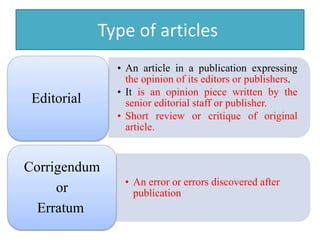
• An article in a publication expressing
the opinion of its editors or publishers.
• It is an opinion piece written by the
senior editorial staff or publisher.
• Short review or critique of original
article.
Editorial
• An error or errors discovered after
publication
Corrigendum
or
Erratum
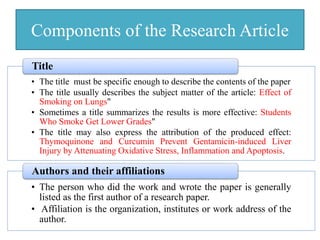
Components of the Research Article
• The title must be specific enough to describe the contents of the paper
• The title usually describes the subject matter of the article: Effect of
Smoking on Lungs"
• Sometimes a title summarizes the results is more effective: Students
Who Smoke Get Lower Grades"
• The title may also express the attribution of the produced effect:
Thymoquinone and Curcumin Prevent Gentamicin-induced Liver
Injury by Attenuating Oxidative Stress, Inflammation and Apoptosis.
Title
• The person who did the work and wrote the paper is generally
listed as the first author of a research paper.
• Affiliation is the organization, institutes or work address of the
author.
Authors and their affiliations
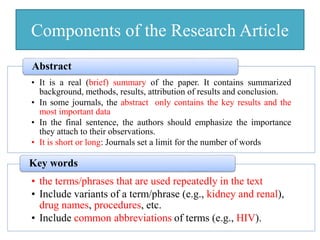
Components of the Research Article
• It is a real (brief) summary of the paper. It contains summarized
background, methods, results, attribution of results and conclusion.
• In some journals, the abstract only contains the key results and the
most important data
• In the final sentence, the authors should emphasize the importance
they attach to their observations.
• It is short or long: Journals set a limit for the number of words
Abstract
• the terms/phrases that are used repeatedly in the text
• Include variants of a term/phrase (e.g., kidney and renal),
drug names, procedures, etc.
• Include common abbreviations of terms (e.g., HIV).
Key words
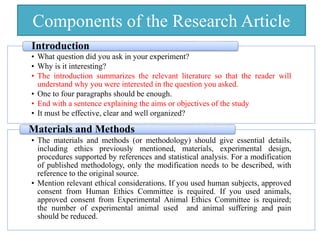
Components of the Research Article
• What question did you ask in your experiment?
• Why is it interesting?
• The introduction summarizes the relevant literature so that the reader will
understand why you were interested in the question you asked.
• One to four paragraphs should be enough.
• End with a sentence explaining the aims or objectives of the study
• It must be effective, clear and well organized?
Introduction
• The materials and methods (or methodology) should give essential details,
including ethics previously mentioned, materials, experimental design,
procedures supported by references and statistical analysis. For a modification
of published methodology, only the modification needs to be described, with
reference to the original source.
• Mention relevant ethical considerations. If you used human subjects, approved
consent from Human Ethics Committee is required. If you used animals,
approved consent from Experimental Animal Ethics Committee is required;
the number of experimental animal used and animal suffering and pain
should be reduced.
Materials and Methods
Components of the Research Article
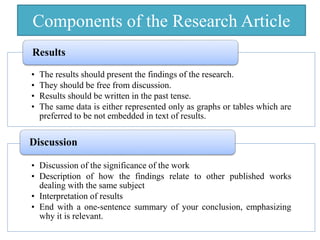
• The results should present the findings of the research.
• They should be free from discussion.
• Results should be written in the past tense.
• The same data is either represented only as graphs or tables which are
preferred to be not embedded in text of results.
Results
• Discussion of the significance of the work
• Description of how the findings relate to other published works
dealing with the same subject
• Interpretation of results
• End with a one-sentence summary of your conclusion, emphasizing
why it is relevant.
Discussion
Components of the Research Article
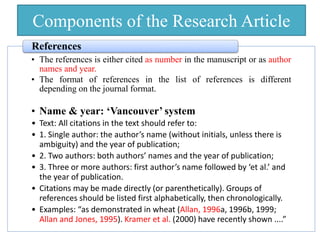
• The references is either cited as number in the manuscript or as author
names and year.
• The format of references in the list of references is different
depending on the journal format.
• Name & year: ‘Vancouver’ system
• Text: All citations in the text should refer to:
• 1. Single author: the author’s name (without initials, unless there is
ambiguity) and the year of publication;
• 2. Two authors: both authors’ names and the year of publication;
• 3. Three or more authors: first author’s name followed by ‘et al.’ and
the year of publication.
• Citations may be made directly (or parenthetically). Groups of
references should be listed first alphabetically, then chronologically.
• Examples: “as demonstrated in wheat (Allan, 1996a, 1996b, 1999;
Allan and Jones, 1995). Kramer et al. (2000) have recently shown ....”
References
Components of the Research Article
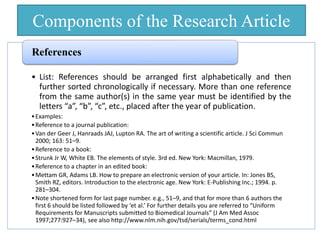
• List: References should be arranged first alphabetically and then
further sorted chronologically if necessary. More than one reference
from the same author(s) in the same year must be identified by the
letters “a”, “b”, “c”, etc., placed after the year of publication.
•Examples:
•Reference to a journal publication:
•Van der Geer J, Hanraads JAJ, Lupton RA. The art of writing a scientific article. J Sci Commun
2000; 163: 51–9.
•Reference to a book:
•Strunk Jr W, White EB. The elements of style. 3rd ed. New York: Macmillan, 1979.
•Reference to a chapter in an edited book:
•Mettam GR, Adams LB. How to prepare an electronic version of your article. In: Jones BS,
Smith RZ, editors. Introduction to the electronic age. New York: E-Publishing Inc.; 1994. p.
281–304.
•Note shortened form for last page number. e.g., 51–9, and that for more than 6 authors the
first 6 should be listed followed by ‘et al.’ For further details you are referred to “Uniform
Requirements for Manuscripts submitted to Biomedical Journals” (J Am Med Assoc
1997;277:927–34), see also http://www.nlm.nih.gov/tsd/serials/terms_cond.html
References
Publication Ethics
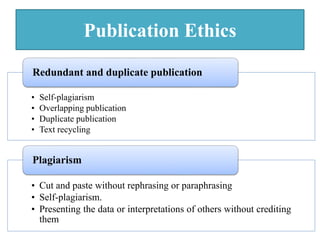
• Self-plagiarism
• Overlapping publication
• Duplicate publication
• Text recycling
Redundant and duplicate publication
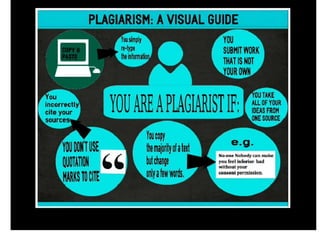
• Cut and paste without rephrasing or paraphrasing
• Self-plagiarism.
• Presenting the data or interpretations of others without crediting
them
Plagiarism
Plagiarism
Plagiarism
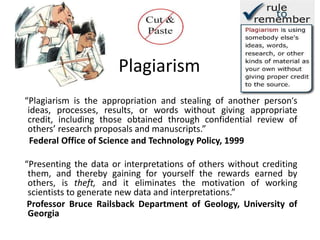
“Plagiarism is the appropriation and stealing of another person’s
ideas, processes, results, or words without giving appropriate
credit, including those obtained through confidential review of
others’ research proposals and manuscripts.”
Federal Office of Science and Technology Policy, 1999
“Presenting the data or interpretations of others without crediting
them, and thereby gaining for yourself the rewards earned by
others, is theft, and it eliminates the motivation of working
scientists to generate new data and interpretations.”
Professor Bruce Railsback Department of Geology, University of
Georgia
Publication Ethics
• Misleading description of results
• Misleading explanation and interpretation of results
• Misleading conclusion
• Incomplete reporting
Misleading reporting
• Gross or partial manipulation of images
• Fabrication of data
Falsification (image manipulation) and
Fabrication
Publication Ethics
• Use of false addresses.
Authorship problems
• Research involving animals or humans without approval
consents from Ethics Committees
Unethical research
Publication Ethics
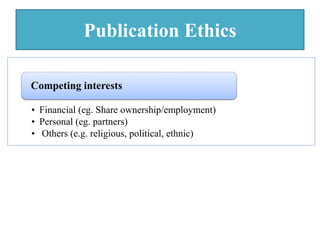
• Financial (eg. Share ownership/employment)
• Personal (eg. partners)
• Others (e.g. religious, political, ethnic)
Competing interests
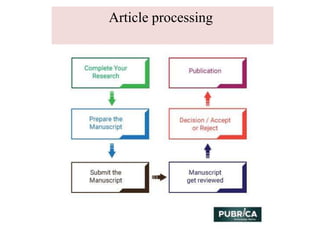
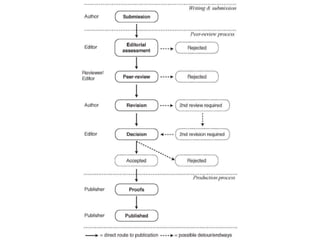
Article processing
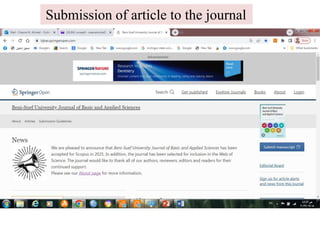
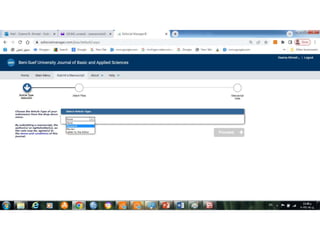
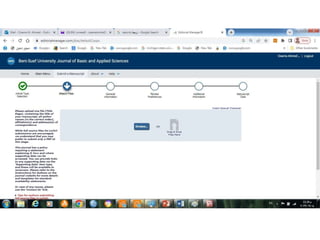
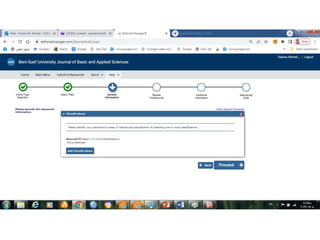
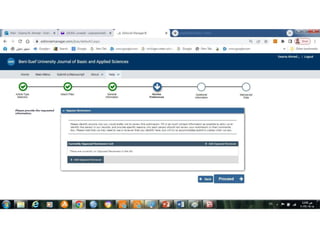
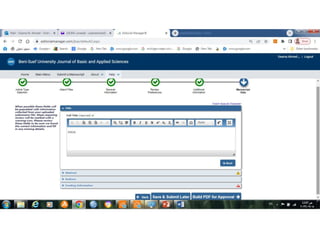
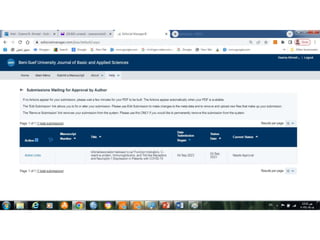
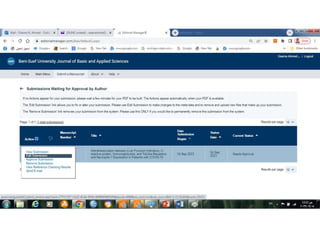
Submission of article to the journal
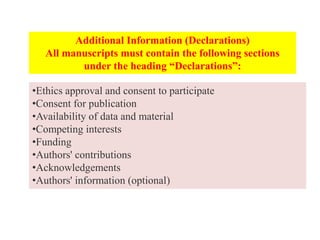
•Ethics approval and consent to participate
•Consent for publication
•Availability of data and material
•Competing interests
•Funding
•Authors' contributions
•Acknowledgements
•Authors' information (optional)
Additional Information (Declarations)
All manuscripts must contain the following sections
under the heading “Declarations”:
Lec.9 Publication Process Dr Osama Mohamed

Lec.9 Publication Process Dr Osama Mohamed

  • 1.
    Publication Process Prof. Dr.Osama Mohamed Ahmed Professor of Physiology Faculty of Science, Beni-Suef University
  • 2.
    Content What is meantby publication? Why is publication important? Reasons to publish?, Types of publications Types of articles Components of the Research Article Publication ethics Article Processing Submission of article to the journal
  • 3.
    What is meantby publication Publication is the act or process of making information available to be public in book, journal, magazine, …. in a print form or online.
  • 4.
    Why is publicationimportant? Reasons to publish 1- Dissemination and popularization of scientific knowledge. 2- Facilitate communication among scientists (Communicating the information). Scientific publications enable results and ideas to be transmitted throughout the scientific community. 3- Publishing helps establish you as an expert in your field of knowledge. You will become a recognized expert In your field 4- Publication is to advance scientific knowledge and improve human life. 5- For preserving research and ensuring access to it. assigning a DOI (Digital Object Identifier) to each publication allows readers to use a numerical identifier to track and find the original source. 6- By publishing papers, scientists ensure that their work is recognized
  • 5.
    Types of publications 1-Scientific articles published in scientific journals 2- Books wholly written by one author or a few co-authors 3- Edited books: The book consists of book chapters and each chapter is the responsibility of a different author or group of authors. The editor is responsible for determining the scope of the project, keeping the work on schedule, and ensuring consistency of style and content. 4- Patents in the relevant subject (for example, biological patents and chemical patents). 5- Reports released by international organization such as WHO, ADA, FDA …… etc. 5- Presentations at academic conferences, especially those organized by approved societies 6- Government reports such as a forensic investigation conducted by a government agency
  • 6.
    Type of articles •Papers should provide novel approaches and new insights into the problem addressed. It should contain an experimental work or a case study. Research Article main titles should arrange in the following order: abstract, brief introduction, materials and methods, results, discussion, acknowledgements, references, figures, tables. Research article Case study Case report • Review article is a survey on a particular topic. Review Articles should inform about: • recent major advances and discoveries • significant gaps in the research • current debates • future directions Only review articles from experts in the field will be considered for publication. Review article A case report is the description of the clinical story of a single patient. It is usually a single case.
  • 7.
    Type of articles •Short communication is for a concise, but independent report representing a significant contribution in the field. • It should be no more than 3000 words, and could include two figures or tables. It should have at least 8 references. Short Communication • A technical note is an article giving a brief description of a technique or procedure. It may also refer to the modification of a technique, procedure or equipment of interest to the journal. Technical note • It is a letter sent from expert researcher for discussion of a subject of interest to the readers, including those published in the journal and for miscellaneous contributions. Letter to the editor
  • 8.
    Type of articles •An article in a publication expressing the opinion of its editors or publishers. • It is an opinion piece written by the senior editorial staff or publisher. • Short review or critique of original article. Editorial • An error or errors discovered after publication Corrigendum or Erratum
  • 9.
    Components of theResearch Article • The title must be specific enough to describe the contents of the paper • The title usually describes the subject matter of the article: Effect of Smoking on Lungs" • Sometimes a title summarizes the results is more effective: Students Who Smoke Get Lower Grades" • The title may also express the attribution of the produced effect: Thymoquinone and Curcumin Prevent Gentamicin-induced Liver Injury by Attenuating Oxidative Stress, Inflammation and Apoptosis. Title • The person who did the work and wrote the paper is generally listed as the first author of a research paper. • Affiliation is the organization, institutes or work address of the author. Authors and their affiliations
  • 10.
    Components of theResearch Article • It is a real (brief) summary of the paper. It contains summarized background, methods, results, attribution of results and conclusion. • In some journals, the abstract only contains the key results and the most important data • In the final sentence, the authors should emphasize the importance they attach to their observations. • It is short or long: Journals set a limit for the number of words Abstract • the terms/phrases that are used repeatedly in the text • Include variants of a term/phrase (e.g., kidney and renal), drug names, procedures, etc. • Include common abbreviations of terms (e.g., HIV). Key words
  • 11.
    Components of theResearch Article • What question did you ask in your experiment? • Why is it interesting? • The introduction summarizes the relevant literature so that the reader will understand why you were interested in the question you asked. • One to four paragraphs should be enough. • End with a sentence explaining the aims or objectives of the study • It must be effective, clear and well organized? Introduction • The materials and methods (or methodology) should give essential details, including ethics previously mentioned, materials, experimental design, procedures supported by references and statistical analysis. For a modification of published methodology, only the modification needs to be described, with reference to the original source. • Mention relevant ethical considerations. If you used human subjects, approved consent from Human Ethics Committee is required. If you used animals, approved consent from Experimental Animal Ethics Committee is required; the number of experimental animal used and animal suffering and pain should be reduced. Materials and Methods
  • 12.
    Components of theResearch Article • The results should present the findings of the research. • They should be free from discussion. • Results should be written in the past tense. • The same data is either represented only as graphs or tables which are preferred to be not embedded in text of results. Results • Discussion of the significance of the work • Description of how the findings relate to other published works dealing with the same subject • Interpretation of results • End with a one-sentence summary of your conclusion, emphasizing why it is relevant. Discussion
  • 13.
    Components of theResearch Article • The references is either cited as number in the manuscript or as author names and year. • The format of references in the list of references is different depending on the journal format. • Name & year: ‘Vancouver’ system • Text: All citations in the text should refer to: • 1. Single author: the author’s name (without initials, unless there is ambiguity) and the year of publication; • 2. Two authors: both authors’ names and the year of publication; • 3. Three or more authors: first author’s name followed by ‘et al.’ and the year of publication. • Citations may be made directly (or parenthetically). Groups of references should be listed first alphabetically, then chronologically. • Examples: “as demonstrated in wheat (Allan, 1996a, 1996b, 1999; Allan and Jones, 1995). Kramer et al. (2000) have recently shown ....” References
  • 14.
    Components of theResearch Article • List: References should be arranged first alphabetically and then further sorted chronologically if necessary. More than one reference from the same author(s) in the same year must be identified by the letters “a”, “b”, “c”, etc., placed after the year of publication. •Examples: •Reference to a journal publication: •Van der Geer J, Hanraads JAJ, Lupton RA. The art of writing a scientific article. J Sci Commun 2000; 163: 51–9. •Reference to a book: •Strunk Jr W, White EB. The elements of style. 3rd ed. New York: Macmillan, 1979. •Reference to a chapter in an edited book: •Mettam GR, Adams LB. How to prepare an electronic version of your article. In: Jones BS, Smith RZ, editors. Introduction to the electronic age. New York: E-Publishing Inc.; 1994. p. 281–304. •Note shortened form for last page number. e.g., 51–9, and that for more than 6 authors the first 6 should be listed followed by ‘et al.’ For further details you are referred to “Uniform Requirements for Manuscripts submitted to Biomedical Journals” (J Am Med Assoc 1997;277:927–34), see also http://www.nlm.nih.gov/tsd/serials/terms_cond.html References
  • 15.
    Publication Ethics • Self-plagiarism •Overlapping publication • Duplicate publication • Text recycling Redundant and duplicate publication • Cut and paste without rephrasing or paraphrasing • Self-plagiarism. • Presenting the data or interpretations of others without crediting them Plagiarism
  • 16.
  • 17.
    Plagiarism “Plagiarism is theappropriation and stealing of another person’s ideas, processes, results, or words without giving appropriate credit, including those obtained through confidential review of others’ research proposals and manuscripts.” Federal Office of Science and Technology Policy, 1999 “Presenting the data or interpretations of others without crediting them, and thereby gaining for yourself the rewards earned by others, is theft, and it eliminates the motivation of working scientists to generate new data and interpretations.” Professor Bruce Railsback Department of Geology, University of Georgia
  • 19.
    Publication Ethics • Misleadingdescription of results • Misleading explanation and interpretation of results • Misleading conclusion • Incomplete reporting Misleading reporting • Gross or partial manipulation of images • Fabrication of data Falsification (image manipulation) and Fabrication
  • 20.
    Publication Ethics • Useof false addresses. Authorship problems • Research involving animals or humans without approval consents from Ethics Committees Unethical research
  • 21.
    Publication Ethics • Financial(eg. Share ownership/employment) • Personal (eg. partners) • Others (e.g. religious, political, ethnic) Competing interests
  • 22.
  • 24.
    Submission of articleto the journal
  • 29.
    •Ethics approval andconsent to participate •Consent for publication •Availability of data and material •Competing interests •Funding •Authors' contributions •Acknowledgements •Authors' information (optional) Additional Information (Declarations) All manuscripts must contain the following sections under the heading “Declarations”: