.
.
The account
• Debit & credits
• Shareholder
equity
• Summary of DR
CR rules

Steps of Recording
Process
• JOURNEL
• LEDGER
• POSTING

Recording process
• Summary

Trial balance
• Limitations of
Trial balance
.
• The name given to the collective process of recording and
processing the accounting events of a company. The series of steps
begin when a transaction occurs and end with its inclusion in the
financial statements.
1. Collecting and analysing data from transactions and events.
2. Putting transactions into the general journal.
3. Posting entries to the general ledger.
4. Preparing an unadjusted trial balance.
5. Adjusting entries appropriately.
6. Preparing an adjusted trial balance.
7. Organizing the accounts into the financial statements.
8. Closing the books.
,
• documents are important because they are the ultimate proof a
business transaction has occurred.

• is a part of the accounting system used to classify and summarize
the increases, decreases, and balances of each asset, liability,
stockholders' equity item, dividend, revenue, and expense.
• that each transaction be recorded by an entry that has equal debits
and credits is called double-entry procedure.
procedure keeps the accounting equation in balance
• A registry of pecuniary transactions; a written or printed statement of
business dealings or debts and credits, and also of other things subjected
to a reckoning or review
• Account a written or printed statement of business dealings or debts
and credits, and also of other things
• The development and use of a system for recording and analysing the
financial transactions and financial status of a business or other
organization.
• Amounts that customers owe the company for normal credit purchases.

Accumulated depreciation is known as a contra account, because it
separately shows a negative amount that is directly associated with
another account.
•

Something or someone of any value; any portion of one's
property or effects so considered
Items of ownership convertible into cash; total resources
of a person or business, as cash, notes and accounts receivable;
securities and accounts receivable, securities, inventories,
goodwill, fixtures, machinery, or real estate (as opposed to
liabilities)

Any property or object of value that one possesses,
usually considered as applicable to the payment of one's debts
A resource with economic value that an individual,
corporation, or country owns or controls with the expectation that
it will provide future benefit
• A debt which cannot be recovered from the debtor, either
because the debtor doesn't have the money to pay or
because the debtor cannot be found and/or forced to pay
• bad debts A bad debt is an amount owed to a business or
individual that is written off by the creditor as a loss (and
classified as an expense) because the debt cannot be
collected and all reasonable efforts to collect it have been
exhausted. This usually occurs when the debtor has
declared bankruptcy or the cost of pursuing further action
in an attempt to collect the debt exceeds the debt itself.
balance sheet A summary of a person's
or organization's assets, liabilities. and
equity as of a specific date. Balance
Sheet A balance sheet is often described
as a "snapshot of a company's financial
condition." A standard company balance
sheet has three parts: assets, liabilities,
and ownership equity
• an entry in the right hand column of an account; credits
increase liability, income, and equity accounts and decrease
asset and expense accounts
• an entry in the left hand column of an account to record a
debt; debits increase asset and expense accounts and decrease
liability, income, and equity accounts
• a written or printed statement of business dealings or debts
and credits, and also of other things subjected to a reckoning
or review
that one person or entity owes or is required to pay to
another, generally as a result of a loan or other financial
transaction
dividend A pro rata payment of
money by a company to its
shareholders, usually made
periodically (e.g., quarterly or
annually)
Equity Ownership interest in a company, as determined by subtracting liabilities from assets.
„
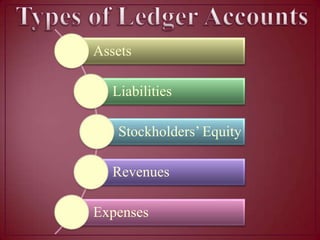
Assets
Liabilities
Stockholders‟ Equity

Revenues
Expenses
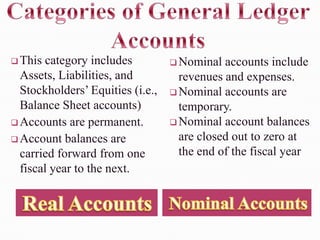
 This

category includes
Assets, Liabilities, and
Stockholders‟ Equities (i.e.,
Balance Sheet accounts)
 Accounts are permanent.
 Account balances are
carried forward from one
fiscal year to the next.

 Nominal

accounts include
revenues and expenses.
 Nominal accounts are
temporary.
 Nominal account balances
are closed out to zero at
the end of the fiscal year
•

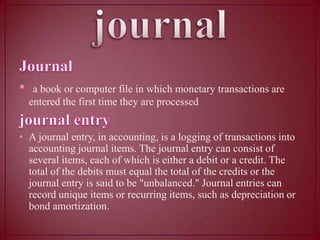
a book or computer file in which monetary transactions are
entered the first time they are processed

• A journal entry, in accounting, is a logging of transactions into
accounting journal items. The journal entry can consist of
several items, each of which is either a debit or a credit. The
total of the debits must equal the total of the credits or the
journal entry is said to be "unbalanced." Journal entries can
record unique items or recurring items, such as depreciation or
bond amortization.
• A collection of accounting entries consisting of credits and
debits.
• A book for keeping notes, especially one for keeping
accounting records.(accounting) A collection of accounting
entries consisting of credits and debits.
• liability An obligation, debt or responsibility owed to
someone.
• liabilities An amount of money in a company that is
owed to someone and has to be paid in the future, such
as tax, debt, interest, and mortgage payments
•
Liabilities Probable future sacrifices of economic
benefits arising from present obligations to transfer
assets or providing services as a result of past
transactions or events.
• an entry in the left hand column of an account to record a
debt; debits increase asset and expense accounts and
decrease liability, income, and equity accounts

• A registry of pecuniary transactions; a written or printed
statement of business dealings or debts and credits, and
also of other things subjected to a reckoning or review
• an entry in the right hand column of an account; credits
increase liability, income, and equity accounts and
decrease asset and expense accounts
.
Shareholder
Equity

Common
stock +

Retained
Earning
• Record of increases and decreases in a specific asset, liability,
equity, revenue, or expense item.
• Debit = “Left”
• Credit = “Right”
Account Name

An Account can be
illustrated in a
T-Account form.

Debit / Dr.

Credit / Cr.
• Each transaction must affect two or more
accounts to keep the basic accounting
equation in balance.
• Recording done by debiting at least one
account and crediting another.
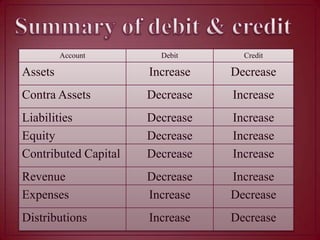
Account

Debit

Credit

Assets

Increase

Decrease

Contra Assets

Decrease

Increase

Liabilities
Equity
Contributed Capital

Decrease
Decrease
Decrease

Increase
Increase
Increase

Revenue
Expenses

Decrease
Increase

Increase
Decrease

Distributions

Increase

Decrease
• Debit (DR)
• Credit (CR)

Debit refers to the LEFT and Credit to the RIGHT side of the T-Account

LEFT
DEBIT SIDE

RIGHT
CREDIT SIDE
Normal
Balance
Credit
Assets
Debit / Dr.

Normal Balance

Chapter
3-23

Credit / Cr.
Asset

= Liability + Equity

Revenue - Expense
Assets
Debit / Dr.

Debits should
exceed credits.
Credits
should exceed debits.

Credit / Cr.

Normal Balance

Chapter
3-23

Liabilities
Debit / Dr.

Credit / Cr.

is on the increase side.
Normal Balance

Chapter
3-24
Owner’s Equity
Debit / Dr.

Credit / Cr.

increase owner‟s equity (credit).

Normal Balance

decrease owner‟s equity (debit).

Chapter
3-25

Owner’s Capital

Owner’s Drawing

Chapter
3-25

Credit / Cr.

Debit / Dr.

Normal Balance

Debit / Dr.

Normal Balance

Chapter
3-23

Credit / Cr.
Relationship among the assets, liabilities & owner‟s
equity of a business:
Assets = Liabilities

+

Owner’s Equity

The equation must be in balance after every
transaction. For every Debit there must be a Credit.
Revenue
Debit / Dr.

Chapter
3-26

Expense

Normal Balance

Chapter
3-27

The purpose of earning
is to benefit the owner(s).



The effect of debits and credits on
revenue accounts is the
their effect on Owner‟s Capital.

Credit / Cr.

Normal Balance

Debit / Dr.



Credit / Cr.

have the opposite
effect: expenses decrease owner‟s
equity.
• Book of original entry.
• Transactions recorded in chronological order.

• Discloses the complete effects of a transaction.
• Provides a chronological record of transactions.
• Helps to prevent or locate errors because the debit
and credit amounts can be easily compared
 On

January 1, 19X7, Caldwell Company borrows
$10,000 from the bank.
 Prepare the appropriate general journal entry for the
above transaction.
 Cash

is increased by $10,000.
 Notes Payable is increased by $10,000.
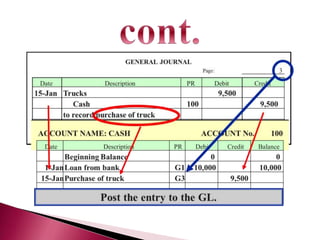
 On

January 15, 19X7, Caldwell Company purchases a
truck for $19,500 cash.

Prepare the appropriate journal entry for the above
transaction.

Trucks is increased by $19,500.
Cash is decreased by $19,500.
 On

January 20, 19X7, Caldwell Co. pays the $400
electric bill for January.

Prepare the appropriate journal entry for the above
transaction.

Utility Expense is increased by $400.
Cash is decreased by $400.
 On

Oct. 3 Purchases office furniture for $1,900, on account.
 Oct.27

Oct. 3.

Pays $700 on balance related to transaction of
 Oct.

30 Pays the administrative assistant $2,500 salary
for Oct.
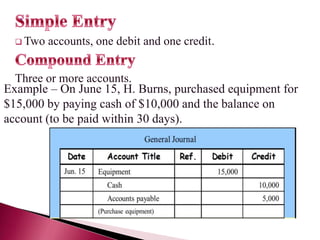
 Two

accounts, one debit and one credit.

Three or more accounts.
Example – On June 15, H. Burns, purchased equipment for
$15,000 by paying cash of $10,000 and the balance on
account (to be paid within 30 days).
.
,
.
 The

Dividends account is a contra account to Retained
Earnings. Therefore, it is affected by debits and credits
Recording business transactions

Recording business transactions

  • 1.
  • 2.
  • 3.
    The account • Debit& credits • Shareholder equity • Summary of DR CR rules Steps of Recording Process • JOURNEL • LEDGER • POSTING Recording process • Summary Trial balance • Limitations of Trial balance
  • 4.
  • 6.
    • The namegiven to the collective process of recording and processing the accounting events of a company. The series of steps begin when a transaction occurs and end with its inclusion in the financial statements. 1. Collecting and analysing data from transactions and events. 2. Putting transactions into the general journal. 3. Posting entries to the general ledger. 4. Preparing an unadjusted trial balance. 5. Adjusting entries appropriately. 6. Preparing an adjusted trial balance. 7. Organizing the accounts into the financial statements. 8. Closing the books.
  • 7.
  • 9.
    • documents areimportant because they are the ultimate proof a business transaction has occurred. • is a part of the accounting system used to classify and summarize the increases, decreases, and balances of each asset, liability, stockholders' equity item, dividend, revenue, and expense. • that each transaction be recorded by an entry that has equal debits and credits is called double-entry procedure. procedure keeps the accounting equation in balance
  • 11.
    • A registryof pecuniary transactions; a written or printed statement of business dealings or debts and credits, and also of other things subjected to a reckoning or review • Account a written or printed statement of business dealings or debts and credits, and also of other things • The development and use of a system for recording and analysing the financial transactions and financial status of a business or other organization. • Amounts that customers owe the company for normal credit purchases. Accumulated depreciation is known as a contra account, because it separately shows a negative amount that is directly associated with another account.
  • 12.
    • Something or someoneof any value; any portion of one's property or effects so considered Items of ownership convertible into cash; total resources of a person or business, as cash, notes and accounts receivable; securities and accounts receivable, securities, inventories, goodwill, fixtures, machinery, or real estate (as opposed to liabilities) Any property or object of value that one possesses, usually considered as applicable to the payment of one's debts A resource with economic value that an individual, corporation, or country owns or controls with the expectation that it will provide future benefit
  • 13.
    • A debtwhich cannot be recovered from the debtor, either because the debtor doesn't have the money to pay or because the debtor cannot be found and/or forced to pay • bad debts A bad debt is an amount owed to a business or individual that is written off by the creditor as a loss (and classified as an expense) because the debt cannot be collected and all reasonable efforts to collect it have been exhausted. This usually occurs when the debtor has declared bankruptcy or the cost of pursuing further action in an attempt to collect the debt exceeds the debt itself.
  • 14.
    balance sheet Asummary of a person's or organization's assets, liabilities. and equity as of a specific date. Balance Sheet A balance sheet is often described as a "snapshot of a company's financial condition." A standard company balance sheet has three parts: assets, liabilities, and ownership equity
  • 15.
    • an entryin the right hand column of an account; credits increase liability, income, and equity accounts and decrease asset and expense accounts • an entry in the left hand column of an account to record a debt; debits increase asset and expense accounts and decrease liability, income, and equity accounts • a written or printed statement of business dealings or debts and credits, and also of other things subjected to a reckoning or review that one person or entity owes or is required to pay to another, generally as a result of a loan or other financial transaction
  • 17.
    dividend A prorata payment of money by a company to its shareholders, usually made periodically (e.g., quarterly or annually)
  • 18.
    Equity Ownership interestin a company, as determined by subtracting liabilities from assets.
  • 19.
  • 21.
  • 23.
     This category includes Assets,Liabilities, and Stockholders‟ Equities (i.e., Balance Sheet accounts)  Accounts are permanent.  Account balances are carried forward from one fiscal year to the next.  Nominal accounts include revenues and expenses.  Nominal accounts are temporary.  Nominal account balances are closed out to zero at the end of the fiscal year
  • 24.
    • a book orcomputer file in which monetary transactions are entered the first time they are processed • A journal entry, in accounting, is a logging of transactions into accounting journal items. The journal entry can consist of several items, each of which is either a debit or a credit. The total of the debits must equal the total of the credits or the journal entry is said to be "unbalanced." Journal entries can record unique items or recurring items, such as depreciation or bond amortization.
  • 25.
    • A collectionof accounting entries consisting of credits and debits. • A book for keeping notes, especially one for keeping accounting records.(accounting) A collection of accounting entries consisting of credits and debits.
  • 26.
    • liability Anobligation, debt or responsibility owed to someone. • liabilities An amount of money in a company that is owed to someone and has to be paid in the future, such as tax, debt, interest, and mortgage payments • Liabilities Probable future sacrifices of economic benefits arising from present obligations to transfer assets or providing services as a result of past transactions or events.
  • 27.
    • an entryin the left hand column of an account to record a debt; debits increase asset and expense accounts and decrease liability, income, and equity accounts • A registry of pecuniary transactions; a written or printed statement of business dealings or debts and credits, and also of other things subjected to a reckoning or review • an entry in the right hand column of an account; credits increase liability, income, and equity accounts and decrease asset and expense accounts
  • 28.
  • 29.
  • 30.
    • Record ofincreases and decreases in a specific asset, liability, equity, revenue, or expense item. • Debit = “Left” • Credit = “Right” Account Name An Account can be illustrated in a T-Account form. Debit / Dr. Credit / Cr.
  • 31.
    • Each transactionmust affect two or more accounts to keep the basic accounting equation in balance. • Recording done by debiting at least one account and crediting another.
  • 32.
  • 33.
    • Debit (DR) •Credit (CR) Debit refers to the LEFT and Credit to the RIGHT side of the T-Account LEFT DEBIT SIDE RIGHT CREDIT SIDE
  • 34.
    Normal Balance Credit Assets Debit / Dr. NormalBalance Chapter 3-23 Credit / Cr.
  • 37.
    Asset = Liability +Equity Revenue - Expense
  • 38.
    Assets Debit / Dr. Debitsshould exceed credits. Credits should exceed debits. Credit / Cr. Normal Balance Chapter 3-23 Liabilities Debit / Dr. Credit / Cr. is on the increase side. Normal Balance Chapter 3-24
  • 40.
    Owner’s Equity Debit /Dr. Credit / Cr. increase owner‟s equity (credit). Normal Balance decrease owner‟s equity (debit). Chapter 3-25 Owner’s Capital Owner’s Drawing Chapter 3-25 Credit / Cr. Debit / Dr. Normal Balance Debit / Dr. Normal Balance Chapter 3-23 Credit / Cr.
  • 41.
    Relationship among theassets, liabilities & owner‟s equity of a business: Assets = Liabilities + Owner’s Equity The equation must be in balance after every transaction. For every Debit there must be a Credit.
  • 42.
    Revenue Debit / Dr. Chapter 3-26 Expense NormalBalance Chapter 3-27 The purpose of earning is to benefit the owner(s).  The effect of debits and credits on revenue accounts is the their effect on Owner‟s Capital. Credit / Cr. Normal Balance Debit / Dr.  Credit / Cr. have the opposite effect: expenses decrease owner‟s equity.
  • 43.
    • Book oforiginal entry. • Transactions recorded in chronological order. • Discloses the complete effects of a transaction. • Provides a chronological record of transactions. • Helps to prevent or locate errors because the debit and credit amounts can be easily compared
  • 45.
     On January 1,19X7, Caldwell Company borrows $10,000 from the bank.  Prepare the appropriate general journal entry for the above transaction.
  • 46.
     Cash is increasedby $10,000.  Notes Payable is increased by $10,000.
  • 47.
     On January 15,19X7, Caldwell Company purchases a truck for $19,500 cash.  Prepare the appropriate journal entry for the above transaction. Trucks is increased by $19,500. Cash is decreased by $19,500.
  • 49.
     On January 20,19X7, Caldwell Co. pays the $400 electric bill for January.  Prepare the appropriate journal entry for the above transaction. Utility Expense is increased by $400. Cash is decreased by $400.
  • 51.
     On Oct. 3Purchases office furniture for $1,900, on account.
  • 52.
     Oct.27 Oct. 3. Pays$700 on balance related to transaction of
  • 53.
     Oct. 30 Paysthe administrative assistant $2,500 salary for Oct.
  • 54.
     Two accounts, onedebit and one credit. Three or more accounts. Example – On June 15, H. Burns, purchased equipment for $15,000 by paying cash of $10,000 and the balance on account (to be paid within 30 days).
  • 61.
  • 63.
  • 64.
  • 65.
     The Dividends accountis a contra account to Retained Earnings. Therefore, it is affected by debits and credits