






Unit 3 
Debits and Credits 
ACCOUNTING & FINANCE 
ORCUTT ACADEMY HIGH SCHOOL 
VIEW THE TEXT AT 
WWW.ACCOUNTING-BASICS-FOR-STUDENTS.COM/DOUBLE - 
ENTRY-ACCOUNTING.HTML
Financing 
 Financing is the act of getting money. 
 Financing means where you get your money from. 
 Financing is the source of money.
Financing 
 Occurs first 
 Can be obtained from 
 the owner 
 a lender 
 the profit you make.
Investing 
 Investing is the spending of money. 
 One can spend money on (invest in) 
 things that provide only immediate benefits (expenses) 
 things that provide continuing benefits into the future (assets)
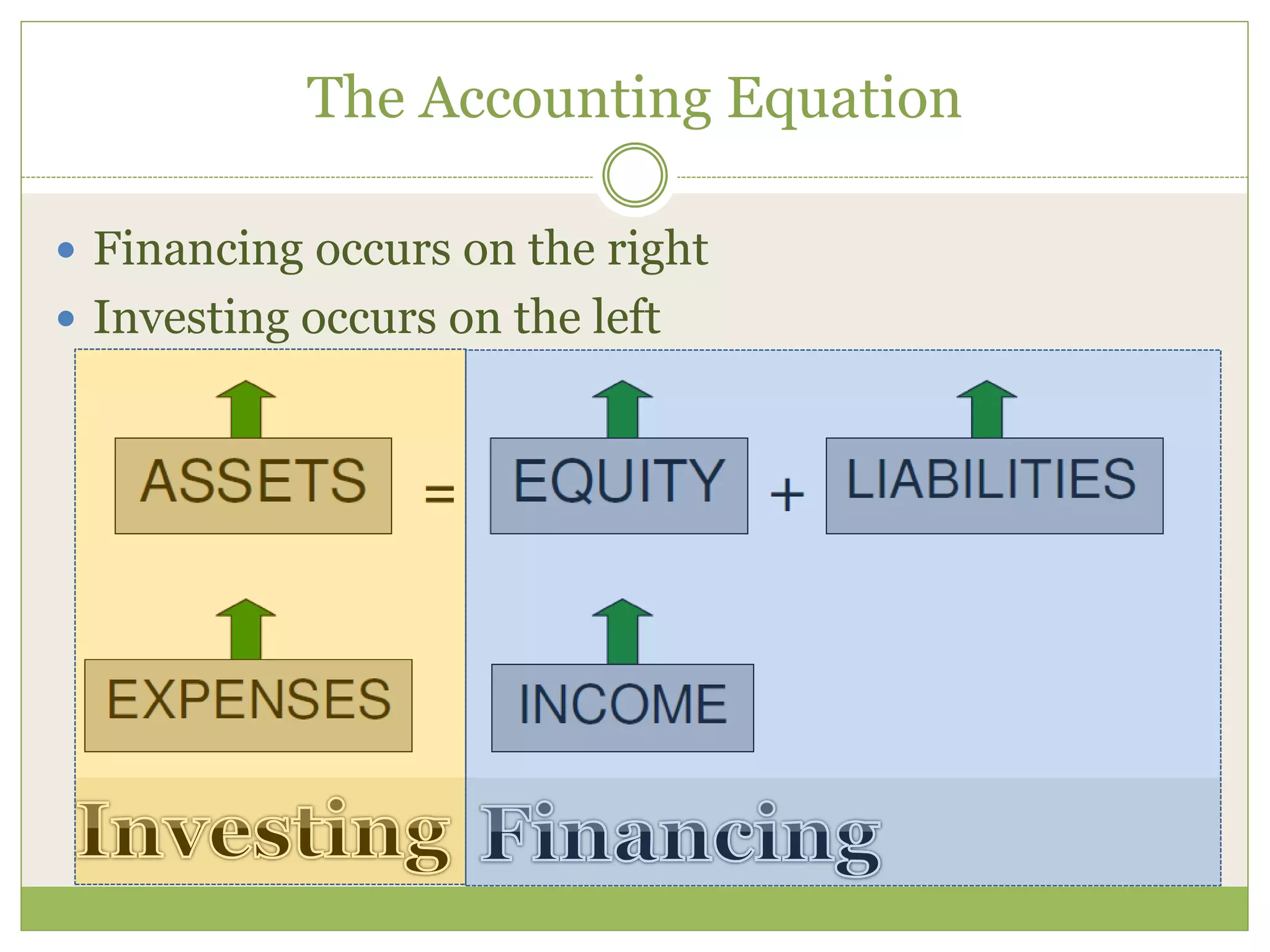
The Accounting Equation 
 Financing occurs on the right 
 Investing occurs on the left
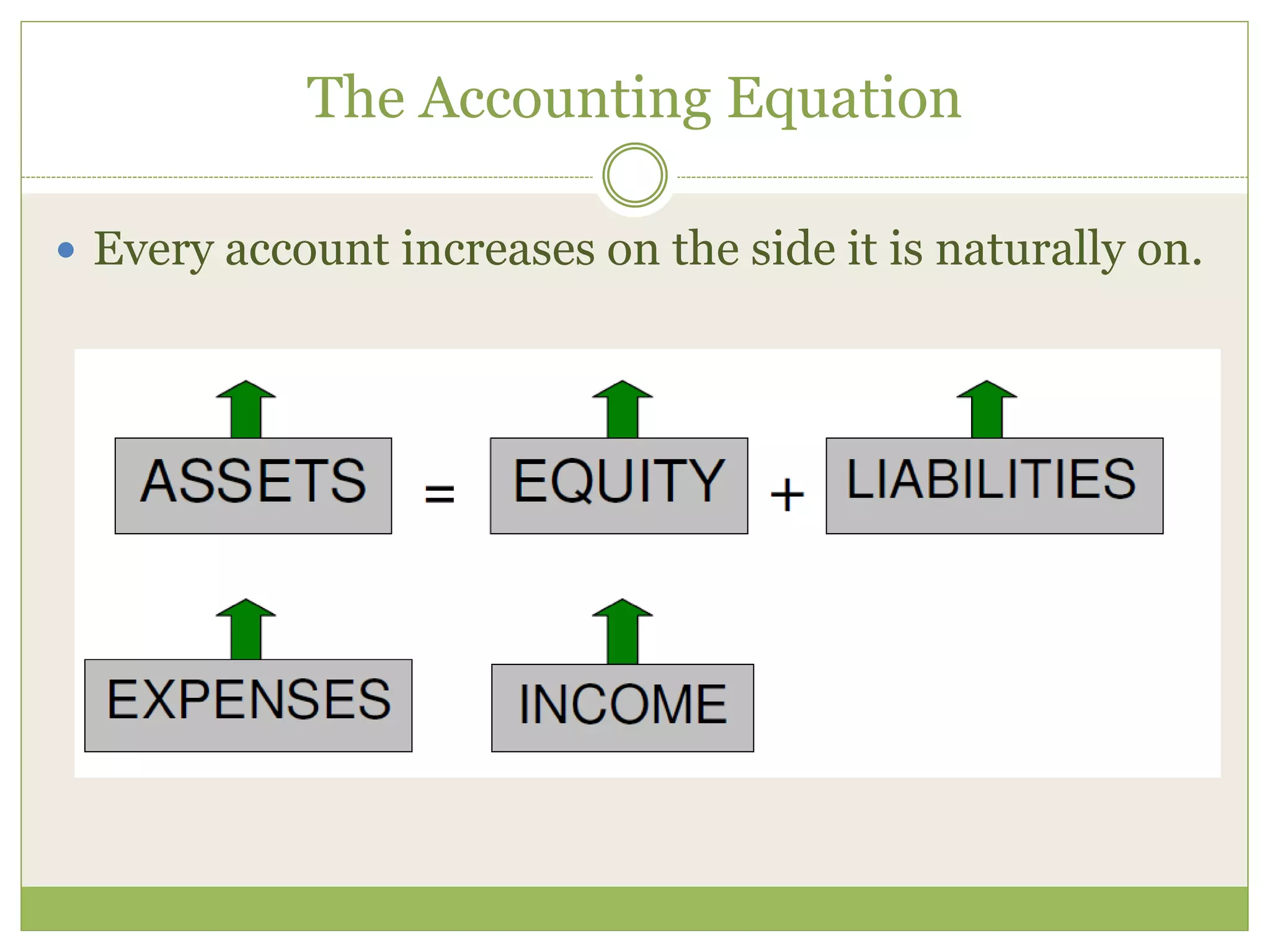
The Accounting Equation 
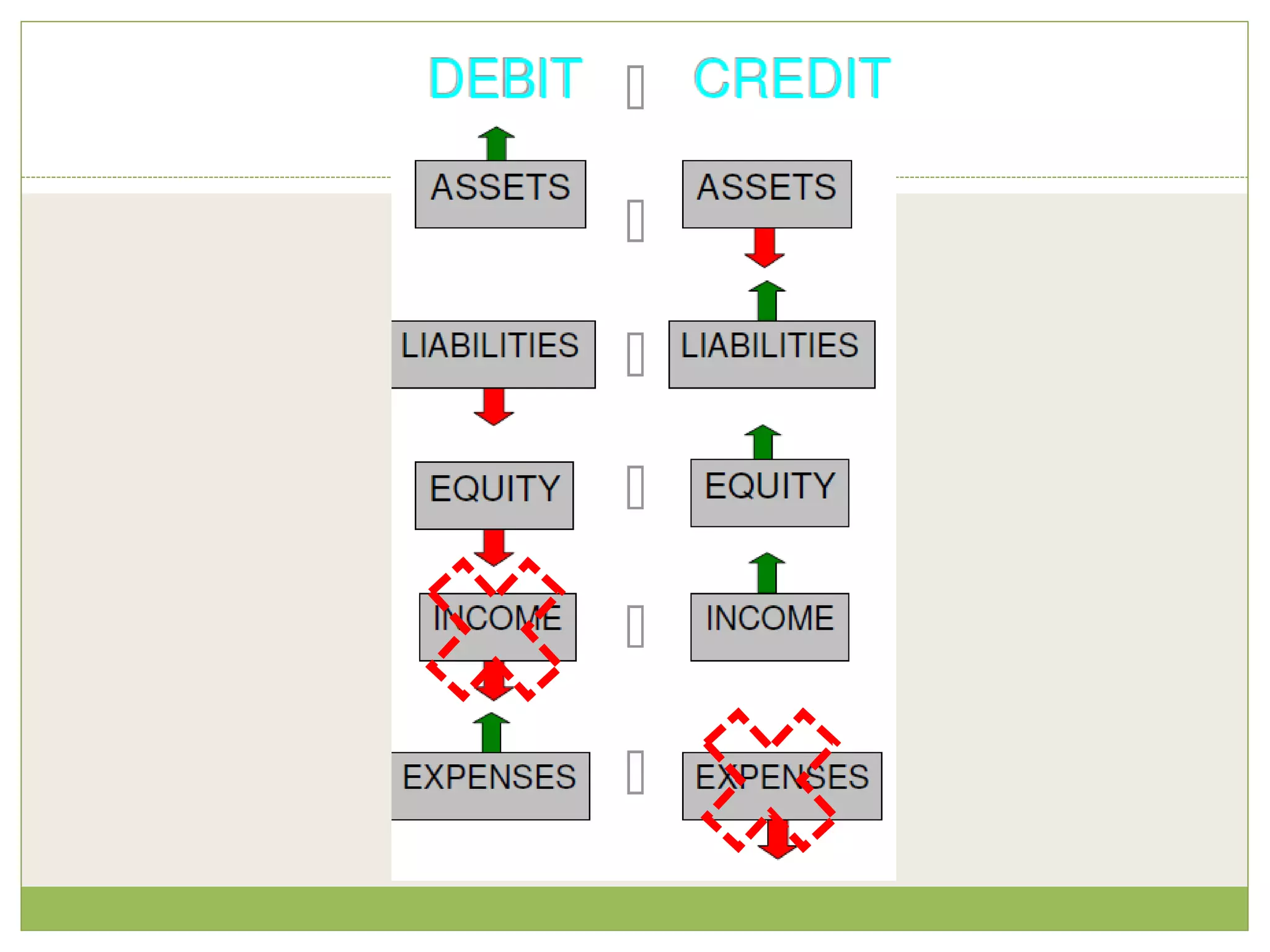
 Every account increases on the side it is naturally on.
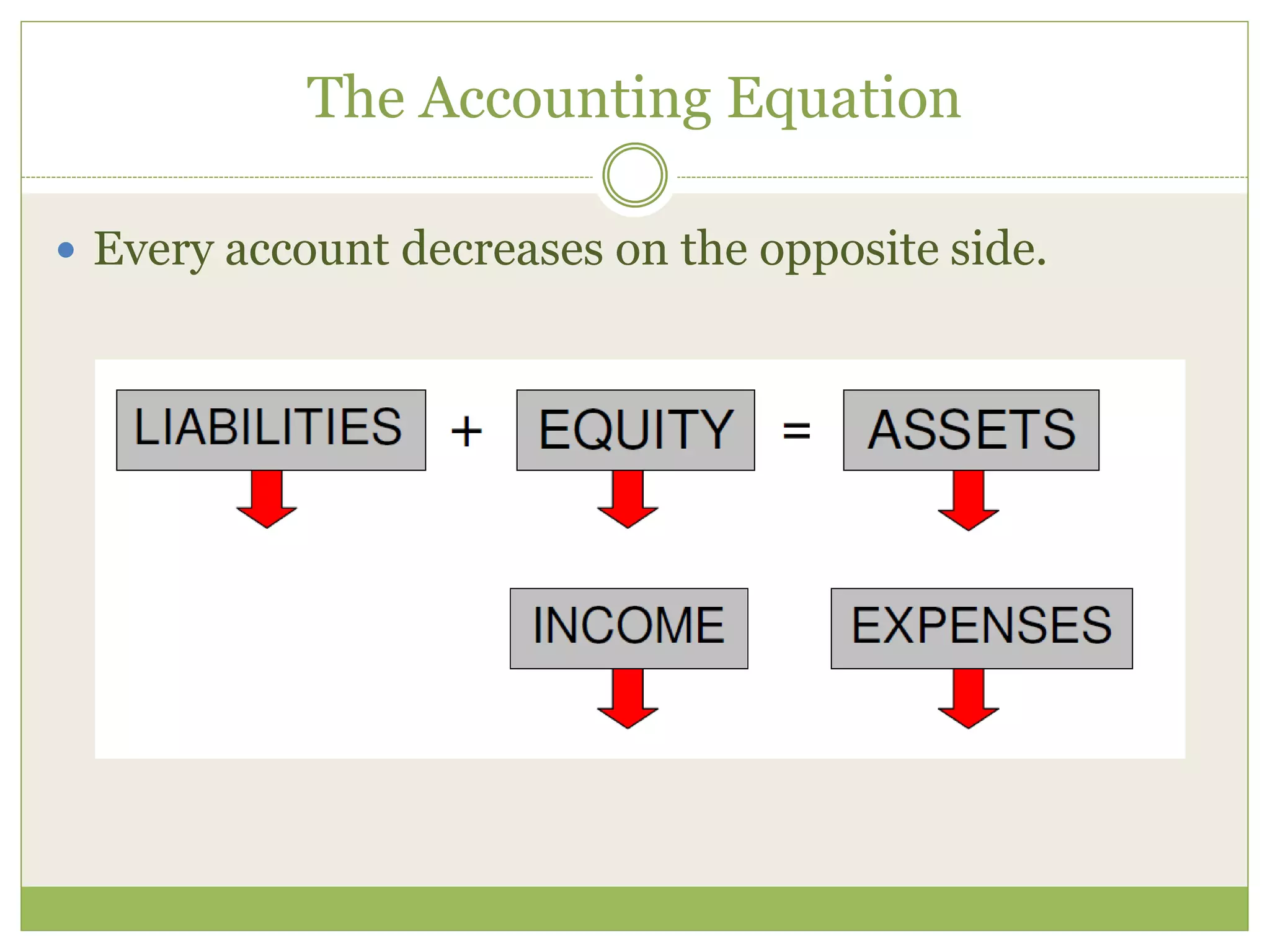
The Accounting Equation 
 Every account decreases on the opposite side.
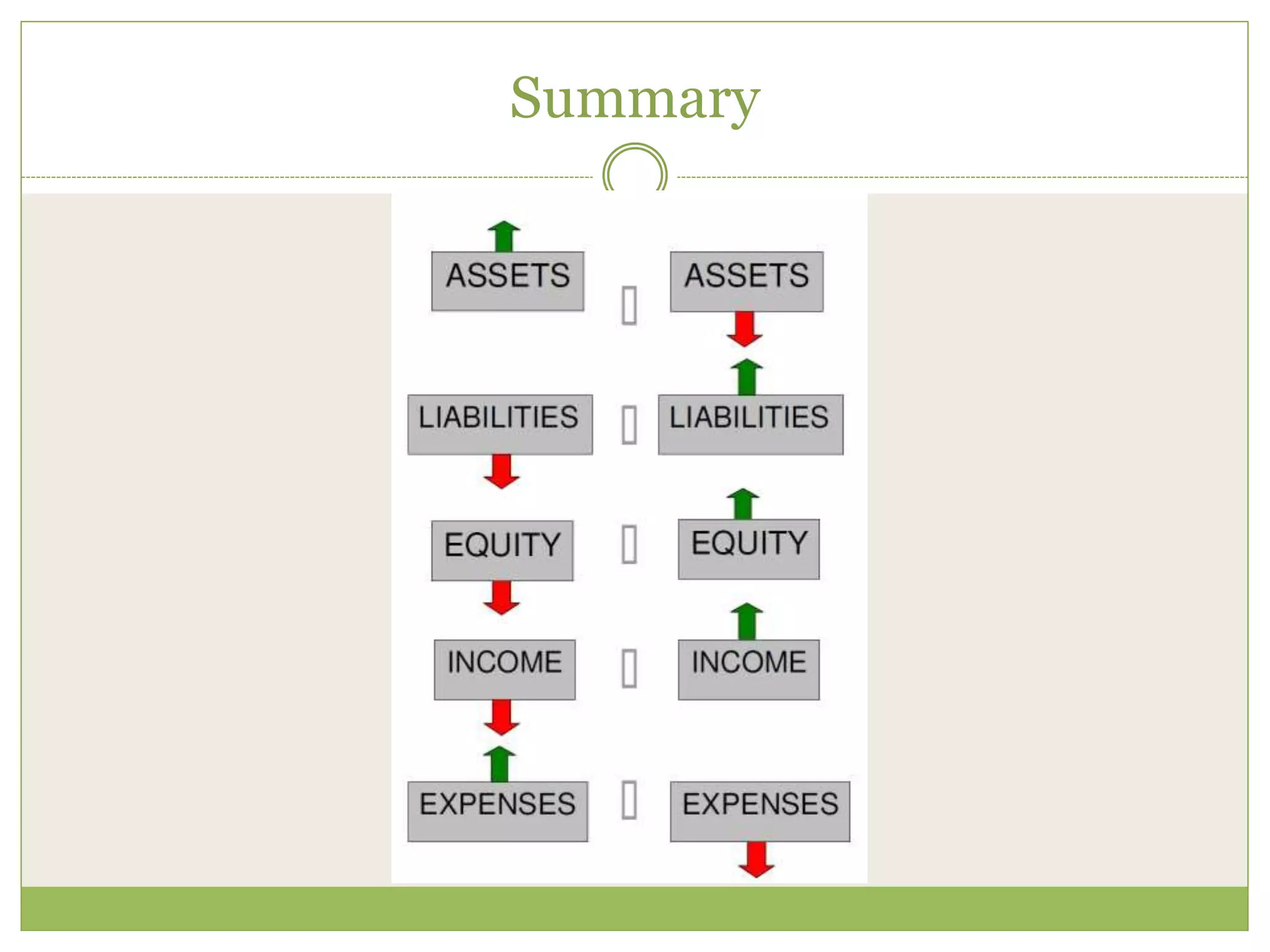
Summary
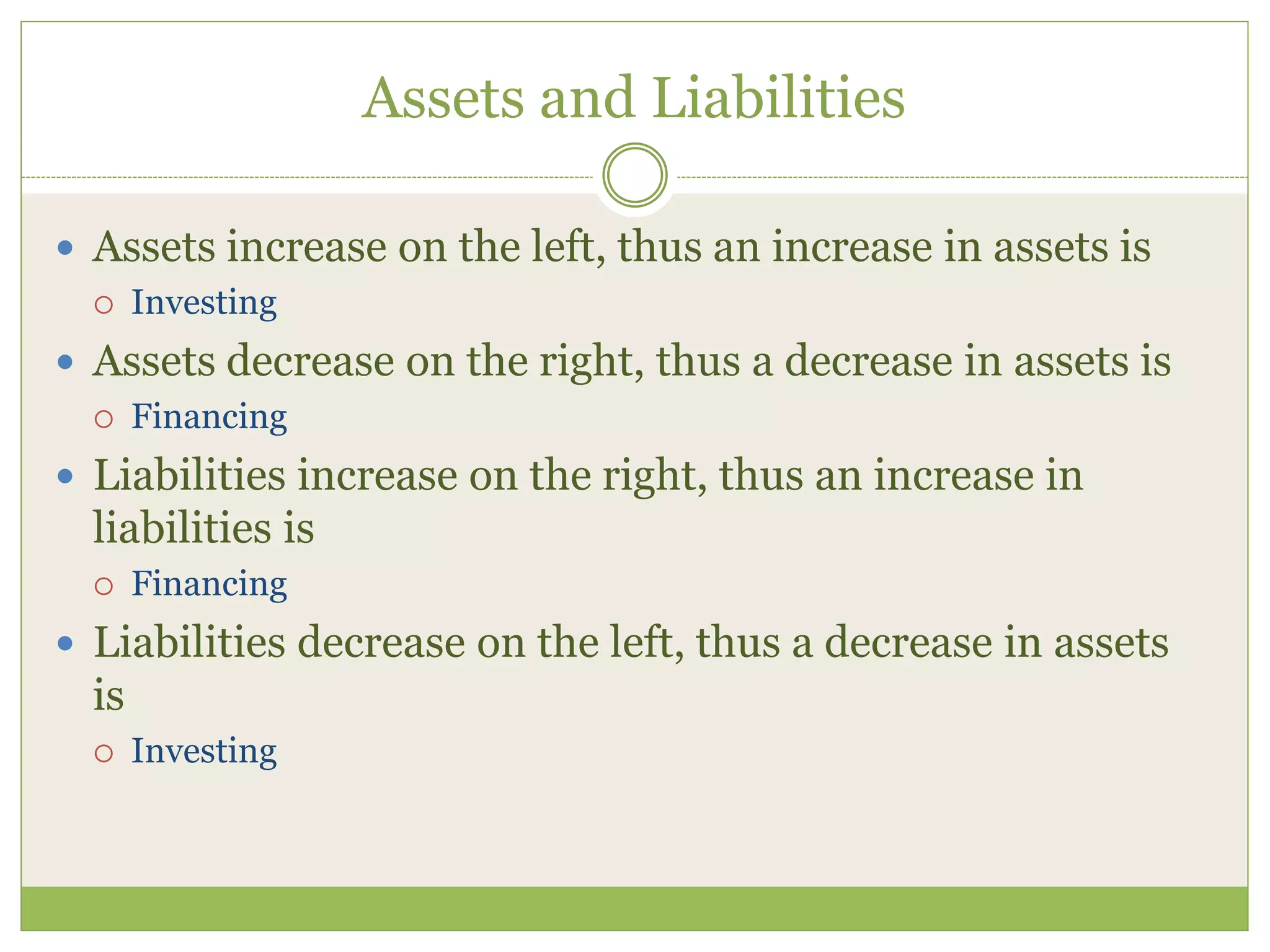
Assets and Liabilities 
 Assets increase on the left, thus an increase in assets is 
 Investing 
 Assets decrease on the right, thus a decrease in assets is 
 Financing 
 Liabilities increase on the right, thus an increase in 
liabilities is 
 Financing 
 Liabilities decrease on the left, thus a decrease in assets 
is 
 Investing
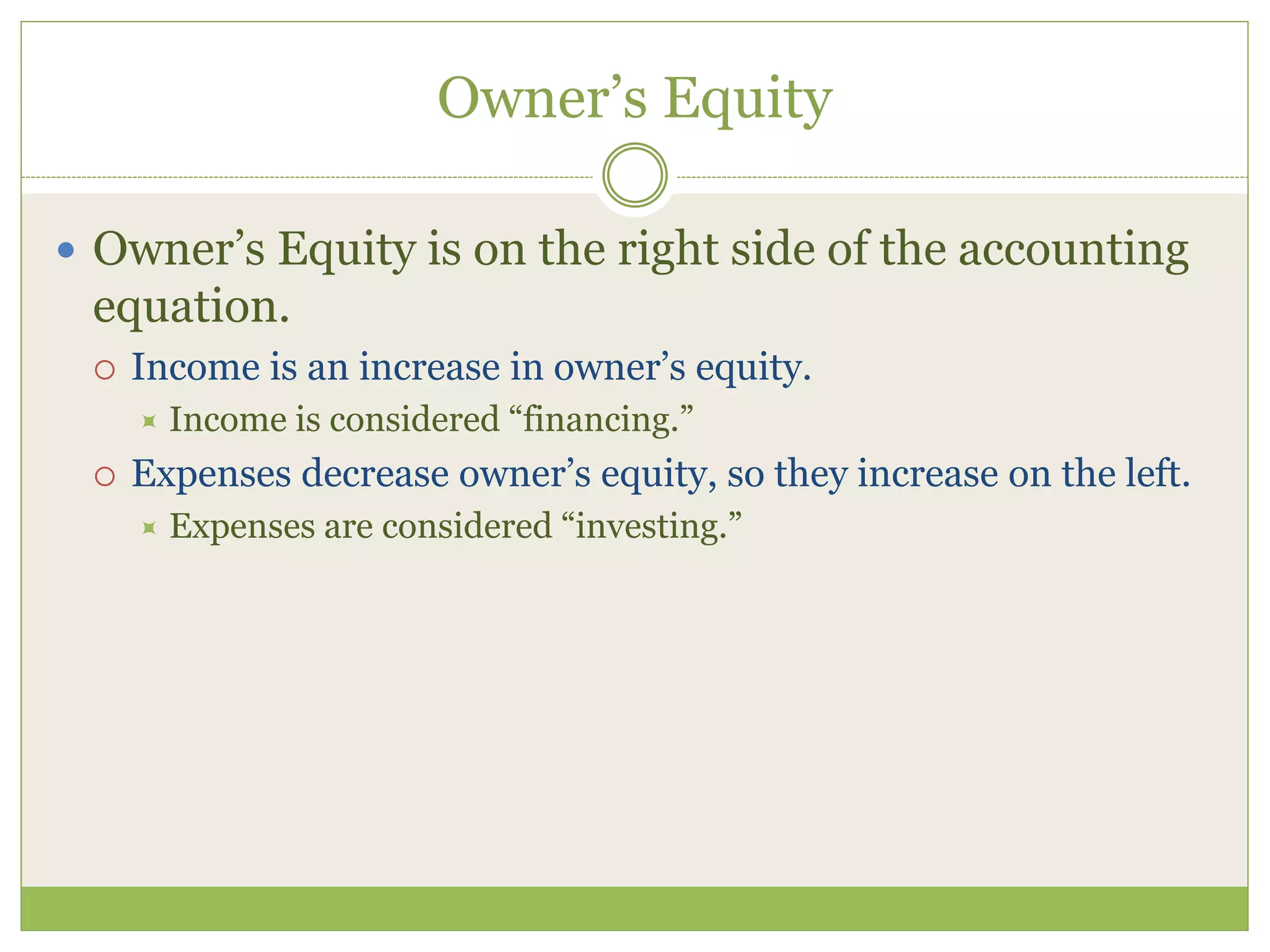
Owner’s Equity 
 Owner’s Equity is on the right side of the accounting 
equation. 
 Income is an increase in owner’s equity. 
 Income is considered “financing.” 
 Expenses decrease owner’s equity, so they increase on the left. 
 Expenses are considered “investing.”
3-2 Intro to Debits and Credits 
WHAT IS AN ACCOUNT? 
DOUBLE ENTRY ACCOUNTING 
DEBITS AND CREDITS 
ACCOUNTING FOR STUDENTS P. 5 2 -53 
DEBITS AND CREDITS P. 1 -4
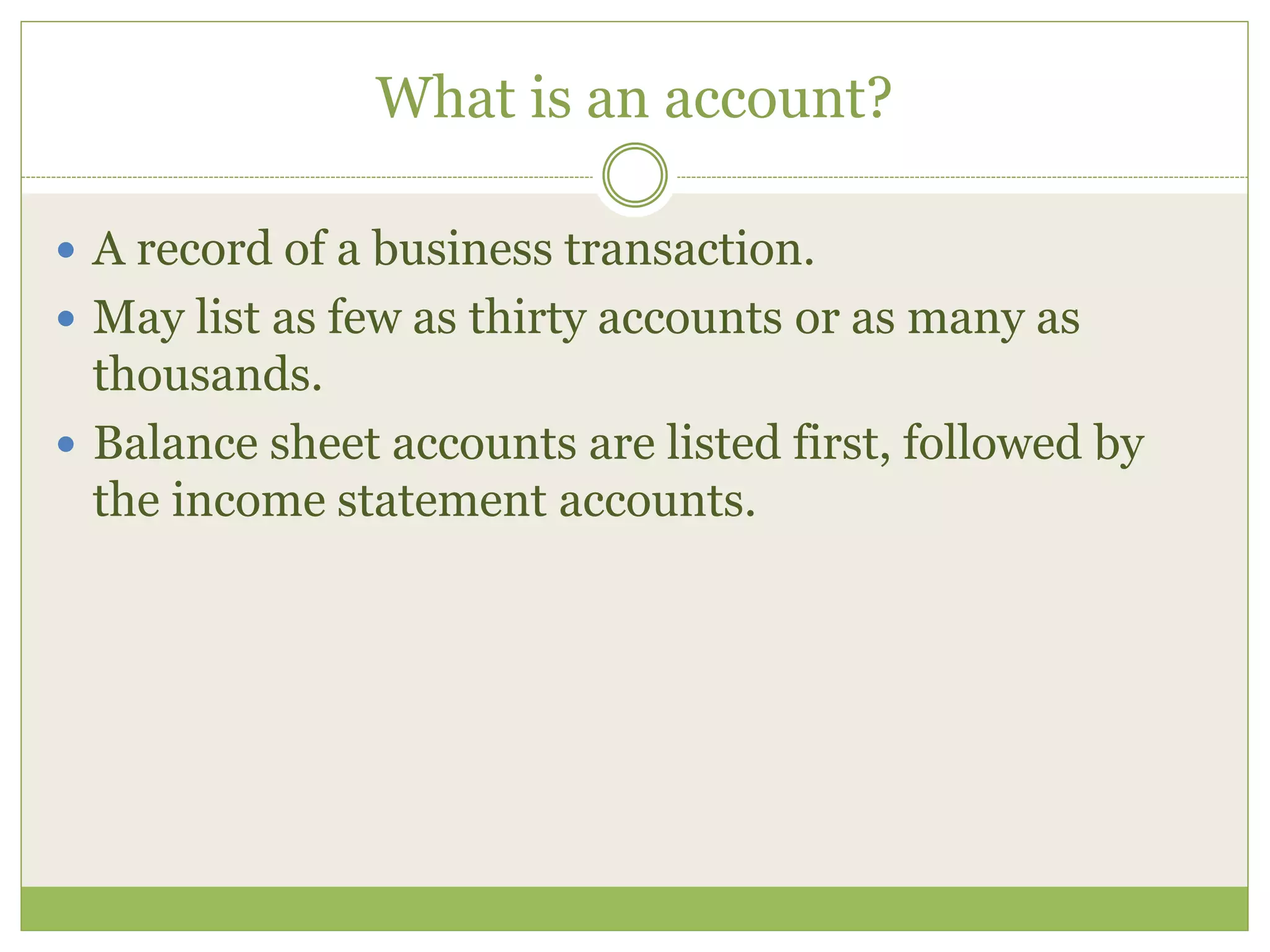
What is an account? 
 A record of a business transaction. 
 May list as few as thirty accounts or as many as 
thousands. 
 Balance sheet accounts are listed first, followed by 
the income statement accounts.
Accounts 
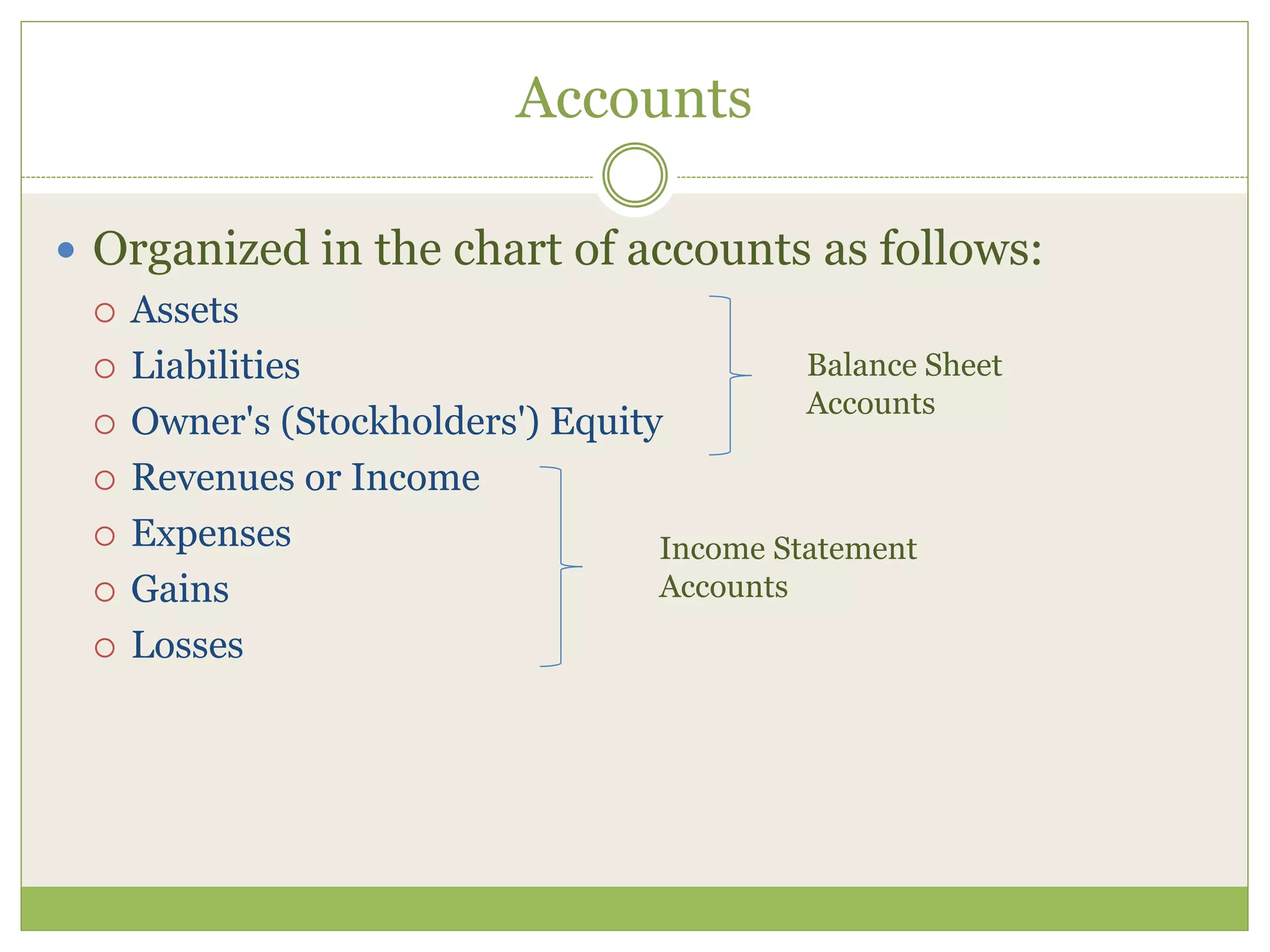
 Organized in the chart of accounts as follows: 
 Assets 
 Liabilities 
 Owner's (Stockholders') Equity 
 Revenues or Income 
 Expenses 
 Gains 
 Losses 
Balance Sheet 
Accounts 
Income Statement 
Accounts
Double Entry Accounting 
 Every business transaction is recorded in at least two 
accounts. 
 One account will receive a "debit" entry, meaning the 
amount will be entered on the left side of that 
account. 
 Another account will receive a "credit" entry, 
meaning the amount will be entered on the right side 
of that account.
Examples of Double Entry 
 When a company borrows $1,000 from a bank, the 
transaction will affect the company's Cash account and the 
company's Notes Payable account. When the company 
repays the bank loan, the Cash account and the Notes 
Payable account are also involved. 
 If a company buys supplies for cash, its Supplies account and 
its Cash account will be affected. If the company buys 
supplies on credit, the accounts involved are Supplies and 
Accounts Payable. 
 If a company pays the rent for the current month, Rent 
Expense and Cash are the two accounts involved. 
 If a company provides a service and gives the client 30 days in 
which to pay, the company's Service Revenues account and 
Accounts Receivable are affected.
More than two accounts 
 An example of a transaction that involves three 
accounts is a company's loan payment to its bank of 
$300. 
 This transaction will involve the following accounts: 
Cash, Notes Payable, and Interest Expense.
Debits and Credits 
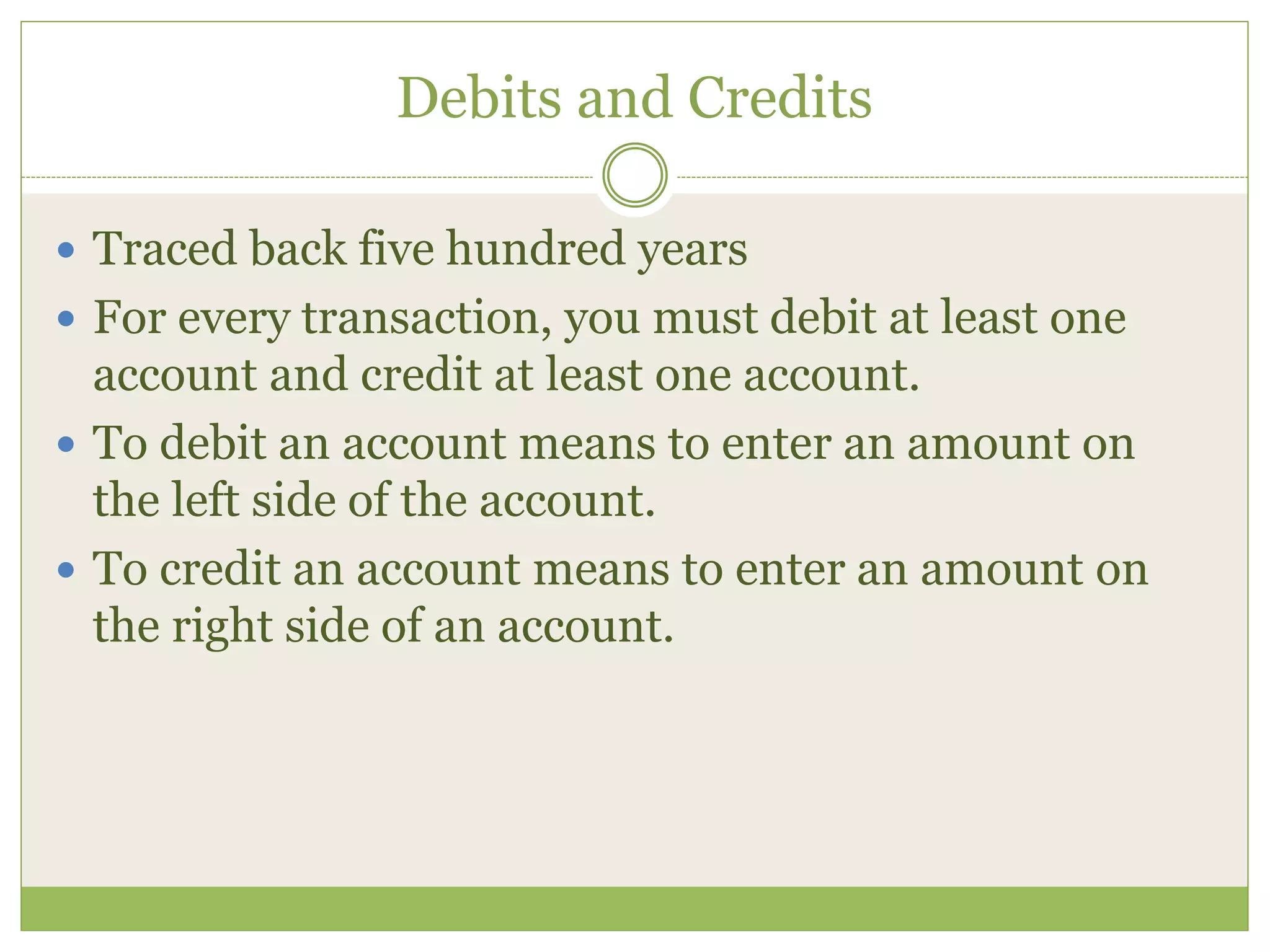
 Traced back five hundred years 
 For every transaction, you must debit at least one 
account and credit at least one account. 
 To debit an account means to enter an amount on 
the left side of the account. 
 To credit an account means to enter an amount on 
the right side of an account.
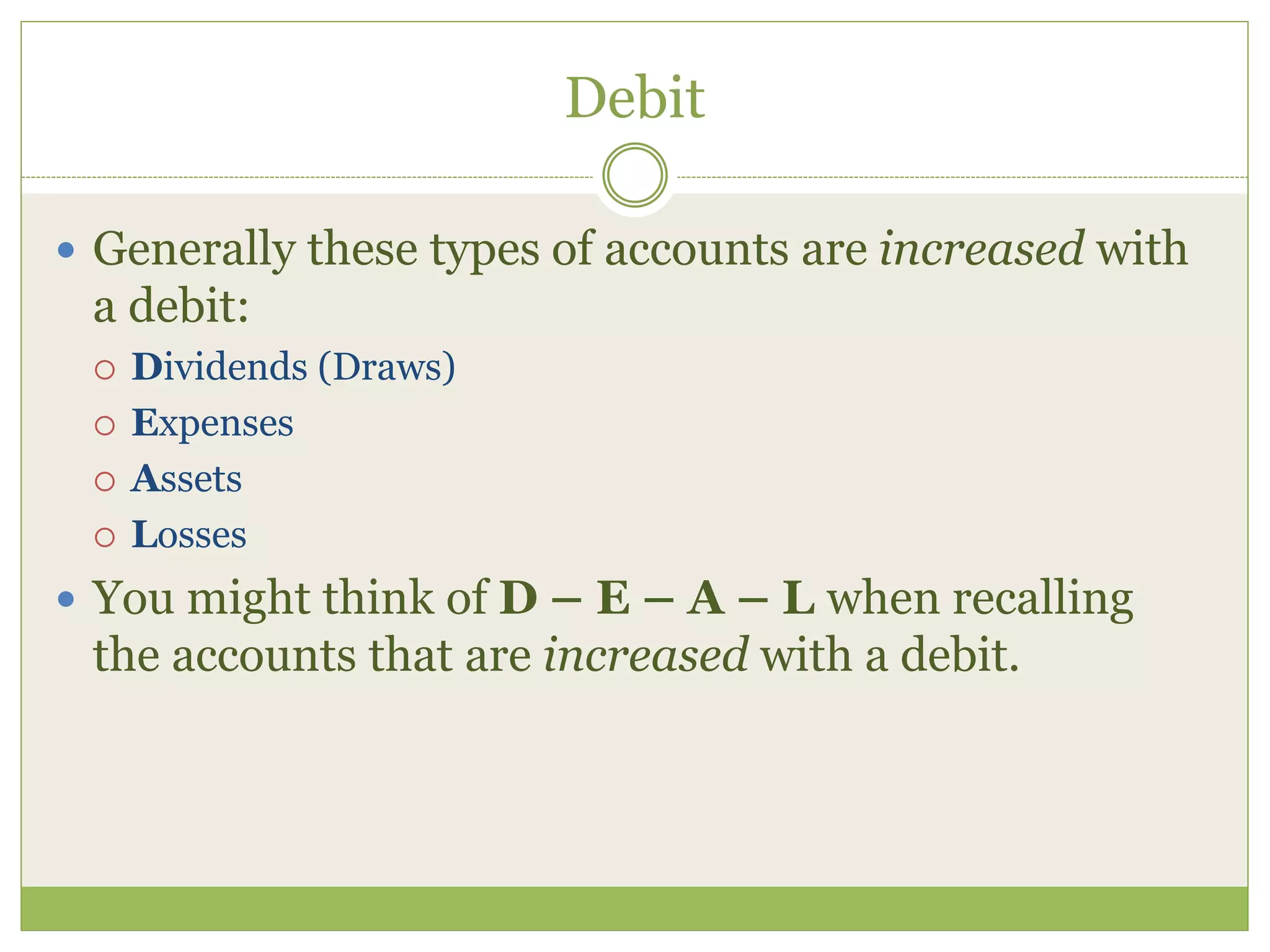
Debit 
 Generally these types of accounts are increased with 
a debit: 
 Dividends (Draws) 
 Expenses 
 Assets 
 Losses 
 You might think of D – E – A – L when recalling 
the accounts that are increased with a debit.
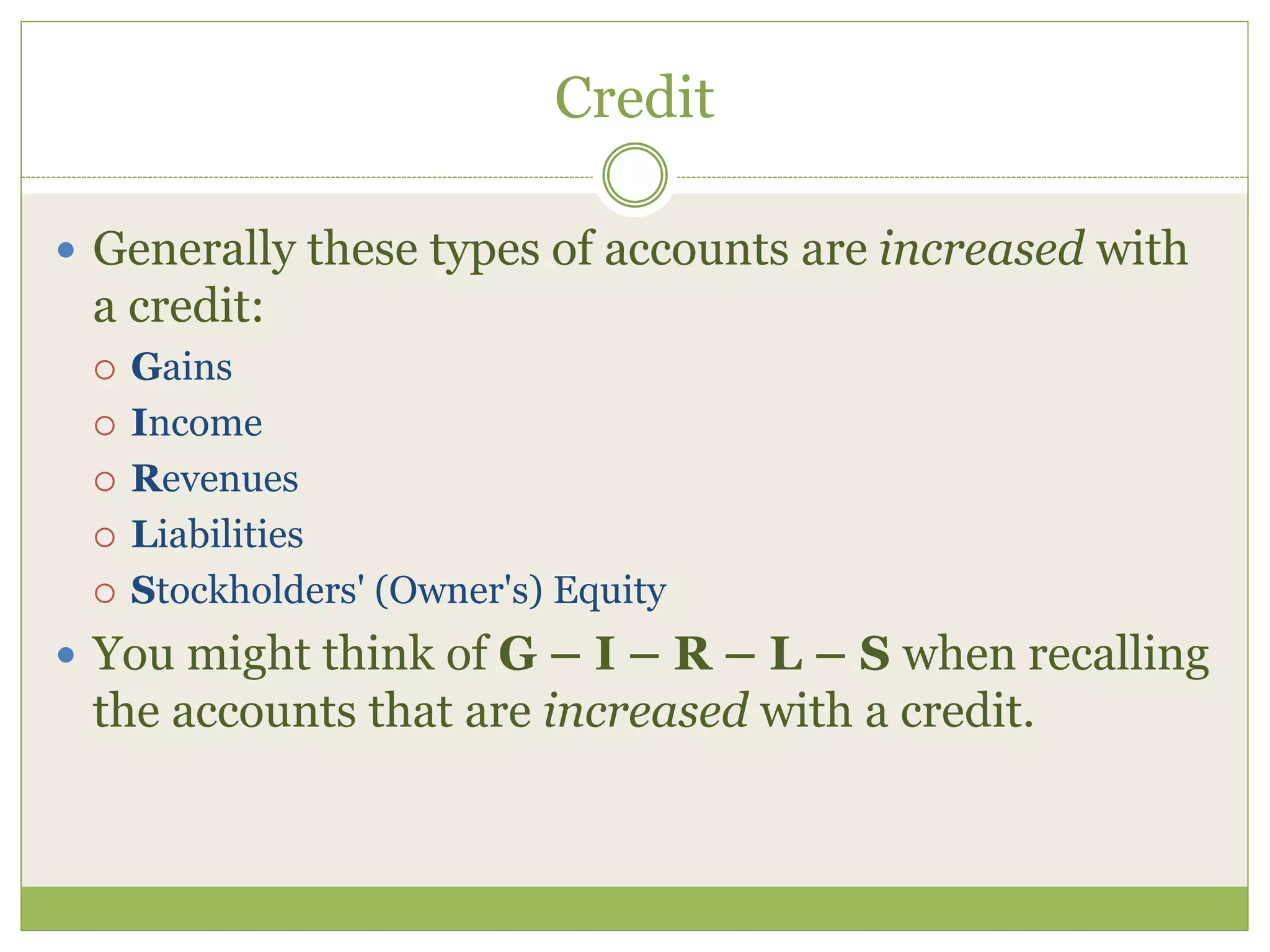
Credit 
 Generally these types of accounts are increased with 
a credit: 
 Gains 
 Income 
 Revenues 
 Liabilities 
 Stockholders' (Owner's) Equity 
 You might think of G – I – R – L – S when recalling 
the accounts that are increased with a credit.
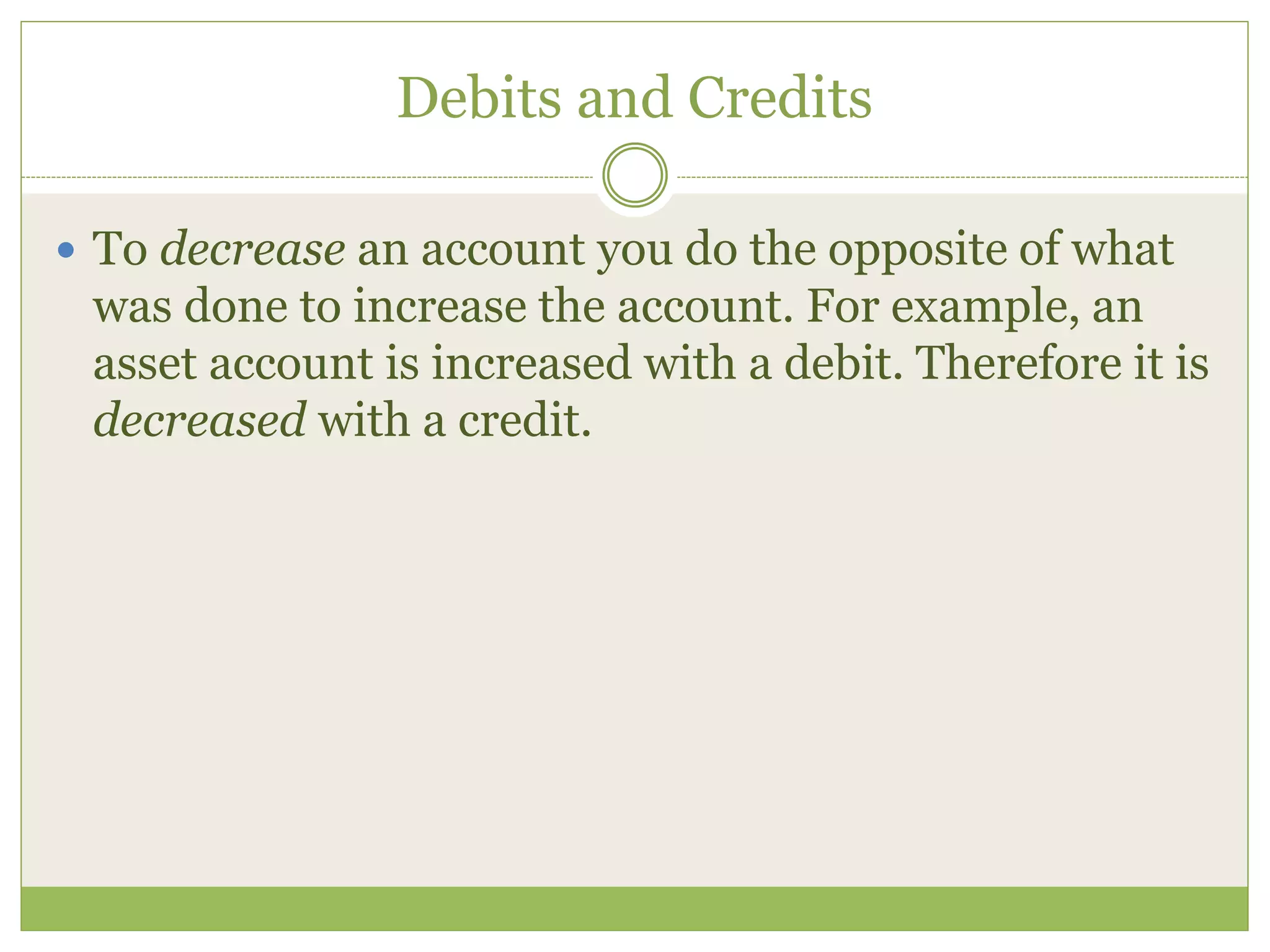
Debits and Credits 
 To decrease an account you do the opposite of what 
was done to increase the account. For example, an 
asset account is increased with a debit. Therefore it is 
decreased with a credit.
3-3 T-Accounts and Journals 
T-ACCOUNTS 
EXAMPLE 1 
EXAMPLE 2 
JOURNAL ENTRIES 
EXAMPLE 1 
EXAMPLE 2
T-Accounts 
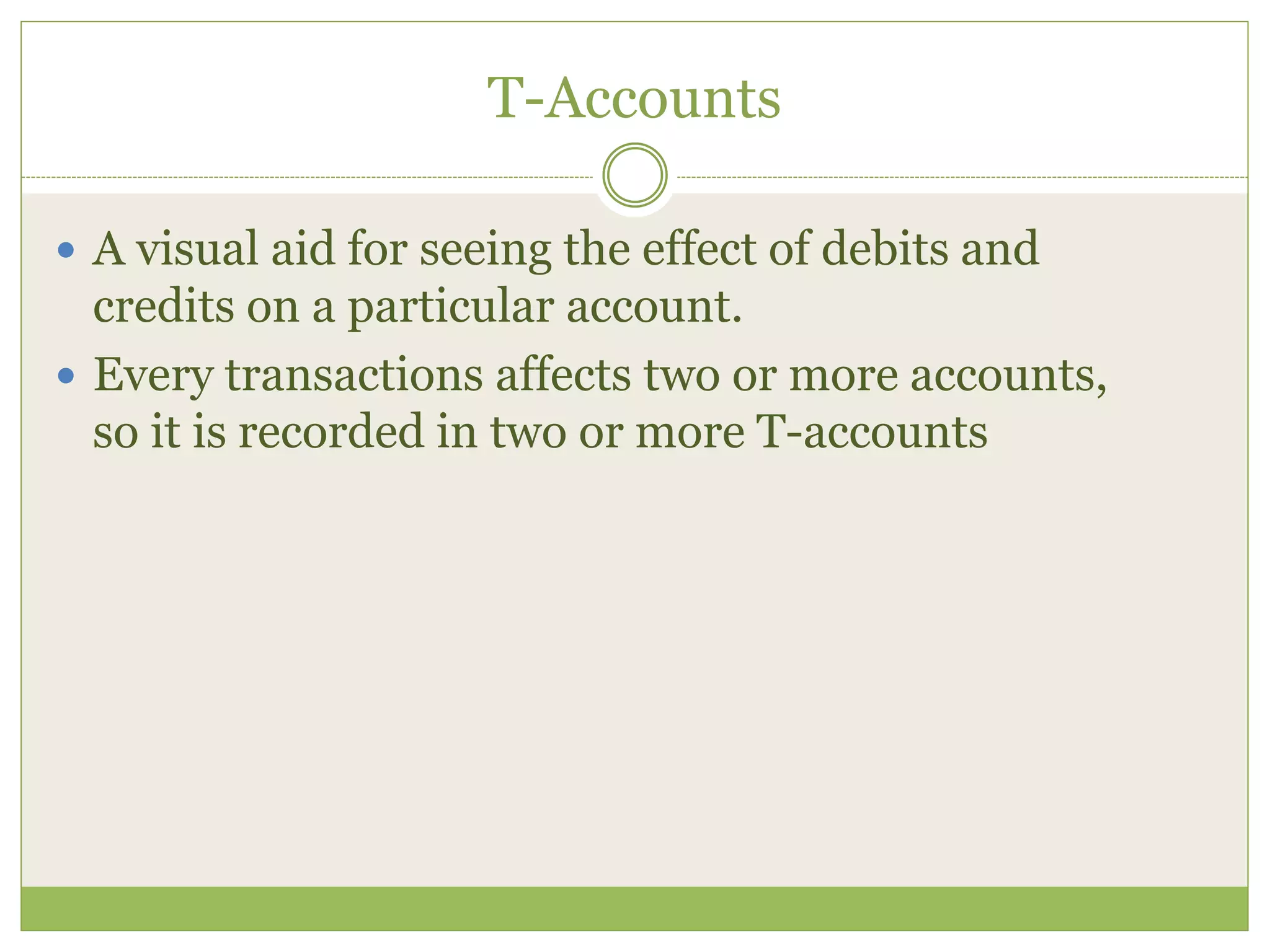
 A visual aid for seeing the effect of debits and 
credits on a particular account. 
 Every transactions affects two or more accounts, 
so it is recorded in two or more T-accounts
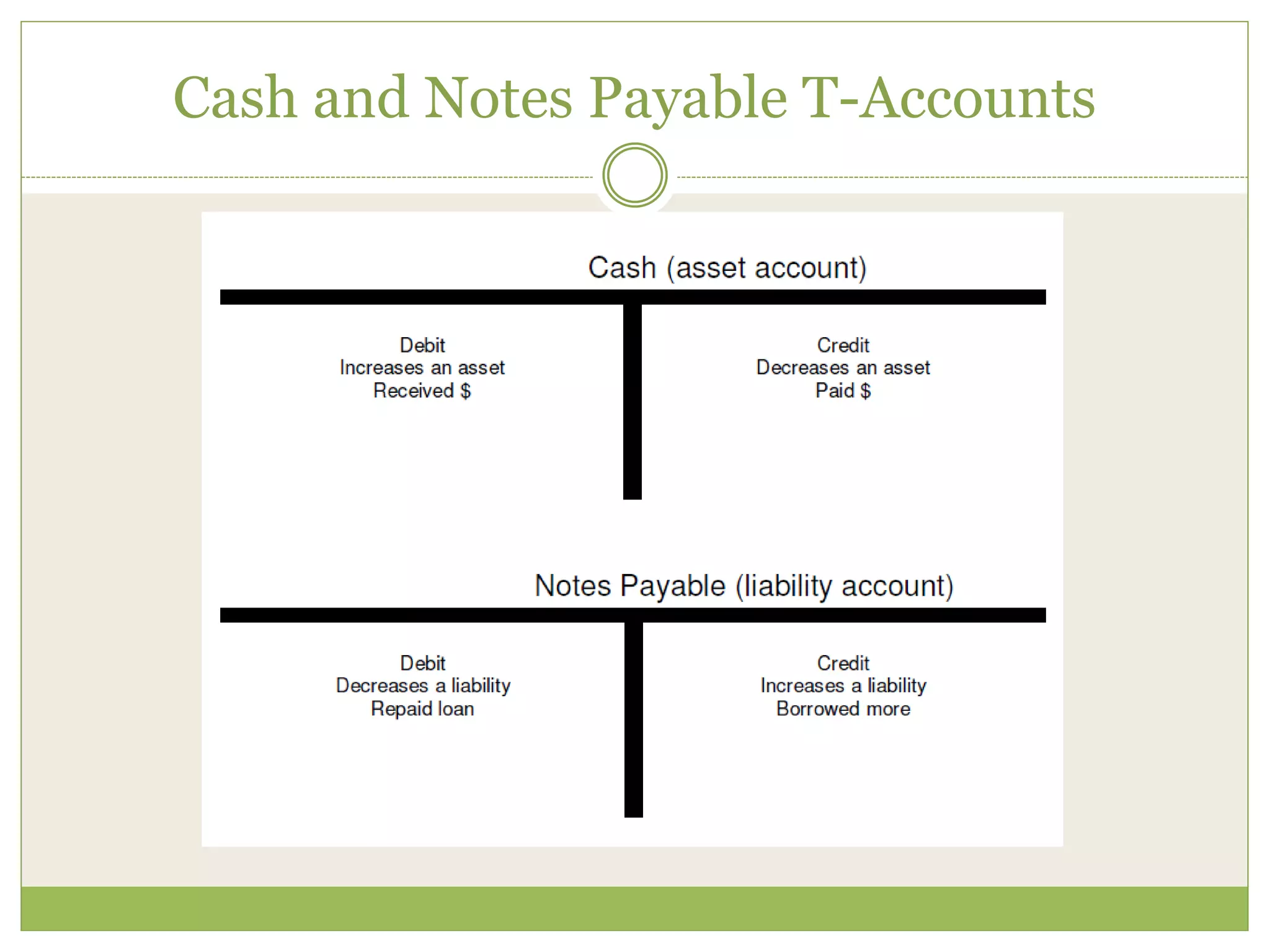
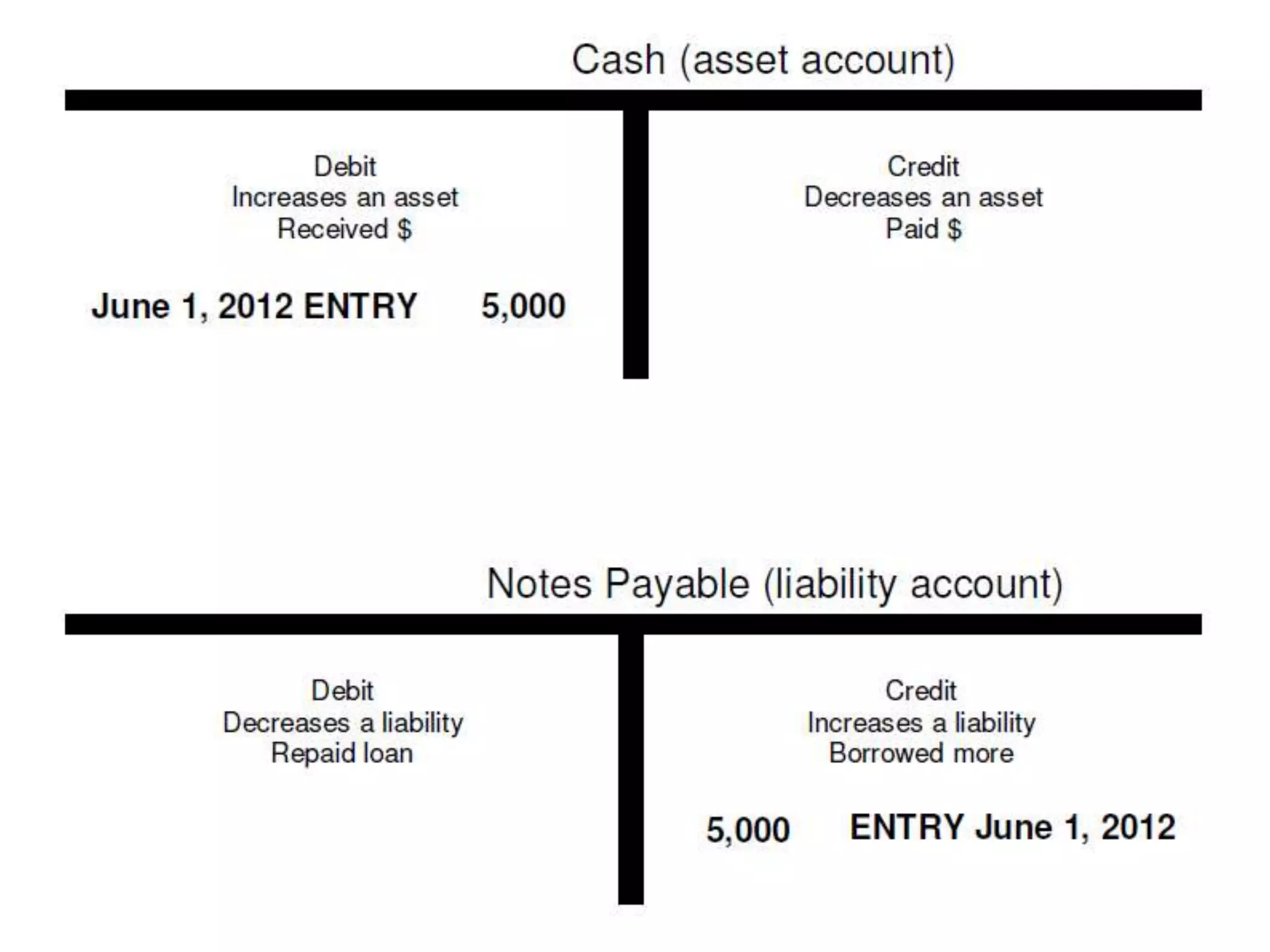
Cash and Notes Payable T-Accounts
Example 1 
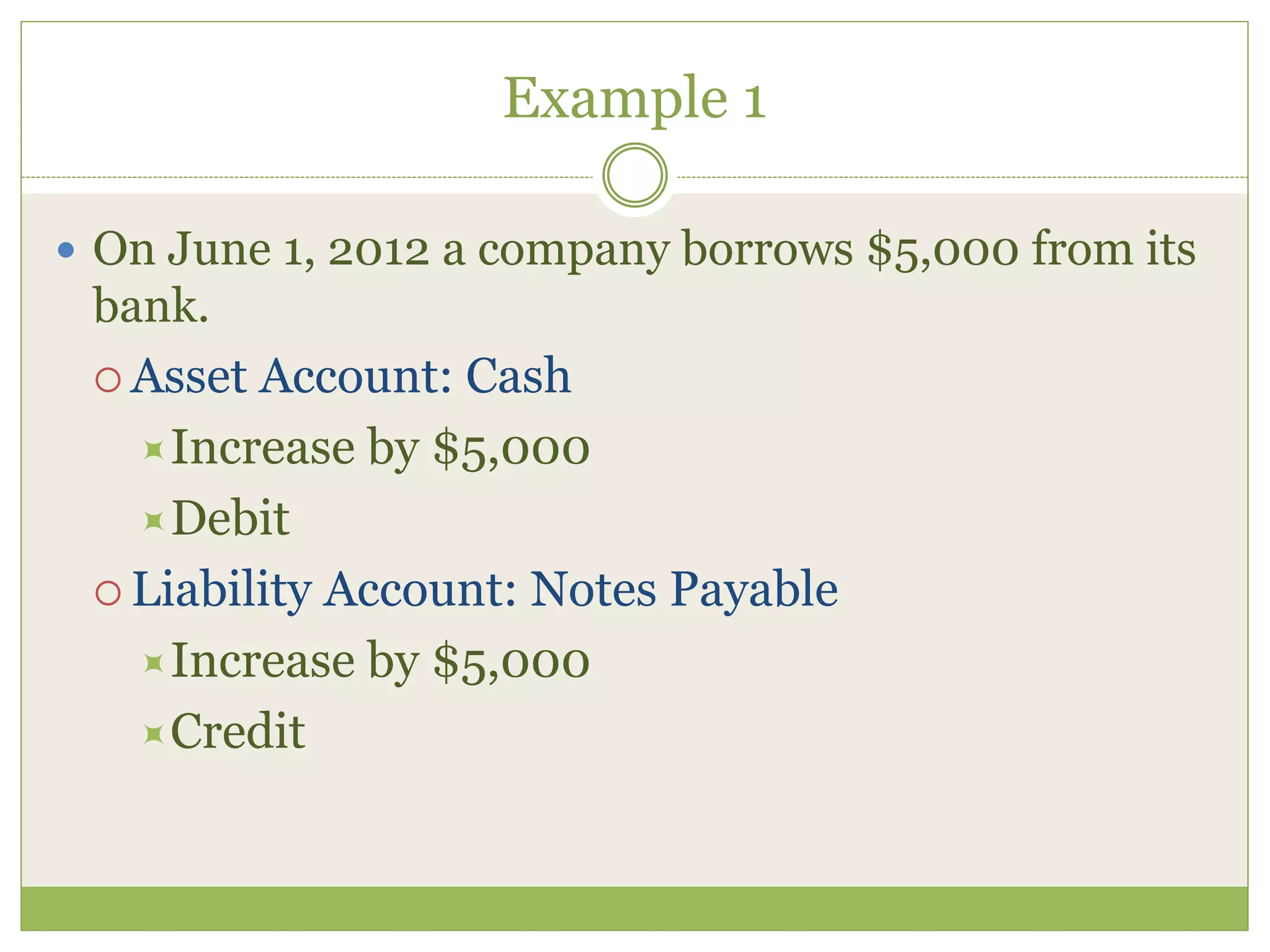
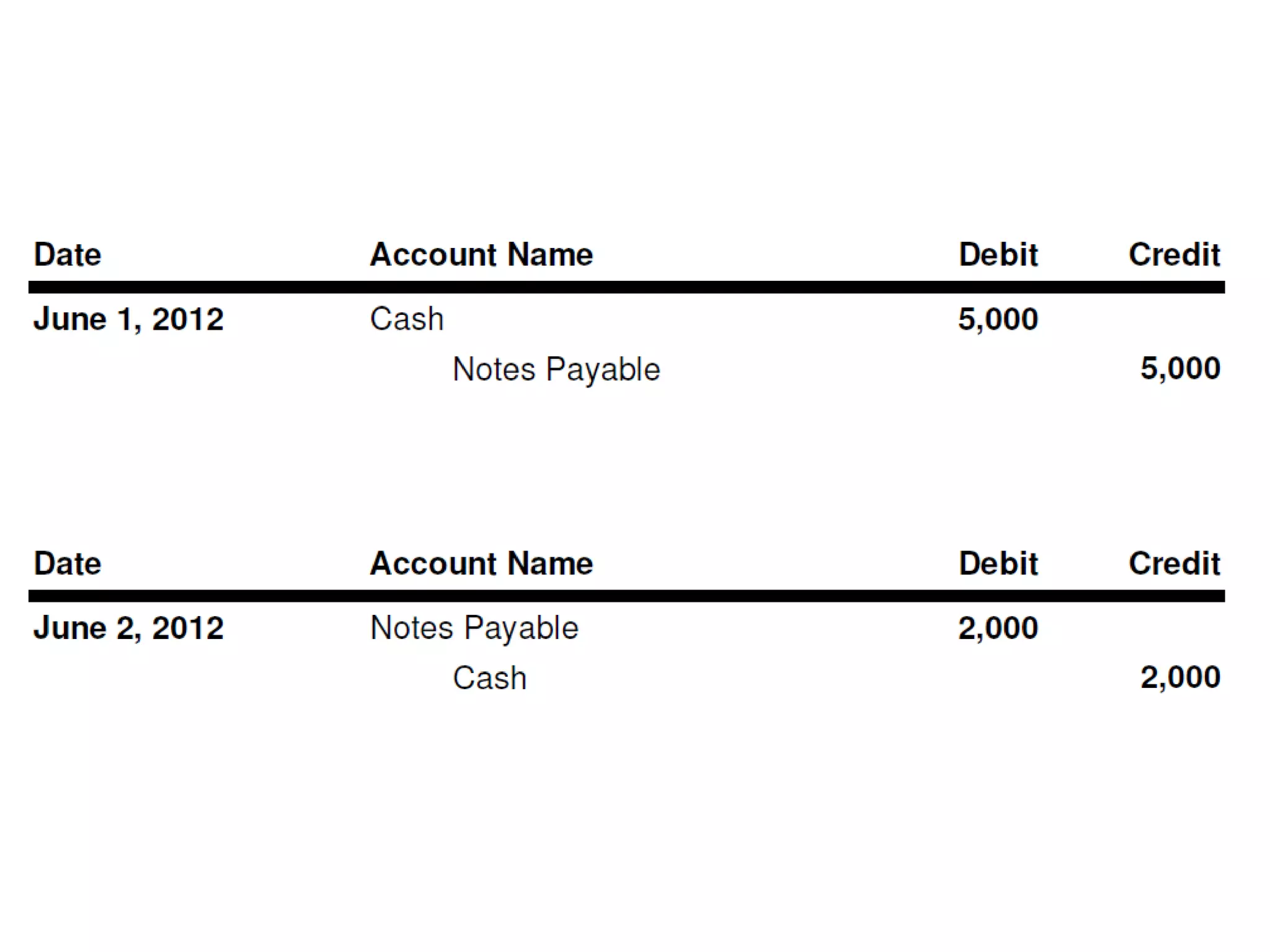
 On June 1, 2012 a company borrows $5,000 from its 
bank. 
 Asset Account: Cash 
Increase by $5,000 
Debit 
 Liability Account: Notes Payable 
Increase by $5,000 
Credit
Example 2 
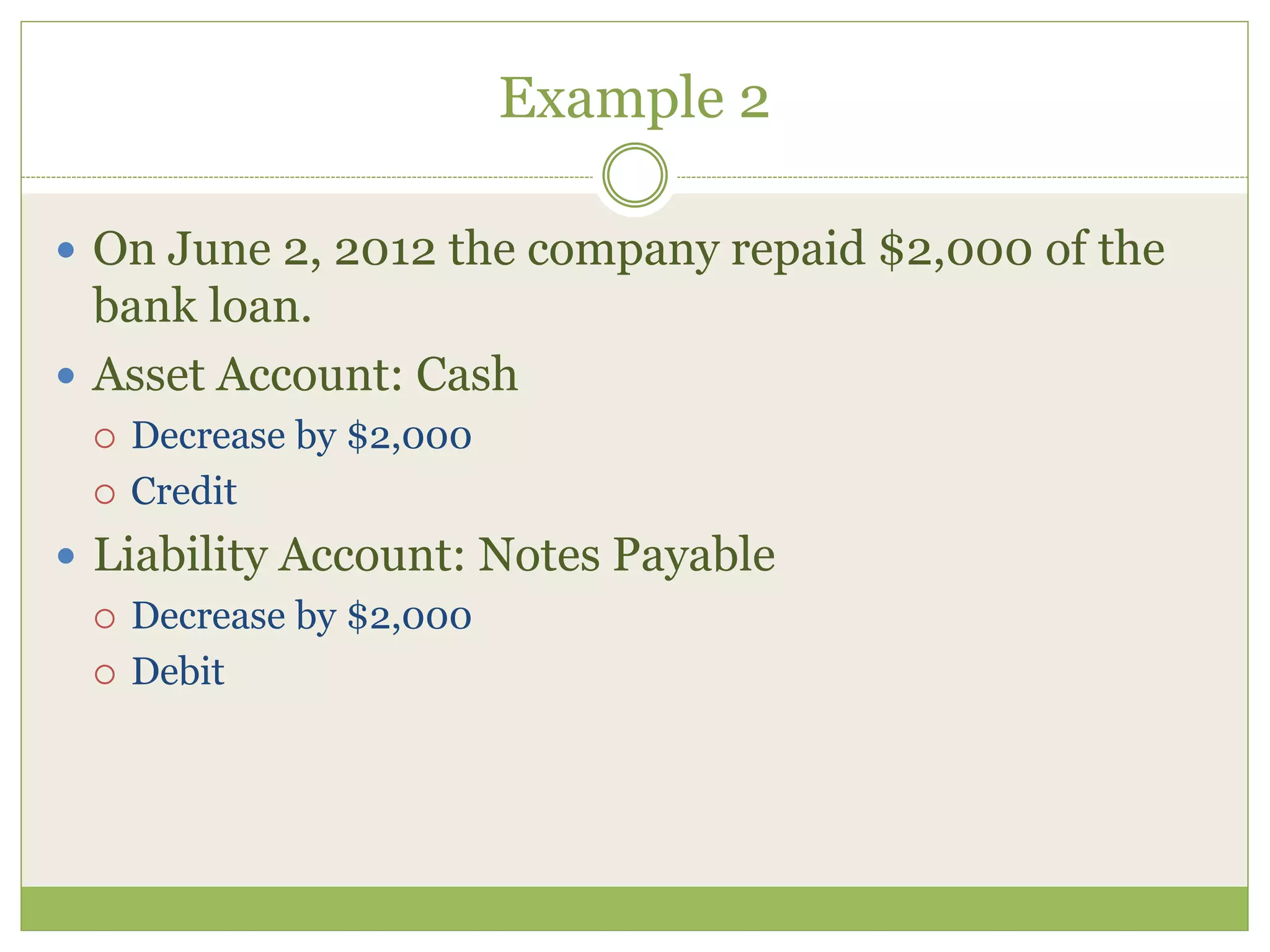
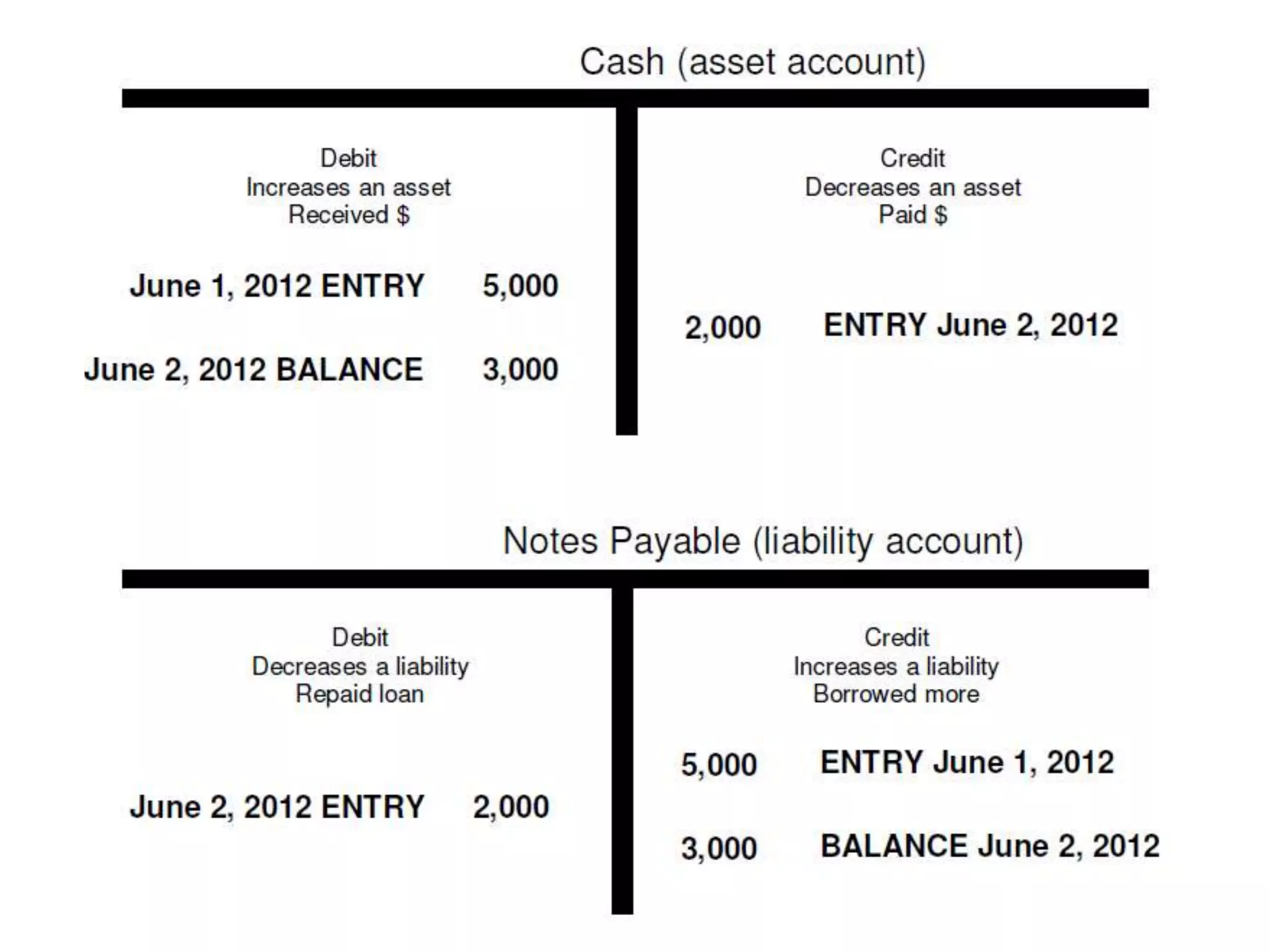
 On June 2, 2012 the company repaid $2,000 of the 
bank loan. 
 Asset Account: Cash 
 Decrease by $2,000 
 Credit 
 Liability Account: Notes Payable 
 Decrease by $2,000 
 Debit
Journal Entries 
 Another way to record transactions 
 Lists 
 the date 
 the account to be debited and the corresponding amount 
 the account to be credited and the corresponding amount 
 The accounts to be credited are indented.
3-5 Revenues and Gains 
REVENUE ACCOUNT S 
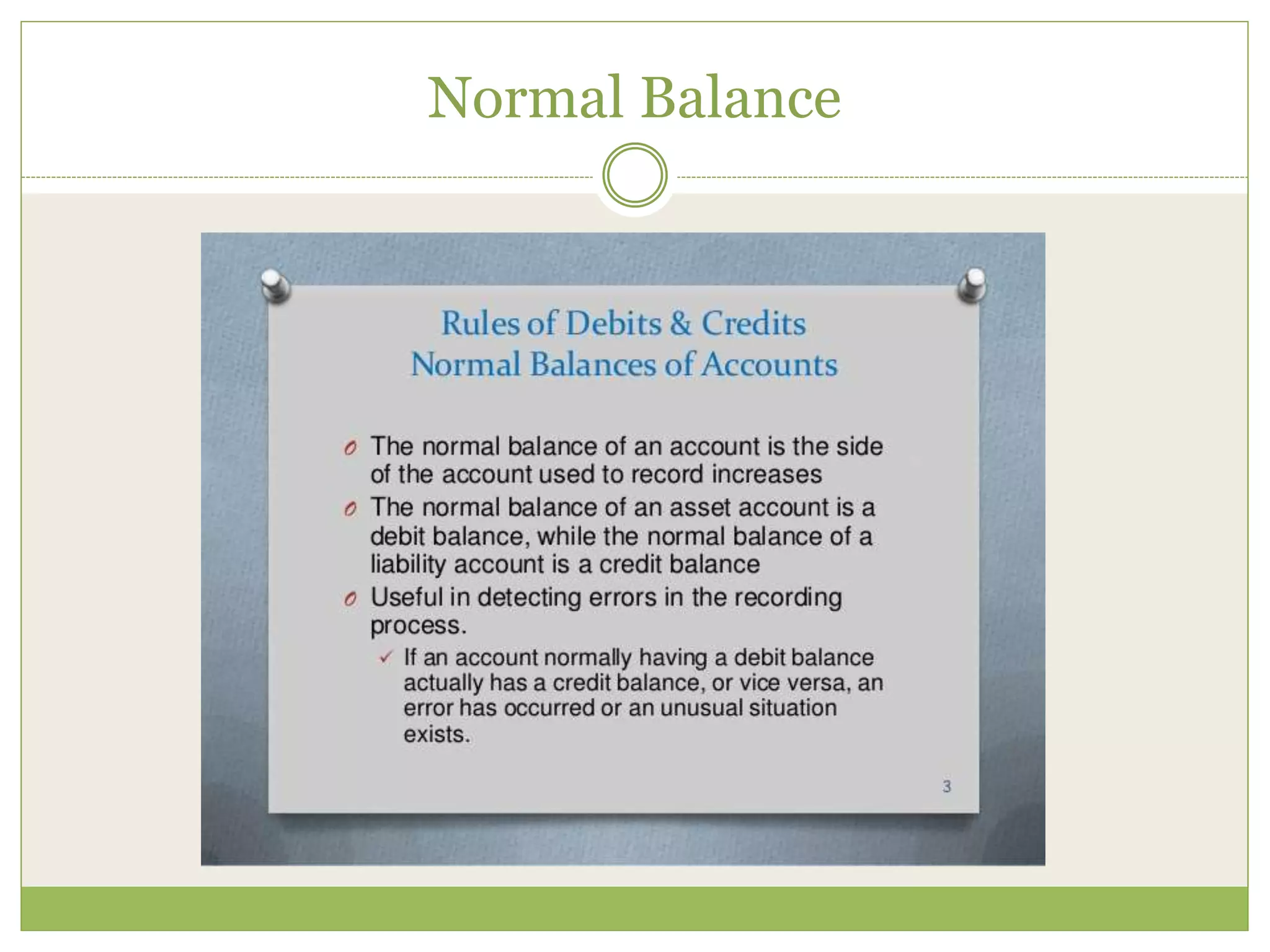
NORMAL BALANCE 
CONTRA ACCOUNTS 
EXAMPLE 1 
EXAMPLE 2 
DEBIT S AND CREDIT S P.
Revenue Accounts 
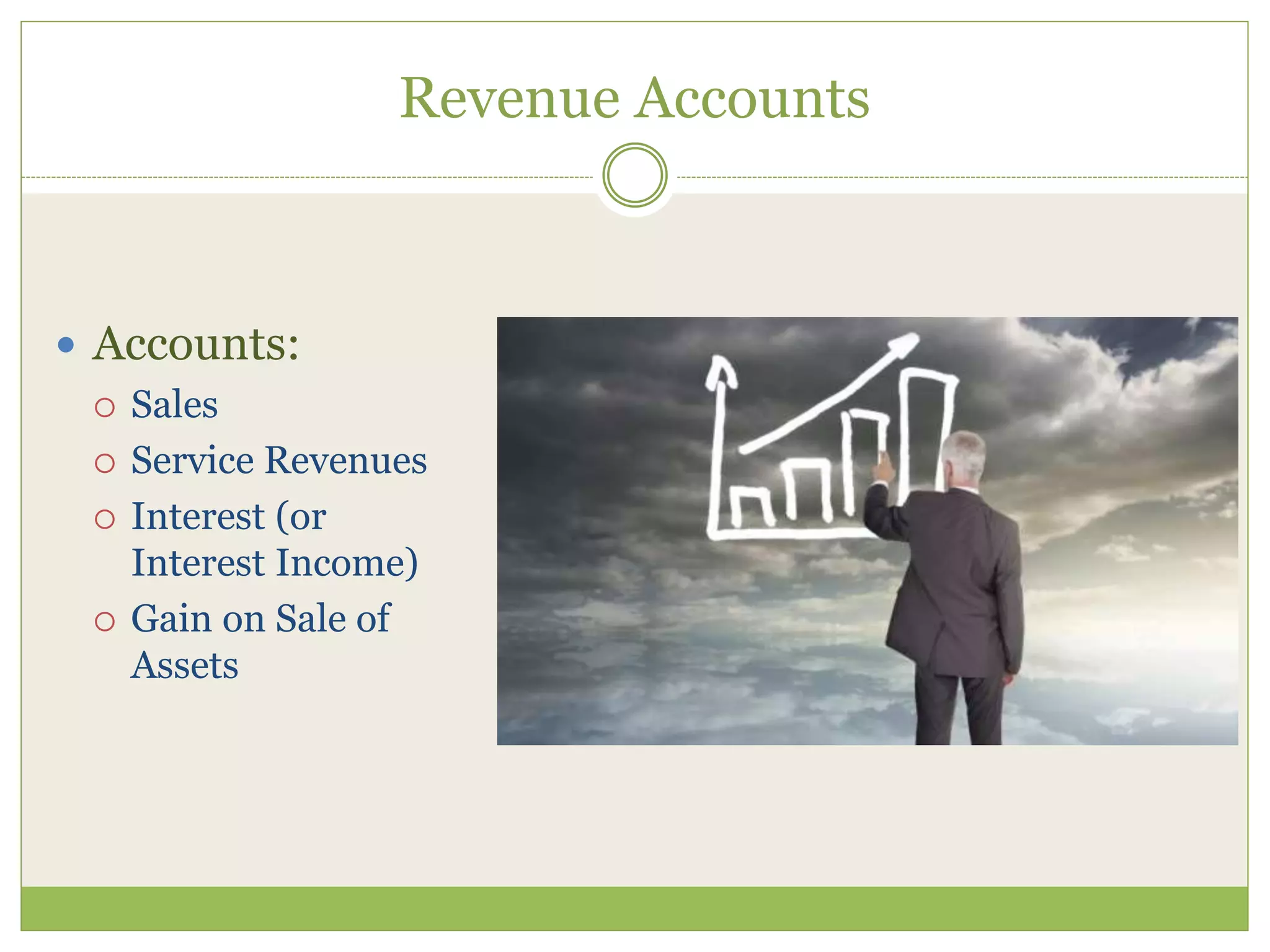
 Accounts: 
 Sales 
 Service Revenues 
 Interest (or 
Interest Income) 
 Gain on Sale of 
Assets
Normal Balance
Contra Accounts 
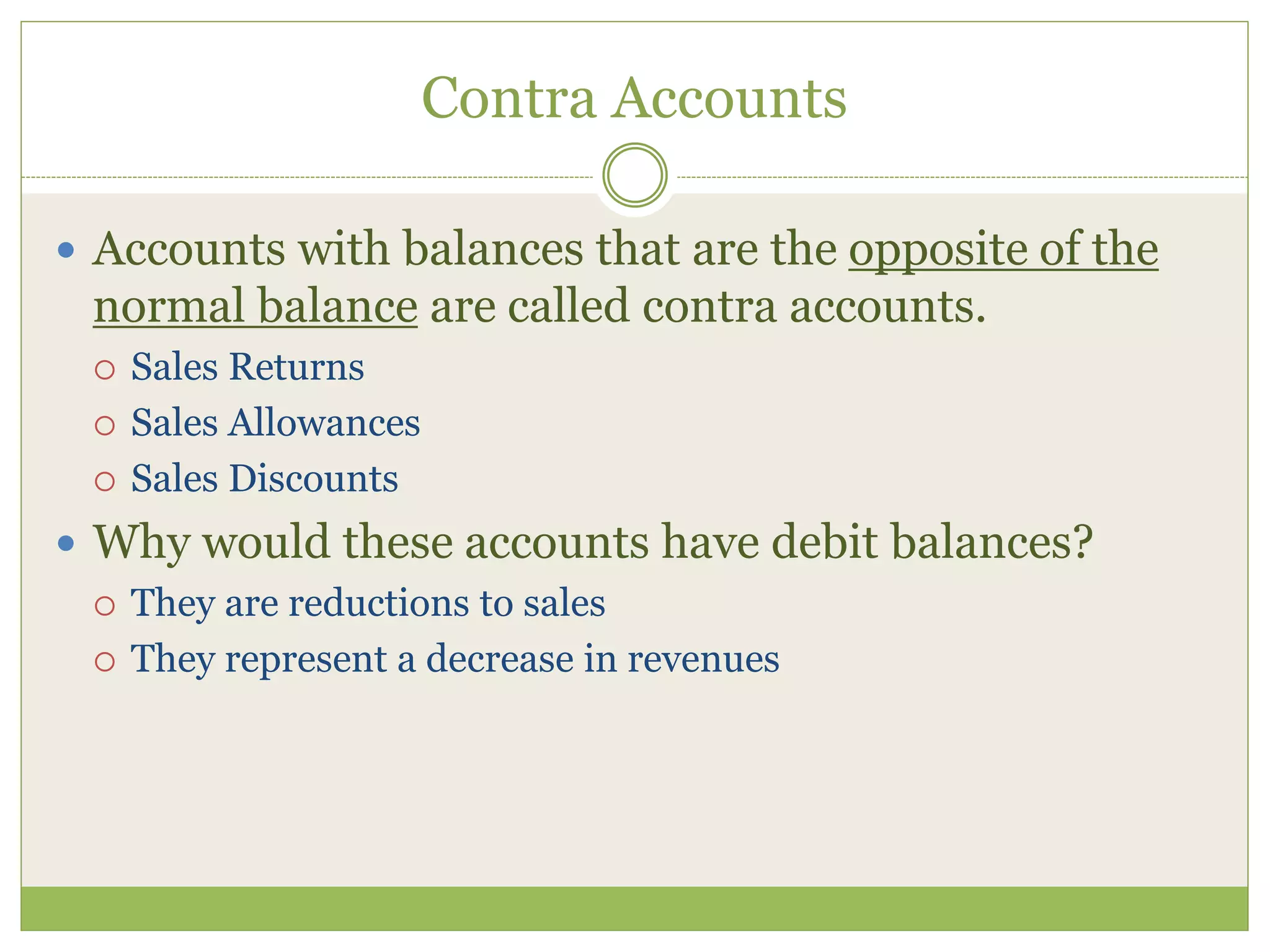
 Accounts with balances that are the opposite of the 
normal balance are called contra accounts. 
 Sales Returns 
 Sales Allowances 
 Sales Discounts 
 Why would these accounts have debit balances? 
 They are reductions to sales 
 They represent a decrease in revenues
Example 1 
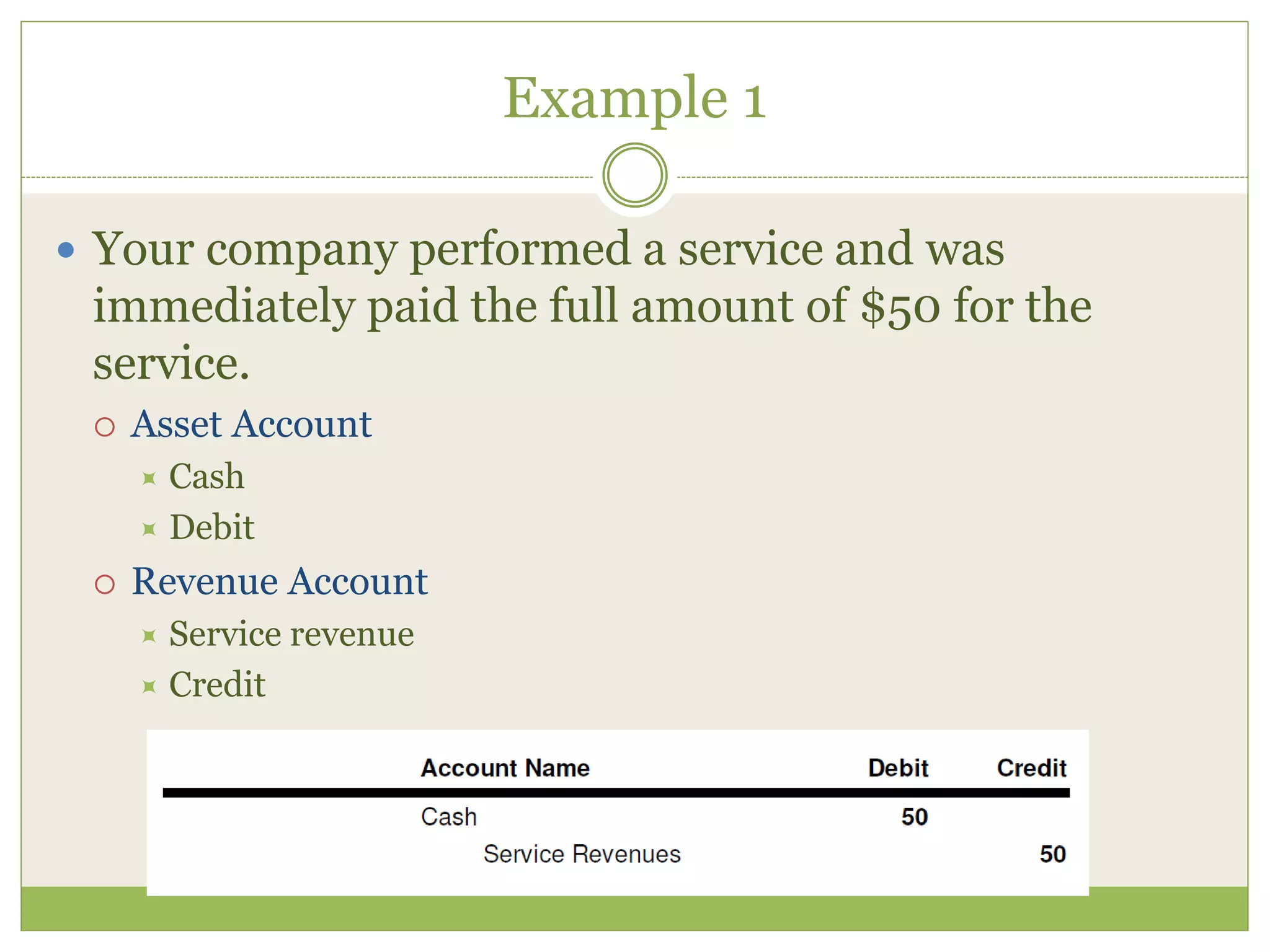
 Your company performed a service and was 
immediately paid the full amount of $50 for the 
service. 
 Asset Account 
 Cash 
 Debit 
 Revenue Account 
 Service revenue 
 Credit
Example 2 
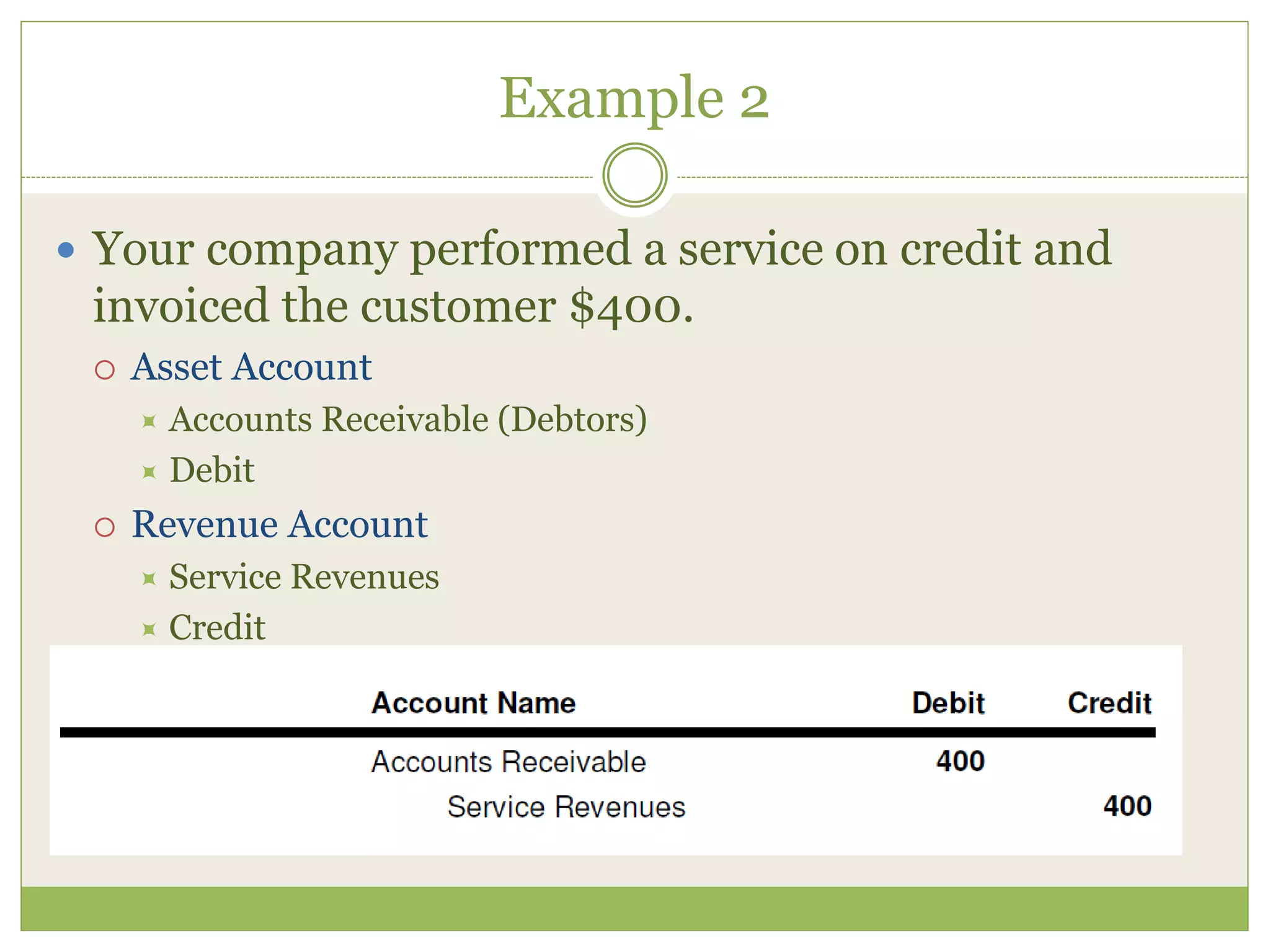
 Your company performed a service on credit and 
invoiced the customer $400. 
 Asset Account 
 Accounts Receivable (Debtors) 
 Debit 
 Revenue Account 
 Service Revenues 
 Credit
3-6 Expenses and Losses 
EXPENSE ACCOUNTS 
NORMAL BALANCE 
EXAMPLE 1 
EXAMPLE 2 
DEBITS AND CREDITS P. 9 -11
Expense Accounts 
 Salaries Expense 
 Wages Expense 
 Rent Expense 
 Supplies Expense 
 Interest Expense
Expenses = Debit 
 Think "debit" when expenses are incurred 
 A debit increases the balance in an expense account 
 A credit decreases the balance. 
 We credit expenses only to reduce them, adjust them, or to 
close the expense accounts. 
 Why are expenses a debit? 
 They represent a DECREASE in Equity
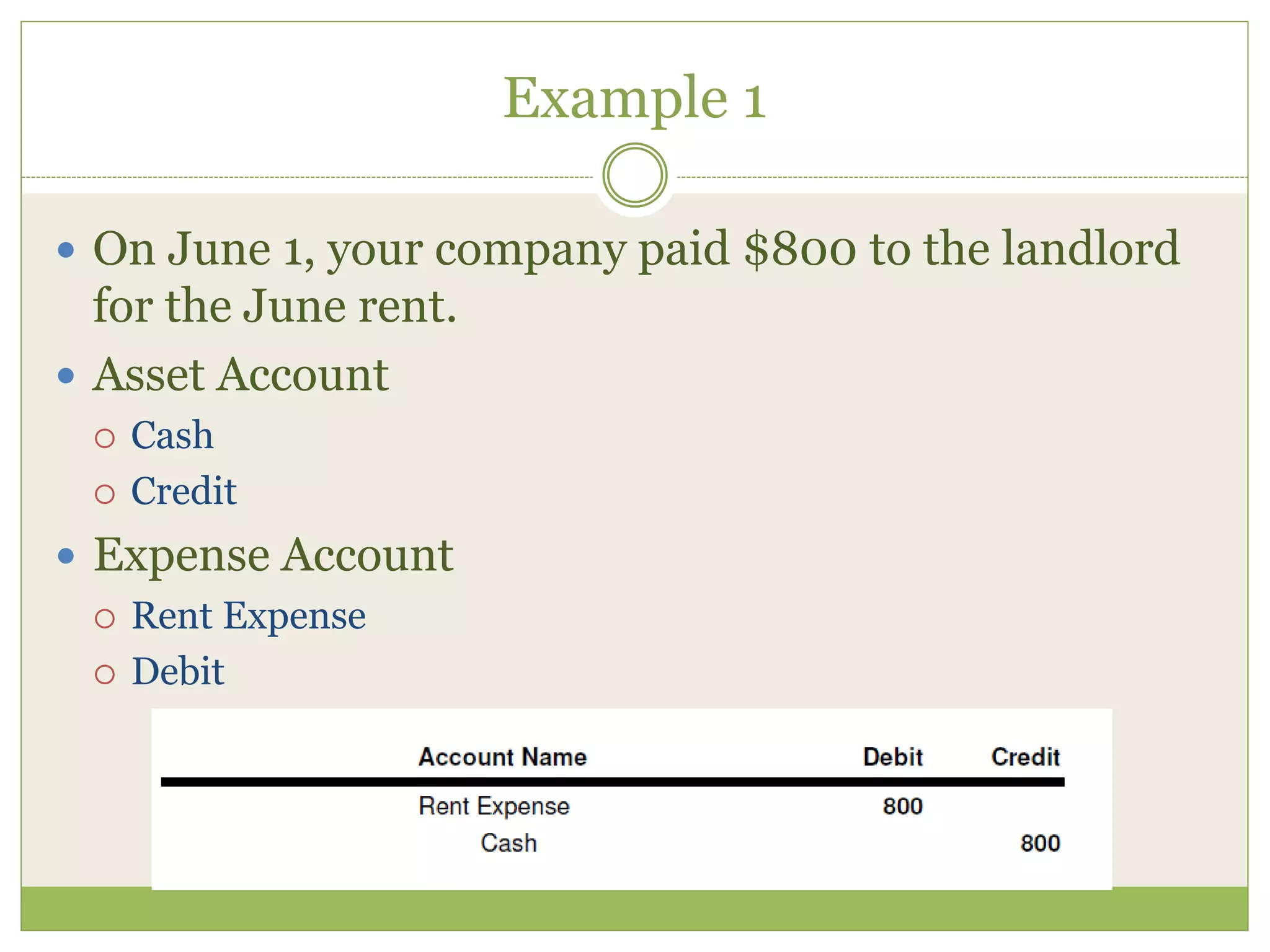
Example 1 
 On June 1, your company paid $800 to the landlord 
for the June rent. 
 Asset Account 
 Cash 
 Credit 
 Expense Account 
 Rent Expense 
 Debit
Example 2 
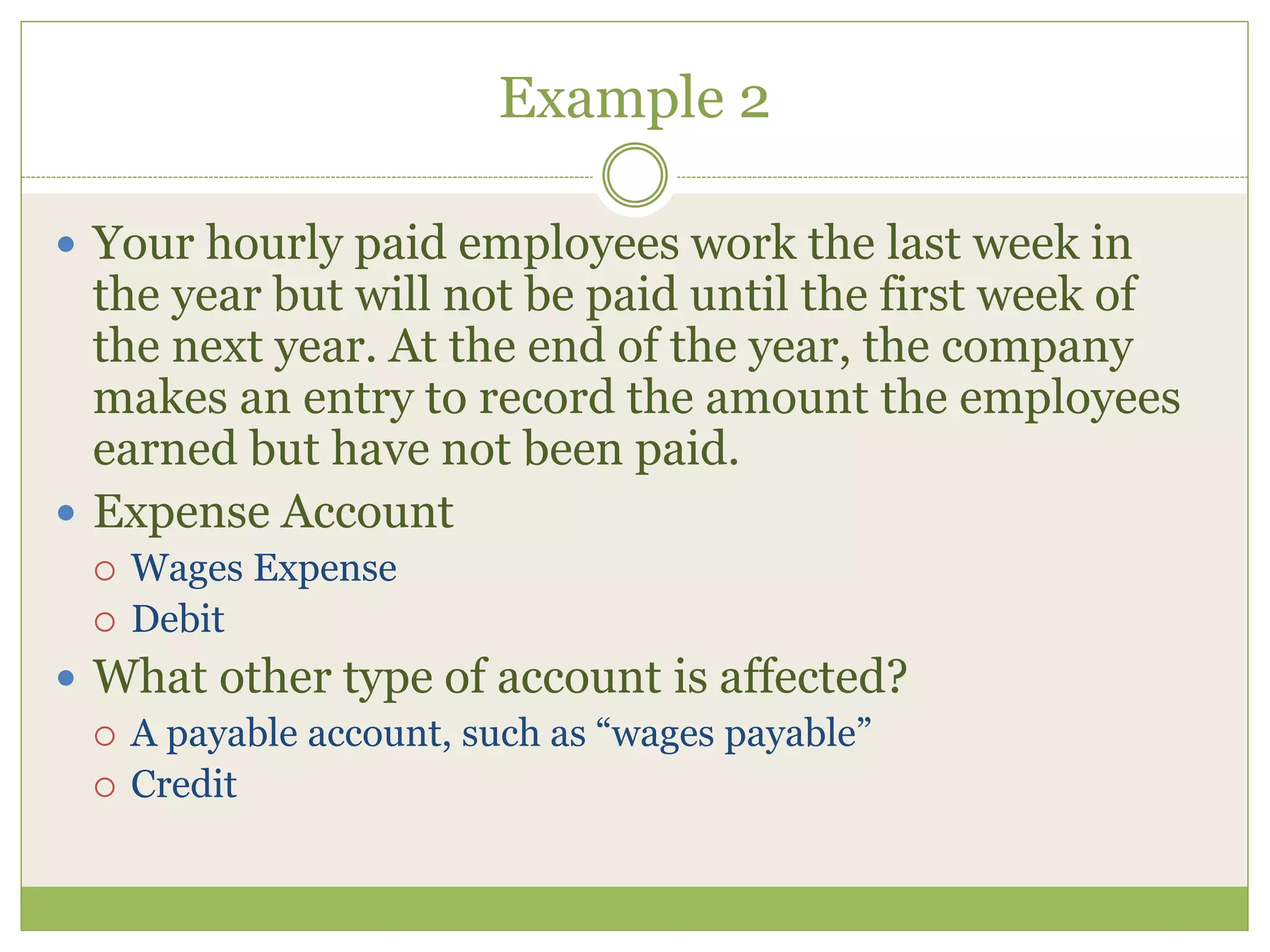
 Your hourly paid employees work the last week in 
the year but will not be paid until the first week of 
the next year. At the end of the year, the company 
makes an entry to record the amount the employees 
earned but have not been paid. 
 Expense Account 
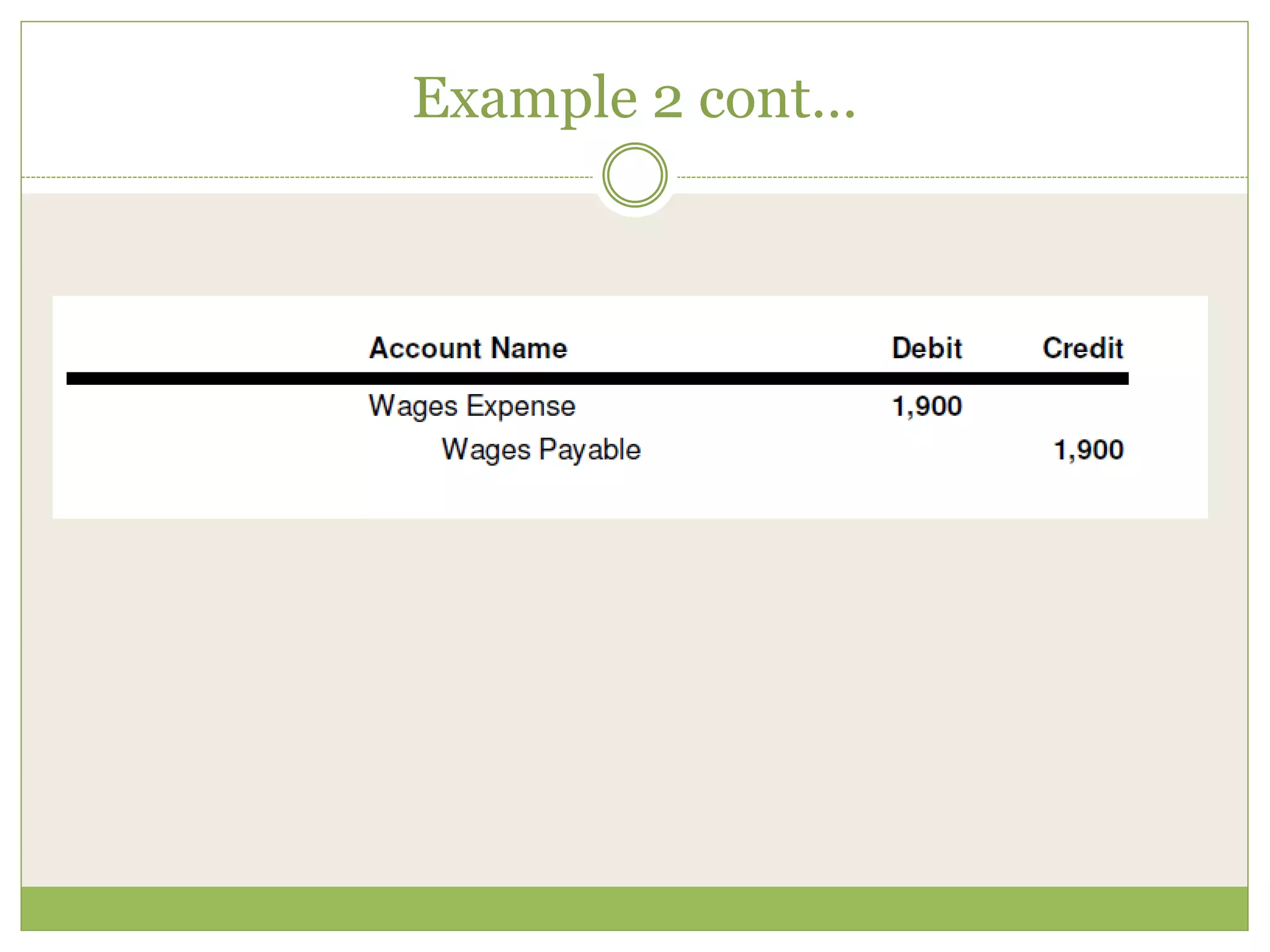
 Wages Expense 
 Debit 
 What other type of account is affected? 
 A payable account, such as “wages payable” 
 Credit
Example 2 cont…
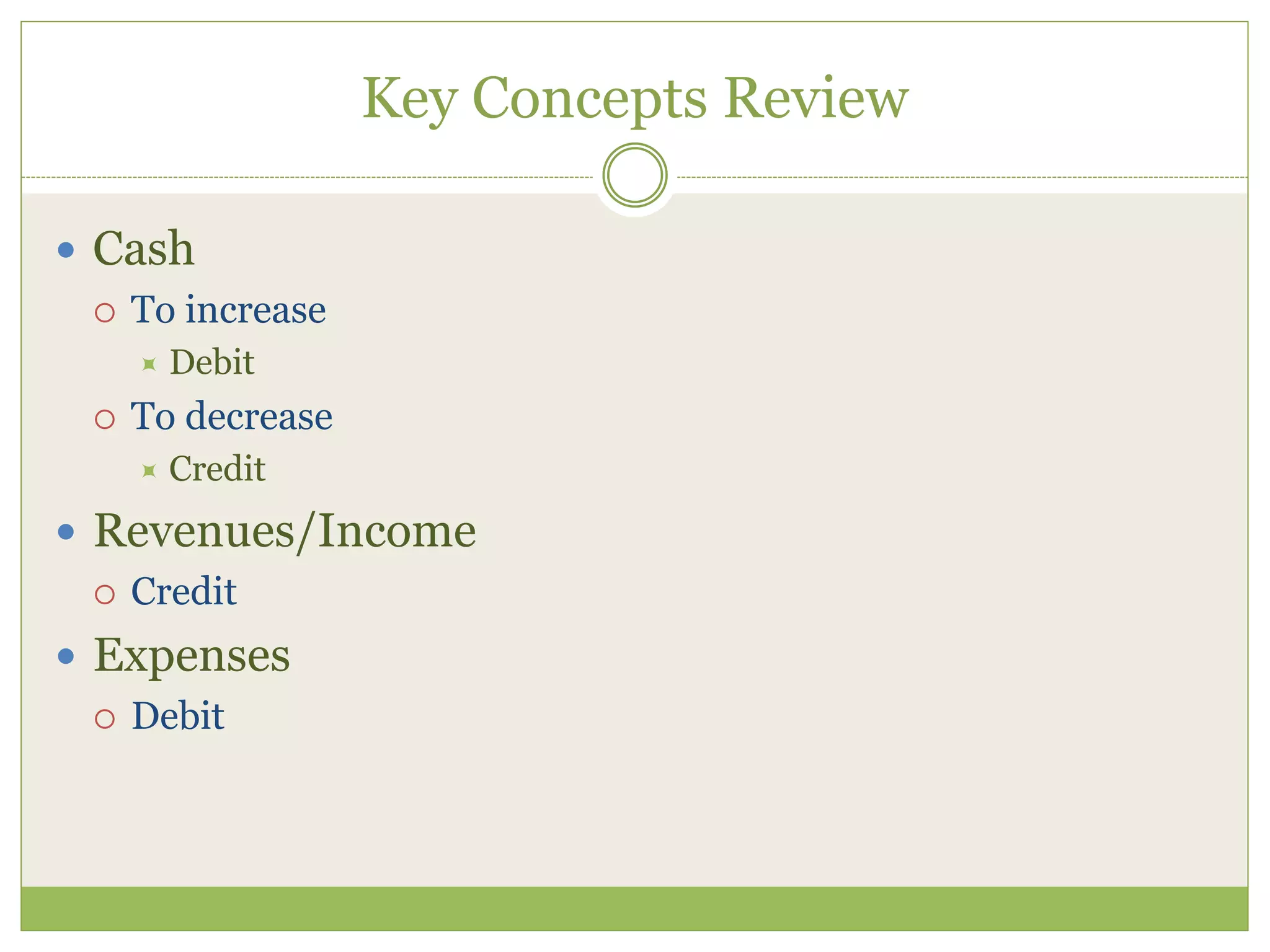
Key Concepts Review 
 Cash 
 To increase 
 Debit 
 To decrease 
 Credit 
 Revenues/Income 
 Credit 
 Expenses 
 Debit
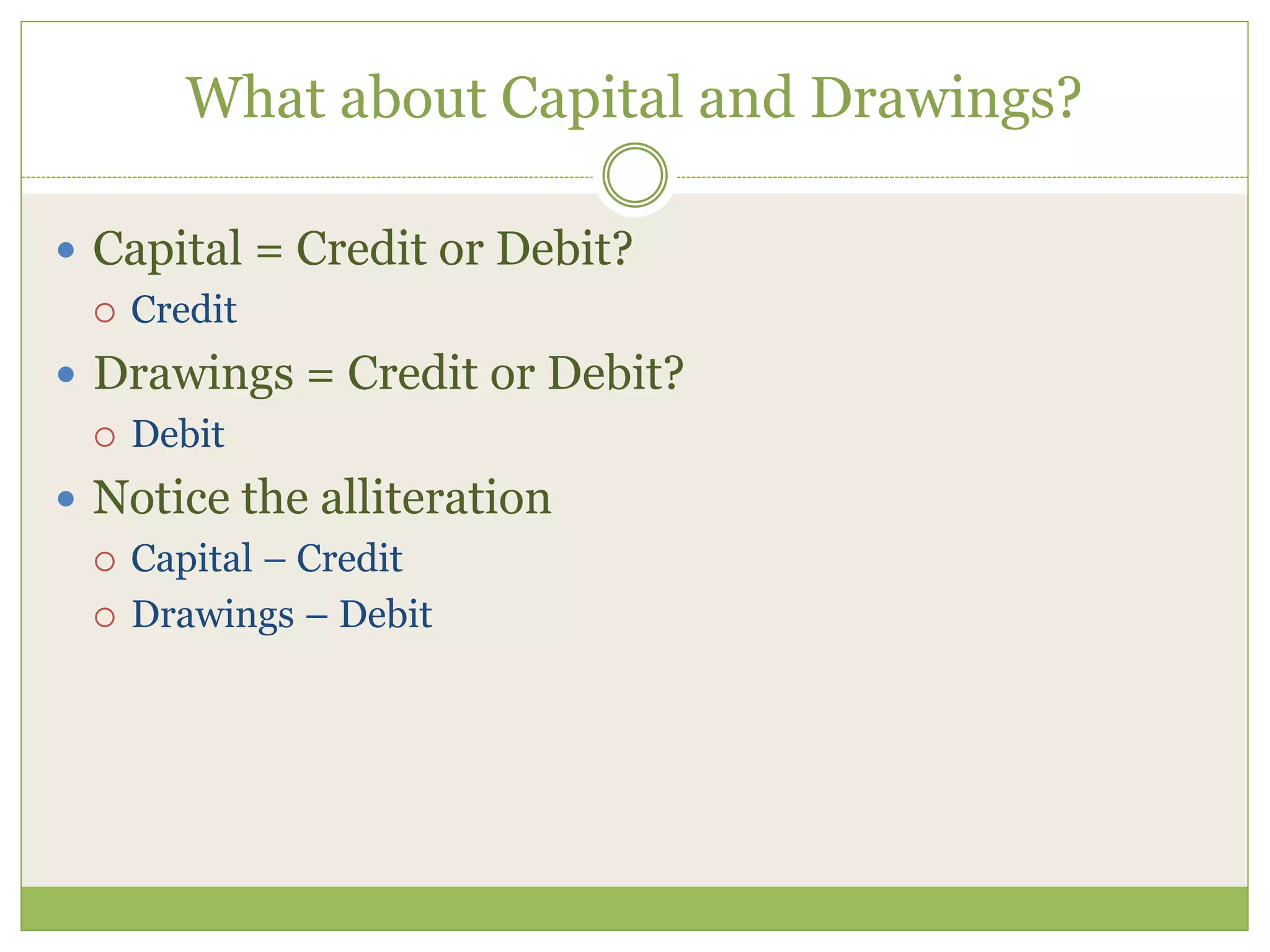
What about Capital and Drawings? 
 Capital = Credit or Debit? 
 Credit 
 Drawings = Credit or Debit? 
 Debit 
 Notice the alliteration 
 Capital – Credit 
 Drawings – Debit
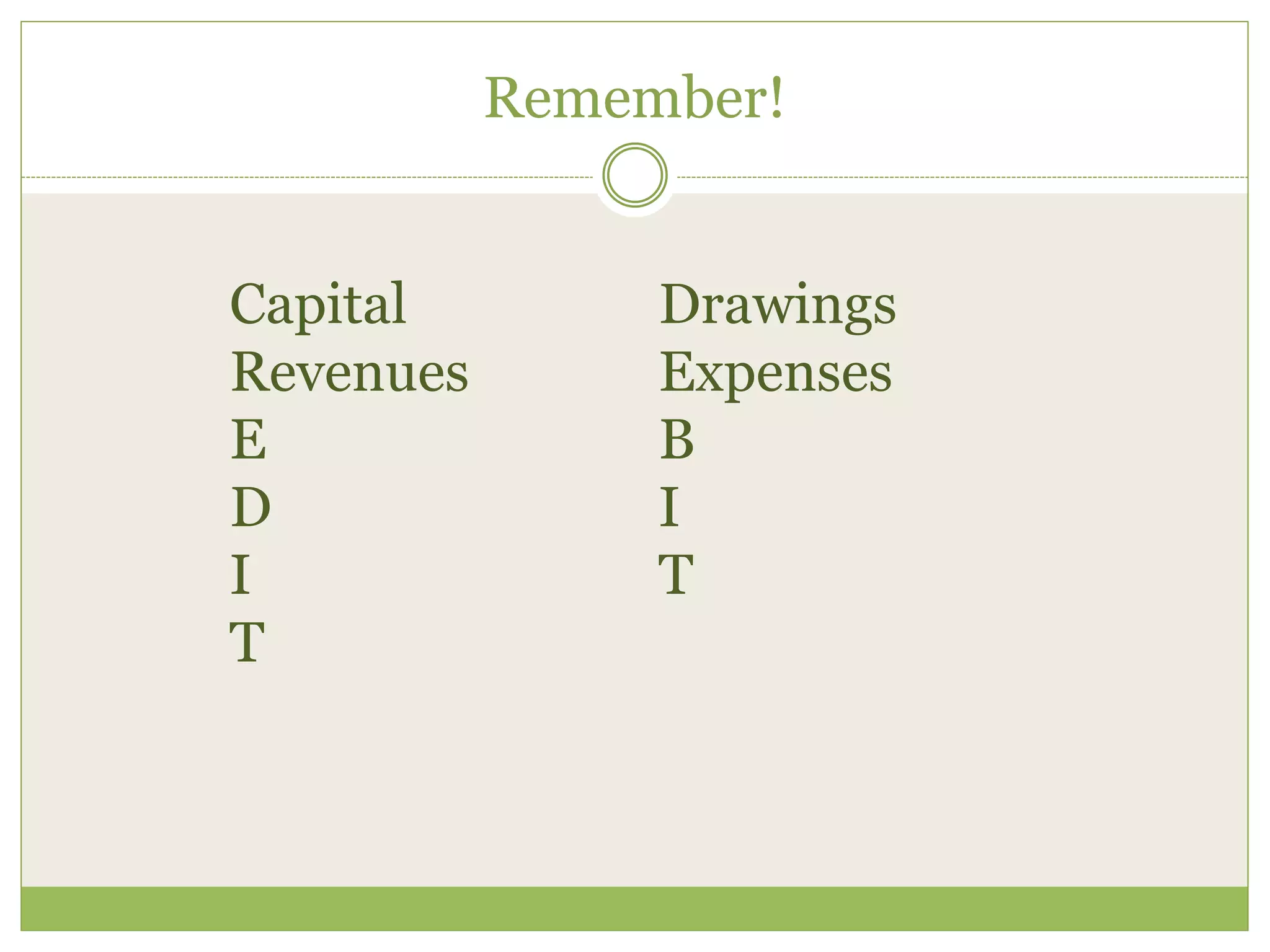
Remember! 
Capital 
Revenues 
E 
D 
I 
T 
Drawings 
Expenses 
B 
I 
T
3-8 Recording 
Debits and Credits 
G E O R G E ’ S C A T E R I N G 
R A M O N A ’ S F L O R A L S H O P
3-9 Excel 
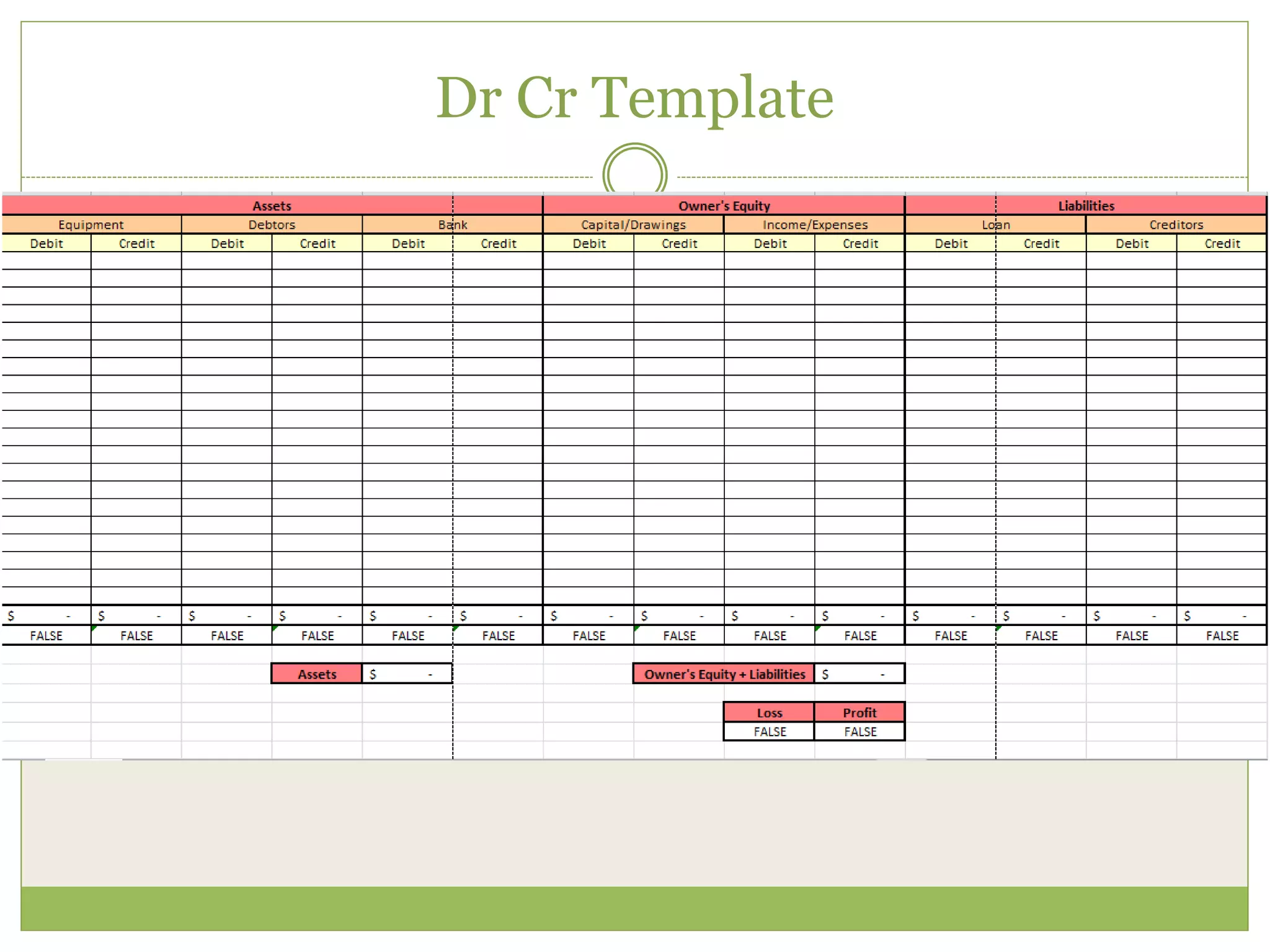
DR/CR TEMPLATE 
R A M O N A ’ S F L O R A L S H O P 
4 COMPANIES 
GROUP QUIZ
Dr Cr Template
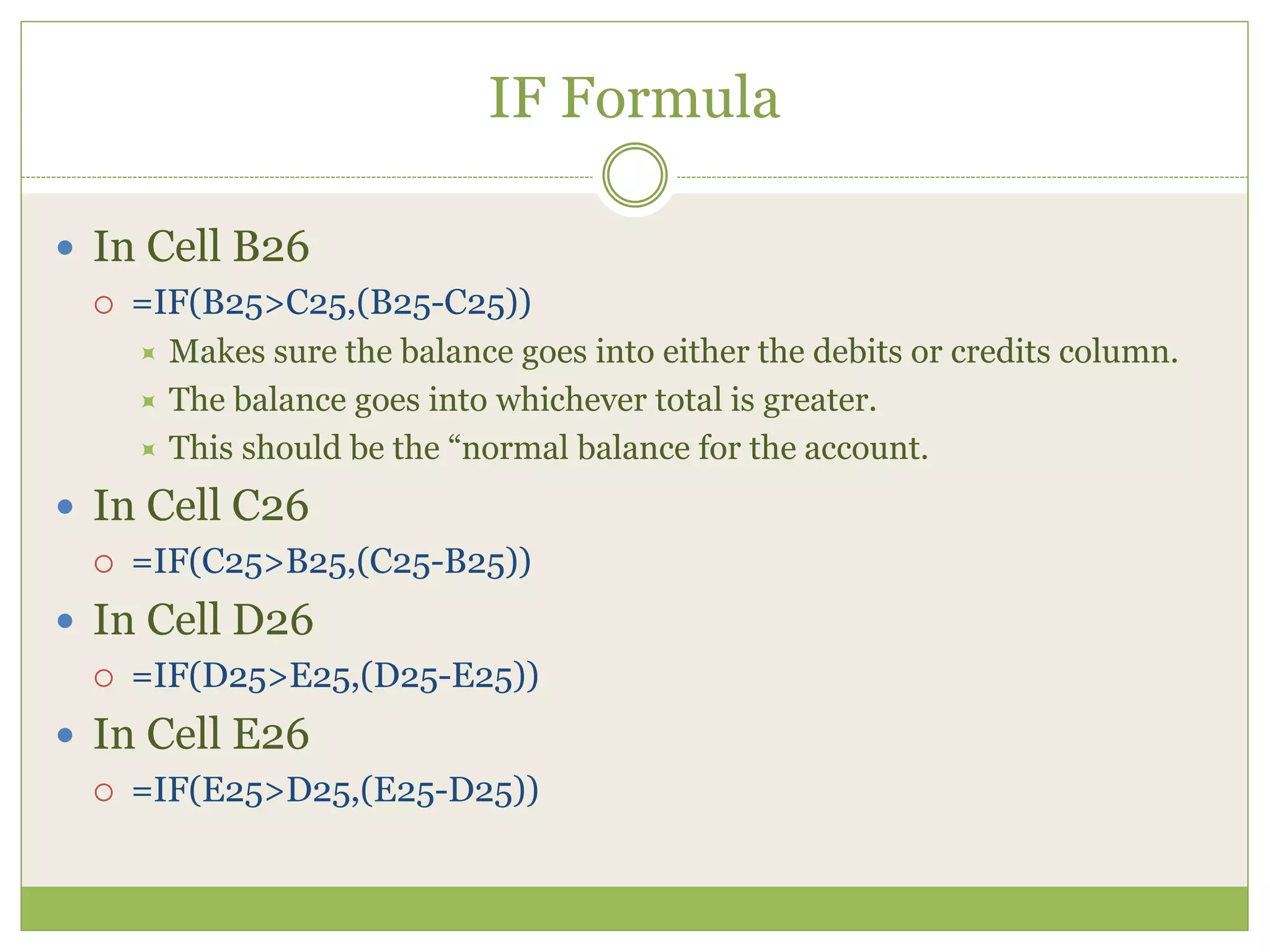
IF Formula 
 In Cell B26 
 =IF(B25>C25,(B25-C25)) 
 Makes sure the balance goes into either the debits or credits column. 
 The balance goes into whichever total is greater. 
 This should be the “normal balance for the account. 
 In Cell C26 
 =IF(C25>B25,(C25-B25)) 
 In Cell D26 
 =IF(D25>E25,(D25-E25)) 
 In Cell E26 
 =IF(E25>D25,(E25-D25))
Ramona’s Floral Shop 
 Open your Dr Cr Template 
 Save as “Last Name Ramona’s” 
 Record the transactions for Ramona’s Floral Shop on 
your Dr Cr Excel Worksheet 
 Check your work and submit online
4 Companies 
 Open your Dr Cr Template 
 Save as “Last Name 4 Companies” 
 Copy/Paste table to 4 sheets 
 Use “Paste Special” 
 “Keep Source Column Widths” 
 Record the financial transactions for each company. 
 Check your work and submit online.
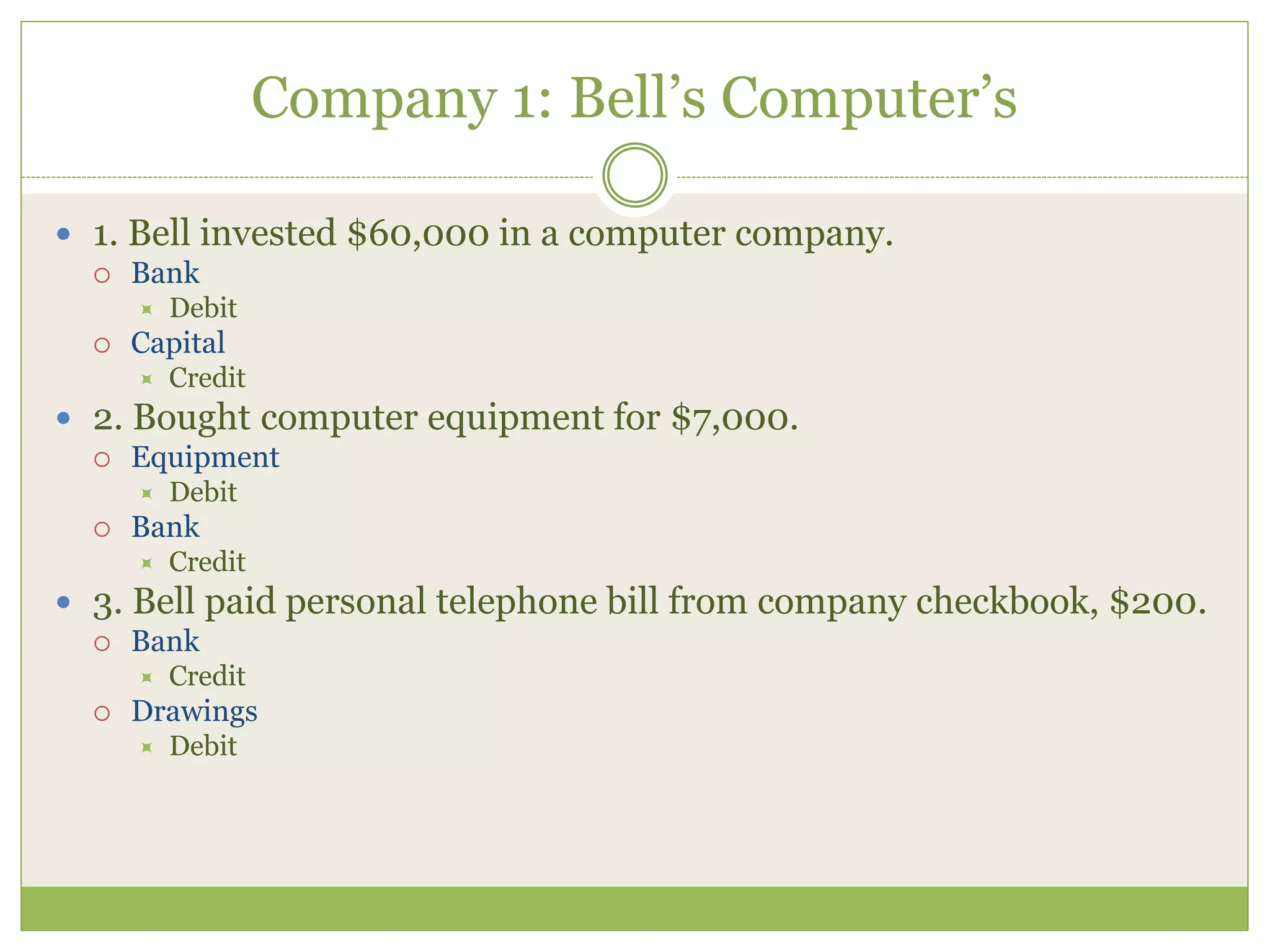
Company 1: Bell’s Computer’s 
 1. Bell invested $60,000 in a computer company. 
 Bank 
 Debit 
 Capital 
 Credit 
 2. Bought computer equipment for $7,000. 
 Equipment 
 Debit 
 Bank 
 Credit 
 3. Bell paid personal telephone bill from company checkbook, $200. 
 Bank 
 Credit 
 Drawings 
 Debit
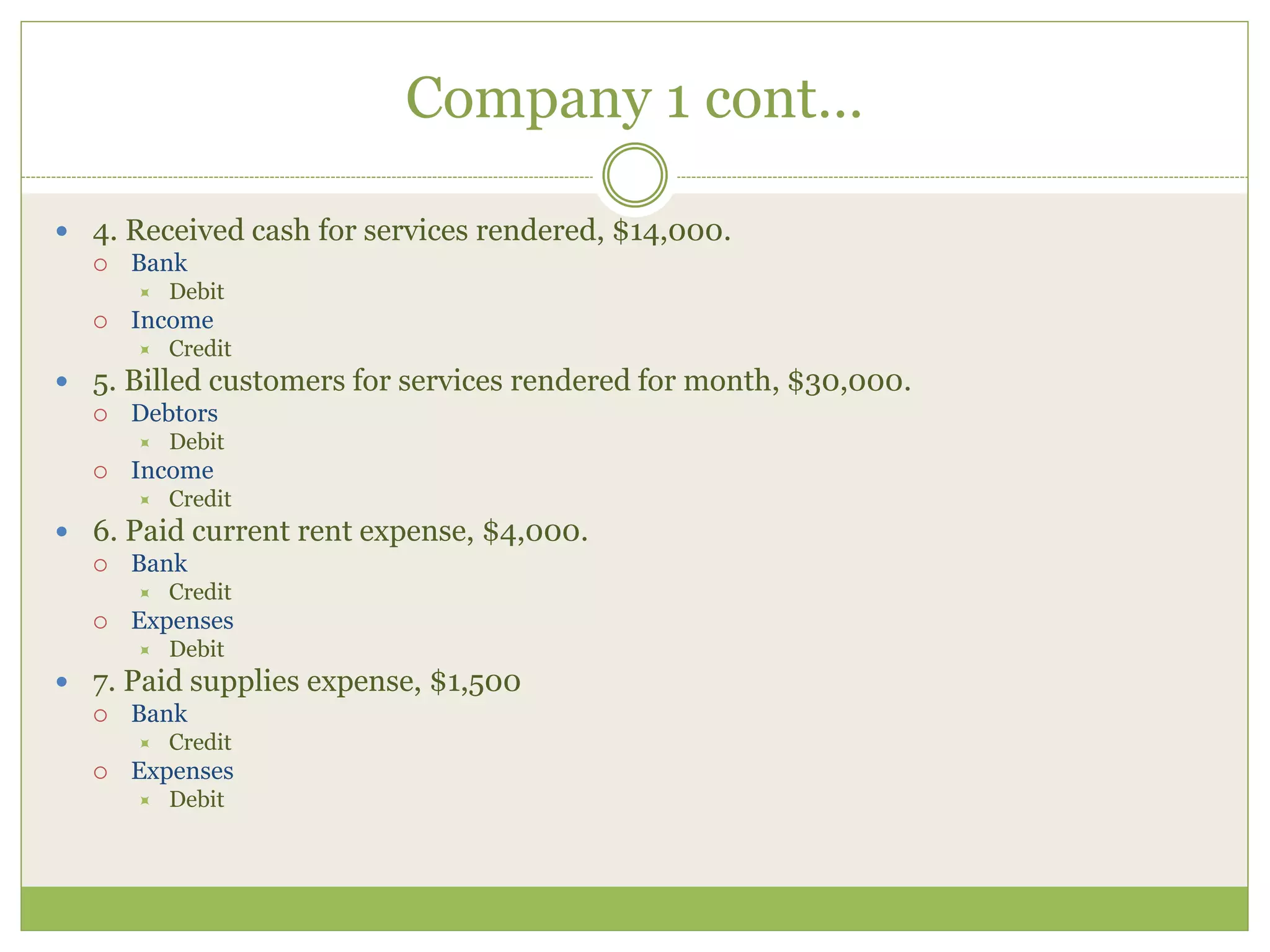
Company 1 cont… 
 4. Received cash for services rendered, $14,000. 
 Bank 
 Debit 
 Income 
 Credit 
 5. Billed customers for services rendered for month, $30,000. 
 Debtors 
 Debit 
 Income 
 Credit 
 6. Paid current rent expense, $4,000. 
 Bank 
 Credit 
 Expenses 
 Debit 
 7. Paid supplies expense, $1,500 
 Bank 
 Credit 
 Expenses 
 Debit

Unit 3 Debits and Credits

  • 1.
    Unit 3 Debitsand Credits ACCOUNTING & FINANCE ORCUTT ACADEMY HIGH SCHOOL VIEW THE TEXT AT WWW.ACCOUNTING-BASICS-FOR-STUDENTS.COM/DOUBLE - ENTRY-ACCOUNTING.HTML
  • 2.
    Financing  Financingis the act of getting money.  Financing means where you get your money from.  Financing is the source of money.
  • 3.
    Financing  Occursfirst  Can be obtained from  the owner  a lender  the profit you make.
  • 4.
    Investing  Investingis the spending of money.  One can spend money on (invest in)  things that provide only immediate benefits (expenses)  things that provide continuing benefits into the future (assets)
  • 5.
    The Accounting Equation  Financing occurs on the right  Investing occurs on the left
  • 6.
    The Accounting Equation  Every account increases on the side it is naturally on.
  • 7.
    The Accounting Equation  Every account decreases on the opposite side.
  • 8.
  • 9.
    Assets and Liabilities  Assets increase on the left, thus an increase in assets is  Investing  Assets decrease on the right, thus a decrease in assets is  Financing  Liabilities increase on the right, thus an increase in liabilities is  Financing  Liabilities decrease on the left, thus a decrease in assets is  Investing
  • 10.
    Owner’s Equity Owner’s Equity is on the right side of the accounting equation.  Income is an increase in owner’s equity.  Income is considered “financing.”  Expenses decrease owner’s equity, so they increase on the left.  Expenses are considered “investing.”
  • 11.
    3-2 Intro toDebits and Credits WHAT IS AN ACCOUNT? DOUBLE ENTRY ACCOUNTING DEBITS AND CREDITS ACCOUNTING FOR STUDENTS P. 5 2 -53 DEBITS AND CREDITS P. 1 -4
  • 12.
    What is anaccount?  A record of a business transaction.  May list as few as thirty accounts or as many as thousands.  Balance sheet accounts are listed first, followed by the income statement accounts.
  • 13.
    Accounts  Organizedin the chart of accounts as follows:  Assets  Liabilities  Owner's (Stockholders') Equity  Revenues or Income  Expenses  Gains  Losses Balance Sheet Accounts Income Statement Accounts
  • 14.
    Double Entry Accounting  Every business transaction is recorded in at least two accounts.  One account will receive a "debit" entry, meaning the amount will be entered on the left side of that account.  Another account will receive a "credit" entry, meaning the amount will be entered on the right side of that account.
  • 15.
    Examples of DoubleEntry  When a company borrows $1,000 from a bank, the transaction will affect the company's Cash account and the company's Notes Payable account. When the company repays the bank loan, the Cash account and the Notes Payable account are also involved.  If a company buys supplies for cash, its Supplies account and its Cash account will be affected. If the company buys supplies on credit, the accounts involved are Supplies and Accounts Payable.  If a company pays the rent for the current month, Rent Expense and Cash are the two accounts involved.  If a company provides a service and gives the client 30 days in which to pay, the company's Service Revenues account and Accounts Receivable are affected.
  • 16.
    More than twoaccounts  An example of a transaction that involves three accounts is a company's loan payment to its bank of $300.  This transaction will involve the following accounts: Cash, Notes Payable, and Interest Expense.
  • 17.
    Debits and Credits  Traced back five hundred years  For every transaction, you must debit at least one account and credit at least one account.  To debit an account means to enter an amount on the left side of the account.  To credit an account means to enter an amount on the right side of an account.
  • 18.
    Debit  Generallythese types of accounts are increased with a debit:  Dividends (Draws)  Expenses  Assets  Losses  You might think of D – E – A – L when recalling the accounts that are increased with a debit.
  • 19.
    Credit  Generallythese types of accounts are increased with a credit:  Gains  Income  Revenues  Liabilities  Stockholders' (Owner's) Equity  You might think of G – I – R – L – S when recalling the accounts that are increased with a credit.
  • 20.
    Debits and Credits  To decrease an account you do the opposite of what was done to increase the account. For example, an asset account is increased with a debit. Therefore it is decreased with a credit.
  • 22.
    3-3 T-Accounts andJournals T-ACCOUNTS EXAMPLE 1 EXAMPLE 2 JOURNAL ENTRIES EXAMPLE 1 EXAMPLE 2
  • 23.
    T-Accounts  Avisual aid for seeing the effect of debits and credits on a particular account.  Every transactions affects two or more accounts, so it is recorded in two or more T-accounts
  • 24.
    Cash and NotesPayable T-Accounts
  • 25.
    Example 1 On June 1, 2012 a company borrows $5,000 from its bank.  Asset Account: Cash Increase by $5,000 Debit  Liability Account: Notes Payable Increase by $5,000 Credit
  • 27.
    Example 2 On June 2, 2012 the company repaid $2,000 of the bank loan.  Asset Account: Cash  Decrease by $2,000  Credit  Liability Account: Notes Payable  Decrease by $2,000  Debit
  • 29.
    Journal Entries Another way to record transactions  Lists  the date  the account to be debited and the corresponding amount  the account to be credited and the corresponding amount  The accounts to be credited are indented.
  • 31.
    3-5 Revenues andGains REVENUE ACCOUNT S NORMAL BALANCE CONTRA ACCOUNTS EXAMPLE 1 EXAMPLE 2 DEBIT S AND CREDIT S P.
  • 32.
    Revenue Accounts Accounts:  Sales  Service Revenues  Interest (or Interest Income)  Gain on Sale of Assets
  • 33.
  • 34.
    Contra Accounts Accounts with balances that are the opposite of the normal balance are called contra accounts.  Sales Returns  Sales Allowances  Sales Discounts  Why would these accounts have debit balances?  They are reductions to sales  They represent a decrease in revenues
  • 35.
    Example 1 Your company performed a service and was immediately paid the full amount of $50 for the service.  Asset Account  Cash  Debit  Revenue Account  Service revenue  Credit
  • 36.
    Example 2 Your company performed a service on credit and invoiced the customer $400.  Asset Account  Accounts Receivable (Debtors)  Debit  Revenue Account  Service Revenues  Credit
  • 37.
    3-6 Expenses andLosses EXPENSE ACCOUNTS NORMAL BALANCE EXAMPLE 1 EXAMPLE 2 DEBITS AND CREDITS P. 9 -11
  • 38.
    Expense Accounts Salaries Expense  Wages Expense  Rent Expense  Supplies Expense  Interest Expense
  • 39.
    Expenses = Debit  Think "debit" when expenses are incurred  A debit increases the balance in an expense account  A credit decreases the balance.  We credit expenses only to reduce them, adjust them, or to close the expense accounts.  Why are expenses a debit?  They represent a DECREASE in Equity
  • 40.
    Example 1 On June 1, your company paid $800 to the landlord for the June rent.  Asset Account  Cash  Credit  Expense Account  Rent Expense  Debit
  • 41.
    Example 2 Your hourly paid employees work the last week in the year but will not be paid until the first week of the next year. At the end of the year, the company makes an entry to record the amount the employees earned but have not been paid.  Expense Account  Wages Expense  Debit  What other type of account is affected?  A payable account, such as “wages payable”  Credit
  • 42.
  • 43.
    Key Concepts Review  Cash  To increase  Debit  To decrease  Credit  Revenues/Income  Credit  Expenses  Debit
  • 44.
    What about Capitaland Drawings?  Capital = Credit or Debit?  Credit  Drawings = Credit or Debit?  Debit  Notice the alliteration  Capital – Credit  Drawings – Debit
  • 45.
    Remember! Capital Revenues E D I T Drawings Expenses B I T
  • 46.
    3-8 Recording Debitsand Credits G E O R G E ’ S C A T E R I N G R A M O N A ’ S F L O R A L S H O P
  • 47.
    3-9 Excel DR/CRTEMPLATE R A M O N A ’ S F L O R A L S H O P 4 COMPANIES GROUP QUIZ
  • 48.
  • 49.
    IF Formula In Cell B26  =IF(B25>C25,(B25-C25))  Makes sure the balance goes into either the debits or credits column.  The balance goes into whichever total is greater.  This should be the “normal balance for the account.  In Cell C26  =IF(C25>B25,(C25-B25))  In Cell D26  =IF(D25>E25,(D25-E25))  In Cell E26  =IF(E25>D25,(E25-D25))
  • 50.
    Ramona’s Floral Shop  Open your Dr Cr Template  Save as “Last Name Ramona’s”  Record the transactions for Ramona’s Floral Shop on your Dr Cr Excel Worksheet  Check your work and submit online
  • 51.
    4 Companies Open your Dr Cr Template  Save as “Last Name 4 Companies”  Copy/Paste table to 4 sheets  Use “Paste Special”  “Keep Source Column Widths”  Record the financial transactions for each company.  Check your work and submit online.
  • 52.
    Company 1: Bell’sComputer’s  1. Bell invested $60,000 in a computer company.  Bank  Debit  Capital  Credit  2. Bought computer equipment for $7,000.  Equipment  Debit  Bank  Credit  3. Bell paid personal telephone bill from company checkbook, $200.  Bank  Credit  Drawings  Debit
  • 53.
    Company 1 cont…  4. Received cash for services rendered, $14,000.  Bank  Debit  Income  Credit  5. Billed customers for services rendered for month, $30,000.  Debtors  Debit  Income  Credit  6. Paid current rent expense, $4,000.  Bank  Credit  Expenses  Debit  7. Paid supplies expense, $1,500  Bank  Credit  Expenses  Debit