









HRM Definition
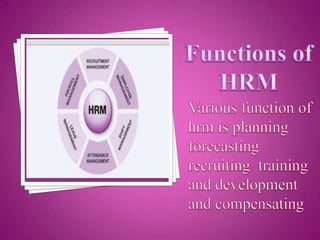
Function of hrm
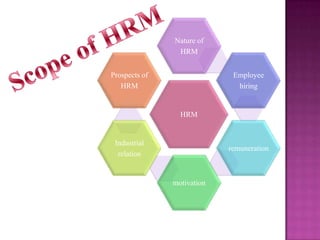
Scope of HRM


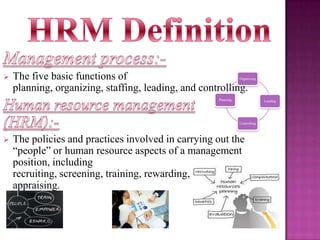
The five basic functions of
planning, organizing, staffing, leading, and controlling.

Organizing

Planning

Leading

Controlling



The policies and practices involved in carrying out the
“people” or human resource aspects of a management
position, including
recruiting, screening, training, rewarding, and
appraising.
Nature of
HRM
Prospects of
HRM

Employee
hiring

HRM

Industrial
relation

remuneration

motivation
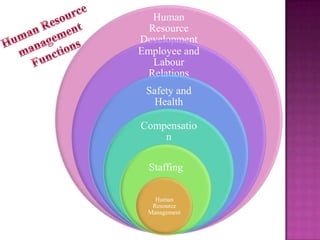
Human
Resource
Development
Employee and
Labour
Relations
Safety and
Health
Compensatio
n
Staffing
Human
Resource
Management
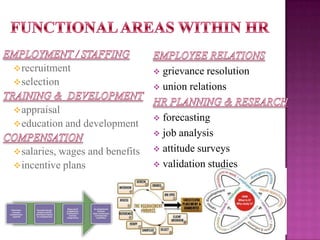
 recruitment

grievance resolution
 union relations


 selection
 appraisal
 education and

development

 salaries, wages
 incentive plans

and benefits

forecasting
 job analysis
 attitude surveys
 validation studies

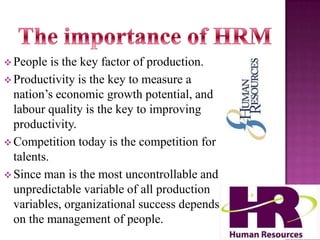
 People

is the key factor of production.
 Productivity is the key to measure a
nation’s economic growth potential, and
labour quality is the key to improving
productivity.
 Competition today is the competition for
talents.
 Since man is the most uncontrollable and
unpredictable variable of all production
variables, organizational success depends
on the management of people.
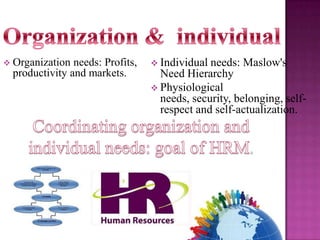
 Organization

needs: Profits,
productivity and markets.

 Individual

needs: Maslow's
Need Hierarchy
 Physiological
needs, security, belonging, selfrespect and self-actualization.








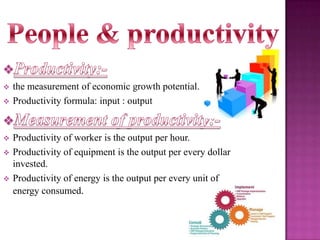
the measurement of economic growth potential.
Productivity formula: input : output

Productivity of worker is the output per hour.
Productivity of equipment is the output per every dollar
invested.
Productivity of energy is the output per every unit of
energy consumed.









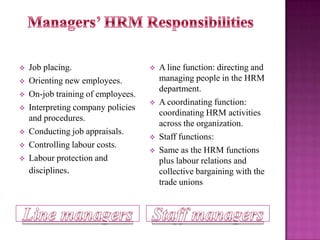
Job placing.
Orienting new employees.
On-job training of employees.
Interpreting company policies
and procedures.
Conducting job appraisals.
Controlling labour costs.
Labour protection and
disciplines.








A line function: directing and
managing people in the HRM
department.
A coordinating function:
coordinating HRM activities
across the organization.
Staff functions:
Same as the HRM functions
plus labour relations and
collective bargaining with the
trade unions
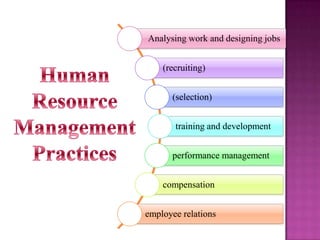
Analysing work and designing jobs
(recruiting)
(selection)
training and development
performance management
compensation
employee relations
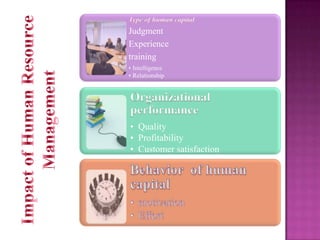
Type of human capital

Judgment
Experience
training
• Intelligence
• Relationship
• insight

Organizational
performance
• Quality
• Profitability
• Customer satisfaction
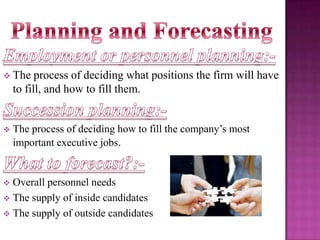
 The

process of deciding what positions the firm will have
to fill, and how to fill them.



The process of deciding how to fill the company’s most
important executive jobs.

Overall personnel needs
 The supply of inside candidates
 The supply of outside candidates



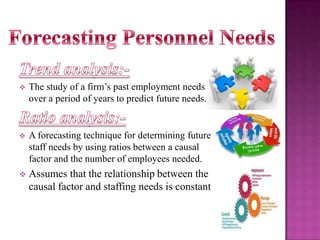
The study of a firm’s past employment needs
over a period of years to predict future needs.



A forecasting technique for determining future
staff needs by using ratios between a causal
factor and the number of employees needed.



Assumes that the relationship between the
causal factor and staffing needs is constant
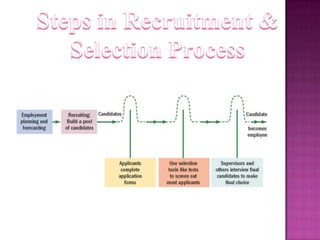
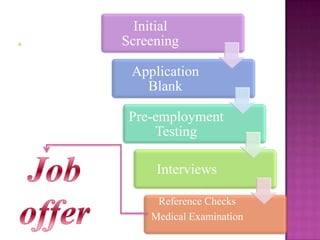
Initial
Screening
Application
Blank
Pre-employment
Testing
Interviews
Reference Checks
Medical Examination
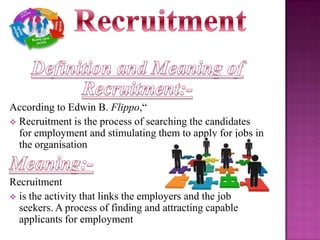
According to Edwin B. Flippo,“
 Recruitment is the process of searching the candidates
for employment and stimulating them to apply for jobs in
the organisation

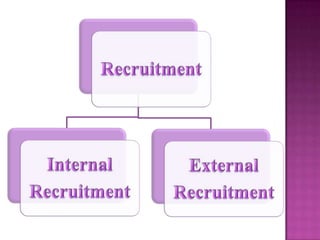
Recruitment
 is the activity that links the employers and the job
seekers. A process of finding and attracting capable
applicants for employment
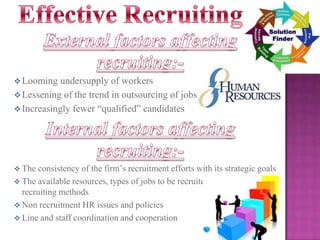
 Looming

undersupply of workers
 Lessening of the trend in outsourcing of jobs
 Increasingly fewer “qualified” candidates

 The

consistency of the firm’s recruitment efforts with its strategic goals
 The available resources, types of jobs to be recruited and choice of
recruiting methods
 Non recruitment HR issues and policies
 Line and staff coordination and cooperation
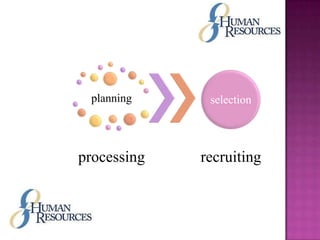
planning

selection

processing

recruiting
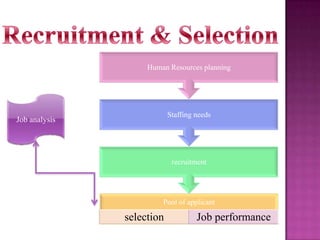
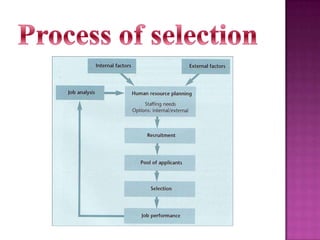
Human Resources planning

Staffing needs

Job analysis

recruitment

Pool of applicant

selection

Job performance
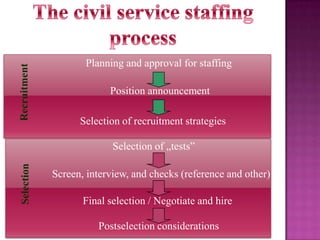
Recruitment

Planning and approval for staffing
Position announcement
Selection of recruitment strategies

Selection

Selection of „tests”
Screen, interview, and checks (reference and other)

Final selection / Negotiate and hire
Postselection considerations
28
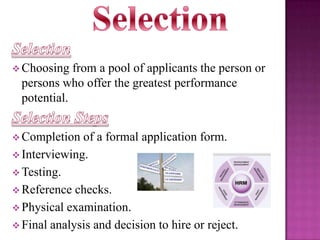
 Choosing

from a pool of applicants the person or
persons who offer the greatest performance
potential.

 Completion

of a formal application form.
 Interviewing.
 Testing.
 Reference checks.
 Physical examination.
 Final analysis and decision to hire or reject.
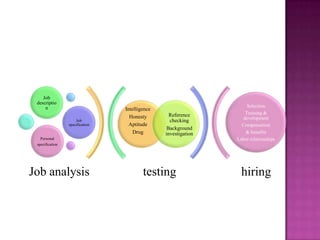
Job
descriptio
n
Job
specification

Intelligence
Honesty
Aptitude
Drug

Reference
checking
Background
investigation

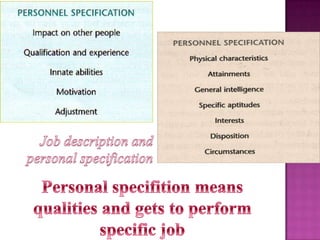
Personal
specification

Job analysis

testing

Selection
Training &
development
Compensation
& benefits
Labor relationships

hiring
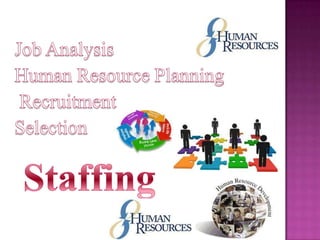
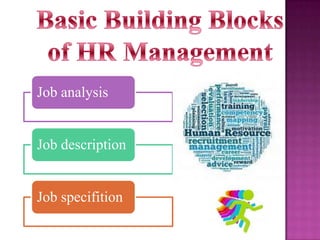
Job analysis

Job description

Job specifition
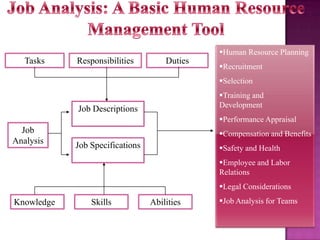
Human Resource Planning

Tasks

Responsibilities

Duties

Recruitment
Selection
Training and
Development

Job Descriptions

Performance Appraisal

Job
Analysis

Compensation and Benefits

Job Specifications

Safety and Health
Employee and Labor
Relations
Legal Considerations

Knowledge

Skills

Abilities

Job Analysis for Teams

34
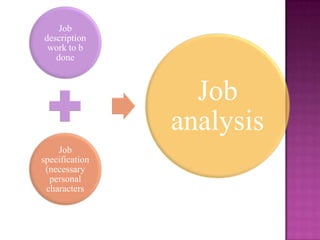
Job
description
work to b
done

Job
analysis
Job
specification
(necessary
personal
characters
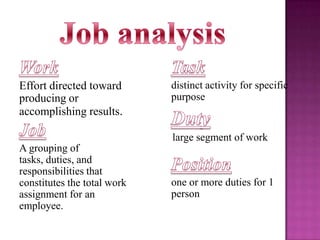
Effort directed toward
producing or
accomplishing results.

distinct activity for specific
purpose

large segment of work
A grouping of
tasks, duties, and
responsibilities that
constitutes the total work
assignment for an
employee.

one or more duties for 1
person
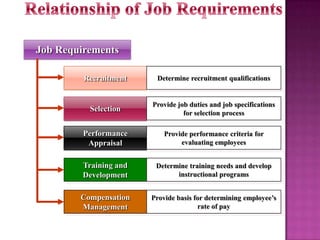
Job Requirements
Recruitment

Determine recruitment qualifications

Selection

Provide job duties and job specifications
for selection process

Performance
Appraisal

Provide performance criteria for
evaluating employees

Training and
Development

Determine training needs and develop
instructional programs

Compensation
Management

Provide basis for determining employee’s
rate of pay


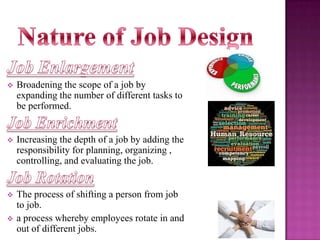
Broadening the scope of a job by
expanding the number of different tasks to
be performed.



Increasing the depth of a job by adding the
responsibility for planning, organizing ,
controlling, and evaluating the job.



The process of shifting a person from job
to job.
a process whereby employees rotate in and
out of different jobs.


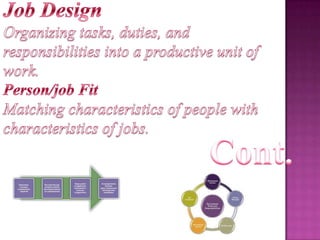
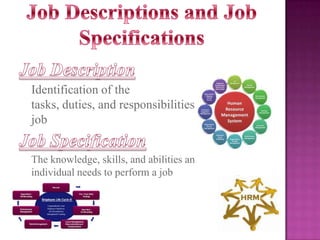
Identification of the
tasks, duties, and responsibilities of a
job
The knowledge, skills, and abilities an
individual needs to perform a job
satisfactorily.
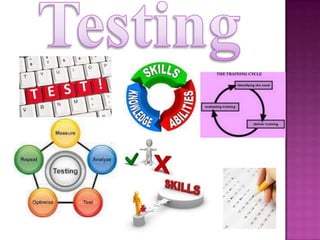
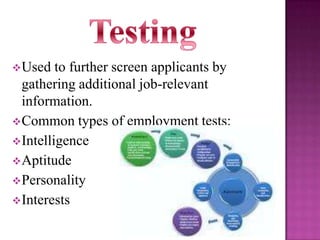
 Used

to further screen applicants by
gathering additional job-relevant
information.
 Common types of employment tests:
 Intelligence
 Aptitude
 Personality
 Interests
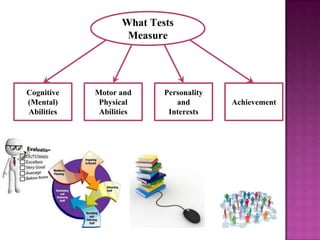
What Tests
Measure

Cognitive
(Mental)
Abilities

Motor and
Physical
Abilities

Personality
and
Interests

Achievement
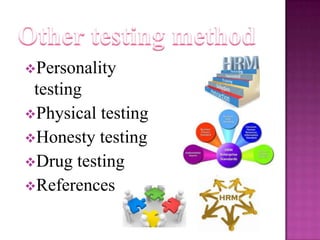
Personality

testing
Physical testing
Honesty testing
Drug testing
References
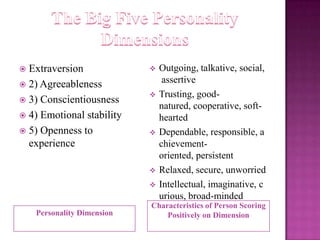
Extraversion
 2) Agreeableness
 3) Conscientiousness
 4) Emotional stability
 5) Openness to
experience











Personality Dimension

Outgoing, talkative, social,
assertive
Trusting, goodnatured, cooperative, softhearted
Dependable, responsible, a
chievementoriented, persistent
Relaxed, secure, unworried
Intellectual, imaginative, c
urious, broad-minded

Characteristics of Person Scoring
Positively on Dimension
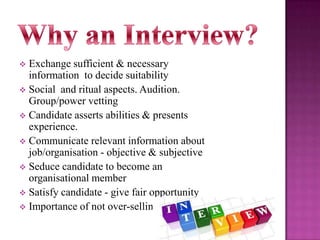
Exchange sufficient & necessary
information to decide suitability
 Social and ritual aspects. Audition.
Group/power vetting
 Candidate asserts abilities & presents
experience.
 Communicate relevant information about
job/organisation - objective & subjective
 Seduce candidate to become an
organisational member
 Satisfy candidate - give fair opportunity
 Importance of not over-selling

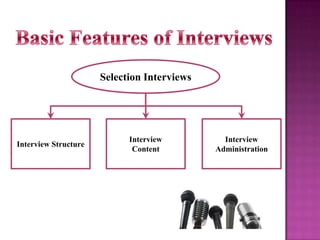
Selection Interviews

Interview Structure

Interview
Content

Interview
Administration
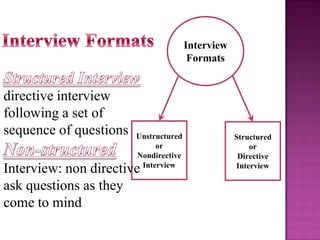
Interview
Formats

directive interview
following a set of
sequence of questions

Unstructured
or
Nondirective
Interview

Interview: non directive
ask questions as they
come to mind

Structured
or
Directive
Interview
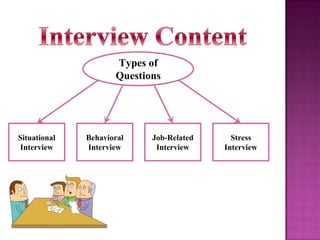
Types of
Questions

Situational
Interview

Behavioral
Interview

Job-Related
Interview

Stress
Interview
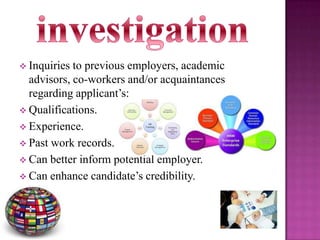
 Inquiries

to previous employers, academic
advisors, co-workers and/or acquaintances
regarding applicant’s:
 Qualifications.
 Experience.
 Past work records.
 Can better inform potential employer.
 Can enhance candidate’s credibility.
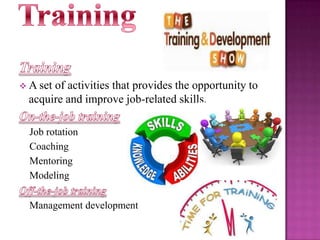
 A set

of activities that provides the opportunity to
acquire and improve job-related skills.
Job rotation
Coaching
Mentoring
Modeling
Management development
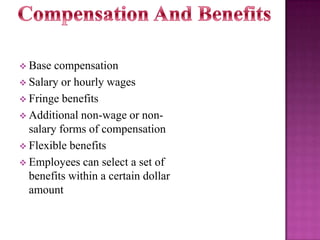
 Base

compensation
 Salary or hourly wages
 Fringe benefits
 Additional non-wage or nonsalary forms of compensation
 Flexible benefits
 Employees can select a set of
benefits within a certain dollar
amount
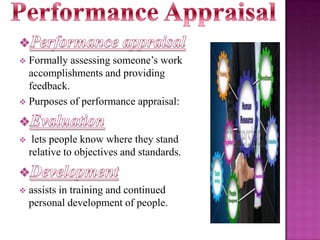
Formally assessing someone’s work
accomplishments and providing
feedback.
 Purposes of performance appraisal:




lets people know where they stand
relative to objectives and standards.



assists in training and continued
personal development of people.
Planning and recruiting

Planning and recruiting