» Accounting as a whole is based on a single
equation:
ASSETS = EQUITY + LIABILITIES
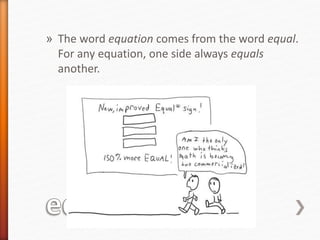
» The word equation comes from the word equal.
For any equation, one side always equals
another.
» The accounting equation should remain in
balance at all times because of double-entry
accounting or bookkeeping.
» Double-entry means that every transaction will
affect at least two accounts in the general
ledger.
» Examples
˃ An owner's investment into the company will increase the company's
assets and will also increase owner's equity.
˃ When the company borrows money from its bank, the company's
assets increase and the company's liabilities increase.
» Well, in order to answer that question we need
to look at what each of the terms in the
equation mean…
1. Assets
2. Liabilities
3. Owner’s Equity
» Official Definition: A resource controlled by the
enterprise as a result of past events and from
which future economic benefits are expected to
flow to the enterprise.
» An asset is
˃ A possession of a business that will bring the business benefits in the
future.
˃ Anything that will add future value to your business.
» Land
» Computer
» Vehicle
» Cash
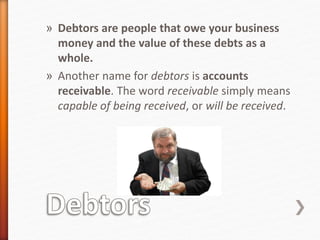
» Debtors are people that owe your business
money and the value of these debts as a
whole.
» Another name for debtors is accounts
receivable. The word receivable simply means
capable of being received, or will be received.
» Would debtors or accounts receivable be an
asset for your business?
˃ Answer: Even though you cannot own a debtor, you will get benefits in
the future from having money owed to your business.
˃ The benefits are simple – you will get paid! So if you have $3,000
owed to you by Mr. Smith, you have a debtor, an asset, worth $3,000.
» An additional requirement for an asset is that
you have to be able to accurately measure its
value.
» This is usually quite simple, as the value is equal
to how much you paid for it.
» Are employees considered an asset?
˃ Can you put an accurate, reliable figure on how much an employee is
worth to you, bearing in mind that he or she can resign at any point
by giving notice? Tricky, right? As you can imagine, it's nearly
impossible to place a value on people – consequently employees are
actually never included as assets in accounting - but only because we
can't value them.
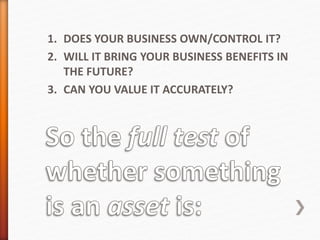
1. DOES YOUR BUSINESS OWN/CONTROL IT?
2. WILL IT BRING YOUR BUSINESS BENEFITS IN
THE FUTURE?
3. CAN YOU VALUE IT ACCURATELY?
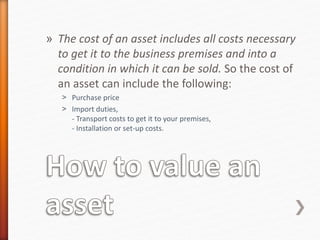
» The cost of an asset includes all costs necessary
to get it to the business premises and into a
condition in which it can be sold. So the cost of
an asset can include the following:
˃ Purchase price
˃ Import duties,
- Transport costs to get it to your premises,
- Installation or set-up costs.
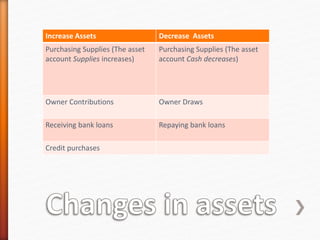
Increase Assets Decrease Assets
Purchasing Supplies (The asset
account Supplies increases)
Purchasing Supplies (The asset
account Cash decreases)
Owner Contributions Owner Draws
Receiving bank loans Repaying bank loans
Credit purchases
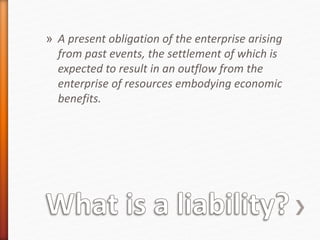
» A present obligation of the enterprise arising
from past events, the settlement of which is
expected to result in an outflow from the
enterprise of resources embodying economic
benefits.
» a liability is simply... a debt of the business.
» The debt will result in assets (usually cash)
leaving the business in the future.
» The most common liability is a loan.
» Another common liability is called creditors.
˃ A creditor, also known as a payable, is any business or person (apart
from the bank) that you owe.
˃ Suppliers (who you owe for products purchased on credit) would fall
under creditors.
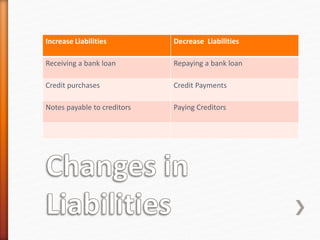
Increase Liabilities Decrease Liabilities
Receiving a bank loan Repaying a bank loan
Credit purchases Credit Payments
Notes payable to creditors Paying Creditors
» The residual interest in the assets of the
enterprise after deducting all its liabilities.
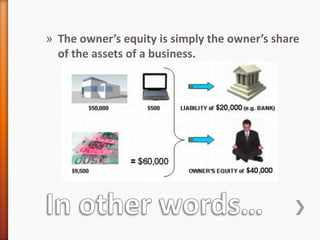
» The owner’s equity is simply the owner’s share
of the assets of a business.
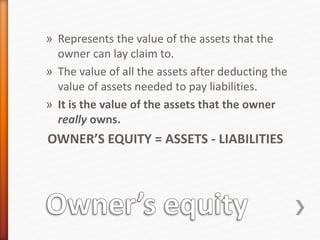
» Represents the value of the assets that the
owner can lay claim to.
» The value of all the assets after deducting the
value of assets needed to pay liabilities.
» It is the value of the assets that the owner
really owns.
OWNER’S EQUITY = ASSETS - LIABILITIES
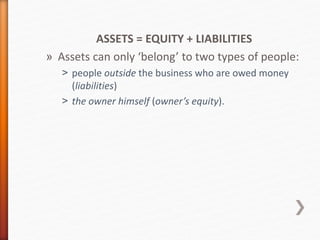
ASSETS = EQUITY + LIABILITIES
» Assets can only ‘belong’ to two types of people:
˃ people outside the business who are owed money
(liabilities)
˃ the owner himself (owner’s equity).
» In the case of a corporation, which is publicly
owned, equity is labeled shareholder’s equity
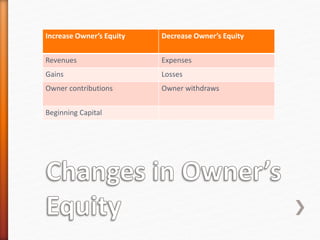
Increase Owner’s Equity Decrease Owner’s Equity
Revenues Expenses
Gains Losses
Owner contributions Owner withdraws
Beginning Capital
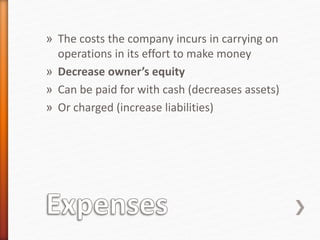
» The costs the company incurs in carrying on
operations in its effort to make money
» Decrease owner’s equity
» Can be paid for with cash (decreases assets)
» Or charged (increase liabilities)
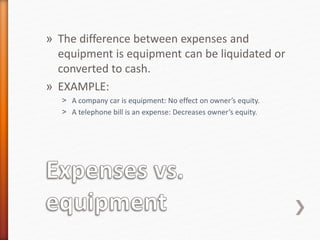
» The difference between expenses and
equipment is equipment can be liquidated or
converted to cash.
» EXAMPLE:
˃ A company car is equipment: No effect on owner’s equity.
˃ A telephone bill is an expense: Decreases owner’s equity.
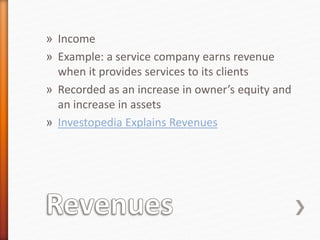
» Income
» Example: a service company earns revenue
when it provides services to its clients
» Recorded as an increase in owner’s equity and
an increase in assets
» Investopedia Explains Revenues
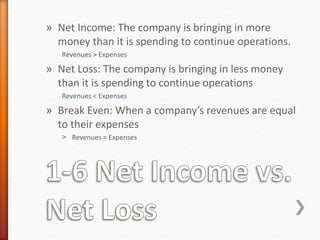
» Net Income: The company is bringing in more
money than it is spending to continue operations.
Revenues > Expenses
» Net Loss: The company is bringing in less money
than it is spending to continue operations
Revenues < Expenses
» Break Even: When a company’s revenues are equal
to their expenses
˃ Revenues = Expenses
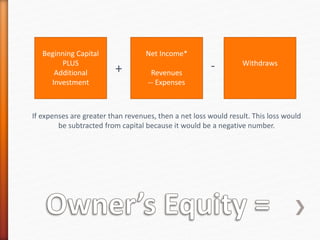
Beginning Capital
PLUS
Additional
Investment
Net Income*
Revenues
-- Expenses
Withdraws
+ -
If expenses are greater than revenues, then a net loss would result. This loss would
be subtracted from capital because it would be a negative number.
» Every transaction affects TWO or more
accounts!
» This is how the accounting equation stays in
balance
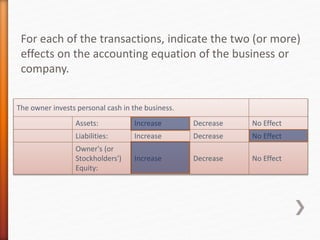
For each of the transactions, indicate the two (or more)
effects on the accounting equation of the business or
company.
The owner invests personal cash in the business.
Assets: Increase Decrease No Effect
Liabilities: Increase Decrease No Effect
Owner's (or
Stockholders')
Equity:
Increase Decrease No Effect
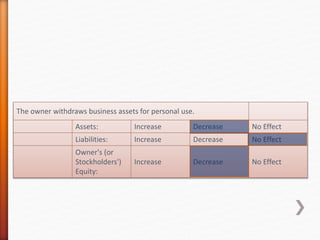
The owner withdraws business assets for personal use.
Assets: Increase Decrease No Effect
Liabilities: Increase Decrease No Effect
Owner's (or
Stockholders')
Equity:
Increase Decrease No Effect
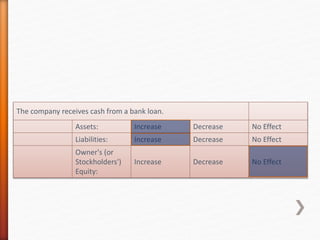
The company receives cash from a bank loan.
Assets: Increase Decrease No Effect
Liabilities: Increase Decrease No Effect
Owner's (or
Stockholders')
Equity:
Increase Decrease No Effect
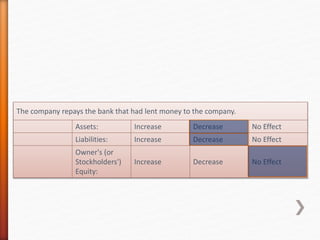
The company repays the bank that had lent money to the company.
Assets: Increase Decrease No Effect
Liabilities: Increase Decrease No Effect
Owner's (or
Stockholders')
Equity:
Increase Decrease No Effect
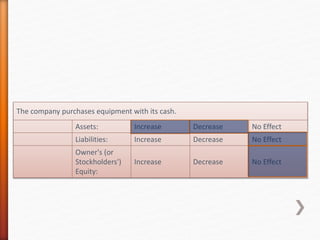
The company purchases equipment with its cash.
Assets: Increase Decrease No Effect
Liabilities: Increase Decrease No Effect
Owner's (or
Stockholders')
Equity:
Increase Decrease No Effect
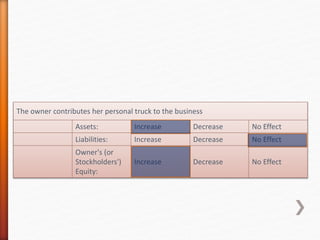
The owner contributes her personal truck to the business
Assets: Increase Decrease No Effect
Liabilities: Increase Decrease No Effect
Owner's (or
Stockholders')
Equity:
Increase Decrease No Effect
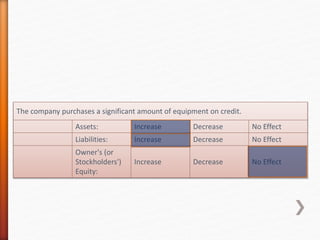
The company purchases a significant amount of equipment on credit.
Assets: Increase Decrease No Effect
Liabilities: Increase Decrease No Effect
Owner's (or
Stockholders')
Equity:
Increase Decrease No Effect
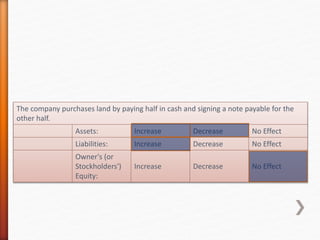
The company purchases land by paying half in cash and signing a note payable for the
other half.
Assets: Increase Decrease No Effect
Liabilities: Increase Decrease No Effect
Owner's (or
Stockholders')
Equity:
Increase Decrease No Effect

Unit 1 The Accounting Equation

  • 3.
    » Accounting asa whole is based on a single equation: ASSETS = EQUITY + LIABILITIES
  • 4.
    » The wordequation comes from the word equal. For any equation, one side always equals another.
  • 5.
    » The accountingequation should remain in balance at all times because of double-entry accounting or bookkeeping. » Double-entry means that every transaction will affect at least two accounts in the general ledger.
  • 6.
    » Examples ˃ Anowner's investment into the company will increase the company's assets and will also increase owner's equity. ˃ When the company borrows money from its bank, the company's assets increase and the company's liabilities increase.
  • 7.
    » Well, inorder to answer that question we need to look at what each of the terms in the equation mean… 1. Assets 2. Liabilities 3. Owner’s Equity
  • 9.
    » Official Definition:A resource controlled by the enterprise as a result of past events and from which future economic benefits are expected to flow to the enterprise.
  • 10.
    » An assetis ˃ A possession of a business that will bring the business benefits in the future. ˃ Anything that will add future value to your business.
  • 11.
    » Land » Computer »Vehicle » Cash
  • 12.
    » Debtors arepeople that owe your business money and the value of these debts as a whole. » Another name for debtors is accounts receivable. The word receivable simply means capable of being received, or will be received.
  • 13.
    » Would debtorsor accounts receivable be an asset for your business? ˃ Answer: Even though you cannot own a debtor, you will get benefits in the future from having money owed to your business. ˃ The benefits are simple – you will get paid! So if you have $3,000 owed to you by Mr. Smith, you have a debtor, an asset, worth $3,000.
  • 14.
    » An additionalrequirement for an asset is that you have to be able to accurately measure its value. » This is usually quite simple, as the value is equal to how much you paid for it. » Are employees considered an asset? ˃ Can you put an accurate, reliable figure on how much an employee is worth to you, bearing in mind that he or she can resign at any point by giving notice? Tricky, right? As you can imagine, it's nearly impossible to place a value on people – consequently employees are actually never included as assets in accounting - but only because we can't value them.
  • 15.
    1. DOES YOURBUSINESS OWN/CONTROL IT? 2. WILL IT BRING YOUR BUSINESS BENEFITS IN THE FUTURE? 3. CAN YOU VALUE IT ACCURATELY?
  • 16.
    » The costof an asset includes all costs necessary to get it to the business premises and into a condition in which it can be sold. So the cost of an asset can include the following: ˃ Purchase price ˃ Import duties, - Transport costs to get it to your premises, - Installation or set-up costs.
  • 17.
    Increase Assets DecreaseAssets Purchasing Supplies (The asset account Supplies increases) Purchasing Supplies (The asset account Cash decreases) Owner Contributions Owner Draws Receiving bank loans Repaying bank loans Credit purchases
  • 19.
    » A presentobligation of the enterprise arising from past events, the settlement of which is expected to result in an outflow from the enterprise of resources embodying economic benefits.
  • 20.
    » a liabilityis simply... a debt of the business. » The debt will result in assets (usually cash) leaving the business in the future.
  • 21.
    » The mostcommon liability is a loan. » Another common liability is called creditors. ˃ A creditor, also known as a payable, is any business or person (apart from the bank) that you owe. ˃ Suppliers (who you owe for products purchased on credit) would fall under creditors.
  • 22.
    Increase Liabilities DecreaseLiabilities Receiving a bank loan Repaying a bank loan Credit purchases Credit Payments Notes payable to creditors Paying Creditors
  • 24.
    » The residualinterest in the assets of the enterprise after deducting all its liabilities.
  • 25.
    » The owner’sequity is simply the owner’s share of the assets of a business.
  • 26.
    » Represents thevalue of the assets that the owner can lay claim to. » The value of all the assets after deducting the value of assets needed to pay liabilities. » It is the value of the assets that the owner really owns. OWNER’S EQUITY = ASSETS - LIABILITIES
  • 27.
    ASSETS = EQUITY+ LIABILITIES » Assets can only ‘belong’ to two types of people: ˃ people outside the business who are owed money (liabilities) ˃ the owner himself (owner’s equity).
  • 28.
    » In thecase of a corporation, which is publicly owned, equity is labeled shareholder’s equity
  • 29.
    Increase Owner’s EquityDecrease Owner’s Equity Revenues Expenses Gains Losses Owner contributions Owner withdraws Beginning Capital
  • 30.
    » The coststhe company incurs in carrying on operations in its effort to make money » Decrease owner’s equity » Can be paid for with cash (decreases assets) » Or charged (increase liabilities)
  • 31.
    » The differencebetween expenses and equipment is equipment can be liquidated or converted to cash. » EXAMPLE: ˃ A company car is equipment: No effect on owner’s equity. ˃ A telephone bill is an expense: Decreases owner’s equity.
  • 32.
    » Income » Example:a service company earns revenue when it provides services to its clients » Recorded as an increase in owner’s equity and an increase in assets » Investopedia Explains Revenues
  • 33.
    » Net Income:The company is bringing in more money than it is spending to continue operations. Revenues > Expenses » Net Loss: The company is bringing in less money than it is spending to continue operations Revenues < Expenses » Break Even: When a company’s revenues are equal to their expenses ˃ Revenues = Expenses
  • 34.
    Beginning Capital PLUS Additional Investment Net Income* Revenues --Expenses Withdraws + - If expenses are greater than revenues, then a net loss would result. This loss would be subtracted from capital because it would be a negative number.
  • 35.
    » Every transactionaffects TWO or more accounts! » This is how the accounting equation stays in balance
  • 36.
    For each ofthe transactions, indicate the two (or more) effects on the accounting equation of the business or company. The owner invests personal cash in the business. Assets: Increase Decrease No Effect Liabilities: Increase Decrease No Effect Owner's (or Stockholders') Equity: Increase Decrease No Effect
  • 37.
    The owner withdrawsbusiness assets for personal use. Assets: Increase Decrease No Effect Liabilities: Increase Decrease No Effect Owner's (or Stockholders') Equity: Increase Decrease No Effect
  • 38.
    The company receivescash from a bank loan. Assets: Increase Decrease No Effect Liabilities: Increase Decrease No Effect Owner's (or Stockholders') Equity: Increase Decrease No Effect
  • 39.
    The company repaysthe bank that had lent money to the company. Assets: Increase Decrease No Effect Liabilities: Increase Decrease No Effect Owner's (or Stockholders') Equity: Increase Decrease No Effect
  • 40.
    The company purchasesequipment with its cash. Assets: Increase Decrease No Effect Liabilities: Increase Decrease No Effect Owner's (or Stockholders') Equity: Increase Decrease No Effect
  • 41.
    The owner contributesher personal truck to the business Assets: Increase Decrease No Effect Liabilities: Increase Decrease No Effect Owner's (or Stockholders') Equity: Increase Decrease No Effect
  • 42.
    The company purchasesa significant amount of equipment on credit. Assets: Increase Decrease No Effect Liabilities: Increase Decrease No Effect Owner's (or Stockholders') Equity: Increase Decrease No Effect
  • 43.
    The company purchasesland by paying half in cash and signing a note payable for the other half. Assets: Increase Decrease No Effect Liabilities: Increase Decrease No Effect Owner's (or Stockholders') Equity: Increase Decrease No Effect