
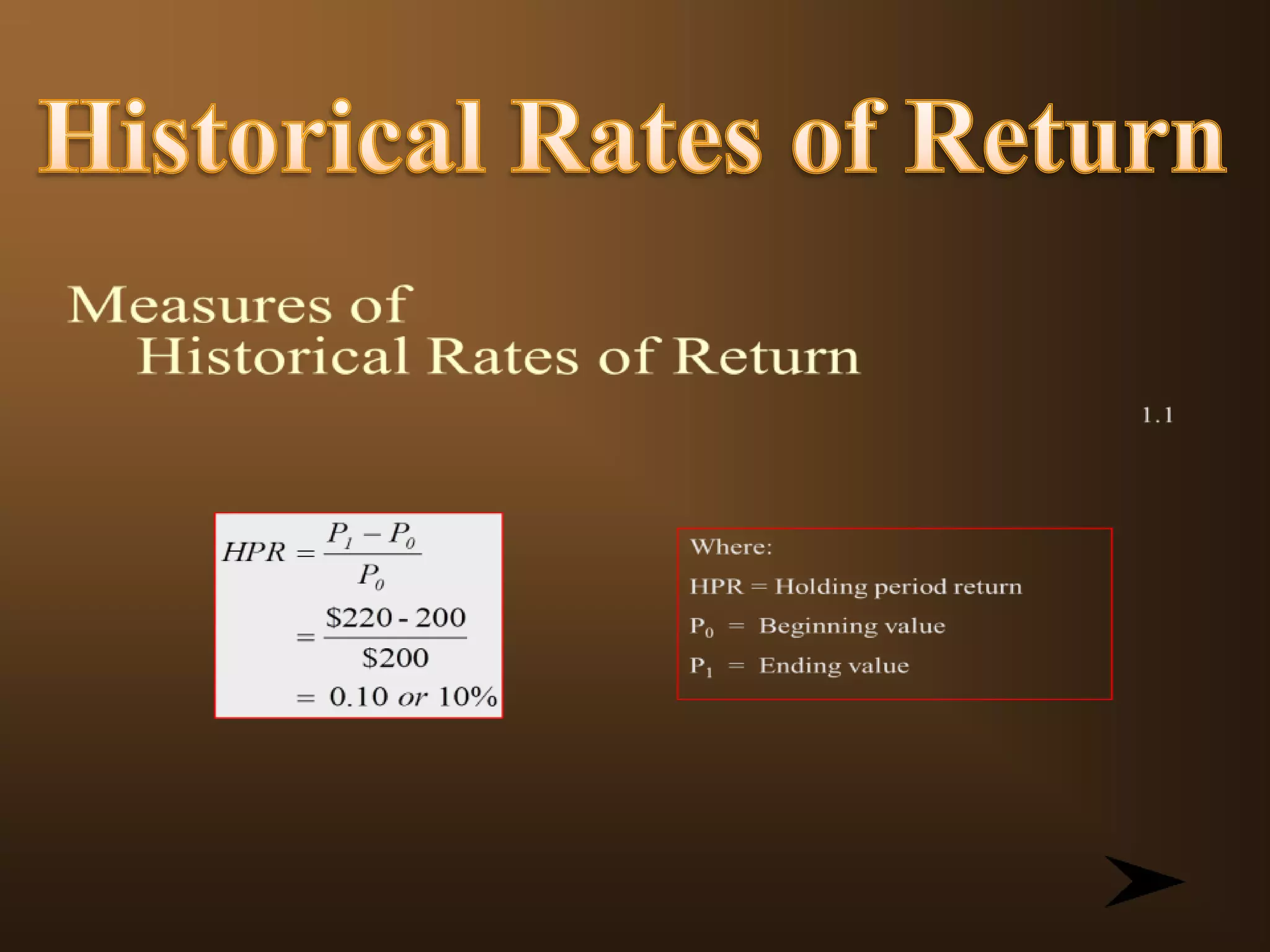
o

o

o
o

Any investment involves a current commitment of
funds for some period of time in order to derive
future payments that will compensate for:
the time the funds are committed (the real rate of
return)
the expected rate of inflation (inflation premium)
uncertainty of future flow of funds (risk premium)
o

o

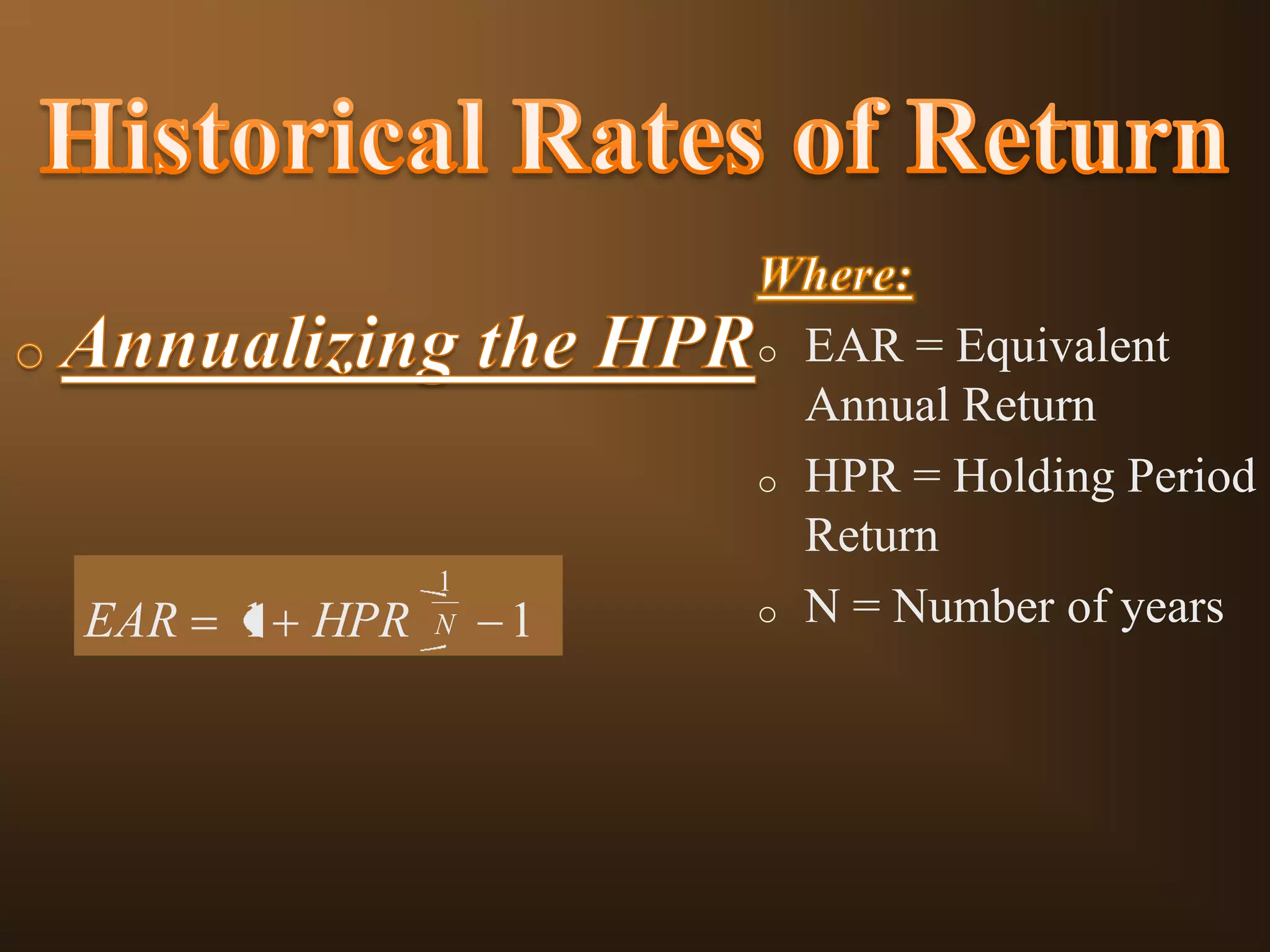
EAR

1 HPR

1
N

1

o

EAR = Equivalent
Annual Return
HPR = Holding Period
Return
N = Number of years
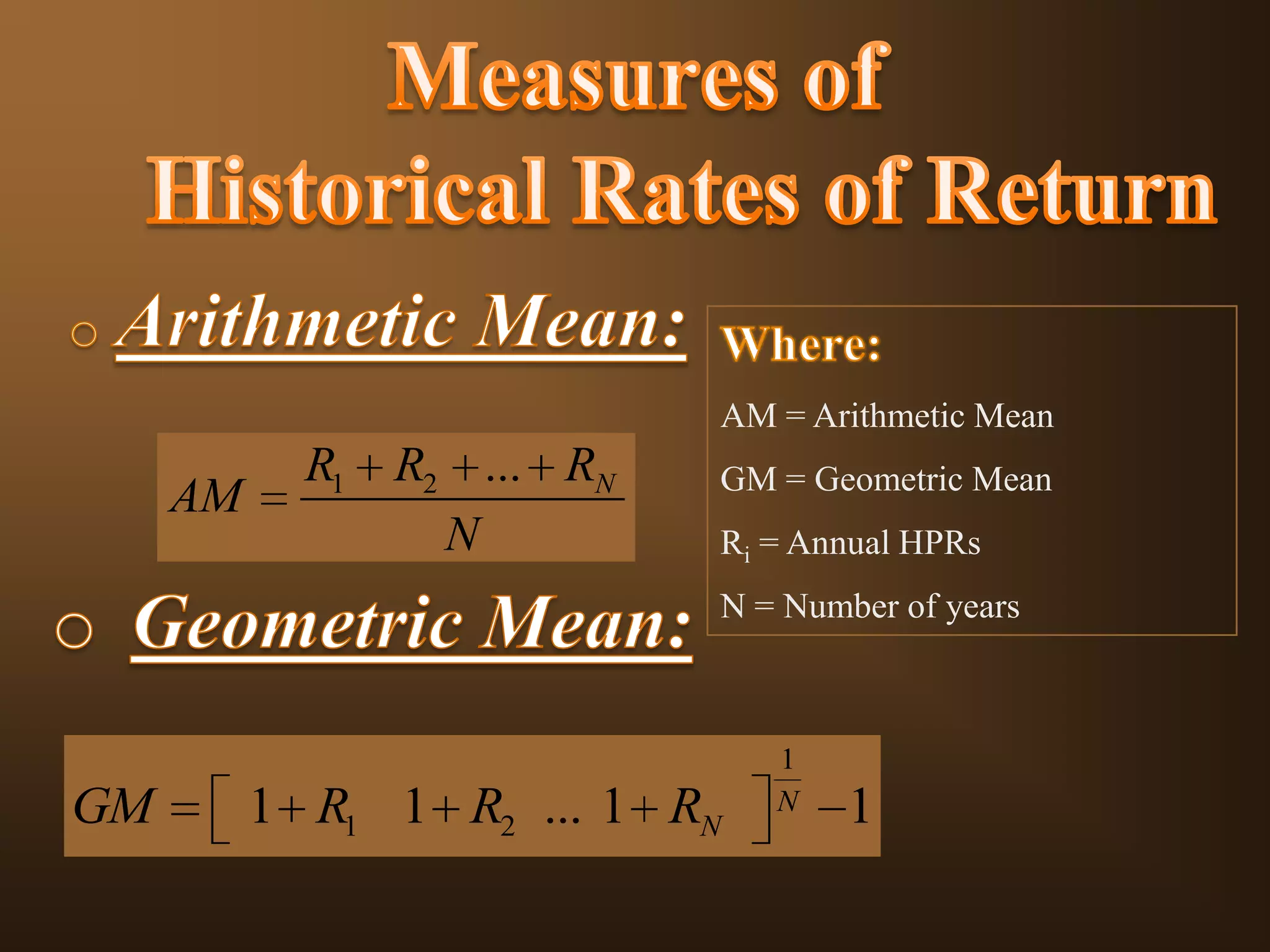
AM = Arithmetic Mean

AM

R1 R2 ... RN
N

GM = Geometric Mean
Ri = Annual HPRs

N = Number of years

GM

1 R1 1 R2 ... 1 RN

1
N

1
o

The mean historical rate of return for a
portfolio of investments is measured as
the weighted average of the HPRs for
the individual investments in the
portfolio, or the overall change in the
value of the original portfolio
o

o

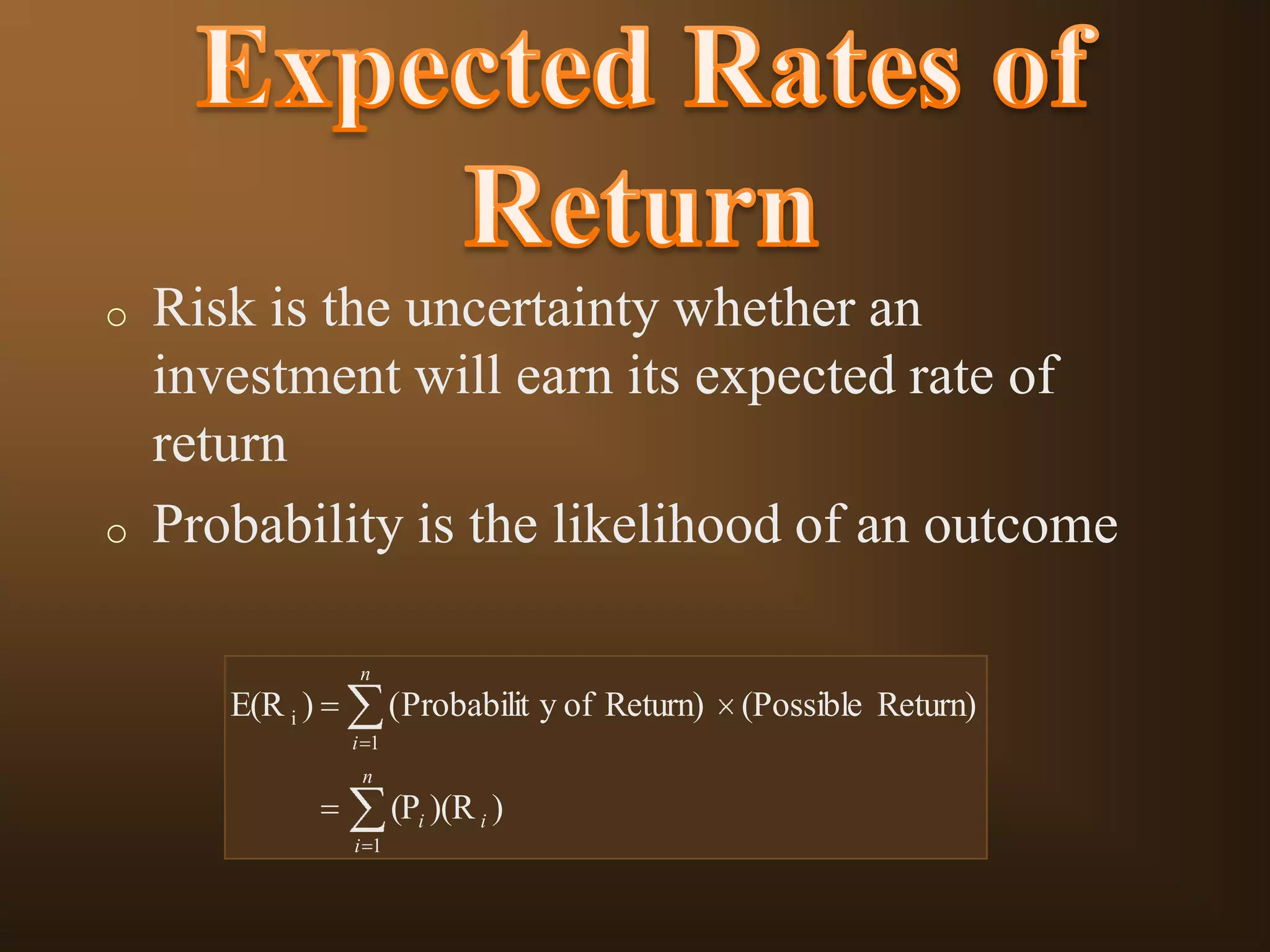
Risk is the uncertainty whether an
investment will earn its expected rate of
return
Probability is the likelihood of an outcome
n

E(R i )

(Probabilit y of Return)
i 1
n

(Pi )(R i )
i 1

(Possible Return)
o

o

Much of modern finance is based on the
principle that investors are risk averse
Risk aversion refers to the assumption that,
all else being equal, most investors will
choose the least risky alternative and that
they will not accept additional risk unless
they are compensated in the form of higher
return
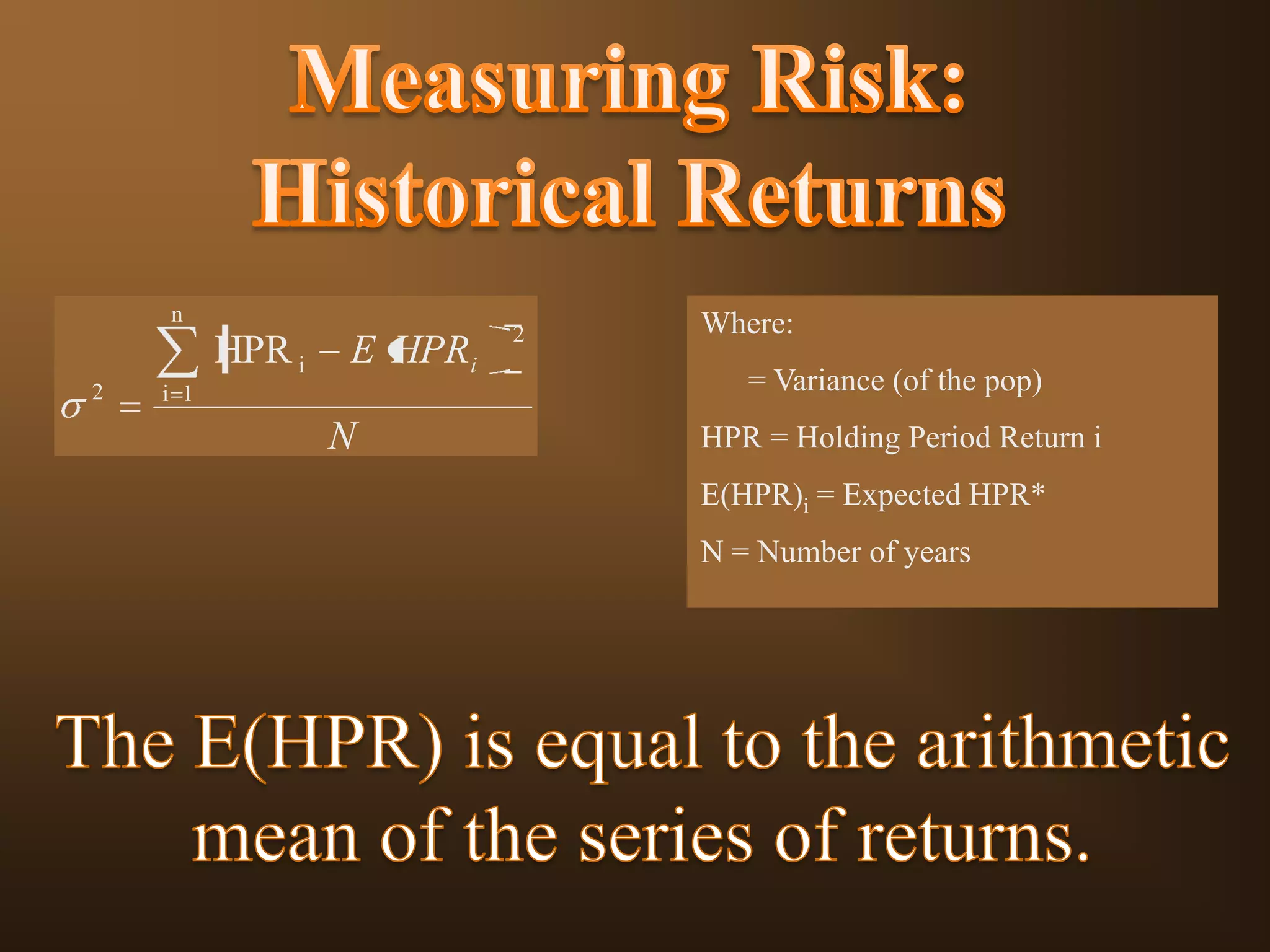
n

HPR i
2

E HPRi

i 1

N

2

Where:
= Variance (of the pop)
HPR = Holding Period Return i
E(HPR)i = Expected HPR*

N = Number of years
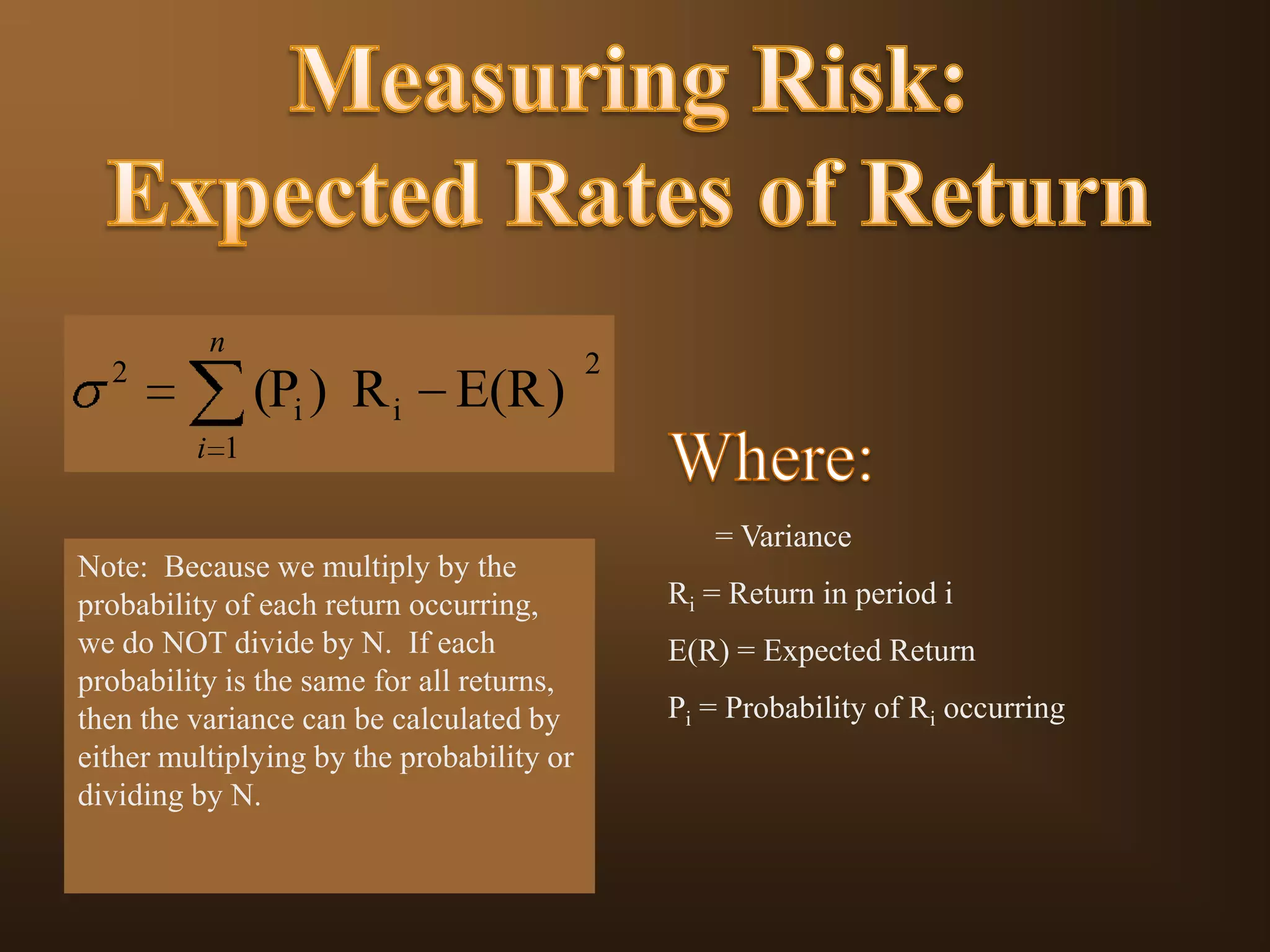
n
2

(Pi ) R i E(R)

2

i 1

= Variance
Note: Because we multiply by the
probability of each return occurring,
we do NOT divide by N. If each
probability is the same for all returns,
then the variance can be calculated by
either multiplying by the probability or
dividing by N.

Ri = Return in period i

E(R) = Expected Return
Pi = Probability of Ri occurring
n

Pi [R i -E(R i )]2
i 1
n

Pi [R i -E(R i )]2
i 1

1
2

Standard Deviation is a measure of
dispersion around the mean. The higher
the standard deviation, the greater the
dispersion of returns around the mean and
the greater the risk.
o

o

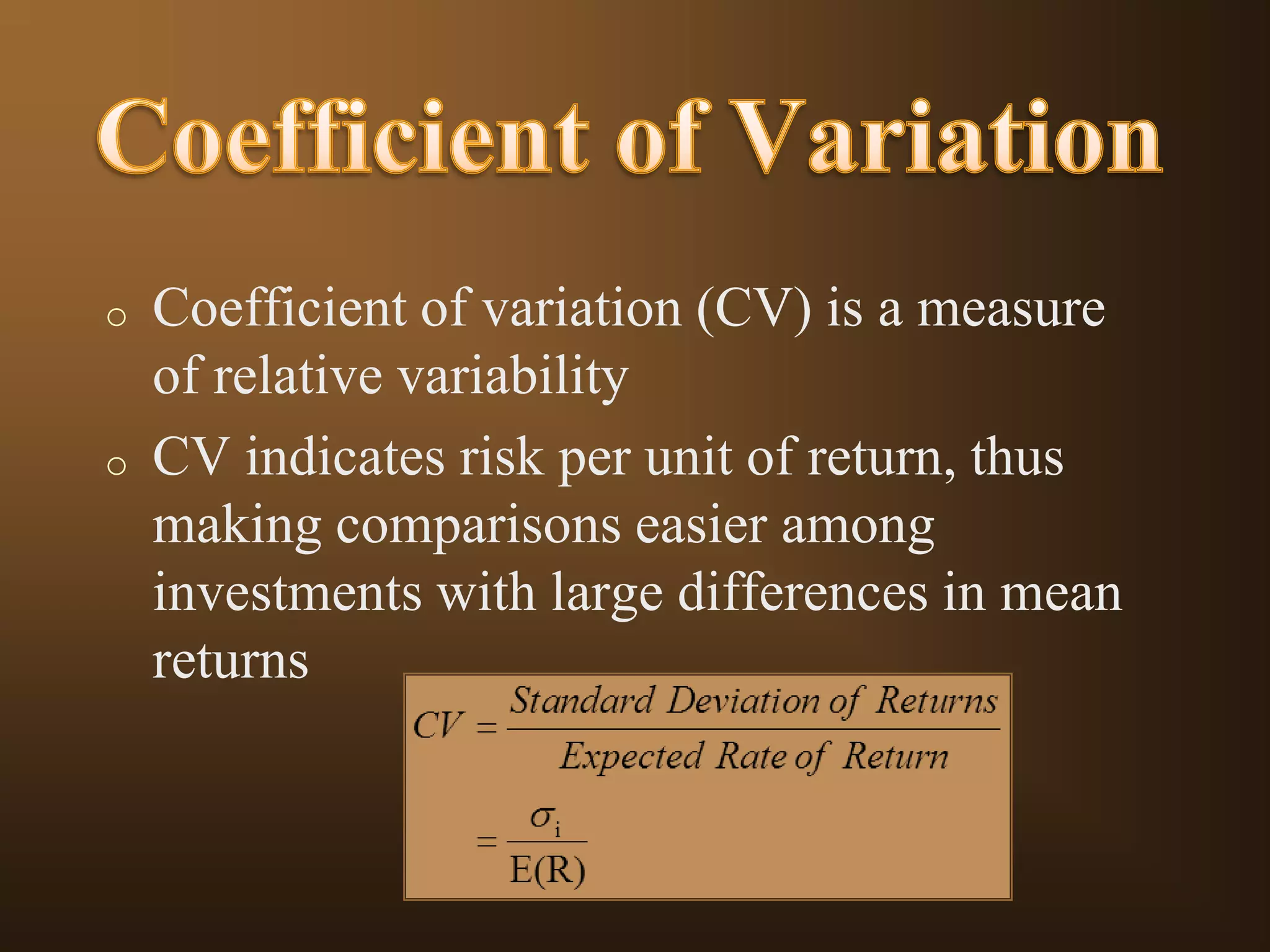
Coefficient of variation (CV) is a measure
of relative variability
CV indicates risk per unit of return, thus
making comparisons easier among
investments with large differences in mean
returns
o

Three factors influence an
investor’s required rate of return
oReal rate of return
oExpected rate of inflation during the
period
oRisk
oAssumes no inflation.
oAssumes no uncertainty about future
cash flows.
oInfluenced by the time preference for
consumption of income and
investment opportunities in the
economy
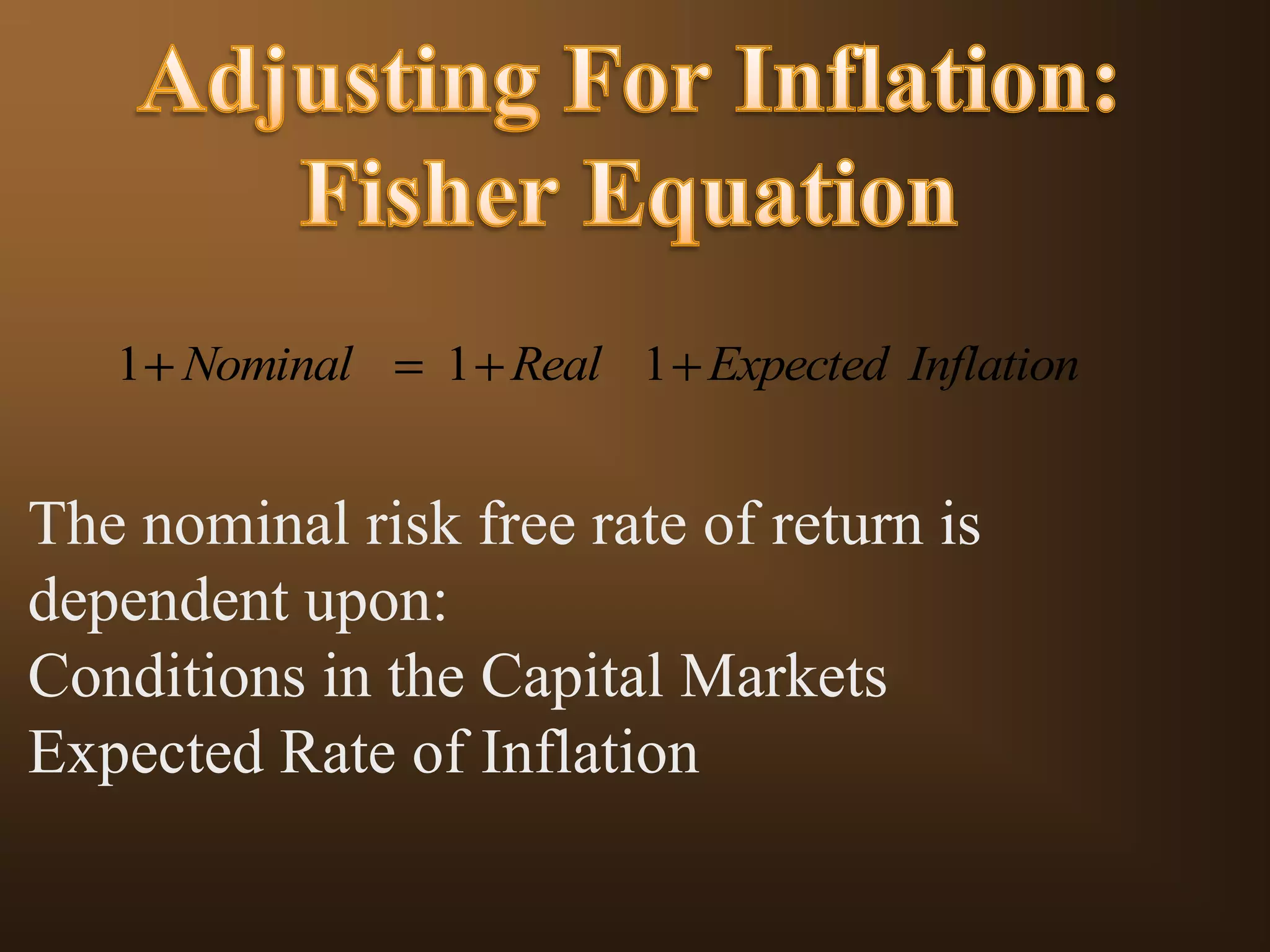
1 Nominal

1 Real 1 Expected Inflation

The nominal risk free rate of return is
dependent upon:
Conditions in the Capital Markets
Expected Rate of Inflation
o

Five factors affect the standard
deviation of returns over time.
oBusiness risk:
oFinancial risk
oLiquidity risk
oExchange rate risk
oCountry risk
oUncertainty of income flows caused by the
nature of a firm’s business
oSales volatility and operating leverage
determine the level of business risk.
o Uncertainty caused by the use of debt financing.
o Borrowing requires fixed payments which must
be paid ahead of payments to stockholders.
o The use of debt increases uncertainty of
stockholder income and causes an increase in the
stock’s risk premium.
o

the uncertainty introduced by the secondary market
for an investment.
o How long will it take to convert an investment into cash?
o How certain is the price that will be received?

o

o

the uncertainty introduced by acquiring securities
denominated in a currency different from that of the
investor.
Changes in exchange rates affect the investors return
when converting an investment back into the
“home” currency.
o

o

Country risk (also called political risk) refers to the
uncertainty of returns caused by the possibility of a
major change in the political or economic
environment in a country.
Individuals who invest in countries that have
unstable political-economic systems must include a
country risk-premium when determining their
required rate of return
Frank K. Reilly & Keith C. Brown

REFERENCE

Inveatment analysis and portfolio management

  • 3.
    o o o o Any investment involvesa current commitment of funds for some period of time in order to derive future payments that will compensate for: the time the funds are committed (the real rate of return) the expected rate of inflation (inflation premium) uncertainty of future flow of funds (risk premium)
  • 5.
    o o EAR 1 HPR 1 N 1 o EAR =Equivalent Annual Return HPR = Holding Period Return N = Number of years
  • 6.
    AM = ArithmeticMean AM R1 R2 ... RN N GM = Geometric Mean Ri = Annual HPRs N = Number of years GM 1 R1 1 R2 ... 1 RN 1 N 1
  • 7.
    o The mean historicalrate of return for a portfolio of investments is measured as the weighted average of the HPRs for the individual investments in the portfolio, or the overall change in the value of the original portfolio
  • 8.
    o o Risk is theuncertainty whether an investment will earn its expected rate of return Probability is the likelihood of an outcome n E(R i ) (Probabilit y of Return) i 1 n (Pi )(R i ) i 1 (Possible Return)
  • 10.
    o o Much of modernfinance is based on the principle that investors are risk averse Risk aversion refers to the assumption that, all else being equal, most investors will choose the least risky alternative and that they will not accept additional risk unless they are compensated in the form of higher return
  • 11.
    n HPR i 2 E HPRi i1 N 2 Where: = Variance (of the pop) HPR = Holding Period Return i E(HPR)i = Expected HPR* N = Number of years
  • 12.
    n 2 (Pi ) Ri E(R) 2 i 1 = Variance Note: Because we multiply by the probability of each return occurring, we do NOT divide by N. If each probability is the same for all returns, then the variance can be calculated by either multiplying by the probability or dividing by N. Ri = Return in period i E(R) = Expected Return Pi = Probability of Ri occurring
  • 13.
    n Pi [R i-E(R i )]2 i 1 n Pi [R i -E(R i )]2 i 1 1 2 Standard Deviation is a measure of dispersion around the mean. The higher the standard deviation, the greater the dispersion of returns around the mean and the greater the risk.
  • 14.
    o o Coefficient of variation(CV) is a measure of relative variability CV indicates risk per unit of return, thus making comparisons easier among investments with large differences in mean returns
  • 16.
    o Three factors influencean investor’s required rate of return oReal rate of return oExpected rate of inflation during the period oRisk
  • 17.
    oAssumes no inflation. oAssumesno uncertainty about future cash flows. oInfluenced by the time preference for consumption of income and investment opportunities in the economy
  • 18.
    1 Nominal 1 Real1 Expected Inflation The nominal risk free rate of return is dependent upon: Conditions in the Capital Markets Expected Rate of Inflation
  • 19.
    o Five factors affectthe standard deviation of returns over time. oBusiness risk: oFinancial risk oLiquidity risk oExchange rate risk oCountry risk
  • 20.
    oUncertainty of incomeflows caused by the nature of a firm’s business oSales volatility and operating leverage determine the level of business risk. o Uncertainty caused by the use of debt financing. o Borrowing requires fixed payments which must be paid ahead of payments to stockholders. o The use of debt increases uncertainty of stockholder income and causes an increase in the stock’s risk premium.
  • 21.
    o the uncertainty introducedby the secondary market for an investment. o How long will it take to convert an investment into cash? o How certain is the price that will be received? o o the uncertainty introduced by acquiring securities denominated in a currency different from that of the investor. Changes in exchange rates affect the investors return when converting an investment back into the “home” currency.
  • 22.
    o o Country risk (alsocalled political risk) refers to the uncertainty of returns caused by the possibility of a major change in the political or economic environment in a country. Individuals who invest in countries that have unstable political-economic systems must include a country risk-premium when determining their required rate of return
  • 25.
    Frank K. Reilly& Keith C. Brown REFERENCE