FinancialandManagementAccounting
ChapterTwo:TheAccountingCycle
Courseleader:SitinaAkmel(Asst.prof.)
Learning Objectives
After studying this chapter, you should be able to:
[1] Explain what an account is and how it helps in the recording process.
[2] Define debits and credits and explain their use in recording business
transactions.
[3] Identify the basic steps in the recording process.
[4] Explain what a journal is and how it helps in the recording process.
[5] Explain what a ledger is and how it helps in the recording process.
[6] Explain what posting is and how it helps in the recording process.
[7] Prepare a trial balance and explain its purposes.
[8] Prepare adjusting entry, worksheet and financial statements.
[9] Prepare closing entry and post closing trial balance
 Record of increases and decreases
in a specific asset, liability, equity,
revenue, or expense item.
 Debit = “Left”
 Credit = “Right”
Account
An account can be
illustrated in a T-
account form.
The Account
Double-entry system
► Each transaction must affect two or more accounts to
keep the basic accounting equation in balance.
► Recording done by debiting at least one account and
crediting another.
► DEBITS must equal CREDITS.
The Account
Debits and Credits
Account Name
Debit / Dr. Credit / Cr.
If Debit amounts are greater than Credit amounts, the
account will have a debit balance.
$10,000 Transaction #2
$3,000
$15,000
8,000
Transaction #3
Balance
Transaction #1
Debits and Credits
Account Name
Debit / Dr. Credit / Cr.
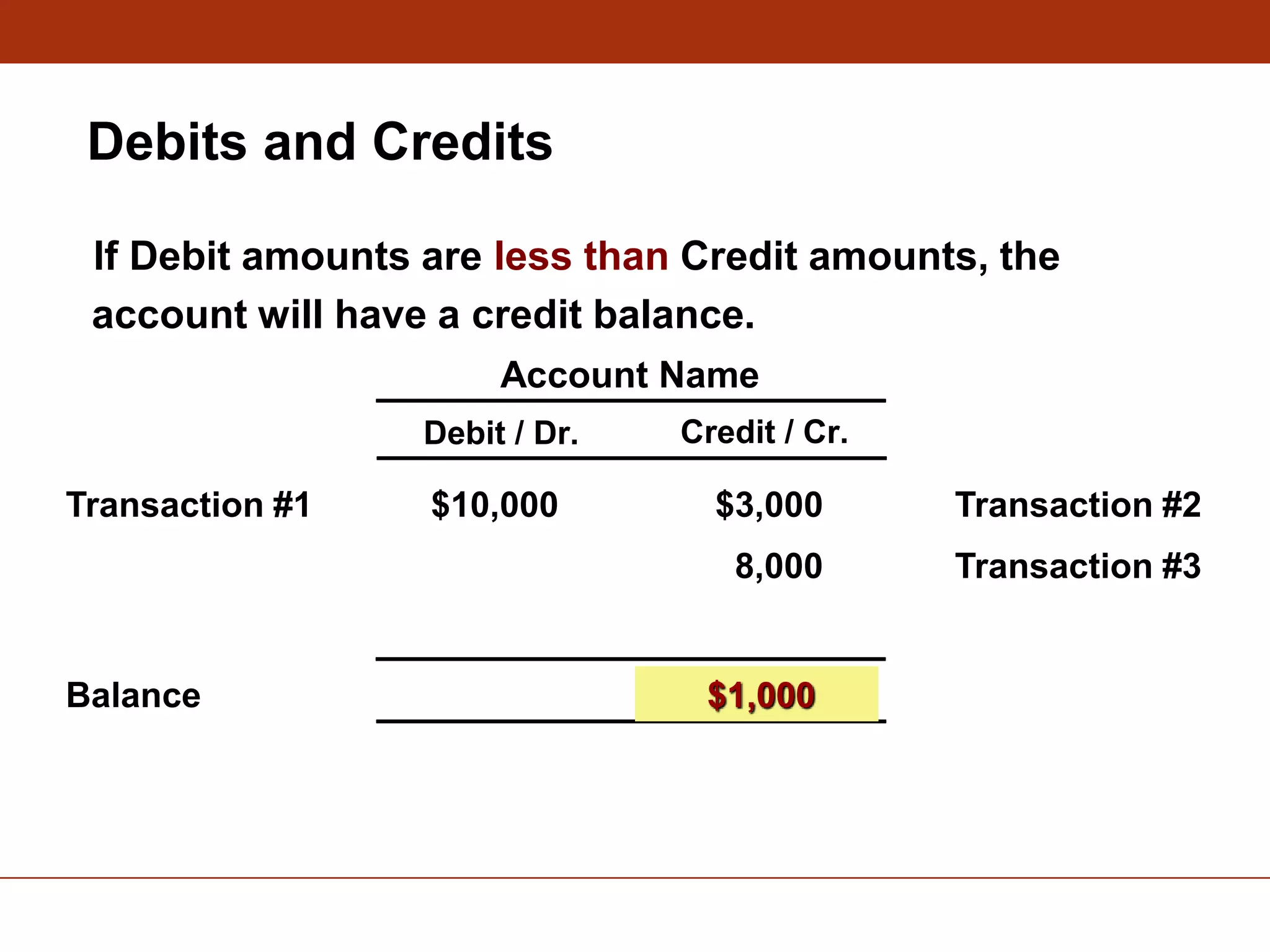
$10,000 Transaction #2
$3,000
Balance
Transaction #1
$1,000
8,000 Transaction #3
If Debit amounts are less than Credit amounts, the
account will have a credit balance.
Debits and Credits
 Assets - Debits should exceed
credits.
 Liabilities – Credits should
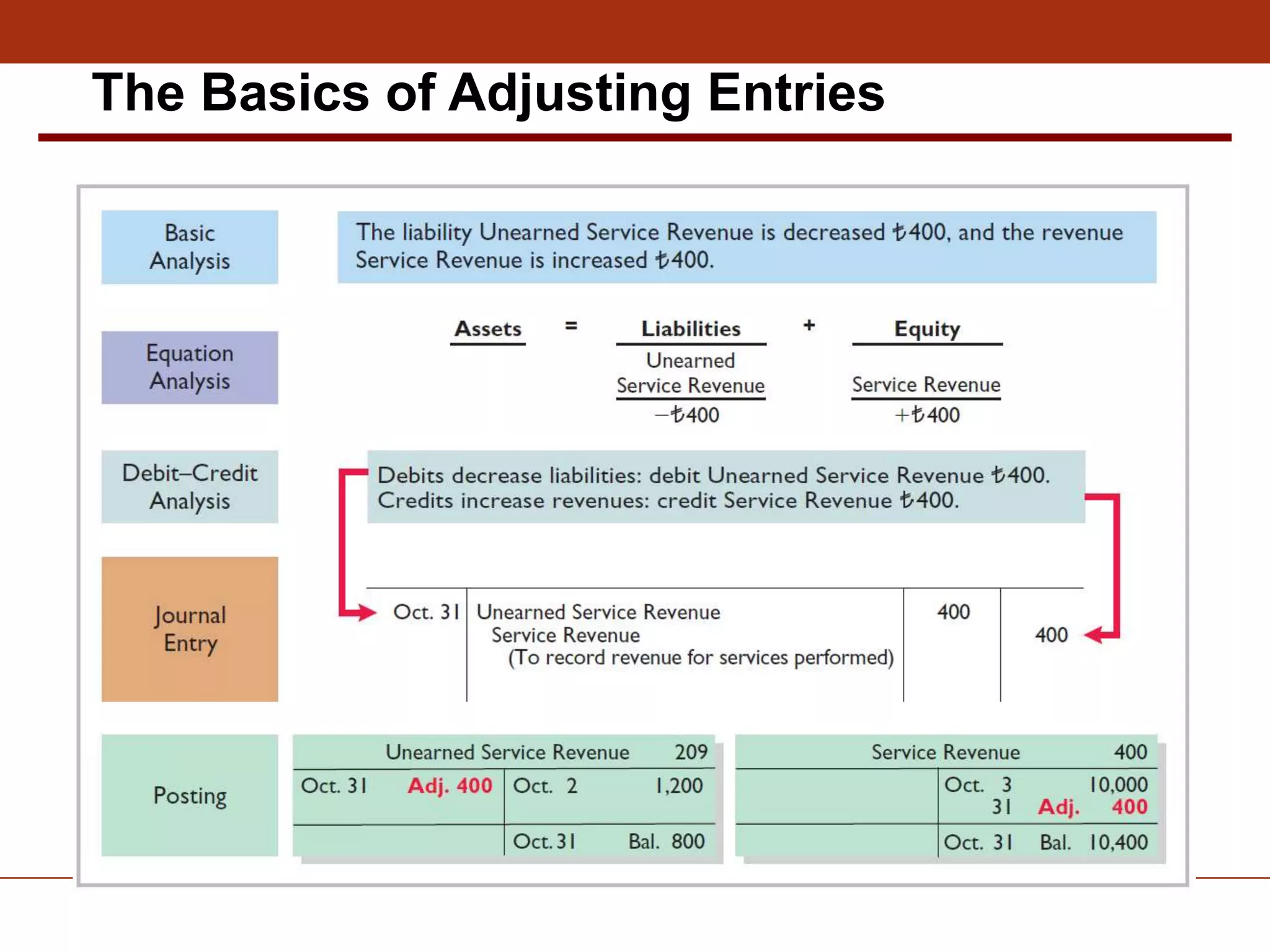
exceed debits.
 Normal balance is on the
increase side.
Chapter
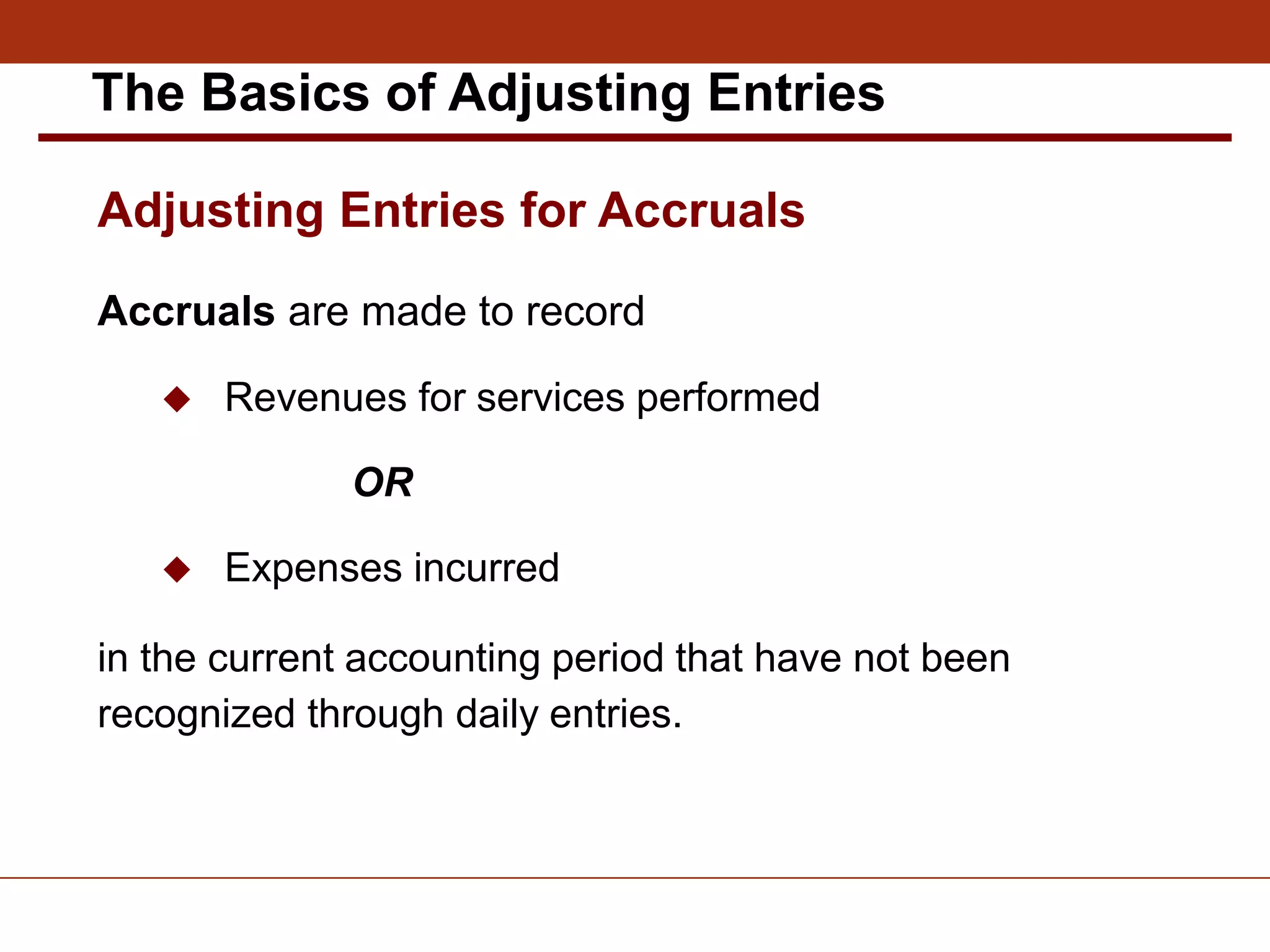
3-23
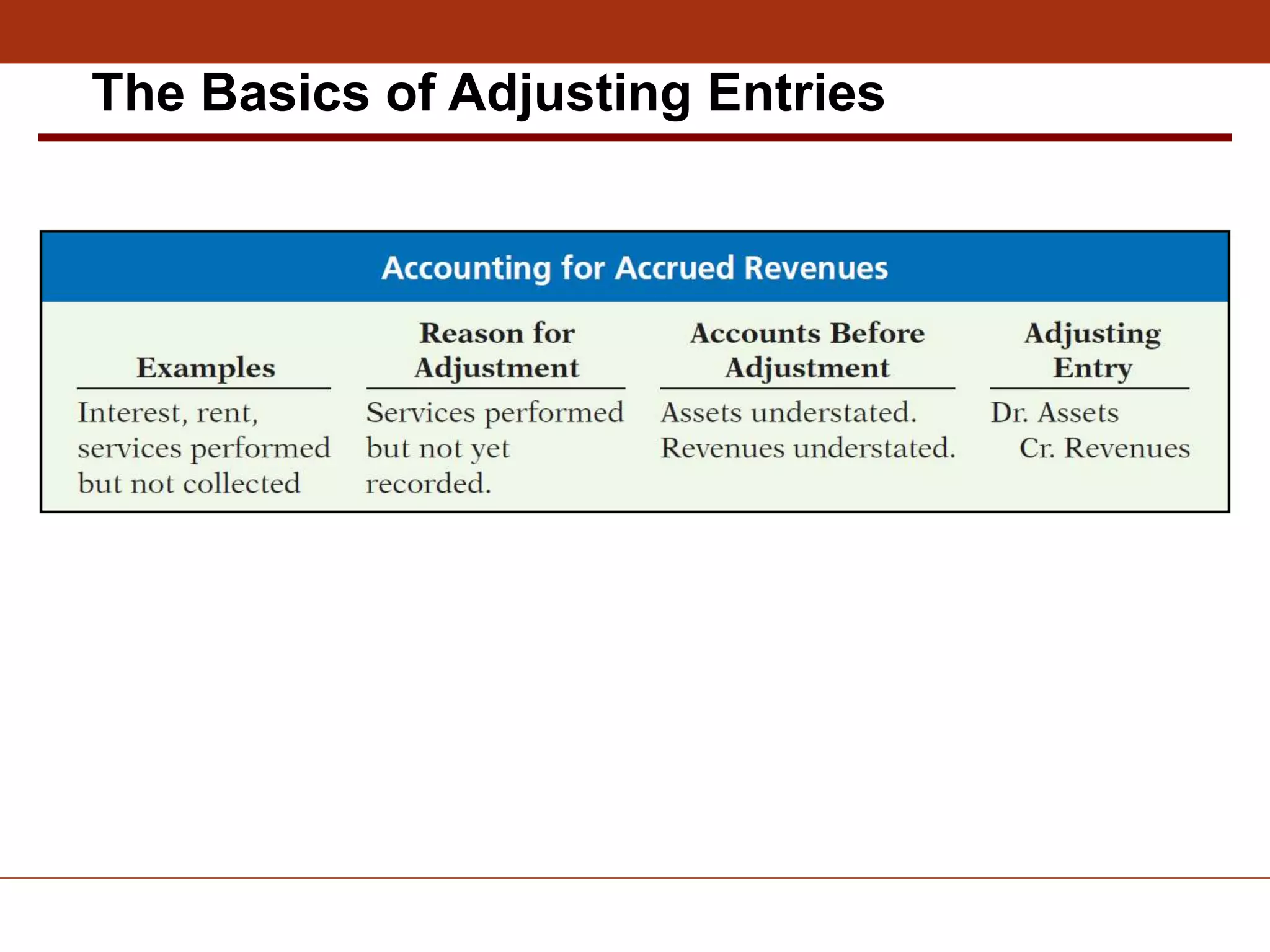
Assets
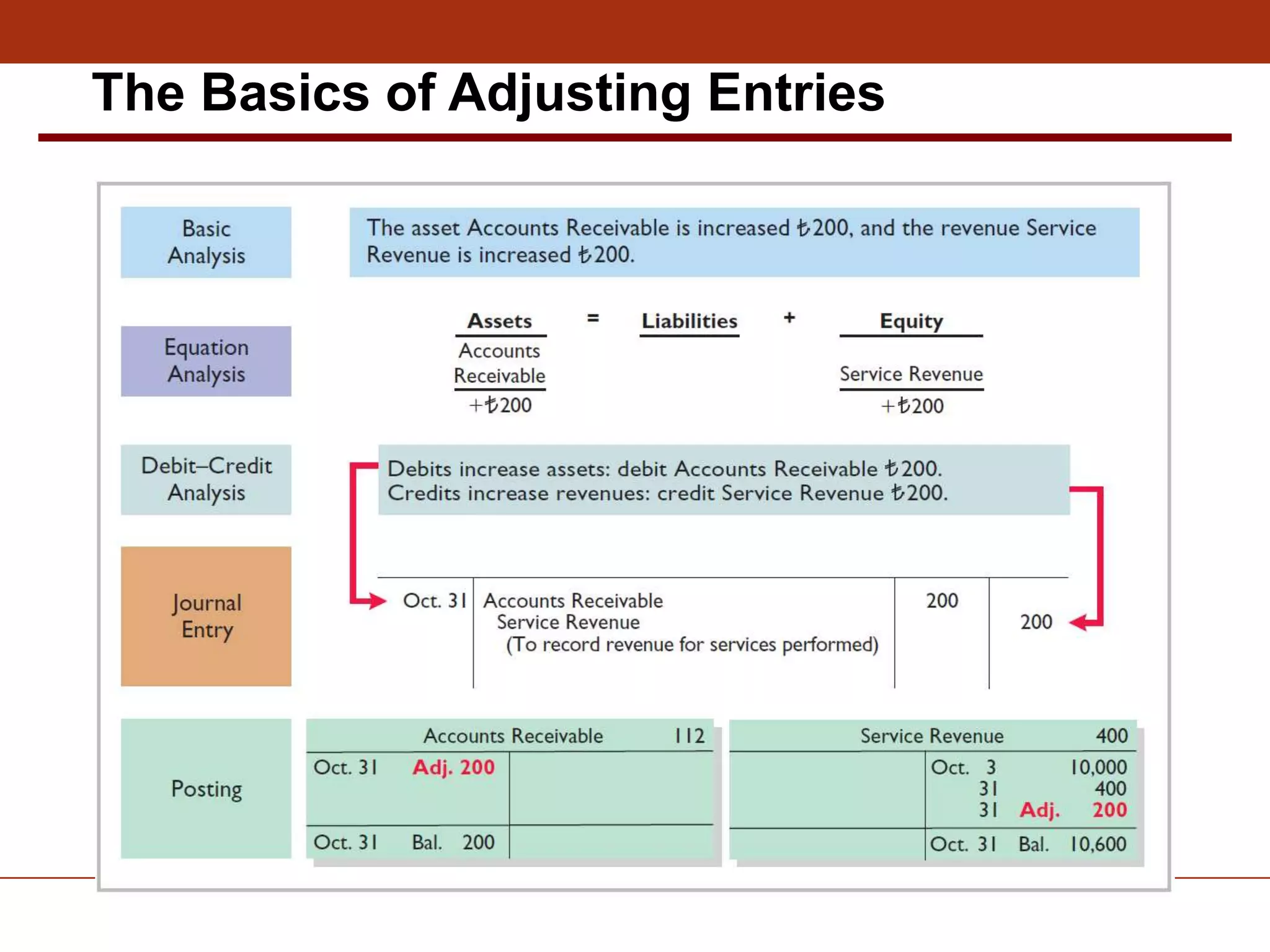
Assets
Debit / Dr. Credit / Cr.
Normal Balance
Normal Balance
Chapter
3-24
Liabilities
Liabilities
Debit / Dr. Credit / Cr.
Normal Balance
Normal Balance
Debits and Credits
 Issuance of share capital and
revenues increase equity (credit).
 Dividends and expenses
decrease equity (debit).
Chapter
3-25
Debit / Dr. Credit / Cr.
Normal Balance
Normal Balance
Share Capital
Share Capital
Chapter
3-23
Dividends
Dividends
Debit / Dr. Credit / Cr.
Normal Balance
Normal Balance
Chapter
3-25
Debit / Dr. Credit / Cr.
Normal Balance
Normal Balance
Equity
Equity
Chapter
3-25
Debit / Dr. Credit / Cr.
Normal Balance
Normal Balance
Retained Earnings
Retained Earnings
Debits and Credits
Chapter
3-27
Debit / Dr. Credit / Cr.
Normal Balance
Normal Balance
Expense
Expense
Chapter
3-26
Debit / Dr. Credit / Cr.
Normal Balance
Normal Balance
Revenue
Revenue
Debits and Credits
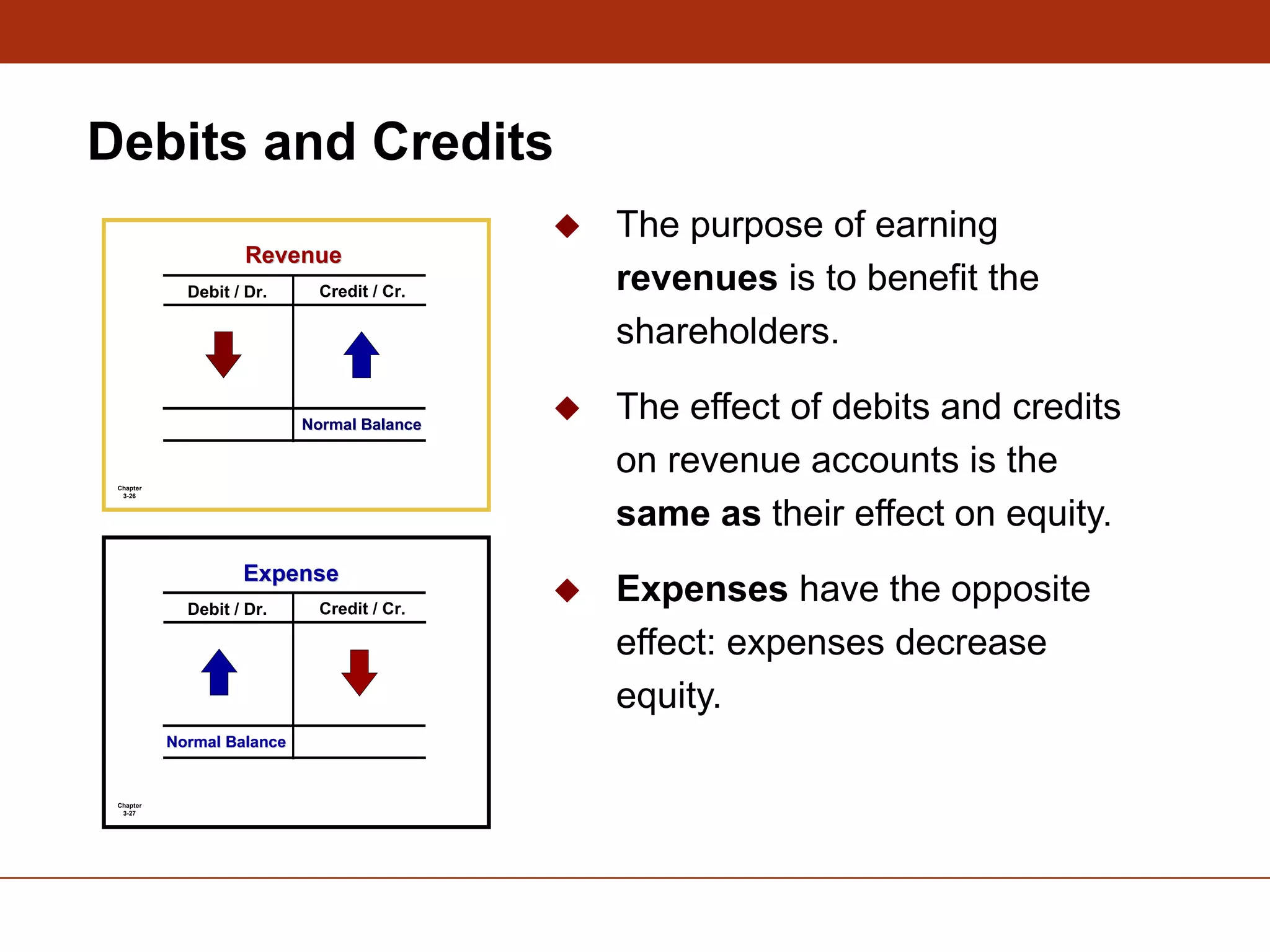
 The purpose of earning
revenues is to benefit the
shareholders.
 The effect of debits and credits
on revenue accounts is the
same as their effect on equity.
 Expenses have the opposite
effect: expenses decrease
equity.
Chapter
3-23
Assets
Assets
Debit / Dr. Credit / Cr.
Normal Balance
Normal Balance
Chapter
3-27
Debit / Dr. Credit / Cr.
Normal Balance
Normal Balance
Expense
Expense
Normal
Balance
Credit
Normal
Balance
Debit
Debit/Credit Rules
Chapter
3-24
Liabilities
Liabilities
Debit / Dr. Credit / Cr.
Normal Balance
Normal Balance
Chapter
3-25
Debit / Dr. Credit / Cr.
Normal Balance
Normal Balance
Equity
Equity
Chapter
3-26
Debit / Dr. Credit / Cr.
Normal Balance
Normal Balance
Revenue
Revenue
Income Statement
= + -
Asset Liability Equity Revenue Expense
Debit
Credit
Debit/Credit Rules
Statement of
Financial Position
Equity Relationships
Summary of Debit/Credit Rules
Relationship among the assets, liabilities and equity of a
business:
The equation must be in balance after every transaction.
For every Debit there must be a Credit.
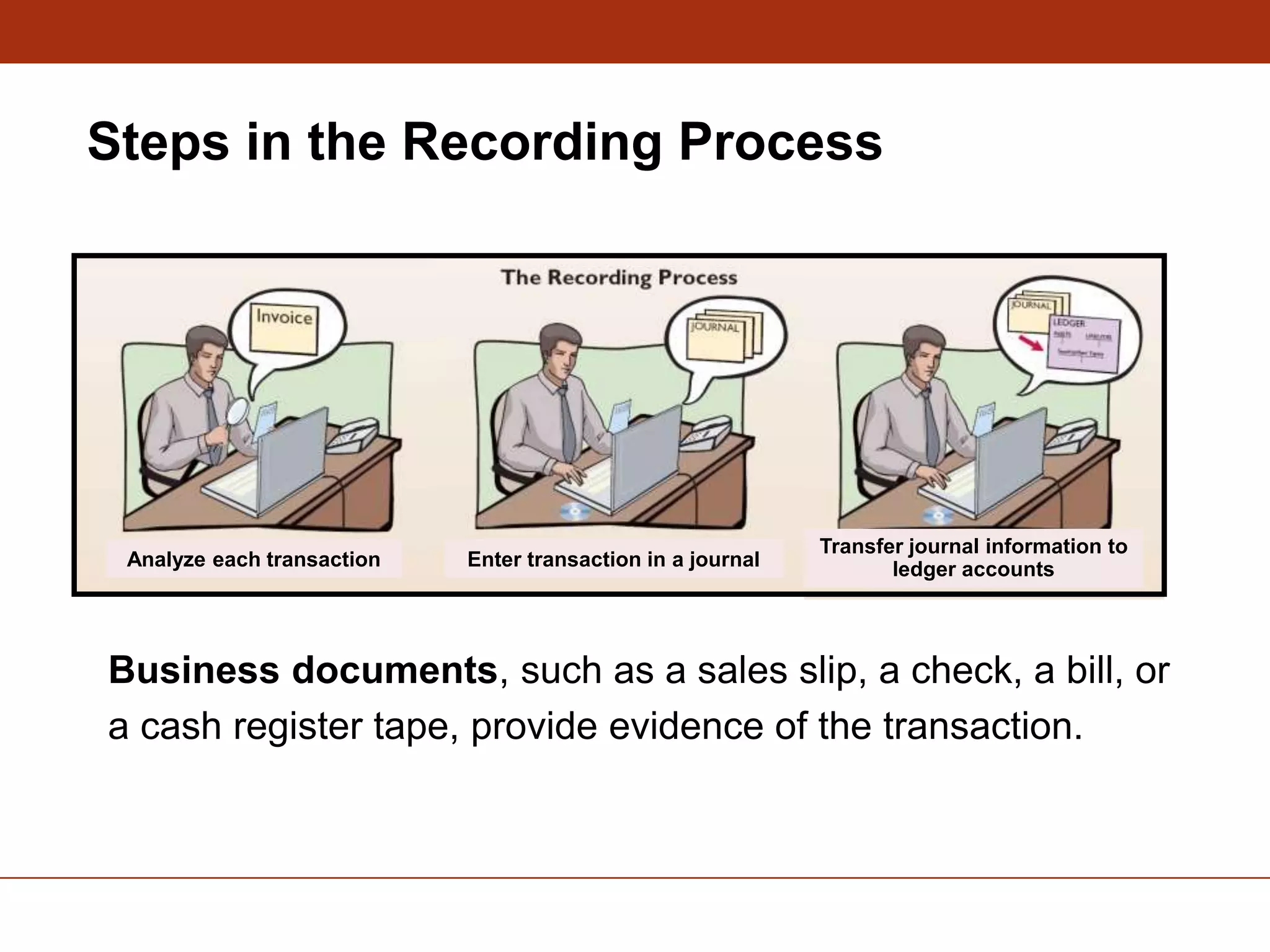
Business documents, such as a sales slip, a check, a bill, or
a cash register tape, provide evidence of the transaction.
Analyze each transaction Enter transaction in a journal
Transfer journal information to
ledger accounts
Steps in the Recording Process
 Book of original entry.
 Transactions recorded in chronological order.
 Contributions to the recording process:
1. Discloses the complete effects of a transaction.
2. Provides a chronological record of transactions.
3. Helps to prevent or locate errors because the debit and
credit amounts can be easily compared.
Steps in the Recording Process
The Journal
Journalizing - Entering transaction data in the journal.
Illustration: On September 1, shareholders’ invested €15,000 cash
in the corporation in exchange for share of stock, and Softbyte
purchased computer equipment for €7,000 cash.
Account Title Ref. Debit Credit
Date
Cash
Share capital-ordinary
Sept. 1 15,000
15,000
General Journal
Equipment
Cash
7,000
7,000
Steps in the Recording Process
Simple and Compound Entries
Illustration: On July 1, Tsai Company purchases a delivery truck
costing $420,000. It pays $240,000 cash now and agrees to pay
the remaining $180,000 on account.
Account Title Ref. Debit Credit
Date
Equipment
Cash
July 1 420,000
240,000
General Journal
180,000
Accounts payable
Steps in the Recording Process
 General Ledger contains the entire group of accounts
maintained by a company.
The Ledger
Steps in the Recording Process
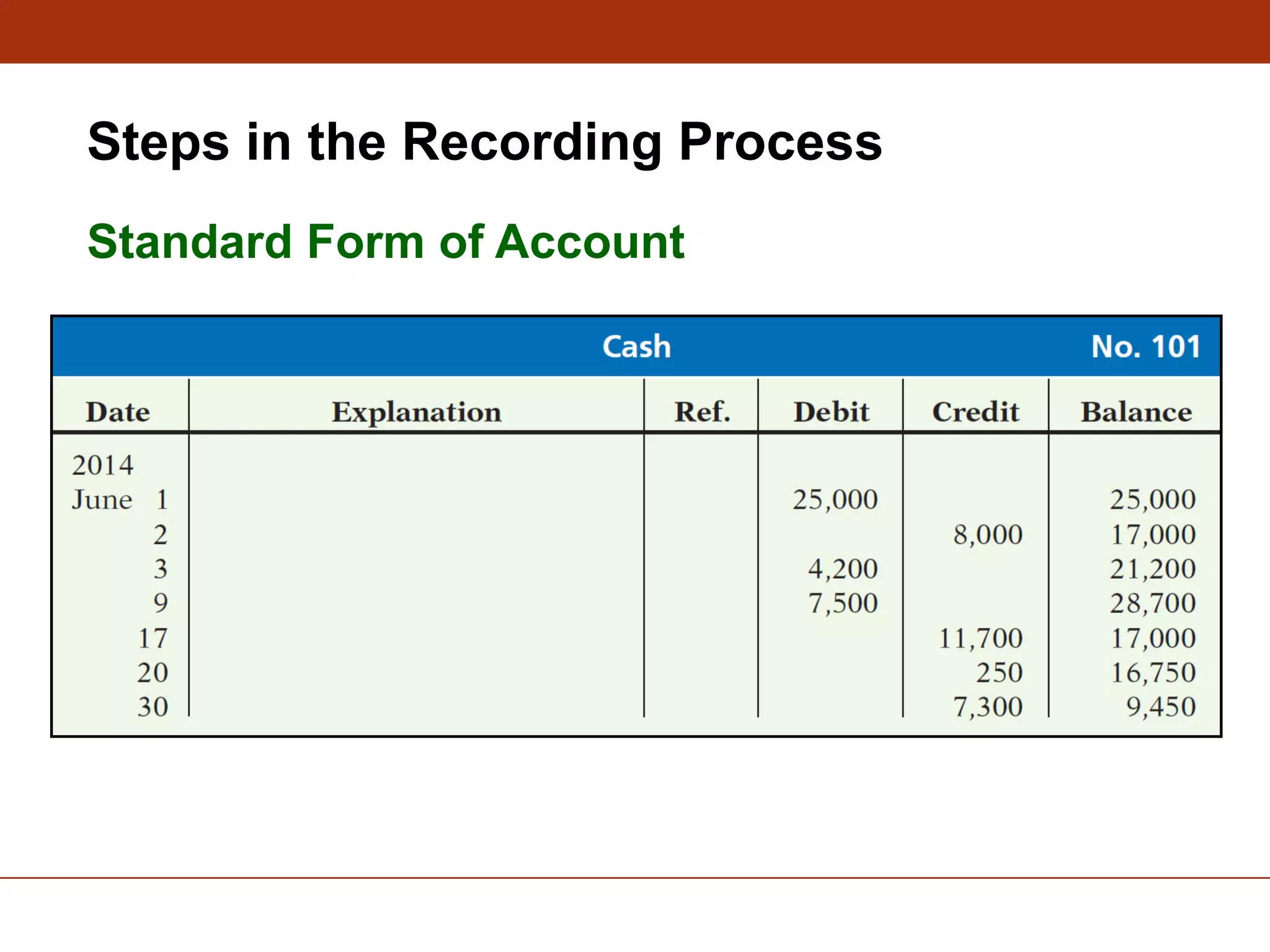
Standard Form of Account
Posting –
process of
transferring
amounts from
the journal to
the ledger
accounts.
Steps
Accounts and account numbers arranged in sequence in which
they are presented in the financial statements.
Chart of Accounts
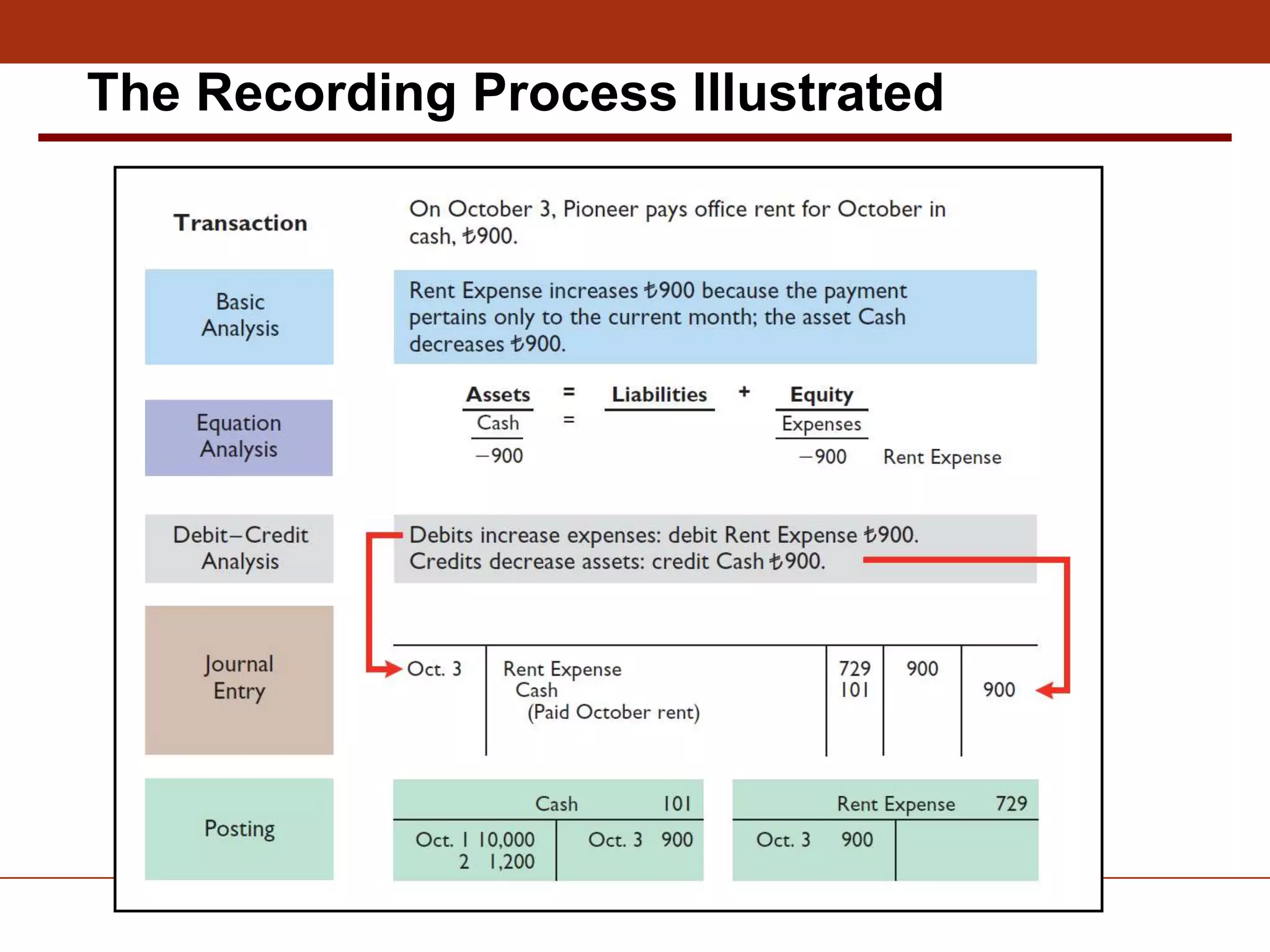
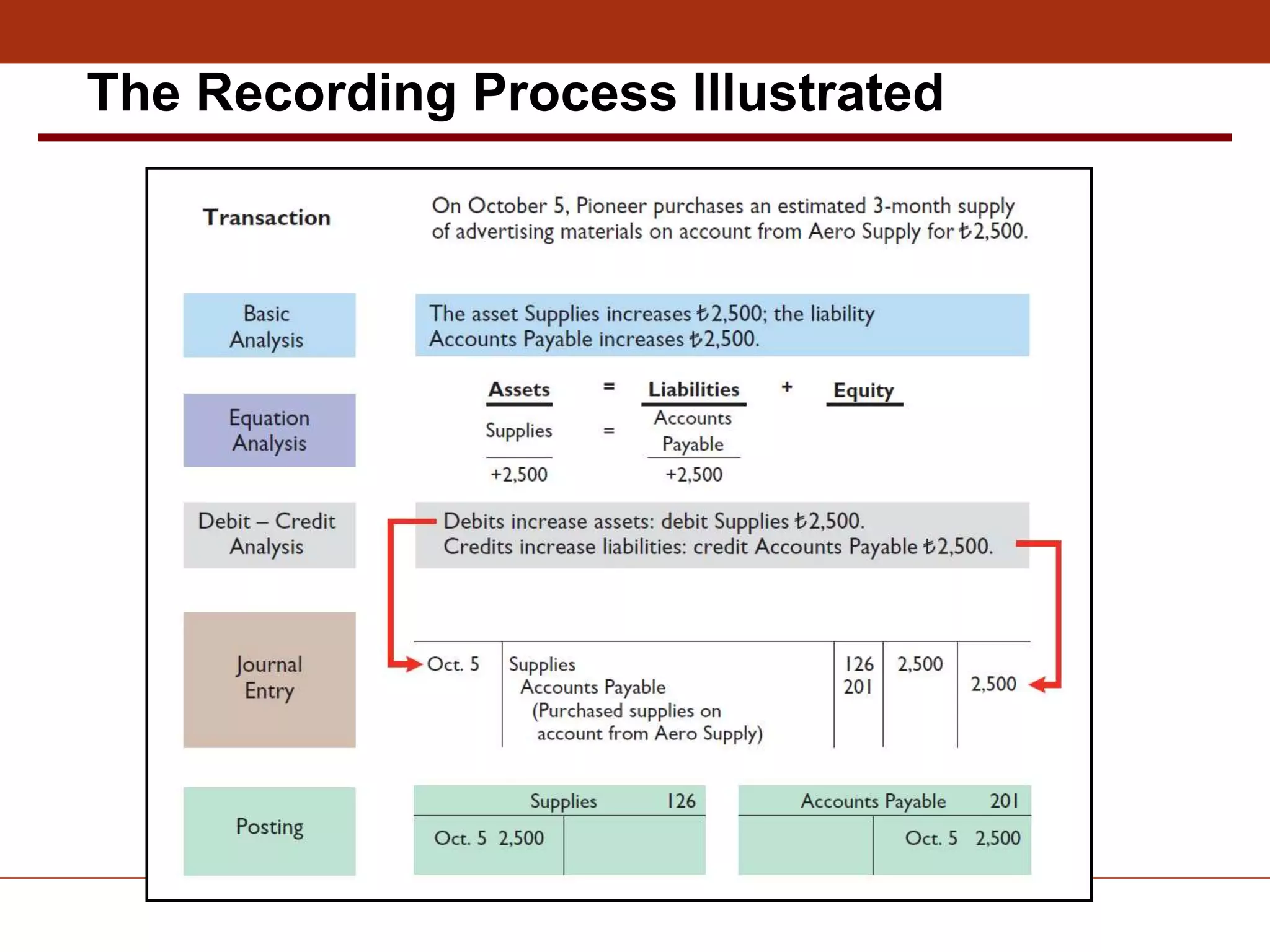
Follow these steps:
1. Determine what
type of account is
involved.
2. Determine what
items increased or
decreased and by
how much.
3. Translate the
increases and
decreases into
debits and credits.
The Recording Process Illustrated
Illustration 2-31
Trial Balance
34
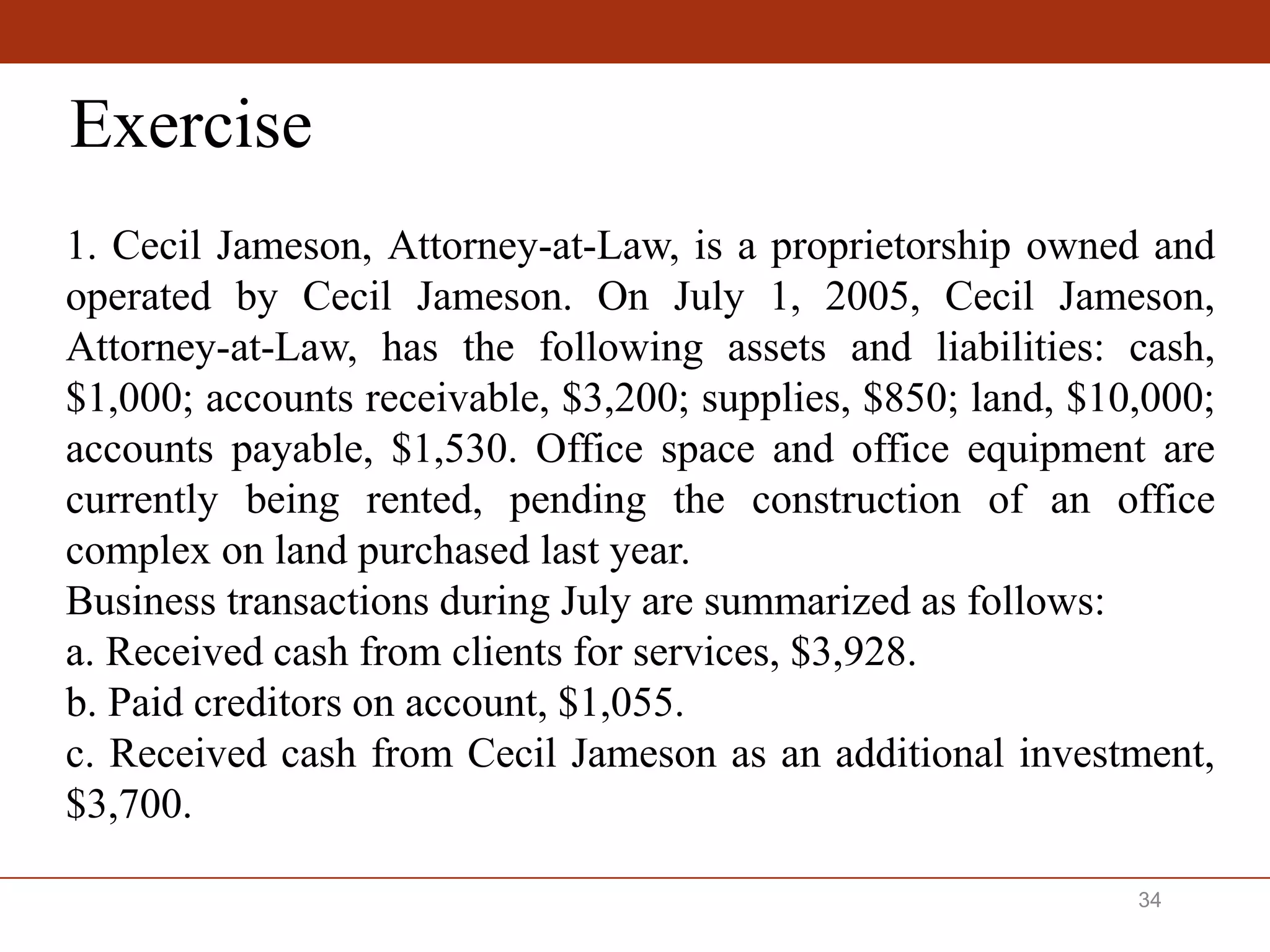
1. Cecil Jameson, Attorney-at-Law, is a proprietorship owned and
operated by Cecil Jameson. On July 1, 2005, Cecil Jameson,
Attorney-at-Law, has the following assets and liabilities: cash,
$1,000; accounts receivable, $3,200; supplies, $850; land, $10,000;
accounts payable, $1,530. Office space and office equipment are
currently being rented, pending the construction of an office
complex on land purchased last year.
Business transactions during July are summarized as follows:
a. Received cash from clients for services, $3,928.
b. Paid creditors on account, $1,055.
c. Received cash from Cecil Jameson as an additional investment,
$3,700.
Exercise
35
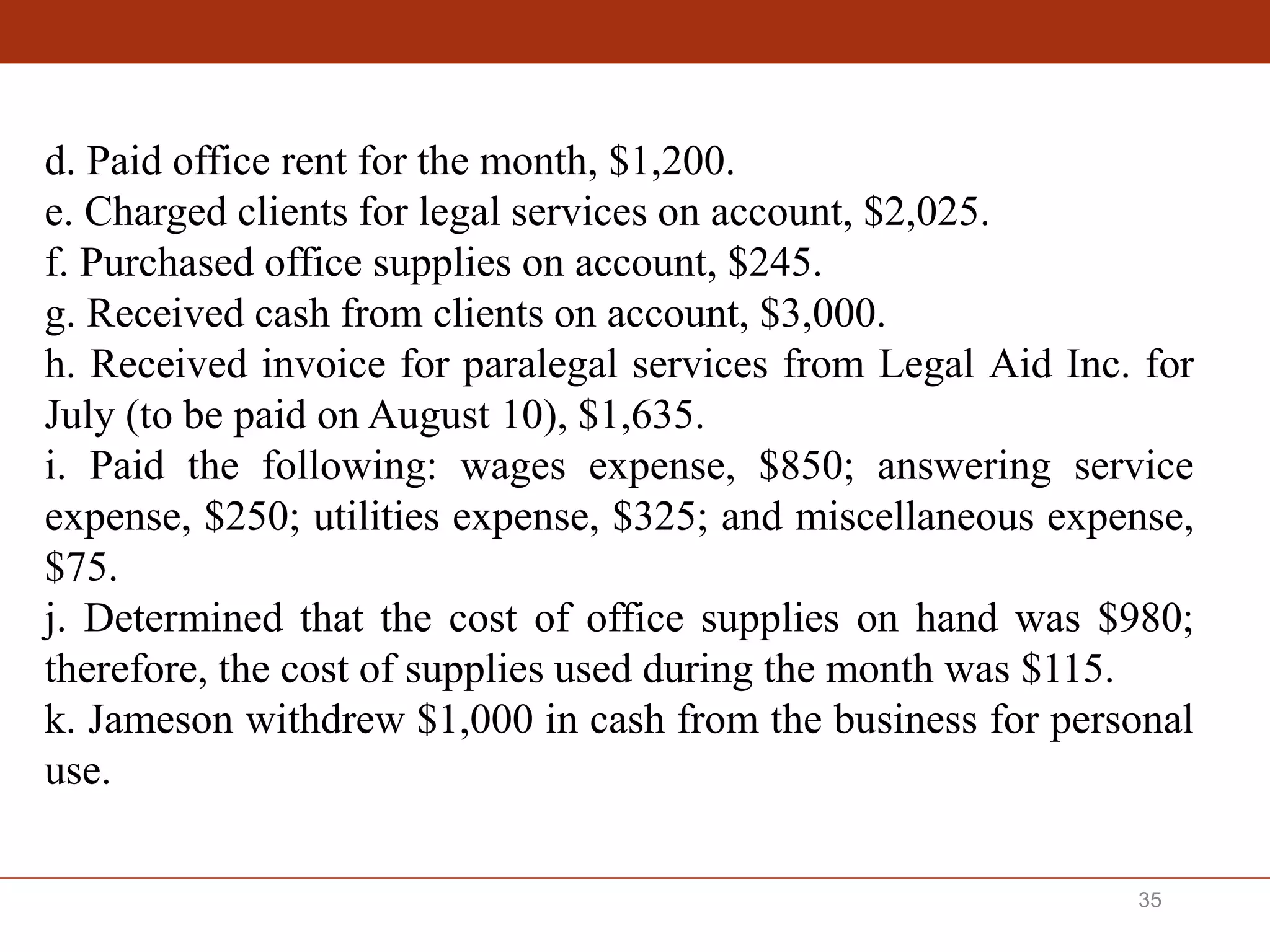
d. Paid office rent for the month, $1,200.
e. Charged clients for legal services on account, $2,025.
f. Purchased office supplies on account, $245.
g. Received cash from clients on account, $3,000.
h. Received invoice for paralegal services from Legal Aid Inc. for
July (to be paid on August 10), $1,635.
i. Paid the following: wages expense, $850; answering service
expense, $250; utilities expense, $325; and miscellaneous expense,
$75.
j. Determined that the cost of office supplies on hand was $980;
therefore, the cost of supplies used during the month was $115.
k. Jameson withdrew $1,000 in cash from the business for personal
use.
 Generally a month, a quarter, or a year.
 Also known as the “Periodicity Assumption”
Timing Issues
Accountants divide the economic life of a business into
artificial time periods (Time Period Assumption).
Jan. Feb. Mar. Apr. Dec.
. . . . .
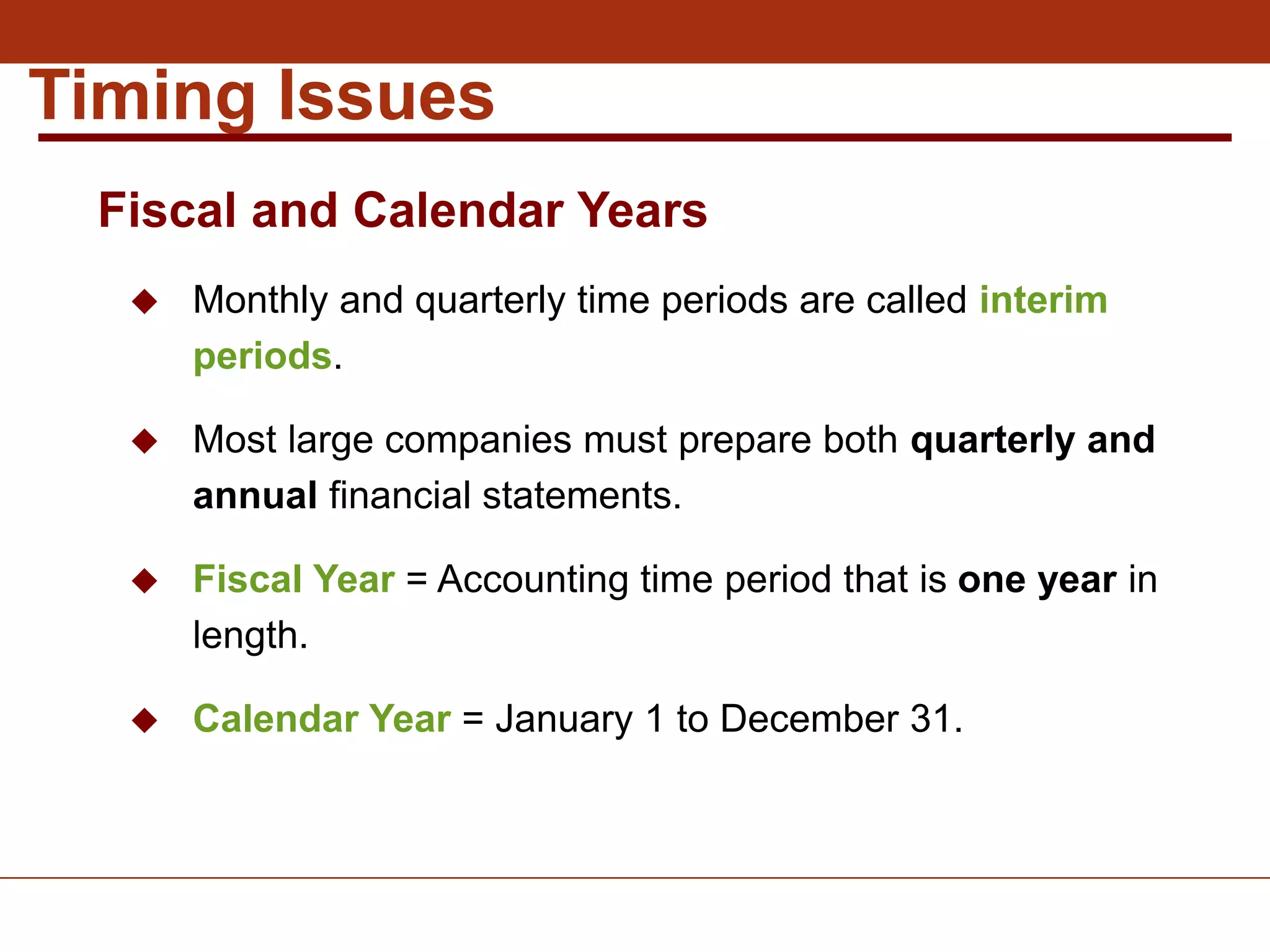
 Monthly and quarterly time periods are called interim
periods.
 Most large companies must prepare both quarterly and
annual financial statements.
 Fiscal Year = Accounting time period that is one year in
length.
 Calendar Year = January 1 to December 31.
Timing Issues
Fiscal and Calendar Years
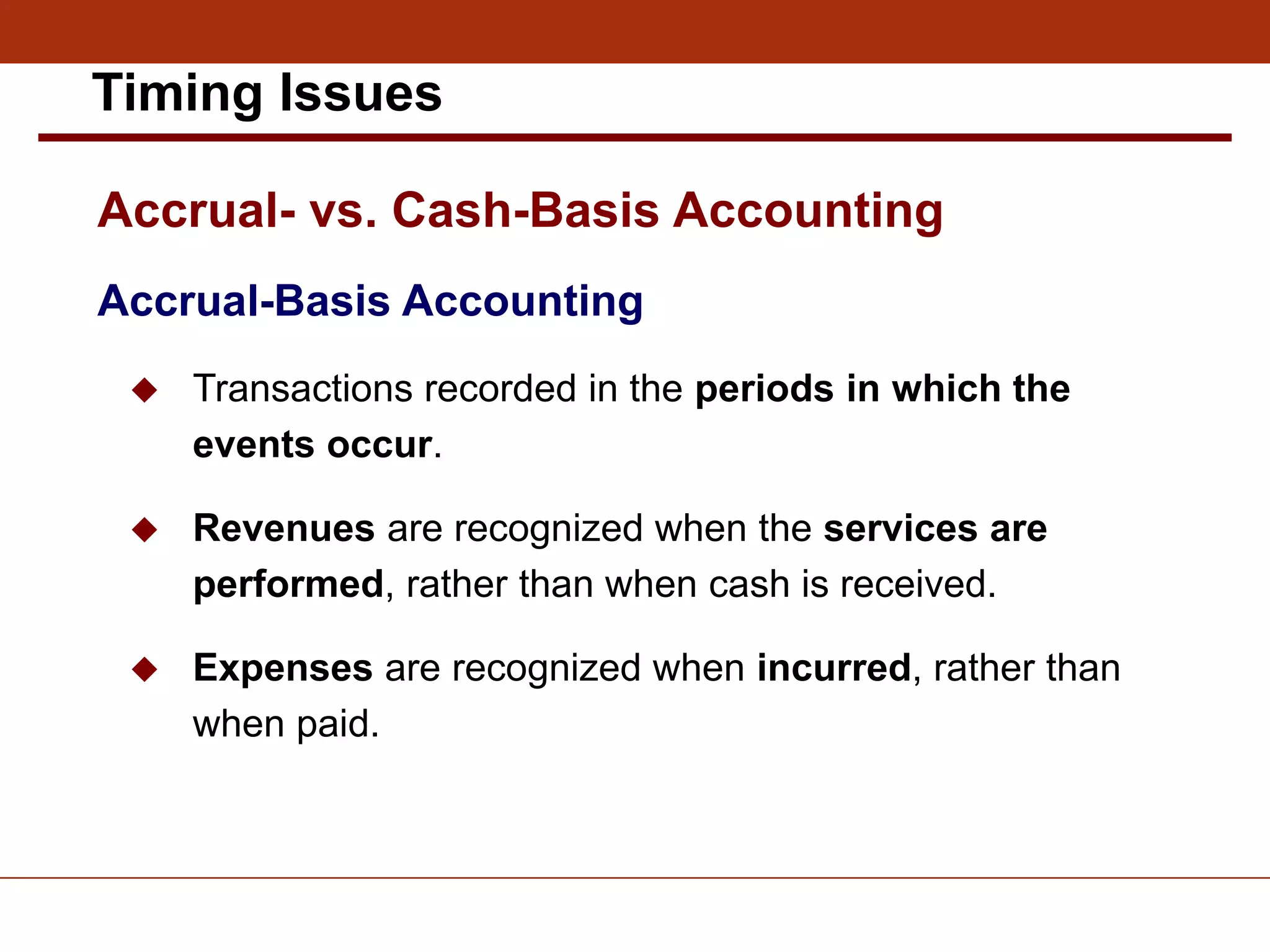
Accrual-Basis Accounting
 Transactions recorded in the periods in which the
events occur.
 Revenues are recognized when the services are
performed, rather than when cash is received.
 Expenses are recognized when incurred, rather than
when paid.
Accrual- vs. Cash-Basis Accounting
Timing Issues
Cash-Basis Accounting
 Revenues recognized when cash is received.
 Expenses recognized when cash is paid.
 Cash-basis accounting is not in accordance with
International Financial Reporting Standards (IFRS).
Accrual- vs. Cash-Basis Accounting
Timing Issues
Revenue Recognition Principle
Recognizing Revenues and Expenses
Recognize revenue in the
accounting period in which the
performance obligation is
satisfied.
In a service enterprise,
revenue is considered to be
earned at the time the service
is performed.
Timing Issues
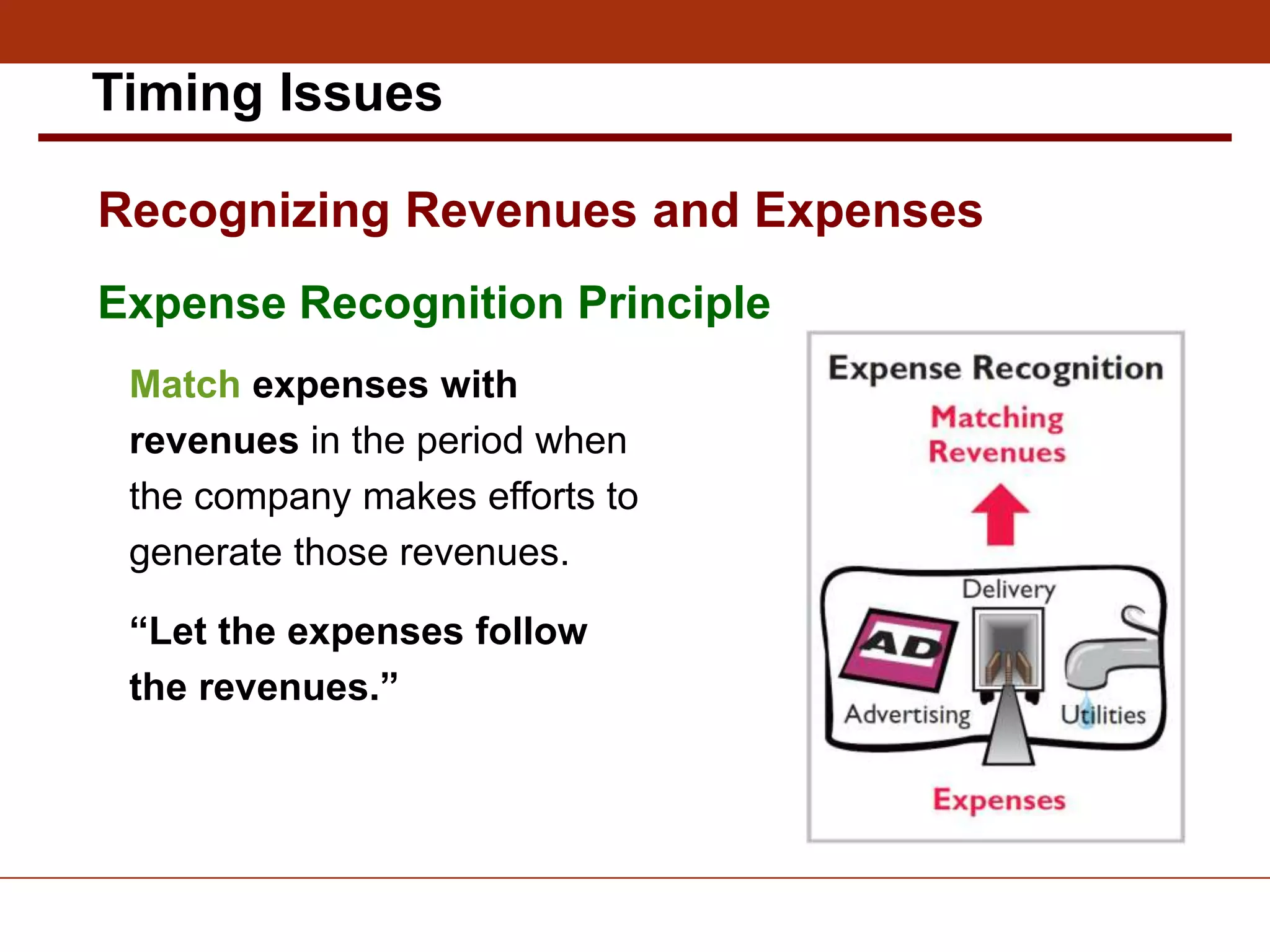
Expense Recognition Principle
Recognizing Revenues and Expenses
Match expenses with
revenues in the period when
the company makes efforts to
generate those revenues.
“Let the expenses follow
the revenues.”
Timing Issues
Timing Issues
Adjusting Entries
 Ensure that the revenue recognition and expense
recognition principles are followed.
 Necessary because the trial balance may not contain
up-to-date and complete data.
 Required every time a company prepares financial
statements.
 Will include one income statement account and one
statement of financial position account.
The Basics of Adjusting Entries
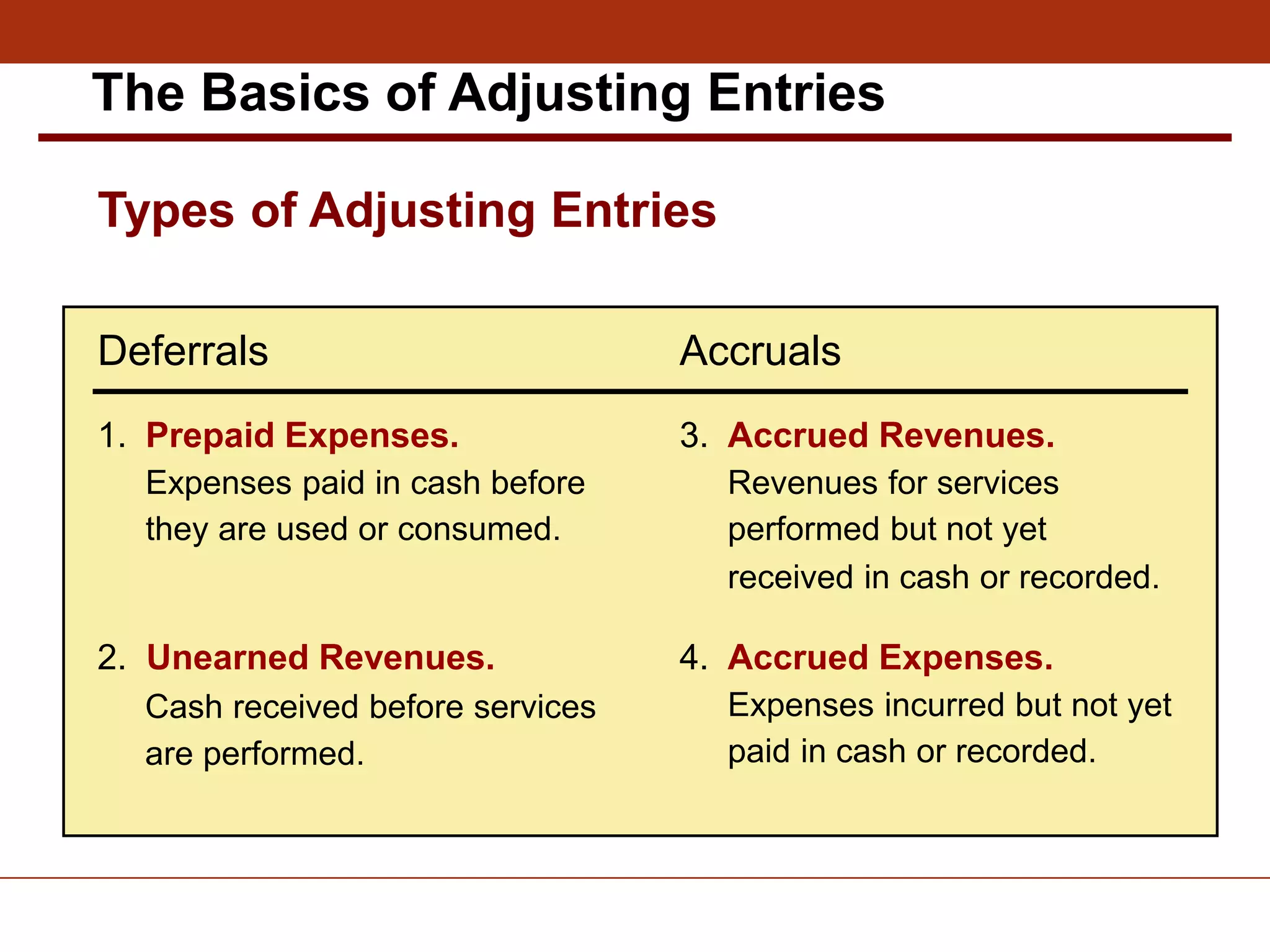
1. Prepaid Expenses.
Expenses paid in cash before
they are used or consumed.
Deferrals
3. Accrued Revenues.
Revenues for services
performed but not yet
received in cash or recorded.
4. Accrued Expenses.
Expenses incurred but not yet
paid in cash or recorded.
2. Unearned Revenues.
Cash received before services
are performed.
Accruals
The Basics of Adjusting Entries
Types of Adjusting Entries
Trial Balance –
Each account is
analyzed to
determine whether
it is complete and
up-to-date.
The Basics of Adjusting Entries
Types of Adjusting Entries
Deferrals are either:
 Prepaid expenses
OR
 Unearned revenues.
Adjusting Entries for Deferrals
The Basics of Adjusting Entries
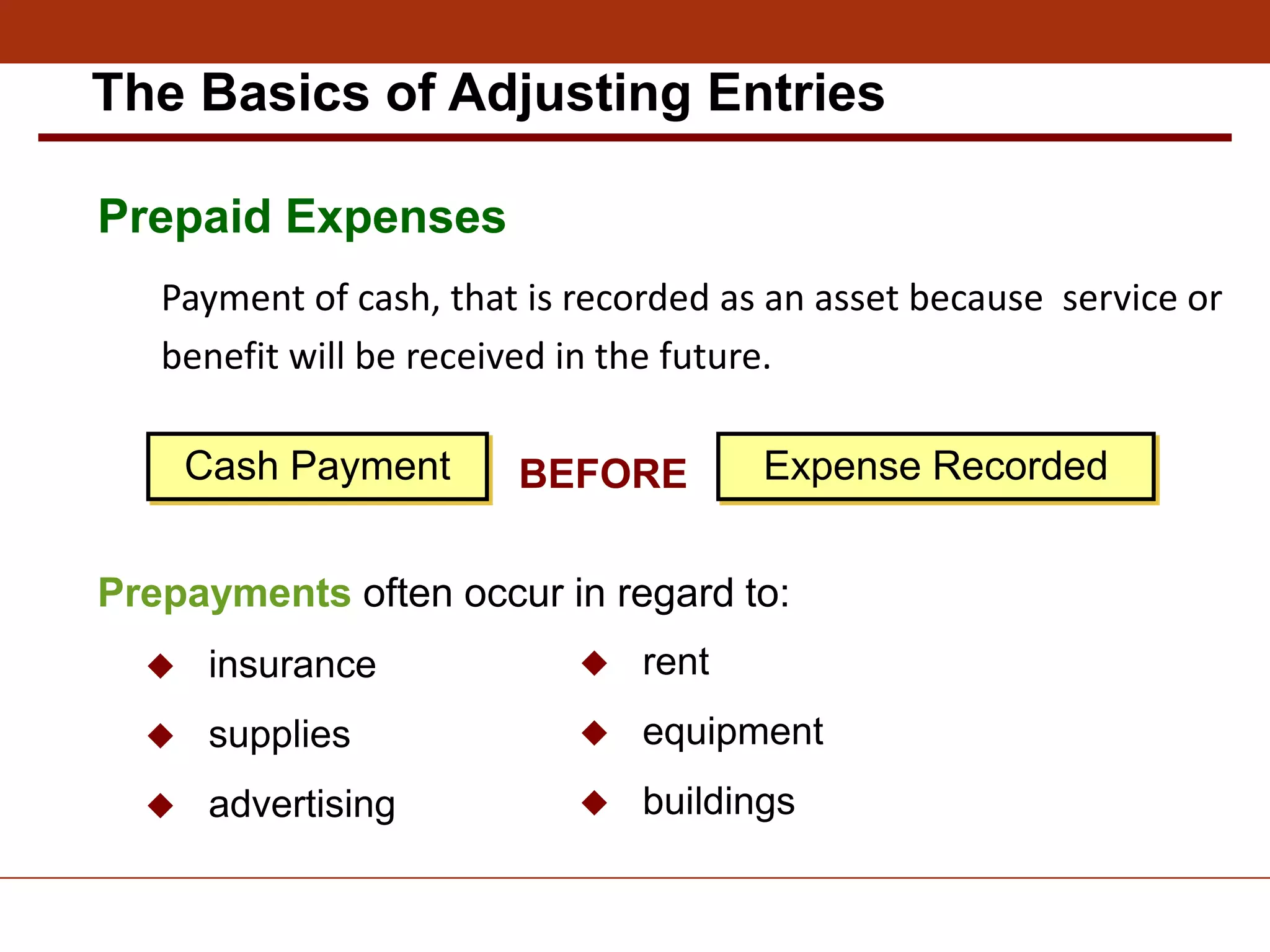
Payment of cash, that is recorded as an asset because service or
benefit will be received in the future.
 insurance
 supplies
 advertising
Cash Payment Expense Recorded
BEFORE
 rent
 equipment
 buildings
Prepayments often occur in regard to:
The Basics of Adjusting Entries
Prepaid Expenses
 Expire either with the passage of time or through use.
 Adjusting entry:
► Increase (debit) to an expense account and
► Decrease (credit) to an asset account.
The Basics of Adjusting Entries
Prepaid Expenses
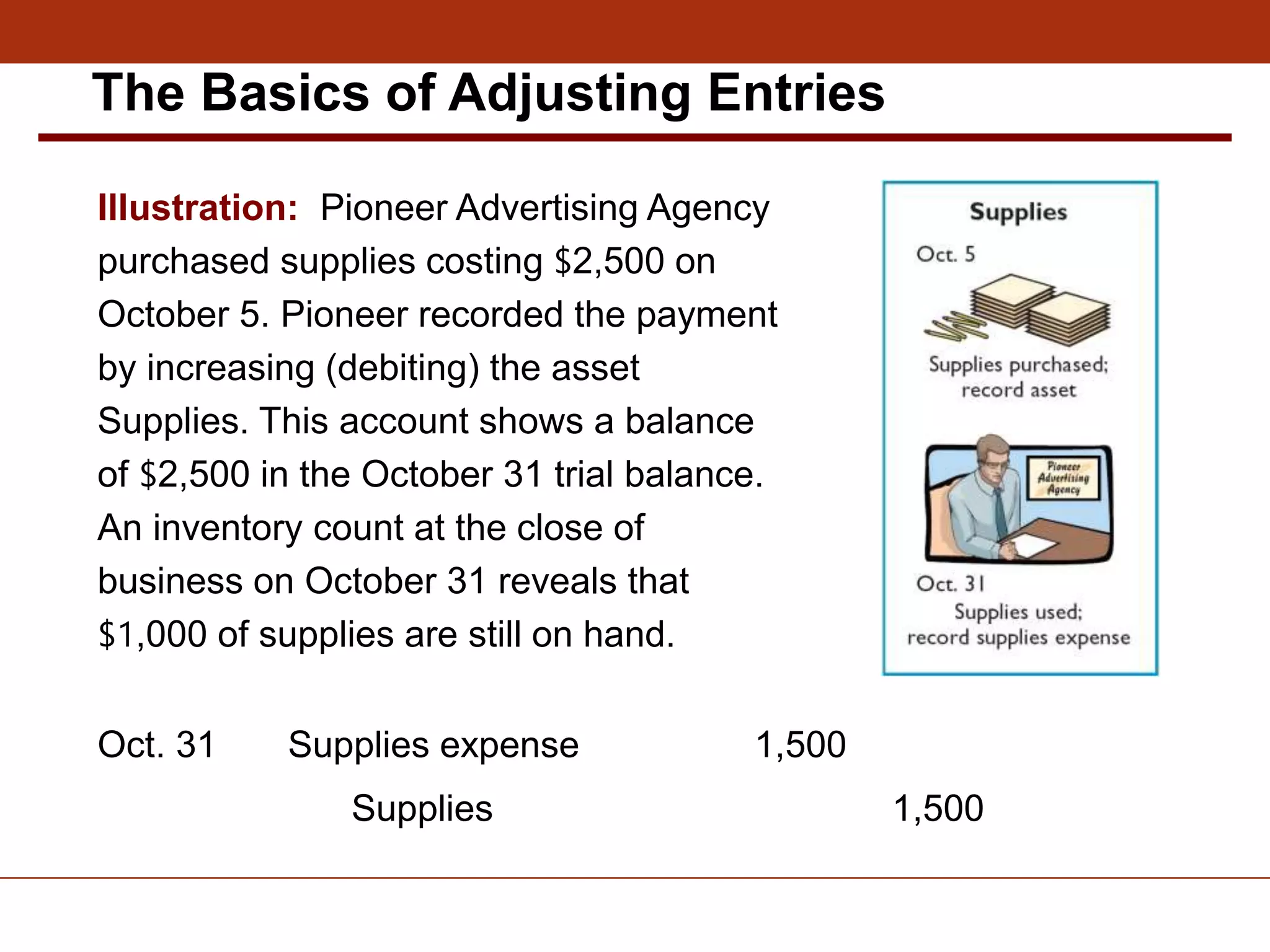
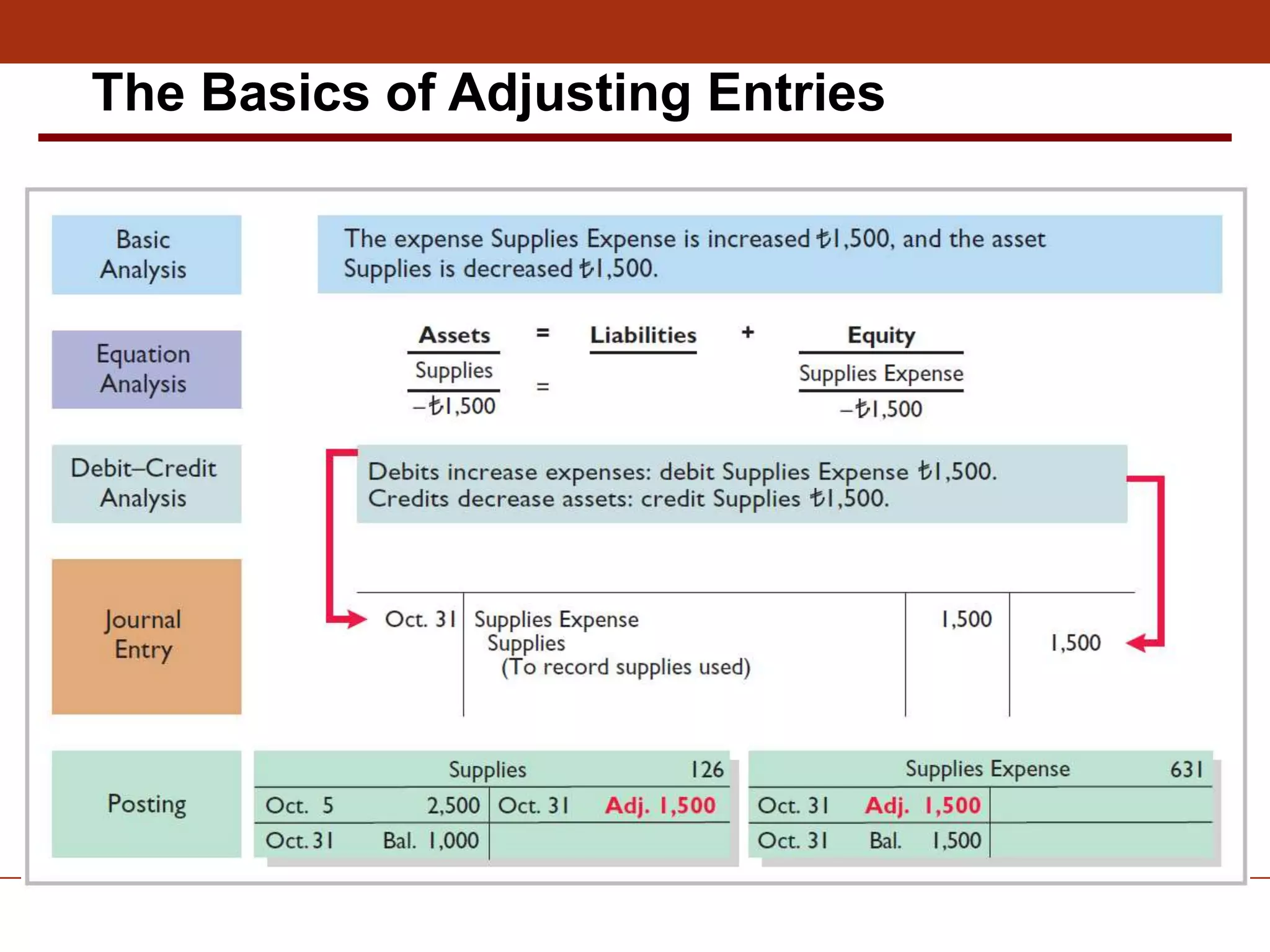
Illustration: Pioneer Advertising Agency
purchased supplies costing $2,500 on
October 5. Pioneer recorded the payment
by increasing (debiting) the asset
Supplies. This account shows a balance
of $2,500 in the October 31 trial balance.
An inventory count at the close of
business on October 31 reveals that
$1,000 of supplies are still on hand.
Supplies 1,500
Supplies expense 1,500
Oct. 31
The Basics of Adjusting Entries
Illustration: On October 4, Pioneer
Advertising paid $600 for a one-year fire
insurance policy. Coverage began on
October 1. Pioneer recorded the payment
by increasing (debiting) Prepaid
Insurance. This account shows a balance
of $600 in the October 31 trial balance.
Insurance of $50 ($600 ÷ 12) expires
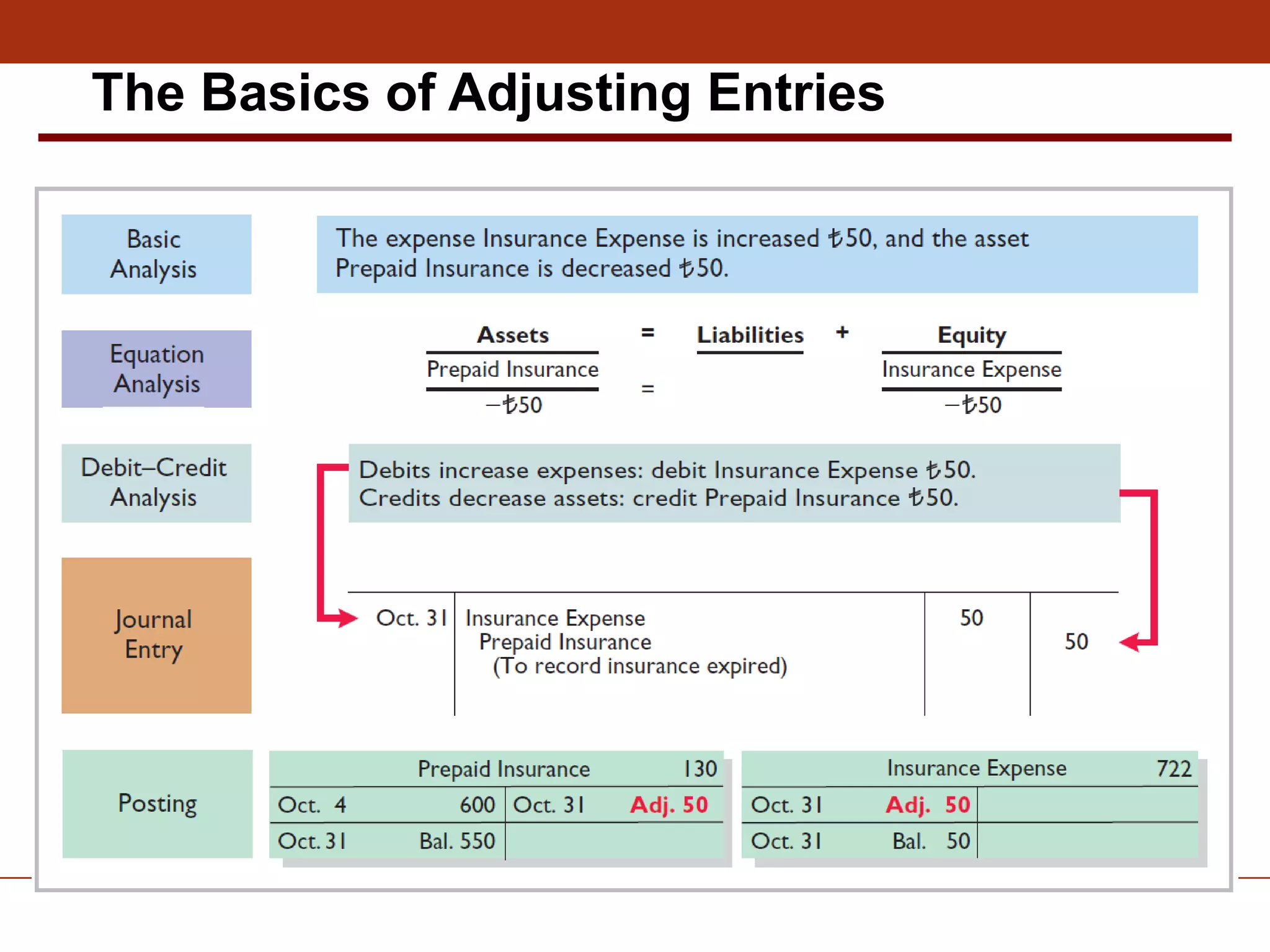
each month.
Prepaid insurance 50
Insurance expense 50
Oct. 31
The Basics of Adjusting Entries
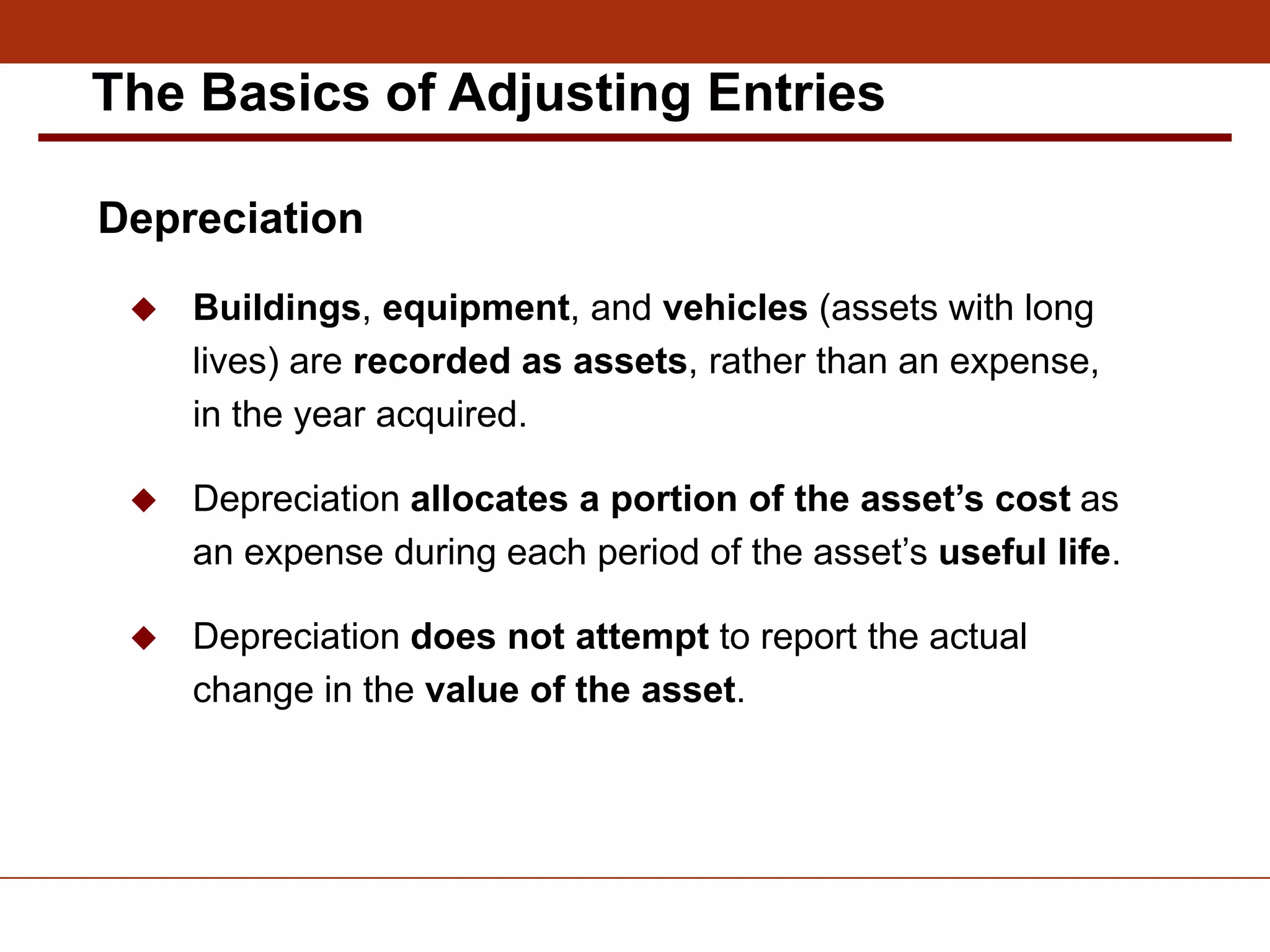
Depreciation
 Buildings, equipment, and vehicles (assets with long
lives) are recorded as assets, rather than an expense,
in the year acquired.
 Depreciation allocates a portion of the asset’s cost as
an expense during each period of the asset’s useful life.
 Depreciation does not attempt to report the actual
change in the value of the asset.
The Basics of Adjusting Entries
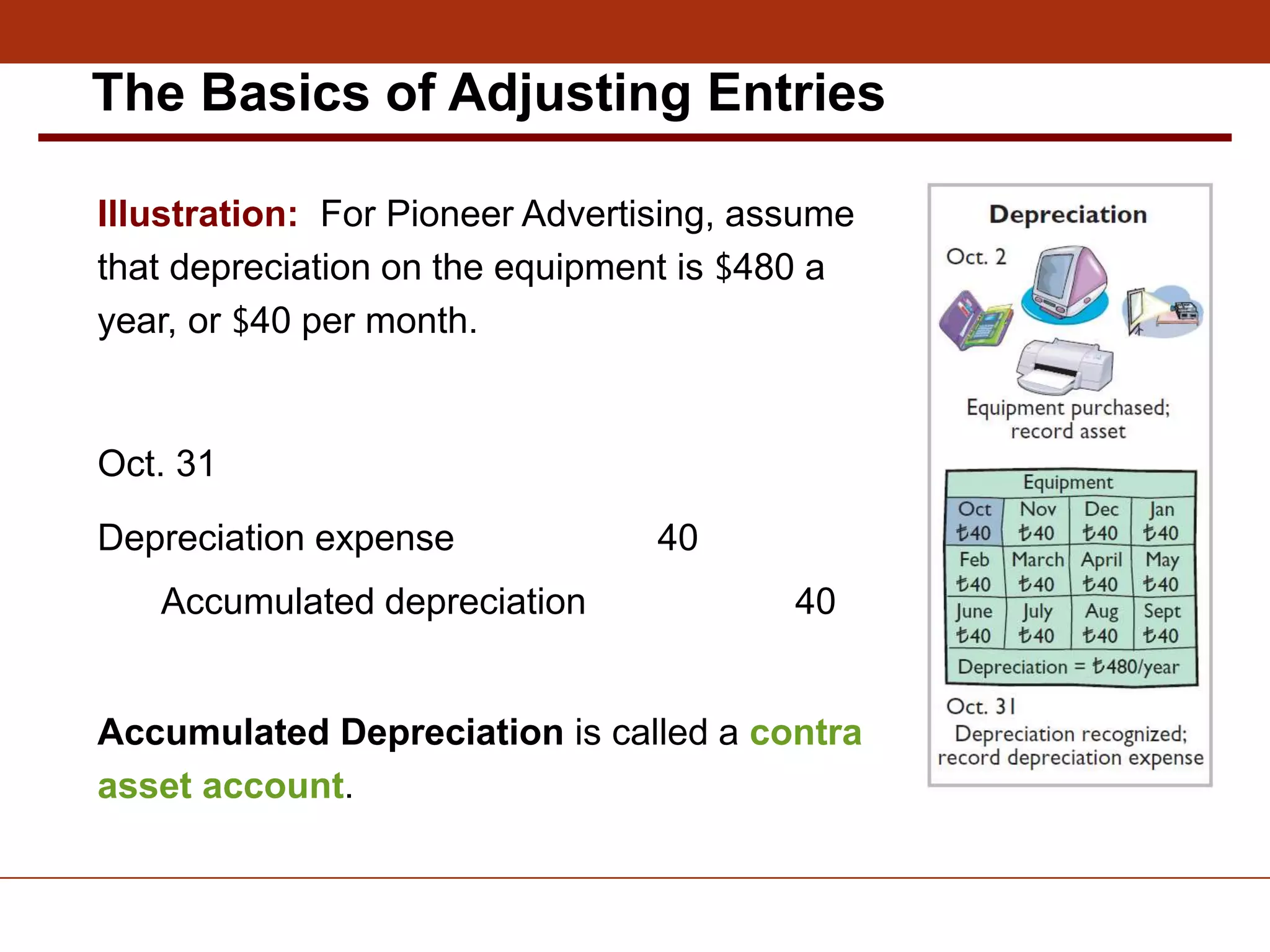
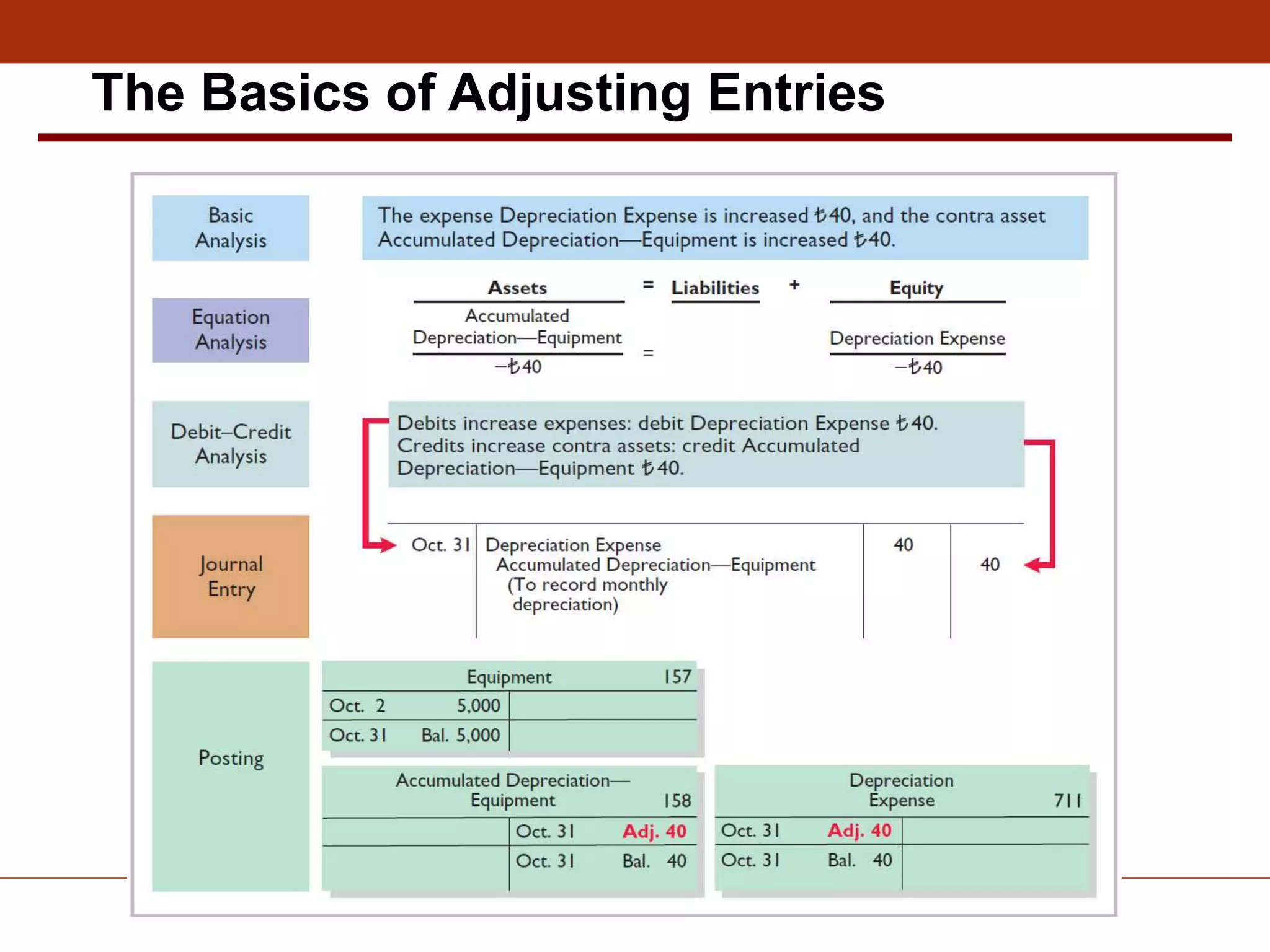
40
Illustration: For Pioneer Advertising, assume
that depreciation on the equipment is $480 a
year, or $40 per month.
Accumulated depreciation 40
Depreciation expense
Oct. 31
The Basics of Adjusting Entries
Accumulated Depreciation is called a contra
asset account.
The Basics of Adjusting Entries
Statement Presentation
 Accumulated Depreciation is a contra asset account
(credit).
 Appears just after the account it offsets (Equipment) on
the statement of financial position.
 Book value is the difference between the cost of any
depreciable asset and its accumulated depreciation.
The Basics of Adjusting Entries
Receipt of cash that is recorded as a liability because service has not
be performed.
 Rent
 Airline tickets
Cash Receipt Revenue Recorded
BEFORE
 Magazine subscriptions
 Customer deposits
Unearned revenues often occur in regard to:
The Basics of Adjusting Entries
Unearned Revenues
 Adjusting entry is made to record the revenue for
services performed and to show the liability that remains.
 Results in a decrease (debit) to a liability account and
an increase (credit) to a revenue account.
The Basics of Adjusting Entries
Unearned Revenues
Illustration: Pioneer Advertising received $1,200 on October 2
from R. Knox for advertising services expected to be completed by
December 31. Unearned Service Revenue shows a balance of
$1,200 in the October 31 trial balance. Analysis reveals that the
company earned $ 400 of those fees in October.
Service revenue 400
Unearned service revenue 400
Oct. 31
The Basics of Adjusting Entries
Accruals are made to record
 Revenues for services performed
OR
 Expenses incurred
in the current accounting period that have not been
recognized through daily entries.
Adjusting Entries for Accruals
The Basics of Adjusting Entries
Revenues for services performed but not yet received in cash or
recorded.
 Interest
 Services performed
 Rent
Accrued revenues often occur in regard to:
The Basics of Adjusting Entries
Accrued Revenues
BEFORE Cash Receipt
Revenue Recorded
 Adjusting entry shows the receivable that exists and
records the revenues for services performed.
 Adjusting entry:
► Increases (debits) an asset account and
► Increases (credits) a revenue account.
The Basics of Adjusting Entries
Accrued Revenues
Illustration: In October Pioneer Advertising
Agency recognized $200 for advertising
services performed but not recorded.
Accounts receivable 200
Cash 200
Nov. 10
The Basics of Adjusting Entries
200
Service revenue 200
Accounts receivable
Oct. 31
On November 10, Pioneer receives cash of $
200 for the services performed.
The Basics of Adjusting Entries
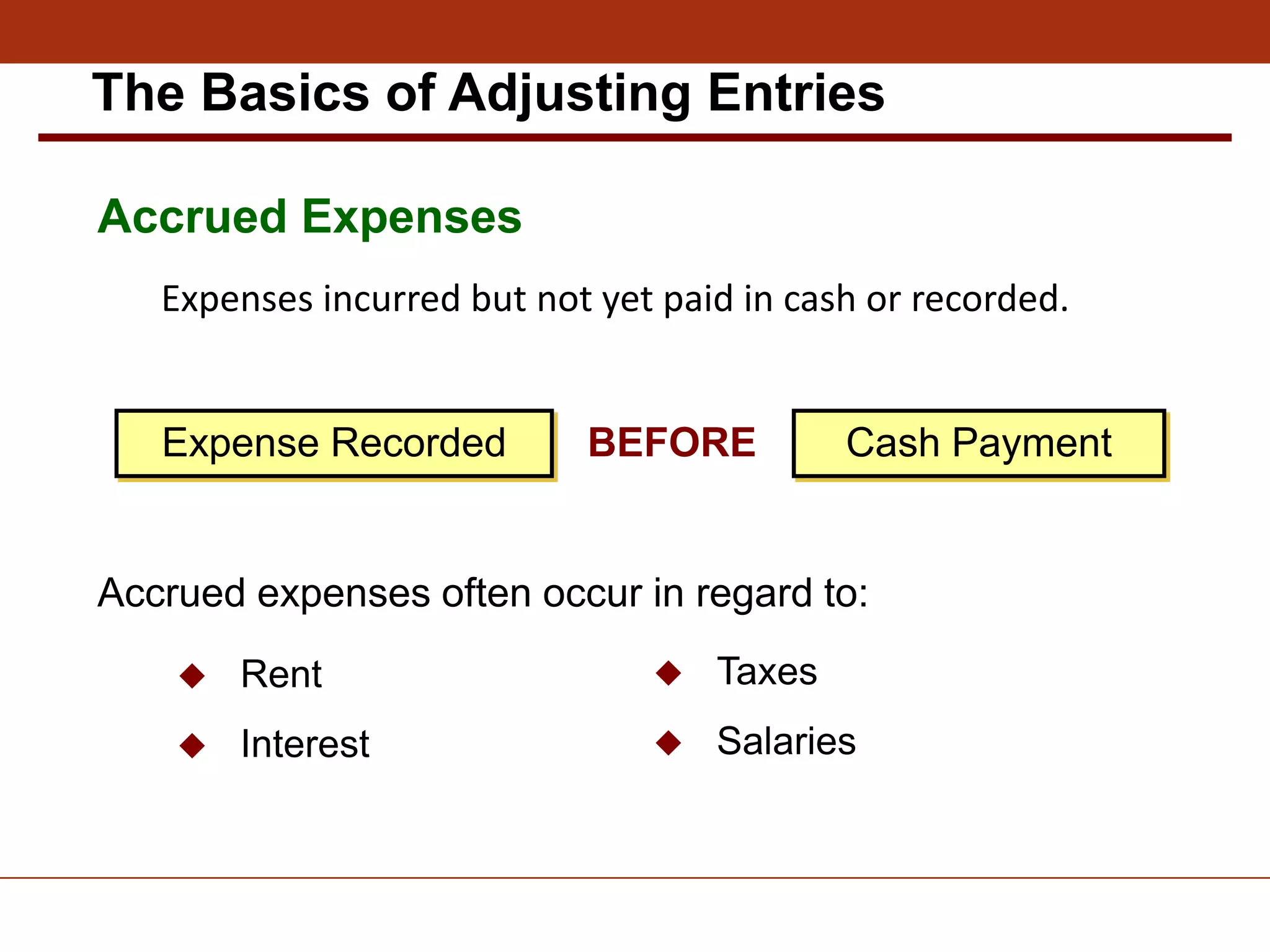
Expenses incurred but not yet paid in cash or recorded.
 Rent
 Interest
 Taxes
 Salaries
Accrued expenses often occur in regard to:
The Basics of Adjusting Entries
Accrued Expenses
BEFORE Cash Payment
Expense Recorded
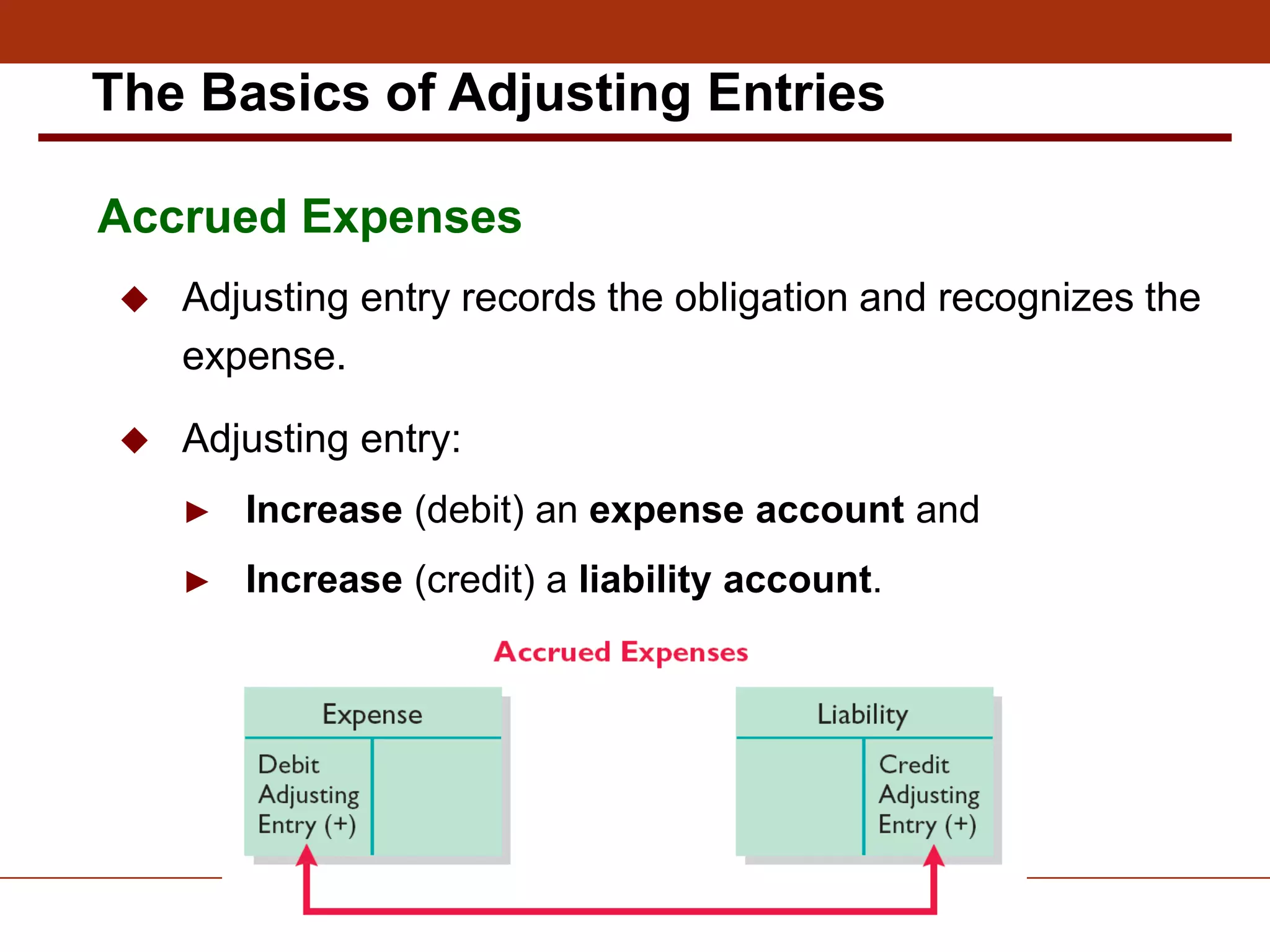
 Adjusting entry records the obligation and recognizes the
expense.
 Adjusting entry:
► Increase (debit) an expense account and
► Increase (credit) a liability account.
The Basics of Adjusting Entries
Accrued Expenses
Illustration: Pioneer Advertising signed a three-month note
payable in the amount of $5,000 on October 1. The note requires
Pioneer to pay interest at an annual rate of 12%.
Interest payable 50
Interest expense 50
Oct. 31
The Basics of Adjusting Entries
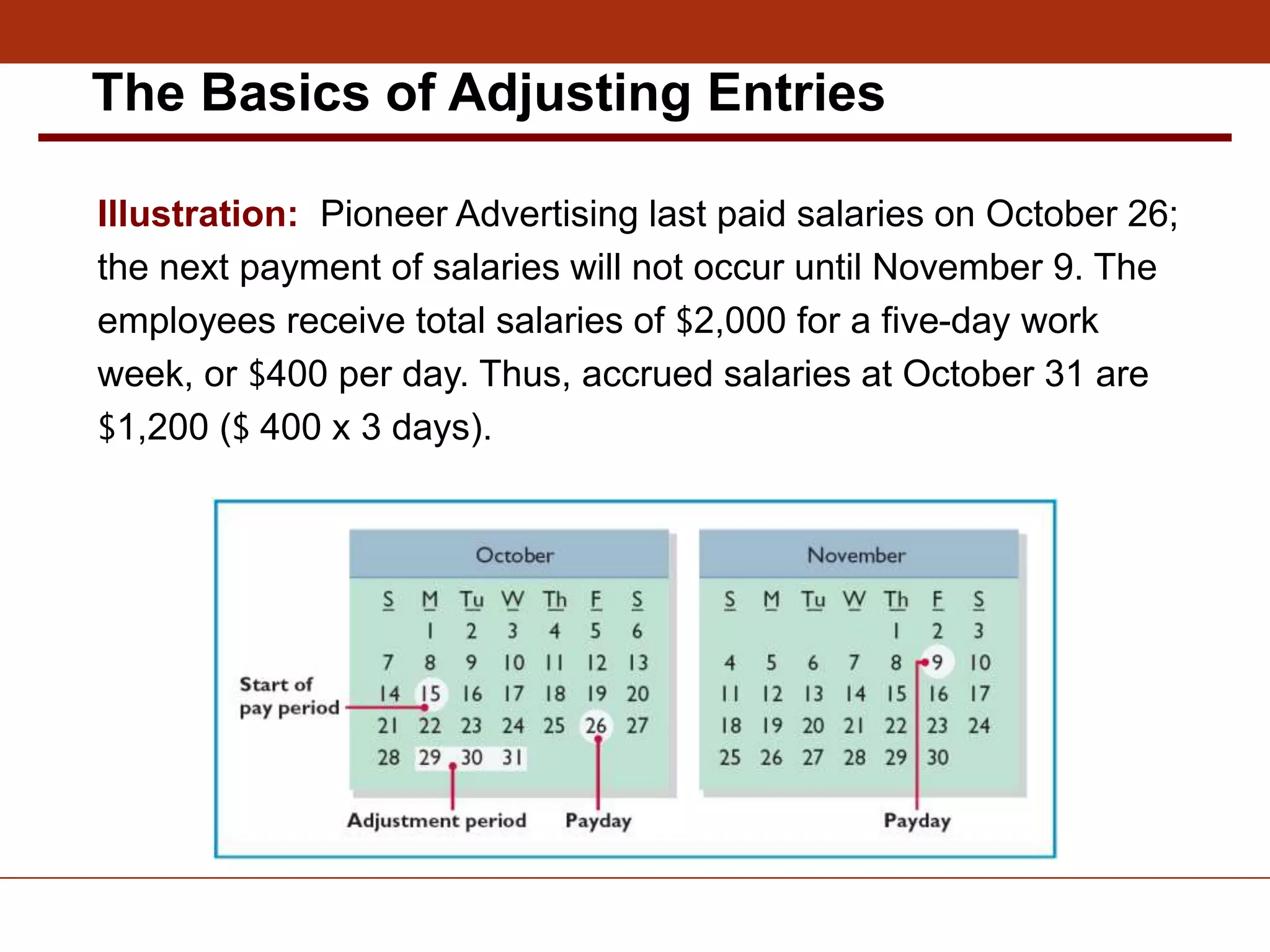
Illustration: Pioneer Advertising last paid salaries on October 26;
the next payment of salaries will not occur until November 9. The
employees receive total salaries of $2,000 for a five-day work
week, or $400 per day. Thus, accrued salaries at October 31 are
$1,200 ($ 400 x 3 days).
The Basics of Adjusting Entries
Summary of Basic Relationships
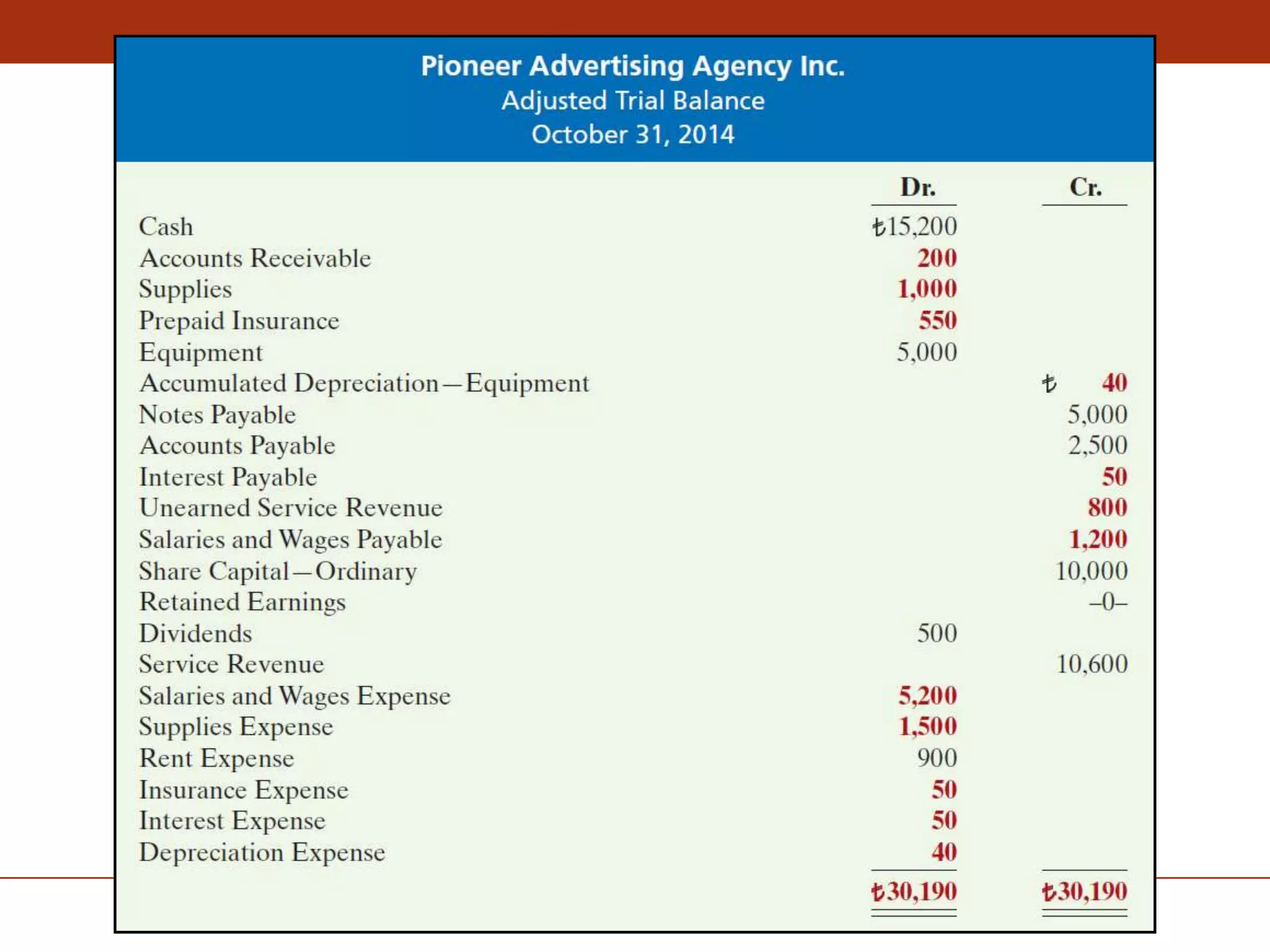
 Prepared after all adjusting entries are journalized and
posted.
 Purpose is to prove the equality of debit balances and
credit balances in the ledger.
 Is the primary basis for the preparation of financial
statements.
The Adjusted Trial Balance
Adjusted Trial Balance
Financial Statements are prepared directly from the
Adjusted Trial Balance.
Statement
of Financial
Position
Income
Statement
Retained
Earnings
Statement
Preparing Financial Statements
 Multiple-column form used in preparing financial
statements.
 Not a permanent accounting record.
 Five step process.
 Use of worksheet is optional.
Preparing a Worksheet
Using a Worksheet
Steps in Preparing a Worksheet
Account Titles Dr. Cr. Dr. Cr. Dr. Cr. Dr. Cr. Dr. Cr.
Cash 15,200
Supplies 2,500
Prepaid Insurance 600
Equipment 5,000
Notes Payable 5,000
Accounts Payable 2,500
Unearned Revenue 1,200
Share Capital-Ordinary 10,000
Dividends 500
Service Revenue 10,000
Salaries and Wages Exp. 4,000
Rent Expense 900
Totals 28,700 28,700
Financial Position
Adjusted Income
Trial Balance Adjustments Trial Balance Statement
Statement of
1. Prepare a Trial Balance on the Worksheet
Trial balance amounts come
directly from ledger accounts.
Include all accounts
with balances.
Steps in Preparing a Worksheet
General journal
showing adjusting
entries
Adjusting
Journal
Entries
(Chapter 3)
Steps in Preparing a Worksheet
Account Titles Dr. Cr. Dr. Cr. Dr. Cr. Dr. Cr. Dr. Cr.
Cash 15,200
Supplies 2,500 1,500
Prepaid Insurance 600 50
Equipment 5,000
Notes Payable 5,000
Accounts Payable 2,500
Unearned Revenue 1,200 400
Share Capital-Ordinary 10,000
Dividends 500
Service Revenue 10,000 400
200
Salaries and Wages Exp. 4,000 1,200
Rent Expense 900
Totals 28,700 28,700
Supplies Expense 1,500
Insurance Expense 50
Accumulated Depreciation 40
Depreciation Expense 40
Accounts Receivable 200
Interest Expense 50
Interest Payable 50
Salaries and Wages Payable 1,200
Totals 3,440 3,440
Financial Position
Adjusted Income
Trial Balance Adjustments Trial Balance Statement
Statement of
2. Enter the Adjustments in the Adjustments Columns
(a)
(b)
(a)
(g)
(c)
(d)
(d)
(e)
(b)
(e)
(f)
(f)
(g)
(c)
Enter adjustment amounts, total
adjustments columns,
and check for equality.
Add additional accounts as needed.
Adjustments Key:
(a) Supplies Used.
(b) Insurance Expired.
(c) Depreciation Expensed.
(d) Service Revenue Earned.
(e) Service Revenue Accrued.
(f) Interest Accrued.
(g) Salaries Accrued.
Steps in Preparing a Worksheet
Account Titles Dr. Cr. Dr. Cr. Dr. Cr. Dr. Cr. Dr. Cr.
Cash 15,200 15,200
Supplies 2,500 1,500 1,000
Prepaid Insurance 600 50 550
Equipment 5,000 5,000
Notes Payable 5,000 5,000
Accounts Payable 2,500 2,500
Unearned Revenue 1,200 400 800
Share Capital-Ordinary 10,000 10,000
Dividends 500 500
Service Revenue 10,000 400 10,600
200
Salaries and Wages Exp. 4,000 1,200 5,200
Rent Expense 900 900
Totals 28,700 28,700
Supplies Expense 1,500 1,500
Insurance Expense 50 50
Accumulated Depreciation 40 40
Depreciation Expense 40 40
Accounts Receivable 200 200
Interest Expense 50 50
Interest Payable 50 50
Salaries and Wages Payable 1,200 1,200
Totals 3,440 3,440 30,190 30,190
Financial Position
Adjusted Income
Trial Balance Adjustments Trial Balance Statement
Statement of
3. Complete the Adjusted Trial Balance Columns
(a)
(b)
(a)
(g)
(c)
(d)
(d)
(e)
(b)
(e)
(f)
(f)
(g)
(c)
Total the adjusted trial balance
columns and check for equality.
Steps in Preparing a Worksheet
Account Titles Dr. Cr. Dr. Cr. Dr. Cr. Dr. Cr. Dr. Cr.
Cash 15,200 15,200
Supplies 2,500 1,500 1,000
Prepaid Insurance 600 50 550
Equipment 5,000 5,000
Notes Payable 5,000 5,000
Accounts Payable 2,500 2,500
Unearned Revenue 1,200 400 800
Share Capital-Ordinary 10,000 10,000
Dividends 500 500
Service Revenue 10,000 400 10,600 10,600
200
Salaries and Wages Exp. 4,000 1,200 5,200 5,200
Rent Expense 900 900 900
Totals 28,700 28,700
Supplies Expense 1,500 1,500 1,500
Insurance Expense 50 50 50
Accumulated Depreciation 40 40
Depreciation Expense 40 40 40
Accounts Receivable 200 200
Interest Expense 50 50 50
Interest Payable 50 50
Salaries and Wages Payable 1,200 1,200
Totals 3,440 3,440 30,190 30,190 7,740 10,600
Financial Position
Adjusted Income
Trial Balance Adjustments Trial Balance Statement
Statement of
4. Extend Amounts to Financial Statement Columns
(a)
(b)
(a)
(g)
(c)
(d)
(d)
(e)
(b)
(e)
(f)
(f)
(g)
(c)
Extend all revenue and expense account
balances to the income statement columns.
Steps in Preparing a Worksheet
Account Titles Dr. Cr. Dr. Cr. Dr. Cr. Dr. Cr. Dr. Cr.
Cash 15,200 15,200 15,200
Supplies 2,500 1,500 1,000 1,000
Prepaid Insurance 600 50 550 550
Equipment 5,000 5,000 5,000
Notes Payable 5,000 5,000 5,000
Accounts Payable 2,500 2,500 2,500
Unearned Revenue 1,200 400 800 800
Share Capital-Ordinary 10,000 10,000 10,000
Dividends 500 500 500
Service Revenue 10,000 400 10,600 10,600
200
Salaries and Wages Exp. 4,000 1,200 5,200 5,200
Rent Expense 900 900 900
Totals 28,700 28,700
Supplies Expense 1,500 1,500 1,500
Insurance Expense 50 50 50
Accumulated Depreciation 40 40 40
Depreciation Expense 40 40 40
Accounts Receivable 200 200 200
Interest Expense 50 50 50
Interest Payable 50 50 50
Salaries and Wages Payable 1,200 1,200 1,200
Totals 3,440 3,440 30,190 30,190 7,740 10,600 22,450 19,590
Net Income 2,860 2,860
Totals 10,600 10,600 22,450 22,450
Financial Position
Adjusted Income
Trial Balance Adjustments Trial Balance Statement
Statement of
(a)
(b)
(a)
(g)
(c)
(d)
(d)
(e)
(b)
(e)
(f)
(f)
(g)
(c)
Steps in Preparing a Worksheet
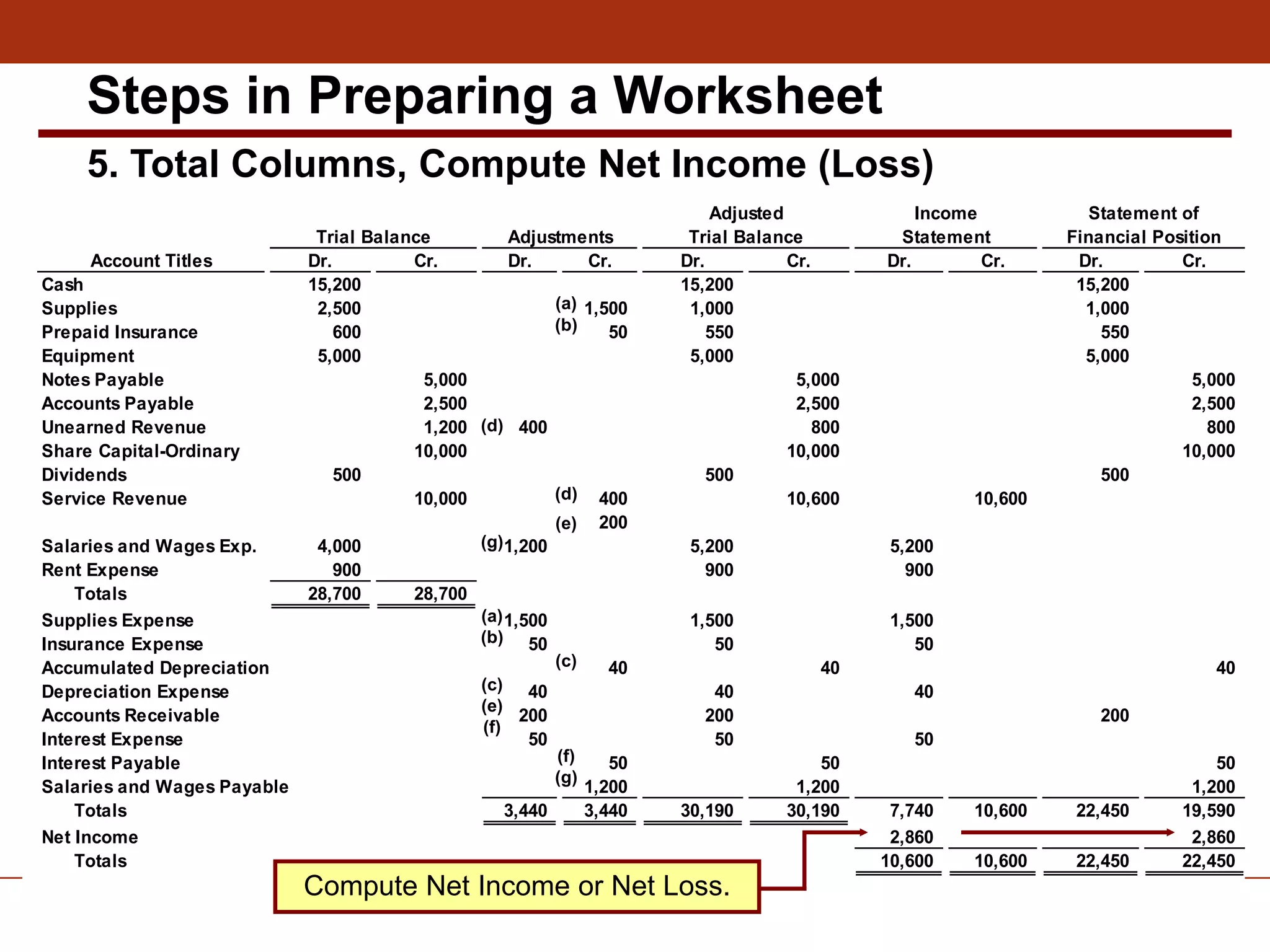
Compute Net Income or Net Loss.
5. Total Columns, Compute Net Income (Loss)
 Income statement is prepared from the income
statement columns.
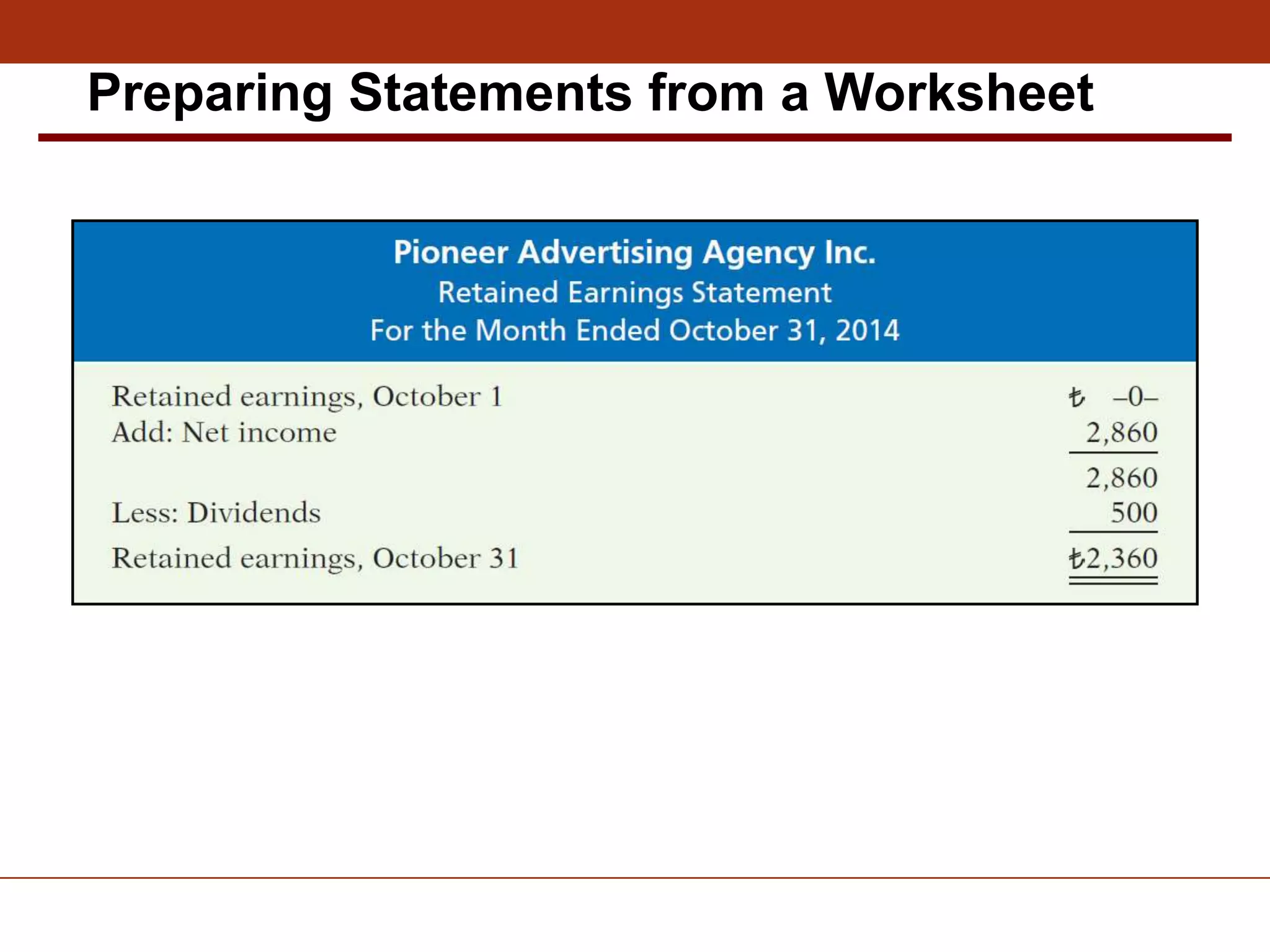
 Statement of financial position and retained earnings
statement are prepared from the statement of financial
position columns.
 Companies journalize and post adjusting entries.
Preparing Statements from a Worksheet
Using a Worksheet
Preparing Statements from a Worksheet
 Adjusting entries are prepared from the adjustments
columns of the worksheet.
 Journalizing and posting of adjusting entries follows the
preparation of financial statements when a worksheet is
used.
Using a Worksheet
Preparing Adjusting Entries from a Worksheet
At the end of the accounting period, the company makes
the accounts ready for the next period.
Closing the Books
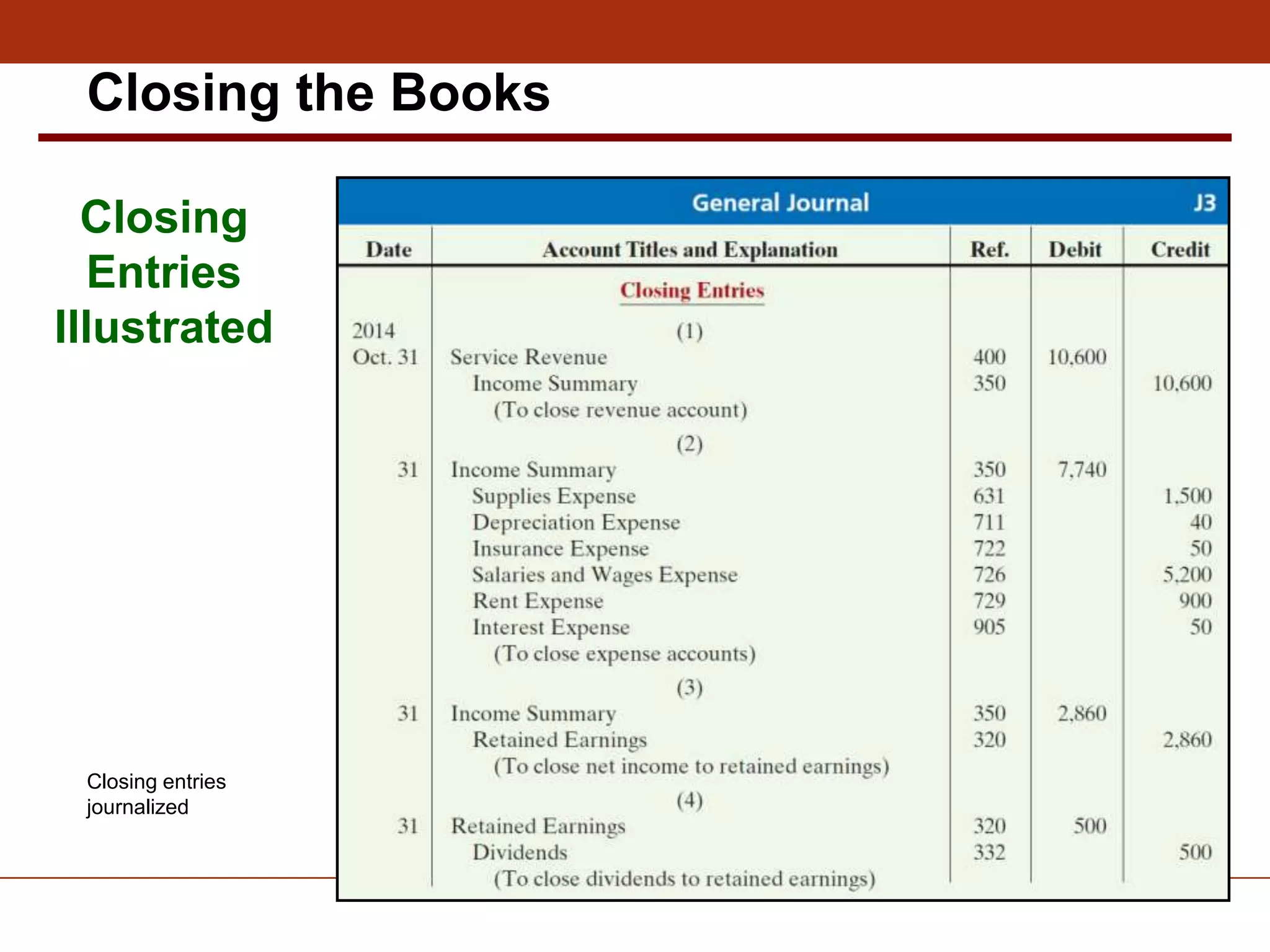
Closing entries formally recognize, in the general ledger, the
transfer of
 net income (or net loss) and
 dividends
to retained earnings.
Closing entries are only made at the end of the annual
accounting period.
Closing the Books
Preparing Closing Entries
Retained earnings is a
permanent account; all
other accounts are
temporary accounts.
Dividends are closed directly
to retained earnings and not
to Income Summary because
dividends are not an
expense.
Note:
Closing the Books
Closing
Entries
Illustrated
Closing entries
journalized
Closing the Books
Posting
Closing
Entries
Closing the Books
Purpose is to prove the equality of the permanent account
balances after journalizing and posting of closing entries.
Preparing a Post-Closing Trial Balance
1. Analyze business transactions
2. Journalize the
transactions
6. Prepare an adjusted trial
balance
7. Prepare financial
statements
8. Journalize and post
closing entries
9. Prepare a post-closing
trial balance
4. Prepare a trial balance
3. Post to ledger accounts
5. Journalize and post
adjusting entries
Summary of the Accounting Cycle
End of chapter two

Chapter Two LIC.ppt

  • 1.
  • 2.
    Learning Objectives After studyingthis chapter, you should be able to: [1] Explain what an account is and how it helps in the recording process. [2] Define debits and credits and explain their use in recording business transactions. [3] Identify the basic steps in the recording process. [4] Explain what a journal is and how it helps in the recording process. [5] Explain what a ledger is and how it helps in the recording process. [6] Explain what posting is and how it helps in the recording process. [7] Prepare a trial balance and explain its purposes. [8] Prepare adjusting entry, worksheet and financial statements. [9] Prepare closing entry and post closing trial balance
  • 3.
     Record ofincreases and decreases in a specific asset, liability, equity, revenue, or expense item.  Debit = “Left”  Credit = “Right” Account An account can be illustrated in a T- account form. The Account
  • 4.
    Double-entry system ► Eachtransaction must affect two or more accounts to keep the basic accounting equation in balance. ► Recording done by debiting at least one account and crediting another. ► DEBITS must equal CREDITS. The Account Debits and Credits
  • 5.
    Account Name Debit /Dr. Credit / Cr. If Debit amounts are greater than Credit amounts, the account will have a debit balance. $10,000 Transaction #2 $3,000 $15,000 8,000 Transaction #3 Balance Transaction #1 Debits and Credits
  • 6.
    Account Name Debit /Dr. Credit / Cr. $10,000 Transaction #2 $3,000 Balance Transaction #1 $1,000 8,000 Transaction #3 If Debit amounts are less than Credit amounts, the account will have a credit balance. Debits and Credits
  • 7.
     Assets -Debits should exceed credits.  Liabilities – Credits should exceed debits.  Normal balance is on the increase side. Chapter 3-23 Assets Assets Debit / Dr. Credit / Cr. Normal Balance Normal Balance Chapter 3-24 Liabilities Liabilities Debit / Dr. Credit / Cr. Normal Balance Normal Balance Debits and Credits
  • 8.
     Issuance ofshare capital and revenues increase equity (credit).  Dividends and expenses decrease equity (debit). Chapter 3-25 Debit / Dr. Credit / Cr. Normal Balance Normal Balance Share Capital Share Capital Chapter 3-23 Dividends Dividends Debit / Dr. Credit / Cr. Normal Balance Normal Balance Chapter 3-25 Debit / Dr. Credit / Cr. Normal Balance Normal Balance Equity Equity Chapter 3-25 Debit / Dr. Credit / Cr. Normal Balance Normal Balance Retained Earnings Retained Earnings Debits and Credits
  • 9.
    Chapter 3-27 Debit / Dr.Credit / Cr. Normal Balance Normal Balance Expense Expense Chapter 3-26 Debit / Dr. Credit / Cr. Normal Balance Normal Balance Revenue Revenue Debits and Credits  The purpose of earning revenues is to benefit the shareholders.  The effect of debits and credits on revenue accounts is the same as their effect on equity.  Expenses have the opposite effect: expenses decrease equity.
  • 10.
    Chapter 3-23 Assets Assets Debit / Dr.Credit / Cr. Normal Balance Normal Balance Chapter 3-27 Debit / Dr. Credit / Cr. Normal Balance Normal Balance Expense Expense Normal Balance Credit Normal Balance Debit Debit/Credit Rules Chapter 3-24 Liabilities Liabilities Debit / Dr. Credit / Cr. Normal Balance Normal Balance Chapter 3-25 Debit / Dr. Credit / Cr. Normal Balance Normal Balance Equity Equity Chapter 3-26 Debit / Dr. Credit / Cr. Normal Balance Normal Balance Revenue Revenue
  • 11.
    Income Statement = +- Asset Liability Equity Revenue Expense Debit Credit Debit/Credit Rules Statement of Financial Position
  • 12.
  • 13.
    Summary of Debit/CreditRules Relationship among the assets, liabilities and equity of a business: The equation must be in balance after every transaction. For every Debit there must be a Credit.
  • 14.
    Business documents, suchas a sales slip, a check, a bill, or a cash register tape, provide evidence of the transaction. Analyze each transaction Enter transaction in a journal Transfer journal information to ledger accounts Steps in the Recording Process
  • 15.
     Book oforiginal entry.  Transactions recorded in chronological order.  Contributions to the recording process: 1. Discloses the complete effects of a transaction. 2. Provides a chronological record of transactions. 3. Helps to prevent or locate errors because the debit and credit amounts can be easily compared. Steps in the Recording Process The Journal
  • 16.
    Journalizing - Enteringtransaction data in the journal. Illustration: On September 1, shareholders’ invested €15,000 cash in the corporation in exchange for share of stock, and Softbyte purchased computer equipment for €7,000 cash. Account Title Ref. Debit Credit Date Cash Share capital-ordinary Sept. 1 15,000 15,000 General Journal Equipment Cash 7,000 7,000 Steps in the Recording Process
  • 17.
    Simple and CompoundEntries Illustration: On July 1, Tsai Company purchases a delivery truck costing $420,000. It pays $240,000 cash now and agrees to pay the remaining $180,000 on account. Account Title Ref. Debit Credit Date Equipment Cash July 1 420,000 240,000 General Journal 180,000 Accounts payable Steps in the Recording Process
  • 18.
     General Ledgercontains the entire group of accounts maintained by a company. The Ledger Steps in the Recording Process
  • 19.
    Steps in theRecording Process Standard Form of Account
  • 20.
    Posting – process of transferring amountsfrom the journal to the ledger accounts. Steps
  • 21.
    Accounts and accountnumbers arranged in sequence in which they are presented in the financial statements. Chart of Accounts
  • 22.
    Follow these steps: 1.Determine what type of account is involved. 2. Determine what items increased or decreased and by how much. 3. Translate the increases and decreases into debits and credits. The Recording Process Illustrated
  • 23.
  • 24.
  • 25.
  • 26.
  • 27.
  • 28.
  • 29.
  • 30.
  • 31.
  • 32.
  • 33.
  • 34.
    34 1. Cecil Jameson,Attorney-at-Law, is a proprietorship owned and operated by Cecil Jameson. On July 1, 2005, Cecil Jameson, Attorney-at-Law, has the following assets and liabilities: cash, $1,000; accounts receivable, $3,200; supplies, $850; land, $10,000; accounts payable, $1,530. Office space and office equipment are currently being rented, pending the construction of an office complex on land purchased last year. Business transactions during July are summarized as follows: a. Received cash from clients for services, $3,928. b. Paid creditors on account, $1,055. c. Received cash from Cecil Jameson as an additional investment, $3,700. Exercise
  • 35.
    35 d. Paid officerent for the month, $1,200. e. Charged clients for legal services on account, $2,025. f. Purchased office supplies on account, $245. g. Received cash from clients on account, $3,000. h. Received invoice for paralegal services from Legal Aid Inc. for July (to be paid on August 10), $1,635. i. Paid the following: wages expense, $850; answering service expense, $250; utilities expense, $325; and miscellaneous expense, $75. j. Determined that the cost of office supplies on hand was $980; therefore, the cost of supplies used during the month was $115. k. Jameson withdrew $1,000 in cash from the business for personal use.
  • 36.
     Generally amonth, a quarter, or a year.  Also known as the “Periodicity Assumption” Timing Issues Accountants divide the economic life of a business into artificial time periods (Time Period Assumption). Jan. Feb. Mar. Apr. Dec. . . . . .
  • 37.
     Monthly andquarterly time periods are called interim periods.  Most large companies must prepare both quarterly and annual financial statements.  Fiscal Year = Accounting time period that is one year in length.  Calendar Year = January 1 to December 31. Timing Issues Fiscal and Calendar Years
  • 38.
    Accrual-Basis Accounting  Transactionsrecorded in the periods in which the events occur.  Revenues are recognized when the services are performed, rather than when cash is received.  Expenses are recognized when incurred, rather than when paid. Accrual- vs. Cash-Basis Accounting Timing Issues
  • 39.
    Cash-Basis Accounting  Revenuesrecognized when cash is received.  Expenses recognized when cash is paid.  Cash-basis accounting is not in accordance with International Financial Reporting Standards (IFRS). Accrual- vs. Cash-Basis Accounting Timing Issues
  • 40.
    Revenue Recognition Principle RecognizingRevenues and Expenses Recognize revenue in the accounting period in which the performance obligation is satisfied. In a service enterprise, revenue is considered to be earned at the time the service is performed. Timing Issues
  • 41.
    Expense Recognition Principle RecognizingRevenues and Expenses Match expenses with revenues in the period when the company makes efforts to generate those revenues. “Let the expenses follow the revenues.” Timing Issues
  • 42.
  • 43.
    Adjusting Entries  Ensurethat the revenue recognition and expense recognition principles are followed.  Necessary because the trial balance may not contain up-to-date and complete data.  Required every time a company prepares financial statements.  Will include one income statement account and one statement of financial position account. The Basics of Adjusting Entries
  • 44.
    1. Prepaid Expenses. Expensespaid in cash before they are used or consumed. Deferrals 3. Accrued Revenues. Revenues for services performed but not yet received in cash or recorded. 4. Accrued Expenses. Expenses incurred but not yet paid in cash or recorded. 2. Unearned Revenues. Cash received before services are performed. Accruals The Basics of Adjusting Entries Types of Adjusting Entries
  • 45.
    Trial Balance – Eachaccount is analyzed to determine whether it is complete and up-to-date. The Basics of Adjusting Entries Types of Adjusting Entries
  • 46.
    Deferrals are either: Prepaid expenses OR  Unearned revenues. Adjusting Entries for Deferrals The Basics of Adjusting Entries
  • 47.
    Payment of cash,that is recorded as an asset because service or benefit will be received in the future.  insurance  supplies  advertising Cash Payment Expense Recorded BEFORE  rent  equipment  buildings Prepayments often occur in regard to: The Basics of Adjusting Entries Prepaid Expenses
  • 48.
     Expire eitherwith the passage of time or through use.  Adjusting entry: ► Increase (debit) to an expense account and ► Decrease (credit) to an asset account. The Basics of Adjusting Entries Prepaid Expenses
  • 49.
    Illustration: Pioneer AdvertisingAgency purchased supplies costing $2,500 on October 5. Pioneer recorded the payment by increasing (debiting) the asset Supplies. This account shows a balance of $2,500 in the October 31 trial balance. An inventory count at the close of business on October 31 reveals that $1,000 of supplies are still on hand. Supplies 1,500 Supplies expense 1,500 Oct. 31 The Basics of Adjusting Entries
  • 50.
    The Basics ofAdjusting Entries
  • 51.
    Illustration: On October4, Pioneer Advertising paid $600 for a one-year fire insurance policy. Coverage began on October 1. Pioneer recorded the payment by increasing (debiting) Prepaid Insurance. This account shows a balance of $600 in the October 31 trial balance. Insurance of $50 ($600 ÷ 12) expires each month. Prepaid insurance 50 Insurance expense 50 Oct. 31 The Basics of Adjusting Entries
  • 52.
    The Basics ofAdjusting Entries
  • 53.
    Depreciation  Buildings, equipment,and vehicles (assets with long lives) are recorded as assets, rather than an expense, in the year acquired.  Depreciation allocates a portion of the asset’s cost as an expense during each period of the asset’s useful life.  Depreciation does not attempt to report the actual change in the value of the asset. The Basics of Adjusting Entries
  • 54.
    40 Illustration: For PioneerAdvertising, assume that depreciation on the equipment is $480 a year, or $40 per month. Accumulated depreciation 40 Depreciation expense Oct. 31 The Basics of Adjusting Entries Accumulated Depreciation is called a contra asset account.
  • 55.
    The Basics ofAdjusting Entries
  • 56.
    Statement Presentation  AccumulatedDepreciation is a contra asset account (credit).  Appears just after the account it offsets (Equipment) on the statement of financial position.  Book value is the difference between the cost of any depreciable asset and its accumulated depreciation. The Basics of Adjusting Entries
  • 57.
    The Basics ofAdjusting Entries
  • 58.
    Receipt of cashthat is recorded as a liability because service has not be performed.  Rent  Airline tickets Cash Receipt Revenue Recorded BEFORE  Magazine subscriptions  Customer deposits Unearned revenues often occur in regard to: The Basics of Adjusting Entries Unearned Revenues
  • 59.
     Adjusting entryis made to record the revenue for services performed and to show the liability that remains.  Results in a decrease (debit) to a liability account and an increase (credit) to a revenue account. The Basics of Adjusting Entries Unearned Revenues
  • 60.
    Illustration: Pioneer Advertisingreceived $1,200 on October 2 from R. Knox for advertising services expected to be completed by December 31. Unearned Service Revenue shows a balance of $1,200 in the October 31 trial balance. Analysis reveals that the company earned $ 400 of those fees in October. Service revenue 400 Unearned service revenue 400 Oct. 31 The Basics of Adjusting Entries
  • 61.
    The Basics ofAdjusting Entries
  • 62.
    The Basics ofAdjusting Entries
  • 63.
    Accruals are madeto record  Revenues for services performed OR  Expenses incurred in the current accounting period that have not been recognized through daily entries. Adjusting Entries for Accruals The Basics of Adjusting Entries
  • 64.
    Revenues for servicesperformed but not yet received in cash or recorded.  Interest  Services performed  Rent Accrued revenues often occur in regard to: The Basics of Adjusting Entries Accrued Revenues BEFORE Cash Receipt Revenue Recorded
  • 65.
     Adjusting entryshows the receivable that exists and records the revenues for services performed.  Adjusting entry: ► Increases (debits) an asset account and ► Increases (credits) a revenue account. The Basics of Adjusting Entries Accrued Revenues
  • 66.
    Illustration: In OctoberPioneer Advertising Agency recognized $200 for advertising services performed but not recorded. Accounts receivable 200 Cash 200 Nov. 10 The Basics of Adjusting Entries 200 Service revenue 200 Accounts receivable Oct. 31 On November 10, Pioneer receives cash of $ 200 for the services performed.
  • 67.
    The Basics ofAdjusting Entries
  • 68.
    The Basics ofAdjusting Entries
  • 69.
    Expenses incurred butnot yet paid in cash or recorded.  Rent  Interest  Taxes  Salaries Accrued expenses often occur in regard to: The Basics of Adjusting Entries Accrued Expenses BEFORE Cash Payment Expense Recorded
  • 70.
     Adjusting entryrecords the obligation and recognizes the expense.  Adjusting entry: ► Increase (debit) an expense account and ► Increase (credit) a liability account. The Basics of Adjusting Entries Accrued Expenses
  • 71.
    Illustration: Pioneer Advertisingsigned a three-month note payable in the amount of $5,000 on October 1. The note requires Pioneer to pay interest at an annual rate of 12%. Interest payable 50 Interest expense 50 Oct. 31 The Basics of Adjusting Entries
  • 72.
    The Basics ofAdjusting Entries
  • 73.
    Illustration: Pioneer Advertisinglast paid salaries on October 26; the next payment of salaries will not occur until November 9. The employees receive total salaries of $2,000 for a five-day work week, or $400 per day. Thus, accrued salaries at October 31 are $1,200 ($ 400 x 3 days). The Basics of Adjusting Entries
  • 74.
    The Basics ofAdjusting Entries
  • 75.
    The Basics ofAdjusting Entries
  • 76.
    The Basics ofAdjusting Entries Summary of Basic Relationships
  • 77.
     Prepared afterall adjusting entries are journalized and posted.  Purpose is to prove the equality of debit balances and credit balances in the ledger.  Is the primary basis for the preparation of financial statements. The Adjusted Trial Balance Adjusted Trial Balance
  • 79.
    Financial Statements areprepared directly from the Adjusted Trial Balance. Statement of Financial Position Income Statement Retained Earnings Statement Preparing Financial Statements
  • 82.
     Multiple-column formused in preparing financial statements.  Not a permanent accounting record.  Five step process.  Use of worksheet is optional. Preparing a Worksheet Using a Worksheet
  • 83.
    Steps in Preparinga Worksheet
  • 84.
    Account Titles Dr.Cr. Dr. Cr. Dr. Cr. Dr. Cr. Dr. Cr. Cash 15,200 Supplies 2,500 Prepaid Insurance 600 Equipment 5,000 Notes Payable 5,000 Accounts Payable 2,500 Unearned Revenue 1,200 Share Capital-Ordinary 10,000 Dividends 500 Service Revenue 10,000 Salaries and Wages Exp. 4,000 Rent Expense 900 Totals 28,700 28,700 Financial Position Adjusted Income Trial Balance Adjustments Trial Balance Statement Statement of 1. Prepare a Trial Balance on the Worksheet Trial balance amounts come directly from ledger accounts. Include all accounts with balances. Steps in Preparing a Worksheet
  • 85.
  • 86.
    Account Titles Dr.Cr. Dr. Cr. Dr. Cr. Dr. Cr. Dr. Cr. Cash 15,200 Supplies 2,500 1,500 Prepaid Insurance 600 50 Equipment 5,000 Notes Payable 5,000 Accounts Payable 2,500 Unearned Revenue 1,200 400 Share Capital-Ordinary 10,000 Dividends 500 Service Revenue 10,000 400 200 Salaries and Wages Exp. 4,000 1,200 Rent Expense 900 Totals 28,700 28,700 Supplies Expense 1,500 Insurance Expense 50 Accumulated Depreciation 40 Depreciation Expense 40 Accounts Receivable 200 Interest Expense 50 Interest Payable 50 Salaries and Wages Payable 1,200 Totals 3,440 3,440 Financial Position Adjusted Income Trial Balance Adjustments Trial Balance Statement Statement of 2. Enter the Adjustments in the Adjustments Columns (a) (b) (a) (g) (c) (d) (d) (e) (b) (e) (f) (f) (g) (c) Enter adjustment amounts, total adjustments columns, and check for equality. Add additional accounts as needed. Adjustments Key: (a) Supplies Used. (b) Insurance Expired. (c) Depreciation Expensed. (d) Service Revenue Earned. (e) Service Revenue Accrued. (f) Interest Accrued. (g) Salaries Accrued. Steps in Preparing a Worksheet
  • 87.
    Account Titles Dr.Cr. Dr. Cr. Dr. Cr. Dr. Cr. Dr. Cr. Cash 15,200 15,200 Supplies 2,500 1,500 1,000 Prepaid Insurance 600 50 550 Equipment 5,000 5,000 Notes Payable 5,000 5,000 Accounts Payable 2,500 2,500 Unearned Revenue 1,200 400 800 Share Capital-Ordinary 10,000 10,000 Dividends 500 500 Service Revenue 10,000 400 10,600 200 Salaries and Wages Exp. 4,000 1,200 5,200 Rent Expense 900 900 Totals 28,700 28,700 Supplies Expense 1,500 1,500 Insurance Expense 50 50 Accumulated Depreciation 40 40 Depreciation Expense 40 40 Accounts Receivable 200 200 Interest Expense 50 50 Interest Payable 50 50 Salaries and Wages Payable 1,200 1,200 Totals 3,440 3,440 30,190 30,190 Financial Position Adjusted Income Trial Balance Adjustments Trial Balance Statement Statement of 3. Complete the Adjusted Trial Balance Columns (a) (b) (a) (g) (c) (d) (d) (e) (b) (e) (f) (f) (g) (c) Total the adjusted trial balance columns and check for equality. Steps in Preparing a Worksheet
  • 88.
    Account Titles Dr.Cr. Dr. Cr. Dr. Cr. Dr. Cr. Dr. Cr. Cash 15,200 15,200 Supplies 2,500 1,500 1,000 Prepaid Insurance 600 50 550 Equipment 5,000 5,000 Notes Payable 5,000 5,000 Accounts Payable 2,500 2,500 Unearned Revenue 1,200 400 800 Share Capital-Ordinary 10,000 10,000 Dividends 500 500 Service Revenue 10,000 400 10,600 10,600 200 Salaries and Wages Exp. 4,000 1,200 5,200 5,200 Rent Expense 900 900 900 Totals 28,700 28,700 Supplies Expense 1,500 1,500 1,500 Insurance Expense 50 50 50 Accumulated Depreciation 40 40 Depreciation Expense 40 40 40 Accounts Receivable 200 200 Interest Expense 50 50 50 Interest Payable 50 50 Salaries and Wages Payable 1,200 1,200 Totals 3,440 3,440 30,190 30,190 7,740 10,600 Financial Position Adjusted Income Trial Balance Adjustments Trial Balance Statement Statement of 4. Extend Amounts to Financial Statement Columns (a) (b) (a) (g) (c) (d) (d) (e) (b) (e) (f) (f) (g) (c) Extend all revenue and expense account balances to the income statement columns. Steps in Preparing a Worksheet
  • 89.
    Account Titles Dr.Cr. Dr. Cr. Dr. Cr. Dr. Cr. Dr. Cr. Cash 15,200 15,200 15,200 Supplies 2,500 1,500 1,000 1,000 Prepaid Insurance 600 50 550 550 Equipment 5,000 5,000 5,000 Notes Payable 5,000 5,000 5,000 Accounts Payable 2,500 2,500 2,500 Unearned Revenue 1,200 400 800 800 Share Capital-Ordinary 10,000 10,000 10,000 Dividends 500 500 500 Service Revenue 10,000 400 10,600 10,600 200 Salaries and Wages Exp. 4,000 1,200 5,200 5,200 Rent Expense 900 900 900 Totals 28,700 28,700 Supplies Expense 1,500 1,500 1,500 Insurance Expense 50 50 50 Accumulated Depreciation 40 40 40 Depreciation Expense 40 40 40 Accounts Receivable 200 200 200 Interest Expense 50 50 50 Interest Payable 50 50 50 Salaries and Wages Payable 1,200 1,200 1,200 Totals 3,440 3,440 30,190 30,190 7,740 10,600 22,450 19,590 Net Income 2,860 2,860 Totals 10,600 10,600 22,450 22,450 Financial Position Adjusted Income Trial Balance Adjustments Trial Balance Statement Statement of (a) (b) (a) (g) (c) (d) (d) (e) (b) (e) (f) (f) (g) (c) Steps in Preparing a Worksheet Compute Net Income or Net Loss. 5. Total Columns, Compute Net Income (Loss)
  • 90.
     Income statementis prepared from the income statement columns.  Statement of financial position and retained earnings statement are prepared from the statement of financial position columns.  Companies journalize and post adjusting entries. Preparing Statements from a Worksheet Using a Worksheet
  • 91.
  • 92.
  • 93.
  • 94.
     Adjusting entriesare prepared from the adjustments columns of the worksheet.  Journalizing and posting of adjusting entries follows the preparation of financial statements when a worksheet is used. Using a Worksheet Preparing Adjusting Entries from a Worksheet
  • 95.
    At the endof the accounting period, the company makes the accounts ready for the next period. Closing the Books
  • 96.
    Closing entries formallyrecognize, in the general ledger, the transfer of  net income (or net loss) and  dividends to retained earnings. Closing entries are only made at the end of the annual accounting period. Closing the Books Preparing Closing Entries
  • 97.
    Retained earnings isa permanent account; all other accounts are temporary accounts. Dividends are closed directly to retained earnings and not to Income Summary because dividends are not an expense. Note: Closing the Books
  • 98.
  • 99.
  • 100.
    Purpose is toprove the equality of the permanent account balances after journalizing and posting of closing entries. Preparing a Post-Closing Trial Balance
  • 101.
    1. Analyze businesstransactions 2. Journalize the transactions 6. Prepare an adjusted trial balance 7. Prepare financial statements 8. Journalize and post closing entries 9. Prepare a post-closing trial balance 4. Prepare a trial balance 3. Post to ledger accounts 5. Journalize and post adjusting entries Summary of the Accounting Cycle
  • 102.