Recording Transactions
Learning Objectives After studying this chapter, you should be able to Use double-entry accounting Analyze and journalize transactions Post journal entries to the ledgers Prepare and use a trial balance Close revenue and expense accounts and update retained earnings Correct erroneous journal entries and describe how errors affect accounts Explain how computers have transformed processing of accounting data
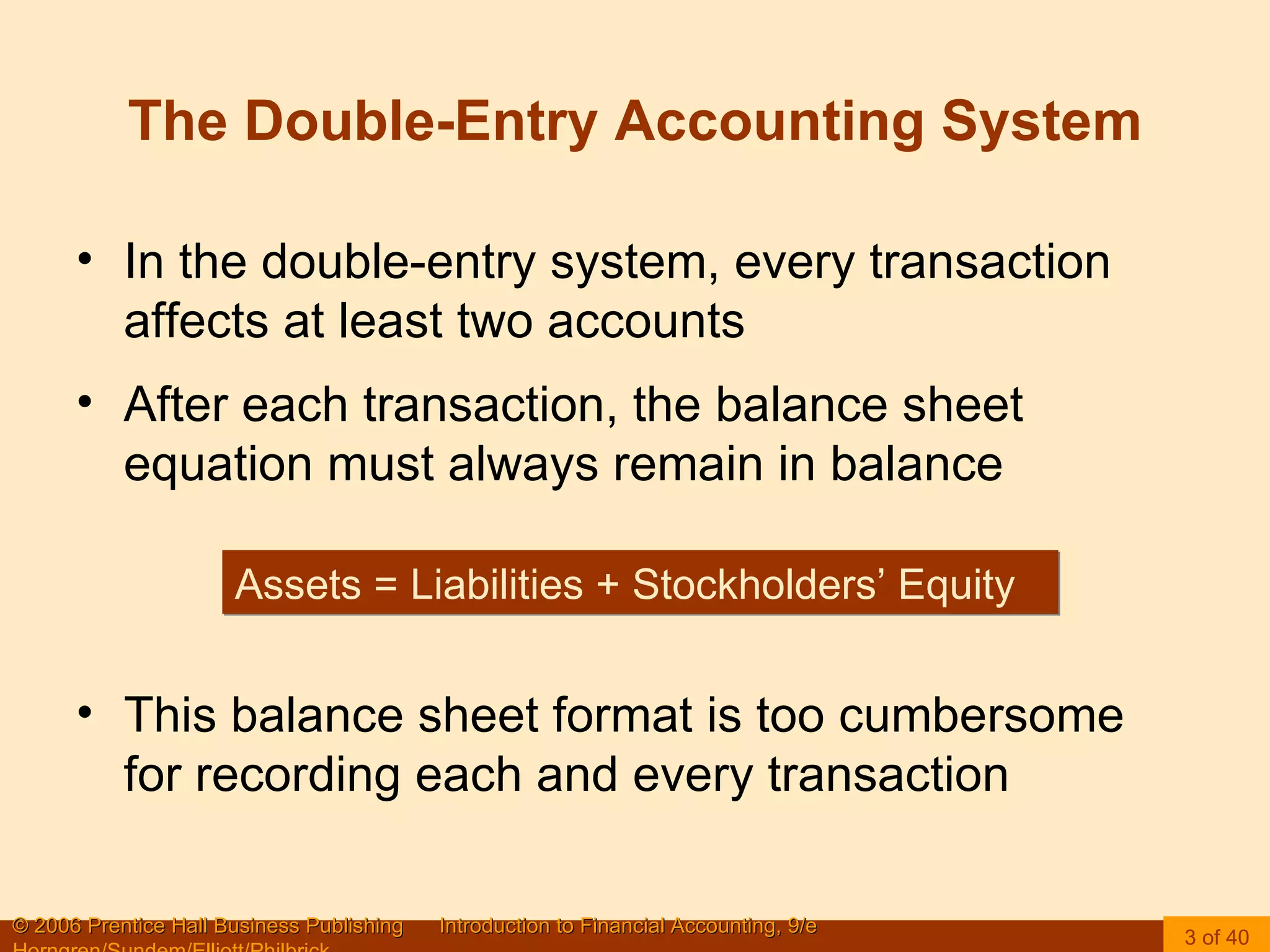
The Double-Entry Accounting System In the double-entry system, every transaction affects at least two accounts After each transaction, the balance sheet equation must always remain in balance This balance sheet format is too cumbersome for recording each and every transaction  Assets = Liabilities + Stockholders’ Equity
Ledger Accounts The elements of transactions are organized into  accounts  that group similar items together In a double-entry system, a  ledger  contains the records for a group of related accounts A  general ledger  is the collection of accounts that accumulate the amounts reported in the financial statements
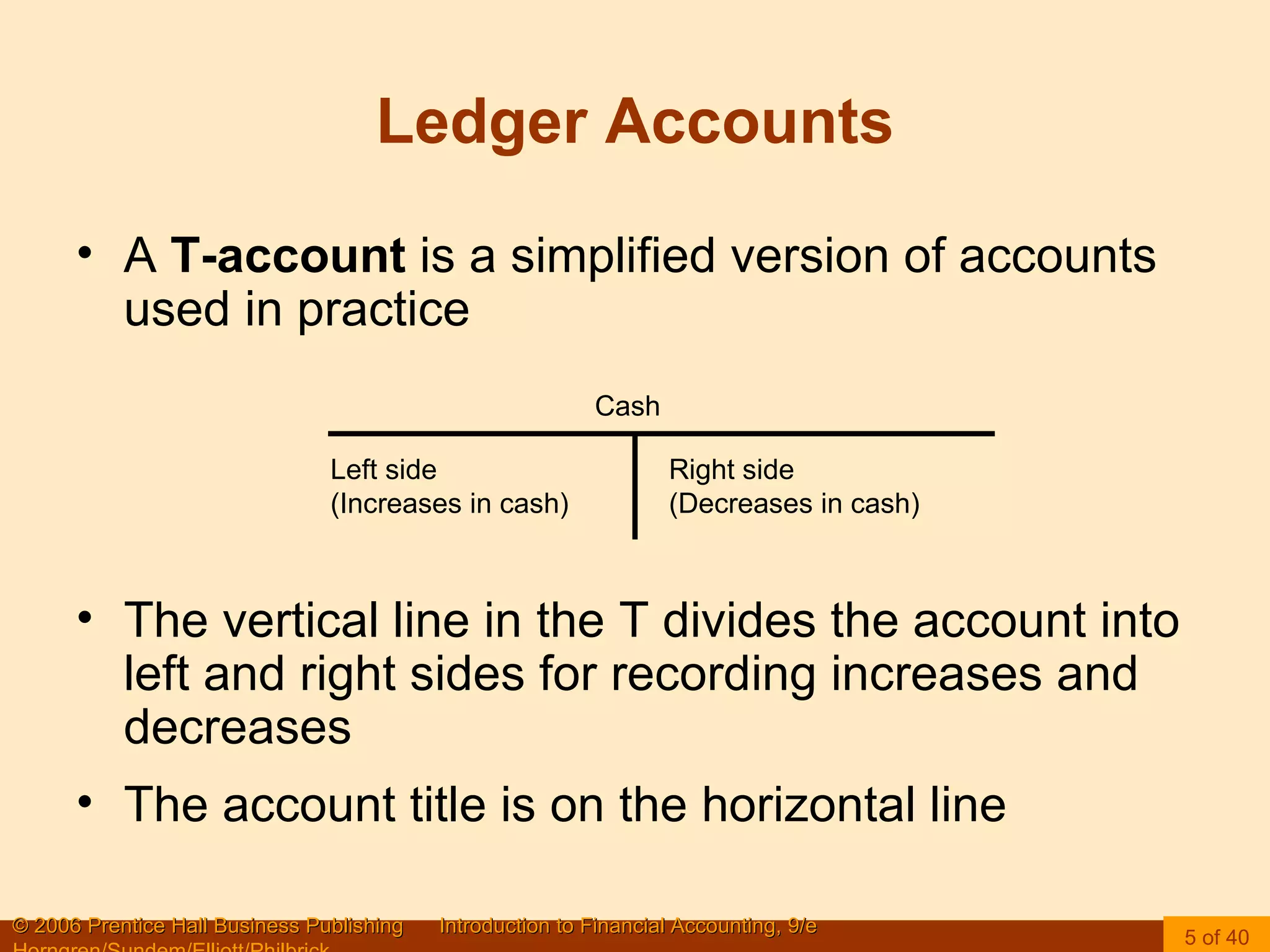
Ledger Accounts A  T-account  is a simplified version of accounts used in practice The vertical line in the T divides the account into left and right sides for recording increases and decreases The account title is on the horizontal line Cash Left side (Increases in cash) Right side (Decreases in cash)
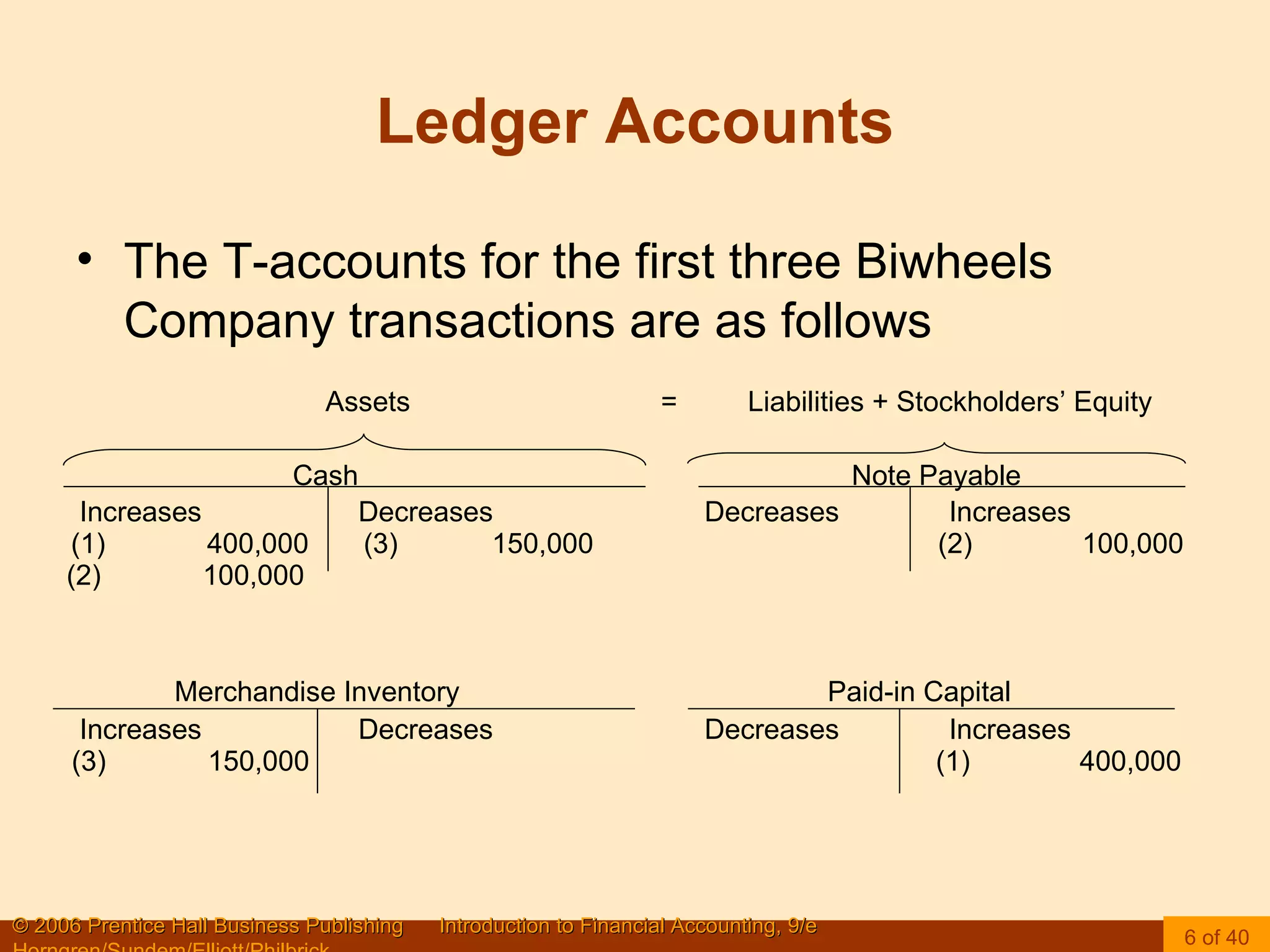
Ledger Accounts The T-accounts for the first three Biwheels Company transactions are as follows Assets  =  Liabilities + Stockholders’ Equity Cash  Note Payable Increases  Decreases  Decreases  Increases (1)  400,000  (3)  150,000  (2)  100,000 (2)  100,000 Merchandise Inventory  Paid-in Capital Increases  Decreases  Decreases  Increases (3)  150,000  (1)  400,000
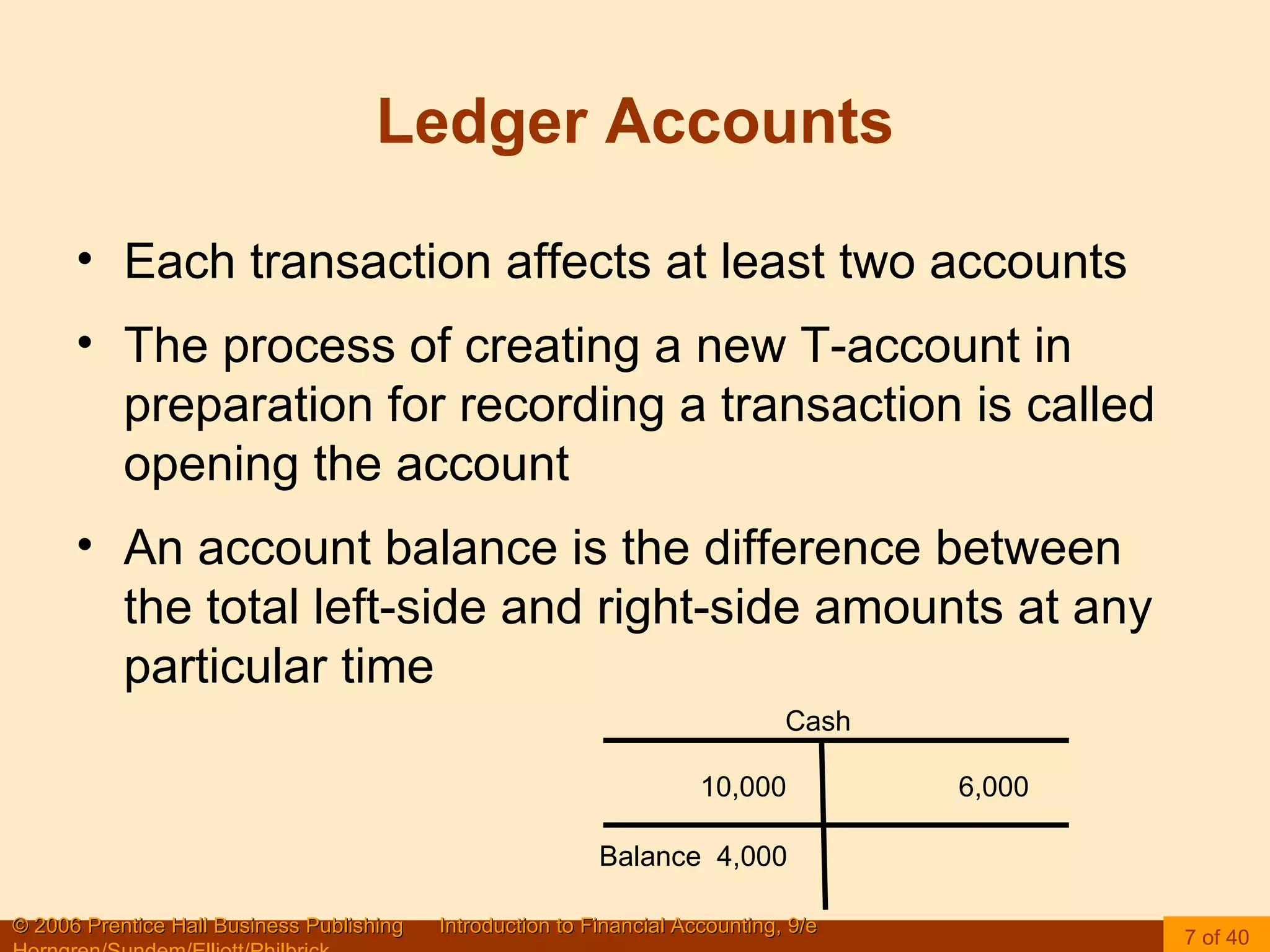
Ledger Accounts Each transaction affects at least two accounts The process of creating a new T-account in preparation for recording a transaction is called opening the account An account balance is the difference between the total left-side and right-side amounts at any particular time Cash Balance  4,000 10,000  6,000
Ledger Accounts Asset accounts have left-side balances Entries on the left side increase asset account balances  Entries on the right side decrease them Liabilities and owners’ equity accounts have right-side balances Entries on the right side increase their balances  Entries on the left side decrease them
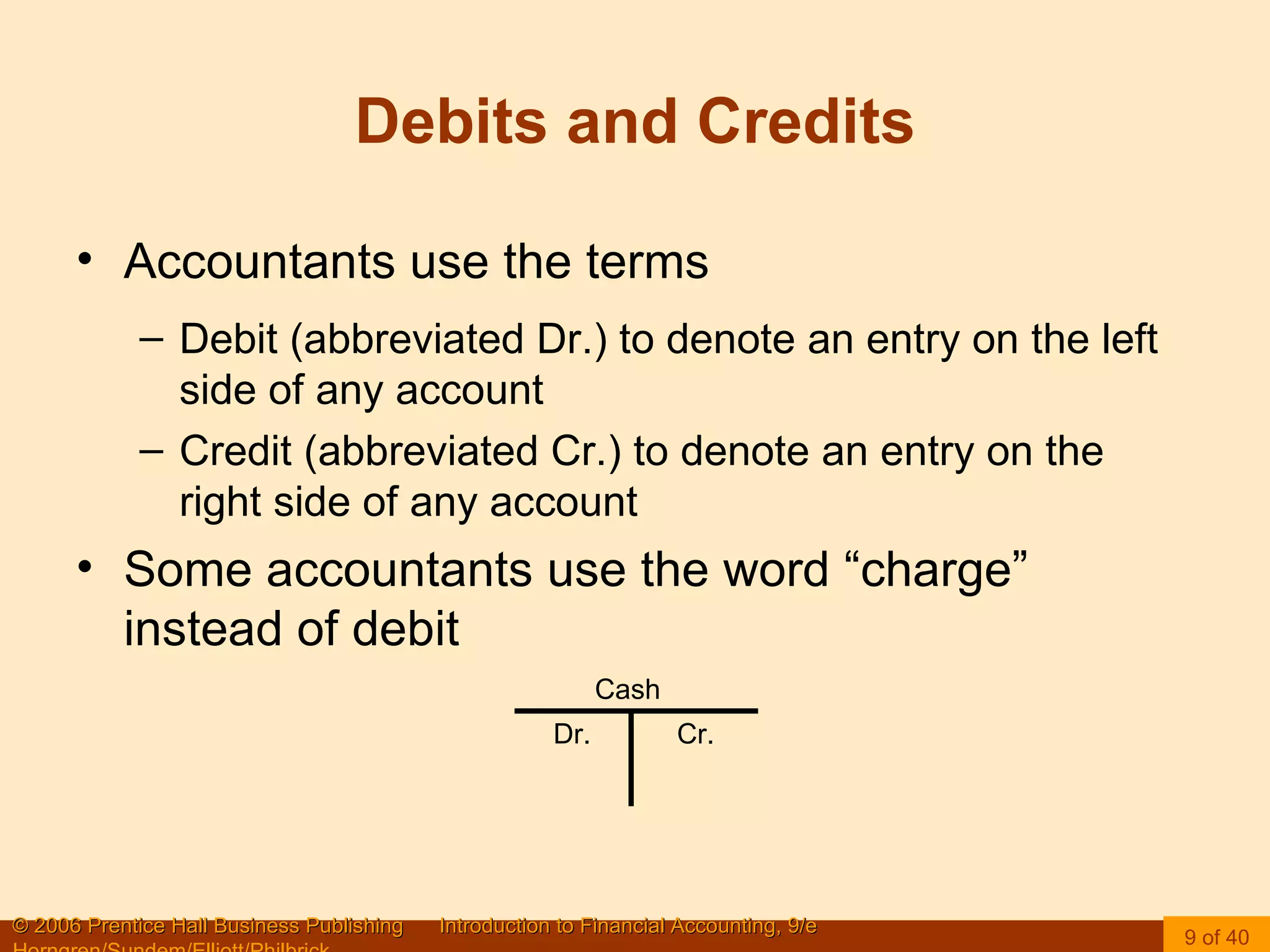
Debits and Credits Accountants use the terms Debit (abbreviated Dr.) to denote an entry on the left side of any account Credit (abbreviated Cr.) to denote an entry on the right side of any account Some accountants use the word “charge” instead of debit Cash Dr.  Cr.
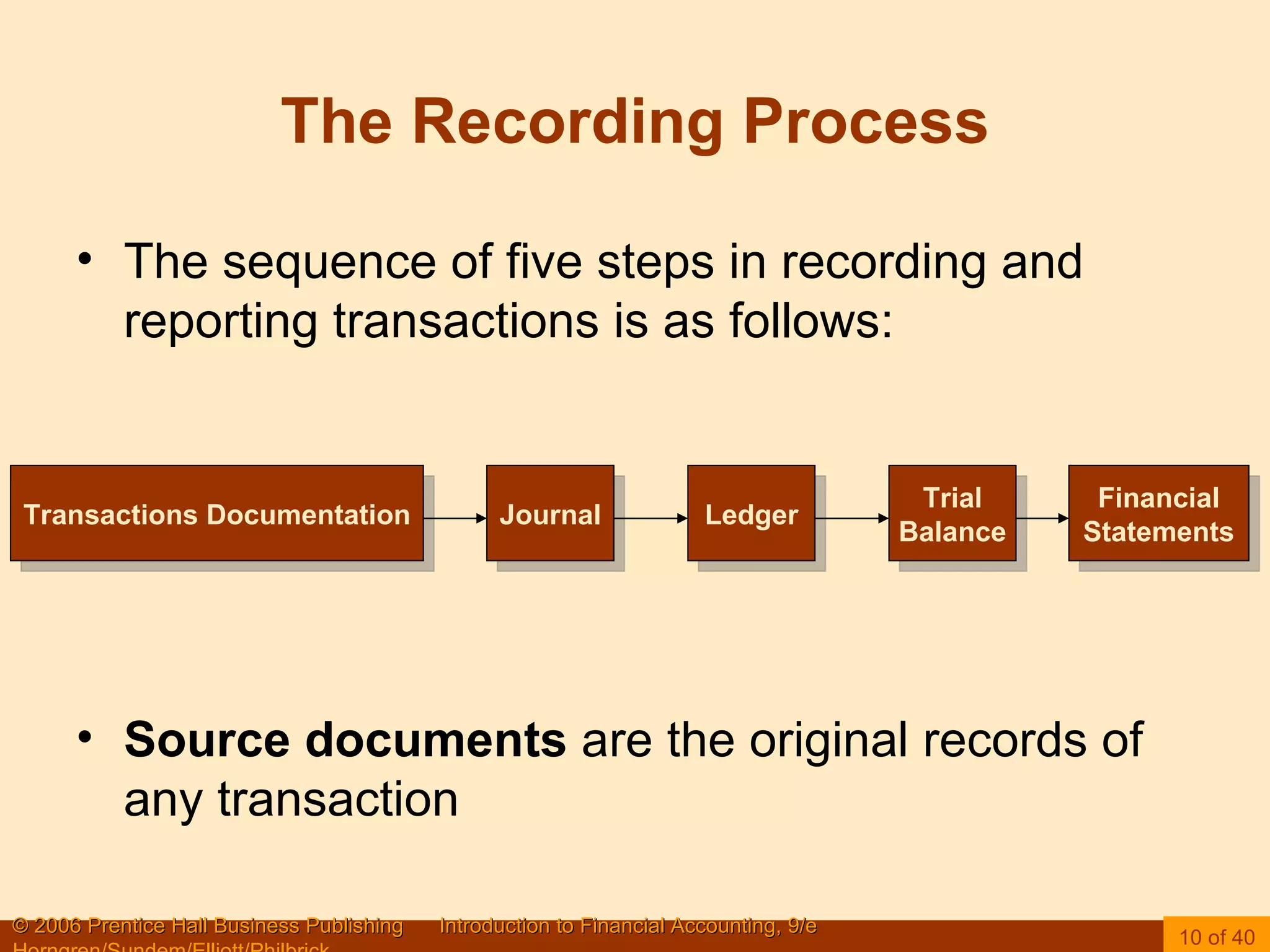
The Recording Process The sequence of five steps in recording and reporting transactions is as follows: Source documents  are the original records of any transaction Transactions Documentation Journal Ledger Trial Balance Financial Statements
The Recording Process The  general journal  is a formal chronological listing of each transaction and how it affects the balances in the accounts Transactions  are entered into the ledger The  trial balance  is a simple listing of the accounts in the general ledger together with their balances Preparation of  financial statements  occurs at least once a quarter for publicly traded companies
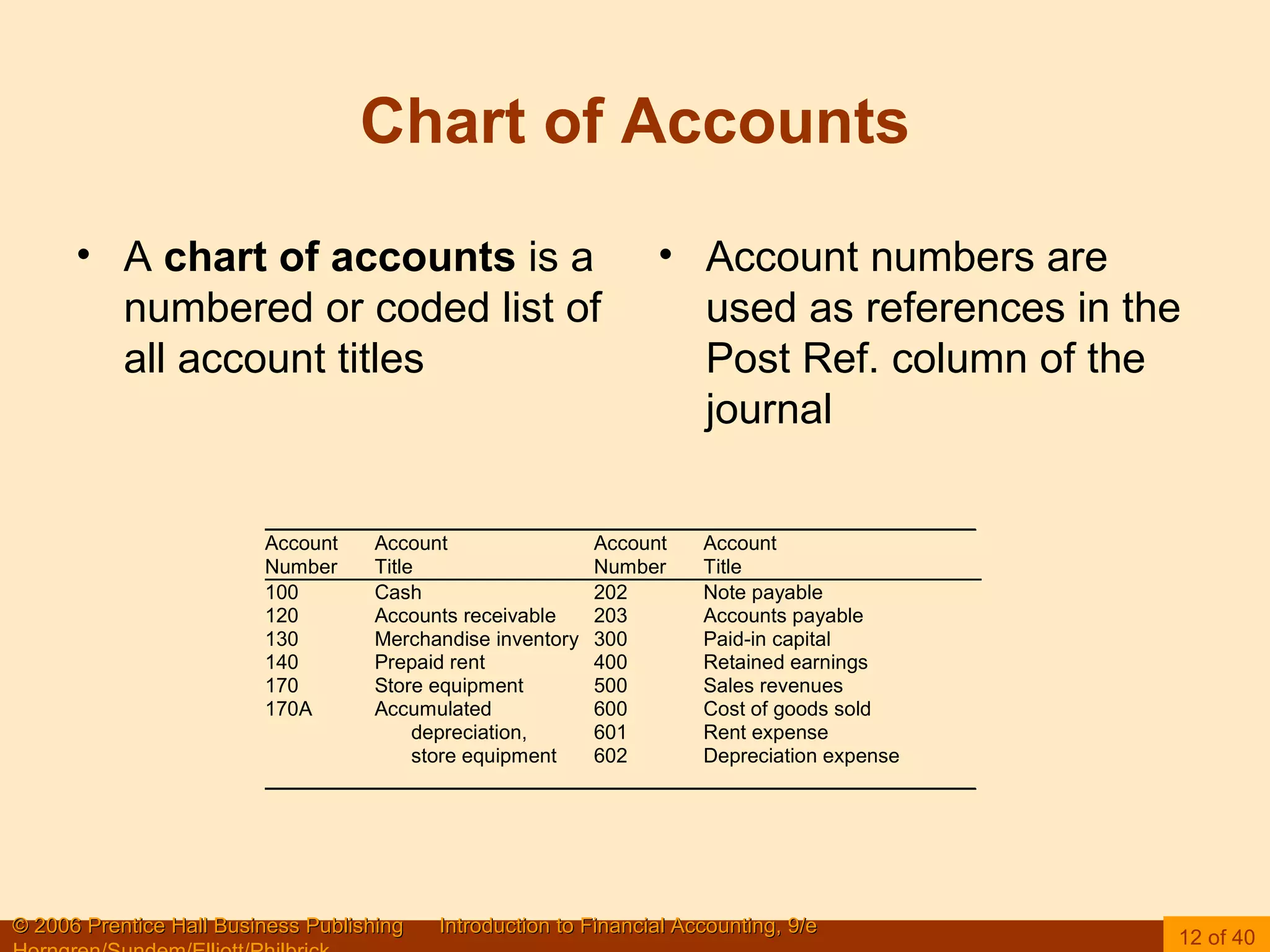
Chart of Accounts A  chart of accounts  is a numbered or coded list of all account titles Account numbers are used as references in the Post Ref. column of the journal
Journalizing Transactions Journalizing  is the process of entering transactions into the general journal A  journal entry  is an analysis of all the effects of a single transaction on the various accounts, usually accompanied by an explanation A compound entry means that a single transaction affects more than two accounts
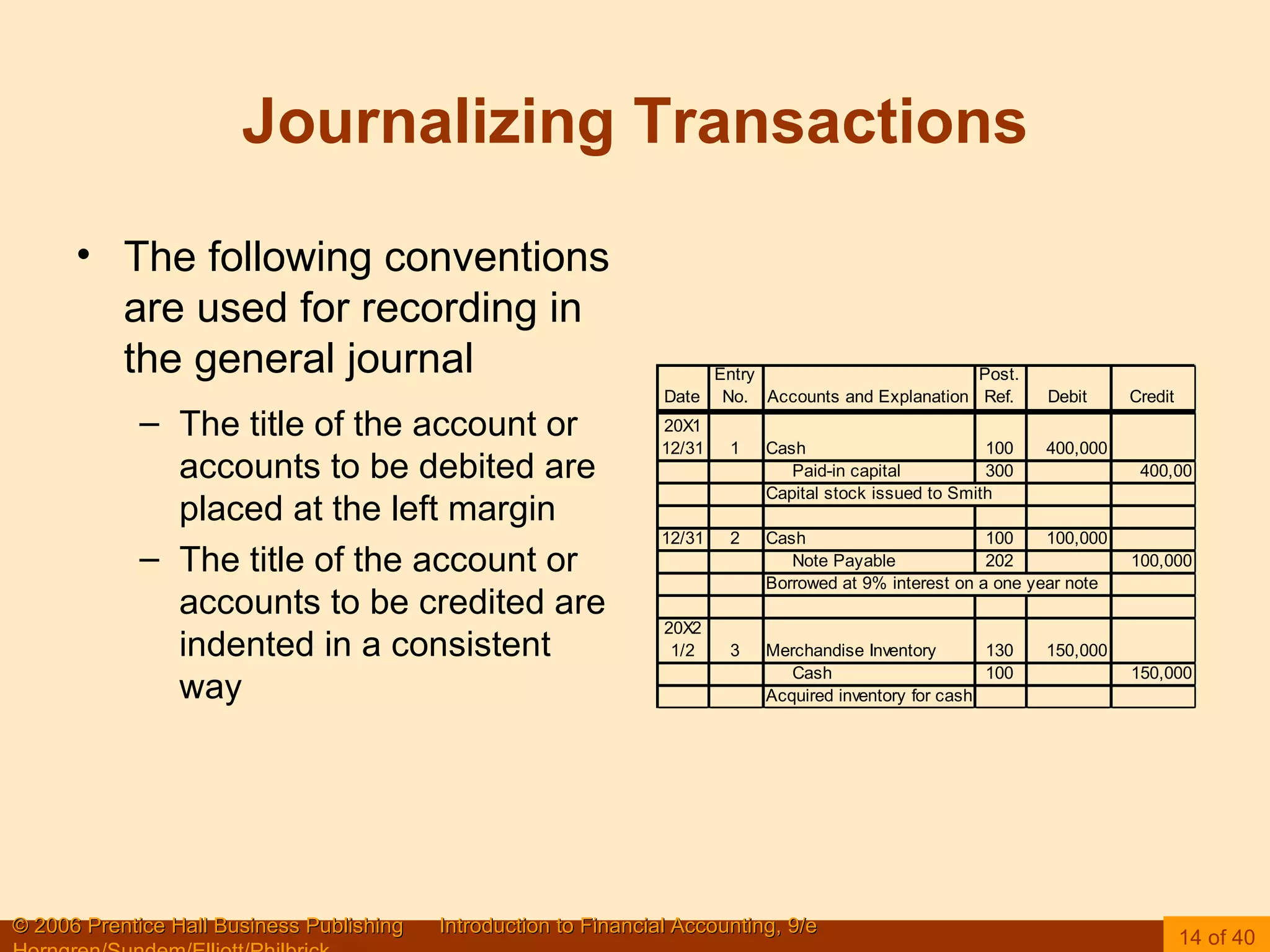
Journalizing Transactions The following conventions are used for recording in the general journal The title of the account or accounts to be debited are placed at the left margin The title of the account or accounts to be credited are indented in a consistent way
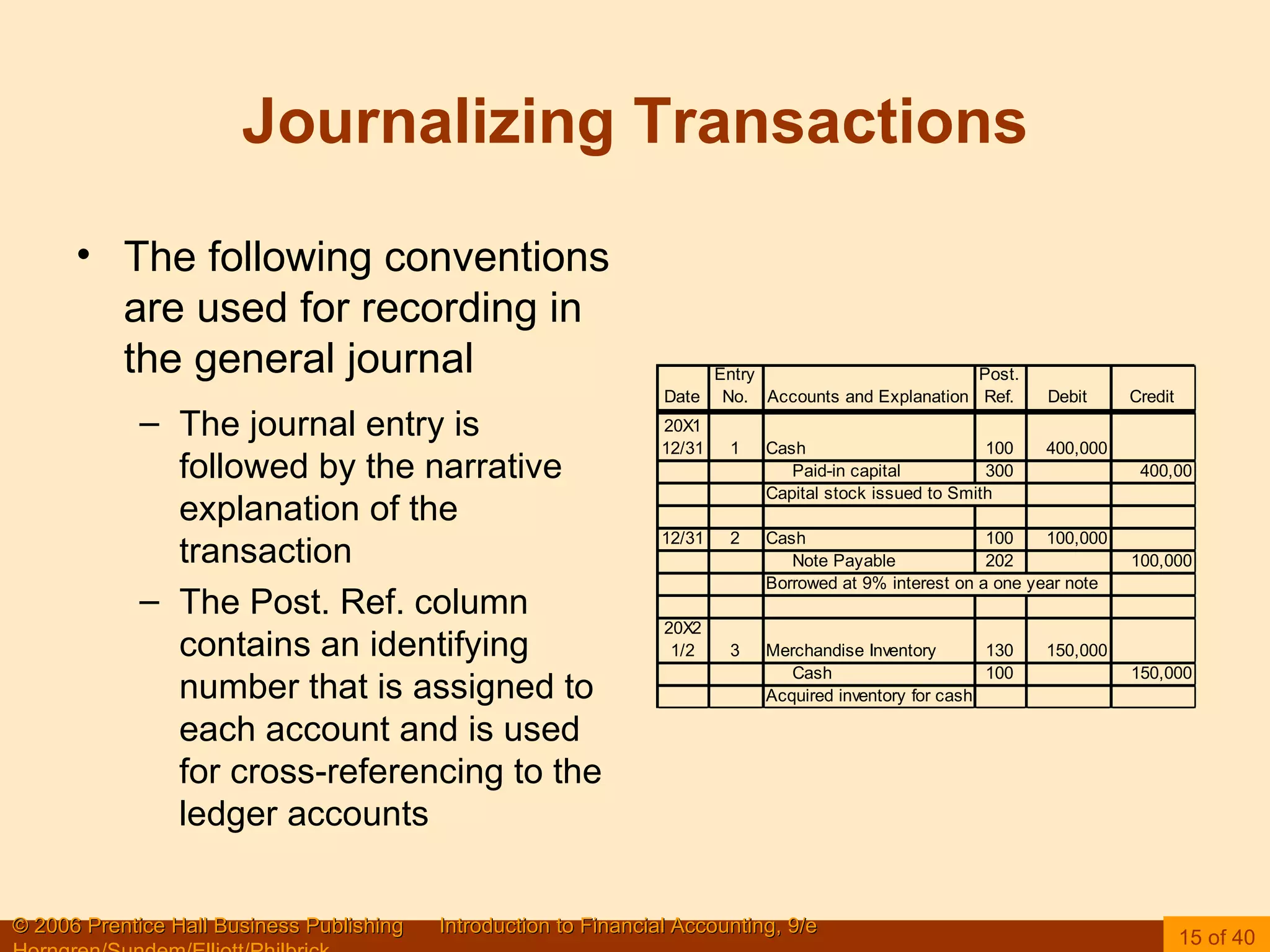
Journalizing Transactions The following conventions are used for recording in the general journal The journal entry is followed by the narrative explanation of the transaction The Post. Ref. column contains an identifying number that is assigned to each account and is used for cross-referencing to the ledger accounts
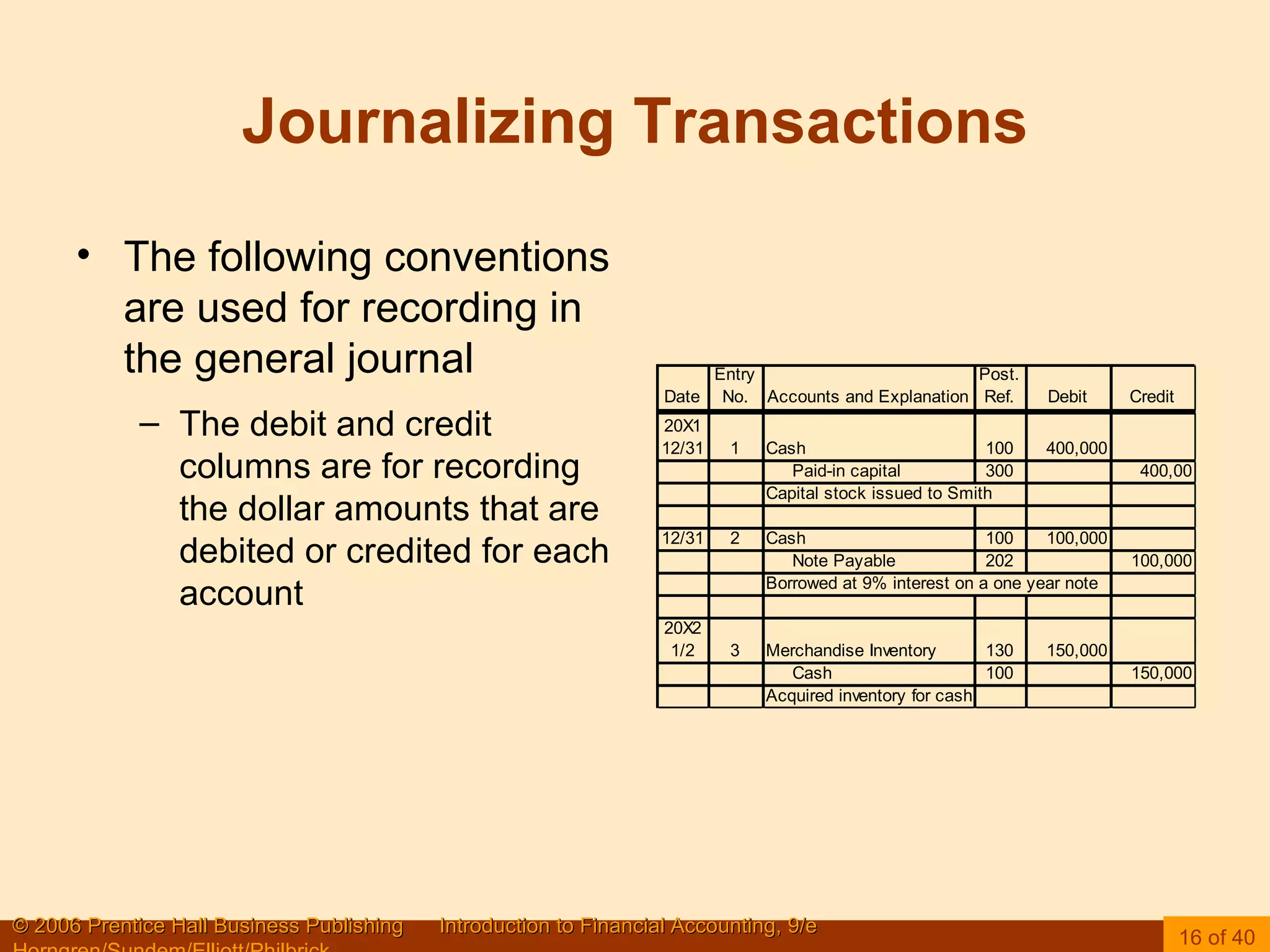
Journalizing Transactions The following conventions are used for recording in the general journal The debit and credit columns are for recording the dollar amounts that are debited or credited for each account
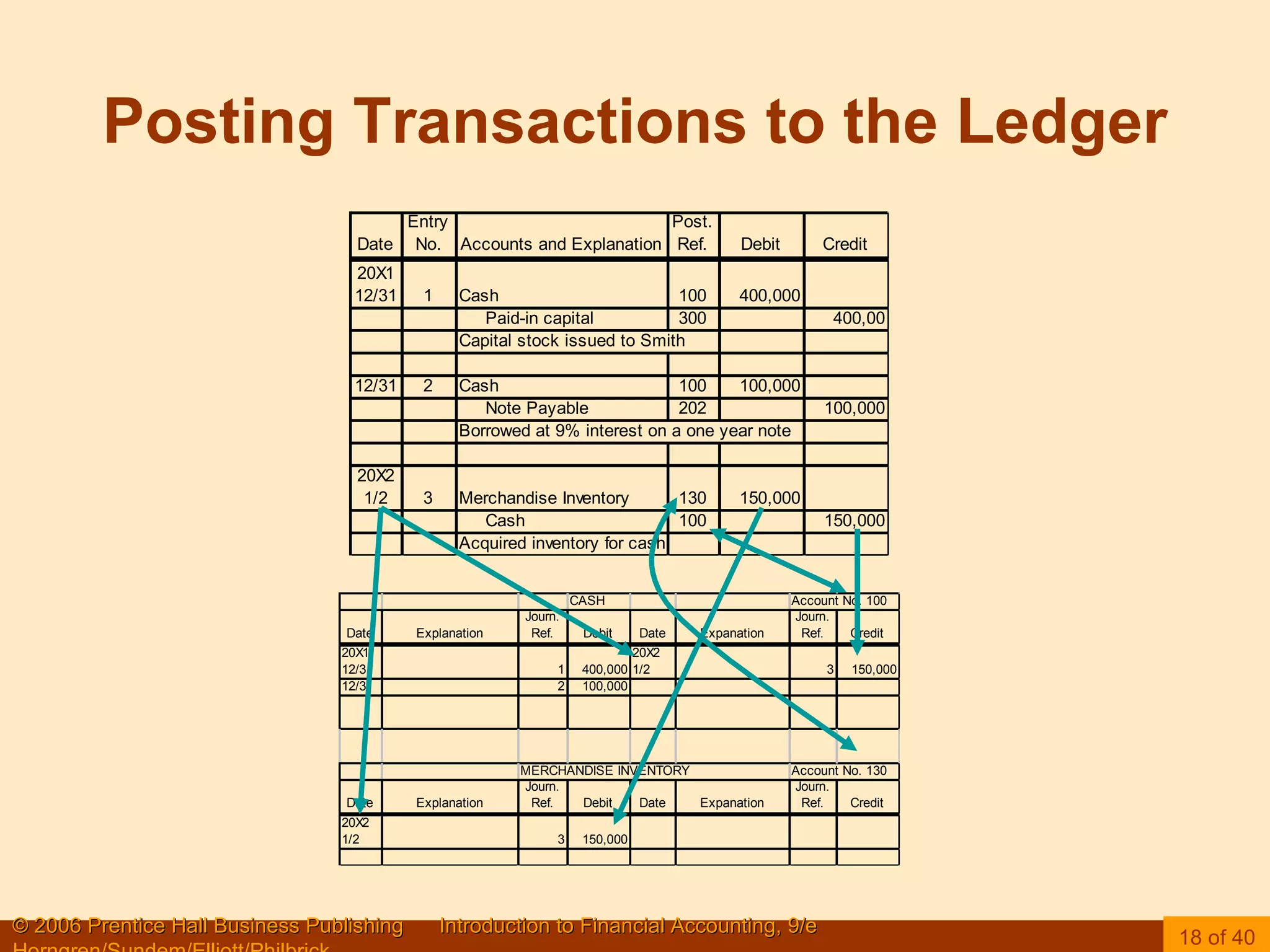
Posting Transactions to the Ledger Posting  is the transferring of amounts from the journal to the appropriate accounts in the ledger The following example shows How the debit to merchandise inventory and the credit to cash are posted Columns for dates, explanations, journal references, and amounts in the ledger
Posting Transactions to the Ledger
Posting Transactions to the Ledger Cross-referencing  is the process of using numbering, dating, and/or some other form of identification to relate each ledger posting to the appropriate journal entry A single transaction from the journal might be posted to several different ledger accounts Cross-referencing allows users to find all the components of the transactions in the ledger no matter where they start
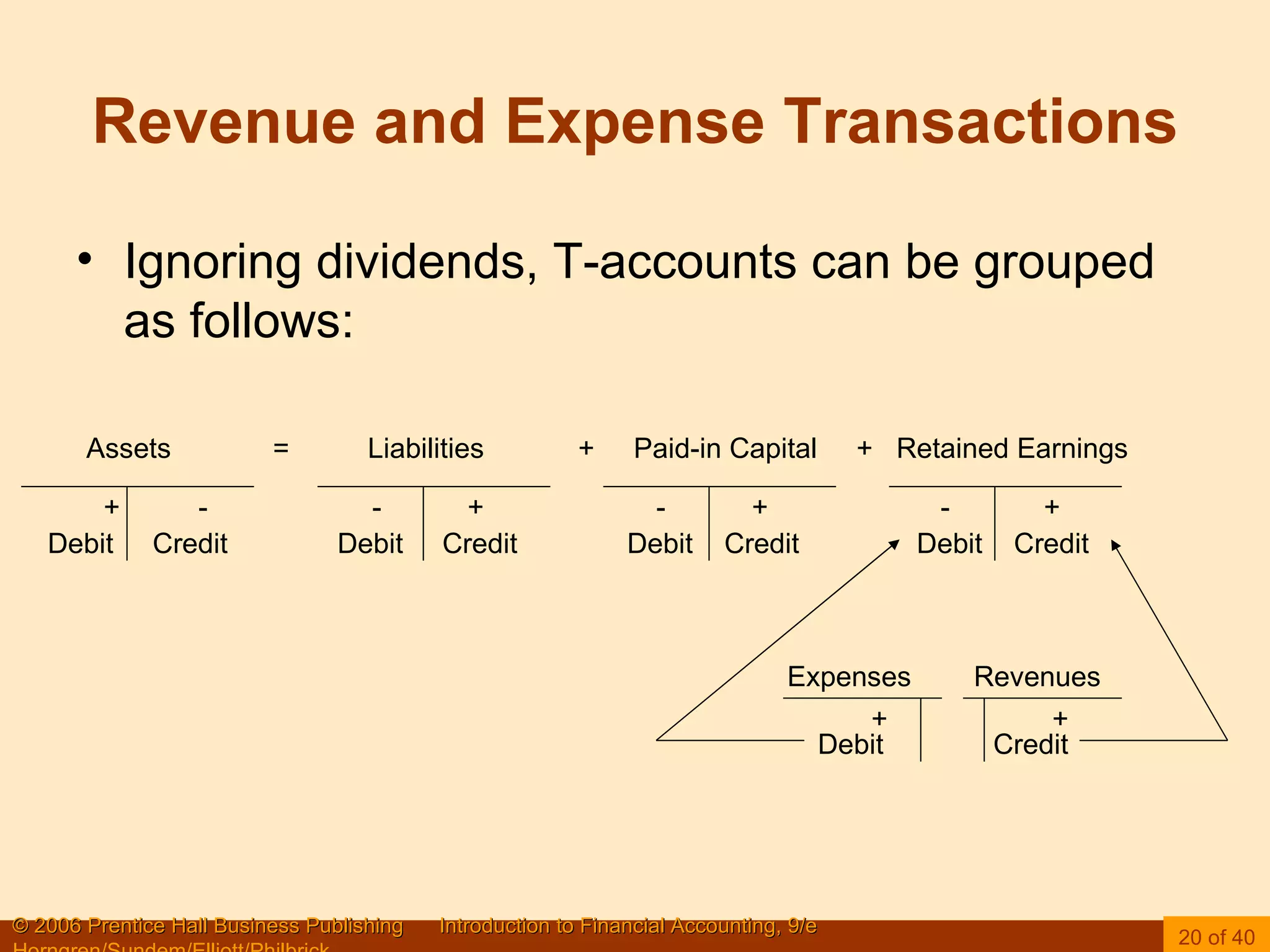
Revenue and Expense Transactions Ignoring dividends, T-accounts can be grouped as follows: Assets  =  Liabilities  +  Paid-in Capital  +  Retained Earnings Debit  Credit  Debit  Credit  Debit  Credit  Debit  Credit +  -  -  +  -  +  -  + Expenses  Revenues Debit  Credit +  +
Revenue and Expense Transactions Revenue and expense information is accumulated separately to prepare a more meaningful income statement Expense and revenue accounts are part of Retained Earnings A revenue account increases retained earnings An expense account decreases retained earnings Although a debit entry increases expenses, it results in a decrease in retained earnings
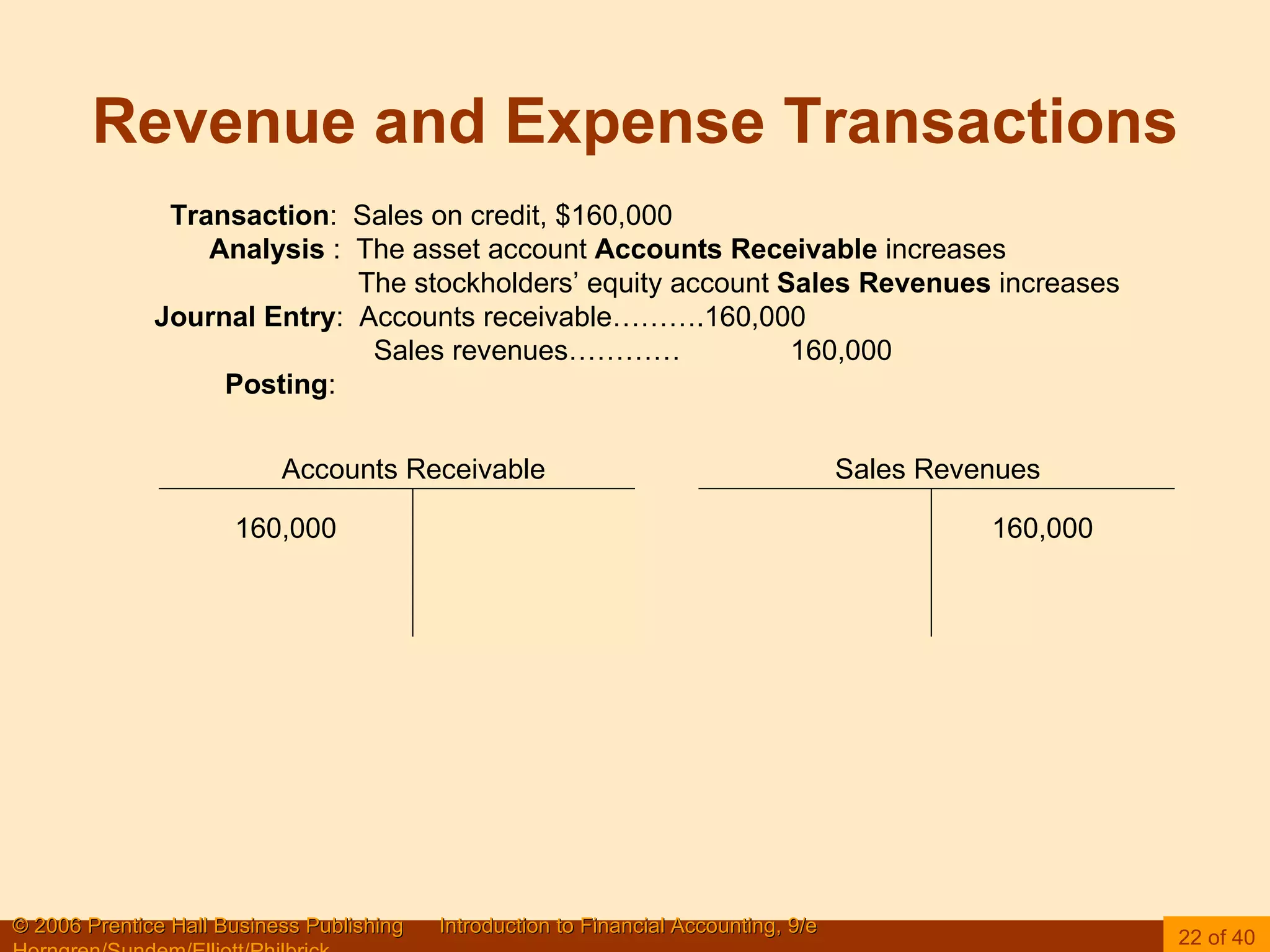
Revenue and Expense Transactions Transaction :  Sales on credit, $160,000 Analysis  :  The asset account  Accounts Receivable  increases The stockholders’ equity account  Sales Revenues  increases Journal Entry :  Accounts receivable……….160,000 Sales revenues…………  160,000 Posting : Accounts Receivable  Sales Revenues 160,000 160,000
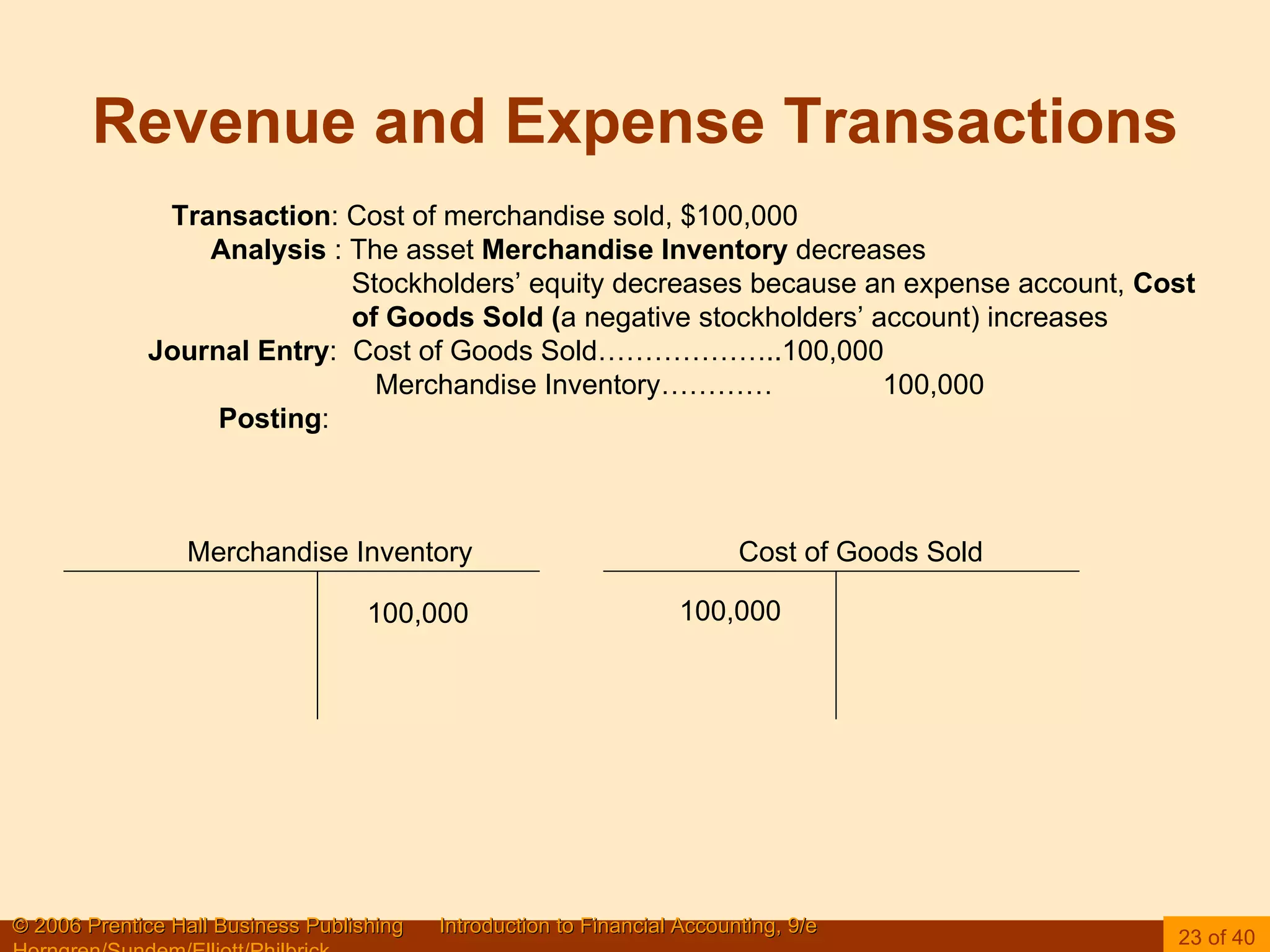
Revenue and Expense Transactions Transaction : Cost of merchandise sold, $100,000 Analysis  : The asset  Merchandise Inventory  decreases Stockholders’ equity decreases because an expense account,  Cost   of Goods Sold ( a negative stockholders’ account) increases  Journal Entry :  Cost of Goods Sold………………..100,000 Merchandise Inventory…………  100,000 Posting : Merchandise Inventory  Cost of Goods Sold 100,000 100,000
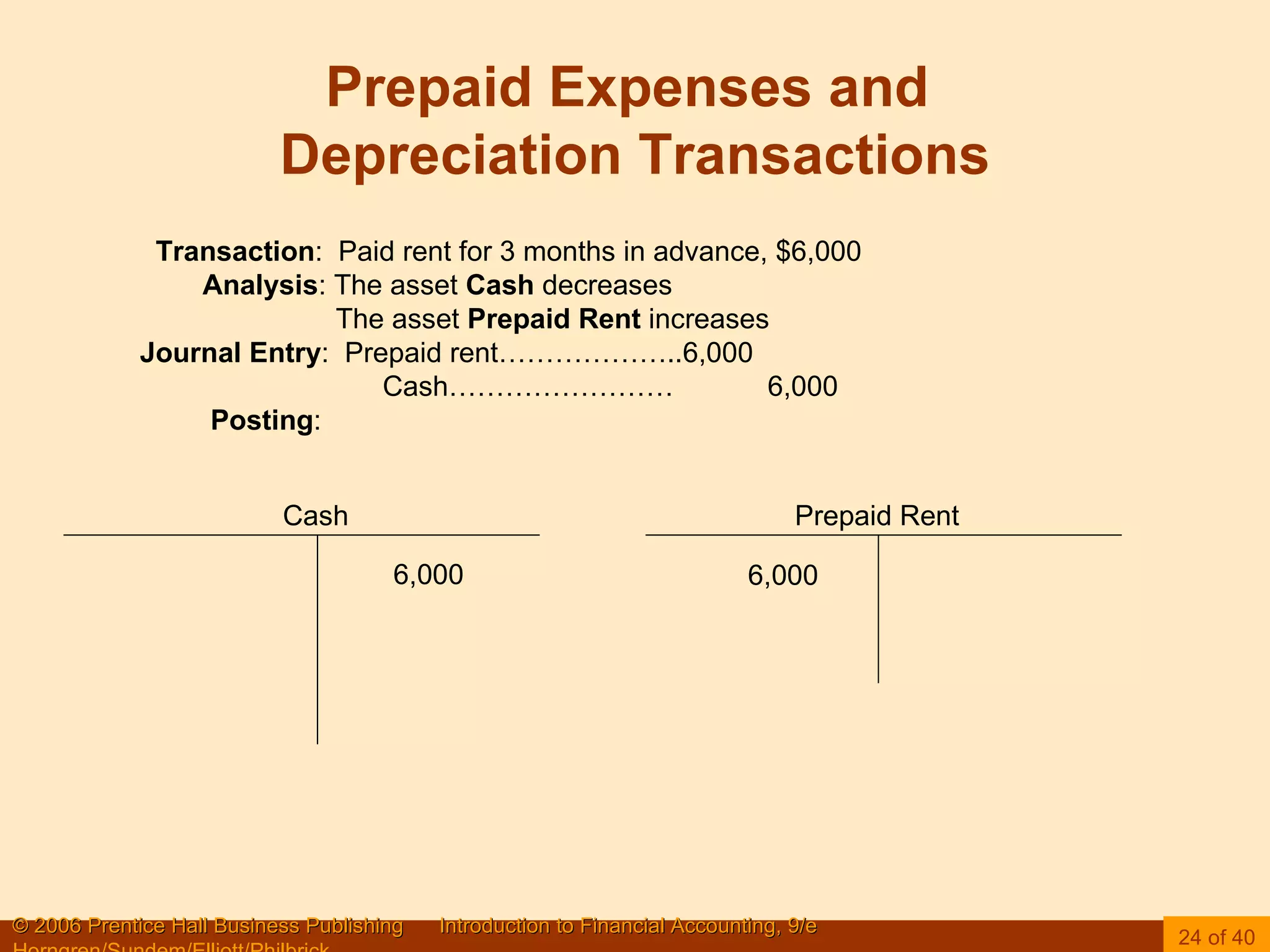
Prepaid Expenses and  Depreciation Transactions Transaction :  Paid rent for 3 months in advance, $6,000 Analysis : The asset  Cash  decreases The asset  Prepaid Rent  increases Journal Entry :  Prepaid rent………………..6,000 Cash……………………  6,000 Posting : Cash  Prepaid Rent 6,000 6,000
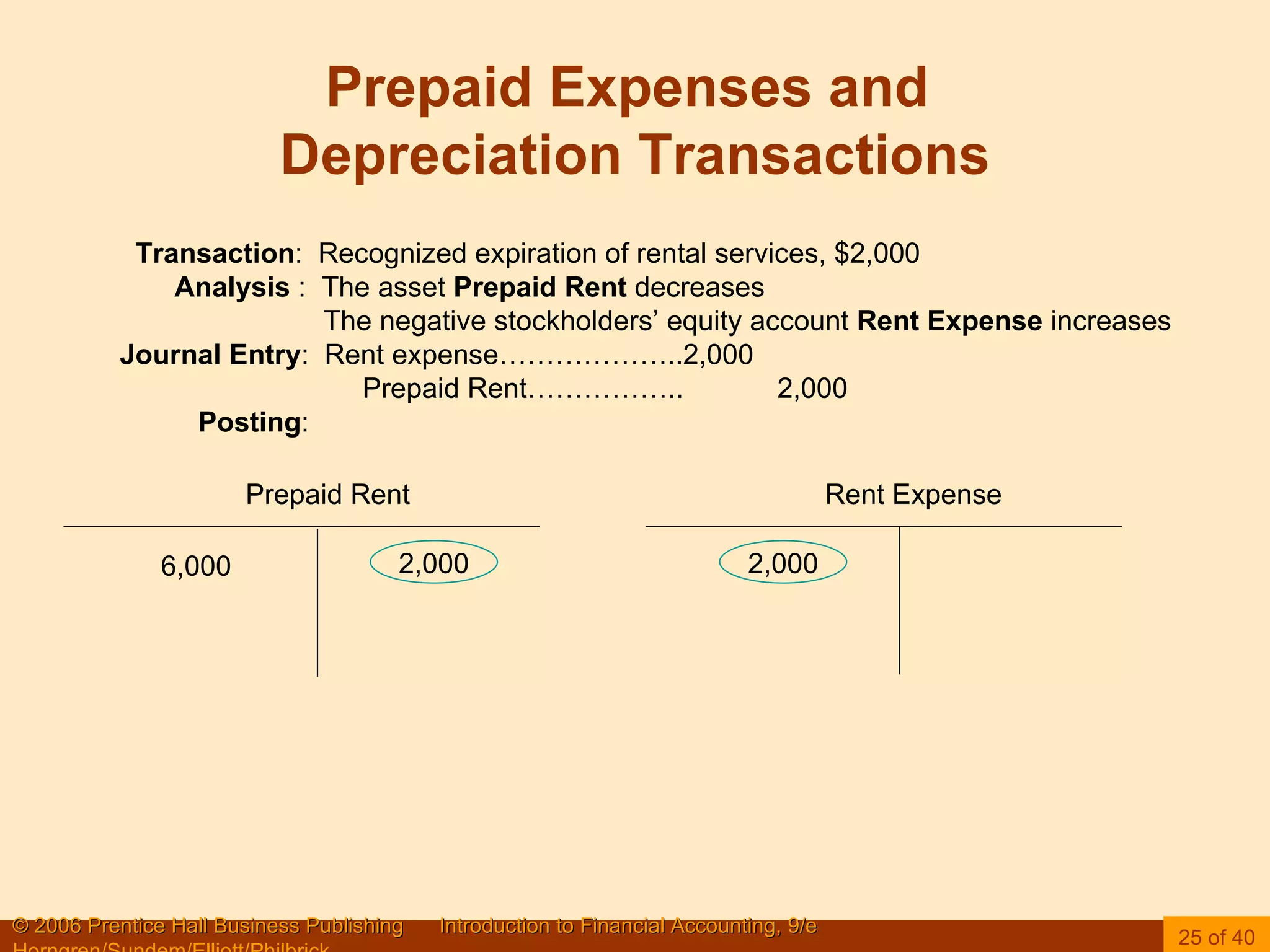
Prepaid Expenses and  Depreciation Transactions Transaction :  Recognized expiration of rental services, $2,000 Analysis  :  The asset  Prepaid Rent  decreases The negative stockholders’ equity account  Rent Expense  increases Journal Entry :  Rent expense………………..2,000 Prepaid Rent……………..  2,000 Posting : Prepaid Rent  Rent Expense 6,000 2,000 2,000
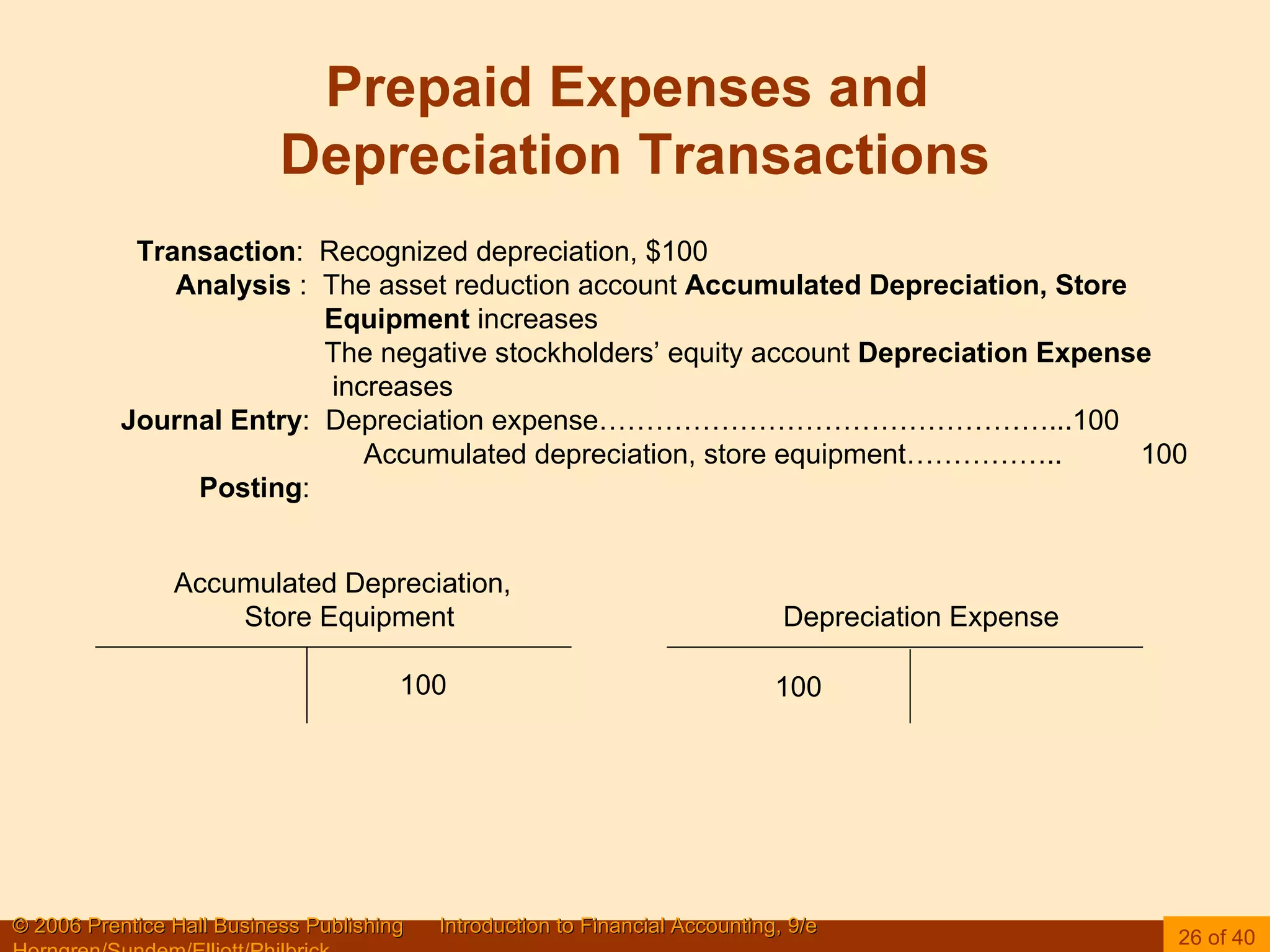
Prepaid Expenses and  Depreciation Transactions Accumulated Depreciation, Store Equipment  Depreciation Expense  Transaction :  Recognized depreciation, $100 Analysis  :  The asset reduction account  Accumulated Depreciation, Store  Equipment  increases The negative stockholders’ equity account  Depreciation Expense   increases Journal Entry :  Depreciation expense…………………………………………...100 Accumulated depreciation, store equipment……………..  100 Posting : 100 100
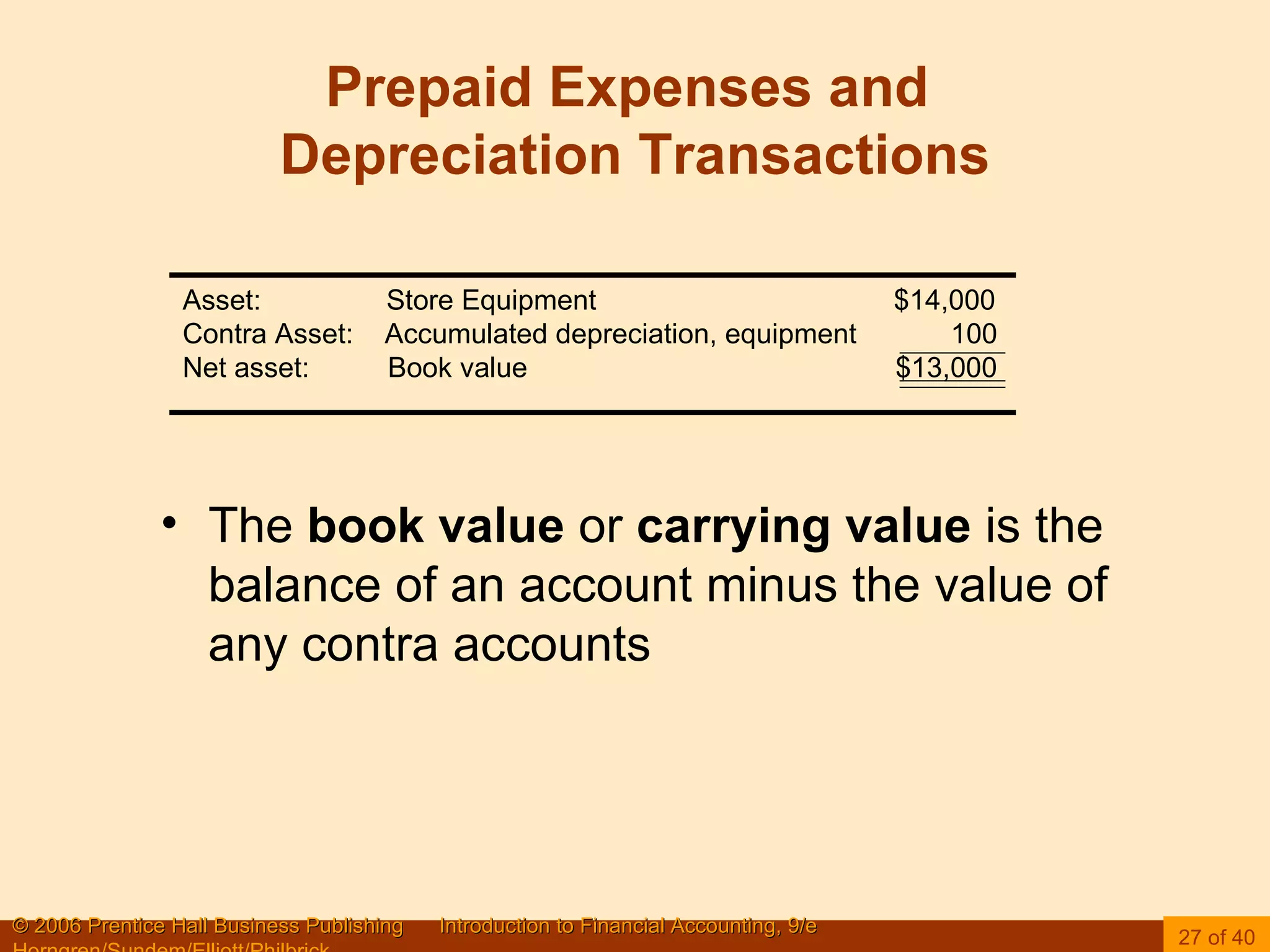
Prepaid Expenses and  Depreciation Transactions Asset:  Store Equipment  $14,000 Contra Asset:  Accumulated depreciation, equipment  100 Net asset:  Book value  $13,000 The  book value  or  carrying value  is the balance of an account minus the value of any contra accounts
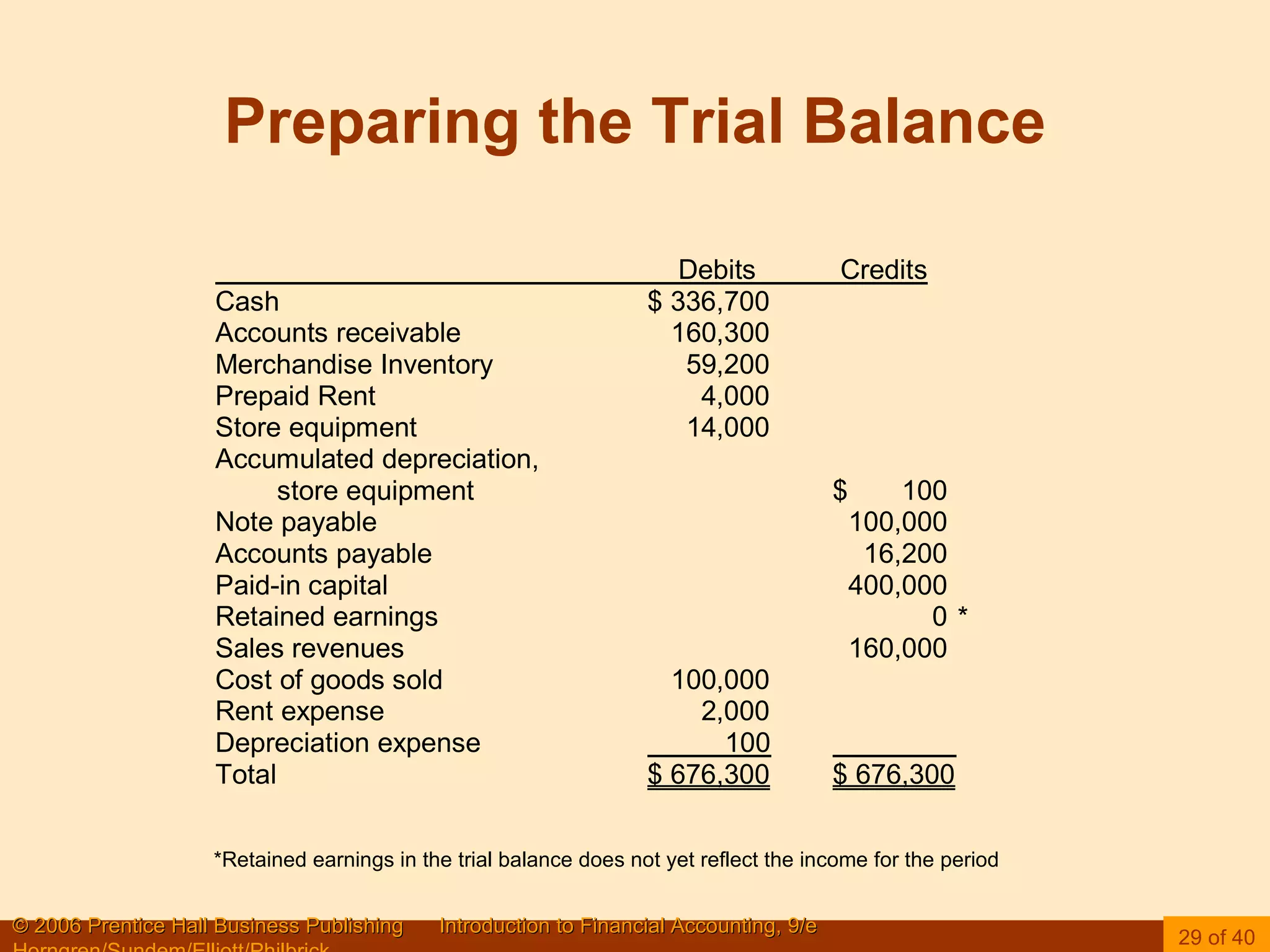
Preparing the Trial Balance A trial balance is a list of all the accounts with their balances The purpose of the trial balance is twofold: Proving whether the total debits equal the total credits in the ledger Summarizing  the balances in the ledger accounts in preparation to construct the financial statements
Preparing the Trial Balance *Retained earnings in the trial balance does not yet reflect the income for the period *
Preparing the Trial Balance The trial balance is prepared with the accounts in the following order: Asset accounts Liability accounts Stockholders’ equity accounts Revenue accounts Expense accounts The trial balance is the springboard for preparing the balance sheet and the income statement
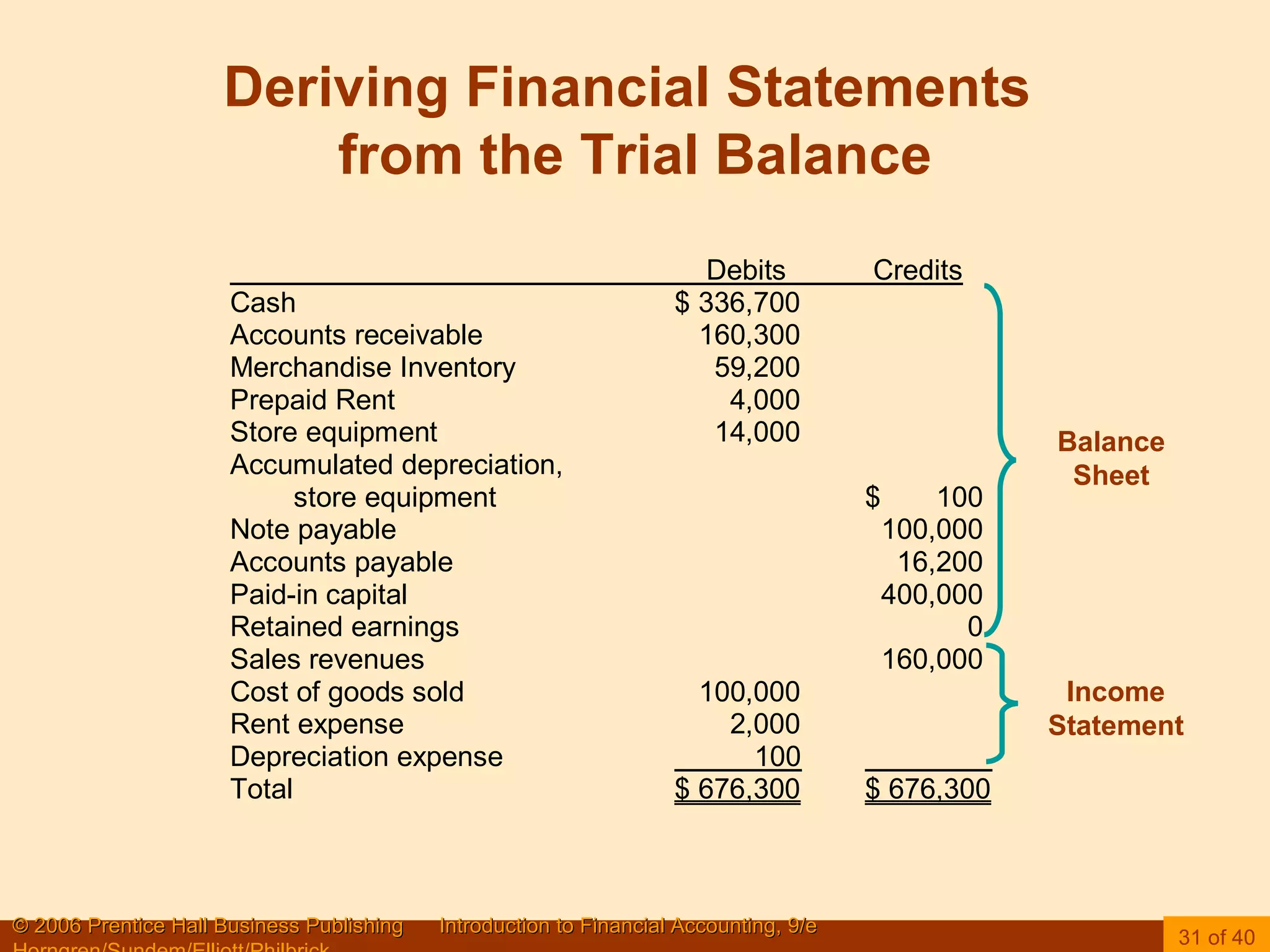
Deriving Financial Statements  from the Trial Balance Balance Sheet Income Statement
Closing the Accounts Closing the accounts has two purposes: It transfers the balances of the “temporary” stockholders’ equity accounts (revenues and expenses) to the “permanent” stockholders’ equity account (retained earnings)  It makes the revenues and expense accounts have a zero balance, which readies them for the next period’s transactions
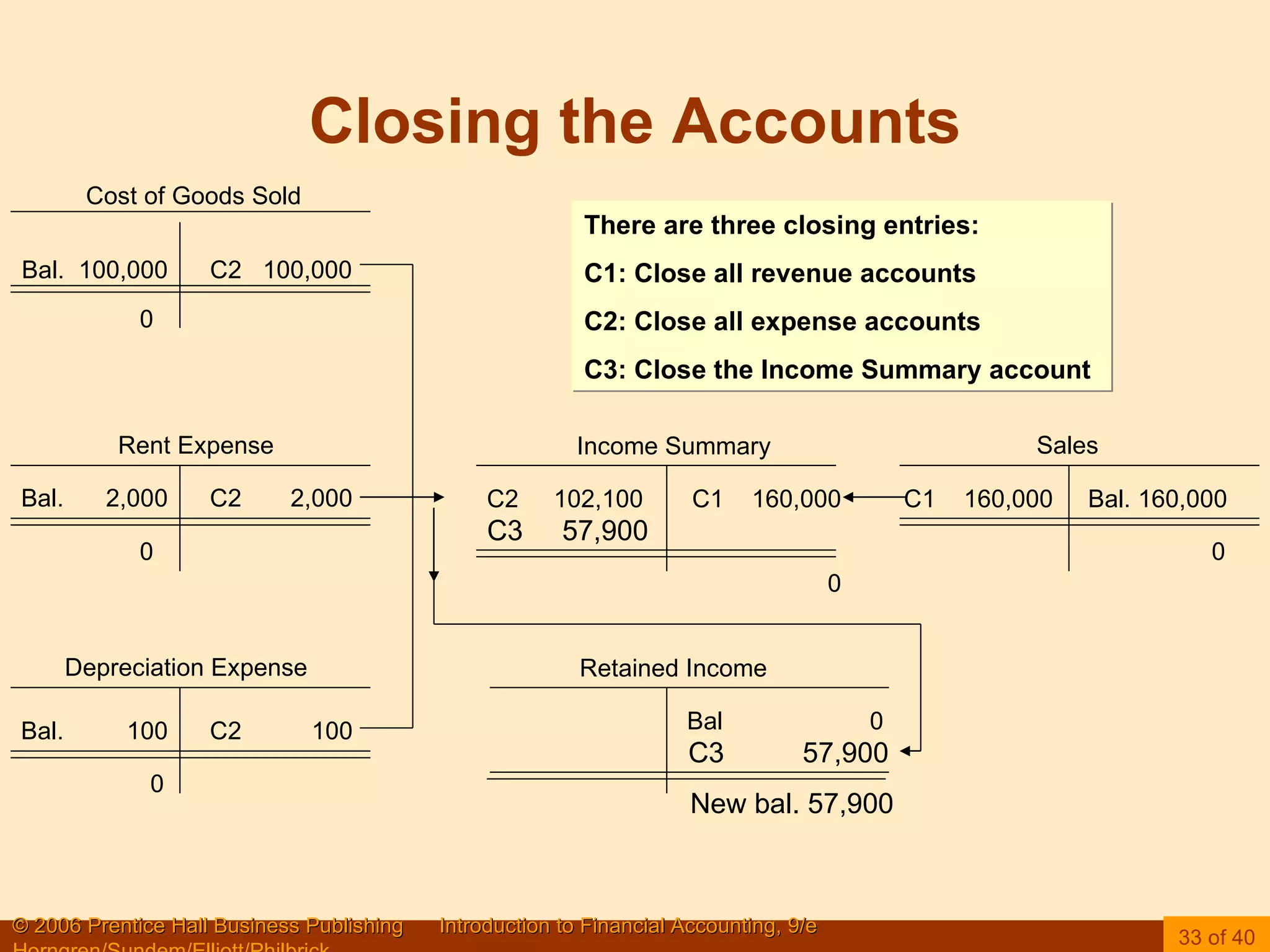
Closing the Accounts Cost of Goods Sold Bal.  100,000  C2  100,000 0 Rent Expense Bal.  2,000  C2  2,000 Bal.  100  C2  100 0 0 Depreciation Expense Income Summary C2  102,100  C1  160,000 Sales C1  160,000  Bal. 160,000 0 Retained Income Bal  0 C3  57,900 C3  57,900 New bal. 57,900 0 There are three closing entries: C1: Close all revenue accounts C2: Close all expense accounts C3: Close the Income Summary account
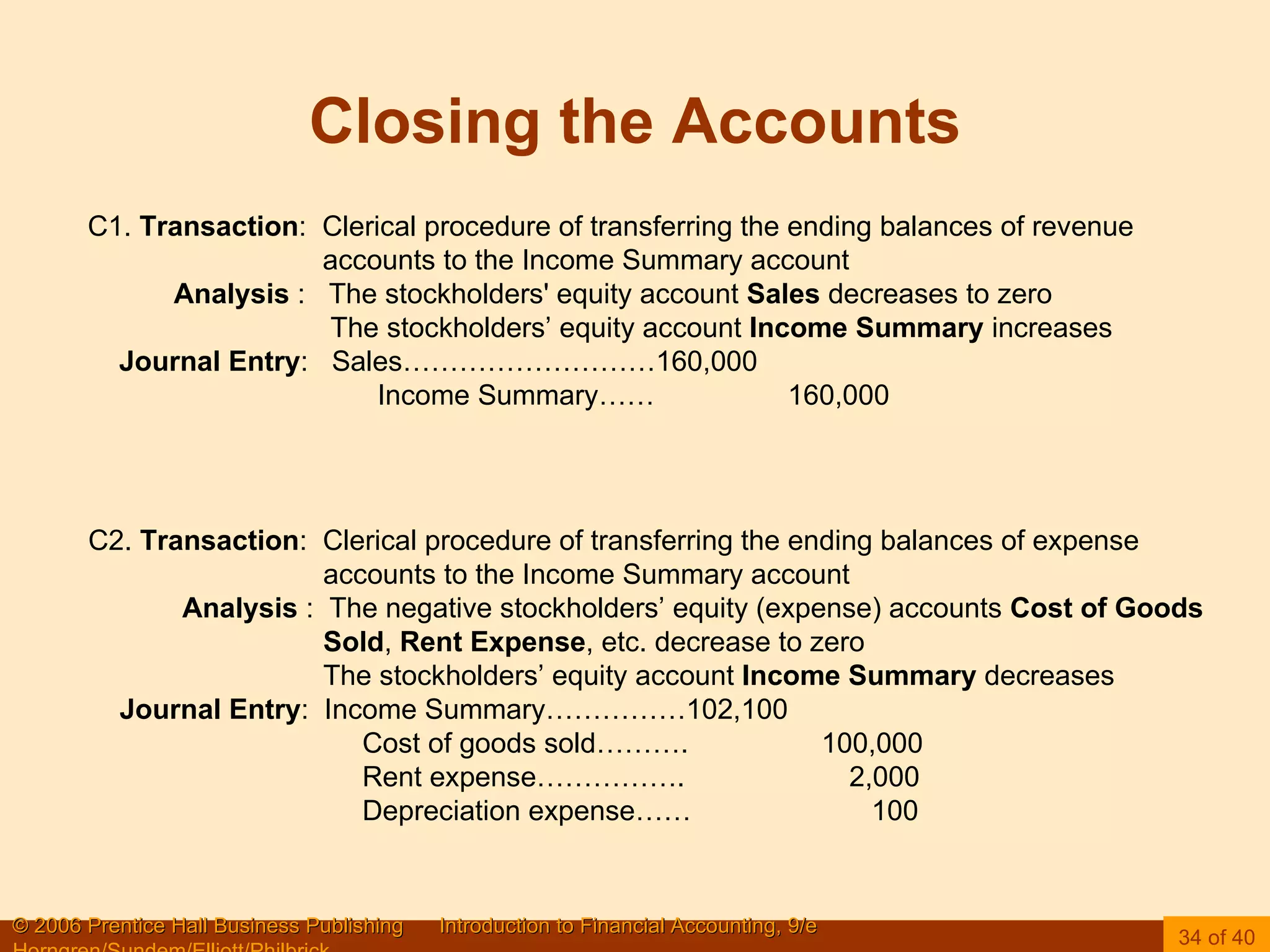
Closing the Accounts C1.  Transaction :  Clerical procedure of transferring the ending balances of revenue accounts to the Income Summary account Analysis  :  The stockholders' equity account  Sales  decreases to zero The stockholders’ equity account  Income Summary  increases Journal Entry :  Sales………………………160,000 Income Summary……  160,000 C2.  Transaction :  Clerical procedure of transferring the ending balances of expense accounts to the Income Summary account Analysis  :  The negative stockholders’ equity (expense) accounts  Cost of Goods Sold ,  Rent Expense , etc. decrease to zero The stockholders’ equity account  Income Summary  decreases Journal Entry :  Income Summary……………102,100 Cost of goods sold……….  100,000 Rent expense…………….  2,000 Depreciation expense……  100
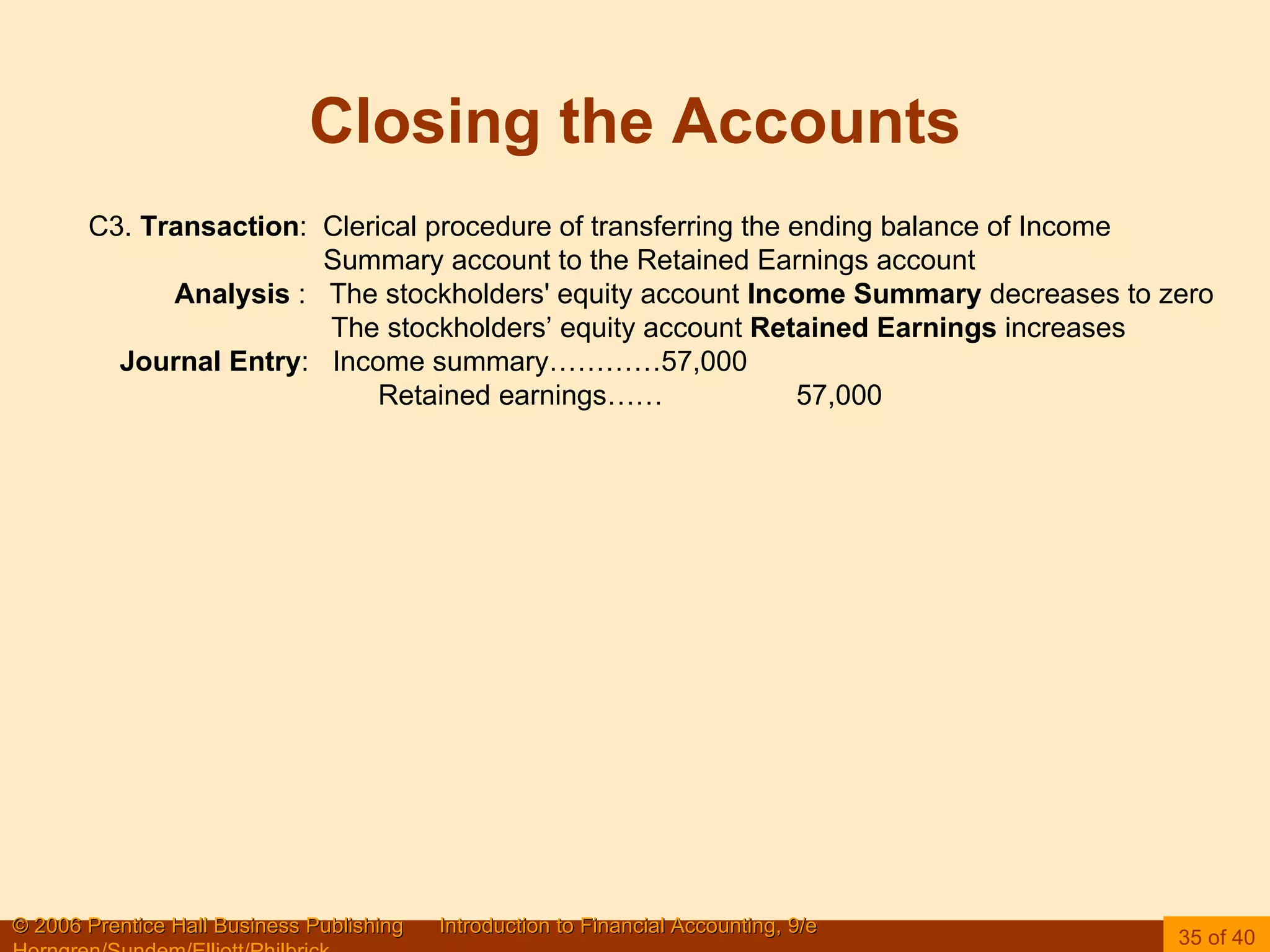
Closing the Accounts C3.  Transaction :  Clerical procedure of transferring the ending balance of Income Summary account to the Retained Earnings account Analysis  :  The stockholders' equity account  Income Summary  decreases to zero The stockholders’ equity account  Retained Earnings  increases Journal Entry :  Income summary…………57,000 Retained earnings……  57,000
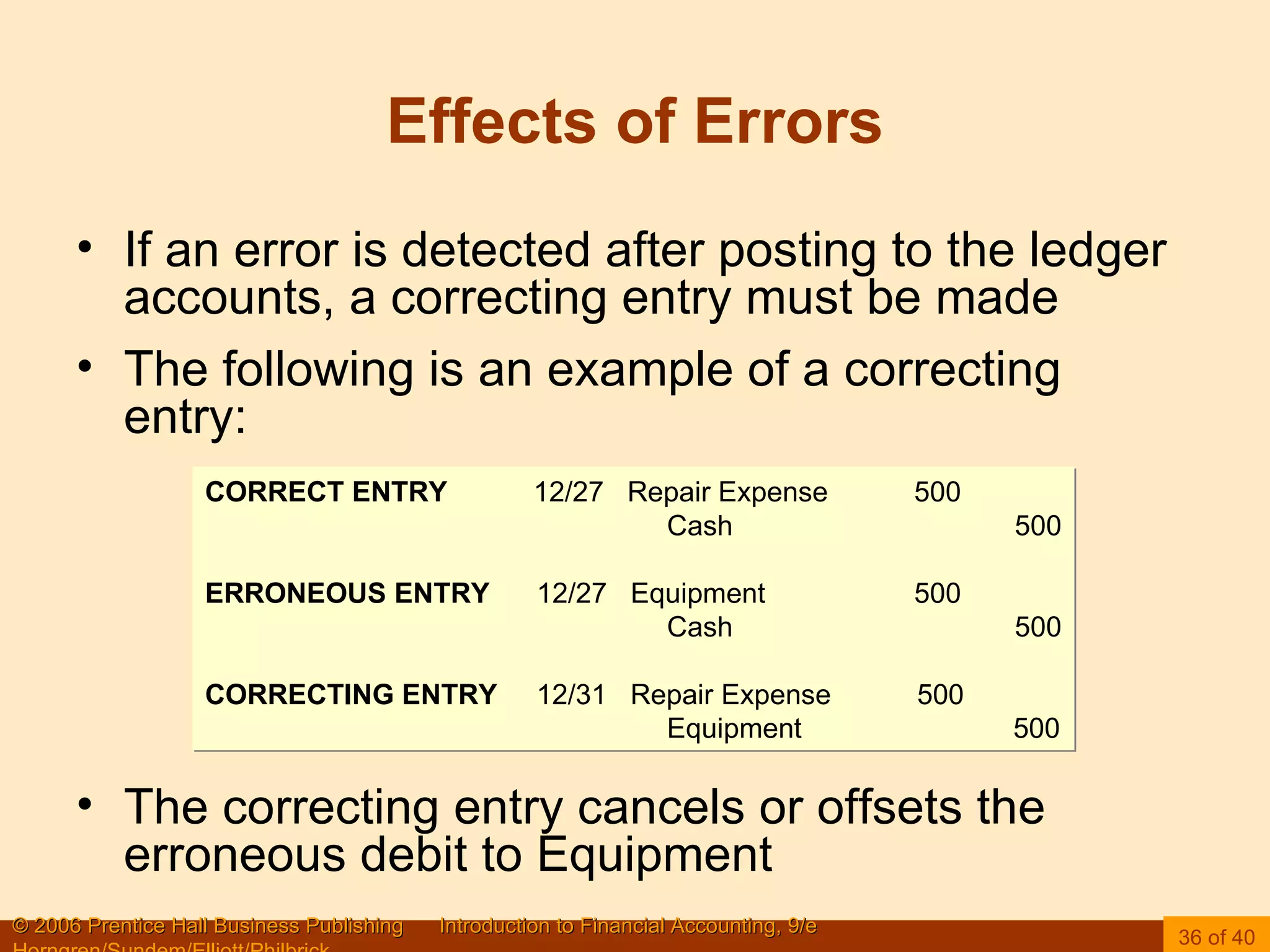
Effects of Errors If an error is detected after posting to the ledger accounts, a correcting entry must be made The following is an example of a correcting entry: The correcting entry cancels or offsets the erroneous debit to Equipment CORRECT ENTRY   12/27  Repair Expense  500 Cash  500 ERRONEOUS ENTRY   12/27  Equipment  500 Cash  500 CORRECTING ENTRY   12/31  Repair Expense  500 Equipment  500
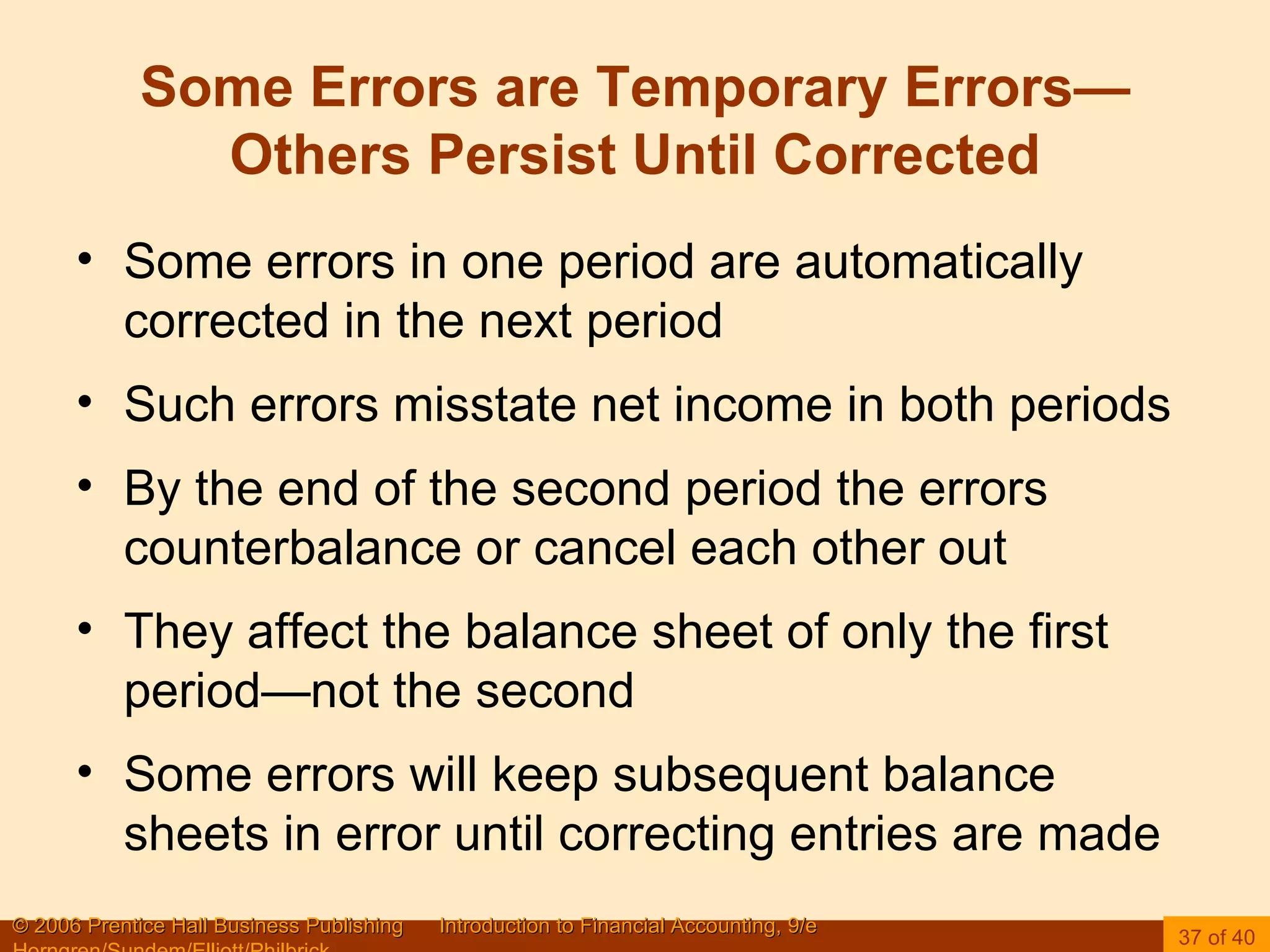
Some Errors are Temporary Errors—Others Persist Until Corrected Some errors in one period are automatically corrected in the next period Such errors misstate net income in both periods By the end of the second period the errors counterbalance or cancel each other out They affect the balance sheet of only the first period—not the second Some errors will keep subsequent balance sheets in error until correcting entries are made
Data Processing and  Accounting Systems Data processing  refers to the procedures used to record, analyze, store, and report on chosen activities In an accounting data processing system, a computer can automatically carry out steps such as ledger postings and financial statement preparation
Data Processing and  Accounting Systems The cash register may be linked to a computer that also records a decrease in inventory It may also Activate an order to a supplier Check a credit limit Update the accounts receivable Prepare monthly statements
Data Processing and  Accounting Systems Computers also reduce the time it takes to close the books and prepare financial statements The most recent advance in data processing for financial reporting is the use of XBRL XBRL is an XML-based computer language that allows easy comparisons across companies

Recording Transactions

  • 1.
  • 2.
    Learning Objectives Afterstudying this chapter, you should be able to Use double-entry accounting Analyze and journalize transactions Post journal entries to the ledgers Prepare and use a trial balance Close revenue and expense accounts and update retained earnings Correct erroneous journal entries and describe how errors affect accounts Explain how computers have transformed processing of accounting data
  • 3.
    The Double-Entry AccountingSystem In the double-entry system, every transaction affects at least two accounts After each transaction, the balance sheet equation must always remain in balance This balance sheet format is too cumbersome for recording each and every transaction Assets = Liabilities + Stockholders’ Equity
  • 4.
    Ledger Accounts Theelements of transactions are organized into accounts that group similar items together In a double-entry system, a ledger contains the records for a group of related accounts A general ledger is the collection of accounts that accumulate the amounts reported in the financial statements
  • 5.
    Ledger Accounts A T-account is a simplified version of accounts used in practice The vertical line in the T divides the account into left and right sides for recording increases and decreases The account title is on the horizontal line Cash Left side (Increases in cash) Right side (Decreases in cash)
  • 6.
    Ledger Accounts TheT-accounts for the first three Biwheels Company transactions are as follows Assets = Liabilities + Stockholders’ Equity Cash Note Payable Increases Decreases Decreases Increases (1) 400,000 (3) 150,000 (2) 100,000 (2) 100,000 Merchandise Inventory Paid-in Capital Increases Decreases Decreases Increases (3) 150,000 (1) 400,000
  • 7.
    Ledger Accounts Eachtransaction affects at least two accounts The process of creating a new T-account in preparation for recording a transaction is called opening the account An account balance is the difference between the total left-side and right-side amounts at any particular time Cash Balance 4,000 10,000 6,000
  • 8.
    Ledger Accounts Assetaccounts have left-side balances Entries on the left side increase asset account balances Entries on the right side decrease them Liabilities and owners’ equity accounts have right-side balances Entries on the right side increase their balances Entries on the left side decrease them
  • 9.
    Debits and CreditsAccountants use the terms Debit (abbreviated Dr.) to denote an entry on the left side of any account Credit (abbreviated Cr.) to denote an entry on the right side of any account Some accountants use the word “charge” instead of debit Cash Dr. Cr.
  • 10.
    The Recording ProcessThe sequence of five steps in recording and reporting transactions is as follows: Source documents are the original records of any transaction Transactions Documentation Journal Ledger Trial Balance Financial Statements
  • 11.
    The Recording ProcessThe general journal is a formal chronological listing of each transaction and how it affects the balances in the accounts Transactions are entered into the ledger The trial balance is a simple listing of the accounts in the general ledger together with their balances Preparation of financial statements occurs at least once a quarter for publicly traded companies
  • 12.
    Chart of AccountsA chart of accounts is a numbered or coded list of all account titles Account numbers are used as references in the Post Ref. column of the journal
  • 13.
    Journalizing Transactions Journalizing is the process of entering transactions into the general journal A journal entry is an analysis of all the effects of a single transaction on the various accounts, usually accompanied by an explanation A compound entry means that a single transaction affects more than two accounts
  • 14.
    Journalizing Transactions Thefollowing conventions are used for recording in the general journal The title of the account or accounts to be debited are placed at the left margin The title of the account or accounts to be credited are indented in a consistent way
  • 15.
    Journalizing Transactions Thefollowing conventions are used for recording in the general journal The journal entry is followed by the narrative explanation of the transaction The Post. Ref. column contains an identifying number that is assigned to each account and is used for cross-referencing to the ledger accounts
  • 16.
    Journalizing Transactions Thefollowing conventions are used for recording in the general journal The debit and credit columns are for recording the dollar amounts that are debited or credited for each account
  • 17.
    Posting Transactions tothe Ledger Posting is the transferring of amounts from the journal to the appropriate accounts in the ledger The following example shows How the debit to merchandise inventory and the credit to cash are posted Columns for dates, explanations, journal references, and amounts in the ledger
  • 18.
  • 19.
    Posting Transactions tothe Ledger Cross-referencing is the process of using numbering, dating, and/or some other form of identification to relate each ledger posting to the appropriate journal entry A single transaction from the journal might be posted to several different ledger accounts Cross-referencing allows users to find all the components of the transactions in the ledger no matter where they start
  • 20.
    Revenue and ExpenseTransactions Ignoring dividends, T-accounts can be grouped as follows: Assets = Liabilities + Paid-in Capital + Retained Earnings Debit Credit Debit Credit Debit Credit Debit Credit + - - + - + - + Expenses Revenues Debit Credit + +
  • 21.
    Revenue and ExpenseTransactions Revenue and expense information is accumulated separately to prepare a more meaningful income statement Expense and revenue accounts are part of Retained Earnings A revenue account increases retained earnings An expense account decreases retained earnings Although a debit entry increases expenses, it results in a decrease in retained earnings
  • 22.
    Revenue and ExpenseTransactions Transaction : Sales on credit, $160,000 Analysis : The asset account Accounts Receivable increases The stockholders’ equity account Sales Revenues increases Journal Entry : Accounts receivable……….160,000 Sales revenues………… 160,000 Posting : Accounts Receivable Sales Revenues 160,000 160,000
  • 23.
    Revenue and ExpenseTransactions Transaction : Cost of merchandise sold, $100,000 Analysis : The asset Merchandise Inventory decreases Stockholders’ equity decreases because an expense account, Cost of Goods Sold ( a negative stockholders’ account) increases Journal Entry : Cost of Goods Sold………………..100,000 Merchandise Inventory………… 100,000 Posting : Merchandise Inventory Cost of Goods Sold 100,000 100,000
  • 24.
    Prepaid Expenses and Depreciation Transactions Transaction : Paid rent for 3 months in advance, $6,000 Analysis : The asset Cash decreases The asset Prepaid Rent increases Journal Entry : Prepaid rent………………..6,000 Cash…………………… 6,000 Posting : Cash Prepaid Rent 6,000 6,000
  • 25.
    Prepaid Expenses and Depreciation Transactions Transaction : Recognized expiration of rental services, $2,000 Analysis : The asset Prepaid Rent decreases The negative stockholders’ equity account Rent Expense increases Journal Entry : Rent expense………………..2,000 Prepaid Rent…………….. 2,000 Posting : Prepaid Rent Rent Expense 6,000 2,000 2,000
  • 26.
    Prepaid Expenses and Depreciation Transactions Accumulated Depreciation, Store Equipment Depreciation Expense Transaction : Recognized depreciation, $100 Analysis : The asset reduction account Accumulated Depreciation, Store Equipment increases The negative stockholders’ equity account Depreciation Expense increases Journal Entry : Depreciation expense…………………………………………...100 Accumulated depreciation, store equipment…………….. 100 Posting : 100 100
  • 27.
    Prepaid Expenses and Depreciation Transactions Asset: Store Equipment $14,000 Contra Asset: Accumulated depreciation, equipment 100 Net asset: Book value $13,000 The book value or carrying value is the balance of an account minus the value of any contra accounts
  • 28.
    Preparing the TrialBalance A trial balance is a list of all the accounts with their balances The purpose of the trial balance is twofold: Proving whether the total debits equal the total credits in the ledger Summarizing the balances in the ledger accounts in preparation to construct the financial statements
  • 29.
    Preparing the TrialBalance *Retained earnings in the trial balance does not yet reflect the income for the period *
  • 30.
    Preparing the TrialBalance The trial balance is prepared with the accounts in the following order: Asset accounts Liability accounts Stockholders’ equity accounts Revenue accounts Expense accounts The trial balance is the springboard for preparing the balance sheet and the income statement
  • 31.
    Deriving Financial Statements from the Trial Balance Balance Sheet Income Statement
  • 32.
    Closing the AccountsClosing the accounts has two purposes: It transfers the balances of the “temporary” stockholders’ equity accounts (revenues and expenses) to the “permanent” stockholders’ equity account (retained earnings) It makes the revenues and expense accounts have a zero balance, which readies them for the next period’s transactions
  • 33.
    Closing the AccountsCost of Goods Sold Bal. 100,000 C2 100,000 0 Rent Expense Bal. 2,000 C2 2,000 Bal. 100 C2 100 0 0 Depreciation Expense Income Summary C2 102,100 C1 160,000 Sales C1 160,000 Bal. 160,000 0 Retained Income Bal 0 C3 57,900 C3 57,900 New bal. 57,900 0 There are three closing entries: C1: Close all revenue accounts C2: Close all expense accounts C3: Close the Income Summary account
  • 34.
    Closing the AccountsC1. Transaction : Clerical procedure of transferring the ending balances of revenue accounts to the Income Summary account Analysis : The stockholders' equity account Sales decreases to zero The stockholders’ equity account Income Summary increases Journal Entry : Sales………………………160,000 Income Summary…… 160,000 C2. Transaction : Clerical procedure of transferring the ending balances of expense accounts to the Income Summary account Analysis : The negative stockholders’ equity (expense) accounts Cost of Goods Sold , Rent Expense , etc. decrease to zero The stockholders’ equity account Income Summary decreases Journal Entry : Income Summary……………102,100 Cost of goods sold………. 100,000 Rent expense……………. 2,000 Depreciation expense…… 100
  • 35.
    Closing the AccountsC3. Transaction : Clerical procedure of transferring the ending balance of Income Summary account to the Retained Earnings account Analysis : The stockholders' equity account Income Summary decreases to zero The stockholders’ equity account Retained Earnings increases Journal Entry : Income summary…………57,000 Retained earnings…… 57,000
  • 36.
    Effects of ErrorsIf an error is detected after posting to the ledger accounts, a correcting entry must be made The following is an example of a correcting entry: The correcting entry cancels or offsets the erroneous debit to Equipment CORRECT ENTRY 12/27 Repair Expense 500 Cash 500 ERRONEOUS ENTRY 12/27 Equipment 500 Cash 500 CORRECTING ENTRY 12/31 Repair Expense 500 Equipment 500
  • 37.
    Some Errors areTemporary Errors—Others Persist Until Corrected Some errors in one period are automatically corrected in the next period Such errors misstate net income in both periods By the end of the second period the errors counterbalance or cancel each other out They affect the balance sheet of only the first period—not the second Some errors will keep subsequent balance sheets in error until correcting entries are made
  • 38.
    Data Processing and Accounting Systems Data processing refers to the procedures used to record, analyze, store, and report on chosen activities In an accounting data processing system, a computer can automatically carry out steps such as ledger postings and financial statement preparation
  • 39.
    Data Processing and Accounting Systems The cash register may be linked to a computer that also records a decrease in inventory It may also Activate an order to a supplier Check a credit limit Update the accounts receivable Prepare monthly statements
  • 40.
    Data Processing and Accounting Systems Computers also reduce the time it takes to close the books and prepare financial statements The most recent advance in data processing for financial reporting is the use of XBRL XBRL is an XML-based computer language that allows easy comparisons across companies