Bookkeeping
Brought to you by TutorCounty 1
Elements of A Business Entity
• In bookkeeping a business is considered to have 3 elements. These
are It`s
1. Assets - Value of all which are owned
2. Liabilities - Value of all which are owed
3. Owner`s Equity - Value of It`s Net Worth
Brought to you by TutorCounty 2
Transactions of business
• Exchange of products or services is referred as a transaction.
Transactions change elements of businesses.
Example- Tom & Company borrows $1000 to from ABC Bank
Result of This Transaction to Tom & Co is
Cash Asset Increase by $1000
Bank Loan Liability Increase by $1000
Brought to you by TutorCounty 3
What is Bookkeeping
• Bookkeeping is the systematic way of recording financial transactions
of a business.
• In recording the changes to Assets, Liabilities, Owner`s Equity are
considered.
Brought to you by TutorCounty 4
Elements of Bookkeeping
• Double Entry System
• Source Documents
• Journal/The day book
• Ledger
• Trial Balance
• Financial Statements
• Post Closing Trial Balance
Brought to you by TutorCounty 5
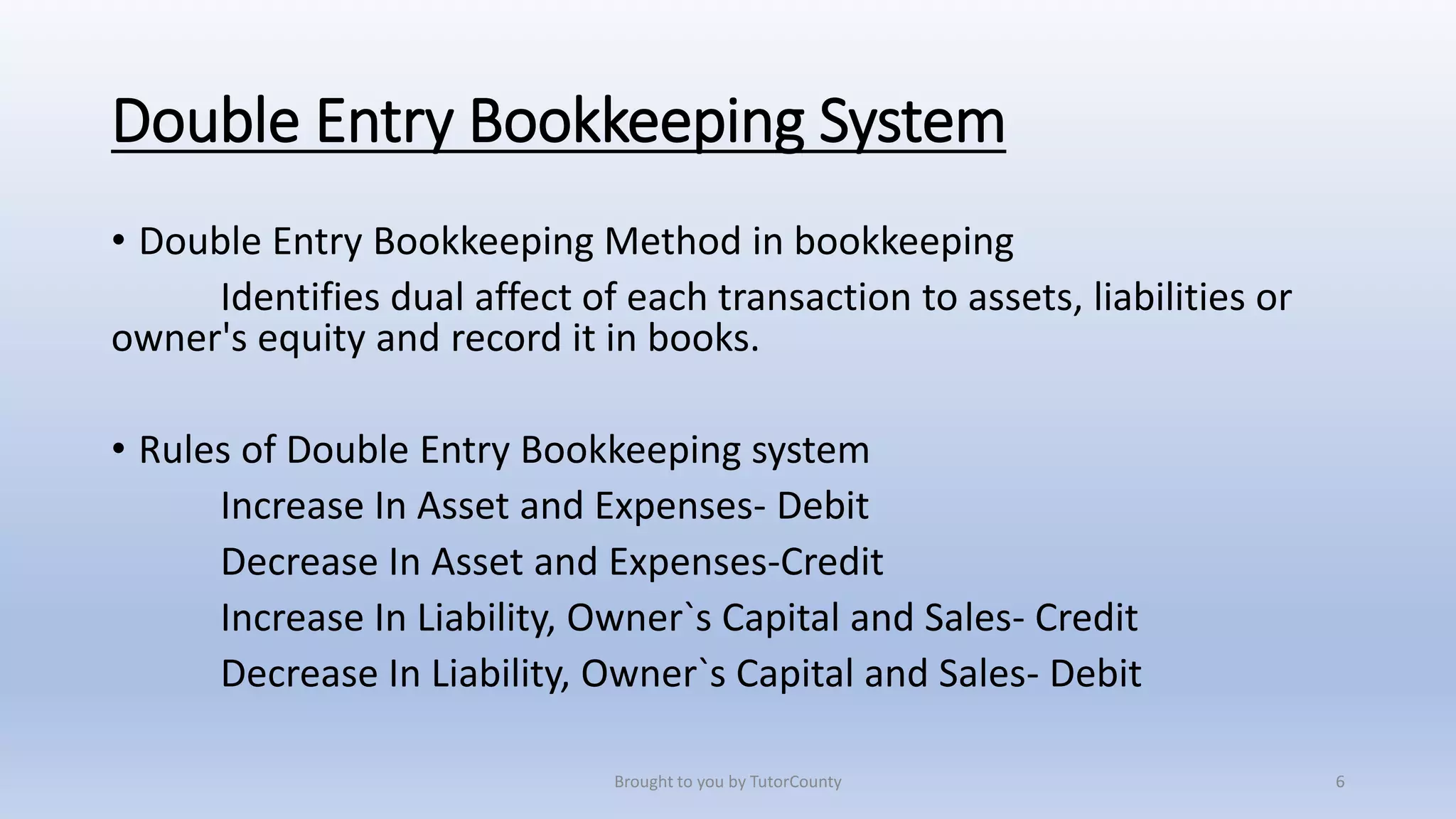
Double Entry Bookkeeping System
• Double Entry Bookkeeping Method in bookkeeping
Identifies dual affect of each transaction to assets, liabilities or
owner's equity and record it in books.
• Rules of Double Entry Bookkeeping system
Increase In Asset and Expenses- Debit
Decrease In Asset and Expenses-Credit
Increase In Liability, Owner`s Capital and Sales- Credit
Decrease In Liability, Owner`s Capital and Sales- Debit
Brought to you by TutorCounty 6
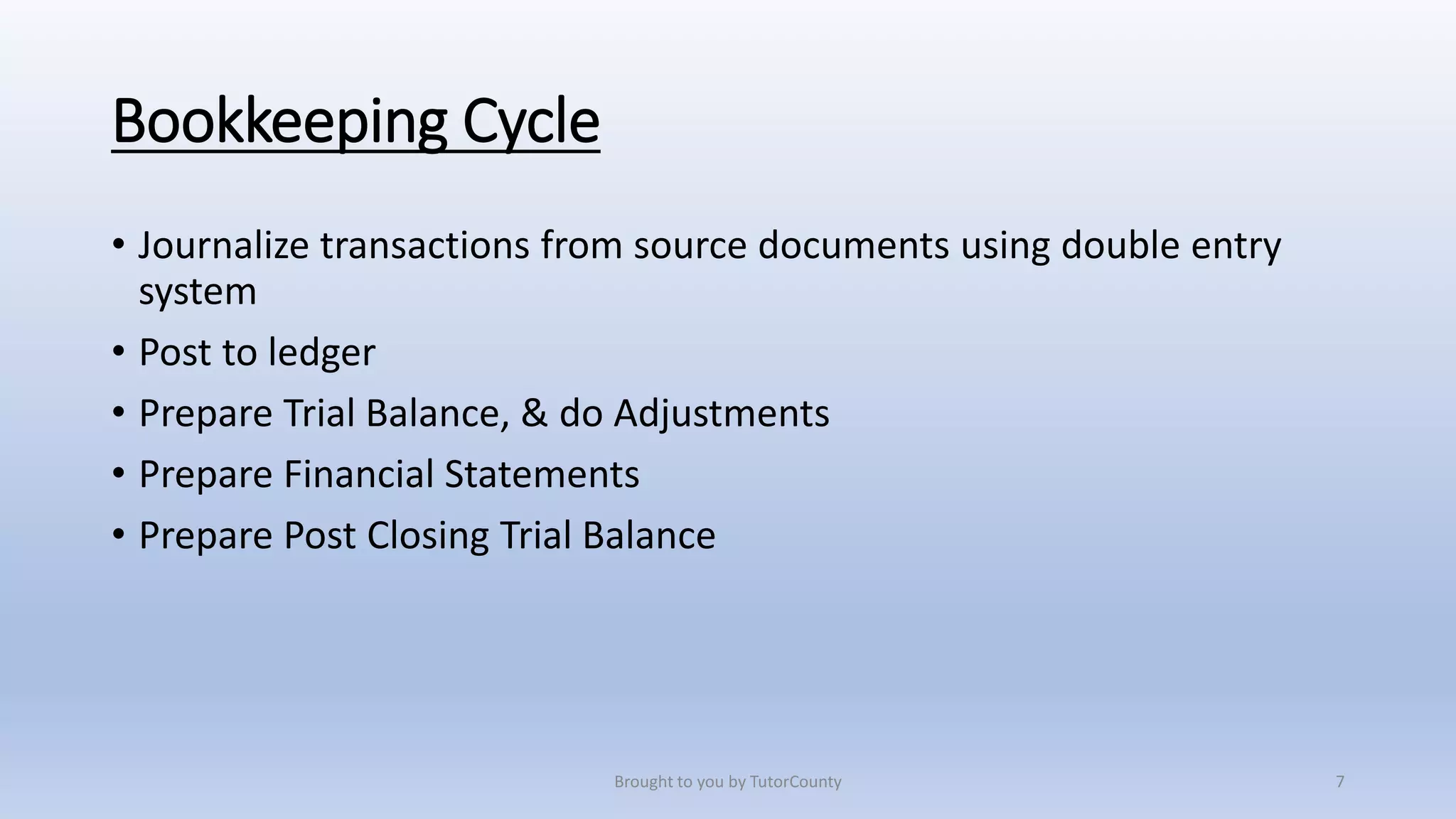
Bookkeeping Cycle
• Journalize transactions from source documents using double entry
system
• Post to ledger
• Prepare Trial Balance, & do Adjustments
• Prepare Financial Statements
• Prepare Post Closing Trial Balance
Brought to you by TutorCounty 7
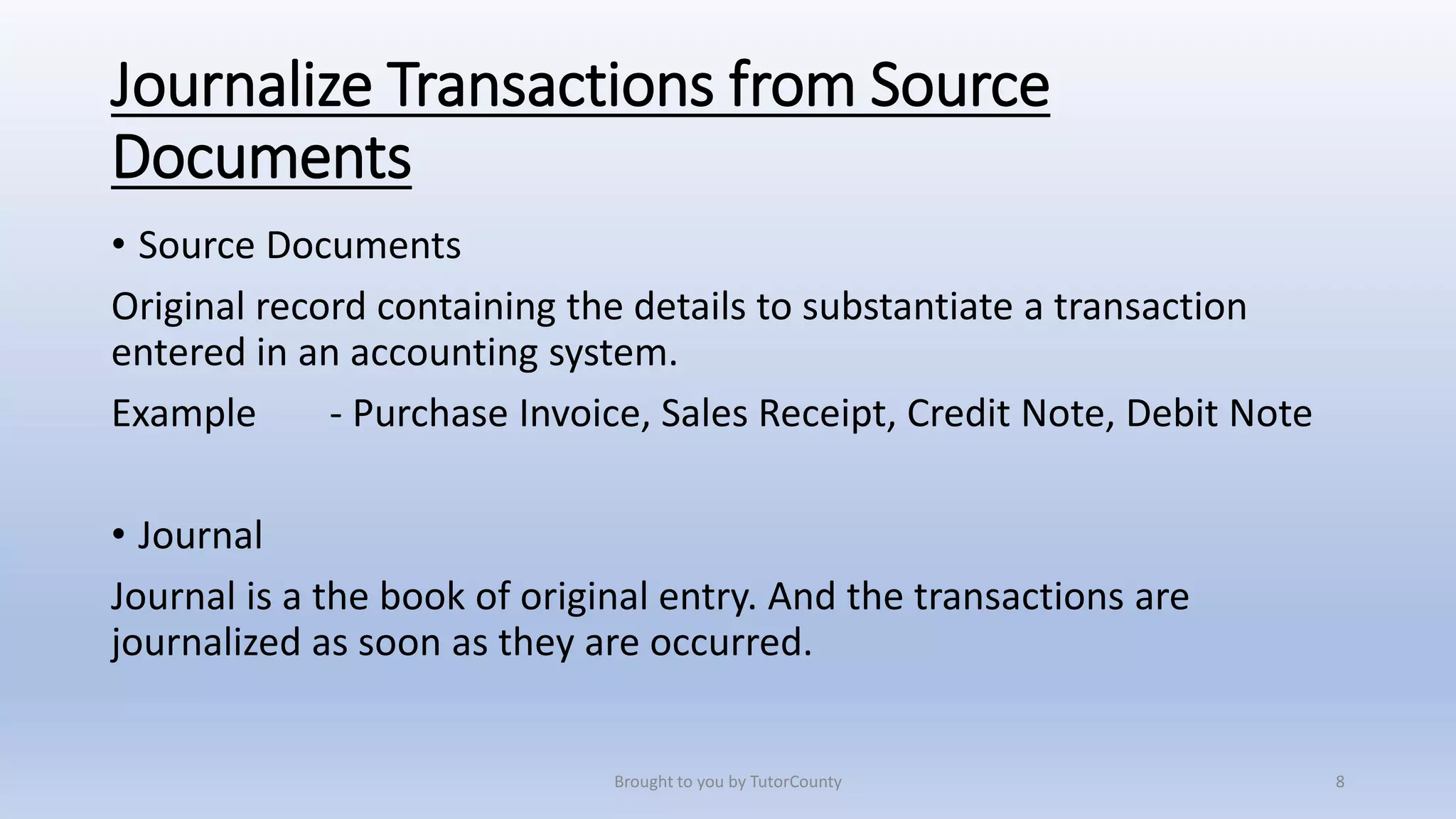
Journalize Transactions from Source
Documents
• Source Documents
Original record containing the details to substantiate a transaction
entered in an accounting system.
Example - Purchase Invoice, Sales Receipt, Credit Note, Debit Note
• Journal
Journal is a the book of original entry. And the transactions are
journalized as soon as they are occurred.
Brought to you by TutorCounty 8
Journal
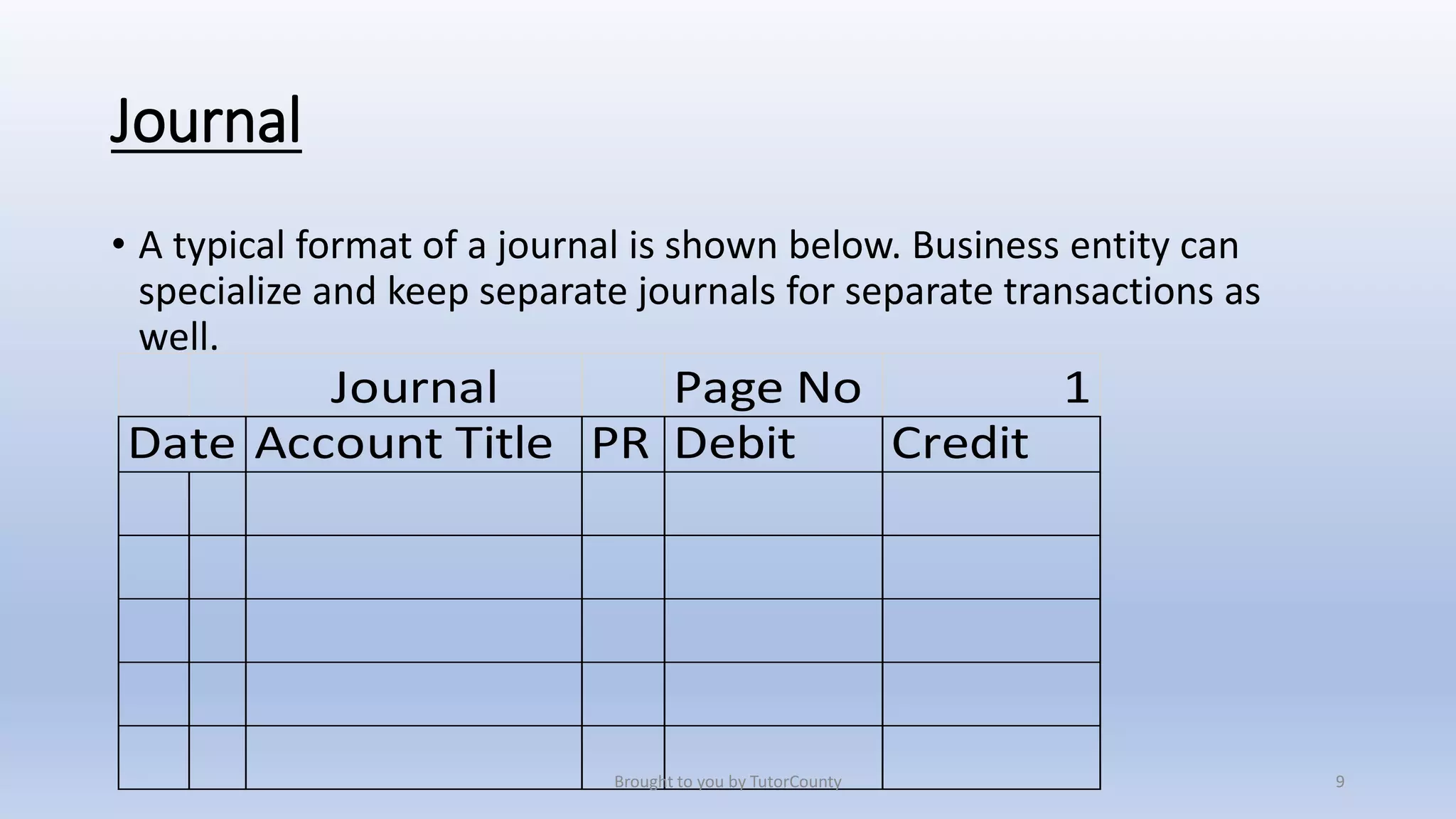
• A typical format of a journal is shown below. Business entity can
specialize and keep separate journals for separate transactions as
well.
Journal Page No 1
Date Account Title PR Debit Credit
Brought to you by TutorCounty 9
Journalize transaction
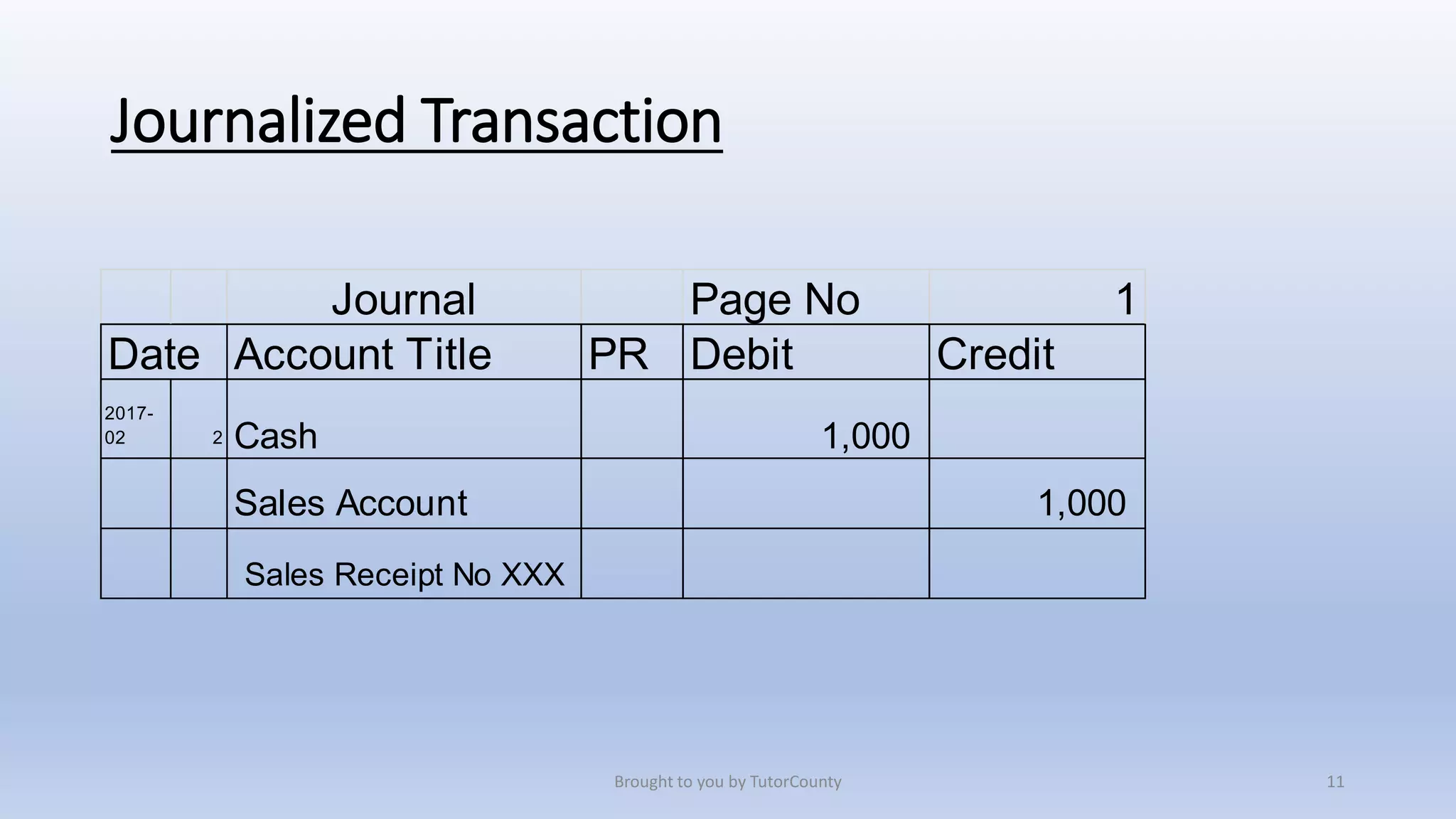
• Example - Tom & Company Sales goods for $1000 on 02nd February
2017
• Result of this transaction is, Company`s Cash Asset increases and
Sales Income Increases by $1000.
• Applying rules of double entry to this transaction will Debit Cash and
Credit Sales.
Brought to you by TutorCounty 10
Journalized Transaction
Journal Page No 1
Date Account Title PR Debit Credit
2017-
02 2 Cash 1,000
Sales Account 1,000
Sales Receipt No XXX
Brought to you by TutorCounty 11
Post to Ledger
• At the end of each day the bookkeeper transfer the entries from the
journal to the ledger. This is referred to as posting to ledger.
• The ledger consist separate accounts for all assets, liabilities, owner`s
equity, Income and Expenses. Collection of those accounts are called
the ledger.
• A ledger account has two sides Left and the right. Left side is for
debut transaction and right is for credit transactions.
Brought to you by TutorCounty 12
Posting to ledger
No1
2017-
02 1 Sales 1 1000
No2
2017-
02 1 Cash 1 1000
Cash Account
Sales Account
Brought to you by TutorCounty 13
Posting to ledger
Journal Page No 1
Date Account Title PR Debit Credit
2017-
02 2 Cash 1 1,000
Sales Account 2 1,000
Sales Receipt No XXX
Brought to you by TutorCounty 14
Prepare Trial Balance
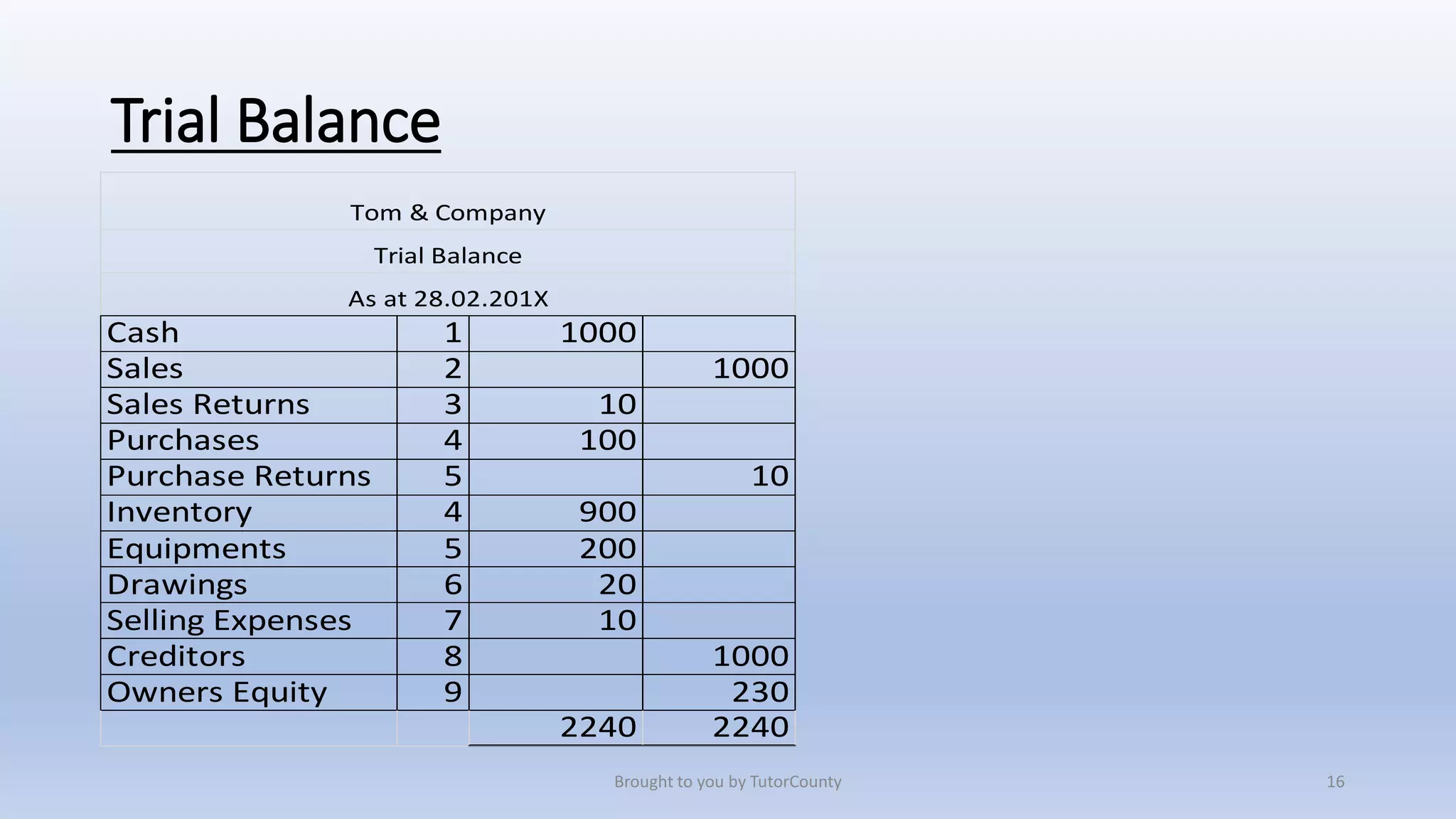
• At a considered date the bookkeeper list down all the balances of the
ledger accounts to a report. This is called the trial balance.
• To prepare trial balance the bookkeeper go through all the ledger
accounts and pencil footing the difference between credit & Debit
sides.
• These difference will list down in the Trial Balance as debit and credit
balances.
Brought to you by TutorCounty 15
Trial Balance
Cash 1 1000
Sales 2 1000
Sales Returns 3 10
Purchases 4 100
Purchase Returns 5 10
Inventory 4 900
Equipments 5 200
Drawings 6 20
Selling Expenses 7 10
Creditors 8 1000
Owners Equity 9 230
2240 2240
Tom & Company
Trial Balance
As at 28.02.201X
Brought to you by TutorCounty 16
Trial Balance
• The Totals of Debits and Credits of the trial balance should equal.
Then the Trial balance is In balance
• Trial balance may Out of balance.
• A trial balance may out of balance due to errors in posting.
• Example- Missing posting entry to one ledger account
Debit both accounts
Debit and Credit different amounts
Brought to you by TutorCounty 17
Trial Balance
• When trial balance is out of balance the bookkeeper used to re-check
the debit and credit totals. If any totaling mistake has happened then
it is sorted.
• If it is still out of balance the bookkeeper used to go through the
pencil footings, journal and posting entries to locate any errors.
• If any error is met the bookkeeper needs to correct it to get the trial
balance in balance.
Brought to you by TutorCounty 18
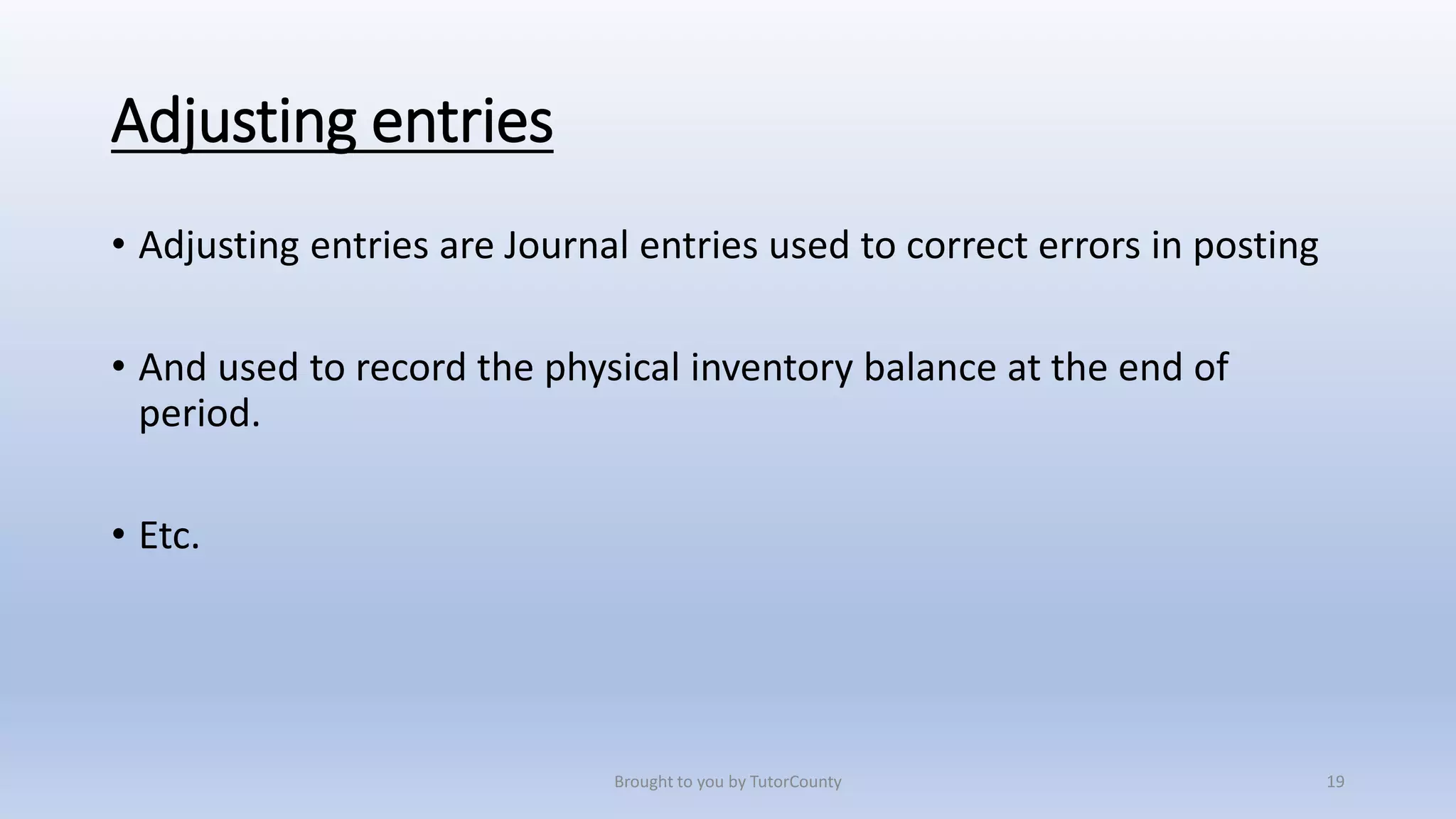
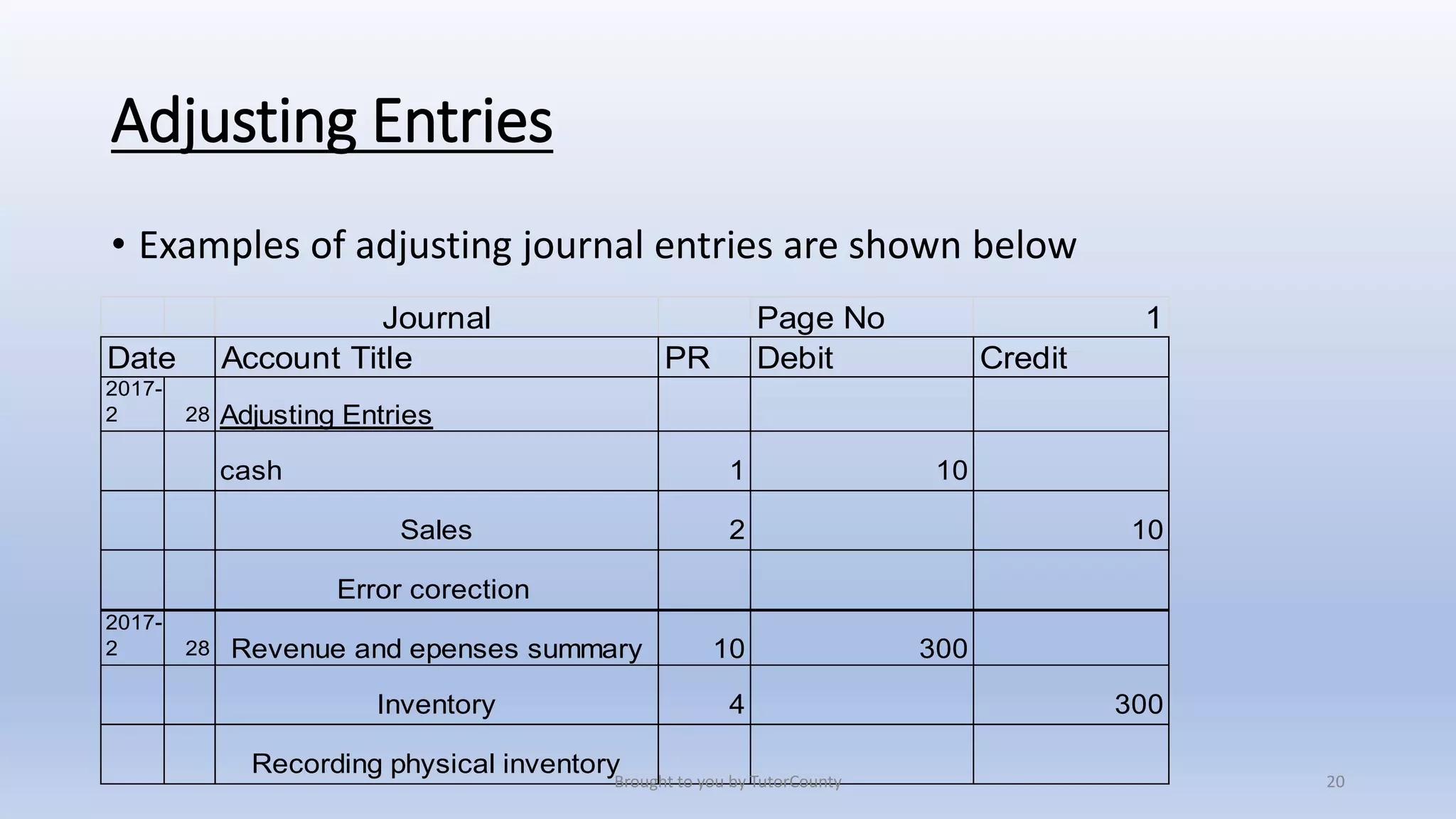
Adjusting entries
• Adjusting entries are Journal entries used to correct errors in posting
• And used to record the physical inventory balance at the end of
period.
• Etc.
Brought to you by TutorCounty 19
Adjusting Entries
• Examples of adjusting journal entries are shown below
Journal Page No 1
Date Account Title PR Debit Credit
2017-
2 28 Adjusting Entries
cash 1 10
Sales 2 10
Error corection
2017-
2 28 Revenue and epenses summary 10 300
Inventory 4 300
Recording physical inventory
Brought to you by TutorCounty 20
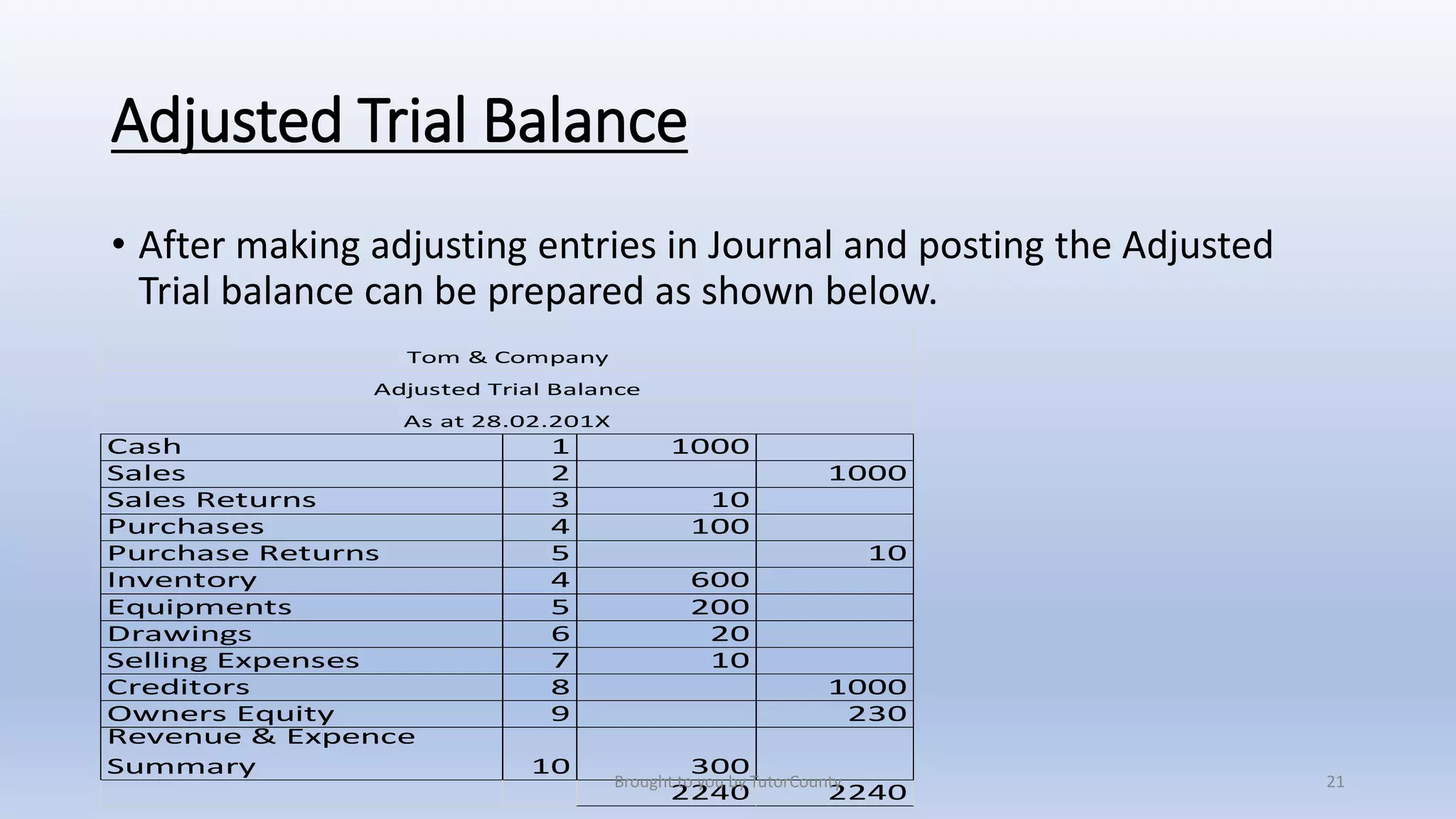
Adjusted Trial Balance
• After making adjusting entries in Journal and posting the Adjusted
Trial balance can be prepared as shown below.
Cash 1 1000
Sales 2 1000
Sales Returns 3 10
Purchases 4 100
Purchase Returns 5 10
Inventory 4 600
Equipments 5 200
Drawings 6 20
Selling Expenses 7 10
Creditors 8 1000
Owners Equity 9 230
Revenue & Expence
Summary 10 300
2240 2240
Tom & Company
Adjusted Trial Balance
As at 28.02.201X
Brought to you by TutorCounty 21
Financial Statements
• Consists
The Income Statement,
Capital Statement,
Balance Sheet,
Let`s go through one by one.
Brought to you by TutorCounty 22
Income Statement
• Income statement is prepared for measure the profitability of the
business over a period.
• Income statement is prepared in report form.
• Income and Expenses account balances are considered in preparing
income statement.
• Income statement shows the Gross profit and the Net profit
• Gross profit is calculated by deducting Cost of goods sold from Sales.
• Net profit is calculated by deducting other expenses from Gross profit
Brought to you by TutorCounty 23
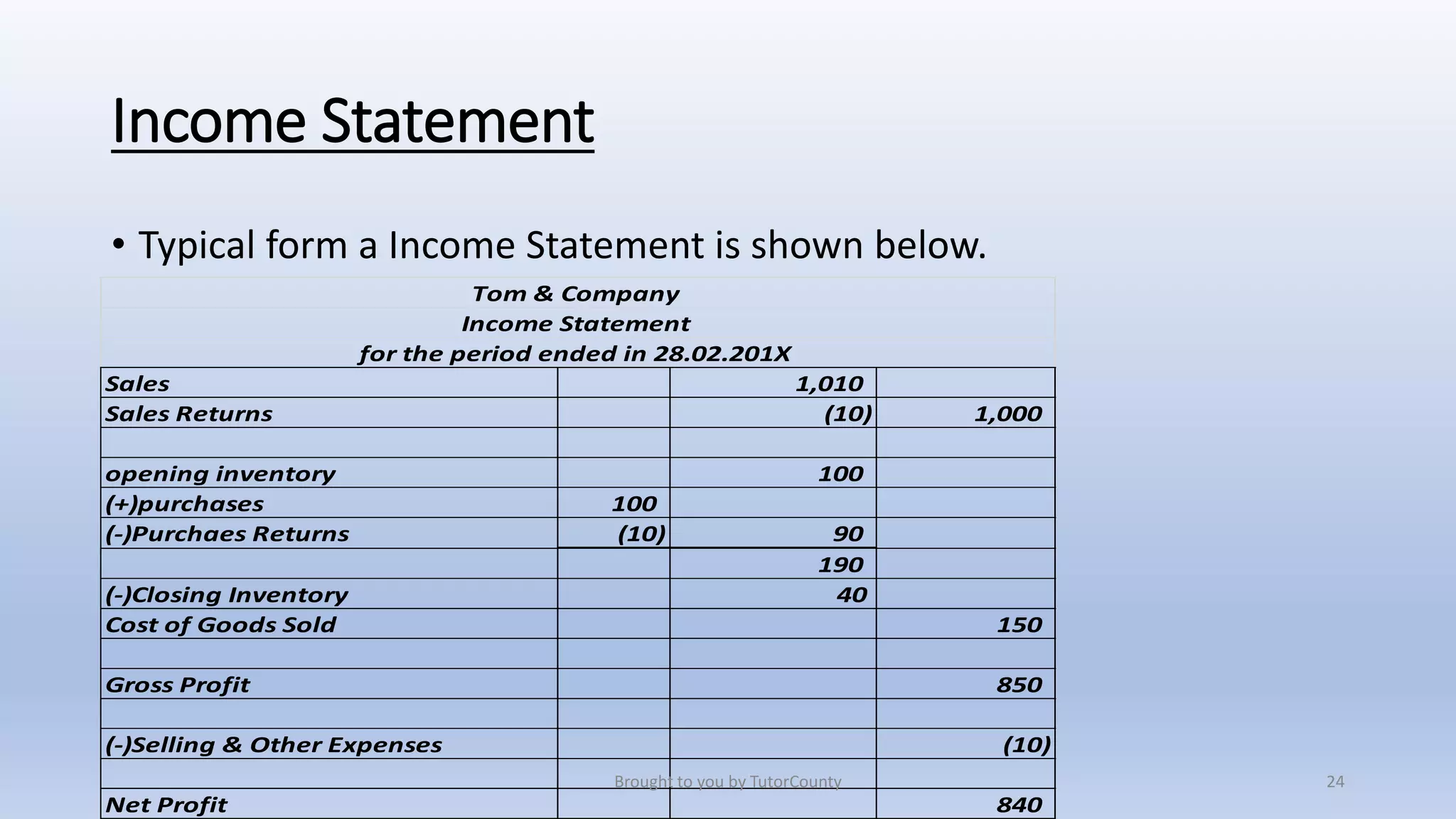
Income Statement
• Typical form a Income Statement is shown below.
Sales 1,010
Sales Returns (10) 1,000
opening inventory 100
(+)purchases 100
(-)Purchaes Returns (10) 90
190
(-)Closing Inventory 40
Cost of Goods Sold 150
Gross Profit 850
(-)Selling & Other Expenses (10)
Net Profit 840
Tom & Company
Income Statement
for the period ended in 28.02.201X
Brought to you by TutorCounty 24
Capital Statement
• Capital Statement is prepared to report the changes during the period
to owner`s equity accounts of a company.
• To prepare capitals statement, balance of accounts related to owner`s
equity are considered.
• And the Net profit or loss occurred during the period will be
considered as well.
Brought to you by TutorCounty 25
Capital Statement
• Typical format of a Capital Statement is shown below.
Opening Capital 150
(+) Additional Investment 80
230
(+) Net Proft of the period 840
Capital after net profit 1,070
(-)Drawings (20)
Closing Balance as at 28.02.201X 1,050
Tom & Company
Capital Statement
for the period ended in 28.02.201X
Brought to you by TutorCounty 26
Balance Sheet
• In order to report the financial condition at a certain date The balance
sheet is prepared.
• The assets, Liabilities and the Owner`s Equity related accounts
balance are listed to prepare the balance sheet.
Brought to you by TutorCounty 27
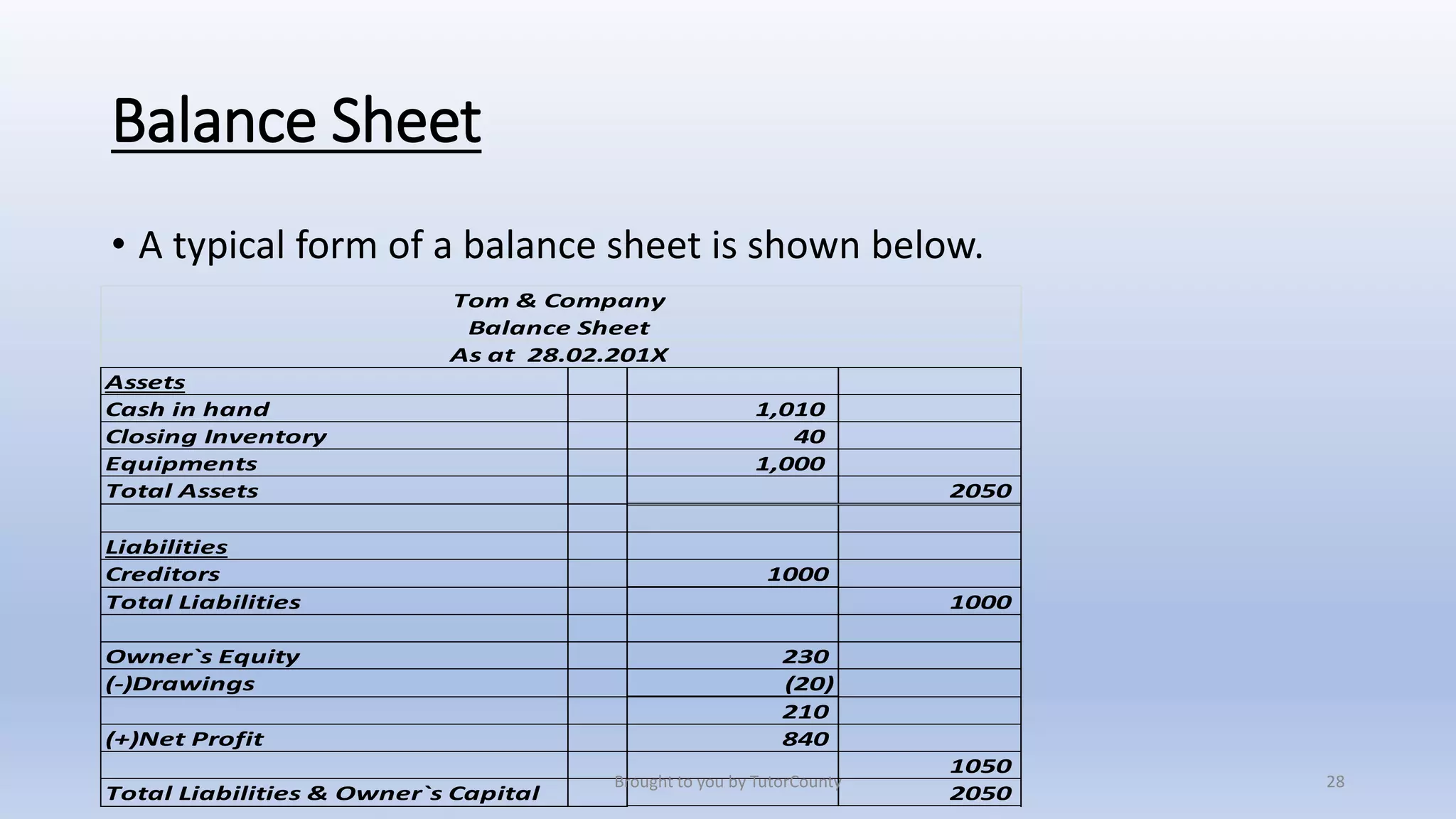
Balance Sheet
• A typical form of a balance sheet is shown below.
Assets
Cash in hand 1,010
Closing Inventory 40
Equipments 1,000
Total Assets 2050
Liabilities
Creditors 1000
Total Liabilities 1000
Owner`s Equity 230
(-)Drawings (20)
210
(+)Net Profit 840
1050
Total Liabilities & Owner`s Capital 2050
As at 28.02.201X
Tom & Company
Balance Sheet
Brought to you by TutorCounty 28
Revenue & Expense Summery
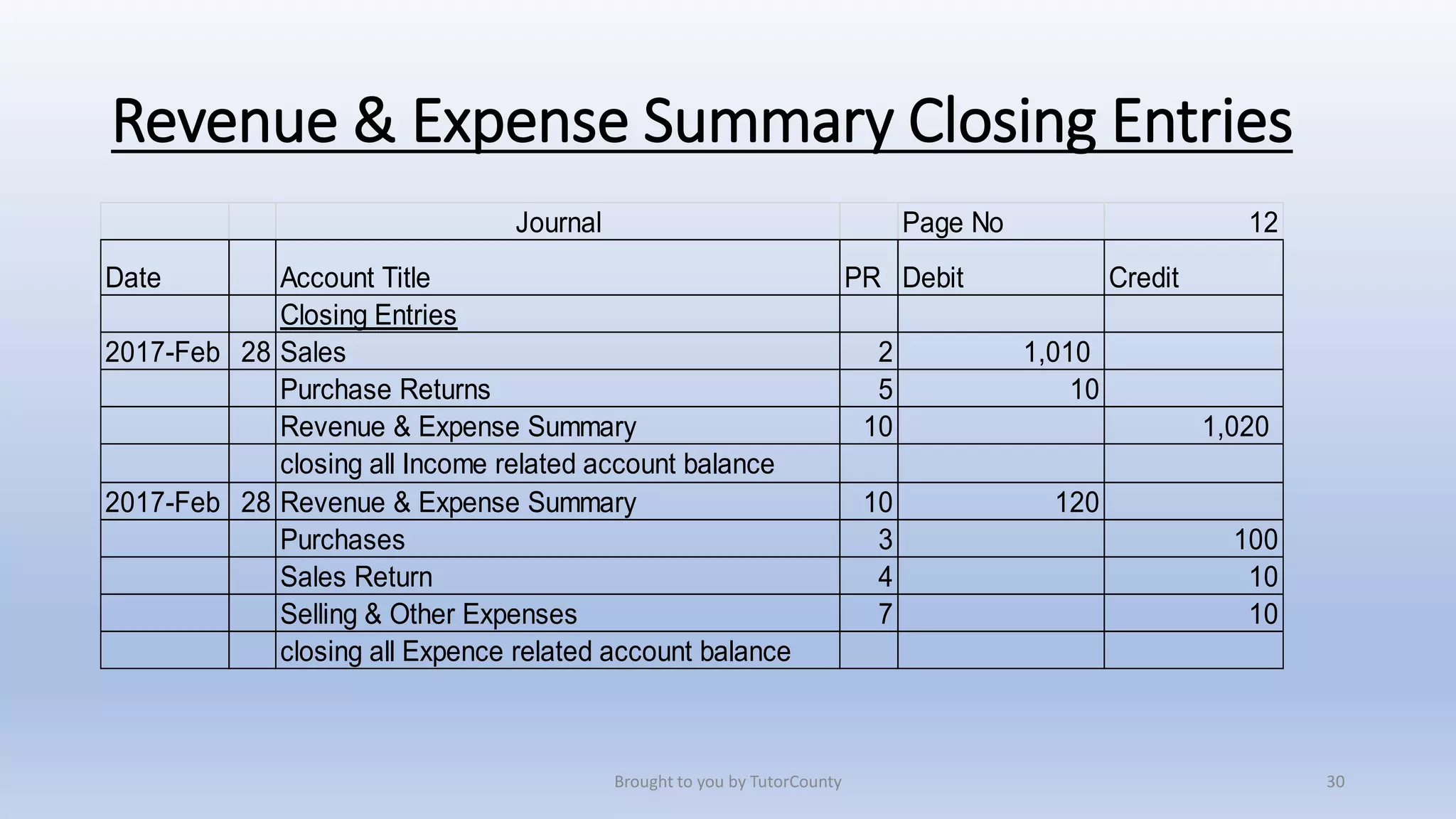
• At the end of a accounting period Revenue & expense summary is
prepared to close all income and expenses.
• Closing entries will be made in general journal transferring all income
and expense balances to revenue and expense summary.
Brought to you by TutorCounty 29
Revenue & Expense Summary Closing Entries
Journal Page No 12
Date Account Title PR Debit Credit
Closing Entries
2017-Feb 28 Sales 2 1,010
Purchase Returns 5 10
Revenue & Expense Summary 10 1,020
closing all Income related account balance
2017-Feb 28 Revenue & Expense Summary 10 120
Purchases 3 100
Sales Return 4 10
Selling & Other Expenses 7 10
closing all Expence related account balance
Brought to you by TutorCounty 30
Closing Revenue & Expense Summary Account
• At the end of accounting period the balance of the revenue &
expense summary which equals to the profit or loss of the period will
be transferred to capital accounts.
• With closing revenue & expenses summary, the Balance of the
drawing account will be transferred to capital account as well
• A journal entry will be made to get capital account up-to-date
• .
Brought to you by TutorCounty 31
Closing Revenue & Expense Summary Account
Journal Page No 12
Account Title PR Debit Credit
Closing Entries
28 Revenue & Expense Summary 10 840
Capital Account 9 840
Transfer profit to capital accounts
28 Capital Account 9 20
Drawings Account 6 20
Transfer profit to capital accounts
Brought to you by TutorCounty 32
Post-Closing Trial Balance
• After closing all temporary accounts (Income, Expenses and Drawing
Accounts) the remaining Assets, Liabilities and Capital Accounts will
be balances & Ruled. Balance & Ruled account is shown below.
• And the all the balances of them will be listed on a trial balance.
Cash Account No1
2017-
Feb 1 Sales 1 1000
2017-
Feb 28 Sales 8 10
2017-
Feb 28 Balance 1010
2017-
Feb 28 1010
2017-
Feb 28 1010
Brought to you by TutorCounty 33
Post-Closing Trial Balance
Cash In Hand 1 1010
Inventory 4 40
Equipments 5 1000
Creditors 8 1000
Capital Account 9 1050
2050 2050
Tom & Company
Post-Closing Trial Balance
As at 28.02.201X
Brought to you by TutorCounty 34

Bookkeeping

  • 1.
  • 2.
    Elements of ABusiness Entity • In bookkeeping a business is considered to have 3 elements. These are It`s 1. Assets - Value of all which are owned 2. Liabilities - Value of all which are owed 3. Owner`s Equity - Value of It`s Net Worth Brought to you by TutorCounty 2
  • 3.
    Transactions of business •Exchange of products or services is referred as a transaction. Transactions change elements of businesses. Example- Tom & Company borrows $1000 to from ABC Bank Result of This Transaction to Tom & Co is Cash Asset Increase by $1000 Bank Loan Liability Increase by $1000 Brought to you by TutorCounty 3
  • 4.
    What is Bookkeeping •Bookkeeping is the systematic way of recording financial transactions of a business. • In recording the changes to Assets, Liabilities, Owner`s Equity are considered. Brought to you by TutorCounty 4
  • 5.
    Elements of Bookkeeping •Double Entry System • Source Documents • Journal/The day book • Ledger • Trial Balance • Financial Statements • Post Closing Trial Balance Brought to you by TutorCounty 5
  • 6.
    Double Entry BookkeepingSystem • Double Entry Bookkeeping Method in bookkeeping Identifies dual affect of each transaction to assets, liabilities or owner's equity and record it in books. • Rules of Double Entry Bookkeeping system Increase In Asset and Expenses- Debit Decrease In Asset and Expenses-Credit Increase In Liability, Owner`s Capital and Sales- Credit Decrease In Liability, Owner`s Capital and Sales- Debit Brought to you by TutorCounty 6
  • 7.
    Bookkeeping Cycle • Journalizetransactions from source documents using double entry system • Post to ledger • Prepare Trial Balance, & do Adjustments • Prepare Financial Statements • Prepare Post Closing Trial Balance Brought to you by TutorCounty 7
  • 8.
    Journalize Transactions fromSource Documents • Source Documents Original record containing the details to substantiate a transaction entered in an accounting system. Example - Purchase Invoice, Sales Receipt, Credit Note, Debit Note • Journal Journal is a the book of original entry. And the transactions are journalized as soon as they are occurred. Brought to you by TutorCounty 8
  • 9.
    Journal • A typicalformat of a journal is shown below. Business entity can specialize and keep separate journals for separate transactions as well. Journal Page No 1 Date Account Title PR Debit Credit Brought to you by TutorCounty 9
  • 10.
    Journalize transaction • Example- Tom & Company Sales goods for $1000 on 02nd February 2017 • Result of this transaction is, Company`s Cash Asset increases and Sales Income Increases by $1000. • Applying rules of double entry to this transaction will Debit Cash and Credit Sales. Brought to you by TutorCounty 10
  • 11.
    Journalized Transaction Journal PageNo 1 Date Account Title PR Debit Credit 2017- 02 2 Cash 1,000 Sales Account 1,000 Sales Receipt No XXX Brought to you by TutorCounty 11
  • 12.
    Post to Ledger •At the end of each day the bookkeeper transfer the entries from the journal to the ledger. This is referred to as posting to ledger. • The ledger consist separate accounts for all assets, liabilities, owner`s equity, Income and Expenses. Collection of those accounts are called the ledger. • A ledger account has two sides Left and the right. Left side is for debut transaction and right is for credit transactions. Brought to you by TutorCounty 12
  • 13.
    Posting to ledger No1 2017- 021 Sales 1 1000 No2 2017- 02 1 Cash 1 1000 Cash Account Sales Account Brought to you by TutorCounty 13
  • 14.
    Posting to ledger JournalPage No 1 Date Account Title PR Debit Credit 2017- 02 2 Cash 1 1,000 Sales Account 2 1,000 Sales Receipt No XXX Brought to you by TutorCounty 14
  • 15.
    Prepare Trial Balance •At a considered date the bookkeeper list down all the balances of the ledger accounts to a report. This is called the trial balance. • To prepare trial balance the bookkeeper go through all the ledger accounts and pencil footing the difference between credit & Debit sides. • These difference will list down in the Trial Balance as debit and credit balances. Brought to you by TutorCounty 15
  • 16.
    Trial Balance Cash 11000 Sales 2 1000 Sales Returns 3 10 Purchases 4 100 Purchase Returns 5 10 Inventory 4 900 Equipments 5 200 Drawings 6 20 Selling Expenses 7 10 Creditors 8 1000 Owners Equity 9 230 2240 2240 Tom & Company Trial Balance As at 28.02.201X Brought to you by TutorCounty 16
  • 17.
    Trial Balance • TheTotals of Debits and Credits of the trial balance should equal. Then the Trial balance is In balance • Trial balance may Out of balance. • A trial balance may out of balance due to errors in posting. • Example- Missing posting entry to one ledger account Debit both accounts Debit and Credit different amounts Brought to you by TutorCounty 17
  • 18.
    Trial Balance • Whentrial balance is out of balance the bookkeeper used to re-check the debit and credit totals. If any totaling mistake has happened then it is sorted. • If it is still out of balance the bookkeeper used to go through the pencil footings, journal and posting entries to locate any errors. • If any error is met the bookkeeper needs to correct it to get the trial balance in balance. Brought to you by TutorCounty 18
  • 19.
    Adjusting entries • Adjustingentries are Journal entries used to correct errors in posting • And used to record the physical inventory balance at the end of period. • Etc. Brought to you by TutorCounty 19
  • 20.
    Adjusting Entries • Examplesof adjusting journal entries are shown below Journal Page No 1 Date Account Title PR Debit Credit 2017- 2 28 Adjusting Entries cash 1 10 Sales 2 10 Error corection 2017- 2 28 Revenue and epenses summary 10 300 Inventory 4 300 Recording physical inventory Brought to you by TutorCounty 20
  • 21.
    Adjusted Trial Balance •After making adjusting entries in Journal and posting the Adjusted Trial balance can be prepared as shown below. Cash 1 1000 Sales 2 1000 Sales Returns 3 10 Purchases 4 100 Purchase Returns 5 10 Inventory 4 600 Equipments 5 200 Drawings 6 20 Selling Expenses 7 10 Creditors 8 1000 Owners Equity 9 230 Revenue & Expence Summary 10 300 2240 2240 Tom & Company Adjusted Trial Balance As at 28.02.201X Brought to you by TutorCounty 21
  • 22.
    Financial Statements • Consists TheIncome Statement, Capital Statement, Balance Sheet, Let`s go through one by one. Brought to you by TutorCounty 22
  • 23.
    Income Statement • Incomestatement is prepared for measure the profitability of the business over a period. • Income statement is prepared in report form. • Income and Expenses account balances are considered in preparing income statement. • Income statement shows the Gross profit and the Net profit • Gross profit is calculated by deducting Cost of goods sold from Sales. • Net profit is calculated by deducting other expenses from Gross profit Brought to you by TutorCounty 23
  • 24.
    Income Statement • Typicalform a Income Statement is shown below. Sales 1,010 Sales Returns (10) 1,000 opening inventory 100 (+)purchases 100 (-)Purchaes Returns (10) 90 190 (-)Closing Inventory 40 Cost of Goods Sold 150 Gross Profit 850 (-)Selling & Other Expenses (10) Net Profit 840 Tom & Company Income Statement for the period ended in 28.02.201X Brought to you by TutorCounty 24
  • 25.
    Capital Statement • CapitalStatement is prepared to report the changes during the period to owner`s equity accounts of a company. • To prepare capitals statement, balance of accounts related to owner`s equity are considered. • And the Net profit or loss occurred during the period will be considered as well. Brought to you by TutorCounty 25
  • 26.
    Capital Statement • Typicalformat of a Capital Statement is shown below. Opening Capital 150 (+) Additional Investment 80 230 (+) Net Proft of the period 840 Capital after net profit 1,070 (-)Drawings (20) Closing Balance as at 28.02.201X 1,050 Tom & Company Capital Statement for the period ended in 28.02.201X Brought to you by TutorCounty 26
  • 27.
    Balance Sheet • Inorder to report the financial condition at a certain date The balance sheet is prepared. • The assets, Liabilities and the Owner`s Equity related accounts balance are listed to prepare the balance sheet. Brought to you by TutorCounty 27
  • 28.
    Balance Sheet • Atypical form of a balance sheet is shown below. Assets Cash in hand 1,010 Closing Inventory 40 Equipments 1,000 Total Assets 2050 Liabilities Creditors 1000 Total Liabilities 1000 Owner`s Equity 230 (-)Drawings (20) 210 (+)Net Profit 840 1050 Total Liabilities & Owner`s Capital 2050 As at 28.02.201X Tom & Company Balance Sheet Brought to you by TutorCounty 28
  • 29.
    Revenue & ExpenseSummery • At the end of a accounting period Revenue & expense summary is prepared to close all income and expenses. • Closing entries will be made in general journal transferring all income and expense balances to revenue and expense summary. Brought to you by TutorCounty 29
  • 30.
    Revenue & ExpenseSummary Closing Entries Journal Page No 12 Date Account Title PR Debit Credit Closing Entries 2017-Feb 28 Sales 2 1,010 Purchase Returns 5 10 Revenue & Expense Summary 10 1,020 closing all Income related account balance 2017-Feb 28 Revenue & Expense Summary 10 120 Purchases 3 100 Sales Return 4 10 Selling & Other Expenses 7 10 closing all Expence related account balance Brought to you by TutorCounty 30
  • 31.
    Closing Revenue &Expense Summary Account • At the end of accounting period the balance of the revenue & expense summary which equals to the profit or loss of the period will be transferred to capital accounts. • With closing revenue & expenses summary, the Balance of the drawing account will be transferred to capital account as well • A journal entry will be made to get capital account up-to-date • . Brought to you by TutorCounty 31
  • 32.
    Closing Revenue &Expense Summary Account Journal Page No 12 Account Title PR Debit Credit Closing Entries 28 Revenue & Expense Summary 10 840 Capital Account 9 840 Transfer profit to capital accounts 28 Capital Account 9 20 Drawings Account 6 20 Transfer profit to capital accounts Brought to you by TutorCounty 32
  • 33.
    Post-Closing Trial Balance •After closing all temporary accounts (Income, Expenses and Drawing Accounts) the remaining Assets, Liabilities and Capital Accounts will be balances & Ruled. Balance & Ruled account is shown below. • And the all the balances of them will be listed on a trial balance. Cash Account No1 2017- Feb 1 Sales 1 1000 2017- Feb 28 Sales 8 10 2017- Feb 28 Balance 1010 2017- Feb 28 1010 2017- Feb 28 1010 Brought to you by TutorCounty 33
  • 34.
    Post-Closing Trial Balance CashIn Hand 1 1010 Inventory 4 40 Equipments 5 1000 Creditors 8 1000 Capital Account 9 1050 2050 2050 Tom & Company Post-Closing Trial Balance As at 28.02.201X Brought to you by TutorCounty 34