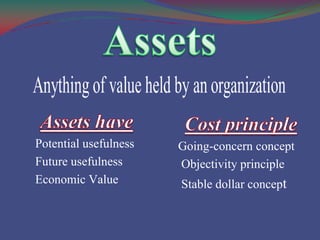
Potential usefulness
Future usefulness
Economic Value

Going-concern concept
Objectivity principle
Stable dollar concept
climes against the total assets of an
organization
Claims of no owners
Owner's Equity
Claims of owners
Cumulative total of net income, net loss, and
dividends since start of business
Inflows of assets that result from performing
services or selling goods

the service is performed or
the goods are delivered
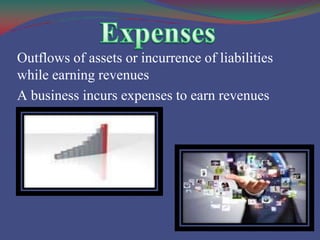
Outflows of assets or incurrence of liabilities
while earning revenues
A business incurs expenses to earn revenues
Things of Value = Claims
Assets = Equities
Assets = Liabilities + Owner's Equity
Assets - Liabilities = Net Assets
Use accounting equation
Is there a change in assets?

How much was the change?
Is there another change in assets?
Is there a change in liabilities?

How much was the change?
Is there another change in liabilities?
Is there a change in owners’ equity?
How much was the change?
1)
2)
3)

4)

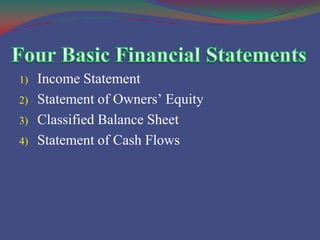
Income Statement
Statement of Owners’ Equity
Classified Balance Sheet
Statement of Cash Flows
Reports changes in owners’ equity from operating
activities
Changes in owners’ interest in assets
Issuances of new stock

Net income or loss
Dividends
Classification - arrangement of financial
statement items into groupings that have
common basis

Current
Property, plant, and equipment
Current
Long-tern

Common stock
Retained earnings
Reports cash flows during period

Operating activities
Investing activities
Financing activities
Are total assets higher or lower?
What is percent change in total assets?
Is the percent of total liabilities to total liabilities
plus owner’s equity increasing or decreasing?
Are revenues higher or lower?
What is the percentage change in total revenues?
Is the percentage of total expenses to total
revenues increasing or decreasing?
Is the business operating efficiently by using the least
amount of asset investment to generate a given level
of total revenues?

Total revenues
divided by
Average total assets
accounting information system

accounting information system

  • 2.
    Potential usefulness Future usefulness EconomicValue Going-concern concept Objectivity principle Stable dollar concept
  • 3.
    climes against thetotal assets of an organization Claims of no owners Owner's Equity Claims of owners
  • 4.
    Cumulative total ofnet income, net loss, and dividends since start of business
  • 5.
    Inflows of assetsthat result from performing services or selling goods the service is performed or the goods are delivered
  • 6.
    Outflows of assetsor incurrence of liabilities while earning revenues A business incurs expenses to earn revenues
  • 7.
    Things of Value= Claims Assets = Equities Assets = Liabilities + Owner's Equity Assets - Liabilities = Net Assets
  • 8.
    Use accounting equation Isthere a change in assets? How much was the change? Is there another change in assets? Is there a change in liabilities? How much was the change? Is there another change in liabilities? Is there a change in owners’ equity? How much was the change?
  • 10.
    1) 2) 3) 4) Income Statement Statement ofOwners’ Equity Classified Balance Sheet Statement of Cash Flows
  • 11.
    Reports changes inowners’ equity from operating activities
  • 12.
    Changes in owners’interest in assets Issuances of new stock Net income or loss Dividends
  • 13.
    Classification - arrangementof financial statement items into groupings that have common basis Current Property, plant, and equipment
  • 14.
  • 15.
    Reports cash flowsduring period Operating activities Investing activities Financing activities
  • 17.
    Are total assetshigher or lower? What is percent change in total assets? Is the percent of total liabilities to total liabilities plus owner’s equity increasing or decreasing?
  • 18.
    Are revenues higheror lower? What is the percentage change in total revenues? Is the percentage of total expenses to total revenues increasing or decreasing?
  • 19.
    Is the businessoperating efficiently by using the least amount of asset investment to generate a given level of total revenues? Total revenues divided by Average total assets