

Fundamentals of Accounting
Visit www.afzalur.com for more content
Chapter 1
Fundamentals of Accounting
www.afzalur.com
Fundamentals of Accounting
CHAPTER AT A GLANCE (Chapter 1)
1.01 Meaning and Definition of Accounting
1.02 Attributes (Characteristics) of Accounting
1.03 Accounting Process
1.04 Difference between Book Keeping, Accounting and
Accountancy
1.05 Objectives of Accounting
1.06 Advantages of Accounting
1.07 Limitations of Accounting
1.08 Users of Accounting Information
1.09 Branches or Sub-fields of Accounting
1.10 Systems of Accounting
www.afzalur.com
Fundamentals of Accounting
1.01
MEANING AND DEFINITION OF ACCOUNTING
Accounting is an art of
 recording,
 classifying and
 summarizing
 in a significant manner and
 in terms of money,
 transactions and events
 which are of a financial character and
 interpreting the result thereof.
www.afzalur.com
Fundamentals of Accounting
1.02
CHARACTERISTICS OF ACCOUNTING
 Transactions and events that are of financial character
are recorded.
 Transactions are recorded in terms of Money.
www.afzalur.com
Fundamentals of Accounting
1.03
FUNCTIONS OF ACCOUNTING
i) Recording:
Recording is a process in which transactions are
recorded in the books of original entries,
i.e. in Journal Books.
Journal Book is sub-divided into subsidiary books
according to the number of transactions of particular
category.
www.afzalur.com
Fundamentals of Accounting
1.03
FUNCTIONS OF ACCOUNTING
These subsidiary books are:
 Cash Book
 Purchases Book
 Purchases Return Book
 Sales Book
 Sales Return Book
 Bills Receivable Book
 Bills Payable Book
www.afzalur.com
Fundamentals of Accounting
1.03
FUNCTIONS OF ACCOUNTING
Cash Book to record cash and bank transactions. Cash
book may be-:
 Single Column Cash Book
 Two Column Cash Book
 Three Column Cash Book
www.afzalur.com
Fundamentals of Accounting
1.03
FUNCTIONS OF ACCOUNTING
ii) Classifying:
 Classification means transactions or entries of one
nature are grouped under one head of account.
 The transactions recorded in ‘Journal’ or the
‘Subsidiary Books’ are classified or posted to the
‘Ledger Account’.
 Ledger is the book that contains individual account
heads under which all financial transactions of a
similar nature are collected.
www.afzalur.com
Fundamentals of Accounting
1.03
FUNCTIONS OF ACCOUNTING
iii) Summarizing:
Summarizing is presenting the classified data in a form that is
understandable and useful to users of accounting
information.
It means preparation of Trial Balance, leading to preparation
of financial statements i.e.
 Trading and Profit and Loss Account, and
 Balance Sheet.
Profit and Loss Account and Balance Sheet are collectively
known as’ Final Accounts or Financial Statements’.
www.afzalur.com
Fundamentals of Accounting
1.03
FUNCTIONS OF ACCOUNTING
iv) Analysis and Interpretation:
Analysis and interpretation means
 analyzing and then interpreting the financial data
 to make a meaningful judgment of the profitability
and financial position of the business.
 It helps in planning the future in a better way.
www.afzalur.com
Fundamentals of Accounting
1.03
FUNCTIONS OF ACCOUNTING
v) Communicating
 Finally, the accounting function is to communicate the
financial data to the users.
www.afzalur.com
Fundamentals of Accounting
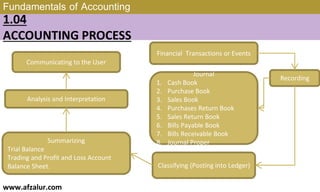
Financial Transactions or
Events
RecordingJournal
1. Cash Book
2. Purchase Book
3. Sales Book
4. Purchases Return Book
5. Sales Return Book
6. Bills Payable Book
7. Bills Receivable Book
8. Journal Proper
Classifying (Posting into
Ledger)
Summarizing
Trial Balance
Trading and Profit and Loss Account
Balance Sheet.
Analysis and Interpretation
Communicating to the User
1.04
ACCOUNTING PROCESS
www.afzalur.com
Fundamentals of Accounting
1.05
BOOK KEEPING
 Book Keeping is a part of accounting and is concerned
with recording financial transactions and events in the
books of accounts following accounting concepts and
principles.
Thus, Book Keeping is concerned with:
• Identifying financial transactions and events;
• Measuring them in terms of money;
• Recording the financial transactions and events so
identified in the books of accounts; and
• Classifying recorded transactions and events, i.e.,
posting them into Ledger accounts.
www.afzalur.com
Fundamentals of Accounting
1.06
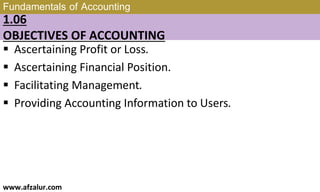
OBJECTIVES OF ACCOUNTING
 Ascertaining Profit or Loss.
 Ascertaining Financial Position.
 Facilitating Management.
 Providing Accounting Information to Users.
www.afzalur.com
Fundamentals of Accounting
1.07
ADVANTAGES OF ACCOUNTING
 Financial Information about Business.
 Assistance to Management.
 Replaces Memory.
 Facilitates Comparative Study.
 Facilitates Settlement of Tax Liabilities.
 Facilitates Loans.
 Evidence in Court.
 Assistance in the Event of Insolvency.
 Helpful in settlement of accounts.
www.afzalur.com
Fundamentals of Accounting
1.08
LIMITATIONS OF ACCOUNTING
1. It is Not Fully Exact.
Accounting is based on evidences but yet estimates are
also made for ascertaining profit or loss. Examples are
 estimating the useful life of an asset,
 bad debts,
 market price of closing stock, etc.
www.afzalur.com
Fundamentals of Accounting
1.08
LIMITATIONS OF ACCOUNTING
2. It Ignores the Qualitative Elements.
Since accounting is confined to monetary matters only,
qualitative elements like
 quality of management
 labour force
 industrial relations
 public relations
 are ignored.
www.afzalur.com
Fundamentals of Accounting
1.08
LIMITATIONS OF ACCOUNTING
3. It Ignores the Effect of Price Level Changes.
 Accounting statements are prepared at historical cost.
Money, as a measurement unit, changes in value.
 Since Price Level Changes are not considered
 the financial statements do not show correct financial
status.
www.afzalur.com
Fundamentals of Accounting
1.08
LIMITATIONS OF ACCOUNTING
4. Accounting May Lead to Window Dressing.
The term window dressing means
 manipulation of accounts
 to conceal vital facts
 present better or worse financial position than actual
 In this situation, income statement fails to provide a
true and fair view of the result of operations and
 the Balance Sheet fails to provide a true and fair view
of the financial position of the enterprise.
www.afzalur.com
Fundamentals of Accounting
1.10
SYSTEMS OF ACCOUNTING
The systems of recording transactions in the books of
accounts are classified into two types:
(a) Double Entry System of Accounting
(b) Single Entry System of Accounting
www.afzalur.com
Fundamentals of Accounting
1.10
SYSTEMS OF ACCOUNTING
(a) Double Entry System of Accounting
 Double entry system of accounting has two aspects—
Debit and Credit.
 At the time of recording a transaction,
 it is recorded once on the debit side and
 again on the credit side.
www.afzalur.com
Fundamentals of Accounting
1.10
SYSTEMS OF ACCOUNTING
For example, at the time of cash purchases, goods are
acquired and in return cash is paid.
In this transaction, two aspects are involved
 receiving goods
 paying cash.
Under the Double Entry System, both these aspects are
recorded.
This system is universally applied in accounting.
www.afzalur.com
Fundamentals of Accounting
1.10
SYSTEMS OF ACCOUNTING
(b) Single Entry System of Accounting
 Single Entry System of accounting may be defined as a
system, which is an incomplete double entry system.
 In this system, all transactions are not recorded on the
double entry basis.
www.afzalur.com
Fundamentals of Accounting
1.11
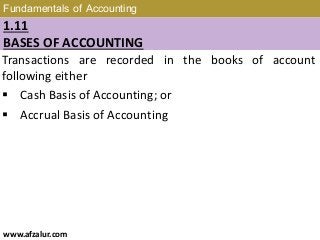
BASES OF ACCOUNTING
Transactions are recorded in the books of account
following either
 Cash Basis of Accounting; or
 Accrual Basis of Accounting
www.afzalur.com
Fundamentals of Accounting
1.11
BASES OF ACCOUNTING
Cash Basis Of Accounting
Cash Basis of Accounting is a method in which
 income is recorded when cash is received, and
 expenses are recorded when cash is paid out.
www.afzalur.com
Fundamentals of Accounting
1.11
BASES OF ACCOUNTING
Cash Basis Of Accounting (Contd…)
Advantages:
(i) It is simple as adjustment entries are not required.
(ii) This approach is more objective as very few estimates
and judgments are required.
(iii) This basis of accounting is suitable for those
enterprises where most of the transactions are on a
cash basis.
www.afzalur.com
Fundamentals of Accounting
1.11
BASES OF ACCOUNTING
Cash Basis Of Accounting (Contd...)
Disadvantages
(i) It does not give a true and fair view of the profit or
loss and the financial position of an enterprise
because
 it ignores outstanding and prepaid expenses,
 accrued incomes and incomes received in advance.
(ii) It does not follow the matching principle of
accounting.
www.afzalur.com
Fundamentals of Accounting
1.11
BASES OF ACCOUNTING
Cash Basis Of Accounting
Disadvantages: (Contd...)
(iii) actual cash inflows and outflows are considered.
Therefore there is great possibility of profit
manipulation.
www.afzalur.com
Fundamentals of Accounting
1.11
BASES OF ACCOUNTING
Accrual Basis of Accounting
 System of accounting is based on 'accrual concept'
 Revenue is recognized (recorded) when earned
 Expenses are recognized when incurred.
Under this system
Income earned and expenditure incurred is recognised
irrespective of cash received or cash paid.
www.afzalur.com
Fundamentals of Accounting
1.11
BASES OF ACCOUNTING
Accrual Basis of Accounting (Contd...)
It is based on two basic accounting principles,
 Revenue Recognition Concept
 Matching Concept
www.afzalur.com
Fundamentals of Accounting
1.11
BASES OF ACCOUNTING
Accrual Basis of Accounting (Contd…)
Revenue Recognition Concept
Accounting rule that revenue should be recorded only
when the
(1) revenue generation process has been substantially
completed, and
(2) an exchange has taken place. It is a restatement of the
old maxim: "Don't count your chickens until they are
hatched."
www.afzalur.com
Fundamentals of Accounting
1.11
BASES OF ACCOUNTING
Accrual Basis of Accounting (Contd...)
Matching Concept
 Fundamental concept of accrual basis accounting that
offsets revenue against expenses on the basis of their
cause-and-effect relationship.
 It requires that, in measuring net income for an
accounting period,
 the costs incurred in that period should be matched
against the revenue generated in the same period.
www.afzalur.com
Fundamentals of Accounting
1.11
BASES OF ACCOUNTING
Accrual Basis of Accounting (Contd...)
Advantages:
(i) It is more scientific compared to Cash Basis
(ii) This basis of accounting shows a complete picture
(iii) This system discloses correct profit or loss for a
particular period and also exhibits true financial
position of the business on a particular day.
(iv) It reflects correct profit or loss during the accounting
period
www.afzalur.com
Fundamentals of Accounting
1.11
BASES OF ACCOUNTING
Disadvantages:
(i) This system is not as simple as Cash Basis of
Accounting.
(ii) The accounting process under this basis is too
elaborate.
(iii) A quick appraisal of the profit/loss is not possible
because many adjustments are required to ascertain
the true financial position of the business.
www.afzalur.com
Fundamentals of Accounting
Example
Illustration
During the financial year 2009 – 10, Ashok had cash sales
of Rs. 3,90,000 and
credit sales of Rs. 1,60,000.
His expenses for the year were Rs. 2,70,000
out of which Rs. 80,000 are yet to be paid.
Find out Ashok’s income for 2009 – 10 under both the
bases of Accounting.
www.afzalur.com
Fundamentals of Accounting
(i)
When Cash Basis of Accounting is followed:
www.afzalur.com
Solution
Revenue (inflow of Cash i.e. Cash Sale) 3,90,000
Less: Expenses (Outflow of Cash)
(Rs.2,70,000 – Rs.80,000)
1,90,000
Net Income 2,00,000
Credit sales and outstanding expenses will not be
considered under Cash Basis of Accounting.
Fundamentals of Accounting
(ii)
When Accrual Basis of Accounting is followed:
www.afzalur.com
Solution
Total Sales = Cash Sales (Rs.3,90,000) + Credit
Sales (Rs.1,60,000)
5,50,000
Less: Total Expenses for the Year 2,70,000
Net Income 2,80,000
Note: Rs. 80,000 on account of expenses still to be paid
relate to this year and hence are to be charged to the
revenue of this year. Similarly, credit sales of Rs.1,60,000 is
taken in the year in which sales transaction is done.
Fundamentals of Accounting
Visit afzalur.com
www.afzalur.com

Chapter 1: Fundamentals of Accounting

  • 1.
    Fundamentals of Accounting Visitwww.afzalur.com for more content Chapter 1 Fundamentals of Accounting www.afzalur.com
  • 2.
    Fundamentals of Accounting CHAPTERAT A GLANCE (Chapter 1) 1.01 Meaning and Definition of Accounting 1.02 Attributes (Characteristics) of Accounting 1.03 Accounting Process 1.04 Difference between Book Keeping, Accounting and Accountancy 1.05 Objectives of Accounting 1.06 Advantages of Accounting 1.07 Limitations of Accounting 1.08 Users of Accounting Information 1.09 Branches or Sub-fields of Accounting 1.10 Systems of Accounting www.afzalur.com
  • 3.
    Fundamentals of Accounting 1.01 MEANINGAND DEFINITION OF ACCOUNTING Accounting is an art of  recording,  classifying and  summarizing  in a significant manner and  in terms of money,  transactions and events  which are of a financial character and  interpreting the result thereof. www.afzalur.com
  • 4.
    Fundamentals of Accounting 1.02 CHARACTERISTICSOF ACCOUNTING  Transactions and events that are of financial character are recorded.  Transactions are recorded in terms of Money. www.afzalur.com
  • 5.
    Fundamentals of Accounting 1.03 FUNCTIONSOF ACCOUNTING i) Recording: Recording is a process in which transactions are recorded in the books of original entries, i.e. in Journal Books. Journal Book is sub-divided into subsidiary books according to the number of transactions of particular category. www.afzalur.com
  • 6.
    Fundamentals of Accounting 1.03 FUNCTIONSOF ACCOUNTING These subsidiary books are:  Cash Book  Purchases Book  Purchases Return Book  Sales Book  Sales Return Book  Bills Receivable Book  Bills Payable Book www.afzalur.com
  • 7.
    Fundamentals of Accounting 1.03 FUNCTIONSOF ACCOUNTING Cash Book to record cash and bank transactions. Cash book may be-:  Single Column Cash Book  Two Column Cash Book  Three Column Cash Book www.afzalur.com
  • 8.
    Fundamentals of Accounting 1.03 FUNCTIONSOF ACCOUNTING ii) Classifying:  Classification means transactions or entries of one nature are grouped under one head of account.  The transactions recorded in ‘Journal’ or the ‘Subsidiary Books’ are classified or posted to the ‘Ledger Account’.  Ledger is the book that contains individual account heads under which all financial transactions of a similar nature are collected. www.afzalur.com
  • 9.
    Fundamentals of Accounting 1.03 FUNCTIONSOF ACCOUNTING iii) Summarizing: Summarizing is presenting the classified data in a form that is understandable and useful to users of accounting information. It means preparation of Trial Balance, leading to preparation of financial statements i.e.  Trading and Profit and Loss Account, and  Balance Sheet. Profit and Loss Account and Balance Sheet are collectively known as’ Final Accounts or Financial Statements’. www.afzalur.com
  • 10.
    Fundamentals of Accounting 1.03 FUNCTIONSOF ACCOUNTING iv) Analysis and Interpretation: Analysis and interpretation means  analyzing and then interpreting the financial data  to make a meaningful judgment of the profitability and financial position of the business.  It helps in planning the future in a better way. www.afzalur.com
  • 11.
    Fundamentals of Accounting 1.03 FUNCTIONSOF ACCOUNTING v) Communicating  Finally, the accounting function is to communicate the financial data to the users. www.afzalur.com
  • 12.
    Fundamentals of Accounting FinancialTransactions or Events RecordingJournal 1. Cash Book 2. Purchase Book 3. Sales Book 4. Purchases Return Book 5. Sales Return Book 6. Bills Payable Book 7. Bills Receivable Book 8. Journal Proper Classifying (Posting into Ledger) Summarizing Trial Balance Trading and Profit and Loss Account Balance Sheet. Analysis and Interpretation Communicating to the User 1.04 ACCOUNTING PROCESS www.afzalur.com
  • 13.
    Fundamentals of Accounting 1.05 BOOKKEEPING  Book Keeping is a part of accounting and is concerned with recording financial transactions and events in the books of accounts following accounting concepts and principles. Thus, Book Keeping is concerned with: • Identifying financial transactions and events; • Measuring them in terms of money; • Recording the financial transactions and events so identified in the books of accounts; and • Classifying recorded transactions and events, i.e., posting them into Ledger accounts. www.afzalur.com
  • 14.
    Fundamentals of Accounting 1.06 OBJECTIVESOF ACCOUNTING  Ascertaining Profit or Loss.  Ascertaining Financial Position.  Facilitating Management.  Providing Accounting Information to Users. www.afzalur.com
  • 15.
    Fundamentals of Accounting 1.07 ADVANTAGESOF ACCOUNTING  Financial Information about Business.  Assistance to Management.  Replaces Memory.  Facilitates Comparative Study.  Facilitates Settlement of Tax Liabilities.  Facilitates Loans.  Evidence in Court.  Assistance in the Event of Insolvency.  Helpful in settlement of accounts. www.afzalur.com
  • 16.
    Fundamentals of Accounting 1.08 LIMITATIONSOF ACCOUNTING 1. It is Not Fully Exact. Accounting is based on evidences but yet estimates are also made for ascertaining profit or loss. Examples are  estimating the useful life of an asset,  bad debts,  market price of closing stock, etc. www.afzalur.com
  • 17.
    Fundamentals of Accounting 1.08 LIMITATIONSOF ACCOUNTING 2. It Ignores the Qualitative Elements. Since accounting is confined to monetary matters only, qualitative elements like  quality of management  labour force  industrial relations  public relations  are ignored. www.afzalur.com
  • 18.
    Fundamentals of Accounting 1.08 LIMITATIONSOF ACCOUNTING 3. It Ignores the Effect of Price Level Changes.  Accounting statements are prepared at historical cost. Money, as a measurement unit, changes in value.  Since Price Level Changes are not considered  the financial statements do not show correct financial status. www.afzalur.com
  • 19.
    Fundamentals of Accounting 1.08 LIMITATIONSOF ACCOUNTING 4. Accounting May Lead to Window Dressing. The term window dressing means  manipulation of accounts  to conceal vital facts  present better or worse financial position than actual  In this situation, income statement fails to provide a true and fair view of the result of operations and  the Balance Sheet fails to provide a true and fair view of the financial position of the enterprise. www.afzalur.com
  • 20.
  • 21.
    Fundamentals of Accounting 1.10 SYSTEMSOF ACCOUNTING The systems of recording transactions in the books of accounts are classified into two types: (a) Double Entry System of Accounting (b) Single Entry System of Accounting www.afzalur.com
  • 22.
    Fundamentals of Accounting 1.10 SYSTEMSOF ACCOUNTING (a) Double Entry System of Accounting  Double entry system of accounting has two aspects— Debit and Credit.  At the time of recording a transaction,  it is recorded once on the debit side and  again on the credit side. www.afzalur.com
  • 23.
    Fundamentals of Accounting 1.10 SYSTEMSOF ACCOUNTING For example, at the time of cash purchases, goods are acquired and in return cash is paid. In this transaction, two aspects are involved  receiving goods  paying cash. Under the Double Entry System, both these aspects are recorded. This system is universally applied in accounting. www.afzalur.com
  • 24.
    Fundamentals of Accounting 1.10 SYSTEMSOF ACCOUNTING (b) Single Entry System of Accounting  Single Entry System of accounting may be defined as a system, which is an incomplete double entry system.  In this system, all transactions are not recorded on the double entry basis. www.afzalur.com
  • 25.
    Fundamentals of Accounting 1.11 BASESOF ACCOUNTING Transactions are recorded in the books of account following either  Cash Basis of Accounting; or  Accrual Basis of Accounting www.afzalur.com
  • 26.
    Fundamentals of Accounting 1.11 BASESOF ACCOUNTING Cash Basis Of Accounting Cash Basis of Accounting is a method in which  income is recorded when cash is received, and  expenses are recorded when cash is paid out. www.afzalur.com
  • 27.
    Fundamentals of Accounting 1.11 BASESOF ACCOUNTING Cash Basis Of Accounting (Contd…) Advantages: (i) It is simple as adjustment entries are not required. (ii) This approach is more objective as very few estimates and judgments are required. (iii) This basis of accounting is suitable for those enterprises where most of the transactions are on a cash basis. www.afzalur.com
  • 28.
    Fundamentals of Accounting 1.11 BASESOF ACCOUNTING Cash Basis Of Accounting (Contd...) Disadvantages (i) It does not give a true and fair view of the profit or loss and the financial position of an enterprise because  it ignores outstanding and prepaid expenses,  accrued incomes and incomes received in advance. (ii) It does not follow the matching principle of accounting. www.afzalur.com
  • 29.
    Fundamentals of Accounting 1.11 BASESOF ACCOUNTING Cash Basis Of Accounting Disadvantages: (Contd...) (iii) actual cash inflows and outflows are considered. Therefore there is great possibility of profit manipulation. www.afzalur.com
  • 30.
    Fundamentals of Accounting 1.11 BASESOF ACCOUNTING Accrual Basis of Accounting  System of accounting is based on 'accrual concept'  Revenue is recognized (recorded) when earned  Expenses are recognized when incurred. Under this system Income earned and expenditure incurred is recognised irrespective of cash received or cash paid. www.afzalur.com
  • 31.
    Fundamentals of Accounting 1.11 BASESOF ACCOUNTING Accrual Basis of Accounting (Contd...) It is based on two basic accounting principles,  Revenue Recognition Concept  Matching Concept www.afzalur.com
  • 32.
    Fundamentals of Accounting 1.11 BASESOF ACCOUNTING Accrual Basis of Accounting (Contd…) Revenue Recognition Concept Accounting rule that revenue should be recorded only when the (1) revenue generation process has been substantially completed, and (2) an exchange has taken place. It is a restatement of the old maxim: "Don't count your chickens until they are hatched." www.afzalur.com
  • 33.
    Fundamentals of Accounting 1.11 BASESOF ACCOUNTING Accrual Basis of Accounting (Contd...) Matching Concept  Fundamental concept of accrual basis accounting that offsets revenue against expenses on the basis of their cause-and-effect relationship.  It requires that, in measuring net income for an accounting period,  the costs incurred in that period should be matched against the revenue generated in the same period. www.afzalur.com
  • 34.
    Fundamentals of Accounting 1.11 BASESOF ACCOUNTING Accrual Basis of Accounting (Contd...) Advantages: (i) It is more scientific compared to Cash Basis (ii) This basis of accounting shows a complete picture (iii) This system discloses correct profit or loss for a particular period and also exhibits true financial position of the business on a particular day. (iv) It reflects correct profit or loss during the accounting period www.afzalur.com
  • 35.
    Fundamentals of Accounting 1.11 BASESOF ACCOUNTING Disadvantages: (i) This system is not as simple as Cash Basis of Accounting. (ii) The accounting process under this basis is too elaborate. (iii) A quick appraisal of the profit/loss is not possible because many adjustments are required to ascertain the true financial position of the business. www.afzalur.com
  • 36.
    Fundamentals of Accounting Example Illustration Duringthe financial year 2009 – 10, Ashok had cash sales of Rs. 3,90,000 and credit sales of Rs. 1,60,000. His expenses for the year were Rs. 2,70,000 out of which Rs. 80,000 are yet to be paid. Find out Ashok’s income for 2009 – 10 under both the bases of Accounting. www.afzalur.com
  • 37.
    Fundamentals of Accounting (i) WhenCash Basis of Accounting is followed: www.afzalur.com Solution Revenue (inflow of Cash i.e. Cash Sale) 3,90,000 Less: Expenses (Outflow of Cash) (Rs.2,70,000 – Rs.80,000) 1,90,000 Net Income 2,00,000 Credit sales and outstanding expenses will not be considered under Cash Basis of Accounting.
  • 38.
    Fundamentals of Accounting (ii) WhenAccrual Basis of Accounting is followed: www.afzalur.com Solution Total Sales = Cash Sales (Rs.3,90,000) + Credit Sales (Rs.1,60,000) 5,50,000 Less: Total Expenses for the Year 2,70,000 Net Income 2,80,000 Note: Rs. 80,000 on account of expenses still to be paid relate to this year and hence are to be charged to the revenue of this year. Similarly, credit sales of Rs.1,60,000 is taken in the year in which sales transaction is done.
  • 39.
    Fundamentals of Accounting Visitafzalur.com www.afzalur.com