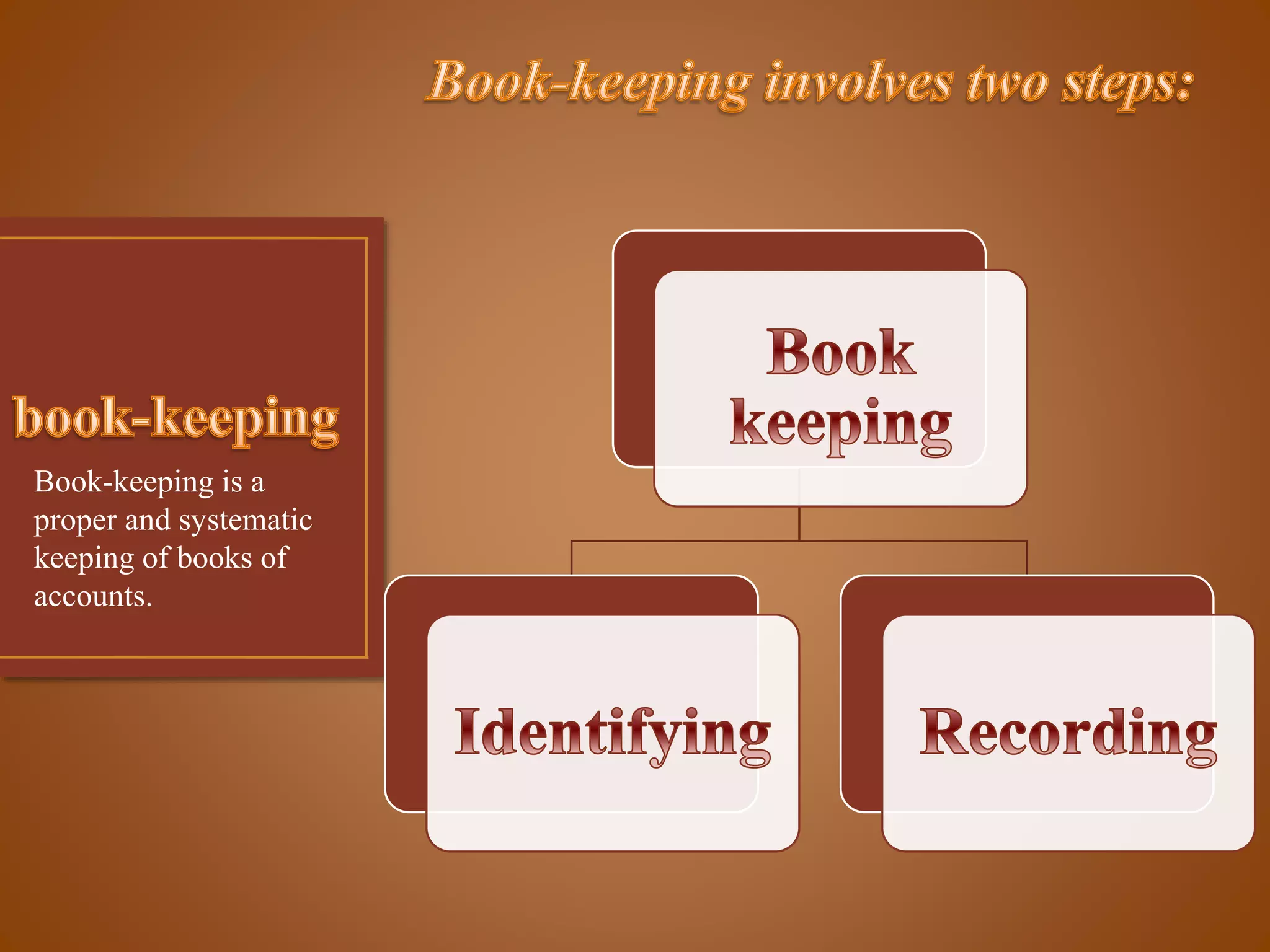
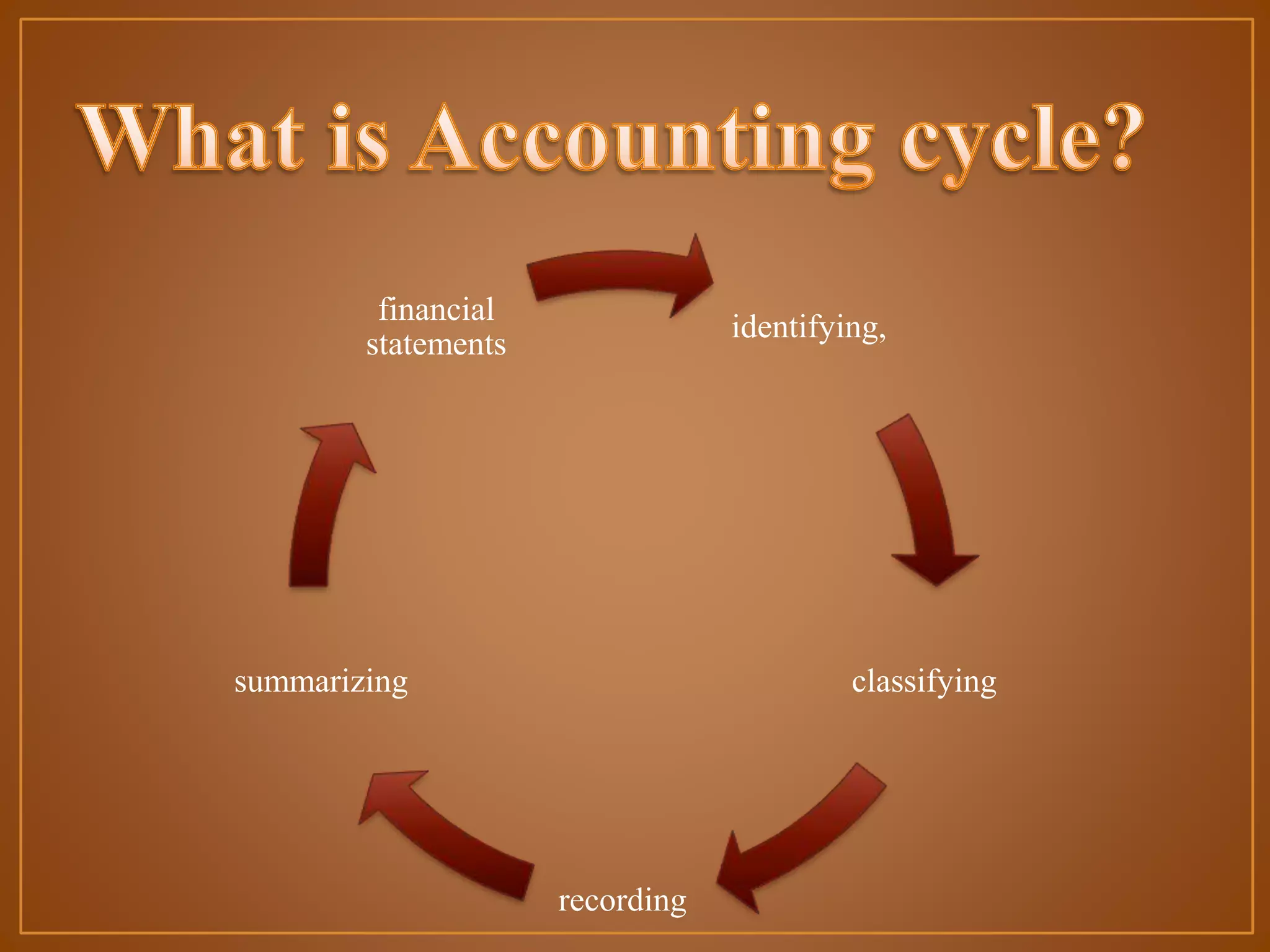

It is the art of identifying, classifying, recording, summarizing
and interpreting the business transaction of financial nature.
o It is the art and science of studying the accounting
and accounts of a business.
o It is the art of identifying, classifying, recording,
summarizing and interpreting the business transaction
of financial nature.

o This involves recording of transaction pertaining to
one person or thing under one head.
Book-keeping is a
proper and systematic
keeping of books of
accounts.
financial
statements

identifying,

summarizing

classifying

recording
.
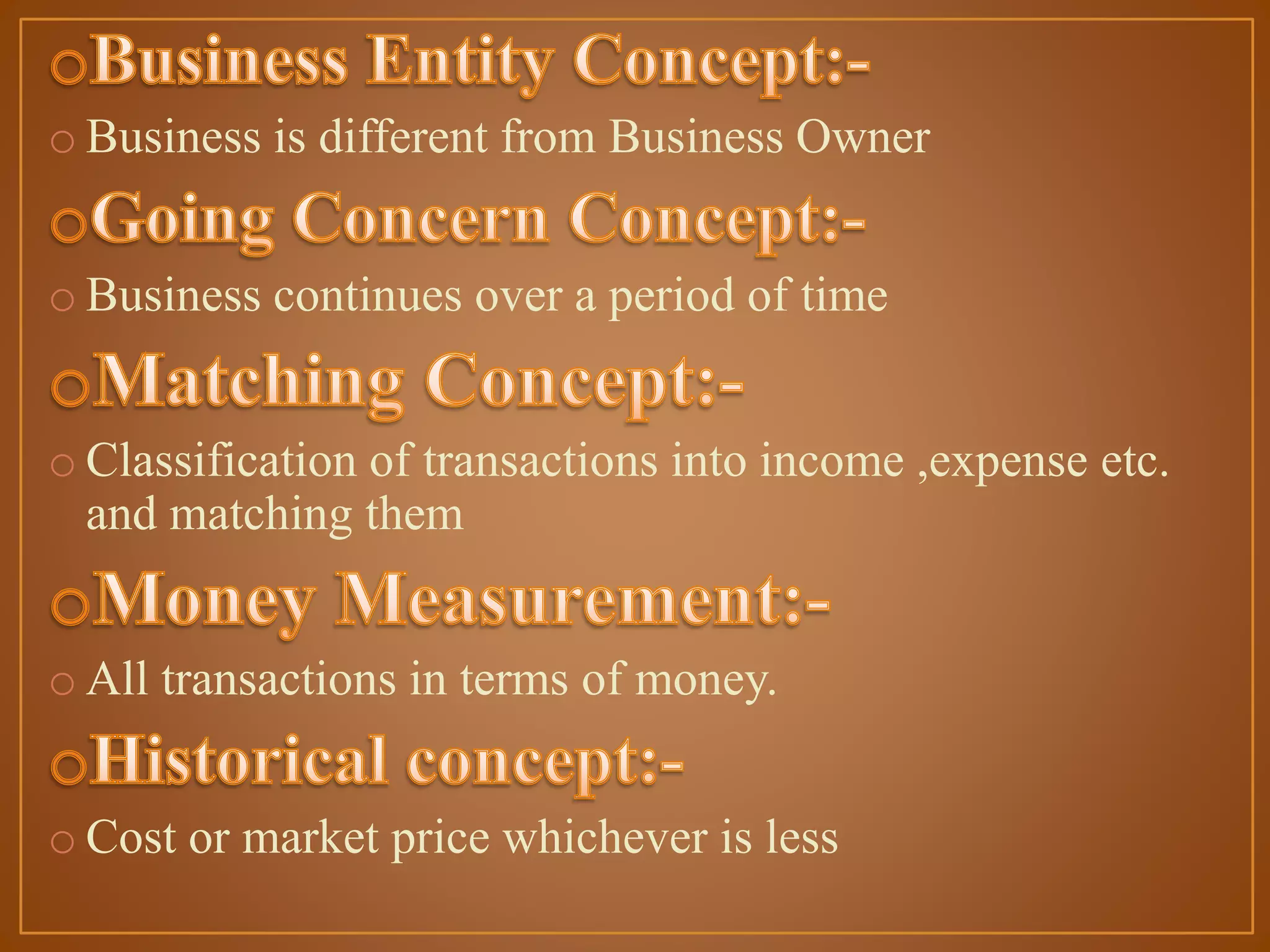
o Business is different from Business Owner
o Business continues over a period of time
o Classification of transactions into income ,expense etc.
and matching them
o All transactions in terms of money.
o Cost or market price whichever is less
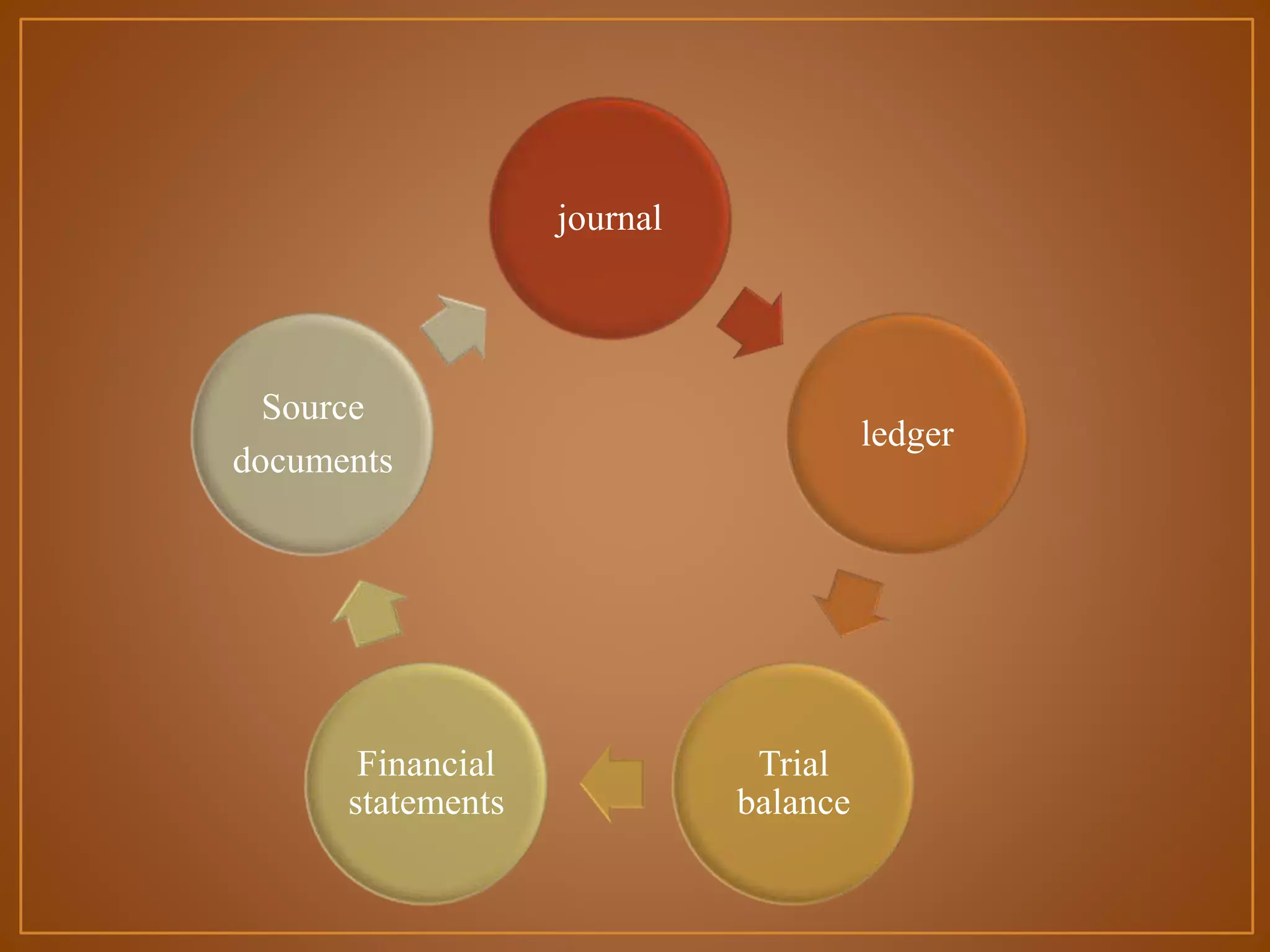
journal

Source
documents

Financial
statements

ledger

Trial
balance
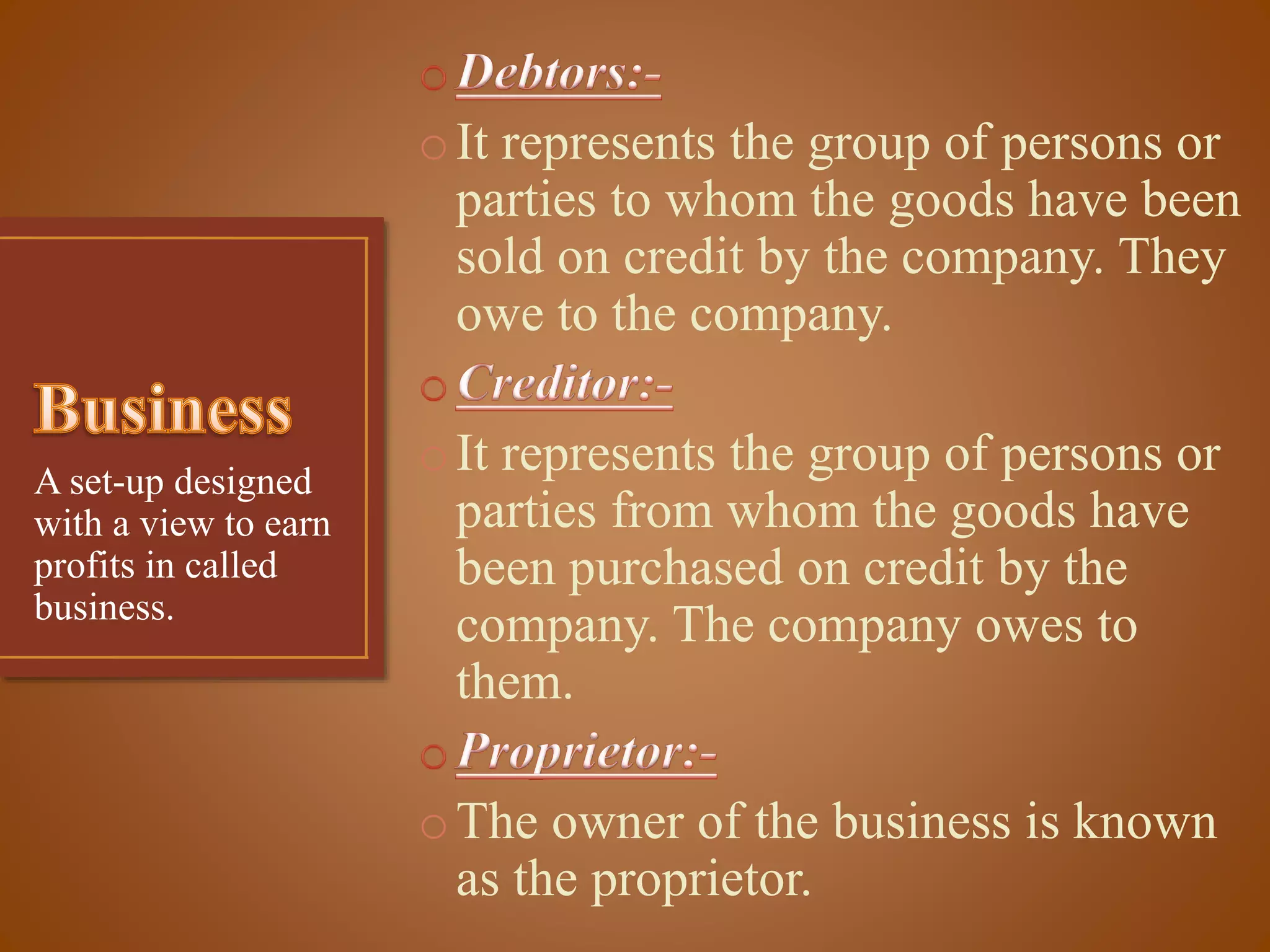
o It represents the group of persons or
parties to whom the goods have been
sold on credit by the company. They
owe to the company.
A set-up designed
with a view to earn
profits in called
business.

o It represents the group of persons or
parties from whom the goods have
been purchased on credit by the
company. The company owes to
them.
o The owner of the business is known
as the proprietor.
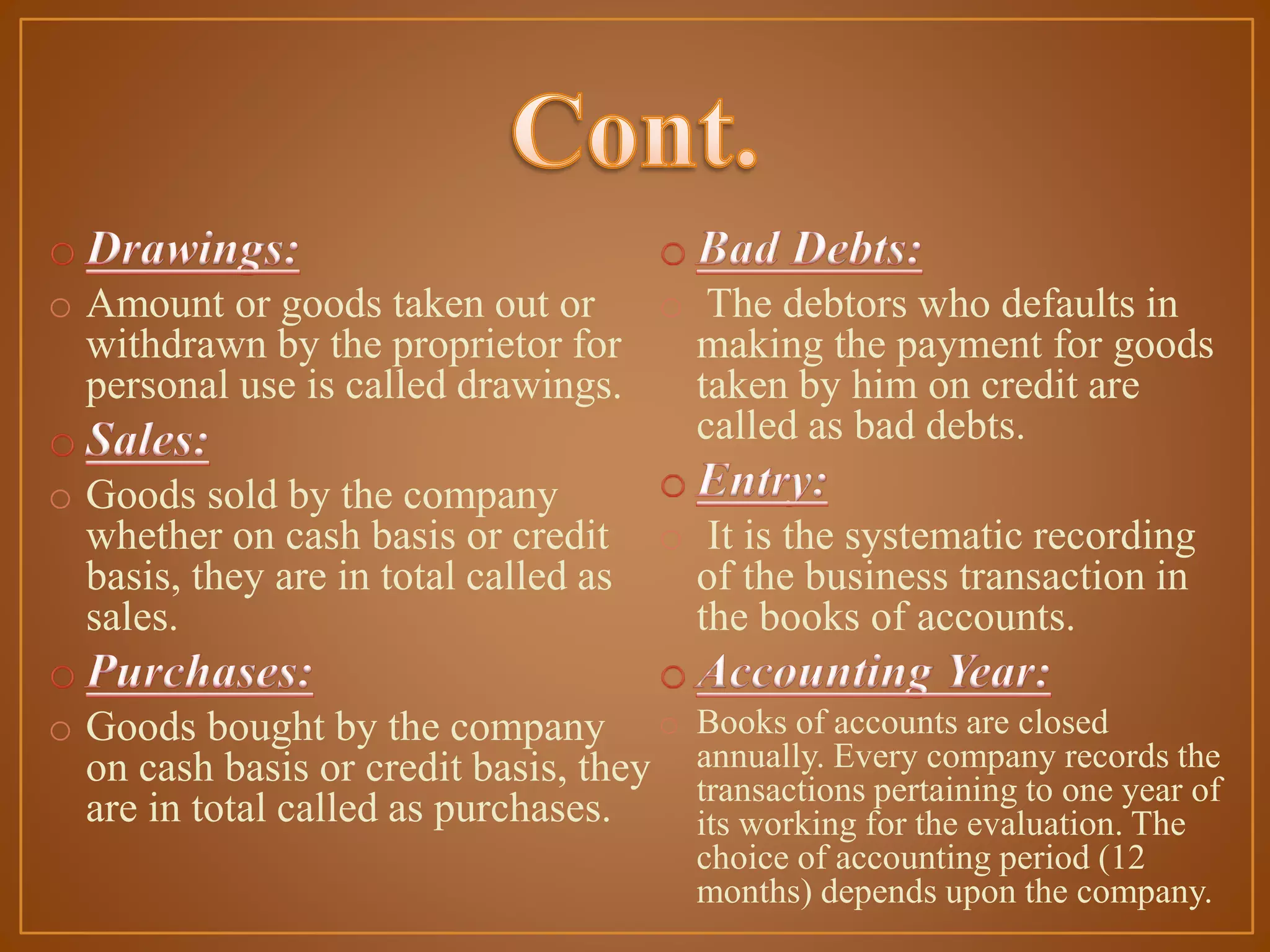
o Amount or goods taken out or
o The debtors who defaults in
withdrawn by the proprietor for
making the payment for goods
personal use is called drawings.
taken by him on credit are
called as bad debts.
o Goods sold by the company
whether on cash basis or credit
basis, they are in total called as
sales.

o It is the systematic recording
of the business transaction in
the books of accounts.

o Goods bought by the company o
on cash basis or credit basis, they
are in total called as purchases.

Books of accounts are closed
annually. Every company records the
transactions pertaining to one year of
its working for the evaluation. The
choice of accounting period (12
months) depends upon the company.
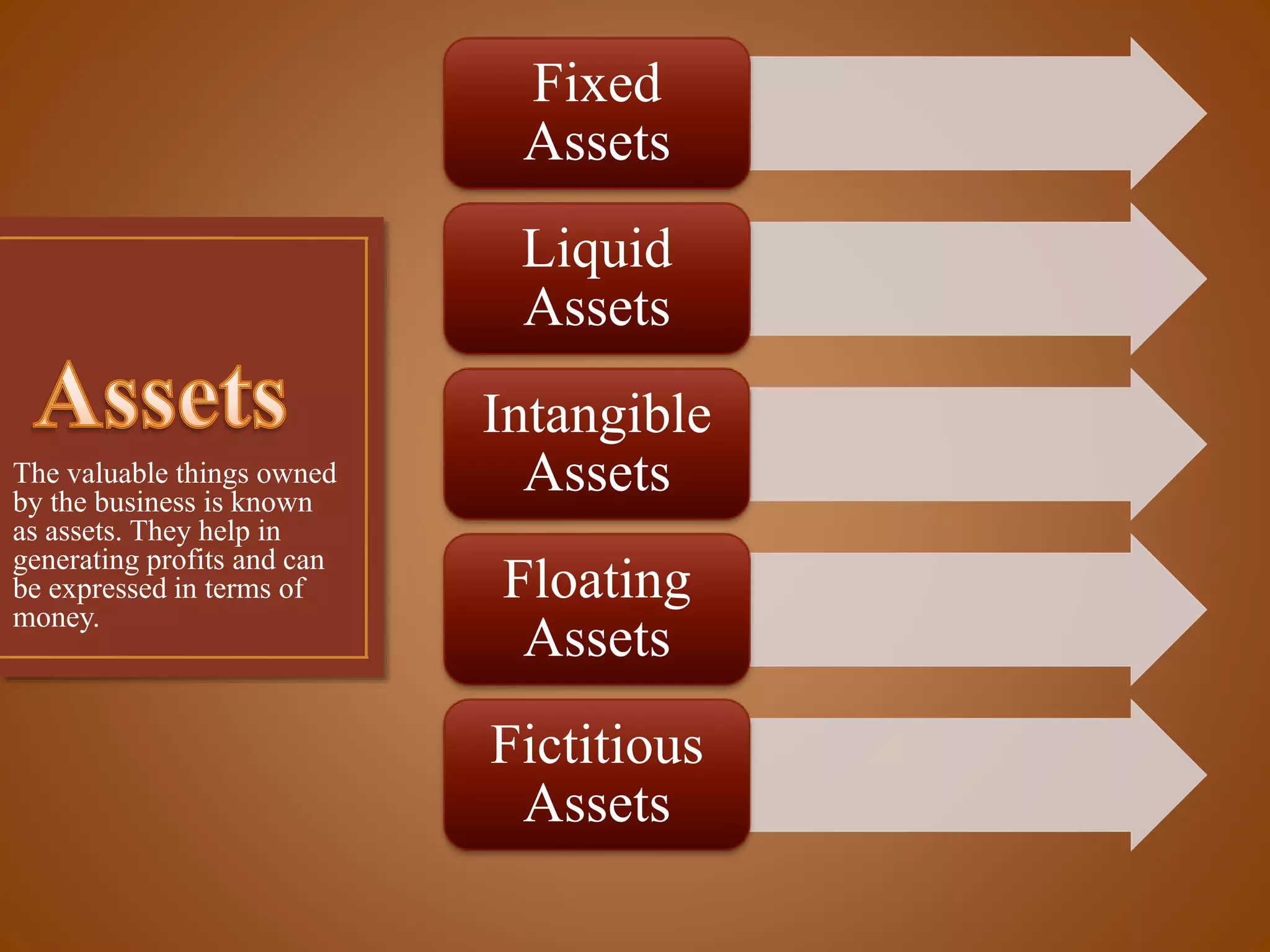
Fixed
Assets
Liquid
Assets
The valuable things owned
by the business is known
as assets. They help in
generating profits and can
be expressed in terms of
money.

Intangible
Assets

Floating
Assets
Fictitious
Assets
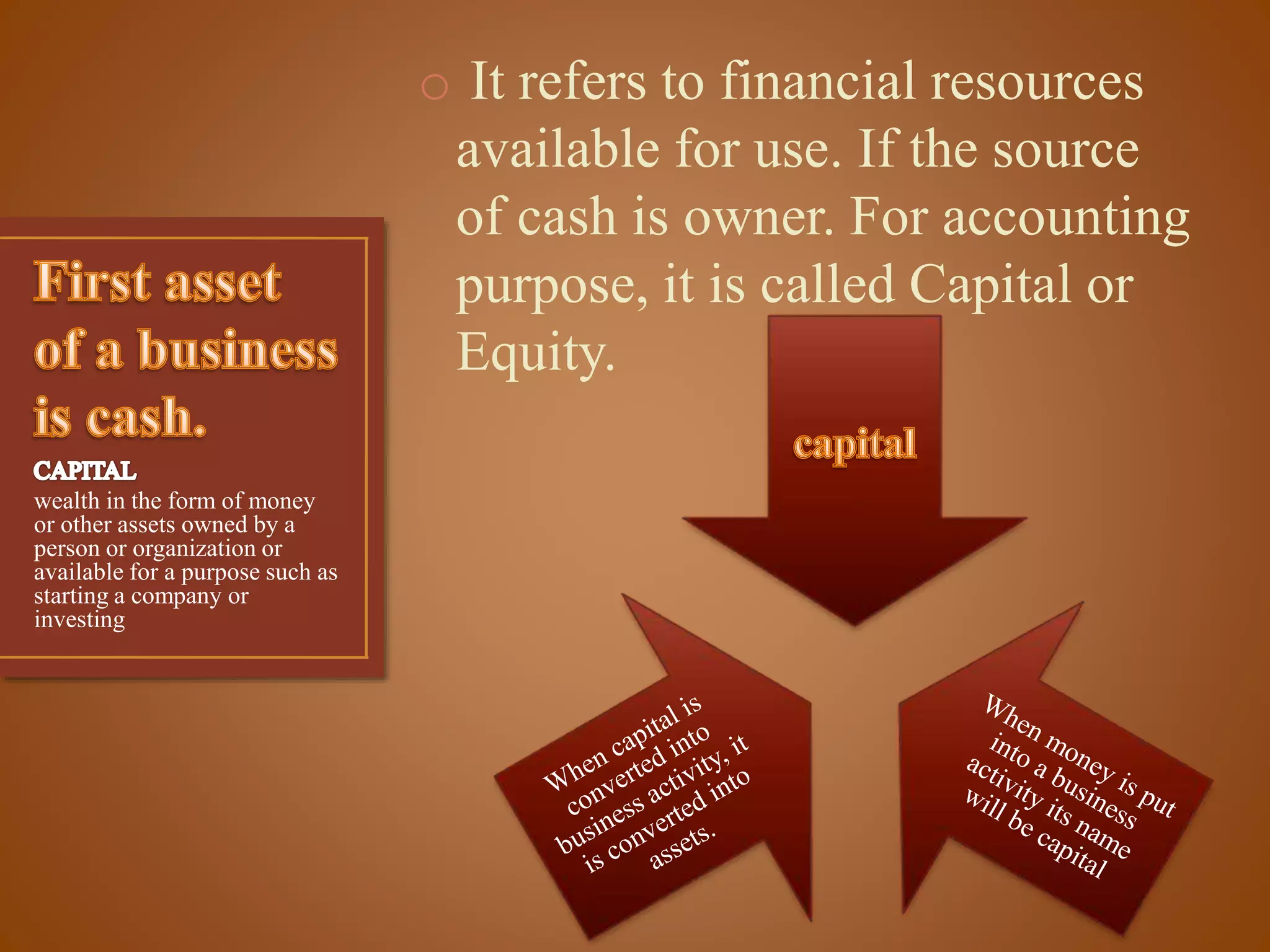
o It refers to financial resources
available for use. If the source
of cash is owner. For accounting
purpose, it is called Capital or
Equity.
wealth in the form of money
or other assets owned by a
person or organization or
available for a purpose such as
starting a company or
investing
• Asset is every conversion of money which helps to earn lawful

profit.
Assets Long Term Assets/Fixed Assets .Current Assets .Other Assets tangible
Assets. Intangible Assets.
• •
Such assets which life is
long.• Such assets are not consumed in a period of a year.• Land , building ,
plant and machinery are fixed assets.• Such assets can not easily be
converted into cash.
• •
23.
The life of such assets is not more than a
year.• Such asset can easily be converted into cash.• Cash, Account
receivable , inventory, marketable securities.
• •
24.
Account receivable are also
called debtors.• Suppose you have sold some goods on credit in November.•
Money will be received after three months.• Your accounts are closed in
December.• Such receivable money is called account
Business raw material placed in the business where houseThe
goods produced in a factory are also placed in the where house.
All material purchased and goods produced and placed in where
house and named as inventory.• Work-in- process is also
included in Inventory.

o Usually business buys shares, debentures of other companies or
bonds issued by Govt. for earning profit.• Such shares ,
debentures or bonds are marketable and can be sold at any time.
o if it is receivable from
more persons, it is called
accounts receivable.
Advance income tax paid.•
Advance sale tax paid.
Payment made to a contractor
but services yet to be
acquired.

Patent.• Trade marks.•
Goodwill.

o Rights for exclusive use of your
invention.• Right for using your new
recipe.• It requires registration from
registrar of patents.
o It is name of your product. It is symbol
used on your product. It is any sign
used by you for marketing your
product.• It requires registration from
registrar Trade Mark.
o Good will is reputation of your
business which you earn over the
years.• When you buy some reputed
business, you pay goodwill.
Such assets
can not be touché Goodwill
Patent Trademarks
•.
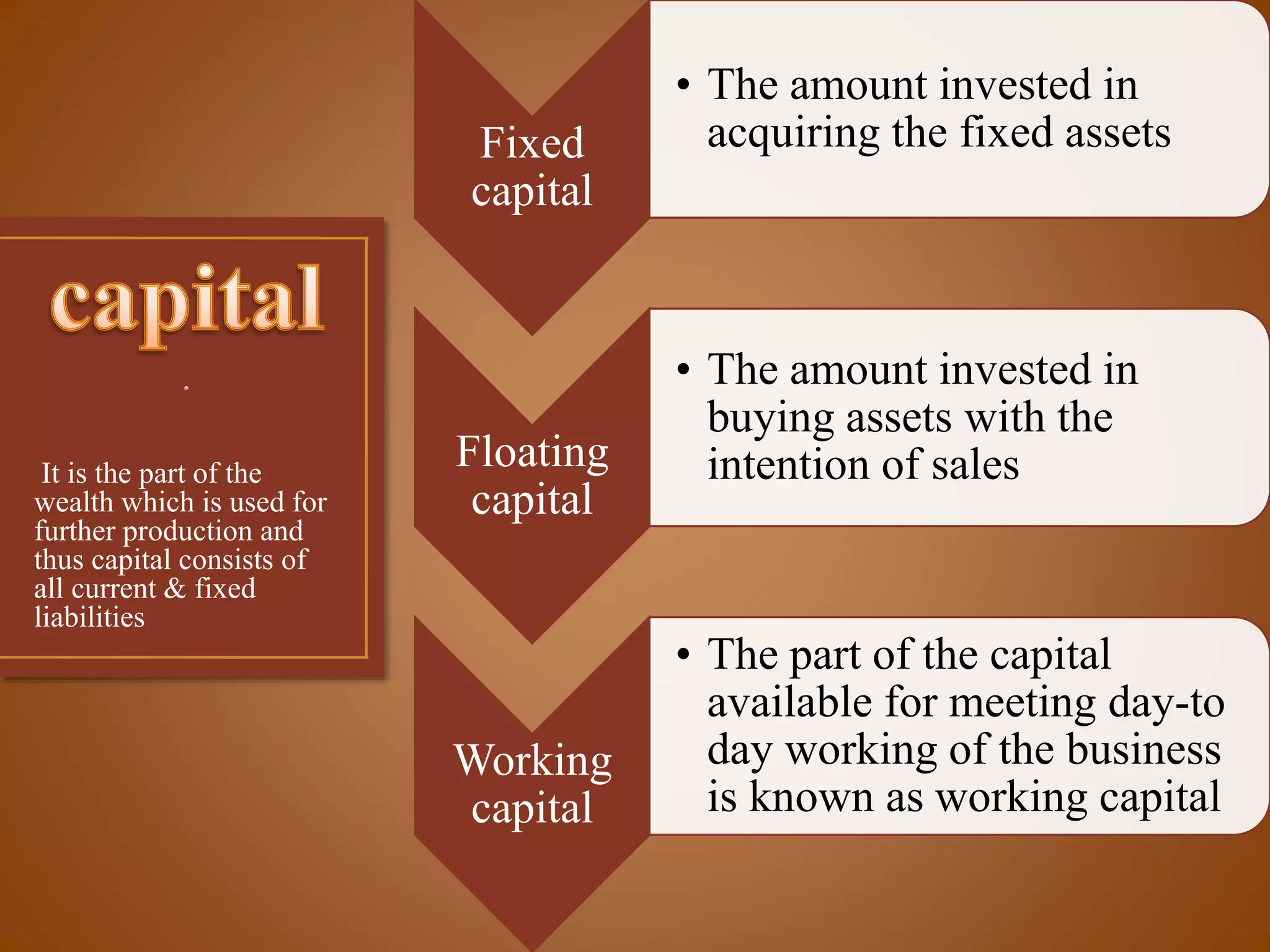
Fixed
capital

It is the part of the
wealth which is used for
further production and
thus capital consists of
all current & fixed
liabilities

Floating
capital

Working
capital

• The amount invested in
acquiring the fixed assets

• The amount invested in
buying assets with the
intention of sales

• The part of the capital
available for meeting day-to
day working of the business
is known as working capital
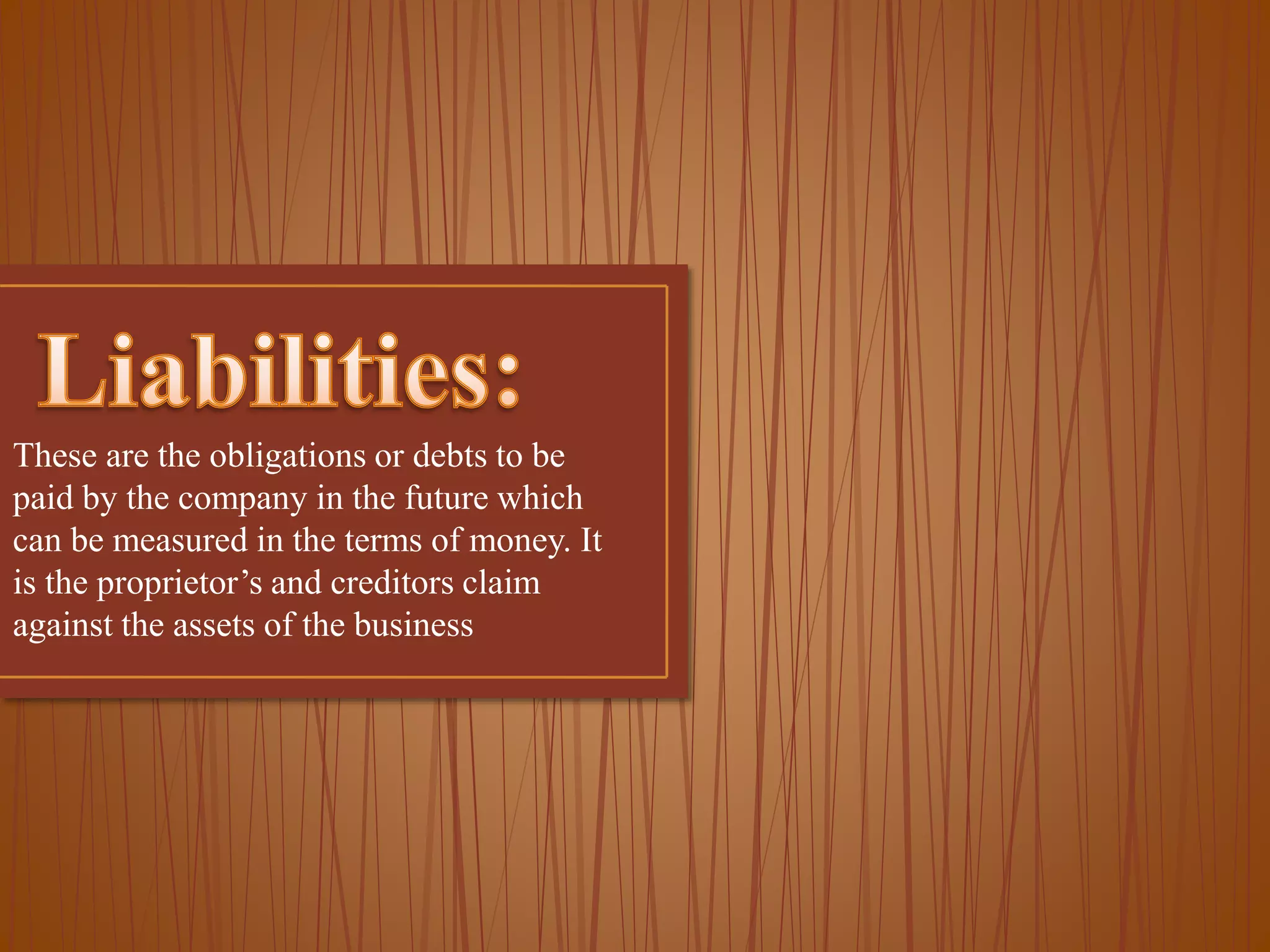
These are the obligations or debts to be
paid by the company in the future which
can be measured in the terms of money. It
is the proprietor’s and creditors claim
against the assets of the business
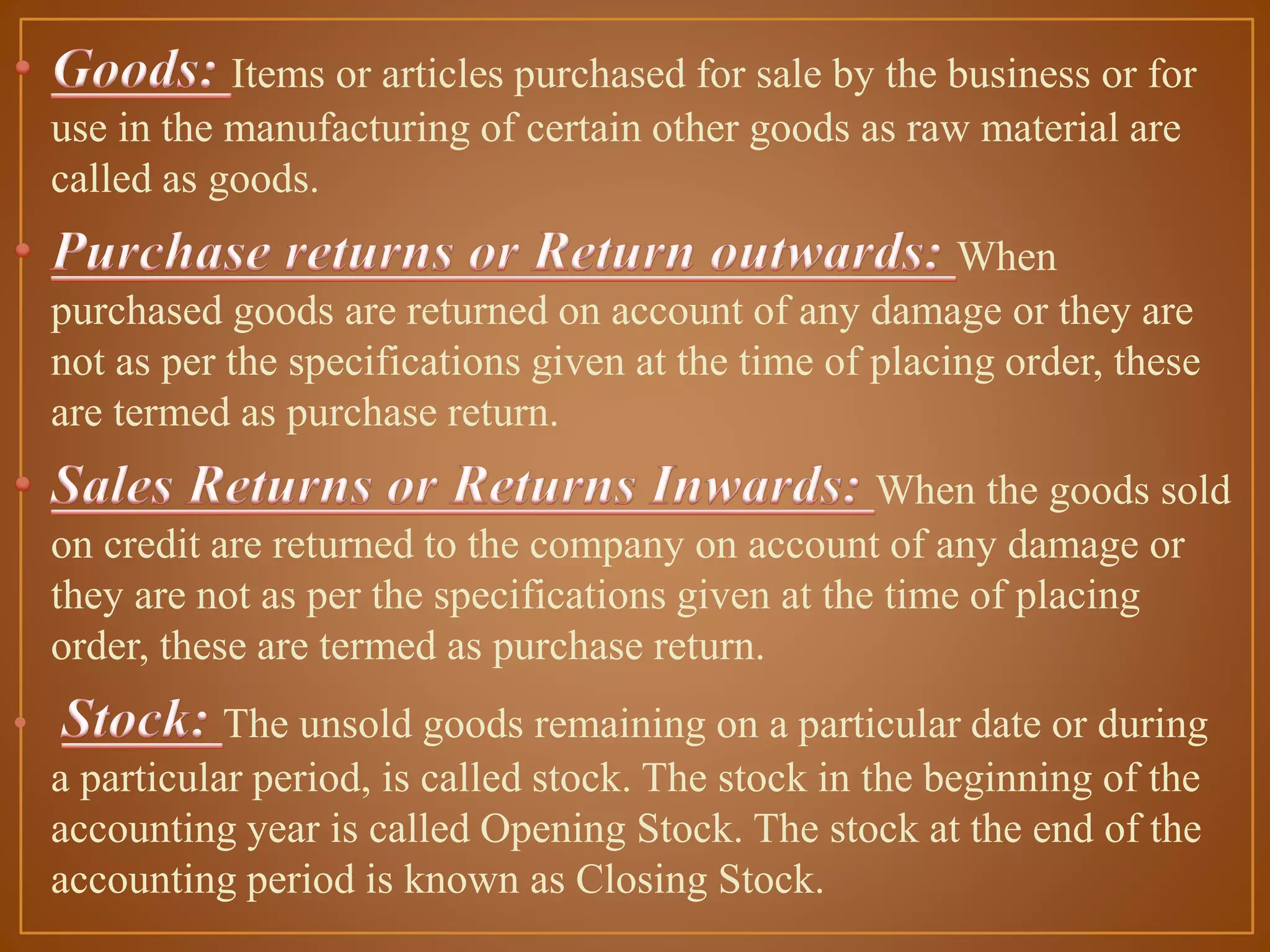
Items or articles purchased for sale by the business or for
use in the manufacturing of certain other goods as raw material are
called as goods.
When
purchased goods are returned on account of any damage or they are
not as per the specifications given at the time of placing order, these
are termed as purchase return.
When the goods sold
on credit are returned to the company on account of any damage or
they are not as per the specifications given at the time of placing
order, these are termed as purchase return.

•

The unsold goods remaining on a particular date or during
a particular period, is called stock. The stock in the beginning of the
accounting year is called Opening Stock. The stock at the end of the
accounting period is known as Closing Stock.
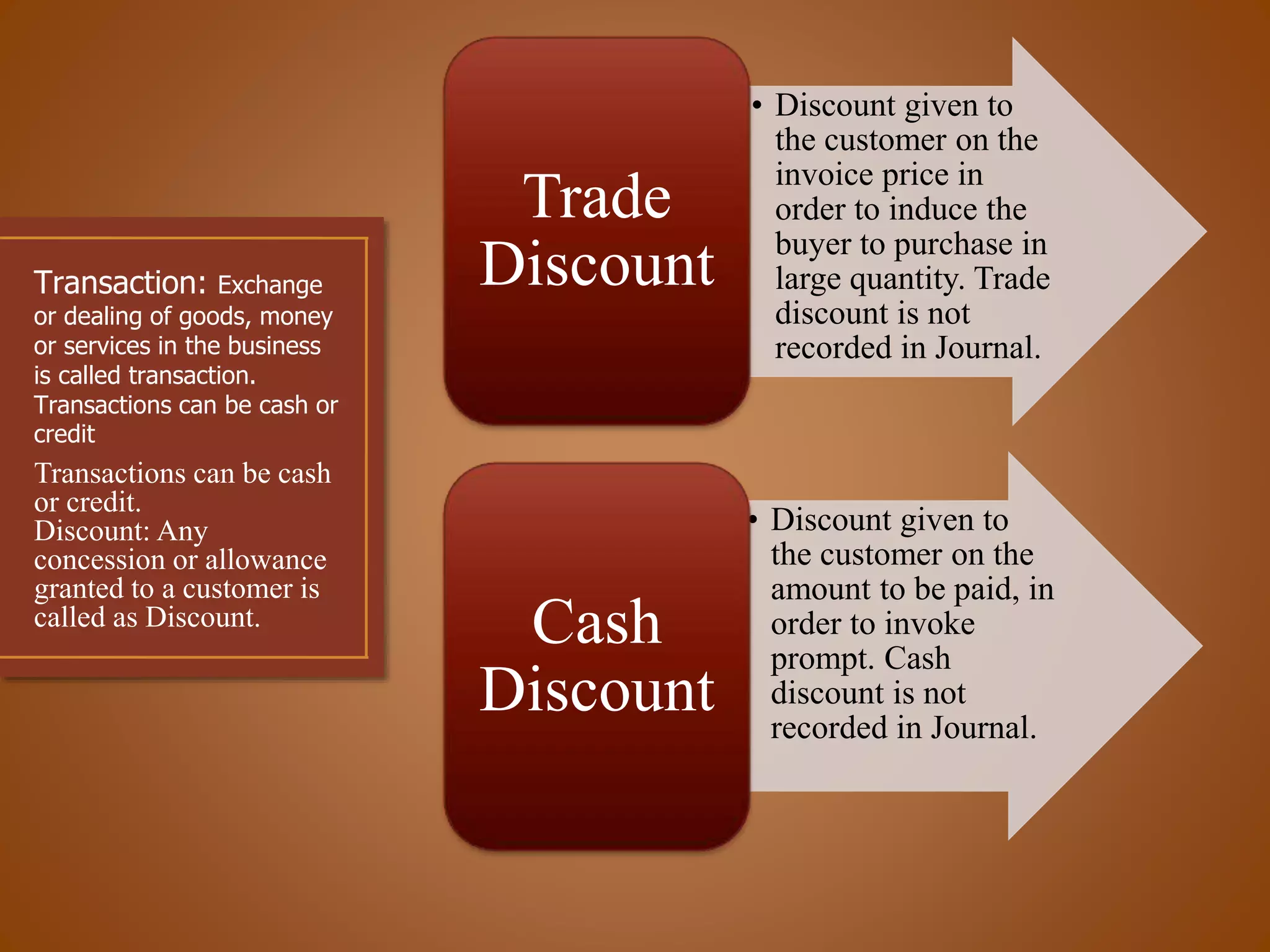
Transaction:

Exchange
or dealing of goods, money
or services in the business
is called transaction.
Transactions can be cash or
credit

Transactions can be cash
or credit.
Discount: Any
concession or allowance
granted to a customer is
called as Discount.

Trade
Discount

Cash
Discount

• Discount given to
the customer on the
invoice price in
order to induce the
buyer to purchase in
large quantity. Trade
discount is not
recorded in Journal.

• Discount given to
the customer on the
amount to be paid, in
order to invoke
prompt. Cash
discount is not
recorded in Journal.
o A businessman who is unable to pay his creditors and an order
has been issued by the court against him to sell-off his property
in order to discharge his liabilities.

o An entry made in the debit column of the journal or account is
called as Debit.

o An entry made in the credit column of the journal or account is
called as Credit.
Introduction to accounting

Introduction to accounting

  • 3.
    It is theart of identifying, classifying, recording, summarizing and interpreting the business transaction of financial nature.
  • 4.
    o It isthe art and science of studying the accounting and accounts of a business. o It is the art of identifying, classifying, recording, summarizing and interpreting the business transaction of financial nature. o This involves recording of transaction pertaining to one person or thing under one head.
  • 5.
    Book-keeping is a properand systematic keeping of books of accounts.
  • 6.
  • 8.
  • 9.
    o Business isdifferent from Business Owner o Business continues over a period of time o Classification of transactions into income ,expense etc. and matching them o All transactions in terms of money. o Cost or market price whichever is less
  • 10.
  • 12.
    o It representsthe group of persons or parties to whom the goods have been sold on credit by the company. They owe to the company. A set-up designed with a view to earn profits in called business. o It represents the group of persons or parties from whom the goods have been purchased on credit by the company. The company owes to them. o The owner of the business is known as the proprietor.
  • 13.
    o Amount orgoods taken out or o The debtors who defaults in withdrawn by the proprietor for making the payment for goods personal use is called drawings. taken by him on credit are called as bad debts. o Goods sold by the company whether on cash basis or credit basis, they are in total called as sales. o It is the systematic recording of the business transaction in the books of accounts. o Goods bought by the company o on cash basis or credit basis, they are in total called as purchases. Books of accounts are closed annually. Every company records the transactions pertaining to one year of its working for the evaluation. The choice of accounting period (12 months) depends upon the company.
  • 14.
    Fixed Assets Liquid Assets The valuable thingsowned by the business is known as assets. They help in generating profits and can be expressed in terms of money. Intangible Assets Floating Assets Fictitious Assets
  • 16.
    o It refersto financial resources available for use. If the source of cash is owner. For accounting purpose, it is called Capital or Equity. wealth in the form of money or other assets owned by a person or organization or available for a purpose such as starting a company or investing
  • 17.
    • Asset isevery conversion of money which helps to earn lawful profit. Assets Long Term Assets/Fixed Assets .Current Assets .Other Assets tangible Assets. Intangible Assets. • • Such assets which life is long.• Such assets are not consumed in a period of a year.• Land , building , plant and machinery are fixed assets.• Such assets can not easily be converted into cash. • • 23. The life of such assets is not more than a year.• Such asset can easily be converted into cash.• Cash, Account receivable , inventory, marketable securities. • • 24. Account receivable are also called debtors.• Suppose you have sold some goods on credit in November.• Money will be received after three months.• Your accounts are closed in December.• Such receivable money is called account
  • 18.
    Business raw materialplaced in the business where houseThe goods produced in a factory are also placed in the where house. All material purchased and goods produced and placed in where house and named as inventory.• Work-in- process is also included in Inventory. o Usually business buys shares, debentures of other companies or bonds issued by Govt. for earning profit.• Such shares , debentures or bonds are marketable and can be sold at any time.
  • 19.
    o if itis receivable from more persons, it is called accounts receivable. Advance income tax paid.• Advance sale tax paid. Payment made to a contractor but services yet to be acquired. Patent.• Trade marks.• Goodwill. o Rights for exclusive use of your invention.• Right for using your new recipe.• It requires registration from registrar of patents. o It is name of your product. It is symbol used on your product. It is any sign used by you for marketing your product.• It requires registration from registrar Trade Mark. o Good will is reputation of your business which you earn over the years.• When you buy some reputed business, you pay goodwill.
  • 20.
    Such assets can notbe touché Goodwill Patent Trademarks
  • 21.
    •. Fixed capital It is thepart of the wealth which is used for further production and thus capital consists of all current & fixed liabilities Floating capital Working capital • The amount invested in acquiring the fixed assets • The amount invested in buying assets with the intention of sales • The part of the capital available for meeting day-to day working of the business is known as working capital
  • 22.
    These are theobligations or debts to be paid by the company in the future which can be measured in the terms of money. It is the proprietor’s and creditors claim against the assets of the business
  • 24.
    Items or articlespurchased for sale by the business or for use in the manufacturing of certain other goods as raw material are called as goods. When purchased goods are returned on account of any damage or they are not as per the specifications given at the time of placing order, these are termed as purchase return. When the goods sold on credit are returned to the company on account of any damage or they are not as per the specifications given at the time of placing order, these are termed as purchase return. • The unsold goods remaining on a particular date or during a particular period, is called stock. The stock in the beginning of the accounting year is called Opening Stock. The stock at the end of the accounting period is known as Closing Stock.
  • 25.
    Transaction: Exchange or dealing ofgoods, money or services in the business is called transaction. Transactions can be cash or credit Transactions can be cash or credit. Discount: Any concession or allowance granted to a customer is called as Discount. Trade Discount Cash Discount • Discount given to the customer on the invoice price in order to induce the buyer to purchase in large quantity. Trade discount is not recorded in Journal. • Discount given to the customer on the amount to be paid, in order to invoke prompt. Cash discount is not recorded in Journal.
  • 26.
    o A businessmanwho is unable to pay his creditors and an order has been issued by the court against him to sell-off his property in order to discharge his liabilities. o An entry made in the debit column of the journal or account is called as Debit. o An entry made in the credit column of the journal or account is called as Credit.