Group
    Member
Hamza
Kabisha
Mehmoona
Zareen
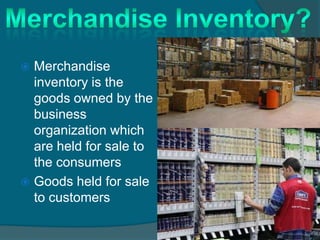
 Merchandise
  inventory is the
  goods owned by the
  business
  organization which
  are held for sale to
  the consumers
 Goods held for sale
  to customers
 Understanding  and journalizing transactions
  using the perpetual and periodic inventory
  system and explaining the difference between
  perpetual and periodic inventory systems
 Use the gross profit percentage and inventory
  turnover to evaluate a business
 Estimate inventory by the gross profit method
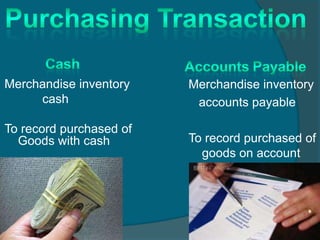
Merchandise inventory    Merchandise inventory
     cash                 accounts payable

To record purchased of
  Goods with cash        To record purchased of
                           goods on account
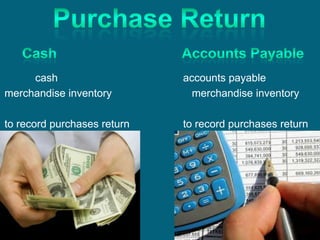
cash                    accounts payable
merchandise inventory          merchandise inventory

to record purchases return   to record purchases return
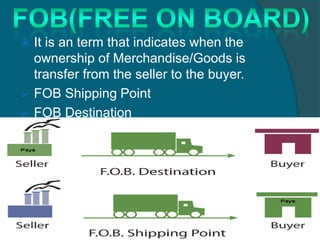
 It is an term that indicates when the
  ownership of Merchandise/Goods is
  transfer from the seller to the buyer.
 FOB Shipping Point
 FOB Destination
 Buyer of the         Seller of the
  Merchandise/          Merchandise/
  Goods Pays the        Goods pays the
  transportation        transportation
                        cost.
  cost.
                       The cost is
 The cost is added     recorded as a
  in merchandise        “Delivery
  inventory.            Expense/Cost”
                        separately.
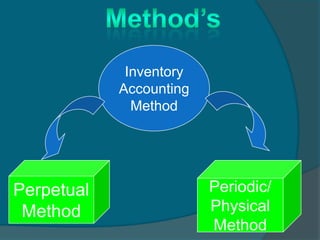
Inventory
            Accounting
              Method


Perpetual                Periodic/
 Method                  Physical
                         Method
 A system  that maintain a running record to
  show the inventory on hand at all time.
 Merchandise inventory and cost of
  merchandise sold accounts are updated
  on continuous basis.
 Inventory counted at least once a year.
 Used for all types of goods.
 FIFO(First-In First-Out) Method
 LIFO(Last-In-First-Out) Method
 Average Cost Method
   Using FIFO cost are included in the
    merchandise sold in the order in which
    they are incurred.


                60 units
Less units sold   40
Ending inventory 20 units

               20 units × $18 per unit = $360
DATE             PURCHASE                   SELLING                    BALANCE

               Unit    Price/   Total    Unit    Price/   Total     Unit    Price/   Total
                        unit                      unit                       unit
January 1st                                                         600     4500     2700000

January 10th   200     4700     940000                              600     4500     2700000

                                                                    200     4700     940000

January 15th                             400      4500    1800000   200     4500     900000

                                                                    200     4700     940000

January 28th                             200      4500    900000     -        -              -

                                         100      4700    940000    100     4700     470000
   Using LIFO the cost of units sold is the
    cost of the most recent purchases.

                 60 units
Less units sold    40
Ending inventory   20 units

                    10 units × 10 = $100
                    10 units × 14 = 140
                    Total           $240
DATE             PURCHASE                   SELLING                    BALANCE

               Unit    Price/   Total    Unit    Price/   Total     Unit    Price/   Total
                        unit                      unit                       unit

January 1st                                                         600     4500     2700000


January 10th   200     4700     940000                              200     4700     940000


                                                                    600     4500     2700000


January 15th                             200      4700    940000    400     4500     180000


                                         200      4500    2700000   100     4500     450000


January 28th                             300      4500    1350000    -        -              -
Cost of Goods Available
      Average Cost
                     =
        per unit
                         Number of units available

 Usually falls between FIFO & LIFO
  amounts
 An average unit cost for each type
  of item is computed each time
  when a purchase is made
DATE             PURCHASE                   SELLING                    BALANCE


               Unit    Price/   Total    Unit    Price/   Total     Unit    Price/   Total
                        unit                      unit                       unit

January 1st                                                         600     4500     2700000


January 10th   200     4700     940000                              800     4550     3640000


January 15th                             400      4550    1820000   400     4550     1820000


January 28th                             300      4550    1365000    -        -              -
LIFO
31%                FIFO
                   46%


 Average   Other
   20%      3%
 A system   that do not keep a
  continuous records of inventory on
  hand all the time.
 Merchandise inventory and cost of
  merchandise sold accounts are
  usually updated at the end of year.
 Inventory counted at least once a
  year.
 Used for inexpensive goods.
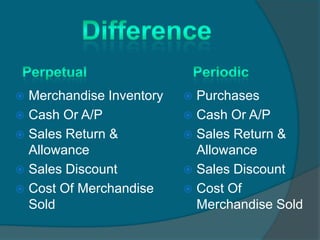
 Merchandise Inventory    Purchases
 Cash Or A/P              Cash Or A/P
 Sales Return &           Sales Return &
  Allowance                 Allowance
 Sales Discount           Sales Discount
 Cost Of Merchandise      Cost Of
  Sold                      Merchandise Sold
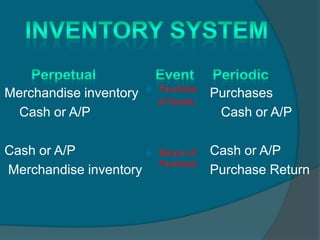
   Purchase
Merchandise inventory                   Purchases
                            of Goods
  Cash or A/P                            Cash or A/P

Cash or A/P                Return of   Cash or A/P
                            Purchase
Merchandise inventory                   Purchase Return
Accounts Payable       Payment
                        Of           Accounts Payable
    Cash                Accounts
                        Payable           Cash

Cash                                 Cash
                       Collection
Accounts Receivable     Of               A/R
                        Accounts
                        Receivable

Accounts Payable                     A/P
                       Payment
     Cash               Of               Cash
                        Accounts
Merchandise             Payable      Purchase Discount
  Inventory             On
                        Discount
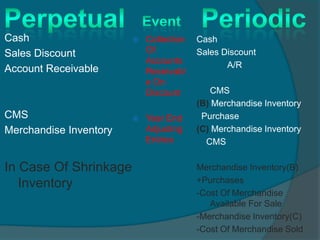
Cash                       Collection   Cash
Sales Discount              Of           Sales Discount
                            Accounts            A/R
Account Receivable          Receivabl
                            e On
                            Discount        CMS
                                         (B) Merchandise Inventory
CMS                        Year End      Purchase
Merchandise Inventory       Adjusting    (C) Merchandise Inventory
                            Entries        CMS

In Case Of Shrinkage                     Merchandise Inventory(B)
   Inventory                             +Purchases
                                         -Cost Of Merchandise
                                            Available For Sale
                                         -Merchandise Inventory(C)
                                         -Cost Of Merchandise Sold
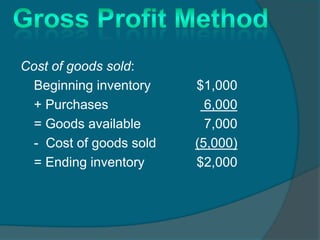
 Gross profit method is a way to estimate
  inventory based on the cost of goods
  sold model.
 Also called gross margin method.
Cost of goods sold:
  Beginning inventory    $1,000
  + Purchases              6,000
  = Goods available        7,000
  - Cost of goods sold   (5,000)
  = Ending inventory     $2,000
Beginning inventory                $14,000
Purchases                           66,000
Goods available                     80,000
Cost of goods sold:
  Net sales revenue     $100,000
  Less estimated
    gross profit 43%     (43,000)
  Estimated cost of goods sold      57,000
Estimated cost of ending inventory $23,000
Merchandise inventory accounting

Merchandise inventory accounting

  • 2.
    Group Member Hamza Kabisha Mehmoona Zareen
  • 3.
     Merchandise inventory is the goods owned by the business organization which are held for sale to the consumers  Goods held for sale to customers
  • 4.
     Understanding and journalizing transactions using the perpetual and periodic inventory system and explaining the difference between perpetual and periodic inventory systems  Use the gross profit percentage and inventory turnover to evaluate a business  Estimate inventory by the gross profit method
  • 5.
    Merchandise inventory Merchandise inventory cash accounts payable To record purchased of Goods with cash To record purchased of goods on account
  • 6.
    cash accounts payable merchandise inventory merchandise inventory to record purchases return to record purchases return
  • 7.
     It isan term that indicates when the ownership of Merchandise/Goods is transfer from the seller to the buyer.  FOB Shipping Point  FOB Destination
  • 8.
     Buyer ofthe  Seller of the Merchandise/ Merchandise/ Goods Pays the Goods pays the transportation transportation cost. cost.  The cost is  The cost is added recorded as a in merchandise “Delivery inventory. Expense/Cost” separately.
  • 9.
    Inventory Accounting Method Perpetual Periodic/ Method Physical Method
  • 10.
     A system that maintain a running record to show the inventory on hand at all time.  Merchandise inventory and cost of merchandise sold accounts are updated on continuous basis.  Inventory counted at least once a year.  Used for all types of goods.
  • 11.
     FIFO(First-In First-Out)Method  LIFO(Last-In-First-Out) Method  Average Cost Method
  • 12.
    Using FIFO cost are included in the merchandise sold in the order in which they are incurred. 60 units Less units sold 40 Ending inventory 20 units 20 units × $18 per unit = $360
  • 13.
    DATE PURCHASE SELLING BALANCE Unit Price/ Total Unit Price/ Total Unit Price/ Total unit unit unit January 1st 600 4500 2700000 January 10th 200 4700 940000 600 4500 2700000 200 4700 940000 January 15th 400 4500 1800000 200 4500 900000 200 4700 940000 January 28th 200 4500 900000 - - - 100 4700 940000 100 4700 470000
  • 14.
    Using LIFO the cost of units sold is the cost of the most recent purchases. 60 units Less units sold 40 Ending inventory 20 units 10 units × 10 = $100 10 units × 14 = 140 Total $240
  • 15.
    DATE PURCHASE SELLING BALANCE Unit Price/ Total Unit Price/ Total Unit Price/ Total unit unit unit January 1st 600 4500 2700000 January 10th 200 4700 940000 200 4700 940000 600 4500 2700000 January 15th 200 4700 940000 400 4500 180000 200 4500 2700000 100 4500 450000 January 28th 300 4500 1350000 - - -
  • 16.
    Cost of GoodsAvailable Average Cost = per unit Number of units available  Usually falls between FIFO & LIFO amounts  An average unit cost for each type of item is computed each time when a purchase is made
  • 17.
    DATE PURCHASE SELLING BALANCE Unit Price/ Total Unit Price/ Total Unit Price/ Total unit unit unit January 1st 600 4500 2700000 January 10th 200 4700 940000 800 4550 3640000 January 15th 400 4550 1820000 400 4550 1820000 January 28th 300 4550 1365000 - - -
  • 18.
    LIFO 31% FIFO 46% Average Other 20% 3%
  • 19.
     A system that do not keep a continuous records of inventory on hand all the time.  Merchandise inventory and cost of merchandise sold accounts are usually updated at the end of year.  Inventory counted at least once a year.  Used for inexpensive goods.
  • 20.
     Merchandise Inventory  Purchases  Cash Or A/P  Cash Or A/P  Sales Return &  Sales Return & Allowance Allowance  Sales Discount  Sales Discount  Cost Of Merchandise  Cost Of Sold Merchandise Sold
  • 21.
    Purchase Merchandise inventory Purchases of Goods Cash or A/P Cash or A/P Cash or A/P  Return of Cash or A/P Purchase Merchandise inventory Purchase Return
  • 22.
    Accounts Payable  Payment Of Accounts Payable Cash Accounts Payable Cash Cash Cash  Collection Accounts Receivable Of A/R Accounts Receivable Accounts Payable A/P  Payment Cash Of Cash Accounts Merchandise Payable Purchase Discount Inventory On Discount
  • 23.
    Cash  Collection Cash Sales Discount Of Sales Discount Accounts A/R Account Receivable Receivabl e On Discount CMS (B) Merchandise Inventory CMS  Year End Purchase Merchandise Inventory Adjusting (C) Merchandise Inventory Entries CMS In Case Of Shrinkage Merchandise Inventory(B) Inventory +Purchases -Cost Of Merchandise Available For Sale -Merchandise Inventory(C) -Cost Of Merchandise Sold
  • 24.
     Gross profitmethod is a way to estimate inventory based on the cost of goods sold model.  Also called gross margin method.
  • 25.
    Cost of goodssold: Beginning inventory $1,000 + Purchases 6,000 = Goods available 7,000 - Cost of goods sold (5,000) = Ending inventory $2,000
  • 26.
    Beginning inventory $14,000 Purchases 66,000 Goods available 80,000 Cost of goods sold: Net sales revenue $100,000 Less estimated gross profit 43% (43,000) Estimated cost of goods sold 57,000 Estimated cost of ending inventory $23,000