Downloaded 12 times
![IOSR Journal of Mechanical and Civil Engineering (IOSR-JMCE)
e-ISSN: 2278-1684,p-ISSN: 2320-334X, Volume 9, Issue 4 (Nov. - Dec. 2013), PP 23-29
www.iosrjournals.org
www.iosrjournals.org 23 | Page
Studies of performance and emission characteristics of
compressed natural gas fuelled S.I. engine and developing CNG
conversion kit
Joyanta Paul1
, Md. Arafat Hossain2
, Shubhra Kanti Das3
, Rezaur Rahman4
[1,2,3,4]
Department of Mechanical Engineering, Khulna University of Engineering &Technology (KUET),
Khulna-9203, BANGLADESH
Abstract: In Bangladesh, petrol, diesel and octane are conventionally used as an engine fuel. Petrol and
octane are used only transport sector. Diesel is used in transport, agriculture and power generation among
them 45% of diesel is consumed in transport sector. Total demand of liquid fuel is rising day by day. The
country has no natural sources of liquid fuels. As a result a huge amount of money spent for importing fuel from
abroad. This expenditure will be massive amount within a few years. The gas could be compressed natural gas
(CNG) or bio methane. The advantage is that this reduces fuel costs and when local bio methane is used, it also
contributes to the use of a more sustainable fuel supply.
CNG system suppliers are currently developing dual-fuel technology and have already converted
trucks, using government grants. Furthermore, various exploratory studies into the dual-fuel principle are being
conducted under contract to various municipalities in the context of sustainable transportation (fermentation of
city waste to produce bio methane for use as engine fuel). According to World Health Organization (WHO), the
safe limit of dust particles in the atmosphere is 40 to 80 micrograms, whereas in Dhaka city, it is 1700 to 2200
micrograms. To minimize environmental pollution in Dhaka, CNG played a vital role now a day. To use CNG
on commercial basis, different programs are taken to use compressed natural gas (CNG). This program mainly
concentrated on road transport. These programs cannot spread throughout the country due to some difficulties.
But there is a huge potentiality in road, marine, railway and stationary engines to use CNG.
Keywords: SI engine, electronic conversion kit, CNG, Diesel.
I. Introduction
Small diesel engines, typically producing less than 20 hp, are widely used all over Bangladesh. The
number of small diesel engine in operation is estimated to be about 0.7 million. The most important
conventional use is in irrigation for driving Low Lift pumps and shallow tube wells in rural Bangladesh.
Although electricity have reached in about 60% villages, still more that2/3rd of the irrigation devices are still
run on diesel [1]. Diesel engines have got a wide application in about 0.9 million country boat, a large
proportion of which run by diesel now-a-days. [1]
Diesel fuel is the largest imported energy resource for Bangladesh. Since the requirement of
octane/petrol is about 0.4 million metric tons per year, only about 0.27 million of the Diesel requirement is met
by refining imported crude oil at the only refinery of the country, while the remaining Diesel needs to be
imported as a finished product. Consumption can be related to small diesel engines in the applications
mentioned above. [1]
Once it is clear that dual-fuel systems can be applied safely as well as environmentally friendly, the
program can be wound up to make place for normal regulations. Compressed natural gas (CNG) is a fossil fuel
substitute for gasoline (petrol), diesel, or propane/LPG. CNG is made by compressing natural gas, to less than
1% of the volume it occupies at standard atmospheric pressure. CNG is used in traditional gasoline internal
combustion (I.C) engine cars that have been converted into bi-fuel vehicles (gasoline/CNG).
II. Objective
The objectives of this project,
1. Conversion of a S.I engine to CNG fuelled engine.
2. Performance test of CNG and fuelled S.I engine.
3. Theoretical development of an electronic conversion kit for CNG fuelled S.I engine.
III. Components Of Engine Generator
In addition to the engine and generator, engine-generators generally include a fuel supply, a constant
engine speed regulator (governor) and a generator voltage regulator, cooling and exhaust systems, and
lubrication system. Units larger than about 1 kW rating often have a battery and electric starter motor; very large](https://image.slidesharecdn.com/e0942329-150120222203-conversion-gate01/85/Studies-of-performance-and-emission-characteristics-of-compressed-natural-gas-fuelled-S-I-engine-and-developing-CNG-conversion-kit-1-320.jpg)
![IOSR Journal of Mechanical and Civil Engineering (IOSR-JMCE)
e-ISSN: 2278-1684,p-ISSN: 2320-334X, Volume 9, Issue 4 (Nov. - Dec. 2013), PP 23-29
www.iosrjournals.org
www.iosrjournals.org 23 | Page
Studies of performance and emission characteristics of
compressed natural gas fuelled S.I. engine and developing CNG
conversion kit
Joyanta Paul1
, Md. Arafat Hossain2
, Shubhra Kanti Das3
, Rezaur Rahman4
[1,2,3,4]
Department of Mechanical Engineering, Khulna University of Engineering &Technology (KUET),
Khulna-9203, BANGLADESH
Abstract: In Bangladesh, petrol, diesel and octane are conventionally used as an engine fuel. Petrol and
octane are used only transport sector. Diesel is used in transport, agriculture and power generation among
them 45% of diesel is consumed in transport sector. Total demand of liquid fuel is rising day by day. The
country has no natural sources of liquid fuels. As a result a huge amount of money spent for importing fuel from
abroad. This expenditure will be massive amount within a few years. The gas could be compressed natural gas
(CNG) or bio methane. The advantage is that this reduces fuel costs and when local bio methane is used, it also
contributes to the use of a more sustainable fuel supply.
CNG system suppliers are currently developing dual-fuel technology and have already converted
trucks, using government grants. Furthermore, various exploratory studies into the dual-fuel principle are being
conducted under contract to various municipalities in the context of sustainable transportation (fermentation of
city waste to produce bio methane for use as engine fuel). According to World Health Organization (WHO), the
safe limit of dust particles in the atmosphere is 40 to 80 micrograms, whereas in Dhaka city, it is 1700 to 2200
micrograms. To minimize environmental pollution in Dhaka, CNG played a vital role now a day. To use CNG
on commercial basis, different programs are taken to use compressed natural gas (CNG). This program mainly
concentrated on road transport. These programs cannot spread throughout the country due to some difficulties.
But there is a huge potentiality in road, marine, railway and stationary engines to use CNG.
Keywords: SI engine, electronic conversion kit, CNG, Diesel.
I. Introduction
Small diesel engines, typically producing less than 20 hp, are widely used all over Bangladesh. The
number of small diesel engine in operation is estimated to be about 0.7 million. The most important
conventional use is in irrigation for driving Low Lift pumps and shallow tube wells in rural Bangladesh.
Although electricity have reached in about 60% villages, still more that2/3rd of the irrigation devices are still
run on diesel [1]. Diesel engines have got a wide application in about 0.9 million country boat, a large
proportion of which run by diesel now-a-days. [1]
Diesel fuel is the largest imported energy resource for Bangladesh. Since the requirement of
octane/petrol is about 0.4 million metric tons per year, only about 0.27 million of the Diesel requirement is met
by refining imported crude oil at the only refinery of the country, while the remaining Diesel needs to be
imported as a finished product. Consumption can be related to small diesel engines in the applications
mentioned above. [1]
Once it is clear that dual-fuel systems can be applied safely as well as environmentally friendly, the
program can be wound up to make place for normal regulations. Compressed natural gas (CNG) is a fossil fuel
substitute for gasoline (petrol), diesel, or propane/LPG. CNG is made by compressing natural gas, to less than
1% of the volume it occupies at standard atmospheric pressure. CNG is used in traditional gasoline internal
combustion (I.C) engine cars that have been converted into bi-fuel vehicles (gasoline/CNG).
II. Objective
The objectives of this project,
1. Conversion of a S.I engine to CNG fuelled engine.
2. Performance test of CNG and fuelled S.I engine.
3. Theoretical development of an electronic conversion kit for CNG fuelled S.I engine.
III. Components Of Engine Generator
In addition to the engine and generator, engine-generators generally include a fuel supply, a constant
engine speed regulator (governor) and a generator voltage regulator, cooling and exhaust systems, and
lubrication system. Units larger than about 1 kW rating often have a battery and electric starter motor; very large](https://image.slidesharecdn.com/e0942329-150120222203-conversion-gate01/75/Studies-of-performance-and-emission-characteristics-of-compressed-natural-gas-fuelled-S-I-engine-and-developing-CNG-conversion-kit-1-2048.jpg)
![Studies of performance and emission characteristics of compressed natural gas fuelled S.I. engine and
www.iosrjournals.org 24 | Page
units may start with compressed air either to an air driven starter motor or introduced directly to the engine
cylinders to initiate engine rotation. Standby power generating units often include an automatic starting system
and a transfer swit to disconnect the load from the utility power source when there is a power failure and
connect it to the generator. [2]
VI. Cng Equivalent To Gasoline Diesel Cng
The CNG can be considered as equivalent to the other existing fuel and comparison are as follows:
Comparison:
1. 1 kg CNG = 1.4 m3 CNG
2. 1 L petrol = 1.0 m3 CNG
3. 1L diesel = 1.2 m3 CNG
4. 1 L LPG = 0.8 m3 CNG [7]
V. Types Of Conversion
Most of the natural gas fuelled vehicles are conversions of existing gasoline or diesel vehicles. In the
case of spark-ignition engines, these conversions are generally bi-fuel where the driver can switch from natural
gas to gasoline and vice versa during engine operation; for compression-ignition engines available options
include dual-fuel conversions, where the engine runs with a mixture of natural gas and diesel but auto ignited
through diesel only, and spark ignition conversions.[3]
1. Bi-fuel Gasoline Conversion
2. Diesel Conversion
VI. Components Required For Conversion
The installation of the gas equipment comprises the following parts:
1. Pressure Regulator (Reducer)
2. Gas/Air Mixer (or Electronic Fuel Injector)
3. CNG Filling valve
4. High-pressure Lines
5. CNG Tank and Valve
6. Gasoline/CNG Selector Switch
7. vii. Pressure Gauge
8. Gasoline Electro valve
9. Low pressure Pipe
VII. Components Of Cng Kits
1. Pressure Regulator (Pressure Reducer).
2. Filling valve.
3. High pressure pipe:
4. CNG Cylinder.
5. Main Shut off Valve:
6. Adjusting Resistor Screw:
7. Petrol I CNG Selector switch.
8. Gasoline Solenoid valve.
9. Pressure Gauge
VIII. Picture Layout Of Conversion System
Figure:1 Layout of Conversion System
IX. Checking Required Before Conversion](https://image.slidesharecdn.com/e0942329-150120222203-conversion-gate01/85/Studies-of-performance-and-emission-characteristics-of-compressed-natural-gas-fuelled-S-I-engine-and-developing-CNG-conversion-kit-2-320.jpg)
![Studies of performance and emission characteristics of compressed natural gas fuelled S.I. engine and
www.iosrjournals.org 25 | Page
There are a few checks that need to be performed before the engine enters the installation workshop for
conversion. The ignition system: spark plugs spark plug cables, contact points, condenser, ignition coil, ignition
plate and distributor. The faulty state of any of these parts will cause a poor ignition spark, thus hindering the
good functioning of the equipment. The battery must provide 12 volts of power to the pressure regulator so that
its electro valve will open properly when the engine is operating on gas. [4]
X. Performance Test
A. Exhaust Gas Components Analysis Using Orsat Apparatus
Different components present in the exhaust gas can be found by using Orsat apparatus with the following
equation.
C x H y + BO2 + CN2 = a CO2 + b O2 + c N2 + d CO +e H2O
Amount of oxygen present in the air, O2 = N2 / 3.76
Equipment & Chemical Required:
1. Orsat gas analyzer.
2. ampling bottle with exhaust gas.
3. KOH solution.
4. Pyrogallic acid and KOH solution.
5. Cu2O and concentrated HCl
SL
Load
Total
volume
of
sample
gas
Volume
after
passing
through
flask, A
Volume
after
passing
through
flask, B
Volume
after
passing
through
flask, C
Volume
of CO2
in c.c
Volume
of O2
in c.c
Volume
of CO
in c.c
V in
VA in
c.c
VB in
c.c
VC in
c.c
(watt) c. c
1
No
load
100 92 90 89 8 2 1
2 200 100 92 91 90 8 1 1
3 400 100 94 91 - 6 2 -
Table 1: Exhaust gas analysis for Petrol
SL
Load
Total
volume
of
sample
gas
Volume
after
passing
through
flask, A
Volume
after
passing
through
flask, B
Volume
after
passing
through
flask, C
Volume
of CO2
in c.c
Volume
of O2
in c.c
Volume
of CO
in c.c
V in
VA in
c.c
VB in
c.c
VC in
c.c
(watt) c. c
1
No
load
100 95 93 - 5 2 -
2 200 100 95 94 - 5 1 -
3 400 100 96 95 - 4 1 -
Table 2: Exhaust gas analysis for CNG
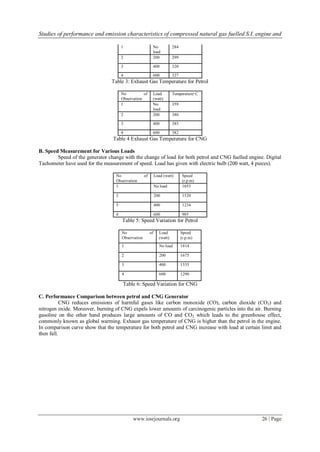
Temperature of exhaust gas varies with the change of load of generator and the change of RPM. The
exhaust gas temperature of petrol running condition and the CNG running condition is different for variable
loads. Temperature also depends on the generator condition.
No of
Observation
Load
(watt)
Temperatureͦ C](https://image.slidesharecdn.com/e0942329-150120222203-conversion-gate01/85/Studies-of-performance-and-emission-characteristics-of-compressed-natural-gas-fuelled-S-I-engine-and-developing-CNG-conversion-kit-3-320.jpg)
![Studies of performance and emission characteristics of compressed natural gas fuelled S.I. engine and
www.iosrjournals.org 28 | Page
Figure 6. Temperature verses load comparison curve for CNG and S.I engine.
XI. Controlled Cng Injection By Microcontroller
In this technique, natural gas is introduced into the cylinder through a specially designed gas injector.
Electronically controlled Units interface via software with existing engine fuel management system that allows
the two computers to communicate. In such system, the gas control unit commands the gas controller and issues
a request for a gas pilot injection of a specific quantity at a specific time. Simultaneously it sends a signal to the
natural gas injectors to inject an appropriate quantity of natural gas into the cylinders. This quantity is calculated
in real time through existing conditions and is based on factor such as manifold pressure, charge air temperature,
gas pressure, gas temperature to provide the best combination of emissions and efficiency.[5]
The speed variation depends on the time of CNG input in the engine cylinder. So the time of CNG
injection should be controlled. This control system can be developed by the microcontroller. The converted
engine could be run either petrol or in gas. But the petrol is needed in the initial starting of the engine; it is the
main drawback of carburetor petrol engine because the ignition temperature of CNG is higher than the petrol
engine. It could be overcome by using high voltage ignition coil. It was very difficult to determine the actual
speed of the engine generator in different load because of its compact casing. Analysis of the exhaust gas was
not so easy because all the components cannot found by one process, only three components are found by using
Orsat apparatus. Actual time setting depends on the design of the injector nozzle. If the nozzle diameter is small,
then the opening time will be long.
XII. Injector Nozzle Design
The main design consideration of an injector nozzle is to properly design its diameter with respect of
the flow rate of fuel. Injector nozzle can be designed separately for different speed of engine. The size of
injector nozzle diameter depends on the swept volume and the speed of the engine generator. But in this control
system single nozzle with different opening time controlled by microcontroller have used.[6]
XIII. Results
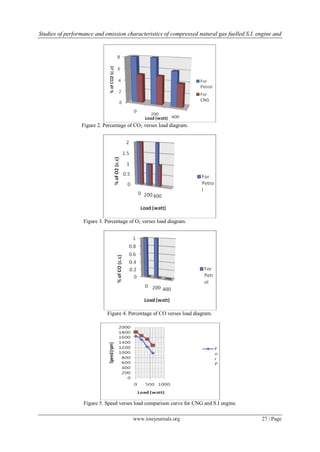
In exhaust gas analysis for petrol and for CNG, maximum CO2 is 8% and 5% respectively, reduction of
CO2 is 20% - 30%.
In starting condition for petrol CO is hardly 1% and for CNG negligible amount is found.
Maximum exhaust temperature in petrol running condition is 327 ͦ c and in CNG running condition is
385 ͦ c. Exhaust gas temperature difference of CNG running generator and petrol running generator is
near 80 ͦ c . Temperature increase with the increase of load at a certain limit, then temperature fall.
Temperature verses load curve show the temperature increase and fall with the variation of load for
both CNG and petrol.
However it need further study for developing conversion kit
.
XIV. Discussion
CNG running condition is higher than the petrol running condition. So the cooling system of CNG
running engine should strong.
XV. Conclusion
The converted engine runs properly either CNG or petrol. In transport sectors use of CNG
engine is rising and its popularity is growing day by day. Because of its advantage over other
existing fuel, in Bangladesh CNG is available in cheaper rate and the CO2 & CO pollutant is less, for which
concern it should be encouraged. Introduction of CNG has a definite impact on environment](https://image.slidesharecdn.com/e0942329-150120222203-conversion-gate01/85/Studies-of-performance-and-emission-characteristics-of-compressed-natural-gas-fuelled-S-I-engine-and-developing-CNG-conversion-kit-6-320.jpg)
![Studies of performance and emission characteristics of compressed natural gas fuelled S.I. engine and
www.iosrjournals.org 29 | Page
improvement. Reduction in CO2 shall result in reducing 10% greenhouse effect and thereby
improving global warming. CNG i s much lighter than air and disperses quickly and rises upward.
Hence the chances of fire hazard are minimized. Again the Cost of CNG is less than half as compared to
that of petrol for developing same amount of energy.
Refenences
[1] Weaver, C. S. and Turner, S. H., "Dual Fuel NaturalGas/DieselEnginesTechnology, Performance, and Emissions," SAE Paper
940548.
[2] Mathur, M.L. & Sharma, R.P. , "A course in Internal Combustion Engine"; First Edition (Reprint-2003); Dhanpat Rai
Publications; New Delhi.
[3]. Khurmi, R.S & Gupta, J.K. , "A text Book of Thermal Engineering (S.I. Unit)''; First Edition (Reprint-2003); S. Chand &
Company Ltd. New Delhi
[4] "Installation Manual for CNG Kit Gasoline/CNG "; Internet Source-www.omnitekcorp.com; Omnitek Engineering Corp. -
1945 S. Rancho Santa Fe Rd.- San Marcos, CA 92078.
[5] Thomas, G. Advantica, Goulding J. and Munteanu, C.; NMSPU Project KTll; "Measurement, Approval and Verification of
CNG Dispensers"- NWML
[6] Jeffrey, B. Gotthelf (Engineering Manager ITT Conoflow); "CNG Regulator I Fuel System Interactions "ITT Industries
[7] Internetsource-http://www.cng.czlwww.cng.en.](https://image.slidesharecdn.com/e0942329-150120222203-conversion-gate01/85/Studies-of-performance-and-emission-characteristics-of-compressed-natural-gas-fuelled-S-I-engine-and-developing-CNG-conversion-kit-7-320.jpg)

The document discusses the performance and emission characteristics of compressed natural gas (CNG) fueled spark-ignition engines, emphasizing the advantages of CNG over traditional fuels like petrol and diesel, particularly in terms of cost-effectiveness and environmental impact. It outlines the objectives of converting an engine to run on CNG, the required components for conversion, and the testing results which indicate lower emissions and higher exhaust gas temperatures for CNG compared to petrol. Ultimately, the study suggests that CNG's growing popularity in Bangladesh presents a sustainable solution to transportation fuel needs, reducing greenhouse gas emissions and reliance on imported fuels.


