COMPRESSED
NATURAL
GAS
SHIVAM KUMAR
 CONTENTS
 Preparation
 Importance
 Advantages
 Disadvantages
 Solutions
 Effects
 Comparison with LNG
 Comparison with HCNG
 Conclusion
 CNG –compressed natural gas
 It is substitute fossil fuel for
DIESEL,PETROL,PROPANE
LOGOS OF CNG
 PREPARATION
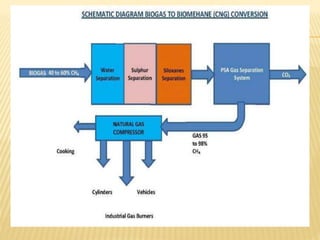
 It is made by compressing the natural gas
(composed of methane) to less than 1% of
the volume at stnd. atmospheric pressure. It
is stored in hard cylindrical containers at a
pressure of 200-280 bars.
AVAILABILITY OF CNG
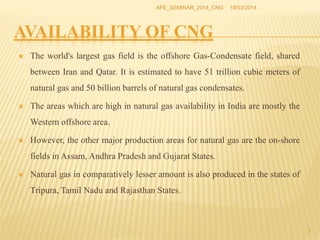
 The world's largest gas field is the offshore Gas-Condensate field, shared
between Iran and Qatar. It is estimated to have 51 trillion cubic meters of
natural gas and 50 billion barrels of natural gas condensates.
 The areas which are high in natural gas availability in India are mostly the
Western offshore area.
 However, the other major production areas for natural gas are the on-shore
fields in Assam, Andhra Pradesh and Gujarat States.
 Natural gas in comparatively lesser amount is also produced in the states of
Tripura, Tamil Nadu and Rajasthan States.
19/03/2014AFE_SEMINAR_2014_CNG
7
CONTI…
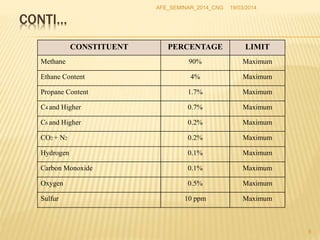
CONSTITUENT PERCENTAGE LIMIT
Methane 90% Maximum
Ethane Content 4% Maximum
Propane Content 1.7% Maximum
C4 and Higher 0.7% Maximum
C6 and Higher 0.2% Maximum
CO2 + N2 0.2% Maximum
Hydrogen 0.1% Maximum
Carbon Monoxide 0.1% Maximum
Oxygen 0.5% Maximum
Sulfur 10 ppm Maximum
19/03/2014AFE_SEMINAR_2014_CNG
8
 IMPORTANCE
 It is cheap than other fuels
 It is dispersed quickly when released
 It is lighter than air
 It releases less carbon into the atm.
WHY USE CNG ENGINE : -
 An engine running on petrol for 100 km emits
22,000 grams of CO2, for same distance on
CNG emits only 16,275 grams of CO2..
 It burns with oxygen to produce 1 mole of
CO2 and 2 moles of H2O. By comparison,
petrol is essentially C6H6 with a c.v. of 3,300
kJ/mol and this burns to produce 6 moles of
CO2 and 3 moles of H2O. So it gives less
pollution .
THE CNG ENGINE

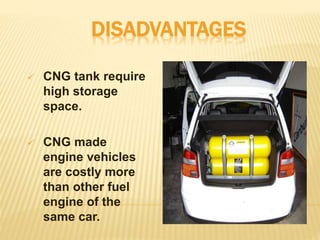
The CNG engine uses a second fuel tank which has
to be attached to the car, and is usually placed in the
trunk (or other place where there is suitable room).
This tank is usually very large, as it has to keep the
gas used compressed. The amount of pressure may
vary from engine to engine, but it is usually
compressed to around 3,600 pounds per square inch.
The driver can then decide which of the fuels they
wish to use by simply pressing a switch on the
dashboard. This means that the car can alternate
between the different tanks, drawing fuel from either.
CNG ENGINE
HOW THE CNG ENGINE POWERS THE CAR

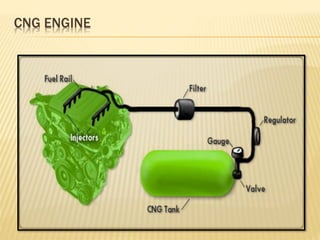
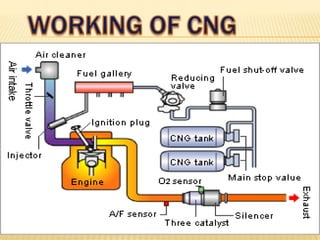
Once the driver selects the CNG tank, the
compressed gas in the tank is pulled through a series
of highly pressurized lines until it reaches the
regulator. Inside the regulator, the pressure on the
gas is lessened until it matches the amount needed
by the fuel injection system of the car's engine. Once
the gas has reached an acceptable pressure, the
solenoid valve allows the gas to move into the fuel
injection system and from there into the engine. Just
as with gasoline, once the engine has received the
gas, it is ignited in the combustion chamber, and this
provides the energy to power the car forward
DAILY USE
 The fuel is taken from a pump in exactly the
same way as one which uses ordinary gas or
diesel fuel. CNG may be harder to find than
regular gas. One solution which many
owners of a CNG engine use is to build a
home gas pump station, which allows their
tanks to be filled overnight.
COMBUSTION AND EMISSIONS
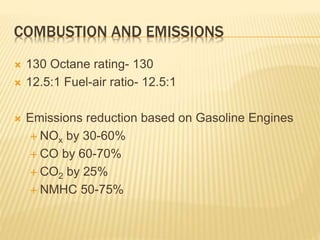
 130 Octane rating- 130
 12.5:1 Fuel-air ratio- 12.5:1
 Emissions reduction based on Gasoline Engines
 NOx by 30-60%
 CO by 60-70%
 CO2 by 25%
 NMHC 50-75%
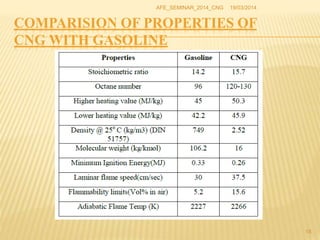
COMPARISION OF PROPERTIES OF
CNG WITH GASOLINE
19/03/2014AFE_SEMINAR_2014_CNG
18
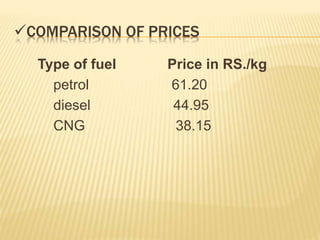
COMPARISON OF PRICES
Type of fuel Price in RS./kg
petrol 61.20
diesel 44.95
CNG 38.15
MAINTENANCE
Proper training is required for all
maintenance personnel working on
CNG vehicles. The oil in a CNG vehicle
does not need to be changed as
frequently because CNG burns more
cleanly than gasoline , producing less
deposits in the oil.
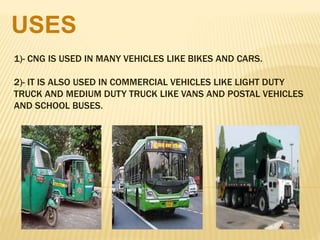
1)- CNG IS USED IN MANY VEHICLES LIKE BIKES AND CARS.
2)- IT IS ALSO USED IN COMMERCIAL VEHICLES LIKE LIGHT DUTY
TRUCK AND MEDIUM DUTY TRUCK LIKE VANS AND POSTAL VEHICLES
AND SCHOOL BUSES.
USES
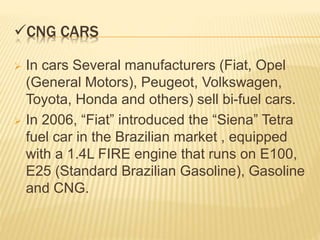
CNG CARS
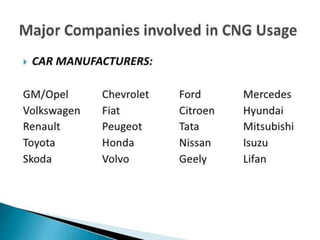
 In cars Several manufacturers (Fiat, Opel
(General Motors), Peugeot, Volkswagen,
Toyota, Honda and others) sell bi-fuel cars.
 In 2006, “Fiat” introduced the “Siena” Tetra
fuel car in the Brazilian market , equipped
with a 1.4L FIRE engine that runs on E100,
E25 (Standard Brazilian Gasoline), Gasoline
and CNG.
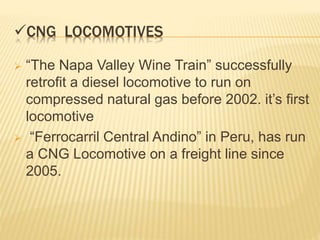
CNG LOCOMOTIVES
 “The Napa Valley Wine Train” successfully
retrofit a diesel locomotive to run on
compressed natural gas before 2002. it’s first
locomotive
 “Ferrocarril Central Andino” in Peru, has run
a CNG Locomotive on a freight line since
2005.
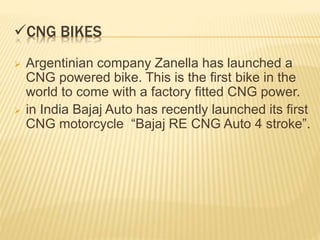
CNG BIKES
 Argentinian company Zanella has launched a
CNG powered bike. This is the first bike in the
world to come with a factory fitted CNG power.
 in India Bajaj Auto has recently launched its first
CNG motorcycle “Bajaj RE CNG Auto 4 stroke”.
ARGENTINIAN COMPANY ZANELLA RX-150
MODEL
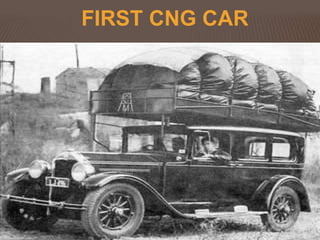
FIRST CNG CAR
 ADVANTAGES
 Environment Friendly.
 Low maintenance cost than other vehicles
 Increases the life of lubricating oils
 It mixes easily and evenly in air
 Engine Life Improves
 Less pollution and more efficiency.
 It is cheaper than petrol and diesel.
Environmental Impact
 It is Greenar fuel.
 Releases lesser Greenhouse
Gas.
 More clean alternative to other
fuel like gasoline.
 Reducing Noise pollution.
DISADVANTAGES
 CNG tank require
high storage
space.
 CNG made
engine vehicles
are costly more
than other fuel
engine of the
same car.
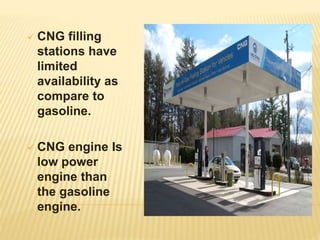
 CNG filling
stations have
limited
availability as
compare to
gasoline.
 CNG engine Is
low power
engine than
the gasoline
engine.
 SOLUTIONS
 Install the tanks under the body of the
vehicle, leaving the trunk free
Eg. Fiat multipla, Volkswagen Touran
Ecofuel,
Volkswagen Caddy Ecofuel.
 Installation of tanks on the roof (typical on
buses).
 COMPARISON WITH LNG
CNG LNG
 CNG is stored at high
pressure as a gas.
 It has lower cost of
production storage
 CNG requires a much
larger volume to store the
same mass of gasoline or
petrol and the use of very
high pressures nearly
3000 to 4000 psi, (or) 205
to 275 bar.
 LNG is stored at very low
temperature as a liquid.
 It has higher cost of
production and storage
 LNG is often used for
transporting natural gas
over large distances, in
ships, trains or pipelines,
and the gas is then
converted into CNG.
 CONCLUSION
 Due to this above reasons CNG most useful for
vehicles as a fuel to reduce the pollution and it
is cheap than other fuels like petrol and diesel.
 CNG is at attractive for this reasons-
1. Clean.
2. Safe and available technology.
3. It is the only fuel Cheaper than gasoline or
diesel.
4. It has produce lower air pollution
19/03/2014
40
AFE_SEMINAR_2014_CNG

Cng ppt

  • 1.
  • 2.
     CONTENTS  Preparation Importance  Advantages  Disadvantages  Solutions  Effects  Comparison with LNG  Comparison with HCNG  Conclusion
  • 3.
     CNG –compressednatural gas  It is substitute fossil fuel for DIESEL,PETROL,PROPANE
  • 4.
  • 5.
     PREPARATION  Itis made by compressing the natural gas (composed of methane) to less than 1% of the volume at stnd. atmospheric pressure. It is stored in hard cylindrical containers at a pressure of 200-280 bars.
  • 7.
    AVAILABILITY OF CNG The world's largest gas field is the offshore Gas-Condensate field, shared between Iran and Qatar. It is estimated to have 51 trillion cubic meters of natural gas and 50 billion barrels of natural gas condensates.  The areas which are high in natural gas availability in India are mostly the Western offshore area.  However, the other major production areas for natural gas are the on-shore fields in Assam, Andhra Pradesh and Gujarat States.  Natural gas in comparatively lesser amount is also produced in the states of Tripura, Tamil Nadu and Rajasthan States. 19/03/2014AFE_SEMINAR_2014_CNG 7
  • 8.
    CONTI… CONSTITUENT PERCENTAGE LIMIT Methane90% Maximum Ethane Content 4% Maximum Propane Content 1.7% Maximum C4 and Higher 0.7% Maximum C6 and Higher 0.2% Maximum CO2 + N2 0.2% Maximum Hydrogen 0.1% Maximum Carbon Monoxide 0.1% Maximum Oxygen 0.5% Maximum Sulfur 10 ppm Maximum 19/03/2014AFE_SEMINAR_2014_CNG 8
  • 9.
     IMPORTANCE  Itis cheap than other fuels  It is dispersed quickly when released  It is lighter than air  It releases less carbon into the atm.
  • 10.
    WHY USE CNGENGINE : -  An engine running on petrol for 100 km emits 22,000 grams of CO2, for same distance on CNG emits only 16,275 grams of CO2..  It burns with oxygen to produce 1 mole of CO2 and 2 moles of H2O. By comparison, petrol is essentially C6H6 with a c.v. of 3,300 kJ/mol and this burns to produce 6 moles of CO2 and 3 moles of H2O. So it gives less pollution .
  • 11.
    THE CNG ENGINE  TheCNG engine uses a second fuel tank which has to be attached to the car, and is usually placed in the trunk (or other place where there is suitable room). This tank is usually very large, as it has to keep the gas used compressed. The amount of pressure may vary from engine to engine, but it is usually compressed to around 3,600 pounds per square inch. The driver can then decide which of the fuels they wish to use by simply pressing a switch on the dashboard. This means that the car can alternate between the different tanks, drawing fuel from either.
  • 12.
  • 13.
    HOW THE CNGENGINE POWERS THE CAR  Once the driver selects the CNG tank, the compressed gas in the tank is pulled through a series of highly pressurized lines until it reaches the regulator. Inside the regulator, the pressure on the gas is lessened until it matches the amount needed by the fuel injection system of the car's engine. Once the gas has reached an acceptable pressure, the solenoid valve allows the gas to move into the fuel injection system and from there into the engine. Just as with gasoline, once the engine has received the gas, it is ignited in the combustion chamber, and this provides the energy to power the car forward
  • 15.
    DAILY USE  Thefuel is taken from a pump in exactly the same way as one which uses ordinary gas or diesel fuel. CNG may be harder to find than regular gas. One solution which many owners of a CNG engine use is to build a home gas pump station, which allows their tanks to be filled overnight.
  • 17.
    COMBUSTION AND EMISSIONS 130 Octane rating- 130  12.5:1 Fuel-air ratio- 12.5:1  Emissions reduction based on Gasoline Engines  NOx by 30-60%  CO by 60-70%  CO2 by 25%  NMHC 50-75%
  • 18.
    COMPARISION OF PROPERTIESOF CNG WITH GASOLINE 19/03/2014AFE_SEMINAR_2014_CNG 18
  • 19.
    COMPARISON OF PRICES Typeof fuel Price in RS./kg petrol 61.20 diesel 44.95 CNG 38.15
  • 20.
    MAINTENANCE Proper training isrequired for all maintenance personnel working on CNG vehicles. The oil in a CNG vehicle does not need to be changed as frequently because CNG burns more cleanly than gasoline , producing less deposits in the oil.
  • 21.
    1)- CNG ISUSED IN MANY VEHICLES LIKE BIKES AND CARS. 2)- IT IS ALSO USED IN COMMERCIAL VEHICLES LIKE LIGHT DUTY TRUCK AND MEDIUM DUTY TRUCK LIKE VANS AND POSTAL VEHICLES AND SCHOOL BUSES. USES
  • 22.
    CNG CARS  Incars Several manufacturers (Fiat, Opel (General Motors), Peugeot, Volkswagen, Toyota, Honda and others) sell bi-fuel cars.  In 2006, “Fiat” introduced the “Siena” Tetra fuel car in the Brazilian market , equipped with a 1.4L FIRE engine that runs on E100, E25 (Standard Brazilian Gasoline), Gasoline and CNG.

  • 23.
    CNG LOCOMOTIVES  “TheNapa Valley Wine Train” successfully retrofit a diesel locomotive to run on compressed natural gas before 2002. it’s first locomotive  “Ferrocarril Central Andino” in Peru, has run a CNG Locomotive on a freight line since 2005.
  • 24.
    CNG BIKES  Argentiniancompany Zanella has launched a CNG powered bike. This is the first bike in the world to come with a factory fitted CNG power.  in India Bajaj Auto has recently launched its first CNG motorcycle “Bajaj RE CNG Auto 4 stroke”.
  • 25.
  • 26.
  • 28.
     ADVANTAGES  EnvironmentFriendly.  Low maintenance cost than other vehicles  Increases the life of lubricating oils  It mixes easily and evenly in air  Engine Life Improves  Less pollution and more efficiency.  It is cheaper than petrol and diesel.
  • 29.
    Environmental Impact  Itis Greenar fuel.  Releases lesser Greenhouse Gas.  More clean alternative to other fuel like gasoline.  Reducing Noise pollution.
  • 30.
    DISADVANTAGES  CNG tankrequire high storage space.  CNG made engine vehicles are costly more than other fuel engine of the same car.
  • 31.
     CNG filling stationshave limited availability as compare to gasoline.  CNG engine Is low power engine than the gasoline engine.
  • 32.
     SOLUTIONS  Installthe tanks under the body of the vehicle, leaving the trunk free Eg. Fiat multipla, Volkswagen Touran Ecofuel, Volkswagen Caddy Ecofuel.  Installation of tanks on the roof (typical on buses).
  • 33.
     COMPARISON WITHLNG CNG LNG  CNG is stored at high pressure as a gas.  It has lower cost of production storage  CNG requires a much larger volume to store the same mass of gasoline or petrol and the use of very high pressures nearly 3000 to 4000 psi, (or) 205 to 275 bar.  LNG is stored at very low temperature as a liquid.  It has higher cost of production and storage  LNG is often used for transporting natural gas over large distances, in ships, trains or pipelines, and the gas is then converted into CNG.
  • 34.
     CONCLUSION  Dueto this above reasons CNG most useful for vehicles as a fuel to reduce the pollution and it is cheap than other fuels like petrol and diesel.  CNG is at attractive for this reasons- 1. Clean. 2. Safe and available technology. 3. It is the only fuel Cheaper than gasoline or diesel. 4. It has produce lower air pollution
  • 40.