RECOMBINANT
ENZYMES
M.VHARSHINI
B.Sc. BMS (HUMAN GENETICS)
SRI RAMACHANDRA UNIVERSITY
CONTENT
•Introduction
•Restriction enzymes
•Ligases
•Methylases
•Topoisomerases
•DNA gyrase
Introduction
• Recombinant DNA technology produce recombinant DNA (rDNA) using a
set of enzymes called recombinant enzymes.
• These include –
• 1. Nucleases
• 2. Ligases
• 3. Polymerases
• 4. DNA modifying enzymes
Restriction enzymes
• Gene cloning requires that DNA molecules be cut in a very precise and
reproducible fashion to insert the new DNA.
• Host-controlled restriction: Some strains of bacteria degrade the foreign DNA
by cleaving its DNA at specific sites by an enzyme before it takes time to
replicate. (The verb restricts means ‘cut’)
• Nucleases are enzymes that degrade DNA molecules by breaking the
phosphodiester bonds. Nucleases that break RNA and DNA are called as
Rnase and Dnase respectively.
• Nucleases are two types. They are Exonuclease: removes the terminal
nucleotide of the DNA molecule and Endonuclease: breaks the internal
phosphodiester bond. Endonucleases are the most widely used ones.
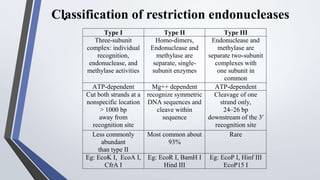
Classification of restriction endonucleases
Type I Type II Type III
Three-subunit
complex: individual
recognition,
endonuclease, and
methylase activities
Homo-dimers,
Endonuclease and
methylase are
separate, single-
subunit enzymes
Endonuclease and
methylase are
separate two-subunit
complexes with
one subunit in
common
ATP-dependent Mg++ dependent ATP-dependent
Cut both strands at a
nonspecific location
> 1000 bp
away from
recognition site
recognize symmetric
DNA sequences and
cleave within
sequence
Cleavage of one
strand only,
24–26 bp
downstream of the 3′
recognition site
Less commonly
abundant
than type II
Most common about
93%
Rare
Eg: EcoK I, EcoA I,
CfrA I
Eg: EcoR I, BamH I
Hind III
Eg: EcoP I, Hinf III
EcoP15 I
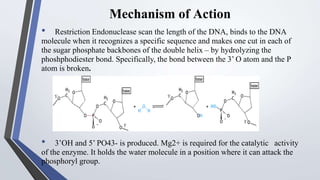
Mechanism of Action
• Restriction Endonuclease scan the length of the DNA, binds to the DNA
molecule when it recognizes a specific sequence and makes one cut in each of
the sugar phosphate backbones of the double helix – by hydrolyzing the
phoshphodiester bond. Specifically, the bond between the 3’ O atom and the P
atom is broken.
• 3’OH and 5’ PO43- is produced. Mg2+ is required for the catalytic activity
of the enzyme. It holds the water molecule in a position where it can attack the
phosphoryl group.
End product of restriction enzyme
• Three types of end products produced by the type II endonucleases:
• • 3’-overhang (protruding)
• • 5’-overhang
• • Blunt end
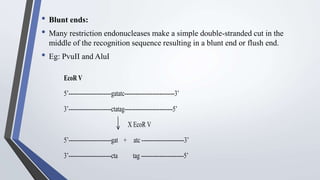
• Blunt ends:
• Many restriction endonucleases make a simple double-stranded cut in the
middle of the recognition sequence resulting in a blunt end or flush end.
• Eg: PvuII and AluI
EcoR V
5’-----------------------gatatc---------------------------3’
3’-----------------------ctatag--------------------------5’
X EcoR V
5’-----------------------gat + atc -----------------------3’
3’-----------------------cta tag -----------------------5’
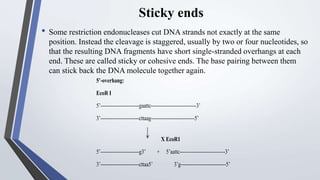
Sticky ends
• Some restriction endonucleases cut DNA strands not exactly at the same
position. Instead the cleavage is staggered, usually by two or four nucleotides, so
that the resulting DNA fragments have short single-stranded overhangs at each
end. These are called sticky or cohesive ends. The base pairing between them
can stick back the DNA molecule together again.
5’-overhang:
EcoR I
5’-----------------------gaattc---------------------------3’
3’-----------------------cttaag--------------------------5’
X EcoR1
5’-----------------------g3’ + 5’aattc---------------------------3’
3’-----------------------cttaa5’ 3’g---------------------------5’
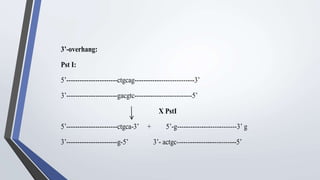
3’-overhang:
Pst I:
5’-----------------------ctgcag---------------------------3’
3’-----------------------gacgtc--------------------------5’
X PstI
5’-----------------------ctgca-3’ + 5’-g---------------------------3’ g
3’-----------------------g-5’ 3’- actgc---------------------------5’
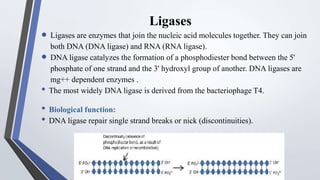
Ligases
 Ligases are enzymes that join the nucleic acid molecules together. They can join
both DNA (DNA ligase) and RNA (RNA ligase).
 DNA ligase catalyzes the formation of a phosphodiester bond between the 5'
phosphate of one strand and the 3' hydroxyl group of another. DNA ligases are
mg++ dependent enzymes .
• The most widely DNA ligase is derived from the bacteriophage T4.
• Biological function:
• DNA ligase repair single strand breaks or nick (discontinuities).
Blunt ended and sticky ended ligation
• Ligation reactions may be blunt ended or sticky ended.
• Sticky ends increase the efficiency of ligation.
Types of DNA ligase
• Two families of DNA ligases:
• ATP dependent – found in eukaryotes.
• NAD+ dependent- found in prokaryotes.
• In mammals four types (I, II, III, IV) of DNA ligases are seen.
Methylases
 It is also known as methyl transferase, found in bacteria to mammals.
 Usually, organisms that make restriction enzymes also synthesis DNA
methyltransferase that protects their own DNA from cleavage.
 These enzymes recognize the same DNA sequence as the restriction enzyme
they accompany.
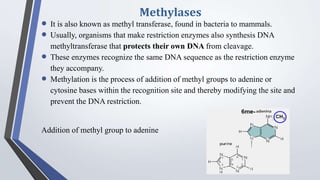
 Methylation is the process of addition of methyl groups to adenine or
cytosine bases within the recognition site and thereby modifying the site and
prevent the DNA restriction.
Addition of methyl group to adenine
• Types of methyl transferase in mammals:
• 1. DNMT1- Maintainance methylase
• 2. DNMT 2
• 3. DNMT3a and DNMT3b-‘de novo’methylases
• 4. DNMT3L
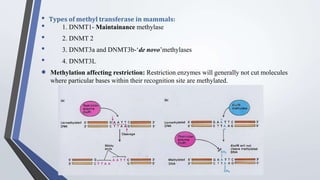
 Methylation affecting restriction: Restriction enzymes will generally not cut molecules
where particular bases within their recognition site are methylated.
TOPOISOMERASE
 They regulate over-winding or under-winding of DNA. They are found in all
types of cells (from virus to man).
 They make incision in the DNA backbone. They are classified into 2 groups,
based on the number of strands they break. They are type I and type II
topoisomerase.
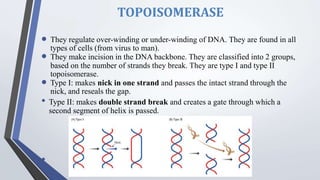
 Type I: makes nick in one strand and passes the intact strand through the
nick, and reseals the gap.
• Type II: makes double strand break and creates a gate through which a
second segment of helix is passed.
•
• Mechanism:
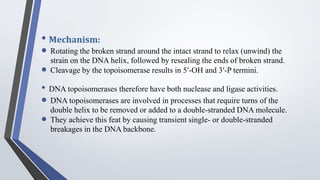
 Rotating the broken strand around the intact strand to relax (unwind) the
strain on the DNA helix, followed by resealing the ends of broken strand.
 Cleavage by the topoisomerase results in 5′-OH and 3′-P termini.
• DNA topoisomerases therefore have both nuclease and ligase activities.
 DNA topoisomerases are involved in processes that require turns of the
double helix to be removed or added to a double-stranded DNA molecule.
 They achieve this feat by causing transient single- or double-stranded
breakages in the DNA backbone.
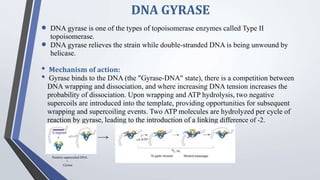
DNA GYRASE
 DNA gyrase is one of the types of topoisomerase enzymes called Type II
topoisomerase.
 DNA gyrase relieves the strain while double-stranded DNA is being unwound by
helicase.
• Mechanism of action:
• Gyrase binds to the DNA (the "Gyrase-DNA" state), there is a competition between
DNA wrapping and dissociation, and where increasing DNA tension increases the
probability of dissociation. Upon wrapping and ATP hydrolysis, two negative
supercoils are introduced into the template, providing opportunities for subsequent
wrapping and supercoiling events. Two ATP molecules are hydrolyzed per cycle of
reaction by gyrase, leading to the introduction of a linking difference of -2.
Positive supercoiled DNA
+
Gyrase
Reference
1. Gene Cloning by Julia Lodge, Pete Lund, and Steve Minchin.
2. GENE CLONING AND DNAANALYSIS an Introduction, sixth edition by T.A.
BROWN
3. Gene CloningandManipulation,Second Edition by Christopher Howe
4. James J. Champoux, DNA TOPOISOMERASES: Structure, Function, and
Mechanism; Annu. Rev. Biochem. 2001. 70:369–413; pg.no 369-413
5. Enzymes used in Recombinant DNA Technology; MHRD project “National
Mission on Education Through ICT”; Prof. S.C. Bhatla; Department of Genetics,
University of Delhi South Campus.
6. Recombinant DNA technology and molecular cloning by Kary B. Mullis, Scientific
American (1990) 262:36. Pg. no 181-234
7. Biochemistry (2002), Freeman & Co. Berg, J.M., Tymoczco, J.L., Stryer, L.
8. New England Biolabs inc.
9. Molecular Cell Biology (2000), Freeman & Co. Lodish, Berk, Zipursky,
Matsudaria, Baltimore, Darnell
10.Multiple modes of E.coli DNA gyrase activity revealed by force and torque;
Marcelo et al., 2013; Nature and structural molecular biology.

Recombinant enzymes

  • 1.
    RECOMBINANT ENZYMES M.VHARSHINI B.Sc. BMS (HUMANGENETICS) SRI RAMACHANDRA UNIVERSITY
  • 2.
  • 3.
    Introduction • Recombinant DNAtechnology produce recombinant DNA (rDNA) using a set of enzymes called recombinant enzymes. • These include – • 1. Nucleases • 2. Ligases • 3. Polymerases • 4. DNA modifying enzymes
  • 4.
    Restriction enzymes • Genecloning requires that DNA molecules be cut in a very precise and reproducible fashion to insert the new DNA. • Host-controlled restriction: Some strains of bacteria degrade the foreign DNA by cleaving its DNA at specific sites by an enzyme before it takes time to replicate. (The verb restricts means ‘cut’) • Nucleases are enzymes that degrade DNA molecules by breaking the phosphodiester bonds. Nucleases that break RNA and DNA are called as Rnase and Dnase respectively. • Nucleases are two types. They are Exonuclease: removes the terminal nucleotide of the DNA molecule and Endonuclease: breaks the internal phosphodiester bond. Endonucleases are the most widely used ones.
  • 5.
    Classification of restrictionendonucleases Type I Type II Type III Three-subunit complex: individual recognition, endonuclease, and methylase activities Homo-dimers, Endonuclease and methylase are separate, single- subunit enzymes Endonuclease and methylase are separate two-subunit complexes with one subunit in common ATP-dependent Mg++ dependent ATP-dependent Cut both strands at a nonspecific location > 1000 bp away from recognition site recognize symmetric DNA sequences and cleave within sequence Cleavage of one strand only, 24–26 bp downstream of the 3′ recognition site Less commonly abundant than type II Most common about 93% Rare Eg: EcoK I, EcoA I, CfrA I Eg: EcoR I, BamH I Hind III Eg: EcoP I, Hinf III EcoP15 I
  • 6.
    Mechanism of Action •Restriction Endonuclease scan the length of the DNA, binds to the DNA molecule when it recognizes a specific sequence and makes one cut in each of the sugar phosphate backbones of the double helix – by hydrolyzing the phoshphodiester bond. Specifically, the bond between the 3’ O atom and the P atom is broken. • 3’OH and 5’ PO43- is produced. Mg2+ is required for the catalytic activity of the enzyme. It holds the water molecule in a position where it can attack the phosphoryl group.
  • 7.
    End product ofrestriction enzyme • Three types of end products produced by the type II endonucleases: • • 3’-overhang (protruding) • • 5’-overhang • • Blunt end
  • 8.
    • Blunt ends: •Many restriction endonucleases make a simple double-stranded cut in the middle of the recognition sequence resulting in a blunt end or flush end. • Eg: PvuII and AluI EcoR V 5’-----------------------gatatc---------------------------3’ 3’-----------------------ctatag--------------------------5’ X EcoR V 5’-----------------------gat + atc -----------------------3’ 3’-----------------------cta tag -----------------------5’
  • 9.
    Sticky ends • Somerestriction endonucleases cut DNA strands not exactly at the same position. Instead the cleavage is staggered, usually by two or four nucleotides, so that the resulting DNA fragments have short single-stranded overhangs at each end. These are called sticky or cohesive ends. The base pairing between them can stick back the DNA molecule together again. 5’-overhang: EcoR I 5’-----------------------gaattc---------------------------3’ 3’-----------------------cttaag--------------------------5’ X EcoR1 5’-----------------------g3’ + 5’aattc---------------------------3’ 3’-----------------------cttaa5’ 3’g---------------------------5’
  • 10.
  • 11.
    Ligases  Ligases areenzymes that join the nucleic acid molecules together. They can join both DNA (DNA ligase) and RNA (RNA ligase).  DNA ligase catalyzes the formation of a phosphodiester bond between the 5' phosphate of one strand and the 3' hydroxyl group of another. DNA ligases are mg++ dependent enzymes . • The most widely DNA ligase is derived from the bacteriophage T4. • Biological function: • DNA ligase repair single strand breaks or nick (discontinuities).
  • 12.
    Blunt ended andsticky ended ligation • Ligation reactions may be blunt ended or sticky ended. • Sticky ends increase the efficiency of ligation.
  • 13.
    Types of DNAligase • Two families of DNA ligases: • ATP dependent – found in eukaryotes. • NAD+ dependent- found in prokaryotes. • In mammals four types (I, II, III, IV) of DNA ligases are seen.
  • 14.
    Methylases  It isalso known as methyl transferase, found in bacteria to mammals.  Usually, organisms that make restriction enzymes also synthesis DNA methyltransferase that protects their own DNA from cleavage.  These enzymes recognize the same DNA sequence as the restriction enzyme they accompany.  Methylation is the process of addition of methyl groups to adenine or cytosine bases within the recognition site and thereby modifying the site and prevent the DNA restriction. Addition of methyl group to adenine
  • 15.
    • Types ofmethyl transferase in mammals: • 1. DNMT1- Maintainance methylase • 2. DNMT 2 • 3. DNMT3a and DNMT3b-‘de novo’methylases • 4. DNMT3L  Methylation affecting restriction: Restriction enzymes will generally not cut molecules where particular bases within their recognition site are methylated.
  • 16.
    TOPOISOMERASE  They regulateover-winding or under-winding of DNA. They are found in all types of cells (from virus to man).  They make incision in the DNA backbone. They are classified into 2 groups, based on the number of strands they break. They are type I and type II topoisomerase.  Type I: makes nick in one strand and passes the intact strand through the nick, and reseals the gap. • Type II: makes double strand break and creates a gate through which a second segment of helix is passed. •
  • 17.
    • Mechanism:  Rotatingthe broken strand around the intact strand to relax (unwind) the strain on the DNA helix, followed by resealing the ends of broken strand.  Cleavage by the topoisomerase results in 5′-OH and 3′-P termini. • DNA topoisomerases therefore have both nuclease and ligase activities.  DNA topoisomerases are involved in processes that require turns of the double helix to be removed or added to a double-stranded DNA molecule.  They achieve this feat by causing transient single- or double-stranded breakages in the DNA backbone.
  • 18.
    DNA GYRASE  DNAgyrase is one of the types of topoisomerase enzymes called Type II topoisomerase.  DNA gyrase relieves the strain while double-stranded DNA is being unwound by helicase. • Mechanism of action: • Gyrase binds to the DNA (the "Gyrase-DNA" state), there is a competition between DNA wrapping and dissociation, and where increasing DNA tension increases the probability of dissociation. Upon wrapping and ATP hydrolysis, two negative supercoils are introduced into the template, providing opportunities for subsequent wrapping and supercoiling events. Two ATP molecules are hydrolyzed per cycle of reaction by gyrase, leading to the introduction of a linking difference of -2. Positive supercoiled DNA + Gyrase
  • 19.
    Reference 1. Gene Cloningby Julia Lodge, Pete Lund, and Steve Minchin. 2. GENE CLONING AND DNAANALYSIS an Introduction, sixth edition by T.A. BROWN 3. Gene CloningandManipulation,Second Edition by Christopher Howe 4. James J. Champoux, DNA TOPOISOMERASES: Structure, Function, and Mechanism; Annu. Rev. Biochem. 2001. 70:369–413; pg.no 369-413 5. Enzymes used in Recombinant DNA Technology; MHRD project “National Mission on Education Through ICT”; Prof. S.C. Bhatla; Department of Genetics, University of Delhi South Campus. 6. Recombinant DNA technology and molecular cloning by Kary B. Mullis, Scientific American (1990) 262:36. Pg. no 181-234 7. Biochemistry (2002), Freeman & Co. Berg, J.M., Tymoczco, J.L., Stryer, L. 8. New England Biolabs inc. 9. Molecular Cell Biology (2000), Freeman & Co. Lodish, Berk, Zipursky, Matsudaria, Baltimore, Darnell 10.Multiple modes of E.coli DNA gyrase activity revealed by force and torque; Marcelo et al., 2013; Nature and structural molecular biology.