BY
M.Vharshini
4th year Biomedical Sciences
Introduction
 Nuclear medicine is the medical specialty in which
unsealed radionucleotides, chemically manipulated to
form radiopharmaceuticals, are used for diagnosis and
therapy.
 Radiopharmaceuticals localize in various target tissues
and organs and provide better display of physiology
and metabolism.
Principles Of Nuclear Medicine
 A wide range of radionucleotides are used in the diagnostic nuclear
medicine that meets the necessary requirements for effective and
efficient imaging.
 All radionucleotides are produced artificially, using four principle
routes of manufacture.
1. CYCLOTRON BOMBARDMENT: gallium-67, indium-111, thallium-201,
cobalt-57, carbon-11, oxygen-15, nitrogen-13 and fluorine-18
2. REACTOR IRRADIATION: chromium-51, selenium-75, iodine-125 and
iodine-131.
3. FISSION PRODUCTS: iodine-131, xenon-133 and strontium-90
4. GENERATORS THAT PROVIDE SECONDARY DECAY PRODUCTS FROM
LONGER LIVED PARENT RADIONUCLIDES: Column generators
incorporating molybdenum-99 for the provision of technetium-99m.
 The use of radiopharmaceuticals for diagnosis or therapy is based on the
accumulation or concentration of the isotope in the organ of interest
referred as Target organ.
 A radiopharmaceutical may have an affinity for a certain organ that is not
necessarily the target organ, in which case this organ is termed as Critical
organ.
 The risk to which the patient is subjected is clearly a function of the doses
received in all organs and is expressed in terms of the effective dose.
 The risk must be balanced against the expected advantages and benefits
rendered by the procedure.
Principles Of Nuclear Medicine
Nuclear Medicine In Diagnosis
 Nuclear Medicine imaging procedures are generally non-
invasive.
 The Nuclear Medicine imaging scans use radioactive
materials called radiopharmaceuticals or radiotracers.
 Depending on the type of nuclear medicine exam, the
radiotracer is either injected into the body, swallowed or
inhaled as a gas and eventually accumulates in the organ or
area of the body to be examined.
Single Photon Emission Computed Tomography
(SPECT)
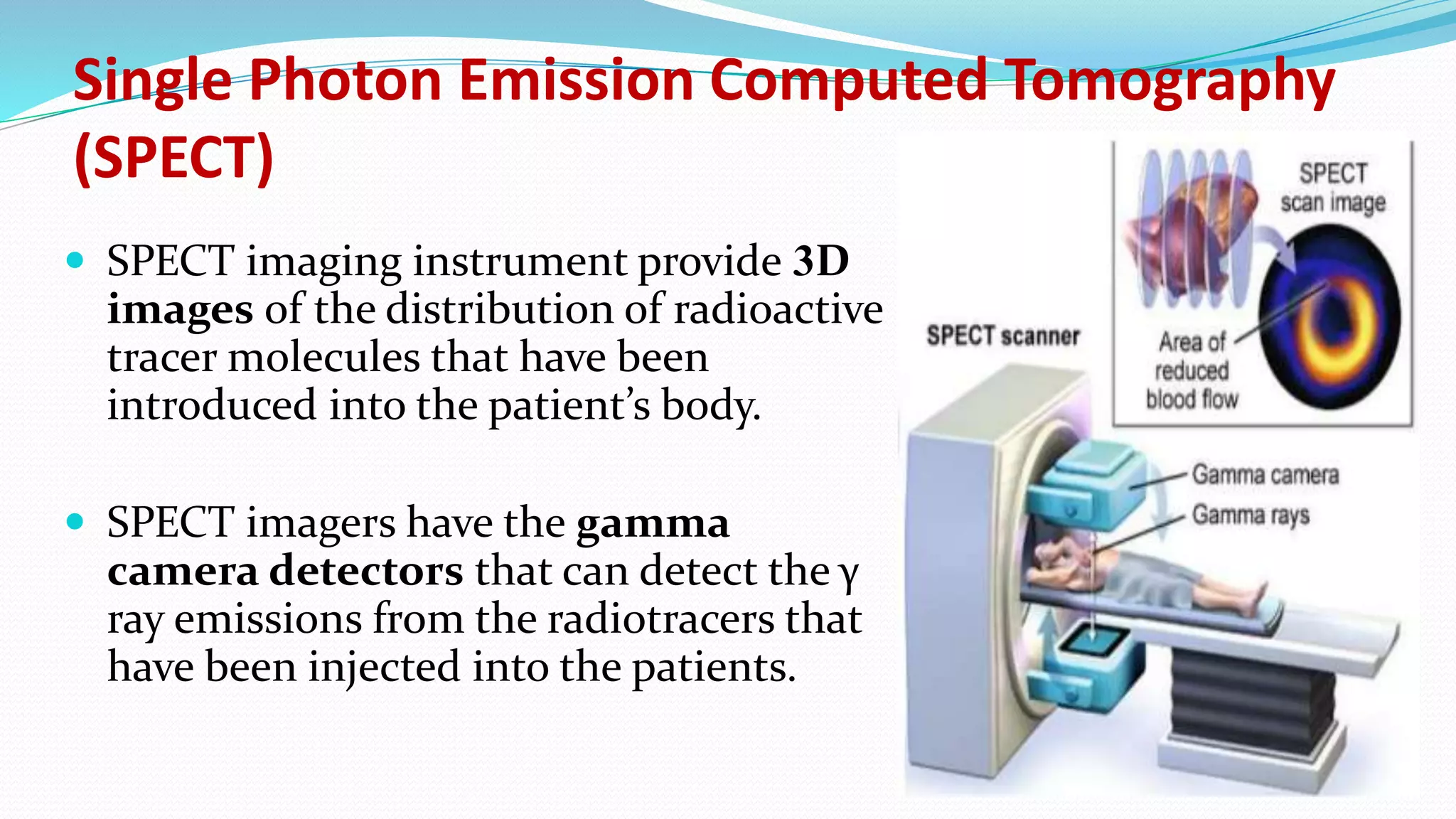
 SPECT imaging instrument provide 3D
images of the distribution of radioactive
tracer molecules that have been
introduced into the patient’s body.
 SPECT imagers have the gamma
camera detectors that can detect the γ
ray emissions from the radiotracers that
have been injected into the patients.
Positron Emission Tomography (PET)
 PET scans also use
radiopharmaceuticals to create
three dimensional images.
 The main difference between
SPECT and PET scans is the
type of radiotracers used.
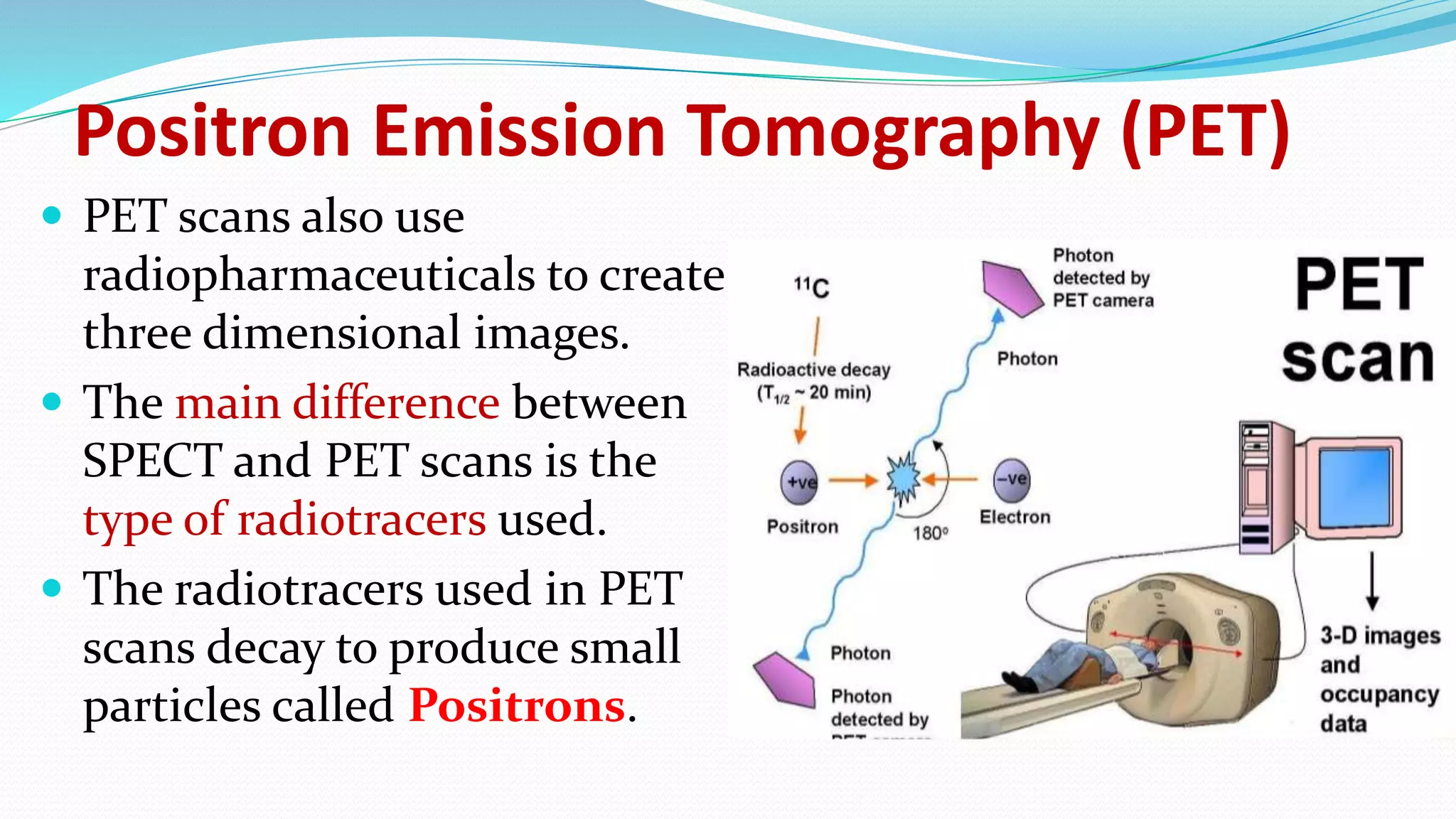
 The radiotracers used in PET
scans decay to produce small
particles called Positrons.
 Positrons have equal mass
of that of electron but
opposite charge.
 When a positron collides
with an electron,
annihilation occurs.
 It results in the production
of two or more gamma ray
photons that shoot off in
opposite directions.
Positron Emission Tomography (PET)
 The detectors in
the PET scanner
measure these
photons and use
the information to
create images of
internal organs.
Positron Emission Tomography (PET)
LIST OF
RADIOPHARMACEUTICALS
USED IN DIAGNOSIS AND
THERAPY
Carbon-11
 Chemical Symbol: 11C
 Chemical Form: Carbon-11 Choline
 Half-life: 20.334 minutes.
 Diagnostic use:
 Indicated for PET imaging of patients with suspected
prostate cancer recurrence based upon elevated
blood prostate specific antigen (PSA).
Carbon-14
 Chemical Symbol: 14C
 Chemical Form: Carbon-14 urea
 Half-life: 5,730 years
 Trade name(s): PYtest
 Diagnostic use: Detection of gastric urease as an
aid in the diagnosis of H.pylori infection in the
stomach
Fluorine-18
 Chemical Symbol: 18F
 Chemical Form: Fluorine-18 sodium fluoride
 Half-life: 109.771 minutes
 Manufacturer: Various
 Diagnostic use: PET bone imaging agent to
delineate areas of altered osteogenesis
Fluorine-18
 Chemical Symbol: 18F
 Chemical Form: Fluorine-18 fludeoxyglucose
 Half-life: 109.771 minutes
 Diagnostic use:
As a PET imaging agent to:
> Assess abnormal glucose metabolism in oncology
> Assess myocardial hibernation
> Identify regions of abnormal glucose metabolism
associated with foci of epileptic seizures
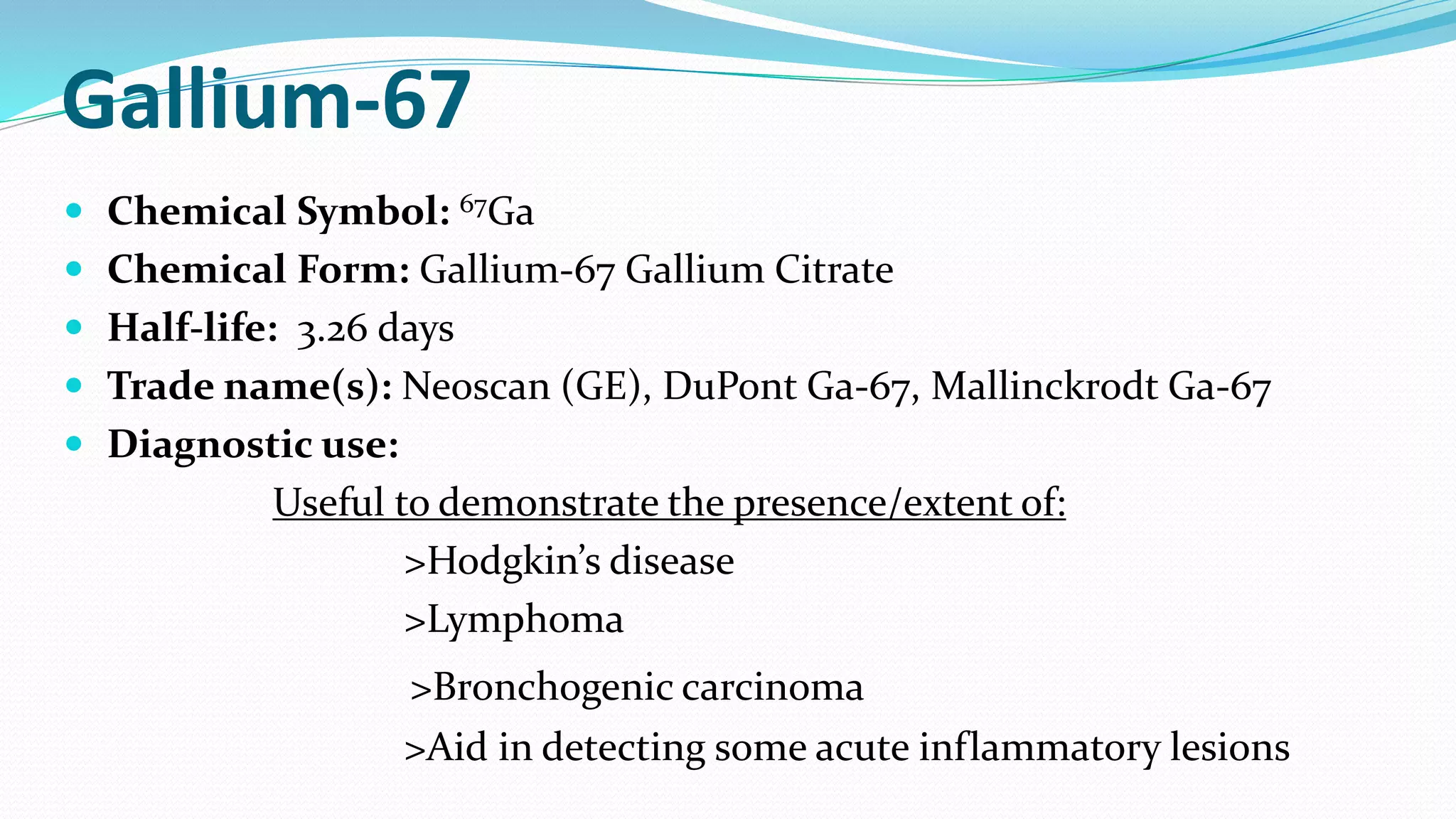
Gallium-67
 Chemical Symbol: 67Ga
 Chemical Form: Gallium-67 Gallium Citrate
 Half-life: 3.26 days
 Trade name(s): Neoscan (GE), DuPont Ga-67, Mallinckrodt Ga-67
 Diagnostic use:
Useful to demonstrate the presence/extent of:
>Hodgkin’s disease
>Lymphoma
>Bronchogenic carcinoma
>Aid in detecting some acute inflammatory lesions
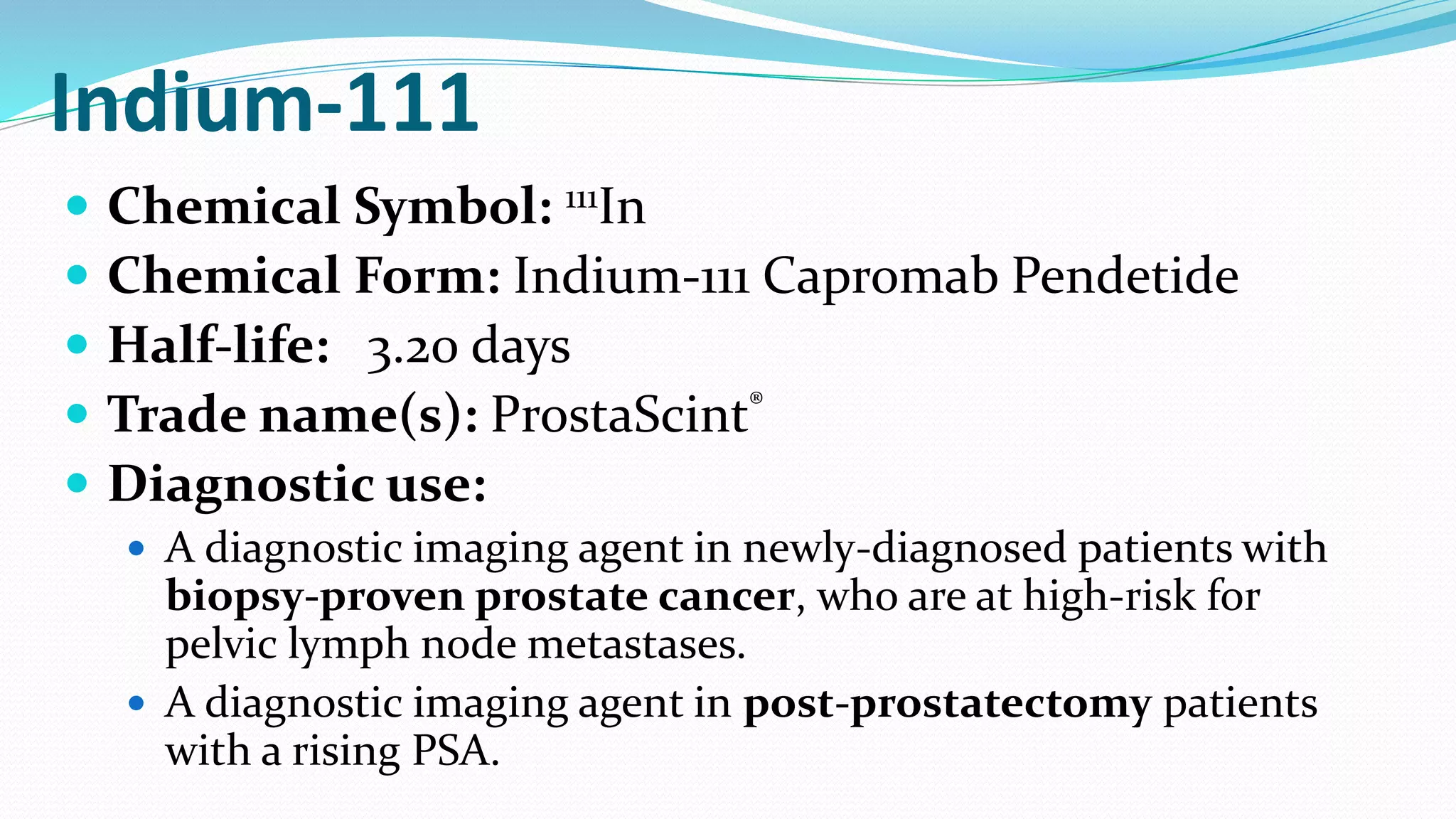
Indium-111
 Chemical Symbol: 111In
 Chemical Form: Indium-111 Capromab Pendetide
 Half-life: 3.20 days
 Trade name(s): ProstaScint®
 Diagnostic use:
 A diagnostic imaging agent in newly-diagnosed patients with
biopsy-proven prostate cancer, who are at high-risk for
pelvic lymph node metastases.
 A diagnostic imaging agent in post-prostatectomy patients
with a rising PSA.
Iodine - 123
 Chemical Symbol: 123I
 Chemical Form: Iodine – 123 Ioflupane
 Half-life: 13.22 hours
 Trade name(s): DaTscan™
 Diagnostic use:
 Indicated for striatal dopamine transporter visualization using SPECT
brain imaging to assist in the evaluation of adult patients with
suspected Parkinsonian syndromes (PS).
 It may help differentiate essential tremor due to PS.
Iodine - 123
 Chemical Symbol: 123I
 Chemical Form: Iodine – 123 Sodium iodide
 Half-life: 13.22 hours
 Trade name(s): Mallinckrodt, Amersham
 Diagnostic use: Indicated for use in the evaluation of thyroid:
• Function
• Morphology
Iodine - 131
 Chemical Symbol: 131I
 Chemical Form: Iodine – 131 human serum albumin
 Half-life: 8.0197 days
 Trade name(s): Megatope
 Diagnostic use: Indicated for use in determinations of:
• Total blood and plasma volumes
• Cardiac output
• Cardiac and pulmonary blood volumes and circulation times
• Protein turnover studies
• Heart and great vessel delineation
• Localization of the placenta
• Localization of cerebral neoplasm
Iodine - 131
 Chemical Symbol: 131I
 Chemical Form: Iodine – 131 sodium iodide
 Half-life: 8.0197 days
 Trade name(s): HICON™
 Diagnostic use:
• Performance of the radioactive iodide (RAI) uptake test to evaluate
thyroid function.
• Localizing metastases associated with thyroid malignancies
 Therapeutic uses:
• Treatment of hyperthyroidism
• Treatment of carcinoma of the thyroid
Iodine – 131 (Radioimmunotherapy)
 Chemical Symbol: 131I
 Chemical Form: Iodine – 131 tositumomab
 Half-life: 8.0197 days
 Trade name(s): BEXXAR®
 Diagnostic use: Indicated for:
 Treatment of patients with CD20 antigen-expressing relapsed
or refractory, low grade, follicular, or transformed non-
Hodgkin’s lymphoma.
Nitrogen-13
 Chemical Symbol: 13N
 Chemical Form: Nitrogen-13 Ammonia
 Half-life: 9.97 min
 Diagnostic use: Indicated for diagnostic Positron Emission
Tomography (PET) imaging of the myocardium under rest or
pharmacologic stress conditions to evaluate myocardial
perfusion in patients with suspected or existing coronary artery
disease.
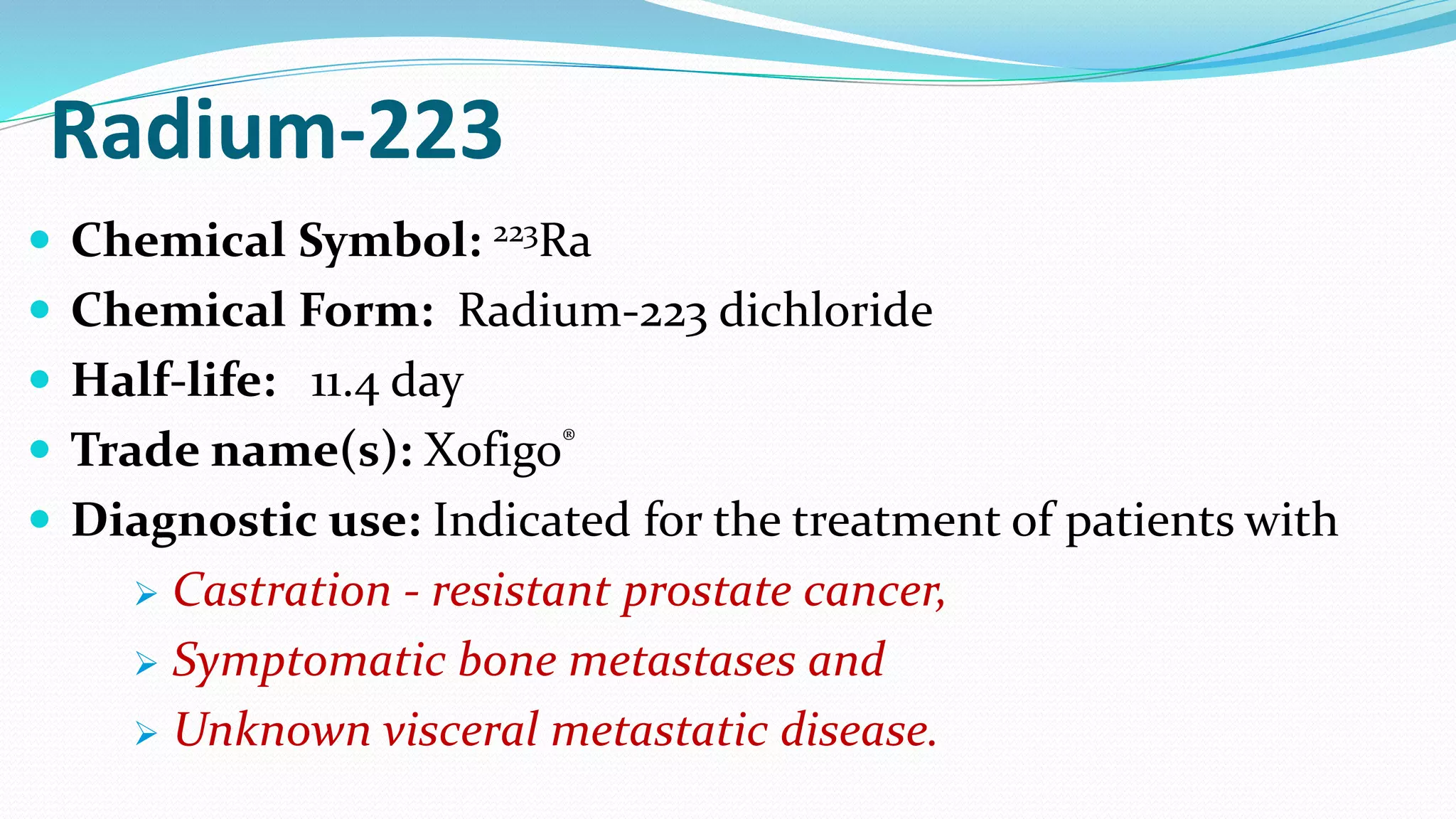
Radium-223
 Chemical Symbol: 223Ra
 Chemical Form: Radium-223 dichloride
 Half-life: 11.4 day
 Trade name(s): Xofigo®
 Diagnostic use: Indicated for the treatment of patients with
 Castration - resistant prostate cancer,
 Symptomatic bone metastases and
 Unknown visceral metastatic disease.
Rubidium-82
 Chemical Symbol: 223Ra
 Chemical Form: Rubidium-82 chloride
 Half-life: 1.27 minutes
 Trade name(s): Cardiogen-82®
 Diagnostic use: PET myocardial perfusion agent that is useful
in distinguishing normal from abnormal myocardium in patients
with suspected myocardial infarction.
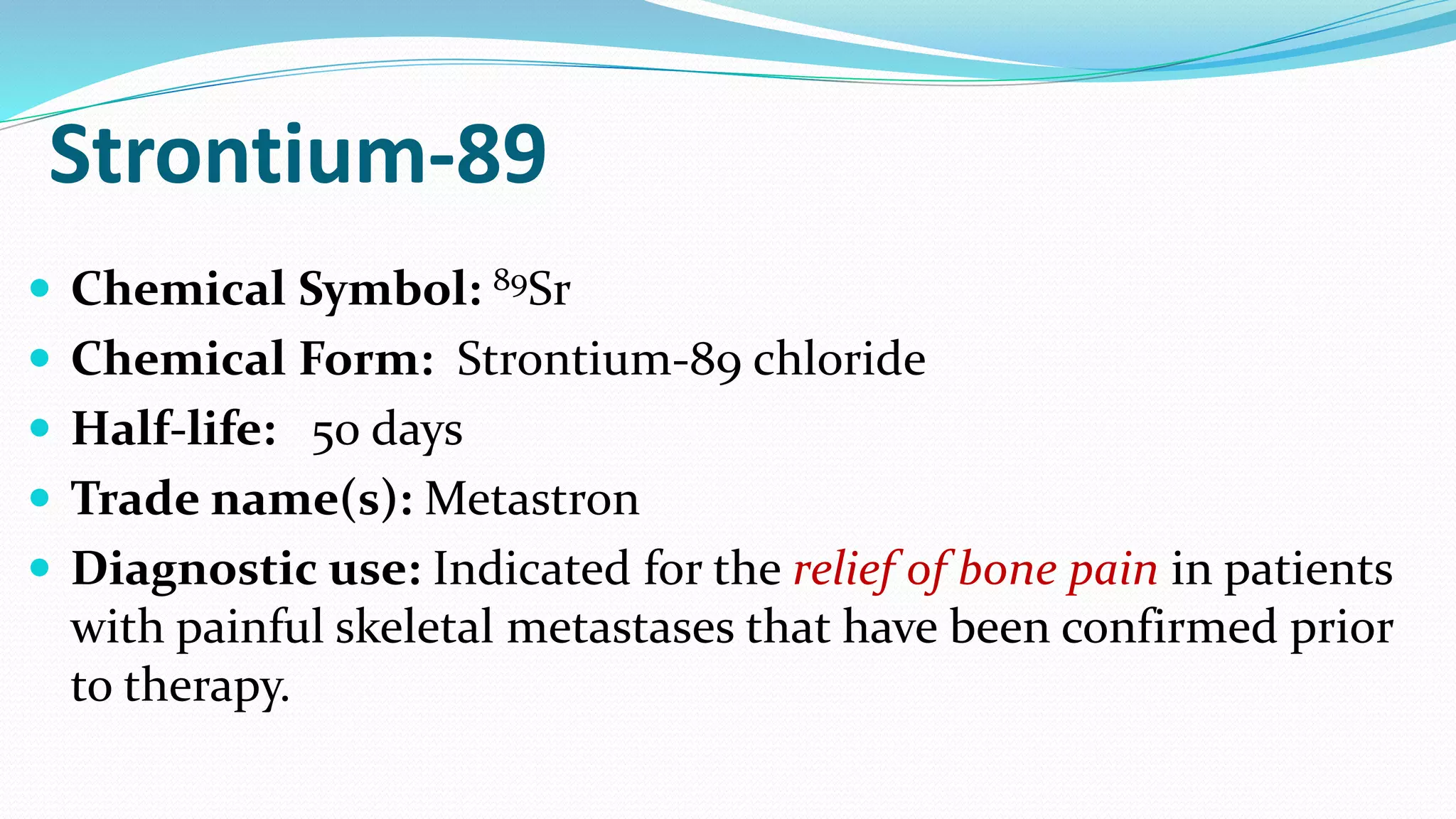
Strontium-89
 Chemical Symbol: 89Sr
 Chemical Form: Strontium-89 chloride
 Half-life: 50 days
 Trade name(s): Metastron
 Diagnostic use: Indicated for the relief of bone pain in patients
with painful skeletal metastases that have been confirmed prior
to therapy.
Technetium-99m
 Chemical Symbol: 99mTc
 Chemical Form: Technetium-99m bicisate
 Half-life: 6.0058 hours
 Trade name(s): Neurolite®
 Diagnostic use: SPECT imaging in the localization of stroke
in patients already diagnosed with stroke.
Technetium-99m
 Chemical Symbol: 99mTc
 Chemical Form: Technetium-99m sestamibi
 Half-life: 6.0058 hours
 Trade name(s): Cardiolite®
 Diagnostic use:
Myocardial perfusion agent that is indicated for:
 Detecting coronary artery disease by localizing myocardial ischemia
(reversible defects) and infarction (non-reversible defects)
 Evaluating myocardial function
 Planar breast imaging as a second line diagnostic drug after
mammography to assist in the evaluation of breast lesions in
patients with an abnormal mammogram or a palpable breast mass
Thallium-201
 Chemical Symbol: 201Tl
 Chemical Form: Thallium-201 chloride
 Half-life: 72.912 hrs
 Trade name(s): DuPont, Mallinckrodt, Amersham
 Diagnostic use:
 Useful in myocardial perfusion imaging for the diagnosis and localization
of myocardial infarction
 As an adjunct in the diagnosis of ischemic heart disease (atherosclerotic
coronary artery disease)
 Localization of sites of parathyroid hyperactivity in patients with elevated
serum calcium and parathyroid hormone levels.
Yttrium-90 (radioimmnunotherapy)
 Chemical Symbol: 90Y
 Chemical Form: Yttrium-90 ibritumomab tiuxetan
 Half-life: 64 hrs
 Trade name(s): Zevalin
 Therapeutic use: Indicated for the:
• Treatment of relapsed or refractory, low-grade or follicular B-cell
non-Hodgkin’s lymphoma (NHL)
• Treatment of previously untreated follicular NHL in patients who
achieve a partial or complete response to first-line chemotherapy
Bibliography
 Radiobiology for the radiologist by Eric Hall.
 National institute of biomedical imaging and
bioengineering. (2017). Nuclear Medicine.
 http://nuclearpharmacy.uams.edu/RPLIST.html
 http://www.radiologyinfo.org/en/info
Nuclear medicine

Nuclear medicine

  • 1.
  • 2.
    Introduction  Nuclear medicineis the medical specialty in which unsealed radionucleotides, chemically manipulated to form radiopharmaceuticals, are used for diagnosis and therapy.  Radiopharmaceuticals localize in various target tissues and organs and provide better display of physiology and metabolism.
  • 3.
    Principles Of NuclearMedicine  A wide range of radionucleotides are used in the diagnostic nuclear medicine that meets the necessary requirements for effective and efficient imaging.  All radionucleotides are produced artificially, using four principle routes of manufacture. 1. CYCLOTRON BOMBARDMENT: gallium-67, indium-111, thallium-201, cobalt-57, carbon-11, oxygen-15, nitrogen-13 and fluorine-18 2. REACTOR IRRADIATION: chromium-51, selenium-75, iodine-125 and iodine-131. 3. FISSION PRODUCTS: iodine-131, xenon-133 and strontium-90 4. GENERATORS THAT PROVIDE SECONDARY DECAY PRODUCTS FROM LONGER LIVED PARENT RADIONUCLIDES: Column generators incorporating molybdenum-99 for the provision of technetium-99m.
  • 4.
     The useof radiopharmaceuticals for diagnosis or therapy is based on the accumulation or concentration of the isotope in the organ of interest referred as Target organ.  A radiopharmaceutical may have an affinity for a certain organ that is not necessarily the target organ, in which case this organ is termed as Critical organ.  The risk to which the patient is subjected is clearly a function of the doses received in all organs and is expressed in terms of the effective dose.  The risk must be balanced against the expected advantages and benefits rendered by the procedure. Principles Of Nuclear Medicine
  • 5.
    Nuclear Medicine InDiagnosis  Nuclear Medicine imaging procedures are generally non- invasive.  The Nuclear Medicine imaging scans use radioactive materials called radiopharmaceuticals or radiotracers.  Depending on the type of nuclear medicine exam, the radiotracer is either injected into the body, swallowed or inhaled as a gas and eventually accumulates in the organ or area of the body to be examined.
  • 6.
    Single Photon EmissionComputed Tomography (SPECT)  SPECT imaging instrument provide 3D images of the distribution of radioactive tracer molecules that have been introduced into the patient’s body.  SPECT imagers have the gamma camera detectors that can detect the γ ray emissions from the radiotracers that have been injected into the patients.
  • 7.
    Positron Emission Tomography(PET)  PET scans also use radiopharmaceuticals to create three dimensional images.  The main difference between SPECT and PET scans is the type of radiotracers used.  The radiotracers used in PET scans decay to produce small particles called Positrons.
  • 8.
     Positrons haveequal mass of that of electron but opposite charge.  When a positron collides with an electron, annihilation occurs.  It results in the production of two or more gamma ray photons that shoot off in opposite directions. Positron Emission Tomography (PET)
  • 9.
     The detectorsin the PET scanner measure these photons and use the information to create images of internal organs. Positron Emission Tomography (PET)
  • 10.
  • 11.
    Carbon-11  Chemical Symbol:11C  Chemical Form: Carbon-11 Choline  Half-life: 20.334 minutes.  Diagnostic use:  Indicated for PET imaging of patients with suspected prostate cancer recurrence based upon elevated blood prostate specific antigen (PSA).
  • 12.
    Carbon-14  Chemical Symbol:14C  Chemical Form: Carbon-14 urea  Half-life: 5,730 years  Trade name(s): PYtest  Diagnostic use: Detection of gastric urease as an aid in the diagnosis of H.pylori infection in the stomach
  • 13.
    Fluorine-18  Chemical Symbol:18F  Chemical Form: Fluorine-18 sodium fluoride  Half-life: 109.771 minutes  Manufacturer: Various  Diagnostic use: PET bone imaging agent to delineate areas of altered osteogenesis
  • 14.
    Fluorine-18  Chemical Symbol:18F  Chemical Form: Fluorine-18 fludeoxyglucose  Half-life: 109.771 minutes  Diagnostic use: As a PET imaging agent to: > Assess abnormal glucose metabolism in oncology > Assess myocardial hibernation > Identify regions of abnormal glucose metabolism associated with foci of epileptic seizures
  • 15.
    Gallium-67  Chemical Symbol:67Ga  Chemical Form: Gallium-67 Gallium Citrate  Half-life: 3.26 days  Trade name(s): Neoscan (GE), DuPont Ga-67, Mallinckrodt Ga-67  Diagnostic use: Useful to demonstrate the presence/extent of: >Hodgkin’s disease >Lymphoma >Bronchogenic carcinoma >Aid in detecting some acute inflammatory lesions
  • 16.
    Indium-111  Chemical Symbol:111In  Chemical Form: Indium-111 Capromab Pendetide  Half-life: 3.20 days  Trade name(s): ProstaScint®  Diagnostic use:  A diagnostic imaging agent in newly-diagnosed patients with biopsy-proven prostate cancer, who are at high-risk for pelvic lymph node metastases.  A diagnostic imaging agent in post-prostatectomy patients with a rising PSA.
  • 17.
    Iodine - 123 Chemical Symbol: 123I  Chemical Form: Iodine – 123 Ioflupane  Half-life: 13.22 hours  Trade name(s): DaTscan™  Diagnostic use:  Indicated for striatal dopamine transporter visualization using SPECT brain imaging to assist in the evaluation of adult patients with suspected Parkinsonian syndromes (PS).  It may help differentiate essential tremor due to PS.
  • 18.
    Iodine - 123 Chemical Symbol: 123I  Chemical Form: Iodine – 123 Sodium iodide  Half-life: 13.22 hours  Trade name(s): Mallinckrodt, Amersham  Diagnostic use: Indicated for use in the evaluation of thyroid: • Function • Morphology
  • 19.
    Iodine - 131 Chemical Symbol: 131I  Chemical Form: Iodine – 131 human serum albumin  Half-life: 8.0197 days  Trade name(s): Megatope  Diagnostic use: Indicated for use in determinations of: • Total blood and plasma volumes • Cardiac output • Cardiac and pulmonary blood volumes and circulation times • Protein turnover studies • Heart and great vessel delineation • Localization of the placenta • Localization of cerebral neoplasm
  • 20.
    Iodine - 131 Chemical Symbol: 131I  Chemical Form: Iodine – 131 sodium iodide  Half-life: 8.0197 days  Trade name(s): HICON™  Diagnostic use: • Performance of the radioactive iodide (RAI) uptake test to evaluate thyroid function. • Localizing metastases associated with thyroid malignancies  Therapeutic uses: • Treatment of hyperthyroidism • Treatment of carcinoma of the thyroid
  • 21.
    Iodine – 131(Radioimmunotherapy)  Chemical Symbol: 131I  Chemical Form: Iodine – 131 tositumomab  Half-life: 8.0197 days  Trade name(s): BEXXAR®  Diagnostic use: Indicated for:  Treatment of patients with CD20 antigen-expressing relapsed or refractory, low grade, follicular, or transformed non- Hodgkin’s lymphoma.
  • 22.
    Nitrogen-13  Chemical Symbol:13N  Chemical Form: Nitrogen-13 Ammonia  Half-life: 9.97 min  Diagnostic use: Indicated for diagnostic Positron Emission Tomography (PET) imaging of the myocardium under rest or pharmacologic stress conditions to evaluate myocardial perfusion in patients with suspected or existing coronary artery disease.
  • 23.
    Radium-223  Chemical Symbol:223Ra  Chemical Form: Radium-223 dichloride  Half-life: 11.4 day  Trade name(s): Xofigo®  Diagnostic use: Indicated for the treatment of patients with  Castration - resistant prostate cancer,  Symptomatic bone metastases and  Unknown visceral metastatic disease.
  • 24.
    Rubidium-82  Chemical Symbol:223Ra  Chemical Form: Rubidium-82 chloride  Half-life: 1.27 minutes  Trade name(s): Cardiogen-82®  Diagnostic use: PET myocardial perfusion agent that is useful in distinguishing normal from abnormal myocardium in patients with suspected myocardial infarction.
  • 25.
    Strontium-89  Chemical Symbol:89Sr  Chemical Form: Strontium-89 chloride  Half-life: 50 days  Trade name(s): Metastron  Diagnostic use: Indicated for the relief of bone pain in patients with painful skeletal metastases that have been confirmed prior to therapy.
  • 26.
    Technetium-99m  Chemical Symbol:99mTc  Chemical Form: Technetium-99m bicisate  Half-life: 6.0058 hours  Trade name(s): Neurolite®  Diagnostic use: SPECT imaging in the localization of stroke in patients already diagnosed with stroke.
  • 27.
    Technetium-99m  Chemical Symbol:99mTc  Chemical Form: Technetium-99m sestamibi  Half-life: 6.0058 hours  Trade name(s): Cardiolite®  Diagnostic use: Myocardial perfusion agent that is indicated for:  Detecting coronary artery disease by localizing myocardial ischemia (reversible defects) and infarction (non-reversible defects)  Evaluating myocardial function  Planar breast imaging as a second line diagnostic drug after mammography to assist in the evaluation of breast lesions in patients with an abnormal mammogram or a palpable breast mass
  • 28.
    Thallium-201  Chemical Symbol:201Tl  Chemical Form: Thallium-201 chloride  Half-life: 72.912 hrs  Trade name(s): DuPont, Mallinckrodt, Amersham  Diagnostic use:  Useful in myocardial perfusion imaging for the diagnosis and localization of myocardial infarction  As an adjunct in the diagnosis of ischemic heart disease (atherosclerotic coronary artery disease)  Localization of sites of parathyroid hyperactivity in patients with elevated serum calcium and parathyroid hormone levels.
  • 29.
    Yttrium-90 (radioimmnunotherapy)  ChemicalSymbol: 90Y  Chemical Form: Yttrium-90 ibritumomab tiuxetan  Half-life: 64 hrs  Trade name(s): Zevalin  Therapeutic use: Indicated for the: • Treatment of relapsed or refractory, low-grade or follicular B-cell non-Hodgkin’s lymphoma (NHL) • Treatment of previously untreated follicular NHL in patients who achieve a partial or complete response to first-line chemotherapy
  • 30.
    Bibliography  Radiobiology forthe radiologist by Eric Hall.  National institute of biomedical imaging and bioengineering. (2017). Nuclear Medicine.  http://nuclearpharmacy.uams.edu/RPLIST.html  http://www.radiologyinfo.org/en/info

Editor's Notes