GROUNDED THEORY AS
RESEARCH METHOD
Dr. Ramakanta Mohalik
Professor of Education
RIE-NCERT, Bhubaneswar
Email-mohalikrk@gmail.com
Understanding the Teacher/Student Relationship in
the English Writing Class
• The purpose of this study is to discover the elements of the teacher
student relationship that exist during the teaching of writing which
are most pertinent to student writing improvement.
• What are the identifiable elements of the teacher student relationship
in the classroom?
• What impact does verbal and nonverbal communication of teacher
have on students’ performance and enjoyment of writing?
• What elements of the teacher-student relationship are directly related
to students’ writing in the English classroom?
• What impact does the teacher-student relationship have on student
writing outcomes?
13-03-2021 Prof. Ramakanta Mohalik, NCERT
Sample
• Three English class with teachers
• Five students from each class
• Selected randomly
• Each class was visited nine times over a period of
three months and follow-up student interviews took
place at the end of that three month period.
13-03-2021 Prof. Ramakanta Mohalik, NCERT
Tools
• The researcher is the primary data-gathering
instrument through observing, interviewing,
distributing and collecting focused questionnaires,
assigning and collecting personal journals for
participants individually, and taped meetings with the
participants.
13-03-2021 Prof. Ramakanta Mohalik, NCERT
Data Analysis
• Transcriptions, Memoing, Identification of ELEMENTS
• Notes were coded and filed under various categories that appear as
the study progresses.
• Researcher has developed concepts from which a theory regarding
the teacher’s influence in and on the writing process was identified.
• Analysis was done through 19 continual logging in and analysis of the
data gathered using a constant comparative method.
• This procedure involves comparison of new data with previously
collected data to note similarities and differences
13-03-2021 Prof. Ramakanta Mohalik, NCERT
Coding
• Different phases of coding took place as the research progressed. Open
coding was used to identify categories based on thematic and conceptual
similarities which led to the identification of new categories.
• While open coding the data, in vivo coding naturally occurred. In vivo
coding occurred when several students referred to the same situation in
the classroom using the same general phrase.
• Axial coding took place. Axial coding described the properties of the open
coding categories, which allowed for discovery by the researcher as to how
the categories were related to one another thematically and conceptually.
• During all three phases of coding, reflective analytical memos were written
by the researcher in order to record perceived connections amongst the
data through inductive and deductive thinking/reasoning
13-03-2021 Prof. Ramakanta Mohalik, NCERT
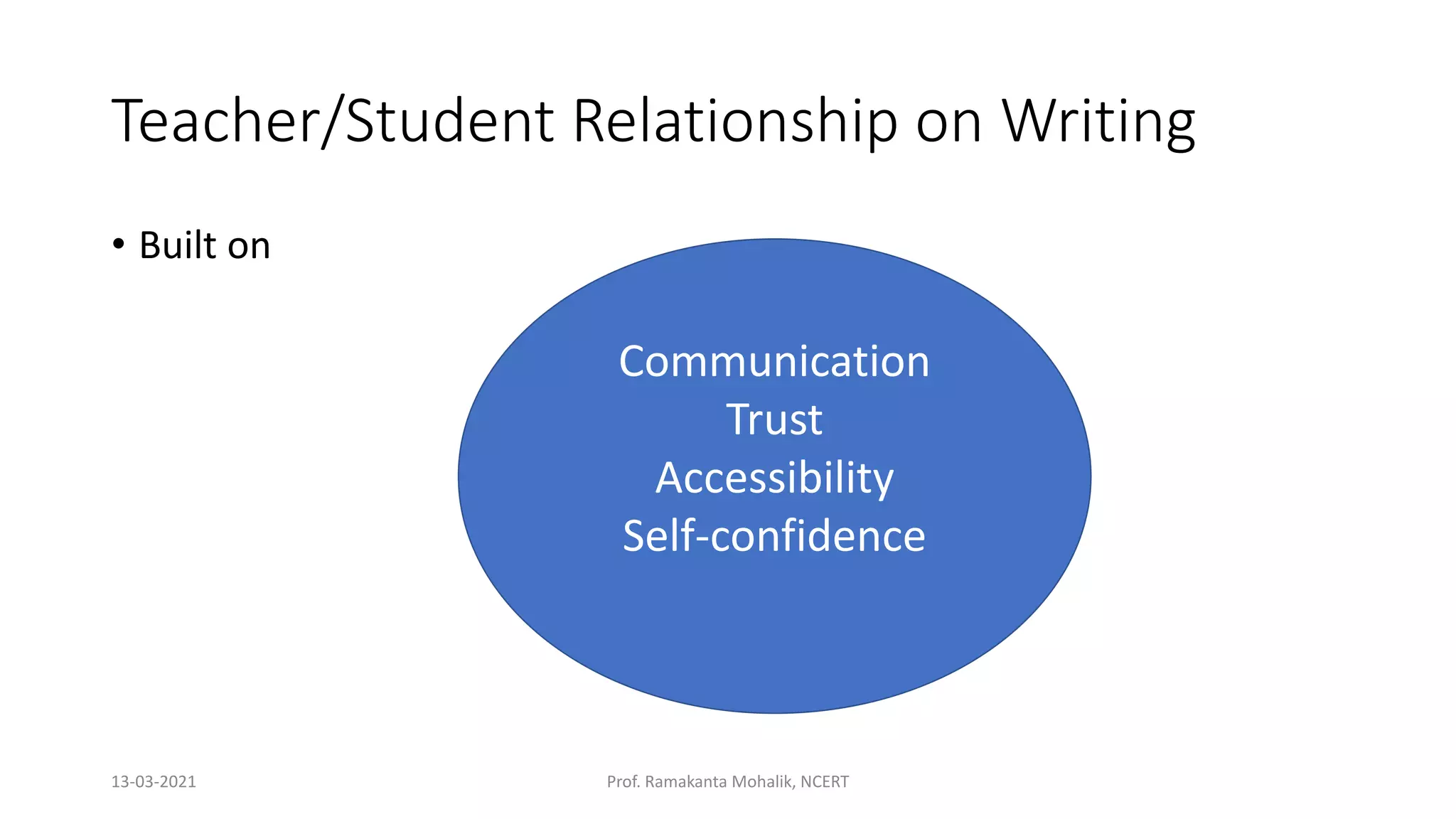
Teacher/Student Relationship on Writing
• Built on
Communication
Trust
Accessibility
Self-confidence
13-03-2021 Prof. Ramakanta Mohalik, NCERT
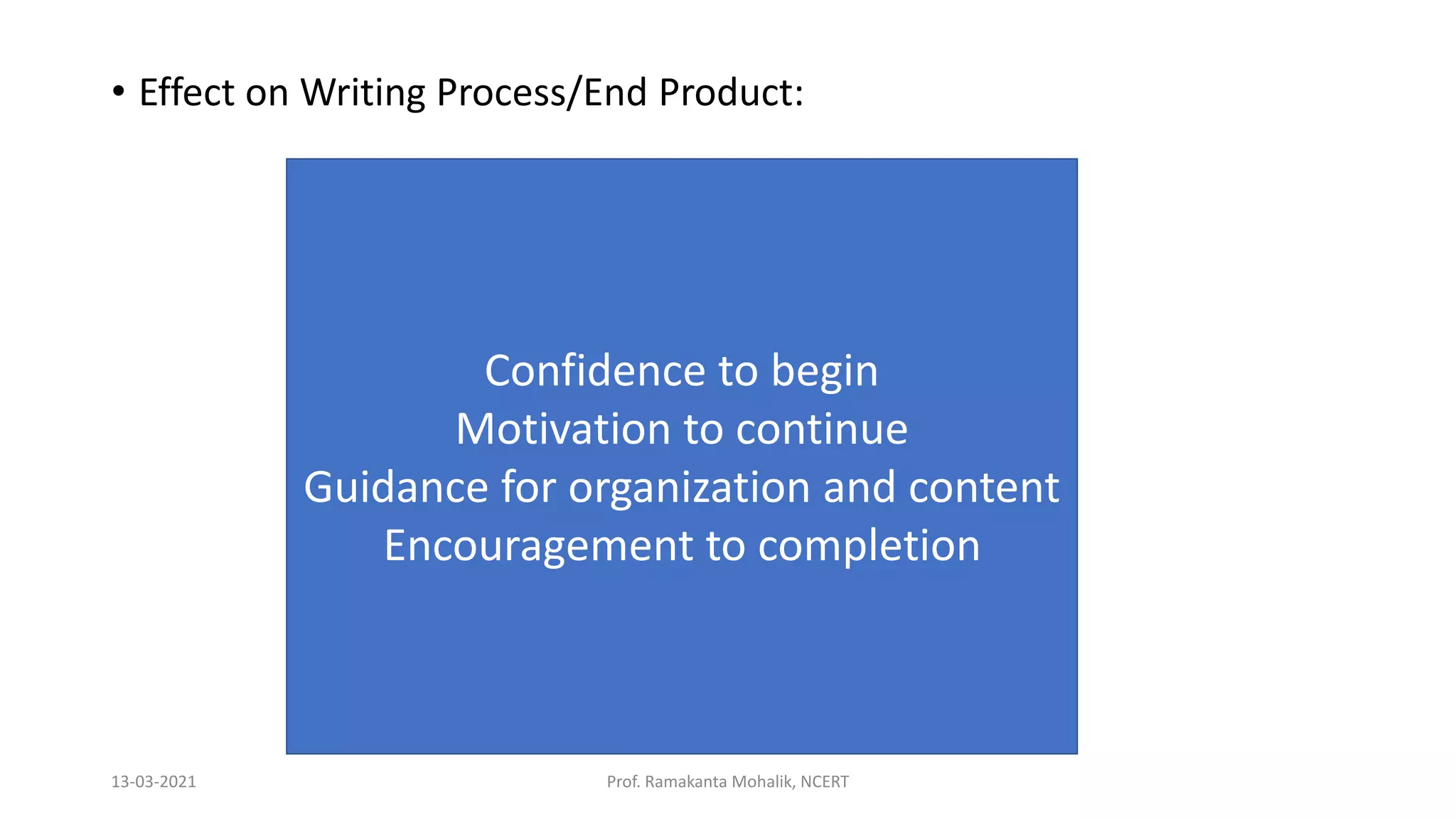
• Effect on Writing Process/End Product:
Confidence to begin
Motivation to continue
Guidance for organization and content
Encouragement to completion
13-03-2021 Prof. Ramakanta Mohalik, NCERT
Resulting students success:
Communication of clear objectives = Confidence to begin the
writing process
Trust in teacher ability and willingness to help = Motivation
to continue once the process has begun
Accessibility through communication in/out of class =
guidance during the process as individually required
Teacher self-confidence/student self-confidence =
Encouragement to completion of best possible written end
product for each students
13-03-2021 Prof. Ramakanta Mohalik, NCERT
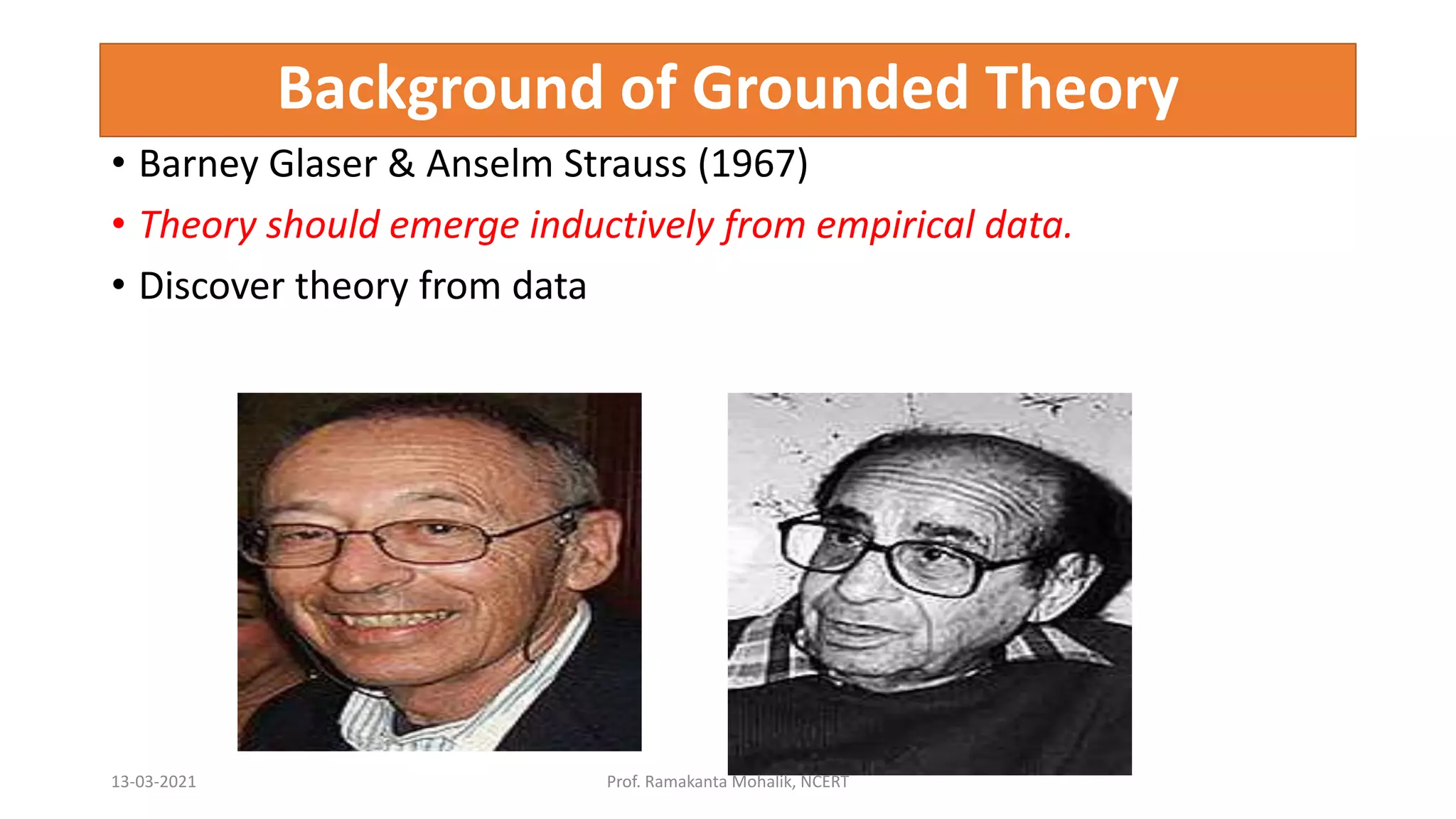
Background of Grounded Theory
• Barney Glaser & Anselm Strauss (1967)
• Theory should emerge inductively from empirical data.
• Discover theory from data
13-03-2021 Prof. Ramakanta Mohalik, NCERT
What is GT
• GT is a general methodology for developing theory that is
grounded in data systematically gathered and analysed.
• GT is not generated a priori (only based on reason) but
generated directly from data that is collected for one or
more studies.
• GT is inductively derived. Induction is bottom-up approach
based on original data.
• During GT, some data are collected & analysed, and as the
theory is being developed, additional data are collected and
analysed to further clarify, develop & validate theory.
13-03-2021 Prof. Ramakanta Mohalik, NCERT
Characteristics of GT
• Theory must fit the real world data not to personal
wishes/biases/predetermined categories if it is to be useful.
• Theory must clearly stated and understandable.
• Theory should have generality (make at abstract level).
• Theory should have control by users.
• Development of GT is never ending process.
• “Person who applies the theory becomes in effect generator of
theory”
13-03-2021 Prof. Ramakanta Mohalik, NCERT
Data Collection in GT
•Data collection and analysis are concurrent &
continual activities.
•Tools are: Any data collection techniques are
allowed in GT. (Open ended interview,
Observation, Field notes)
13-03-2021 Prof. Ramakanta Mohalik, NCERT
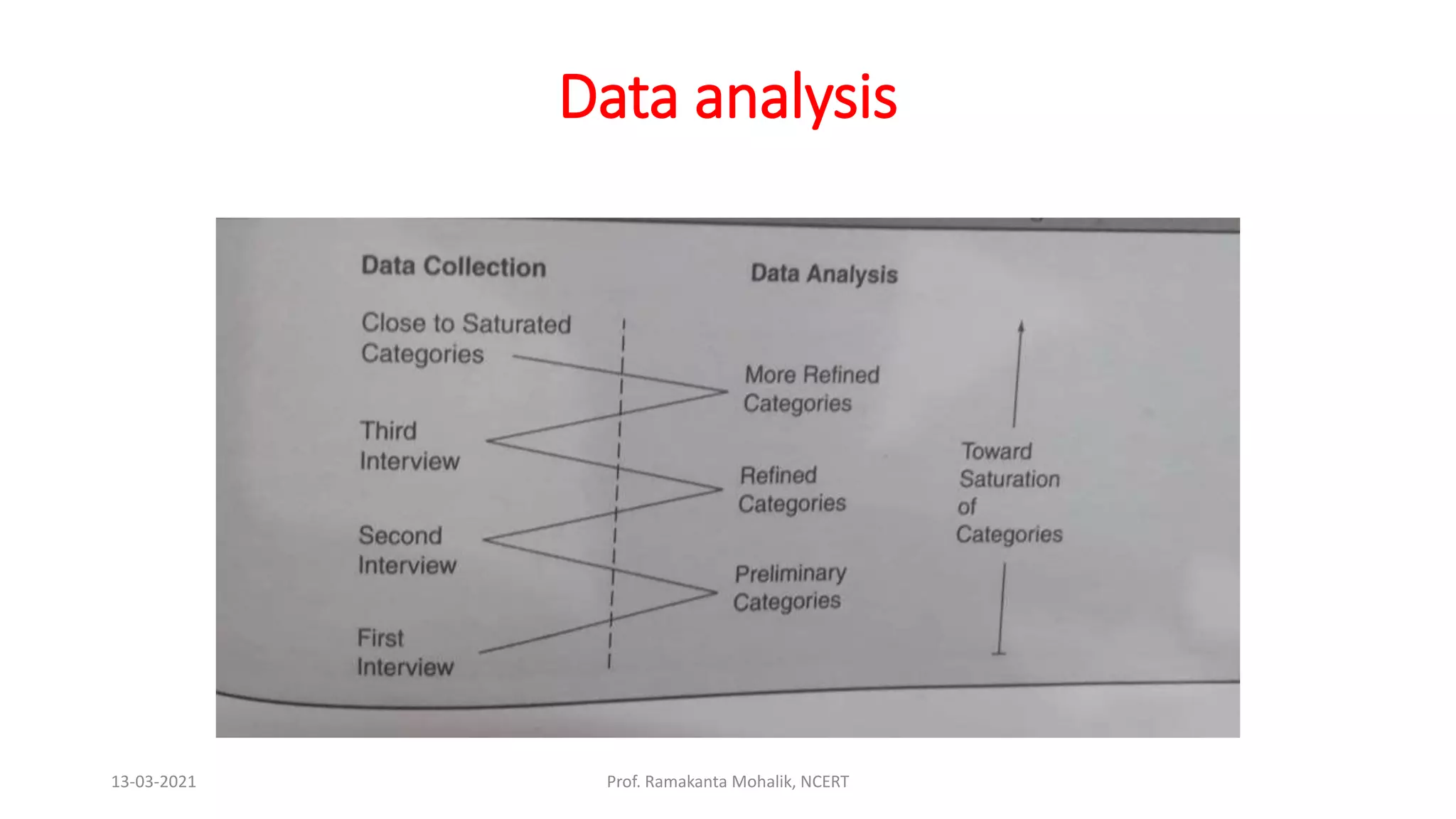
Data analysis
13-03-2021 Prof. Ramakanta Mohalik, NCERT
Data Analysis
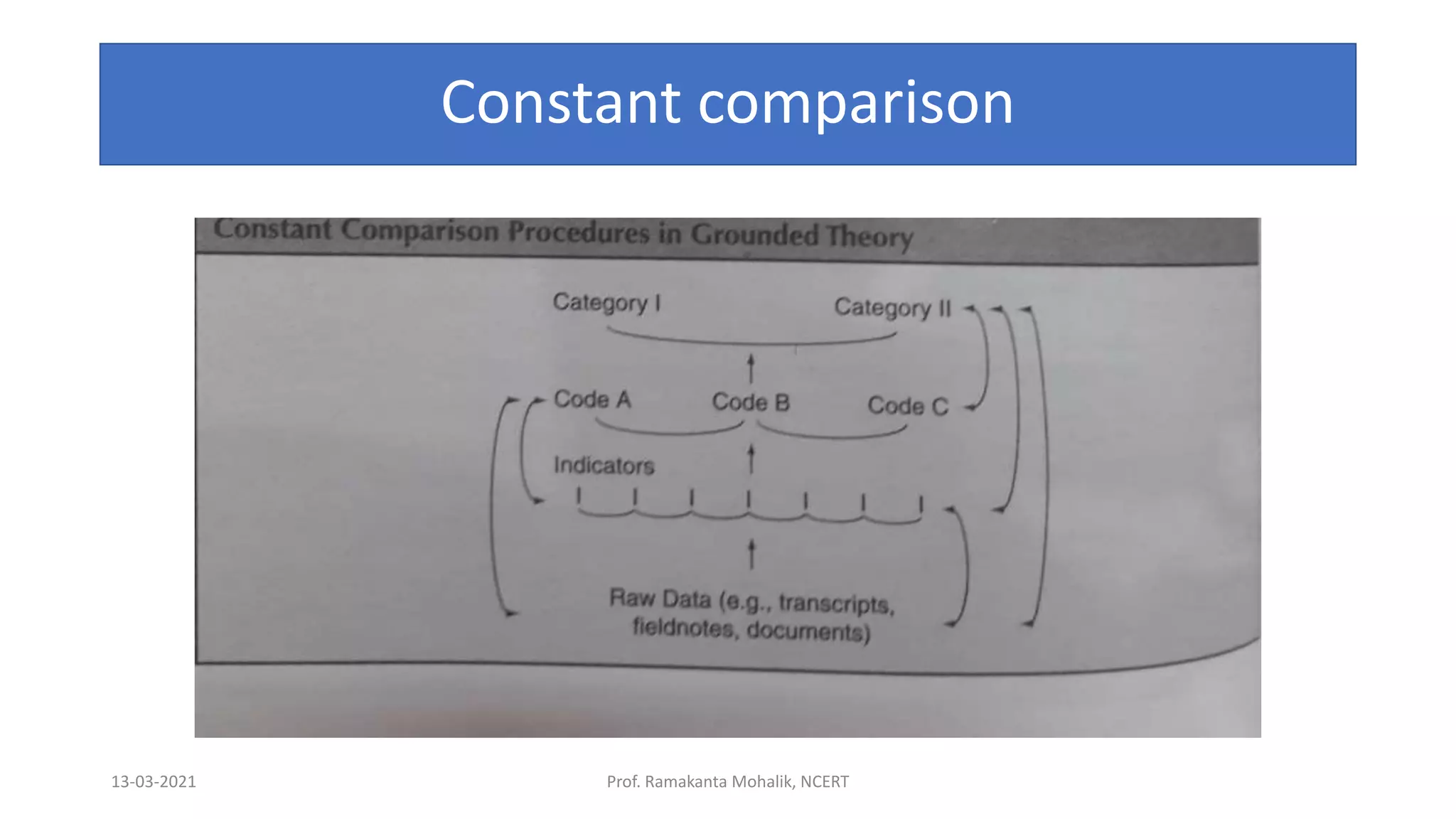
• Constant comparative method: It involves connecting
categories by comparing incidents in data to other incidents,
incidents to categories, categories to other categories. It
involves constant interplay among the researcher, data and
developing theory.
• Theoretical sensitivity: When a researcher is effective at
thinking about what kind of data need to be collected and what
aspects of already collected data are most important for the GT.
• During analysis ideas & hypotheses are generated & then
provisionally tested, with additional data.
13-03-2021 Prof. Ramakanta Mohalik, NCERT
Constant comparison
13-03-2021 Prof. Ramakanta Mohalik, NCERT
Stages of Data Analysis
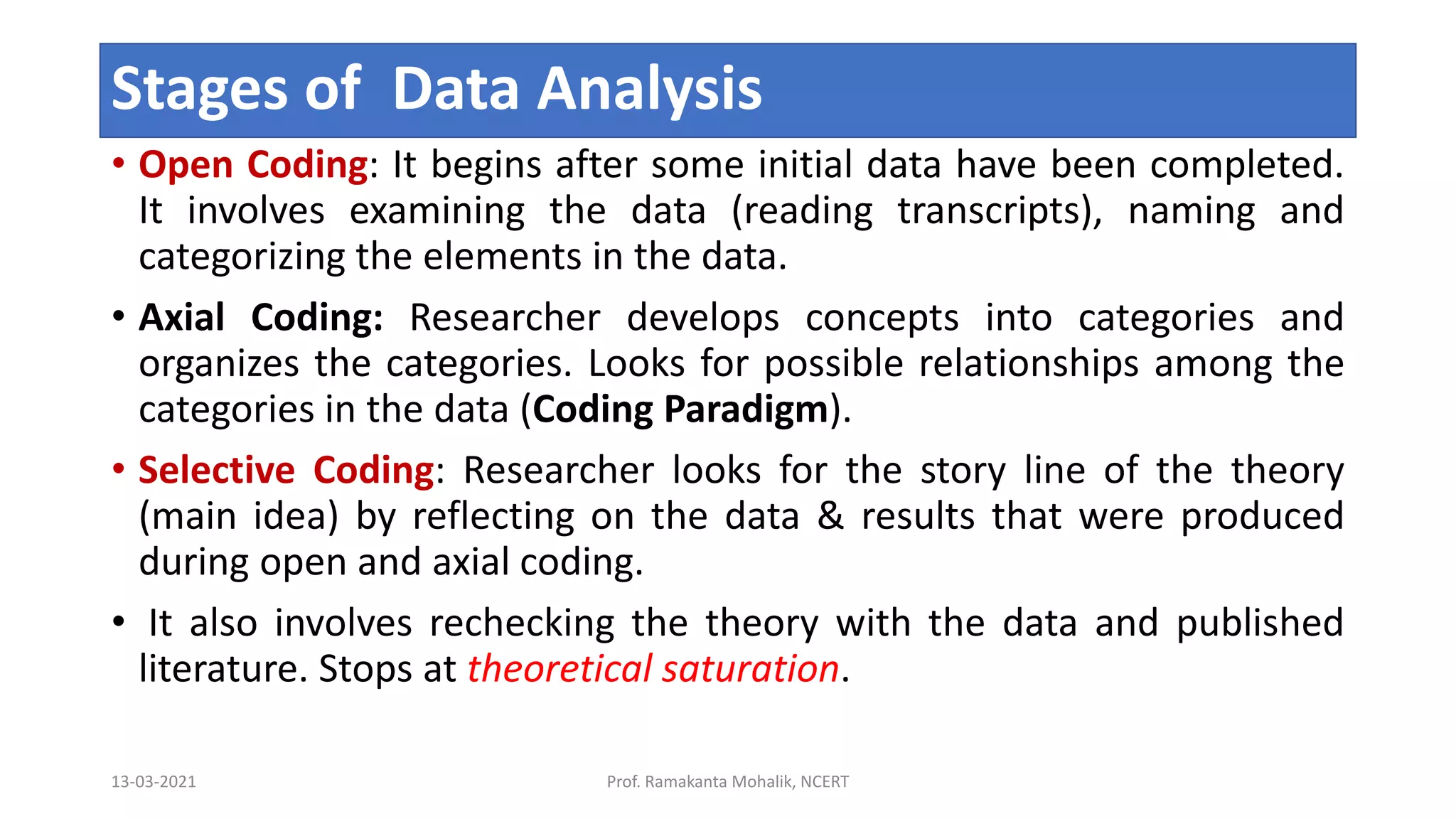
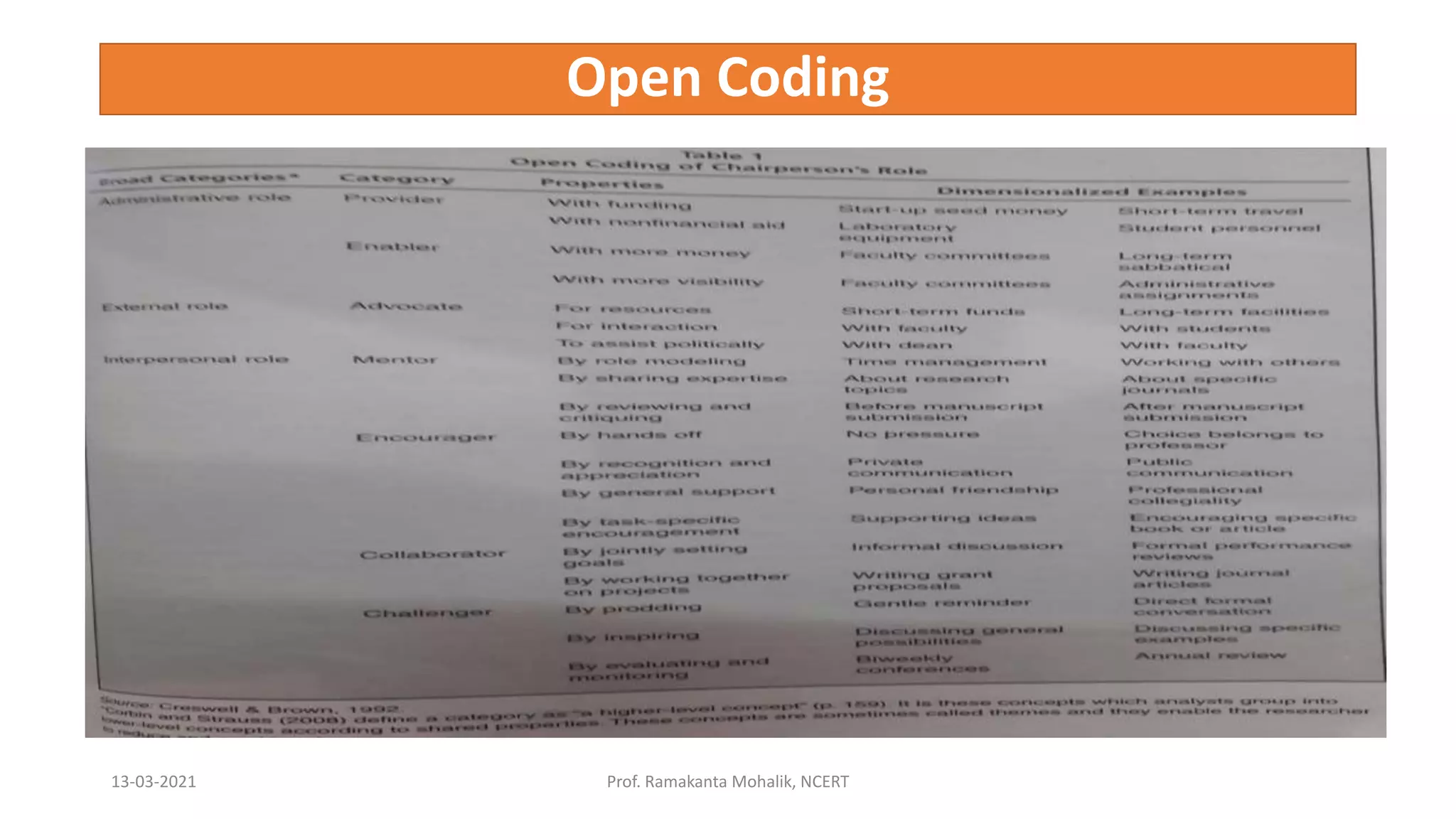
• Open Coding: It begins after some initial data have been completed.
It involves examining the data (reading transcripts), naming and
categorizing the elements in the data.
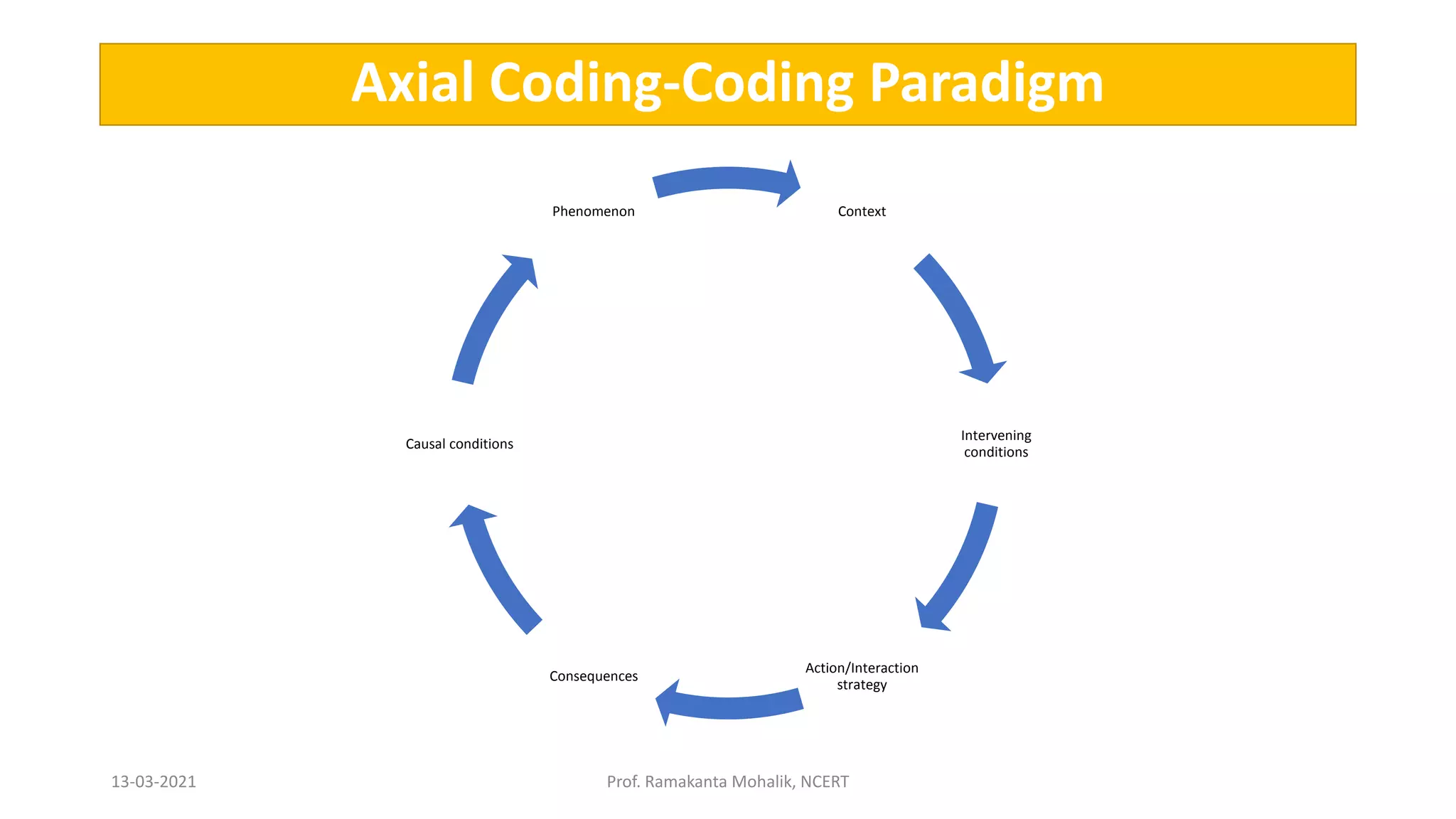
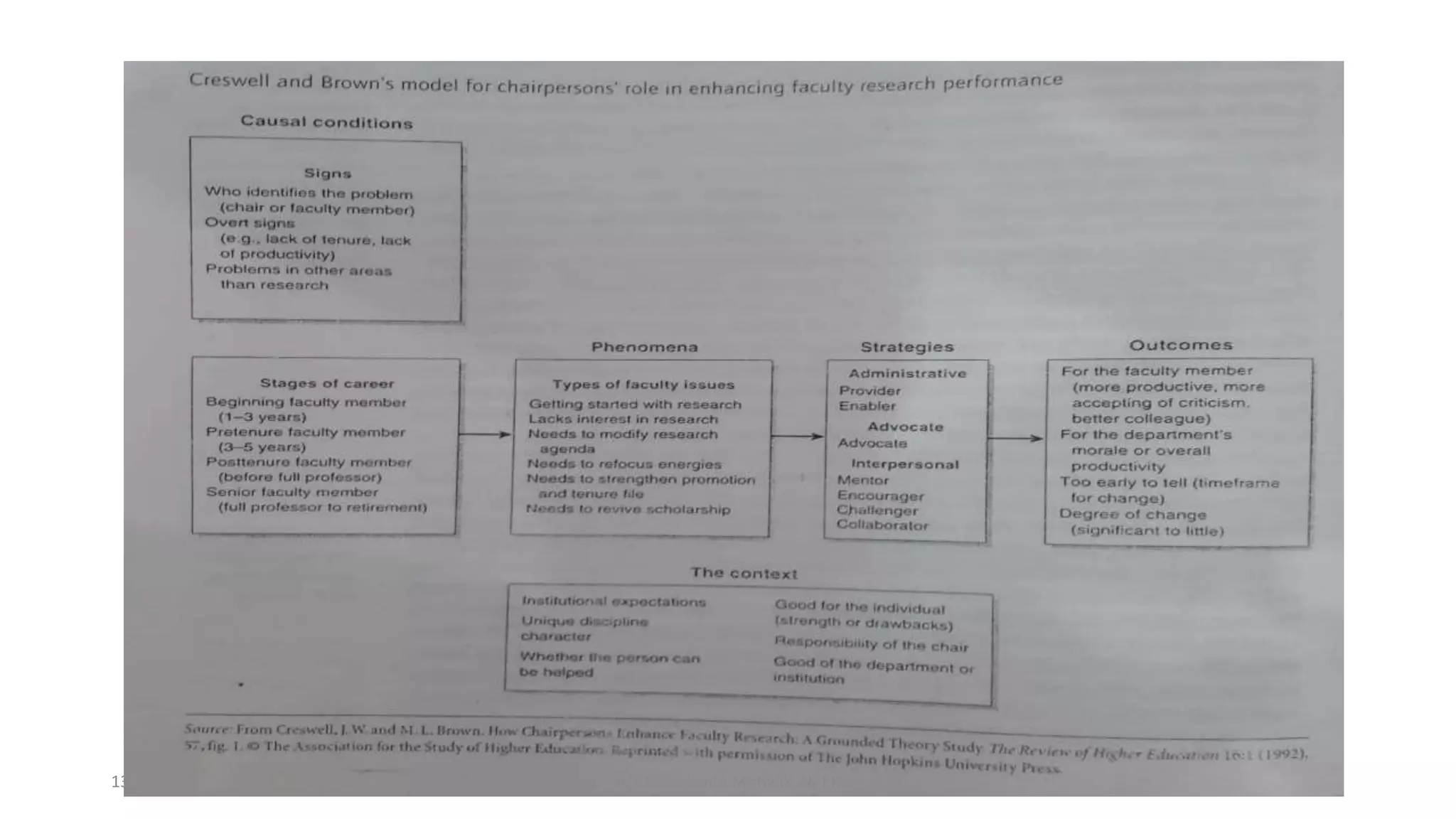
• Axial Coding: Researcher develops concepts into categories and
organizes the categories. Looks for possible relationships among the
categories in the data (Coding Paradigm).
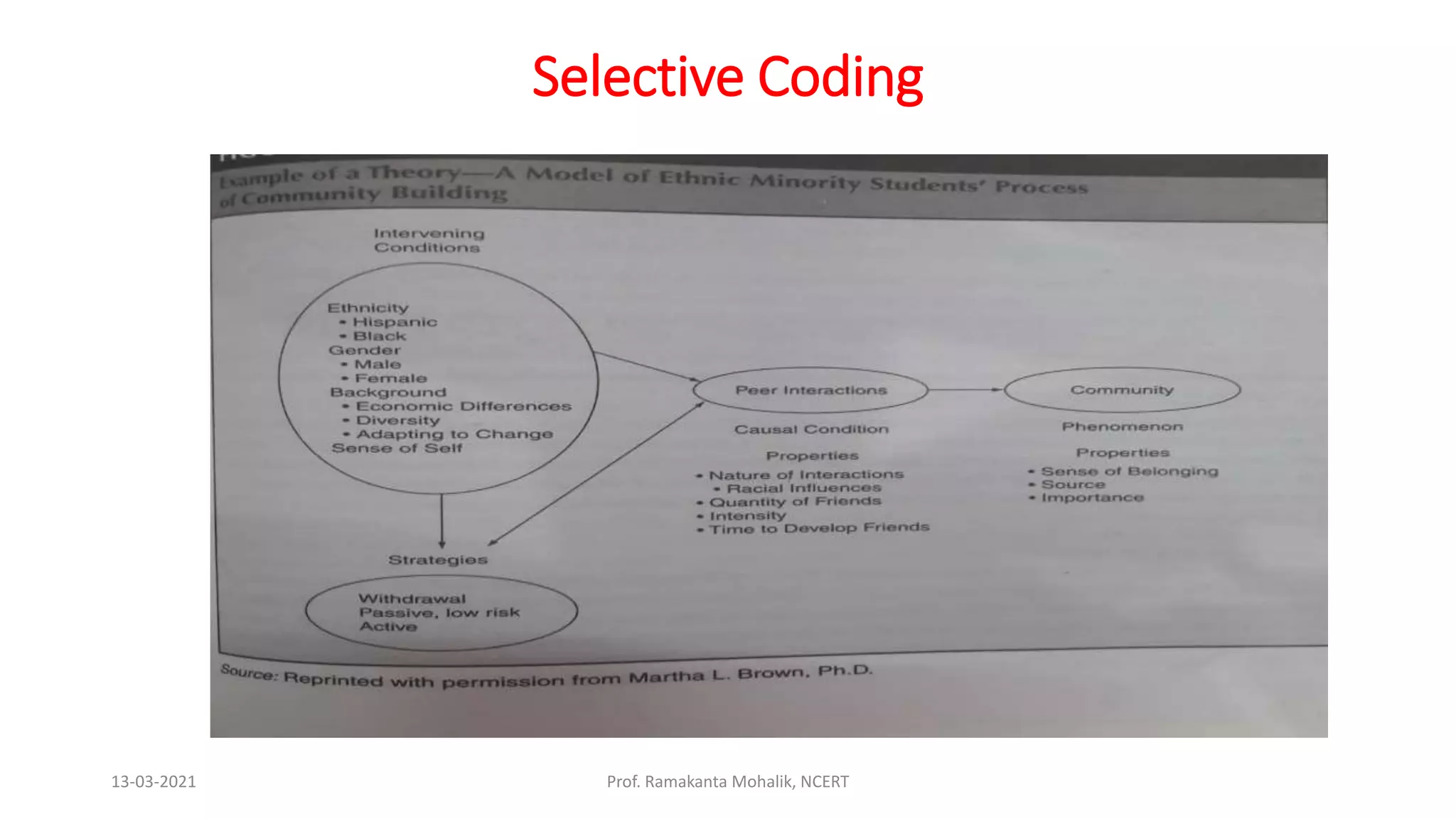
• Selective Coding: Researcher looks for the story line of the theory
(main idea) by reflecting on the data & results that were produced
during open and axial coding.
• It also involves rechecking the theory with the data and published
literature. Stops at theoretical saturation.
13-03-2021 Prof. Ramakanta Mohalik, NCERT
Open Coding
13-03-2021 Prof. Ramakanta Mohalik, NCERT
Axial Coding-Coding Paradigm
Context
Intervening
conditions
Action/Interaction
strategy
Consequences
Causal conditions
Phenomenon
13-03-2021 Prof. Ramakanta Mohalik, NCERT
Selective Coding
13-03-2021 Prof. Ramakanta Mohalik, NCERT
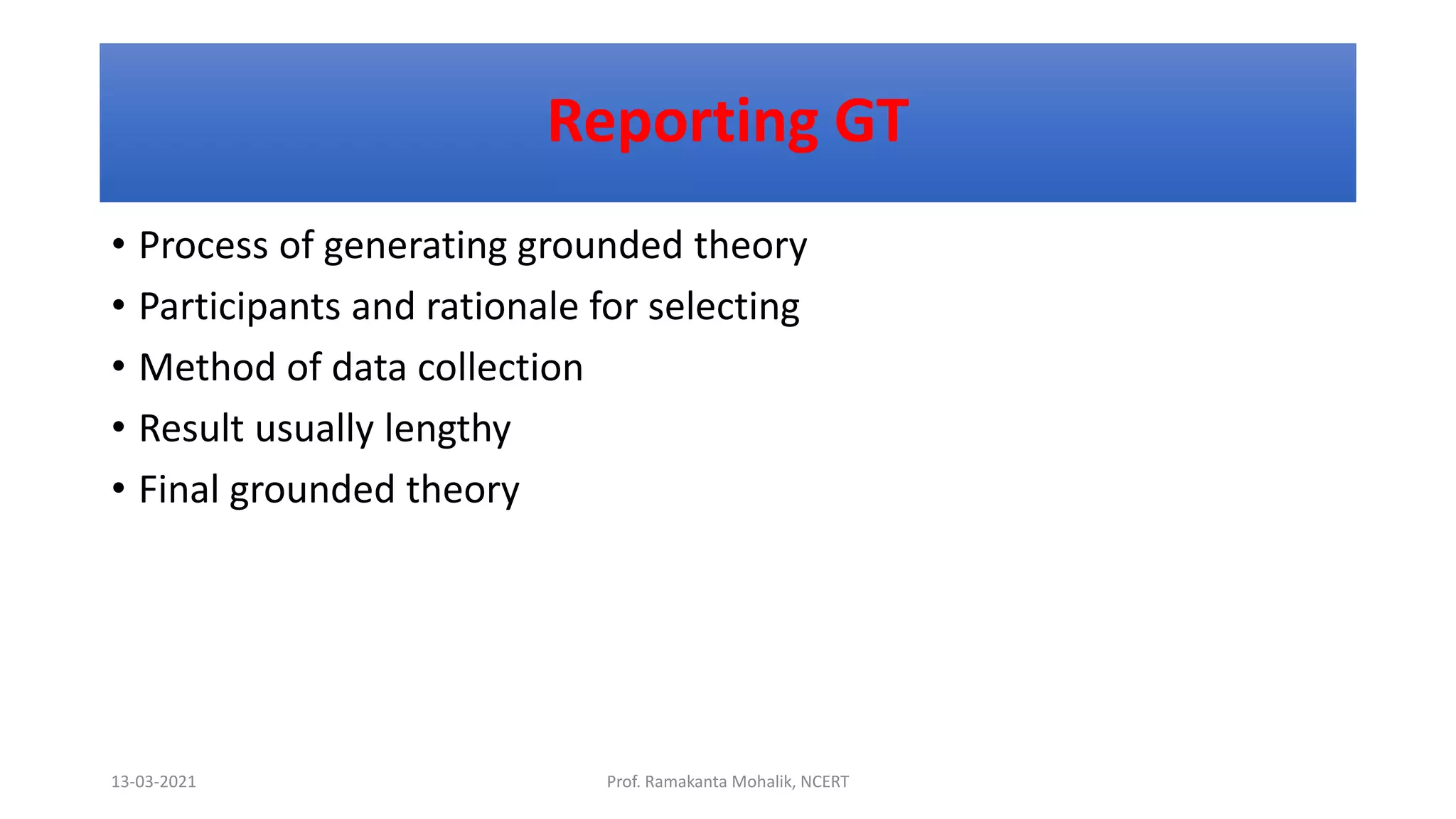
Reporting GT
• Process of generating grounded theory
• Participants and rationale for selecting
• Method of data collection
• Result usually lengthy
• Final grounded theory
13-03-2021 Prof. Ramakanta Mohalik, NCERT
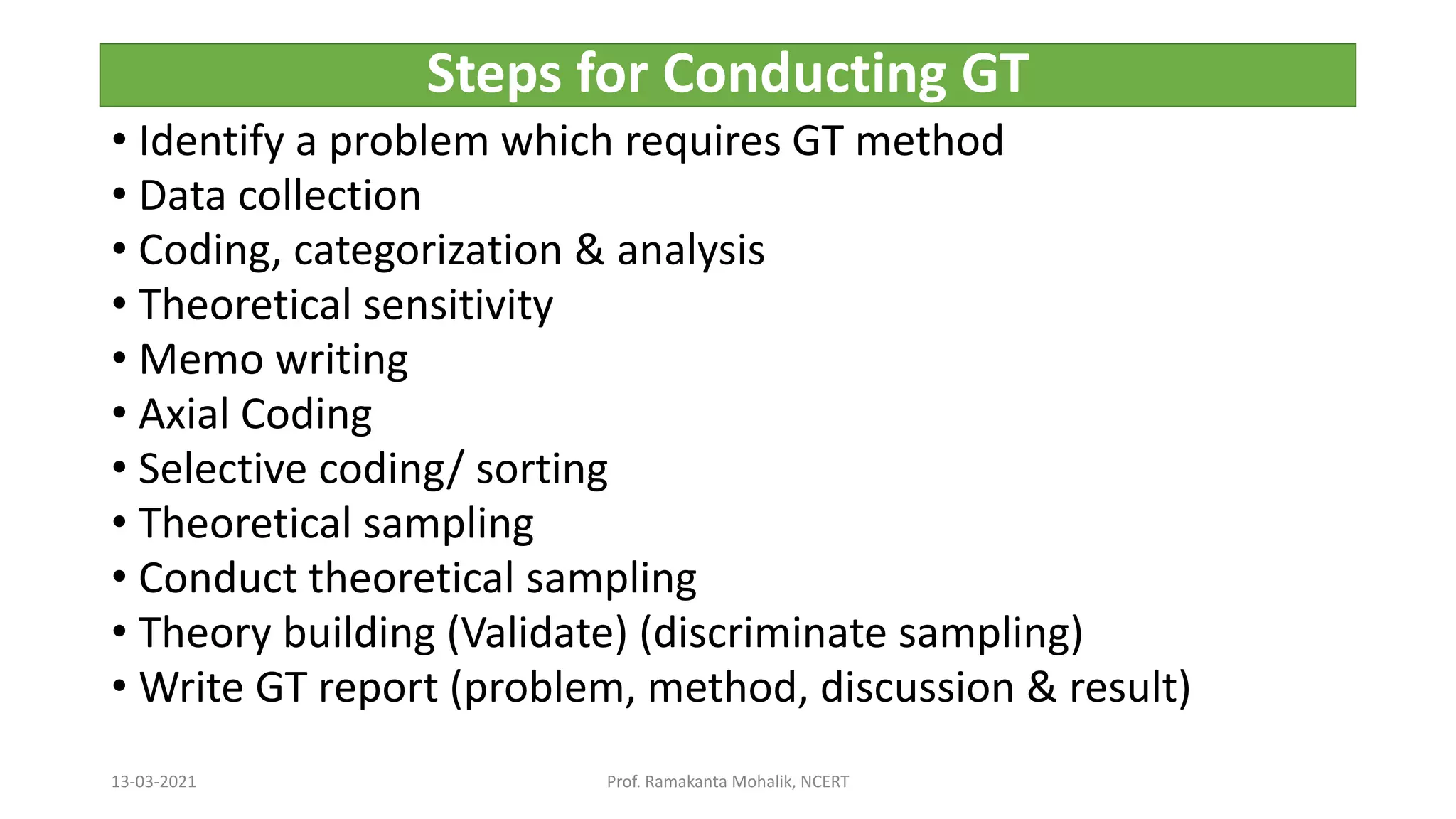
Steps for Conducting GT
• Identify a problem which requires GT method
• Data collection
• Coding, categorization & analysis
• Theoretical sensitivity
• Memo writing
• Axial Coding
• Selective coding/ sorting
• Theoretical sampling
• Conduct theoretical sampling
• Theory building (Validate) (discriminate sampling)
• Write GT report (problem, method, discussion & result)
13-03-2021 Prof. Ramakanta Mohalik, NCERT

Grounded Theory as Research Method

  • 1.
    GROUNDED THEORY AS RESEARCHMETHOD Dr. Ramakanta Mohalik Professor of Education RIE-NCERT, Bhubaneswar Email-mohalikrk@gmail.com
  • 2.
    Understanding the Teacher/StudentRelationship in the English Writing Class • The purpose of this study is to discover the elements of the teacher student relationship that exist during the teaching of writing which are most pertinent to student writing improvement. • What are the identifiable elements of the teacher student relationship in the classroom? • What impact does verbal and nonverbal communication of teacher have on students’ performance and enjoyment of writing? • What elements of the teacher-student relationship are directly related to students’ writing in the English classroom? • What impact does the teacher-student relationship have on student writing outcomes? 13-03-2021 Prof. Ramakanta Mohalik, NCERT
  • 3.
    Sample • Three Englishclass with teachers • Five students from each class • Selected randomly • Each class was visited nine times over a period of three months and follow-up student interviews took place at the end of that three month period. 13-03-2021 Prof. Ramakanta Mohalik, NCERT
  • 4.
    Tools • The researcheris the primary data-gathering instrument through observing, interviewing, distributing and collecting focused questionnaires, assigning and collecting personal journals for participants individually, and taped meetings with the participants. 13-03-2021 Prof. Ramakanta Mohalik, NCERT
  • 5.
    Data Analysis • Transcriptions,Memoing, Identification of ELEMENTS • Notes were coded and filed under various categories that appear as the study progresses. • Researcher has developed concepts from which a theory regarding the teacher’s influence in and on the writing process was identified. • Analysis was done through 19 continual logging in and analysis of the data gathered using a constant comparative method. • This procedure involves comparison of new data with previously collected data to note similarities and differences 13-03-2021 Prof. Ramakanta Mohalik, NCERT
  • 6.
    Coding • Different phasesof coding took place as the research progressed. Open coding was used to identify categories based on thematic and conceptual similarities which led to the identification of new categories. • While open coding the data, in vivo coding naturally occurred. In vivo coding occurred when several students referred to the same situation in the classroom using the same general phrase. • Axial coding took place. Axial coding described the properties of the open coding categories, which allowed for discovery by the researcher as to how the categories were related to one another thematically and conceptually. • During all three phases of coding, reflective analytical memos were written by the researcher in order to record perceived connections amongst the data through inductive and deductive thinking/reasoning 13-03-2021 Prof. Ramakanta Mohalik, NCERT
  • 7.
    Teacher/Student Relationship onWriting • Built on Communication Trust Accessibility Self-confidence 13-03-2021 Prof. Ramakanta Mohalik, NCERT
  • 8.
    • Effect onWriting Process/End Product: Confidence to begin Motivation to continue Guidance for organization and content Encouragement to completion 13-03-2021 Prof. Ramakanta Mohalik, NCERT
  • 9.
    Resulting students success: Communicationof clear objectives = Confidence to begin the writing process Trust in teacher ability and willingness to help = Motivation to continue once the process has begun Accessibility through communication in/out of class = guidance during the process as individually required Teacher self-confidence/student self-confidence = Encouragement to completion of best possible written end product for each students 13-03-2021 Prof. Ramakanta Mohalik, NCERT
  • 10.
    Background of GroundedTheory • Barney Glaser & Anselm Strauss (1967) • Theory should emerge inductively from empirical data. • Discover theory from data 13-03-2021 Prof. Ramakanta Mohalik, NCERT
  • 11.
    What is GT •GT is a general methodology for developing theory that is grounded in data systematically gathered and analysed. • GT is not generated a priori (only based on reason) but generated directly from data that is collected for one or more studies. • GT is inductively derived. Induction is bottom-up approach based on original data. • During GT, some data are collected & analysed, and as the theory is being developed, additional data are collected and analysed to further clarify, develop & validate theory. 13-03-2021 Prof. Ramakanta Mohalik, NCERT
  • 12.
    Characteristics of GT •Theory must fit the real world data not to personal wishes/biases/predetermined categories if it is to be useful. • Theory must clearly stated and understandable. • Theory should have generality (make at abstract level). • Theory should have control by users. • Development of GT is never ending process. • “Person who applies the theory becomes in effect generator of theory” 13-03-2021 Prof. Ramakanta Mohalik, NCERT
  • 13.
    Data Collection inGT •Data collection and analysis are concurrent & continual activities. •Tools are: Any data collection techniques are allowed in GT. (Open ended interview, Observation, Field notes) 13-03-2021 Prof. Ramakanta Mohalik, NCERT
  • 14.
    Data analysis 13-03-2021 Prof.Ramakanta Mohalik, NCERT
  • 15.
    Data Analysis • Constantcomparative method: It involves connecting categories by comparing incidents in data to other incidents, incidents to categories, categories to other categories. It involves constant interplay among the researcher, data and developing theory. • Theoretical sensitivity: When a researcher is effective at thinking about what kind of data need to be collected and what aspects of already collected data are most important for the GT. • During analysis ideas & hypotheses are generated & then provisionally tested, with additional data. 13-03-2021 Prof. Ramakanta Mohalik, NCERT
  • 16.
    Constant comparison 13-03-2021 Prof.Ramakanta Mohalik, NCERT
  • 17.
    Stages of DataAnalysis • Open Coding: It begins after some initial data have been completed. It involves examining the data (reading transcripts), naming and categorizing the elements in the data. • Axial Coding: Researcher develops concepts into categories and organizes the categories. Looks for possible relationships among the categories in the data (Coding Paradigm). • Selective Coding: Researcher looks for the story line of the theory (main idea) by reflecting on the data & results that were produced during open and axial coding. • It also involves rechecking the theory with the data and published literature. Stops at theoretical saturation. 13-03-2021 Prof. Ramakanta Mohalik, NCERT
  • 18.
    Open Coding 13-03-2021 Prof.Ramakanta Mohalik, NCERT
  • 19.
  • 20.
  • 21.
    Selective Coding 13-03-2021 Prof.Ramakanta Mohalik, NCERT
  • 22.
    Reporting GT • Processof generating grounded theory • Participants and rationale for selecting • Method of data collection • Result usually lengthy • Final grounded theory 13-03-2021 Prof. Ramakanta Mohalik, NCERT
  • 23.
    Steps for ConductingGT • Identify a problem which requires GT method • Data collection • Coding, categorization & analysis • Theoretical sensitivity • Memo writing • Axial Coding • Selective coding/ sorting • Theoretical sampling • Conduct theoretical sampling • Theory building (Validate) (discriminate sampling) • Write GT report (problem, method, discussion & result) 13-03-2021 Prof. Ramakanta Mohalik, NCERT

Editor's Notes

  • #3 Jean M. Tweedy (2015). A QUALITATIVE GROUNDED THEORY STUDY IN UNDERSTANDING THE TEACHER/STUDENT RELATIONSHIP IN THE COLLEGE ENGLISH FRESHMAN COMPOSITION CLASSROO. Liberty University