





Lecturer: Yee Bee Choo
IPGKTHO
Research
• Research is a process of steps used to collect
and analyse information to increase our
understanding of a topic or issue.
• Research consists of 3 steps:
1. Pose a question
2. Collect data to answer the question
3. Present an answer to the question
(Creswell, 2012)
Research
• Research can mean any sort of
“careful, systematic, patient study
and investigation in some field of
knowledge, undertaken to
discover or establish facts and
principles.
(Fraenkel & Wallen, 1996)
Aims of Education Research
1. Research adds to our knowledge
• Contribute to existing information about an issue/problem.
• Search for solutions to an issue/problem.
• Address a gap in knowledge.
2. Research improves practice
• Offer educators with new practices that have been tried in other settings or situations.
• Help educators evaluate approaches which work with individuals in educational
settings.
3. Research informs policy debates
• Offer results that can help policy makers weigh various perspectives.
• When they read research on issues, they are informed about current debates and
stances taken by other public officials.
(Creswell, 2012)
Only 28% of students achieved a minimum
credit in the 2011 SPM English
paper against Cambridge 1119 standards.
Poor English proficiency among fresh
graduates has, since 2006, also been
consistently ranked as one of the top five
issues facing Malaysian employers.
(Preliminary Report: Malaysia Education Blueprint 2013-2025)
What is the issue in
Malaysian education?
Poor command of English language
and communication skills were
cited by employers as among the
top reasons for unemployment of
fresh graduates. Studies showed
46% of candidates, who intended
to further their tertiary education,
only obtained Band 1 or 2 (the
lowest) in the Malaysian University
English Test (MUET).
(Annual Report 2015: Malaysia Education
Blueprint 2013-2025) What is the issue in
Malaysian education?
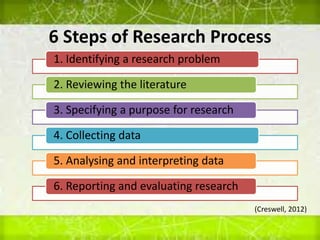
6 Steps of Research Process
1. Identifying a research problem
2. Reviewing the literature
3. Specifying a purpose for research
4. Collecting data
5. Analysing and interpreting data
6. Reporting and evaluating research
(Creswell, 2012)
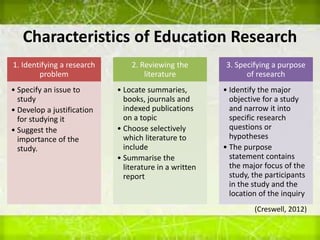
Characteristics of Education Research
1. Identifying a research
problem
• Specify an issue to
study
• Develop a justification
for studying it
• Suggest the
importance of the
study.
2. Reviewing the
literature
• Locate summaries,
books, journals and
indexed publications
on a topic
• Choose selectively
which literature to
include
• Summarise the
literature in a written
report
3. Specifying a purpose
of research
• Identify the major
objective for a study
and narrow it into
specific research
questions or
hypotheses
• The purpose
statement contains
the major focus of the
study, the participants
in the study and the
location of the inquiry
(Creswell, 2012)
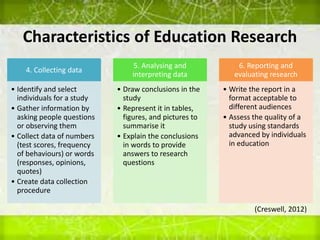
Characteristics of Education Research
4. Collecting data
• Identify and select
individuals for a study
• Gather information by
asking people questions
or observing them
• Collect data of numbers
(test scores, frequency
of behaviours) or words
(responses, opinions,
quotes)
• Create data collection
procedure
5. Analysing and
interpreting data
• Draw conclusions in the
study
• Represent it in tables,
figures, and pictures to
summarise it
• Explain the conclusions
in words to provide
answers to research
questions
6. Reporting and
evaluating research
• Write the report in a
format acceptable to
different audiences
• Assess the quality of a
study using standards
advanced by individuals
in education
(Creswell, 2012)
Approaches in Education Research
Quantitative
(Positivist
approach)
Qualitative
(Interpretive
approach)
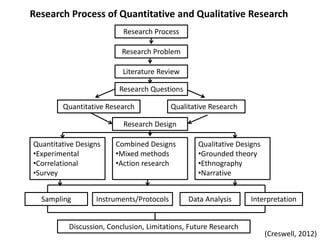
Research Process of Quantitative and Qualitative Research
Research Process
Research Problem
Qualitative Research
Literature Review
Research Design
Research Questions
Quantitative Research
Quantitative Designs
•Experimental
•Correlational
•Survey
Sampling
Combined Designs
•Mixed methods
•Action research
Qualitative Designs
•Grounded theory
•Ethnography
•Narrative
Instruments/Protocols Data Analysis Interpretation
Discussion, Conclusion, Limitations, Future Research
(Creswell, 2012)
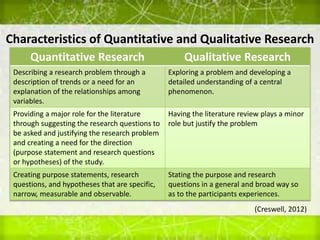
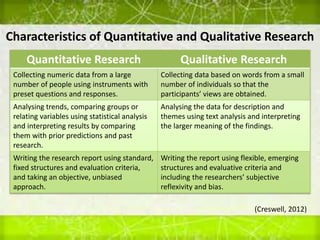
Characteristics of Quantitative and Qualitative Research
Quantitative Research Qualitative Research
Describing a research problem through a
description of trends or a need for an
explanation of the relationships among
variables.
Exploring a problem and developing a
detailed understanding of a central
phenomenon.
Providing a major role for the literature
through suggesting the research questions to
be asked and justifying the research problem
and creating a need for the direction
(purpose statement and research questions
or hypotheses) of the study.
Having the literature review plays a minor
role but justify the problem
Creating purpose statements, research
questions, and hypotheses that are specific,
narrow, measurable and observable.
Stating the purpose and research
questions in a general and broad way so
as to the participants experiences.
(Creswell, 2012)
Characteristics of Quantitative and Qualitative Research
Quantitative Research Qualitative Research
Collecting numeric data from a large
number of people using instruments with
preset questions and responses.
Collecting data based on words from a small
number of individuals so that the
participants’ views are obtained.
Analysing trends, comparing groups or
relating variables using statistical analysis
and interpreting results by comparing
them with prior predictions and past
research.
Analysing the data for description and
themes using text analysis and interpreting
the larger meaning of the findings.
Writing the research report using standard,
fixed structures and evaluation criteria,
and taking an objective, unbiased
approach.
Writing the report using flexible, emerging
structures and evaluative criteria and
including the researchers’ subjective
reflexivity and bias.
(Creswell, 2012)
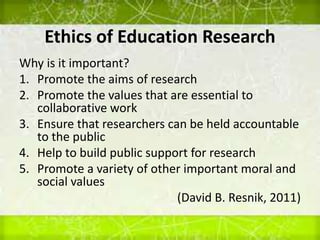
Ethics of Education Research
Why is it important?
1. Promote the aims of research
2. Promote the values that are essential to
collaborative work
3. Ensure that researchers can be held accountable
to the public
4. Help to build public support for research
5. Promote a variety of other important moral and
social values
(David B. Resnik, 2011)
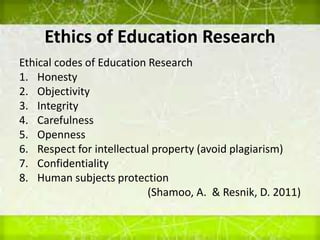
Ethics of Education Research
Ethical codes of Education Research
1. Honesty
2. Objectivity
3. Integrity
4. Carefulness
5. Openness
6. Respect for intellectual property (avoid plagiarism)
7. Confidentiality
8. Human subjects protection
(Shamoo, A. & Resnik, D. 2011)
Ethics of Education Research
Respect for intellectual property
• Borrowing “just a sentence or two” without
attribution is plagiarism.
• But plagiarism is easily avoided: give the
citation.
Ethics of Education Research
Smith reported:
• The parrot is a remarkable bird in many respects. In terms
of intelligence, humor, and manual dexterity, it is
unequalled in the avian kingdom.
Parrots are excellent mimics. But the parrot is a
remarkable bird in many other respects. In terms
of intelligence, humor, and [manual] dexterity, it
is unparalleled in the avian kingdom.
Parrots are excellent mimics. But in addition, as
Smith (2005) observes, “in terms of intelligence,
humor, and manual dexterity, [they are]
unequalled in the avian kingdom.”
Ethics of Education Research
• Citations are good, but stealing citations is not
good.
Ethics of Education Research
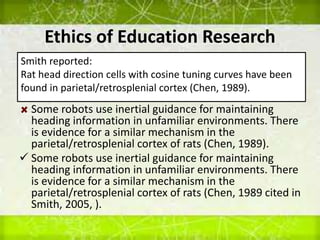
Some robots use inertial guidance for maintaining
heading information in unfamiliar environments. There
is evidence for a similar mechanism in the
parietal/retrosplenial cortex of rats (Chen, 1989).
 Some robots use inertial guidance for maintaining
heading information in unfamiliar environments. There
is evidence for a similar mechanism in the
parietal/retrosplenial cortex of rats (Chen, 1989 cited in
Smith, 2005, ).
Smith reported:
Rat head direction cells with cosine tuning curves have been
found in parietal/retrosplenial cortex (Chen, 1989).
Tutorial 1a
• Identify an issue you face in the classroom during
your practicum.
• Decide on a topic for an English language skill
(LSRWGAV) that you may want to work on for
your proposal.
• Find at least three articles that are related to your
topic of proposal.
• Find out if the research in the articles use
quantitative or qualitative approach.
• Write the references for the articles according to
APA format.
References
Creswell, J.W. (2012). Educational research: planning, conducting and
evaluating quantitative and qualitative research. (4th Ed.). Boston,
MA: Pearson Education Inc.
Fraenkel, J.R. & Wallen, N.E. (1996). How to design and evaluate
research in education. (3rd Ed.). New York: McGraw-Hill Inc.
Ministry of Education (2012). Preliminary Report: Malaysia Education
Blueprint 2013-2025. Kuala Lumpur: MOE.
Shamoo, A. & Resnik, D. (2009). Responsible conduct of research, (2nd
Ed.). New York: Oxford University Press.
Resnik, D.B. (2011). What is ethics in education & why is it important?
Retrieved from
http://www.niehs.nih.gov/research/resources/bioethics/whatis/

TSLB3143 Topic 1a Research in Education

  • 1.
    Lecturer: Yee BeeChoo IPGKTHO
  • 4.
    Research • Research isa process of steps used to collect and analyse information to increase our understanding of a topic or issue. • Research consists of 3 steps: 1. Pose a question 2. Collect data to answer the question 3. Present an answer to the question (Creswell, 2012)
  • 5.
    Research • Research canmean any sort of “careful, systematic, patient study and investigation in some field of knowledge, undertaken to discover or establish facts and principles. (Fraenkel & Wallen, 1996)
  • 6.
    Aims of EducationResearch 1. Research adds to our knowledge • Contribute to existing information about an issue/problem. • Search for solutions to an issue/problem. • Address a gap in knowledge. 2. Research improves practice • Offer educators with new practices that have been tried in other settings or situations. • Help educators evaluate approaches which work with individuals in educational settings. 3. Research informs policy debates • Offer results that can help policy makers weigh various perspectives. • When they read research on issues, they are informed about current debates and stances taken by other public officials. (Creswell, 2012)
  • 7.
    Only 28% ofstudents achieved a minimum credit in the 2011 SPM English paper against Cambridge 1119 standards. Poor English proficiency among fresh graduates has, since 2006, also been consistently ranked as one of the top five issues facing Malaysian employers. (Preliminary Report: Malaysia Education Blueprint 2013-2025) What is the issue in Malaysian education?
  • 8.
    Poor command ofEnglish language and communication skills were cited by employers as among the top reasons for unemployment of fresh graduates. Studies showed 46% of candidates, who intended to further their tertiary education, only obtained Band 1 or 2 (the lowest) in the Malaysian University English Test (MUET). (Annual Report 2015: Malaysia Education Blueprint 2013-2025) What is the issue in Malaysian education?
  • 9.
    6 Steps ofResearch Process 1. Identifying a research problem 2. Reviewing the literature 3. Specifying a purpose for research 4. Collecting data 5. Analysing and interpreting data 6. Reporting and evaluating research (Creswell, 2012)
  • 10.
    Characteristics of EducationResearch 1. Identifying a research problem • Specify an issue to study • Develop a justification for studying it • Suggest the importance of the study. 2. Reviewing the literature • Locate summaries, books, journals and indexed publications on a topic • Choose selectively which literature to include • Summarise the literature in a written report 3. Specifying a purpose of research • Identify the major objective for a study and narrow it into specific research questions or hypotheses • The purpose statement contains the major focus of the study, the participants in the study and the location of the inquiry (Creswell, 2012)
  • 11.
    Characteristics of EducationResearch 4. Collecting data • Identify and select individuals for a study • Gather information by asking people questions or observing them • Collect data of numbers (test scores, frequency of behaviours) or words (responses, opinions, quotes) • Create data collection procedure 5. Analysing and interpreting data • Draw conclusions in the study • Represent it in tables, figures, and pictures to summarise it • Explain the conclusions in words to provide answers to research questions 6. Reporting and evaluating research • Write the report in a format acceptable to different audiences • Assess the quality of a study using standards advanced by individuals in education (Creswell, 2012)
  • 12.
    Approaches in EducationResearch Quantitative (Positivist approach) Qualitative (Interpretive approach)
  • 13.
    Research Process ofQuantitative and Qualitative Research Research Process Research Problem Qualitative Research Literature Review Research Design Research Questions Quantitative Research Quantitative Designs •Experimental •Correlational •Survey Sampling Combined Designs •Mixed methods •Action research Qualitative Designs •Grounded theory •Ethnography •Narrative Instruments/Protocols Data Analysis Interpretation Discussion, Conclusion, Limitations, Future Research (Creswell, 2012)
  • 14.
    Characteristics of Quantitativeand Qualitative Research Quantitative Research Qualitative Research Describing a research problem through a description of trends or a need for an explanation of the relationships among variables. Exploring a problem and developing a detailed understanding of a central phenomenon. Providing a major role for the literature through suggesting the research questions to be asked and justifying the research problem and creating a need for the direction (purpose statement and research questions or hypotheses) of the study. Having the literature review plays a minor role but justify the problem Creating purpose statements, research questions, and hypotheses that are specific, narrow, measurable and observable. Stating the purpose and research questions in a general and broad way so as to the participants experiences. (Creswell, 2012)
  • 15.
    Characteristics of Quantitativeand Qualitative Research Quantitative Research Qualitative Research Collecting numeric data from a large number of people using instruments with preset questions and responses. Collecting data based on words from a small number of individuals so that the participants’ views are obtained. Analysing trends, comparing groups or relating variables using statistical analysis and interpreting results by comparing them with prior predictions and past research. Analysing the data for description and themes using text analysis and interpreting the larger meaning of the findings. Writing the research report using standard, fixed structures and evaluation criteria, and taking an objective, unbiased approach. Writing the report using flexible, emerging structures and evaluative criteria and including the researchers’ subjective reflexivity and bias. (Creswell, 2012)
  • 16.
    Ethics of EducationResearch Why is it important? 1. Promote the aims of research 2. Promote the values that are essential to collaborative work 3. Ensure that researchers can be held accountable to the public 4. Help to build public support for research 5. Promote a variety of other important moral and social values (David B. Resnik, 2011)
  • 17.
    Ethics of EducationResearch Ethical codes of Education Research 1. Honesty 2. Objectivity 3. Integrity 4. Carefulness 5. Openness 6. Respect for intellectual property (avoid plagiarism) 7. Confidentiality 8. Human subjects protection (Shamoo, A. & Resnik, D. 2011)
  • 18.
    Ethics of EducationResearch Respect for intellectual property • Borrowing “just a sentence or two” without attribution is plagiarism. • But plagiarism is easily avoided: give the citation.
  • 19.
    Ethics of EducationResearch Smith reported: • The parrot is a remarkable bird in many respects. In terms of intelligence, humor, and manual dexterity, it is unequalled in the avian kingdom. Parrots are excellent mimics. But the parrot is a remarkable bird in many other respects. In terms of intelligence, humor, and [manual] dexterity, it is unparalleled in the avian kingdom. Parrots are excellent mimics. But in addition, as Smith (2005) observes, “in terms of intelligence, humor, and manual dexterity, [they are] unequalled in the avian kingdom.”
  • 20.
    Ethics of EducationResearch • Citations are good, but stealing citations is not good.
  • 21.
    Ethics of EducationResearch Some robots use inertial guidance for maintaining heading information in unfamiliar environments. There is evidence for a similar mechanism in the parietal/retrosplenial cortex of rats (Chen, 1989).  Some robots use inertial guidance for maintaining heading information in unfamiliar environments. There is evidence for a similar mechanism in the parietal/retrosplenial cortex of rats (Chen, 1989 cited in Smith, 2005, ). Smith reported: Rat head direction cells with cosine tuning curves have been found in parietal/retrosplenial cortex (Chen, 1989).
  • 22.
    Tutorial 1a • Identifyan issue you face in the classroom during your practicum. • Decide on a topic for an English language skill (LSRWGAV) that you may want to work on for your proposal. • Find at least three articles that are related to your topic of proposal. • Find out if the research in the articles use quantitative or qualitative approach. • Write the references for the articles according to APA format.
  • 23.
    References Creswell, J.W. (2012).Educational research: planning, conducting and evaluating quantitative and qualitative research. (4th Ed.). Boston, MA: Pearson Education Inc. Fraenkel, J.R. & Wallen, N.E. (1996). How to design and evaluate research in education. (3rd Ed.). New York: McGraw-Hill Inc. Ministry of Education (2012). Preliminary Report: Malaysia Education Blueprint 2013-2025. Kuala Lumpur: MOE. Shamoo, A. & Resnik, D. (2009). Responsible conduct of research, (2nd Ed.). New York: Oxford University Press. Resnik, D.B. (2011). What is ethics in education & why is it important? Retrieved from http://www.niehs.nih.gov/research/resources/bioethics/whatis/

Editor's Notes

  • #8 Proficiency in English is, however, much lower.
  • #9 The studies concluded students who aspire to enrol in professional courses such as medicine and law will not be able to meet the high entrance requirement due to their low English language proficiency.
  • #17 When most people think of ethics (or morals), they think of rules for distinguishing between right and wrong.
  • #18 When most people think of ethics (or morals), they think of rules for distinguishing between right and wrong. Human Subjects Protection When conducting research on human subjects, minimize harms and risks and maximize benefits; respect human dignity, privacy, and autonomy; take special precautions with vulnerable populations; and strive to distribute the benefits and burdens of research fairly.
  • #19 When most people think of ethics (or morals), they think of rules for distinguishing between right and wrong. Human Subjects Protection When conducting research on human subjects, minimize harms and risks and maximize benefits; respect human dignity, privacy, and autonomy; take special precautions with vulnerable populations; and strive to distribute the benefits and burdens of research fairly.
  • #20 When most people think of ethics (or morals), they think of rules for distinguishing between right and wrong. Human Subjects Protection When conducting research on human subjects, minimize harms and risks and maximize benefits; respect human dignity, privacy, and autonomy; take special precautions with vulnerable populations; and strive to distribute the benefits and burdens of research fairly.
  • #22 Chen (1989) turns out to be an unpublished PhD thesis that Jones has never seen, and wouldn't comprehend if he had.