WRITING QUALITY QUESTION
PAPERS
Professor Ramakanta Mohalik
Regional Institute of Education
Bhubaneswar
email-rkmohalik@riebbs.ac.on
2/13/2021 Prof. Ramakanta Mohalik, RIE BBSR
Concept of Assessment
• Assessment an integral part of teaching
learning in higher education.
• It is the process of gathering, analyzing,
interpreting and using information collected
from students for quality improvement of
learning.
2/13/2021 Prof. Ramakanta Mohalik, RIE BBSR
Drawbacks of Present Exams
• Higher education is examination oriented
• Tests memory-cramming up information
• Non testing of HOTs
• More stress on external exams
• Little focus on continuous exams
• Blocks quest for knowledge, excitement for
discovery & joy of learning
• Poor quality questions
• Delay declaration of results
2/13/2021 Prof. Ramakanta Mohalik, RIE BBSR
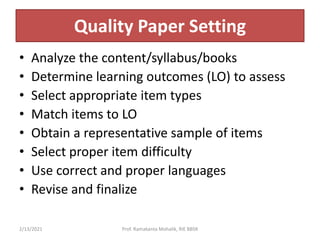
Quality Paper Setting
• Analyze the content/syllabus/books
• Determine learning outcomes (LO) to assess
• Select appropriate item types
• Match items to LO
• Obtain a representative sample of items
• Select proper item difficulty
• Use correct and proper languages
• Revise and finalize
2/13/2021 Prof. Ramakanta Mohalik, RIE BBSR
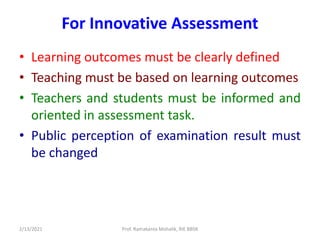
For Innovative Assessment
• Learning outcomes must be clearly defined
• Teaching must be based on learning outcomes
• Teachers and students must be informed and
oriented in assessment task.
• Public perception of examination result must
be changed
2/13/2021 Prof. Ramakanta Mohalik, RIE BBSR
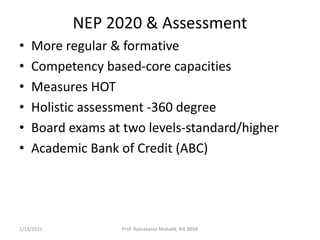
NEP 2020 & Assessment
• More regular & formative
• Competency based-core capacities
• Measures HOT
• Holistic assessment -360 degree
• Board exams at two levels-standard/higher
• Academic Bank of Credit (ABC)
2/13/2021 Prof. Ramakanta Mohalik, RIE BBSR

Writing quality question papers in higher education

  • 1.
    WRITING QUALITY QUESTION PAPERS ProfessorRamakanta Mohalik Regional Institute of Education Bhubaneswar email-rkmohalik@riebbs.ac.on 2/13/2021 Prof. Ramakanta Mohalik, RIE BBSR
  • 2.
    Concept of Assessment •Assessment an integral part of teaching learning in higher education. • It is the process of gathering, analyzing, interpreting and using information collected from students for quality improvement of learning. 2/13/2021 Prof. Ramakanta Mohalik, RIE BBSR
  • 3.
    Drawbacks of PresentExams • Higher education is examination oriented • Tests memory-cramming up information • Non testing of HOTs • More stress on external exams • Little focus on continuous exams • Blocks quest for knowledge, excitement for discovery & joy of learning • Poor quality questions • Delay declaration of results 2/13/2021 Prof. Ramakanta Mohalik, RIE BBSR
  • 4.
    Quality Paper Setting •Analyze the content/syllabus/books • Determine learning outcomes (LO) to assess • Select appropriate item types • Match items to LO • Obtain a representative sample of items • Select proper item difficulty • Use correct and proper languages • Revise and finalize 2/13/2021 Prof. Ramakanta Mohalik, RIE BBSR
  • 5.
    2/13/2021 Prof. RamakantaMohalik, RIE BBSR
  • 6.
    For Innovative Assessment •Learning outcomes must be clearly defined • Teaching must be based on learning outcomes • Teachers and students must be informed and oriented in assessment task. • Public perception of examination result must be changed 2/13/2021 Prof. Ramakanta Mohalik, RIE BBSR
  • 7.
    NEP 2020 &Assessment • More regular & formative • Competency based-core capacities • Measures HOT • Holistic assessment -360 degree • Board exams at two levels-standard/higher • Academic Bank of Credit (ABC) 2/13/2021 Prof. Ramakanta Mohalik, RIE BBSR

Editor's Notes

  • #4 UGC (2919). Evaluation Reforms in Higher Educational Institutions.