DR.TASNIM ARA JHILKY
MD Part II
Phase A
DEPARTMENT OF BIOCHEMISTRY
SIR SALIMULLAH MEDICAL COLLEGE
MIDFORD,DHAKA
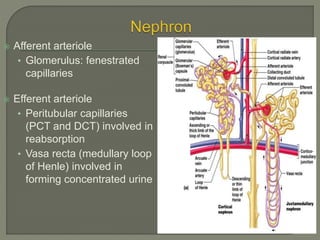
 Afferent arteriole
• Glomerulus: fenestrated
capillaries
 Efferent arteriole
• Peritubular capillaries
(PCT and DCT) involved in
reabsorption
• Vasa recta (medullary loop
of Henle) involved in
forming concentrated urine
Figure 25.5a
 Process concerned with urine formation
 Glomerular filtration..
 Tubular reabsorption..
 Tubular secretion..
 Urine formation begins with the ultrafilteration of
plasma from glomerular capillaries into bowman
s capsule to make filterate.
 Therefore urinary excretion is equal to:
 Glomerular filteration-tubular
reabsorption+tubular secretion
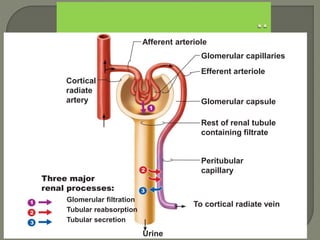
Cortical
radiate
artery
Afferent arteriole
Glomerular capillaries
Efferent arteriole
Glomerular capsule
Rest of renal tubule
containing filtrate
Peritubular
capillary
To cortical radiate vein
Urine
Glomerular filtration
Tubular reabsorption
Tubular secretion
Three major
renal processes:
Pore size.
Glomerular capillary – 8 nm.
podocyte filtration slits – 25 nm.
4 nm -- freely filtered.
4-8 nm -- inversely proportional to
diameter
> 8 nm – not filtered.
Electrical charge.
Negatively charged – It contain proteoglycan & sialic
acid .
so cationic & neutral particals – more
permeability
Filterate turns into urine with followings
changes…
Reduction of volume
Acidification of filterate,
rise of osmolarity
Complete reabsorption of some subs.
Addition of new subs by tubular secretion
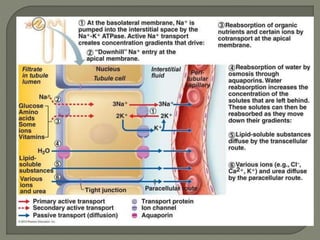
 Reabsorption is defined as movement of a substance from
the tubular fluid to the blood, and this process occurs either
via the tubular cells ”the transcellular route” or between the
cells” the paracellular route .
 Tubular secretion is defined as movement of a substance
from the blood into the tubular fluid.
The reabsorption and secretion that occur via the
transcellular route are largely the result of secondary active
transport of solutes by the tubular cells.
 Paracellular reabsorption occurs as a result of
concentration or electrical gradients that favor movement of
Proximal Convoluted Tubule (PCT);
Reabsorption
.
• PCT is the most active in reabsorption
• All glucose, lactate, & amino acids vitamin
• Most Na+, H2O, HCO3
- , CL-
• and K+
–60-70% Na+ and H2O
–90% HCO3
-
–50% CL-
–70% K+
–Ca,mg,phosphate,urea
–Ammoniagenesis from glutamin
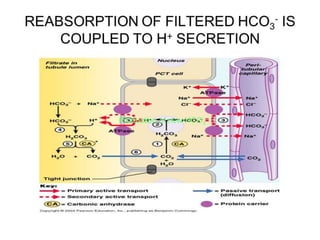
Production of new HCO3
–
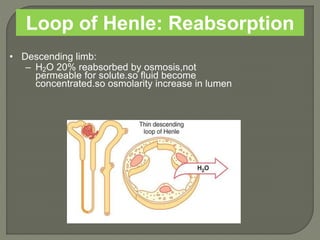
Loop of Henle: Reabsorption
• Descending limb:
– H2O 20% reabsorbed by osmosis,not
permeable for solute.so fluid become
concentrated.so osmolarity increase in lumen
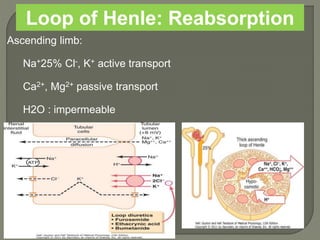
Loop of Henle: Reabsorption
Ascending limb:
Na+25% Cl-, K+ active transport
Ca2+, Mg2+ passive transport
H2O : impermeable
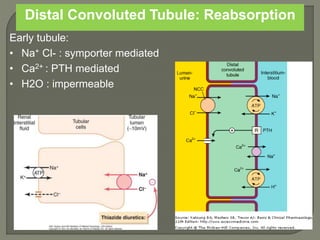
Distal Convoluted Tubule: Reabsorption
Early tubule:
• Na+ Cl- : symporter mediated
• Ca2+ : PTH mediated
• H2O : impermeable
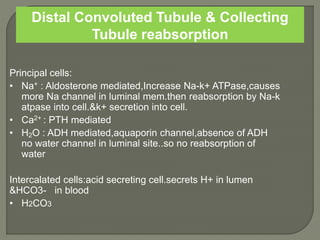
Distal Convoluted Tubule & Collecting
Tubule reabsorption
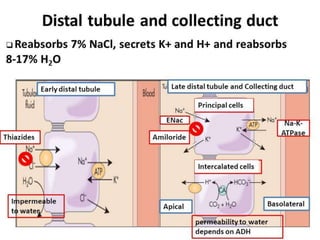
Principal cells:
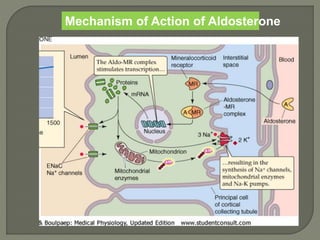
• Na+ : Aldosterone mediated,Increase Na-k+ ATPase,causes
more Na channel in luminal mem.then reabsorption by Na-k
atpase into cell.&k+ secretion into cell.
• Ca2+ : PTH mediated
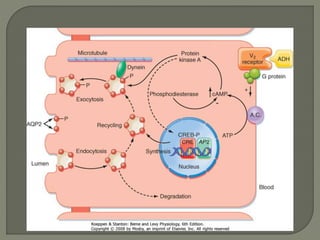
• H2O : ADH mediated,aquaporin channel,absence of ADH
no water channel in luminal site..so no reabsorption of
water
Intercalated cells:acid secreting cell.secrets H+ in lumen
&HCO3- in blood
• H2CO3
Late Distal Convoluted Tubule &
Collecting tubule
Principal cells:
• Na+ : Aldosterone mediated
• Ca2+ : PTH mediated
• H2O : ADH mediated &
concentrated urine
Intercalated cells
• H2CO3
Mechanism of Action of Aldosterone
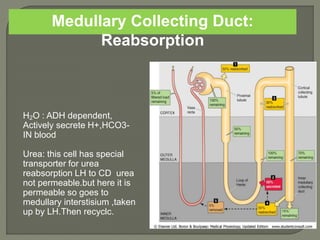
Medullary Collecting Duct:
Reabsorption
H2O : ADH dependent,
Actively secrete H+,HCO3-
IN blood
Urea: this cell has special
transporter for urea
reabsorption LH to CD urea
not permeable.but here it is
permeable so goes to
medullary interstisium ,taken
up by LH.Then recyclc.
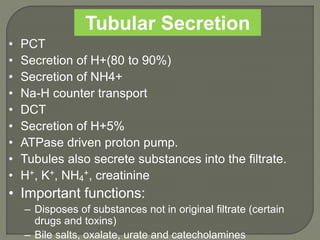
Tubular Secretion
• PCT
• Secretion of H+(80 to 90%)
• Secretion of NH4+
• Na-H counter transport
• DCT
• Secretion of H+5%
• ATPase driven proton pump.
• Tubules also secrete substances into the filtrate.
• H+, K+, NH4
+, creatinine
• Important functions:
– Disposes of substances not in original filtrate (certain
drugs and toxins)
– Bile salts, oxalate, urate and catecholamines
In PCT: H+, K+, NH3,bile salt, oxalate,
urate, PAH.
In DL of loop of henle: Na+ is secreted by
passive diffusion.
In DCT: NH3 is secreted by diffusion. H+,
K+, is secreted by exchange pump.
In CT: secretion of K+ & NH3 with the
help of aldosterone
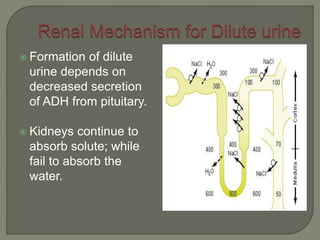
 Formation of dilute
urine depends on
decreased secretion
of ADH from pituitary.
 Kidneys continue to
absorb solute; while
fail to absorb the
water.
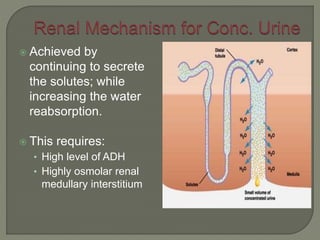
 Achieved by
continuing to secrete
the solutes; while
increasing the water
reabsorption.
 This requires:
• High level of ADH
• Highly osmolar renal
medullary interstitium
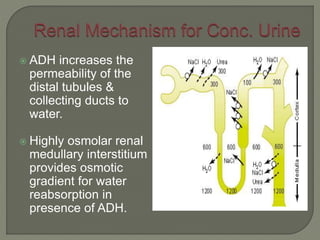
 ADH increases the
permeability of the
distal tubules &
collecting ducts to
water.
 Highly osmolar renal
medullary interstitium
provides osmotic
gradient for water
reabsorption in
presence of ADH.
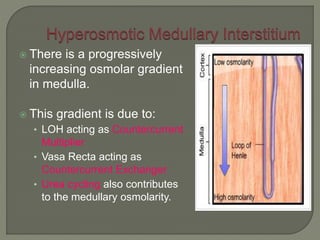
 There is a progressively
increasing osmolar gradient
in medulla.
 This gradient is due to:
• LOH acting as Countercurrent
Multiplier
• Vasa Recta acting as
Countercurrent Exchanger
• Urea cycling also contributes
to the medullary osmolarity.
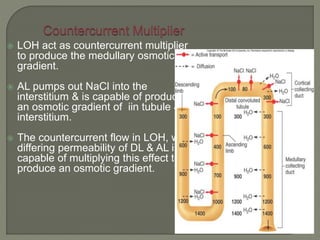
 LOH act as countercurrent multiplier
to produce the medullary osmotic
gradient.
 AL pumps out NaCl into the
interstitium & is capable of producing
an osmotic gradient of iin tubule &
interstitium.
 The countercurrent flow in LOH, with
differing permeability of DL & AL is
capable of multiplying this effect to
produce an osmotic gradient.
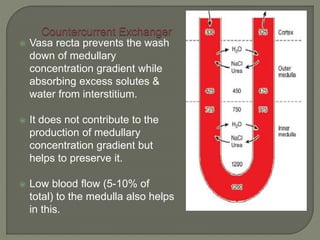
 Vasa recta prevents the wash
down of medullary
concentration gradient while
absorbing excess solutes &
water from interstitium.
 It does not contribute to the
production of medullary
concentration gradient but
helps to preserve it.
 Low blood flow (5-10% of
total) to the medulla also helps
in this.
 It is the minimal volume of urine that
must be excreted each day to get rid the
body of the products of metabolism &
ingested ions.
 It depends upon the maximal
concentrating ability of the kidney.
 Total solutes to be excreted each day in
70 kg man = 600 mosmol
Maximum conc. ability of human kidney =
1200 mosmol/l
OUV = 600/1200 = 0.5 L/day
 Inappropriate secretion of ADH:
• ↓ ADH: Central Diabetes Insipidus
• ↑ ADH: SIADH (Syndrome of Inappropriate
secretion of ADH)
 Impairment of countercurrent mechanism:
• High flow rate: osmotic diuresis
 Inability of tubules to respond to ADH:
• Nephrogenic Diabetes Insipidus
Urinary buffers.
To prevent sudden & and large swings in
Ph buffers are necessary.
Buffers have two major characters…
 consist of either a weak acid &conjugate
base or weak base &conjugate acid
Resist pH changes.
1. Phosphate buffer
2. Bicarbonate buffer
3. Ammonia buffer
bicarbonate/carbonic acid
major plasma buffer
phosphate: H2PO4- / HPO42-
major urine buffer
ammonium: NH3 / NH4+
also used to buffer the urine
 About 70mmol nonvolatile acid formed in the form of
HCl,H2SO4,H3PO4 Lactic acid . In normal
individual.immediately they production ,acid are
buffered by body fluid buffers ,mainly HCO3-buffer
system.
 At the level of DCT &CD ,again tubular cell generate
H+&simultaneous production of HCO3-.thenH+
secreted into lumen by proton pump.HCO3- goes
blood.In filterate of DCT &CD no HCo3-
Phosphate and NH3 buffer are available.H+ combines
with conjugate base of urinary buffers. To make NH4+&
H2PO4- excess H+ excreted of non volatile acids.
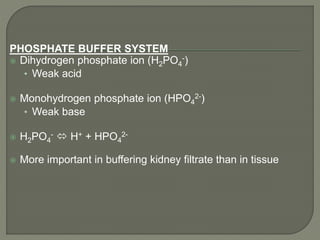
PHOSPHATE BUFFER SYSTEM
 Dihydrogen phosphate ion (H2PO4
-)
• Weak acid
 Monohydrogen phosphate ion (HPO4
2-)
• Weak base
 H2PO4
-  H+ + HPO4
2-
 More important in buffering kidney filtrate than in tissue
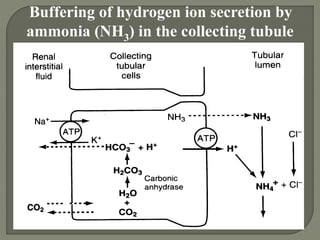
Buffering of hydrogen ion secretion by
ammonia (NH3) in the collecting tubule
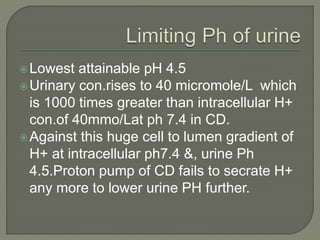
Lowest attainable pH 4.5
Urinary con.rises to 40 micromole/L which
is 1000 times greater than intracellular H+
con.of 40mmo/Lat ph 7.4 in CD.
Against this huge cell to lumen gradient of
H+ at intracellular ph7.4 &, urine Ph
4.5.Proton pump of CD fails to secrate H+
any more to lower urine PH further.
 Since the limiting pH of urine is 4.5 (lowest
possible urinary ph )1L urine excrete only
40micromol/L H+.
 To excrete 70mmol non volatile acid as
freeH+,daily urine volume would have to be
about 1750L.which is impossible.
 Therefore urinary buffers take up the secreted
H+ to form NH4+ and H2PO4.
 This allowed con.secretion of H+ and its
excretion as NH4+ and H2PO4 without
disturbing urinary pH
It is conversion of alkaline filtrate to acidic
urine. It is done by separate mechanism
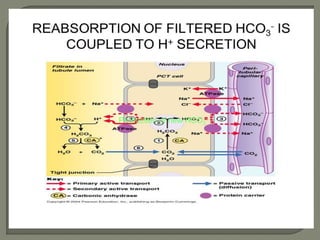
 HCO3 reabsorption /reclamation
mechanism
It is concerned with complete reabsorption
of filtered HCO3- mainly from pct(80-90%)
& partly from ALH(10-20%).
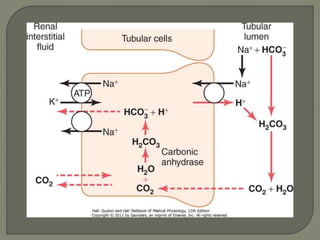
Here secreted H+ from tubular cell is
titrated in tubular fluid by filtered HCO3-
So net loss or gain of HCO3- to blood.
It does not create high luminal H+ con.
It creates a very low PH gradient by
decresing filterate PH from 7.4 to 6.8.
It important becauses it saves huge
amount (4500mmol)HCO3- per day.
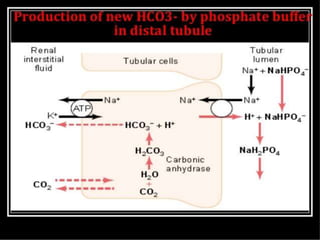
Production of new HCO3
–
Role of NH3 and phosphact buffers
H+ secretion into the lumen & new HCO3-
generation followed by its addition to blood
Secreted H+ is titrated in tubular fluid by
urinary buffers with net loss of H+ from
blood as NH4+,H2PO4- and net gain of
HCO3- to blood to raise serum HCO3-
back to normal.
It creates high luminal H+ con.
It creates large Ph gradient by decreasing
ph from 6.8 to 4.5
So, urinary acidification in fact occur ic CD
&DCT.
 By this mechanism there is net gain of HCO3
- to
the blood which is used during initial buffering of
nonvolatile acids.
 There is also net excretion of H+ from the body in
the form of NaH2PO4, NH4Cl.
 Phosphate & Ammonia buffer are involved here.
• It occurs in DCT & CD by ATP drive proton pump
 If metabolic acids accumulate, the body PH will
fall
 All non-volatile acid is excreted through kidney
 That’s why urine become acidic
• The presence of acidic substances (NH4
+CL &
NaH2PO4) finally make the urine acidic & this
acidification in fact starts from DCT
To maintain stable Ph at 7.40
Physiologic pH necessary to prevent
engyme inactivation and denaturiation.
 proper cellular function.
Clinical consequences of dysregulation of
acid base balance
Poor vascular tone
Myocardial failure
Risk of arrthymia
Musle weakness
Electrolyte abnormalities
Delirium/coma etc
 Most acid comes from CHO and fat metabolism
• 15 to 20 mol of CO2 daily(volatile)
.Incomplete metabolism of glucose and fatty acids to
lactic acid & ketoacids.
• Metabolism of sulfur-containing amino acids (cysteine,
methionine) to sulfuric acid
• Hydrolysis of dietary phospholipid & nucleic acid into
phosphoric acid.
 Most base comes from metabolism of anionic
amino acids (glutamate and aspartate) and from
oxidation and consumption of organic anions
such as lactate and citrate, which produce HCO3
−
 If [H+]↑→ Resp. centre stimulated
→hyperventilation→↑volatile acid
excretion.
 If [H+]↓→hypoventilation→↑volatile acid
retention
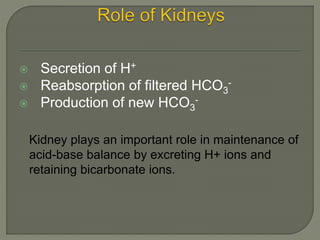
 Secretion of H+
 Reabsorption of filtered HCO3
-
 Production of new HCO3
-
Kidney plays an important role in maintenance of
acid-base balance by excreting H+ ions and
retaining bicarbonate ions.
 Buffer system of the body fluid-
 1st line of defense
• immediately combines with acid / bases to prevent
marked change of [H+]
• works within a fraction of second to minimize the
changes
• do not eliminate H+ from the body but only keep them
tied up until balanced re-established
 Respiratory system-
 2nd line of defense
• respiratory centre regulate the removal of CO2 &
therefore H2CO3 from the body.
• works within a few minutes.
 Kidney system-
 3rd line of defense
• can excrete either acidic or alkaline urine to maintain
ECF [H+]
• works over a period of hours to several days but it is the
most powerful acid –base regulatory systems.
urine formation..mechanism,acidification,urinary buffers by dr.Tasnim

urine formation..mechanism,acidification,urinary buffers by dr.Tasnim

  • 1.
    DR.TASNIM ARA JHILKY MDPart II Phase A DEPARTMENT OF BIOCHEMISTRY SIR SALIMULLAH MEDICAL COLLEGE MIDFORD,DHAKA
  • 3.
     Afferent arteriole •Glomerulus: fenestrated capillaries  Efferent arteriole • Peritubular capillaries (PCT and DCT) involved in reabsorption • Vasa recta (medullary loop of Henle) involved in forming concentrated urine Figure 25.5a
  • 4.
     Process concernedwith urine formation  Glomerular filtration..  Tubular reabsorption..  Tubular secretion..  Urine formation begins with the ultrafilteration of plasma from glomerular capillaries into bowman s capsule to make filterate.  Therefore urinary excretion is equal to:  Glomerular filteration-tubular reabsorption+tubular secretion
  • 5.
    Cortical radiate artery Afferent arteriole Glomerular capillaries Efferentarteriole Glomerular capsule Rest of renal tubule containing filtrate Peritubular capillary To cortical radiate vein Urine Glomerular filtration Tubular reabsorption Tubular secretion Three major renal processes:
  • 6.
    Pore size. Glomerular capillary– 8 nm. podocyte filtration slits – 25 nm. 4 nm -- freely filtered. 4-8 nm -- inversely proportional to diameter > 8 nm – not filtered. Electrical charge. Negatively charged – It contain proteoglycan & sialic acid . so cationic & neutral particals – more permeability
  • 7.
    Filterate turns intourine with followings changes… Reduction of volume Acidification of filterate, rise of osmolarity Complete reabsorption of some subs. Addition of new subs by tubular secretion
  • 8.
     Reabsorption isdefined as movement of a substance from the tubular fluid to the blood, and this process occurs either via the tubular cells ”the transcellular route” or between the cells” the paracellular route .  Tubular secretion is defined as movement of a substance from the blood into the tubular fluid. The reabsorption and secretion that occur via the transcellular route are largely the result of secondary active transport of solutes by the tubular cells.  Paracellular reabsorption occurs as a result of concentration or electrical gradients that favor movement of
  • 9.
    Proximal Convoluted Tubule(PCT); Reabsorption . • PCT is the most active in reabsorption • All glucose, lactate, & amino acids vitamin • Most Na+, H2O, HCO3 - , CL- • and K+ –60-70% Na+ and H2O –90% HCO3 - –50% CL- –70% K+ –Ca,mg,phosphate,urea –Ammoniagenesis from glutamin
  • 11.
  • 12.
    Loop of Henle:Reabsorption • Descending limb: – H2O 20% reabsorbed by osmosis,not permeable for solute.so fluid become concentrated.so osmolarity increase in lumen
  • 13.
    Loop of Henle:Reabsorption Ascending limb: Na+25% Cl-, K+ active transport Ca2+, Mg2+ passive transport H2O : impermeable
  • 14.
    Distal Convoluted Tubule:Reabsorption Early tubule: • Na+ Cl- : symporter mediated • Ca2+ : PTH mediated • H2O : impermeable
  • 15.
    Distal Convoluted Tubule& Collecting Tubule reabsorption Principal cells: • Na+ : Aldosterone mediated,Increase Na-k+ ATPase,causes more Na channel in luminal mem.then reabsorption by Na-k atpase into cell.&k+ secretion into cell. • Ca2+ : PTH mediated • H2O : ADH mediated,aquaporin channel,absence of ADH no water channel in luminal site..so no reabsorption of water Intercalated cells:acid secreting cell.secrets H+ in lumen &HCO3- in blood • H2CO3
  • 16.
    Late Distal ConvolutedTubule & Collecting tubule Principal cells: • Na+ : Aldosterone mediated • Ca2+ : PTH mediated • H2O : ADH mediated & concentrated urine Intercalated cells • H2CO3
  • 17.
    Mechanism of Actionof Aldosterone
  • 19.
    Medullary Collecting Duct: Reabsorption H2O: ADH dependent, Actively secrete H+,HCO3- IN blood Urea: this cell has special transporter for urea reabsorption LH to CD urea not permeable.but here it is permeable so goes to medullary interstisium ,taken up by LH.Then recyclc.
  • 20.
    Tubular Secretion • PCT •Secretion of H+(80 to 90%) • Secretion of NH4+ • Na-H counter transport • DCT • Secretion of H+5% • ATPase driven proton pump. • Tubules also secrete substances into the filtrate. • H+, K+, NH4 +, creatinine • Important functions: – Disposes of substances not in original filtrate (certain drugs and toxins) – Bile salts, oxalate, urate and catecholamines
  • 21.
    In PCT: H+,K+, NH3,bile salt, oxalate, urate, PAH. In DL of loop of henle: Na+ is secreted by passive diffusion. In DCT: NH3 is secreted by diffusion. H+, K+, is secreted by exchange pump. In CT: secretion of K+ & NH3 with the help of aldosterone
  • 22.
     Formation ofdilute urine depends on decreased secretion of ADH from pituitary.  Kidneys continue to absorb solute; while fail to absorb the water.
  • 23.
     Achieved by continuingto secrete the solutes; while increasing the water reabsorption.  This requires: • High level of ADH • Highly osmolar renal medullary interstitium
  • 24.
     ADH increasesthe permeability of the distal tubules & collecting ducts to water.  Highly osmolar renal medullary interstitium provides osmotic gradient for water reabsorption in presence of ADH.
  • 25.
     There isa progressively increasing osmolar gradient in medulla.  This gradient is due to: • LOH acting as Countercurrent Multiplier • Vasa Recta acting as Countercurrent Exchanger • Urea cycling also contributes to the medullary osmolarity.
  • 26.
     LOH actas countercurrent multiplier to produce the medullary osmotic gradient.  AL pumps out NaCl into the interstitium & is capable of producing an osmotic gradient of iin tubule & interstitium.  The countercurrent flow in LOH, with differing permeability of DL & AL is capable of multiplying this effect to produce an osmotic gradient.
  • 27.
     Vasa rectaprevents the wash down of medullary concentration gradient while absorbing excess solutes & water from interstitium.  It does not contribute to the production of medullary concentration gradient but helps to preserve it.  Low blood flow (5-10% of total) to the medulla also helps in this.
  • 28.
     It isthe minimal volume of urine that must be excreted each day to get rid the body of the products of metabolism & ingested ions.  It depends upon the maximal concentrating ability of the kidney.  Total solutes to be excreted each day in 70 kg man = 600 mosmol Maximum conc. ability of human kidney = 1200 mosmol/l OUV = 600/1200 = 0.5 L/day
  • 29.
     Inappropriate secretionof ADH: • ↓ ADH: Central Diabetes Insipidus • ↑ ADH: SIADH (Syndrome of Inappropriate secretion of ADH)  Impairment of countercurrent mechanism: • High flow rate: osmotic diuresis  Inability of tubules to respond to ADH: • Nephrogenic Diabetes Insipidus
  • 30.
  • 31.
    To prevent sudden& and large swings in Ph buffers are necessary. Buffers have two major characters…  consist of either a weak acid &conjugate base or weak base &conjugate acid Resist pH changes.
  • 32.
    1. Phosphate buffer 2.Bicarbonate buffer 3. Ammonia buffer
  • 33.
    bicarbonate/carbonic acid major plasmabuffer phosphate: H2PO4- / HPO42- major urine buffer ammonium: NH3 / NH4+ also used to buffer the urine
  • 34.
     About 70mmolnonvolatile acid formed in the form of HCl,H2SO4,H3PO4 Lactic acid . In normal individual.immediately they production ,acid are buffered by body fluid buffers ,mainly HCO3-buffer system.  At the level of DCT &CD ,again tubular cell generate H+&simultaneous production of HCO3-.thenH+ secreted into lumen by proton pump.HCO3- goes blood.In filterate of DCT &CD no HCo3- Phosphate and NH3 buffer are available.H+ combines with conjugate base of urinary buffers. To make NH4+& H2PO4- excess H+ excreted of non volatile acids.
  • 35.
    PHOSPHATE BUFFER SYSTEM Dihydrogen phosphate ion (H2PO4 -) • Weak acid  Monohydrogen phosphate ion (HPO4 2-) • Weak base  H2PO4 -  H+ + HPO4 2-  More important in buffering kidney filtrate than in tissue
  • 37.
    Buffering of hydrogenion secretion by ammonia (NH3) in the collecting tubule
  • 38.
    Lowest attainable pH4.5 Urinary con.rises to 40 micromole/L which is 1000 times greater than intracellular H+ con.of 40mmo/Lat ph 7.4 in CD. Against this huge cell to lumen gradient of H+ at intracellular ph7.4 &, urine Ph 4.5.Proton pump of CD fails to secrate H+ any more to lower urine PH further.
  • 39.
     Since thelimiting pH of urine is 4.5 (lowest possible urinary ph )1L urine excrete only 40micromol/L H+.  To excrete 70mmol non volatile acid as freeH+,daily urine volume would have to be about 1750L.which is impossible.  Therefore urinary buffers take up the secreted H+ to form NH4+ and H2PO4.  This allowed con.secretion of H+ and its excretion as NH4+ and H2PO4 without disturbing urinary pH
  • 40.
    It is conversionof alkaline filtrate to acidic urine. It is done by separate mechanism  HCO3 reabsorption /reclamation mechanism It is concerned with complete reabsorption of filtered HCO3- mainly from pct(80-90%) & partly from ALH(10-20%).
  • 41.
    Here secreted H+from tubular cell is titrated in tubular fluid by filtered HCO3- So net loss or gain of HCO3- to blood. It does not create high luminal H+ con. It creates a very low PH gradient by decresing filterate PH from 7.4 to 6.8. It important becauses it saves huge amount (4500mmol)HCO3- per day.
  • 43.
  • 44.
    Role of NH3and phosphact buffers H+ secretion into the lumen & new HCO3- generation followed by its addition to blood Secreted H+ is titrated in tubular fluid by urinary buffers with net loss of H+ from blood as NH4+,H2PO4- and net gain of HCO3- to blood to raise serum HCO3- back to normal.
  • 45.
    It creates highluminal H+ con. It creates large Ph gradient by decreasing ph from 6.8 to 4.5 So, urinary acidification in fact occur ic CD &DCT.
  • 46.
     By thismechanism there is net gain of HCO3 - to the blood which is used during initial buffering of nonvolatile acids.  There is also net excretion of H+ from the body in the form of NaH2PO4, NH4Cl.  Phosphate & Ammonia buffer are involved here. • It occurs in DCT & CD by ATP drive proton pump
  • 47.
     If metabolicacids accumulate, the body PH will fall  All non-volatile acid is excreted through kidney  That’s why urine become acidic • The presence of acidic substances (NH4 +CL & NaH2PO4) finally make the urine acidic & this acidification in fact starts from DCT
  • 49.
    To maintain stablePh at 7.40 Physiologic pH necessary to prevent engyme inactivation and denaturiation.  proper cellular function.
  • 50.
    Clinical consequences ofdysregulation of acid base balance Poor vascular tone Myocardial failure Risk of arrthymia Musle weakness Electrolyte abnormalities Delirium/coma etc
  • 51.
     Most acidcomes from CHO and fat metabolism • 15 to 20 mol of CO2 daily(volatile) .Incomplete metabolism of glucose and fatty acids to lactic acid & ketoacids. • Metabolism of sulfur-containing amino acids (cysteine, methionine) to sulfuric acid • Hydrolysis of dietary phospholipid & nucleic acid into phosphoric acid.
  • 52.
     Most basecomes from metabolism of anionic amino acids (glutamate and aspartate) and from oxidation and consumption of organic anions such as lactate and citrate, which produce HCO3 −
  • 53.
     If [H+]↑→Resp. centre stimulated →hyperventilation→↑volatile acid excretion.  If [H+]↓→hypoventilation→↑volatile acid retention
  • 54.
     Secretion ofH+  Reabsorption of filtered HCO3 -  Production of new HCO3 - Kidney plays an important role in maintenance of acid-base balance by excreting H+ ions and retaining bicarbonate ions.
  • 55.
     Buffer systemof the body fluid-  1st line of defense • immediately combines with acid / bases to prevent marked change of [H+] • works within a fraction of second to minimize the changes • do not eliminate H+ from the body but only keep them tied up until balanced re-established
  • 56.
     Respiratory system- 2nd line of defense • respiratory centre regulate the removal of CO2 & therefore H2CO3 from the body. • works within a few minutes.  Kidney system-  3rd line of defense • can excrete either acidic or alkaline urine to maintain ECF [H+] • works over a period of hours to several days but it is the most powerful acid –base regulatory systems.

Editor's Notes

  • #9 As fluid passes along the renal tubules, its composition is modified by both the reabsorption of some substances and the secretion of others. Paracellular secretion results when such forces favor movement into the tubular fluid.