Calcium Homeostasis

           Faez Baherin MBBS
 MMed (Emergency) Training Programme USM
        Supervised by Dr Hashairi
Outline
•   Introduction
•   Calcium metabolism
-   PTH, Calcitonin, Vitamin d
•   Functions of calcium
•   Disorders of calcium
•   Summary
Introduction
             Body       Bone   intracellular   extracellular
             content


   Calcium   1300 gms   99%    1%              0.1%


• Total plasma [Ca++] = 2.5mmol/L
• Range is 2.0 to 2.5 mmol/L
• Very tightly controlled
Introduction
Factors affecting calcium
             concentration
1) Changes in plasma protein concentration
- Increased [protein] – increased total [Ca2+]

2) Changes in anion concentration
- Increased [anion] – increased fraction of Ca2+
  that is complexed – decrease ionized [Ca2+]

3)Acid base abnormality
Acid Base Abnormality
Functions of Calcium
• 1. Nerve and muscle functions
- Decreased extracellular calcium – increase
  excitability of excitable cells and lowers the
  threshold potential – less inward current is
  required to depolarize the threshold potential
  – less inward current is required to fire AP
- Hence causing tingling ad numbness (sensory)
  and spontaneous muscle twitches (motor
  neurons and muscles)
Functions of Calcium


Cross
bridge
cycling
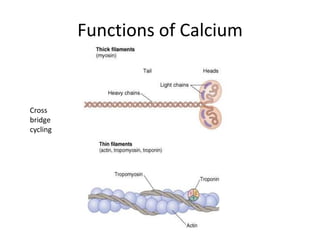
• Increase in intracellular Ca2+ concentration
   Ca2+ binds to troponin C  conformational
  change in the troponin complex  moves
  tropomyosin out of the way  permitting the
  binding of actin to the myosin heads leading
  cross-bridge formation and the muscle
  contracts as a whole
Functions of Calcium
• 2. Homeostasis
-activation of clotting enzyme is the plasma
Functions of Calcium
• 3. Preserving bone density
- construction, formation and maintenance of
  bone and teeth. This function helps reduce
  the occurrence of osteoporosis
Functions of Calcium
• 4. Neurotransmitter release
- Directly proportional to the calcium level
- Arrival of action potential to axonal terminal
opening of voltage gated calcium channels
calcium influx into the terminal  transmitter
  vesicle fuse with the release sites 
  exocytosis-release of transmitters into the
  cleft
Functions of Calcium
• 5. Calcium assists in maintaining all cells and
  connective tissues in the body and regulating
  mitotic transition and cell division.
• 6. Essential component in the production of
  enzyme and hormones that regulate
  digestion, energy, and fat metabolism.
Calcium Homeostasis
• Blood calcium is tightly regulated by:

1) Principle organ systems:
Intestine
Bone
Kidney

2) Hormones:
Parathyroid hormone (PTH)
Vitamin D
Calcitonin
Calcium Homeostasis
Parathyroid Hormone (PTH)
• There are 4 parathyroids glands, located on
  the dorsal side of the thyroid
• The blood supply to the parathyroid glands is
  from the thyroid arteries.
Parathyroid Hormone (PTH)
• Chief cells secrete PTH
• Oxyphil cells – function unknown. Probably
degenerated chief cells
Parathyroid Hormone (PTH)
• Regulation of PTH by plasma calcium
  concentration
Parathyroid Hormone (PTH)
• Mechanism
  Increase in extracellular calcium concentration
   Ca2+ binds to the receptor and activates
  phospholipase C  increased levels of
  IP3/Ca2+  which inhibits PTH secretion.

  When extracellular Ca2+ is decreased, there is
  decreased Ca2+ binding to the receptor, which
  stimulates PTH secretion.
Parathyroid Hormone (PTH)
• Actions of PTH on bone, kidney and small intestine
• Direct vs indirect

1) Actions on bone
- PTH receptors on osteoblasts – initial bone formation
  (direct action)
- Later on – bone resorption (indirect action) via
  cytokines from osteoblast
- Overall effect : promote bone resorption and increase
  calcium concentration
Parathyroid Hormone (PTH)
• 2. Actions on kidneys
Parathyroid Hormone (PTH)
a) Inhibits PO4 reabsorption (inhibits Na-PO4
   cotransport in PCT) – phosphaturia – less
   complexed Ca-PO4 – increase plasma calcium
b) Stimulates calcium reabsorption (on DCT)

Phosphaturia + Ca2+ reabsorption = increase in
Ca2+ concentration
Parathyroid Hormone (PTH)
• 3. Actions on small intestine (indirect)
- Stimulates Ca2+ reabsorption via activation of
vitamin D.
- PTH stimulates renal 1 alpha hydroxylase 
converts 25-hydroxycholecalciferol to 1.25
dihydroxycholecalciferol  stimulates intestinal
Ca2+ absorption
Parathyroid Hormone (PTH)
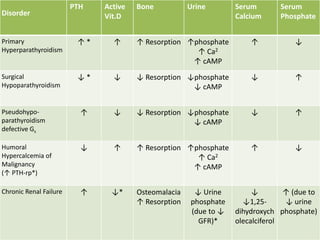
PTH   Active   Bone           Urine       Serum       Serum
Disorder                      Vit.D                               Calcium     Phosphate


Primary                  ↑*     ↑      ↑ Resorption ↑phosphate        ↑           ↓
Hyperparathyroidism                                   ↑ Ca2
                                                     ↑ cAMP
Surgical                 ↓*     ↓      ↓ Resorption ↓phosphate        ↓           ↑
Hypoparathyroidism                                   ↓ cAMP


Pseudohypo-               ↑     ↓      ↓ Resorption ↓phosphate        ↓           ↑
parathyroidism                                       ↓ cAMP
defective Gs

Humoral                   ↓     ↑      ↑ Resorption ↑phosphate        ↑           ↓
Hypercalcemia of                                      ↑ Ca2
Malignancy                                           ↑ cAMP
(↑ PTH-rp*)

Chronic Renal Failure     ↑     ↓*     Osteomalacia    ↓ Urine         ↓        ↑ (due to
                                       ↑ Resorption   phosphate     ↓1,25-      ↓ urine
                                                      (due to ↓   dihydroxych phosphate)
                                                        GFR)*     olecalciferol
Vitamin D
Vitamin D
• Actions of vitamin D
Vitamin D
• Common diseases related to vitamin D
1) Rickets - insufficient amounts of calcium and
   phosphate to mineralize the growing bones
    growth failure and skeletal deformities
2) Osteomalacia – new bone fails to mineralize
    bending and softening of weight bearing
   bones
Calcitonin
• a straight-chain peptide with 32 amino acids.
• synthesized and secreted by the parafollicular cells of the thyroid
  gland.
• major stimulus for calcitonin secretion is increased plasma Ca2+
  concentration
• The major action of calcitonin is to inhibit osteoclastic bone
  resorption, which decreases the plasma Ca2+ concentration.
• calcitonin does not participate in the minute-to-minute regulation
  of the plasma Ca2+ concentration in humans.
• a physiologic role for calcitonin in humans is uncertain because
  neither thyroidectomy (with decreased calcitonin levels) nor thyroid
  tumors (with increased calcitonin levels) cause a derangement of
  Ca2+ metabolism, as would be expected if calcitonin had important
  regulatory functions.
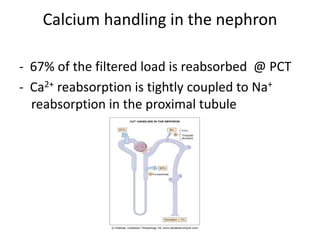
Calcium handling in the nephron

- 67% of the filtered load is reabsorbed @ PCT
- Ca2+ reabsorption is tightly coupled to Na+
  reabsorption in the proximal tubule
Calcium handling in the nephron
- @ ALH , 25% of the filtered load of Ca2+ is reabsorbed
- The mechanism of coupling in the thick ascending limb
  depends on the lumen-positive potential difference,
  which is generated by the Na+-K+-2Cl- cotransporter.
- Loop diuretics such as furosemide inhibit Ca2+
  reabsorption to the same extent that they inhibit Na+
  reabsorption.
Calcium handling in the nephron
• @ DT 8% of the filtered load of Ca2
• the site of regulation of Ca2+ reabsorption.
• the distal tubule is the only nephron segment in which Ca2+
  reabsorption is not coupled directly to Na+ reabsorption.
• it has its own regulatory hormone, PTH.
• Thiazide diuretics increase Ca2+ reabsorption, while the other
  classes of diuretics decrease it.
Hypocalcemia
• Causes
Hypocalcemia
Symptoms and signs
• "CATS go numb"- Convulsions, Arrythmias,
  Tetany and numbness/parasthesias in hands,
  feet, around mouth and lips.
• Trousseau sign of latent tetany (eliciting carpal
  spasm by inflating the blood pressure cuff and
  maintaining the cuff pressure above systolic)
• Chvostek's sign (tapping of the inferior portion
  of the zygoma will produce facial spasms
Hypercalcemia
• Causes
Hypercalcemia
"Stones, Bones, Groans, Thrones and Psychiatric Overtones“

-Stones (renal or biliary)

-Bones (bone pain)

-Groans (abdominal pain, nausea and vomiting)

-Thrones (sit on throne - polyuria)

-Psychiatric overtones (Depression 30-40%, anxiety, cognitive dysfunction, insomnia,
coma)
Calcium Imbalance
Summary
• Calcium is crucial for body physiological
  function
• It must be tightly regulated to maintain
  physiological stability, by the interaction
  between the major organs (Intestine, kidney,
  bone) and hormones ( PTH, Calcitonin,
  Vitamin D)
Summary
• A decrease in calcium level – stimulate PTH
  release – increase bone resorption, increase Ca2+
  reabsorption from kidney (DCT), decrease PO4
  reasbsorption from kidney (PCT), and increase
  calcium uptake from GI (indirect)
• Vitamin D – same action but increase PO4
  reabsorption from kidney
• Calcium imbalance must be recognized and
  treated early to prevent any catastrophe.
Reference
• Physiology by Linda S. Costanzo 3rd edition

Calcium homeostasis

  • 1.
    Calcium Homeostasis Faez Baherin MBBS MMed (Emergency) Training Programme USM Supervised by Dr Hashairi
  • 2.
    Outline • Introduction • Calcium metabolism - PTH, Calcitonin, Vitamin d • Functions of calcium • Disorders of calcium • Summary
  • 3.
    Introduction Body Bone intracellular extracellular content Calcium 1300 gms 99% 1% 0.1% • Total plasma [Ca++] = 2.5mmol/L • Range is 2.0 to 2.5 mmol/L • Very tightly controlled
  • 4.
  • 5.
    Factors affecting calcium concentration 1) Changes in plasma protein concentration - Increased [protein] – increased total [Ca2+] 2) Changes in anion concentration - Increased [anion] – increased fraction of Ca2+ that is complexed – decrease ionized [Ca2+] 3)Acid base abnormality
  • 6.
  • 7.
    Functions of Calcium •1. Nerve and muscle functions - Decreased extracellular calcium – increase excitability of excitable cells and lowers the threshold potential – less inward current is required to depolarize the threshold potential – less inward current is required to fire AP - Hence causing tingling ad numbness (sensory) and spontaneous muscle twitches (motor neurons and muscles)
  • 8.
  • 9.
    • Increase inintracellular Ca2+ concentration  Ca2+ binds to troponin C  conformational change in the troponin complex  moves tropomyosin out of the way  permitting the binding of actin to the myosin heads leading cross-bridge formation and the muscle contracts as a whole
  • 10.
    Functions of Calcium •2. Homeostasis -activation of clotting enzyme is the plasma
  • 11.
    Functions of Calcium •3. Preserving bone density - construction, formation and maintenance of bone and teeth. This function helps reduce the occurrence of osteoporosis
  • 12.
    Functions of Calcium •4. Neurotransmitter release - Directly proportional to the calcium level - Arrival of action potential to axonal terminal opening of voltage gated calcium channels calcium influx into the terminal  transmitter vesicle fuse with the release sites  exocytosis-release of transmitters into the cleft
  • 13.
    Functions of Calcium •5. Calcium assists in maintaining all cells and connective tissues in the body and regulating mitotic transition and cell division. • 6. Essential component in the production of enzyme and hormones that regulate digestion, energy, and fat metabolism.
  • 14.
    Calcium Homeostasis • Bloodcalcium is tightly regulated by: 1) Principle organ systems: Intestine Bone Kidney 2) Hormones: Parathyroid hormone (PTH) Vitamin D Calcitonin
  • 15.
  • 16.
    Parathyroid Hormone (PTH) •There are 4 parathyroids glands, located on the dorsal side of the thyroid • The blood supply to the parathyroid glands is from the thyroid arteries.
  • 17.
    Parathyroid Hormone (PTH) •Chief cells secrete PTH • Oxyphil cells – function unknown. Probably degenerated chief cells
  • 18.
    Parathyroid Hormone (PTH) •Regulation of PTH by plasma calcium concentration
  • 19.
    Parathyroid Hormone (PTH) •Mechanism Increase in extracellular calcium concentration  Ca2+ binds to the receptor and activates phospholipase C  increased levels of IP3/Ca2+  which inhibits PTH secretion. When extracellular Ca2+ is decreased, there is decreased Ca2+ binding to the receptor, which stimulates PTH secretion.
  • 20.
    Parathyroid Hormone (PTH) •Actions of PTH on bone, kidney and small intestine • Direct vs indirect 1) Actions on bone - PTH receptors on osteoblasts – initial bone formation (direct action) - Later on – bone resorption (indirect action) via cytokines from osteoblast - Overall effect : promote bone resorption and increase calcium concentration
  • 21.
    Parathyroid Hormone (PTH) •2. Actions on kidneys
  • 22.
    Parathyroid Hormone (PTH) a)Inhibits PO4 reabsorption (inhibits Na-PO4 cotransport in PCT) – phosphaturia – less complexed Ca-PO4 – increase plasma calcium b) Stimulates calcium reabsorption (on DCT) Phosphaturia + Ca2+ reabsorption = increase in Ca2+ concentration
  • 23.
    Parathyroid Hormone (PTH) •3. Actions on small intestine (indirect) - Stimulates Ca2+ reabsorption via activation of vitamin D. - PTH stimulates renal 1 alpha hydroxylase  converts 25-hydroxycholecalciferol to 1.25 dihydroxycholecalciferol  stimulates intestinal Ca2+ absorption
  • 24.
  • 25.
    PTH Active Bone Urine Serum Serum Disorder Vit.D Calcium Phosphate Primary ↑* ↑ ↑ Resorption ↑phosphate ↑ ↓ Hyperparathyroidism ↑ Ca2 ↑ cAMP Surgical ↓* ↓ ↓ Resorption ↓phosphate ↓ ↑ Hypoparathyroidism ↓ cAMP Pseudohypo- ↑ ↓ ↓ Resorption ↓phosphate ↓ ↑ parathyroidism ↓ cAMP defective Gs Humoral ↓ ↑ ↑ Resorption ↑phosphate ↑ ↓ Hypercalcemia of ↑ Ca2 Malignancy ↑ cAMP (↑ PTH-rp*) Chronic Renal Failure ↑ ↓* Osteomalacia ↓ Urine ↓ ↑ (due to ↑ Resorption phosphate ↓1,25- ↓ urine (due to ↓ dihydroxych phosphate) GFR)* olecalciferol
  • 26.
  • 27.
  • 28.
    Vitamin D • Commondiseases related to vitamin D 1) Rickets - insufficient amounts of calcium and phosphate to mineralize the growing bones  growth failure and skeletal deformities 2) Osteomalacia – new bone fails to mineralize  bending and softening of weight bearing bones
  • 29.
    Calcitonin • a straight-chainpeptide with 32 amino acids. • synthesized and secreted by the parafollicular cells of the thyroid gland. • major stimulus for calcitonin secretion is increased plasma Ca2+ concentration • The major action of calcitonin is to inhibit osteoclastic bone resorption, which decreases the plasma Ca2+ concentration. • calcitonin does not participate in the minute-to-minute regulation of the plasma Ca2+ concentration in humans. • a physiologic role for calcitonin in humans is uncertain because neither thyroidectomy (with decreased calcitonin levels) nor thyroid tumors (with increased calcitonin levels) cause a derangement of Ca2+ metabolism, as would be expected if calcitonin had important regulatory functions.
  • 30.
  • 31.
    Calcium handling inthe nephron - 67% of the filtered load is reabsorbed @ PCT - Ca2+ reabsorption is tightly coupled to Na+ reabsorption in the proximal tubule
  • 32.
    Calcium handling inthe nephron - @ ALH , 25% of the filtered load of Ca2+ is reabsorbed - The mechanism of coupling in the thick ascending limb depends on the lumen-positive potential difference, which is generated by the Na+-K+-2Cl- cotransporter. - Loop diuretics such as furosemide inhibit Ca2+ reabsorption to the same extent that they inhibit Na+ reabsorption.
  • 33.
    Calcium handling inthe nephron • @ DT 8% of the filtered load of Ca2 • the site of regulation of Ca2+ reabsorption. • the distal tubule is the only nephron segment in which Ca2+ reabsorption is not coupled directly to Na+ reabsorption. • it has its own regulatory hormone, PTH. • Thiazide diuretics increase Ca2+ reabsorption, while the other classes of diuretics decrease it.
  • 34.
  • 35.
    Hypocalcemia Symptoms and signs •"CATS go numb"- Convulsions, Arrythmias, Tetany and numbness/parasthesias in hands, feet, around mouth and lips. • Trousseau sign of latent tetany (eliciting carpal spasm by inflating the blood pressure cuff and maintaining the cuff pressure above systolic) • Chvostek's sign (tapping of the inferior portion of the zygoma will produce facial spasms
  • 36.
  • 37.
    Hypercalcemia "Stones, Bones, Groans,Thrones and Psychiatric Overtones“ -Stones (renal or biliary) -Bones (bone pain) -Groans (abdominal pain, nausea and vomiting) -Thrones (sit on throne - polyuria) -Psychiatric overtones (Depression 30-40%, anxiety, cognitive dysfunction, insomnia, coma)
  • 38.
  • 39.
    Summary • Calcium iscrucial for body physiological function • It must be tightly regulated to maintain physiological stability, by the interaction between the major organs (Intestine, kidney, bone) and hormones ( PTH, Calcitonin, Vitamin D)
  • 40.
    Summary • A decreasein calcium level – stimulate PTH release – increase bone resorption, increase Ca2+ reabsorption from kidney (DCT), decrease PO4 reasbsorption from kidney (PCT), and increase calcium uptake from GI (indirect) • Vitamin D – same action but increase PO4 reabsorption from kidney • Calcium imbalance must be recognized and treated early to prevent any catastrophe.
  • 41.
    Reference • Physiology byLinda S. Costanzo 3rd edition