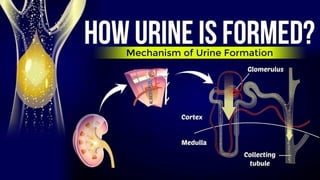
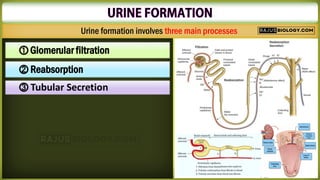
Urine formation involves three main processes
⓵ Glomerular filtration
⓶ Reabsorption
⓷ Tubular Secretion
⓵ GLOMERULAR FILTRATION
➢ The first step in urine formation is the filtration of
blood, which is carried out by the glomerulus
➢ This process occurs in the Malpighian corpuscle of
the nephron
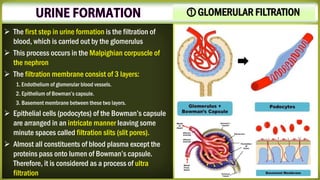
➢ The filtration membrane consist of 3 layers:
1. Endothelium of glomerular blood vessels.
2. Epithelium of Bowman’s capsule.
3. Basement membrane between these two layers.
➢ Epithelial cells (podocytes) of the Bowman’s capsule
are arranged in an intricate manner leaving some
minute spaces called filtration slits (slit pores).
➢ Almost all constituents of blood plasma except the
proteins pass onto lumen of Bowman’s capsule.
Therefore, it is considered as a process of ultra
filtration
⓵ GLOMERULAR FILTRATION
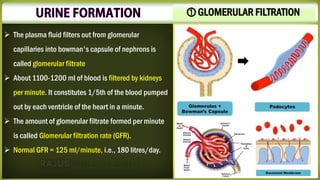
➢ The plasma fluid filters out from glomerular
capillaries into bowman's capsule of nephrons is
called glomerular filtrate
➢ About 1100-1200 ml of blood is filtered by kidneys
per minute. It constitutes 1/5th of the blood pumped
out by each ventricle of the heart in a minute.
➢ The amount of glomerular filtrate formed per minute
is called Glomerular filtration rate (GFR).
➢ Normal GFR = 125 ml/minute, i.e., 180 litres/day.
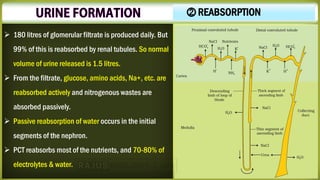
➢ 180 litres of glomerular filtrate is produced daily. But
99% of this is reabsorbed by renal tubules. So normal
volume of urine released is 1.5 litres.
➢ From the filtrate, glucose, amino acids, Na+, etc. are
reabsorbed actively and nitrogenous wastes are
absorbed passively.
➢ Passive reabsorption of water occurs in the initial
segments of the nephron.
➢ PCT reabsorbs most of the nutrients, and 70-80% of
electrolytes & water.
⓶ REABSORPTION
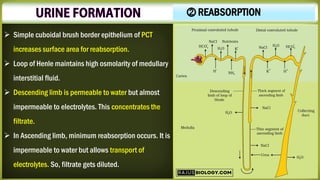
➢ Simple cuboidal brush border epithelium of PCT
increases surface area for reabsorption.
➢ Loop of Henle maintains high osmolarity of medullary
interstitial fluid.
➢ Descending limb is permeable to water but almost
impermeable to electrolytes. This concentrates the
filtrate.
➢ In Ascending limb, minimum reabsorption occurs. It is
impermeable to water but allows transport of
electrolytes. So, filtrate gets diluted.
⓶ REABSORPTION
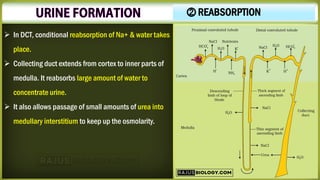
➢ In DCT, conditional reabsorption of Na+ & water takes
place.
➢ Collecting duct extends from cortex to inner parts of
medulla. It reabsorbs large amount of water to
concentrate urine.
➢ It also allows passage of small amounts of urea into
medullary interstitium to keep up the osmolarity.
⓶ REABSORPTION
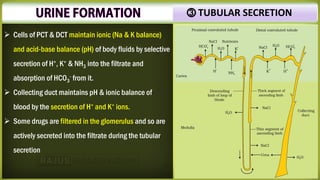
➢ Cells of PCT & DCT maintain ionic (Na & K balance)
and acid-base balance (pH) of body fluids by selective
secretion of H+, K+ & NH3 into the filtrate and
absorption of HCO3
- from it.
➢ Collecting duct maintains pH & ionic balance of
blood by the secretion of H+ and K+ ions.
➢ Some drugs are filtered in the glomerulus and so are
actively secreted into the filtrate during the tubular
secretion
⓷ TUBULAR SECRETION
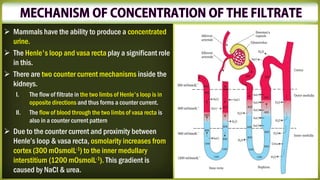
➢ Mammals have the ability to produce a concentrated
urine.
➢ The Henle's loop and vasa recta play a significant role
in this.
➢ There are two counter current mechanisms inside the
kidneys.
I. The flow of filtrate in the two limbs of Henle's loop is in
opposite directions and thus forms a counter current.
II. The flow of blood through the two limbs of vasa recta is
also in a counter current pattern
➢ Due to the counter current and proximity between
Henle’s loop & vasa recta, osmolarity increases from
cortex (300 mOsmolL-1) to the inner medullary
interstitium (1200 mOsmolL-1). This gradient is
caused by NaCl & urea.
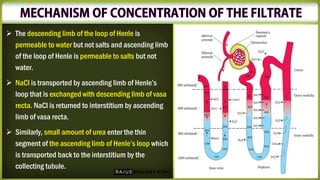
➢ The descending limb of the loop of Henle is
permeable to water but not salts and ascending limb
of the loop of Henle is permeable to salts but not
water.
➢ NaCl is transported by ascending limb of Henle’s
loop that is exchanged with descending limb of vasa
recta. NaCl is returned to interstitium by ascending
limb of vasa recta.
➢ Similarly, small amount of urea enter the thin
segment of the ascending limb of Henle’s loop which
is transported back to the interstitium by the
collecting tubule.
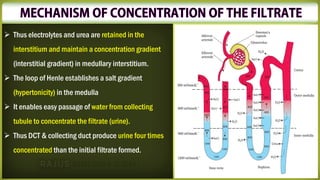
➢ Thus electrolytes and urea are retained in the
interstitium and maintain a concentration gradient
(interstitial gradient) in medullary interstitium.
➢ The loop of Henle establishes a salt gradient
(hypertonicity) in the medulla
➢ It enables easy passage of water from collecting
tubule to concentrate the filtrate (urine).
➢ Thus DCT & collecting duct produce urine four times
concentrated than the initial filtrate formed.
➭CLICK HERE FOR NEXT PART
➭CLICK HERE FOR VIDEO LECTURES
➭CLICK HERE FOR OTHER CHAPTERS

Urine Formation | Human Excretory System.pdf

  • 2.
    Urine formation involvesthree main processes ⓵ Glomerular filtration ⓶ Reabsorption ⓷ Tubular Secretion
  • 3.
    ⓵ GLOMERULAR FILTRATION ➢The first step in urine formation is the filtration of blood, which is carried out by the glomerulus ➢ This process occurs in the Malpighian corpuscle of the nephron ➢ The filtration membrane consist of 3 layers: 1. Endothelium of glomerular blood vessels. 2. Epithelium of Bowman’s capsule. 3. Basement membrane between these two layers. ➢ Epithelial cells (podocytes) of the Bowman’s capsule are arranged in an intricate manner leaving some minute spaces called filtration slits (slit pores). ➢ Almost all constituents of blood plasma except the proteins pass onto lumen of Bowman’s capsule. Therefore, it is considered as a process of ultra filtration
  • 4.
    ⓵ GLOMERULAR FILTRATION ➢The plasma fluid filters out from glomerular capillaries into bowman's capsule of nephrons is called glomerular filtrate ➢ About 1100-1200 ml of blood is filtered by kidneys per minute. It constitutes 1/5th of the blood pumped out by each ventricle of the heart in a minute. ➢ The amount of glomerular filtrate formed per minute is called Glomerular filtration rate (GFR). ➢ Normal GFR = 125 ml/minute, i.e., 180 litres/day.
  • 5.
    ➢ 180 litresof glomerular filtrate is produced daily. But 99% of this is reabsorbed by renal tubules. So normal volume of urine released is 1.5 litres. ➢ From the filtrate, glucose, amino acids, Na+, etc. are reabsorbed actively and nitrogenous wastes are absorbed passively. ➢ Passive reabsorption of water occurs in the initial segments of the nephron. ➢ PCT reabsorbs most of the nutrients, and 70-80% of electrolytes & water. ⓶ REABSORPTION
  • 6.
    ➢ Simple cuboidalbrush border epithelium of PCT increases surface area for reabsorption. ➢ Loop of Henle maintains high osmolarity of medullary interstitial fluid. ➢ Descending limb is permeable to water but almost impermeable to electrolytes. This concentrates the filtrate. ➢ In Ascending limb, minimum reabsorption occurs. It is impermeable to water but allows transport of electrolytes. So, filtrate gets diluted. ⓶ REABSORPTION
  • 7.
    ➢ In DCT,conditional reabsorption of Na+ & water takes place. ➢ Collecting duct extends from cortex to inner parts of medulla. It reabsorbs large amount of water to concentrate urine. ➢ It also allows passage of small amounts of urea into medullary interstitium to keep up the osmolarity. ⓶ REABSORPTION
  • 8.
    ➢ Cells ofPCT & DCT maintain ionic (Na & K balance) and acid-base balance (pH) of body fluids by selective secretion of H+, K+ & NH3 into the filtrate and absorption of HCO3 - from it. ➢ Collecting duct maintains pH & ionic balance of blood by the secretion of H+ and K+ ions. ➢ Some drugs are filtered in the glomerulus and so are actively secreted into the filtrate during the tubular secretion ⓷ TUBULAR SECRETION
  • 10.
    ➢ Mammals havethe ability to produce a concentrated urine. ➢ The Henle's loop and vasa recta play a significant role in this. ➢ There are two counter current mechanisms inside the kidneys. I. The flow of filtrate in the two limbs of Henle's loop is in opposite directions and thus forms a counter current. II. The flow of blood through the two limbs of vasa recta is also in a counter current pattern ➢ Due to the counter current and proximity between Henle’s loop & vasa recta, osmolarity increases from cortex (300 mOsmolL-1) to the inner medullary interstitium (1200 mOsmolL-1). This gradient is caused by NaCl & urea.
  • 11.
    ➢ The descendinglimb of the loop of Henle is permeable to water but not salts and ascending limb of the loop of Henle is permeable to salts but not water. ➢ NaCl is transported by ascending limb of Henle’s loop that is exchanged with descending limb of vasa recta. NaCl is returned to interstitium by ascending limb of vasa recta. ➢ Similarly, small amount of urea enter the thin segment of the ascending limb of Henle’s loop which is transported back to the interstitium by the collecting tubule.
  • 12.
    ➢ Thus electrolytesand urea are retained in the interstitium and maintain a concentration gradient (interstitial gradient) in medullary interstitium. ➢ The loop of Henle establishes a salt gradient (hypertonicity) in the medulla ➢ It enables easy passage of water from collecting tubule to concentrate the filtrate (urine). ➢ Thus DCT & collecting duct produce urine four times concentrated than the initial filtrate formed.
  • 13.
    ➭CLICK HERE FORNEXT PART ➭CLICK HERE FOR VIDEO LECTURES ➭CLICK HERE FOR OTHER CHAPTERS