Retrograde Intrarenal Ureteroscopic Surgery (RIRS):  a Step by Step Introduction Gerhard J. Fuchs, M.D., Dr. med., F.A.C.S. Professor of Urology, UCLA School of Medicine Vice Chair, Cedars Sinai Department of Surgery Medallion Chair in Minimally Invasive Urology Cedars-Sinai Medical Center Los Angeles, USA
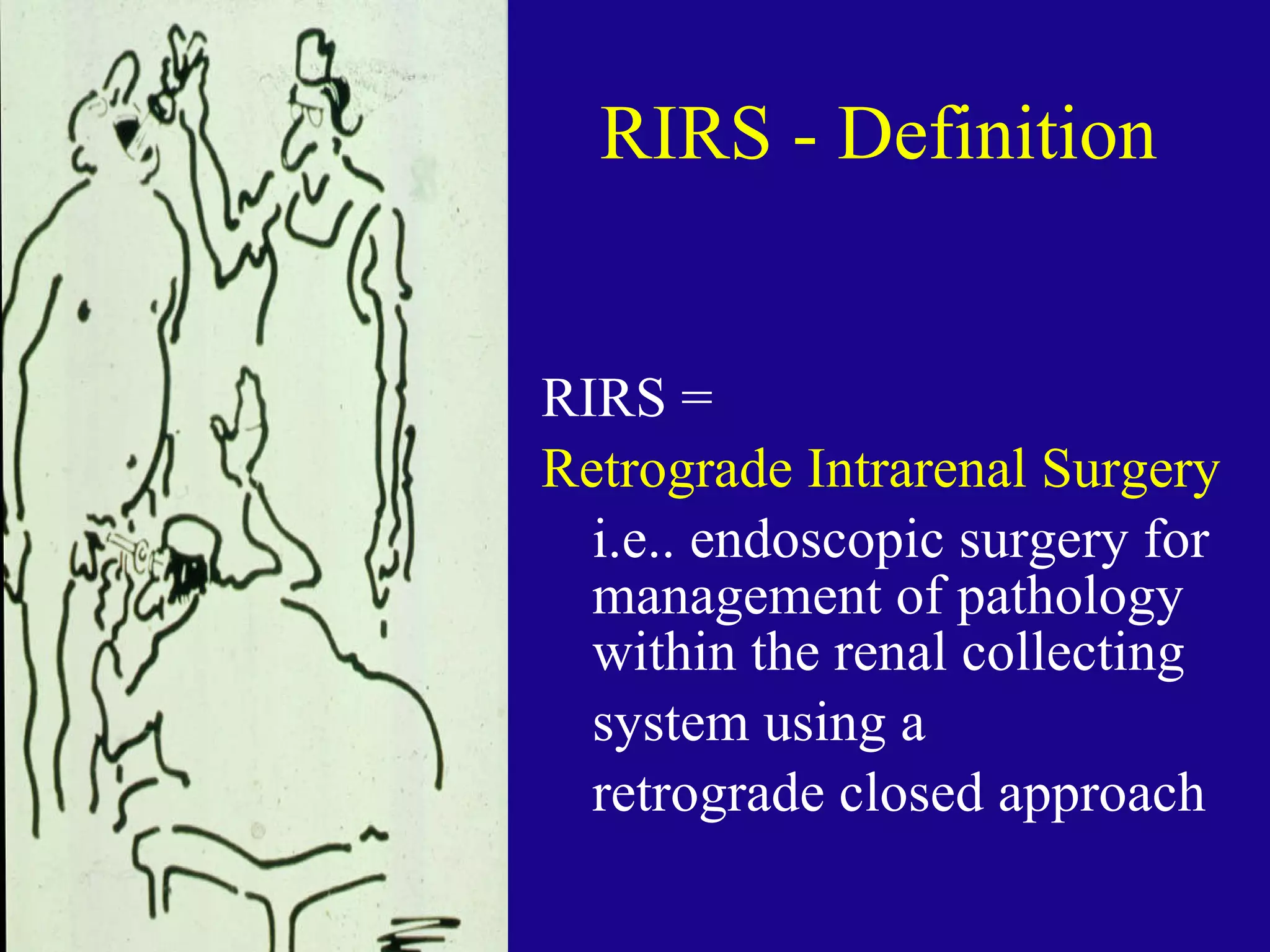
RIRS - Definition RIRS =  Retrograde Intrarenal Surgery i.e.. endoscopic surgery for management of pathology within the renal collecting  system using a  retrograde closed approach
Retrograde Intrarenal Surgery (RIRS) Contraindications Overview of Current Indications Equipment, Techniques (covered during the live surgery) Examples of Clinical Cases
Retrograde Intrarenal Surgery (RIRS) Contraindications:  ( infection  and coagulopathy): Absolute:  Untreated urinary tract infection (UTI) Treat according to C&S with antibiotics for 10 d If obstruction – start antibiotic and manage obstruction with ureteral stent or PCN tube Caution:  Infection stone or History of UTIs Pretreat with broad spectrum Abx for 10 d even if culture negative
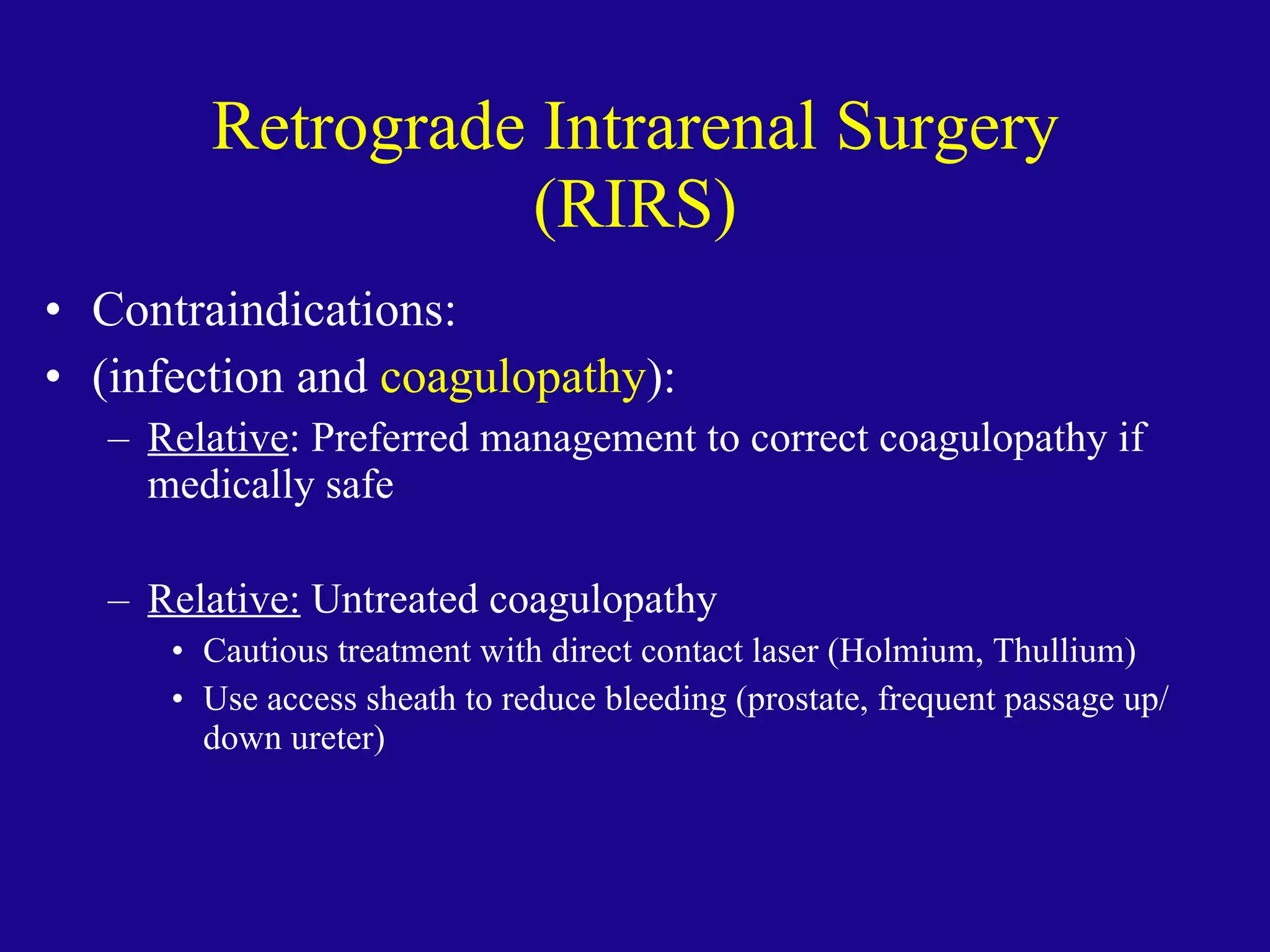
Retrograde Intrarenal Surgery (RIRS) Contraindications:  (infection and  coagulopathy ): Relative : Preferred management to correct coagulopathy if medically safe Relative:  Untreated coagulopathy Cautious treatment with direct contact laser (Holmium, Thullium) Use access sheath to reduce bleeding (prostate, frequent passage up/down ureter)
RIRS - 21 Years Review  Range of Present Indications Development of Indications (equipment, techniques) Results Outlook to Future Role
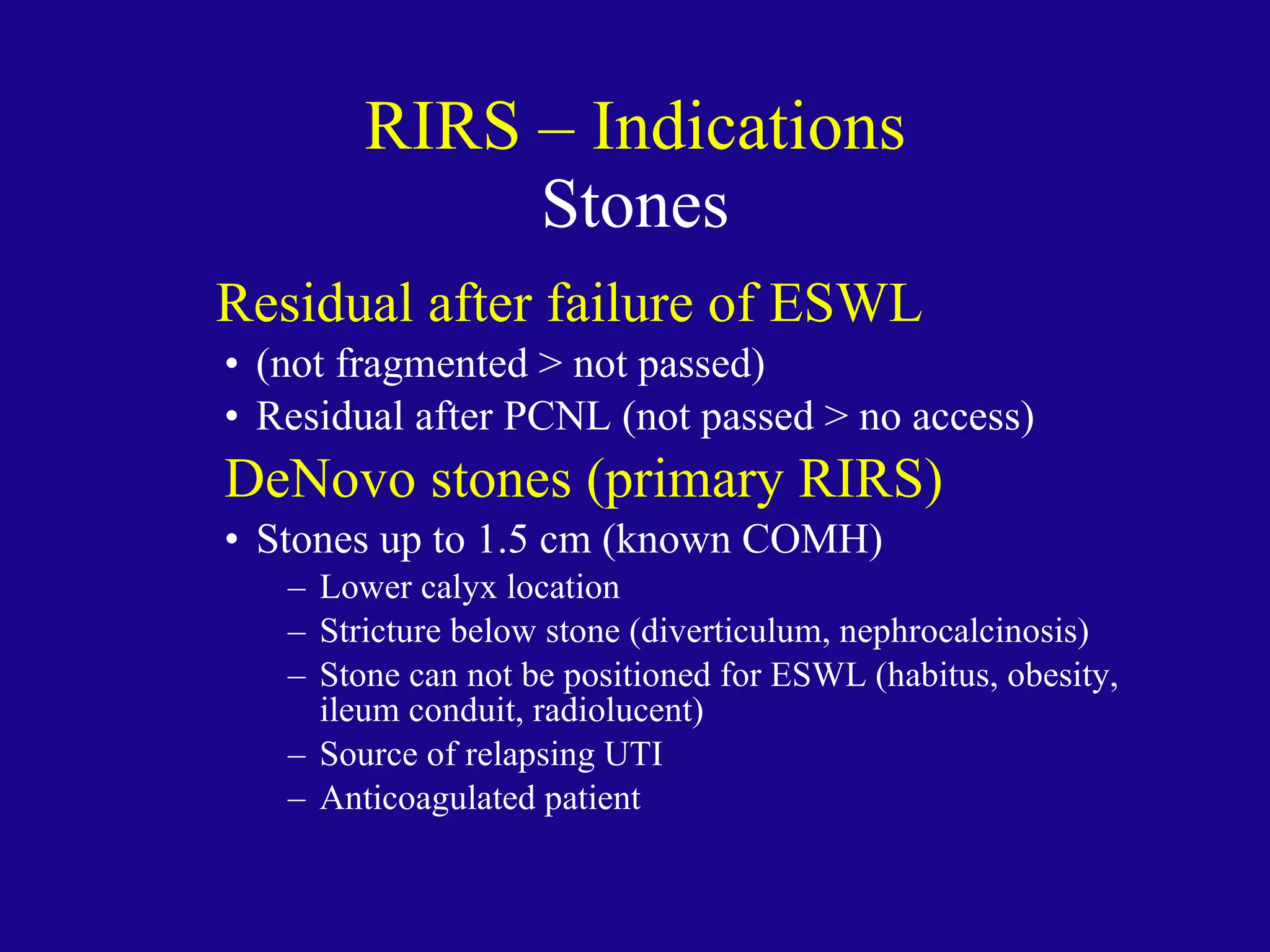
RIRS – Indications Stones   Residual after failure of ESWL  (not fragmented > not passed) Residual after PCNL (not passed > no access) DeNovo stones (primary RIRS) Stones up to 1.5 cm (known COMH) Lower calyx location Stricture below stone (diverticulum, nephrocalcinosis) Stone can not be positioned for ESWL (habitus, obesity, ileum conduit, radiolucent) Source of relapsing UTI Anticoagulated patient
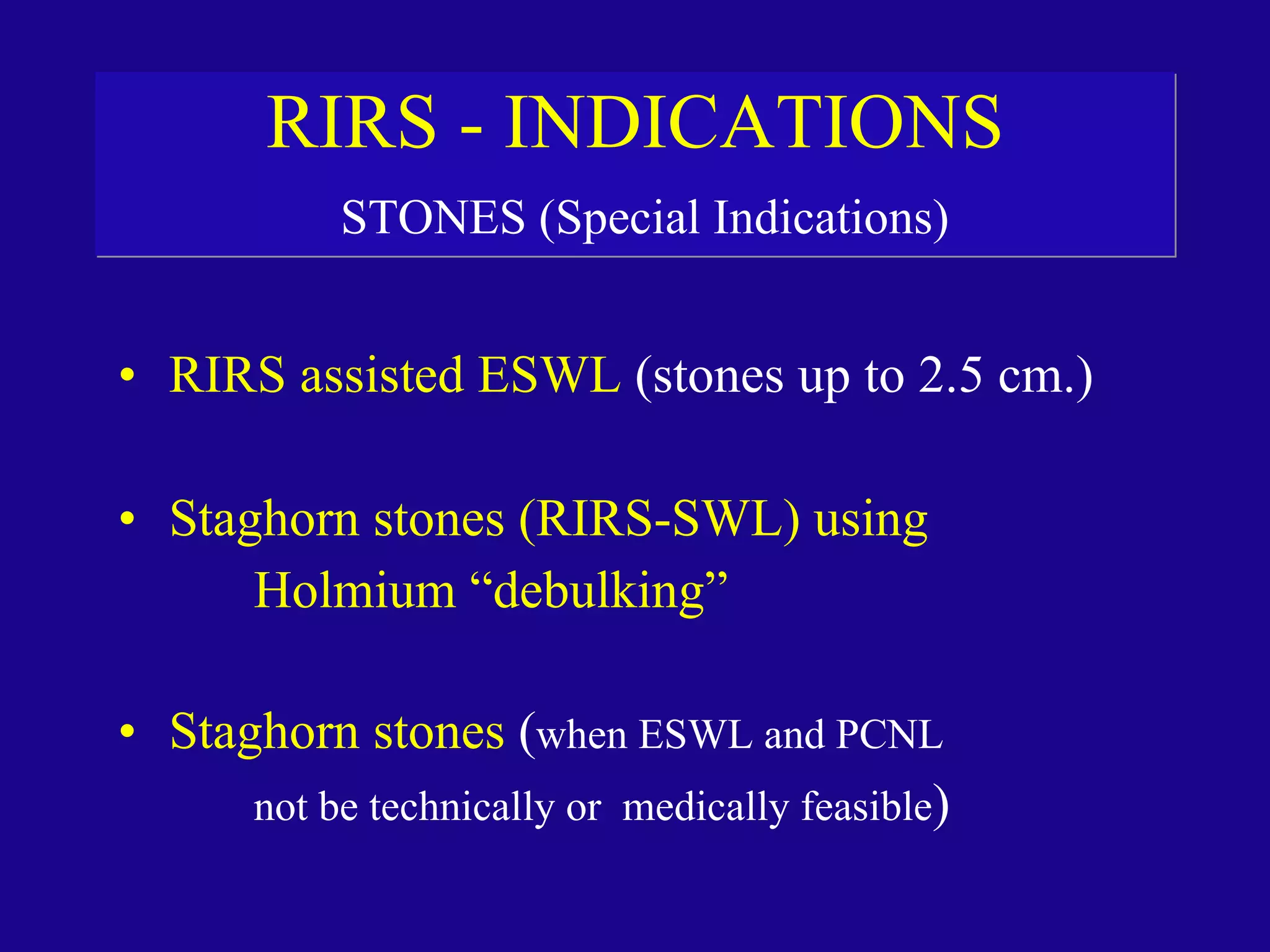
RIRS - INDICATIONS   STONES (Special Indications) RIRS assisted ESWL  (stones up to 2.5 cm.) Staghorn stones (RIRS-SWL) using  Holmium “debulking” Staghorn stones  ( when ESWL and PCNL  not be technically or  medically feasible )
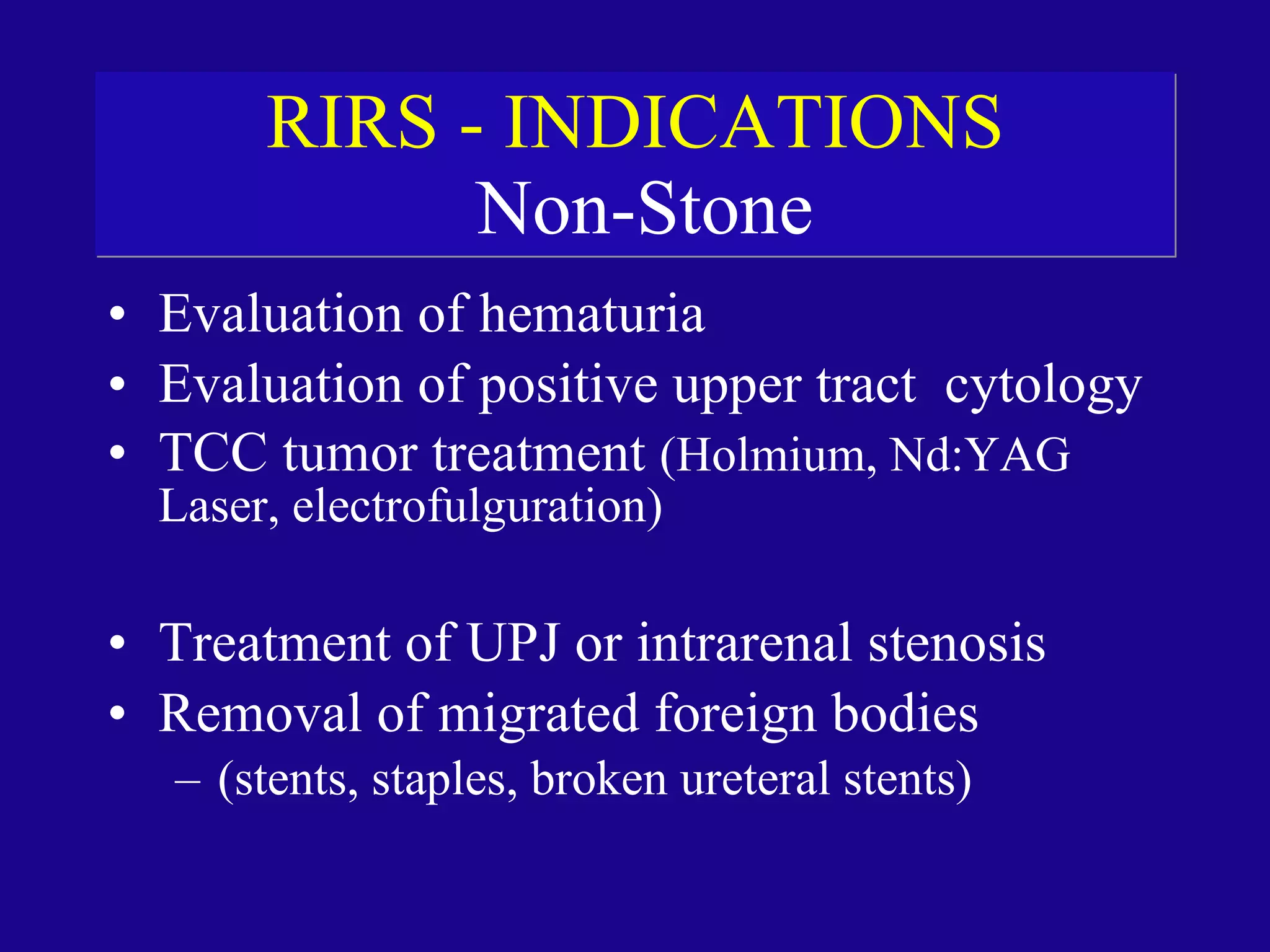
RIRS - INDICATIONS   Non-Stone Evaluation of hematuria Evaluation of positive upper tract  cytology TCC tumor treatment  (Holmium, Nd:YAG Laser, electrofulguration) Treatment of UPJ or intrarenal stenosis Removal of migrated foreign bodies (stents, staples, broken ureteral stents)
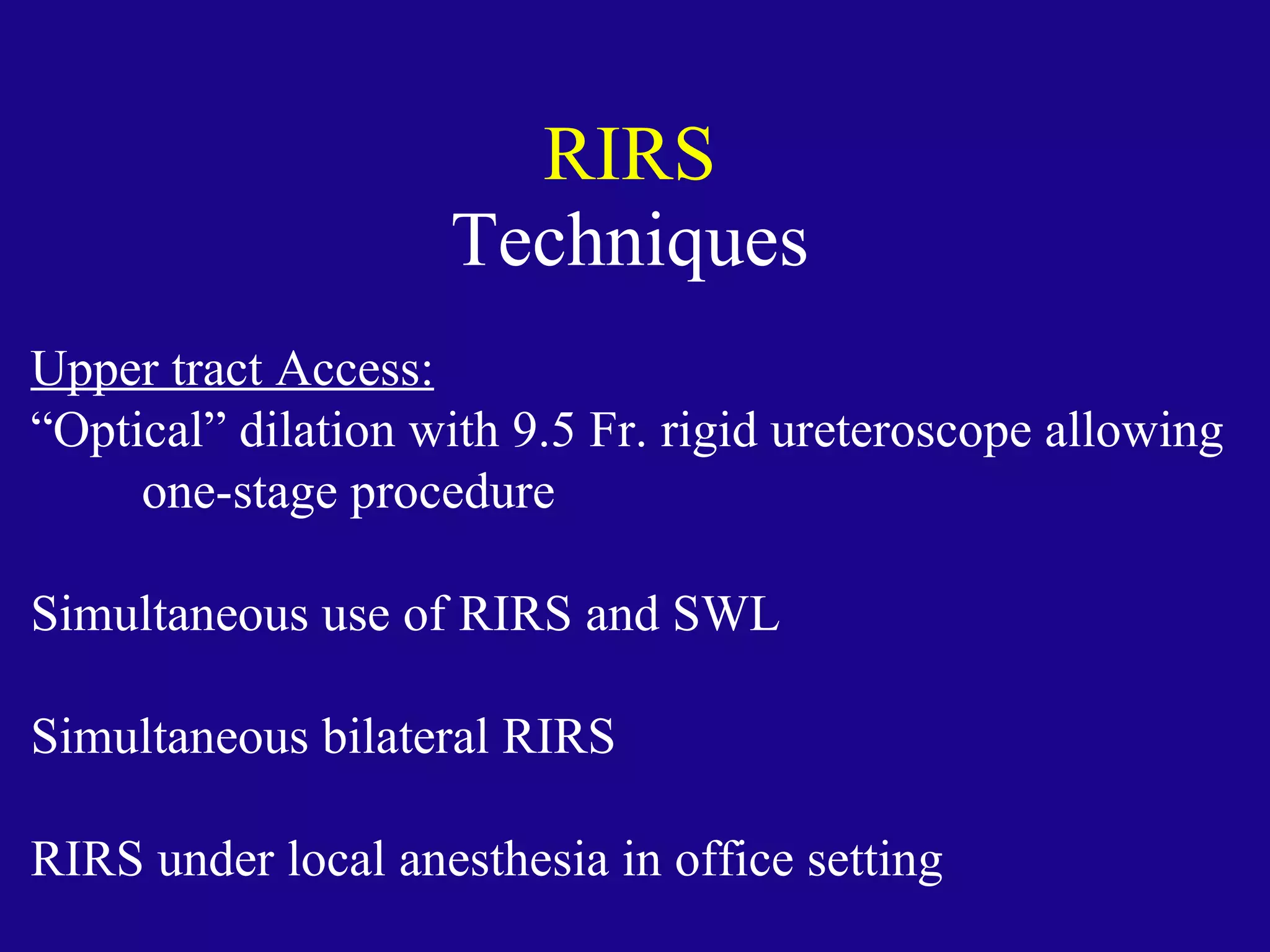
RIRS  Techniques   Upper tract Access: “ Optical” dilation with 9.5 Fr. rigid ureteroscope allowing  one-stage procedure Simultaneous use of RIRS and SWL Simultaneous bilateral RIRS RIRS under local anesthesia in office setting
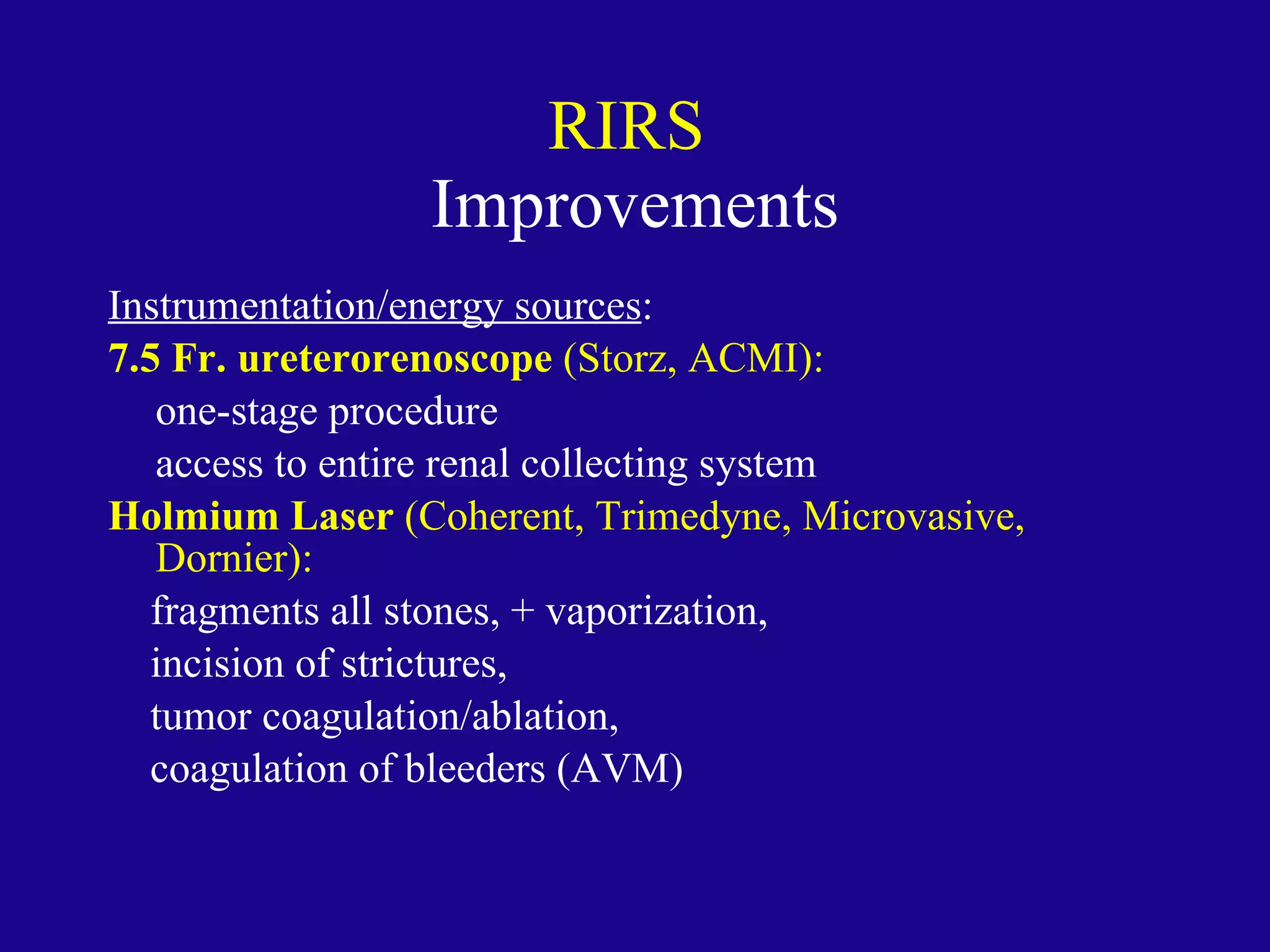
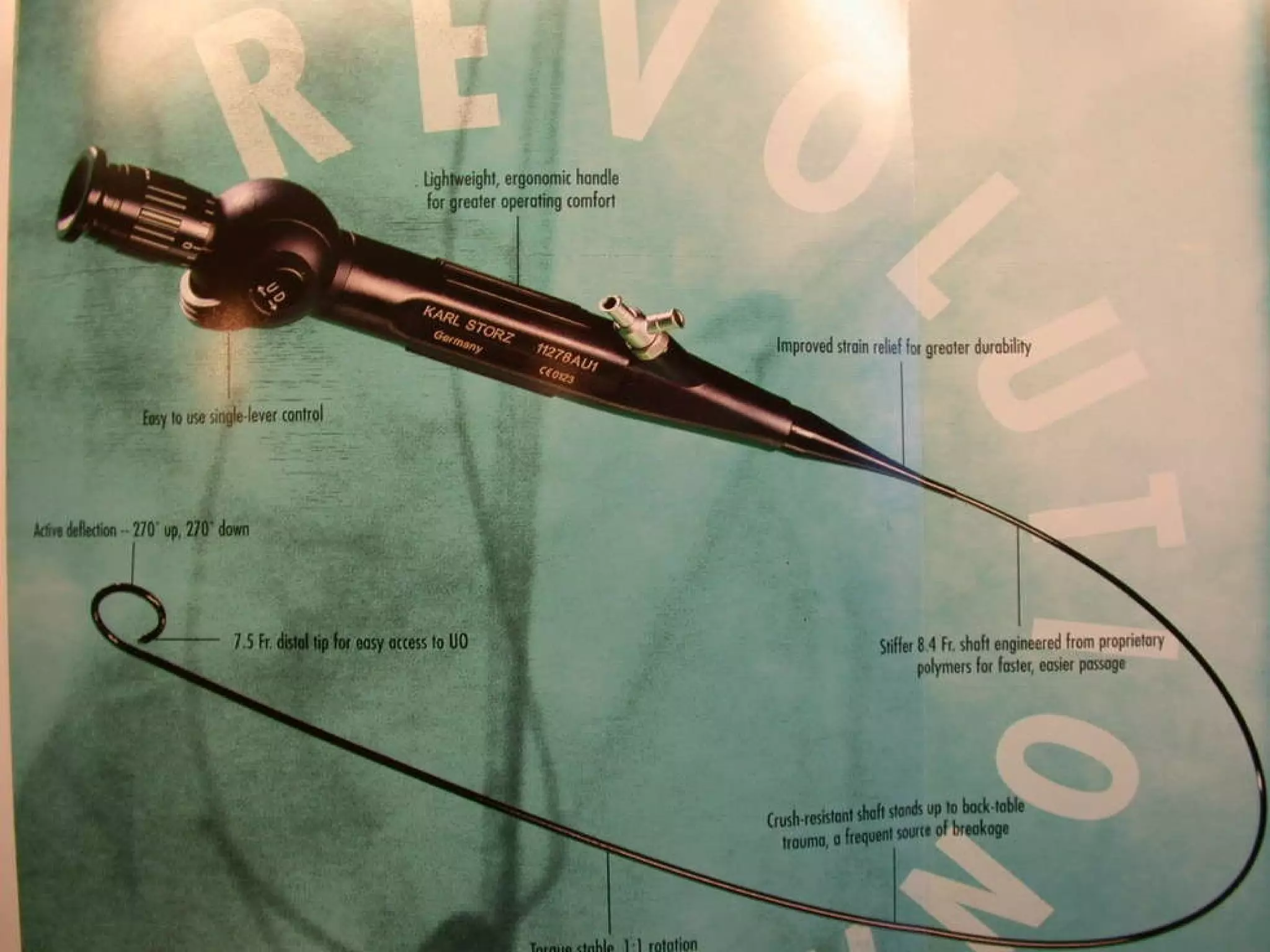
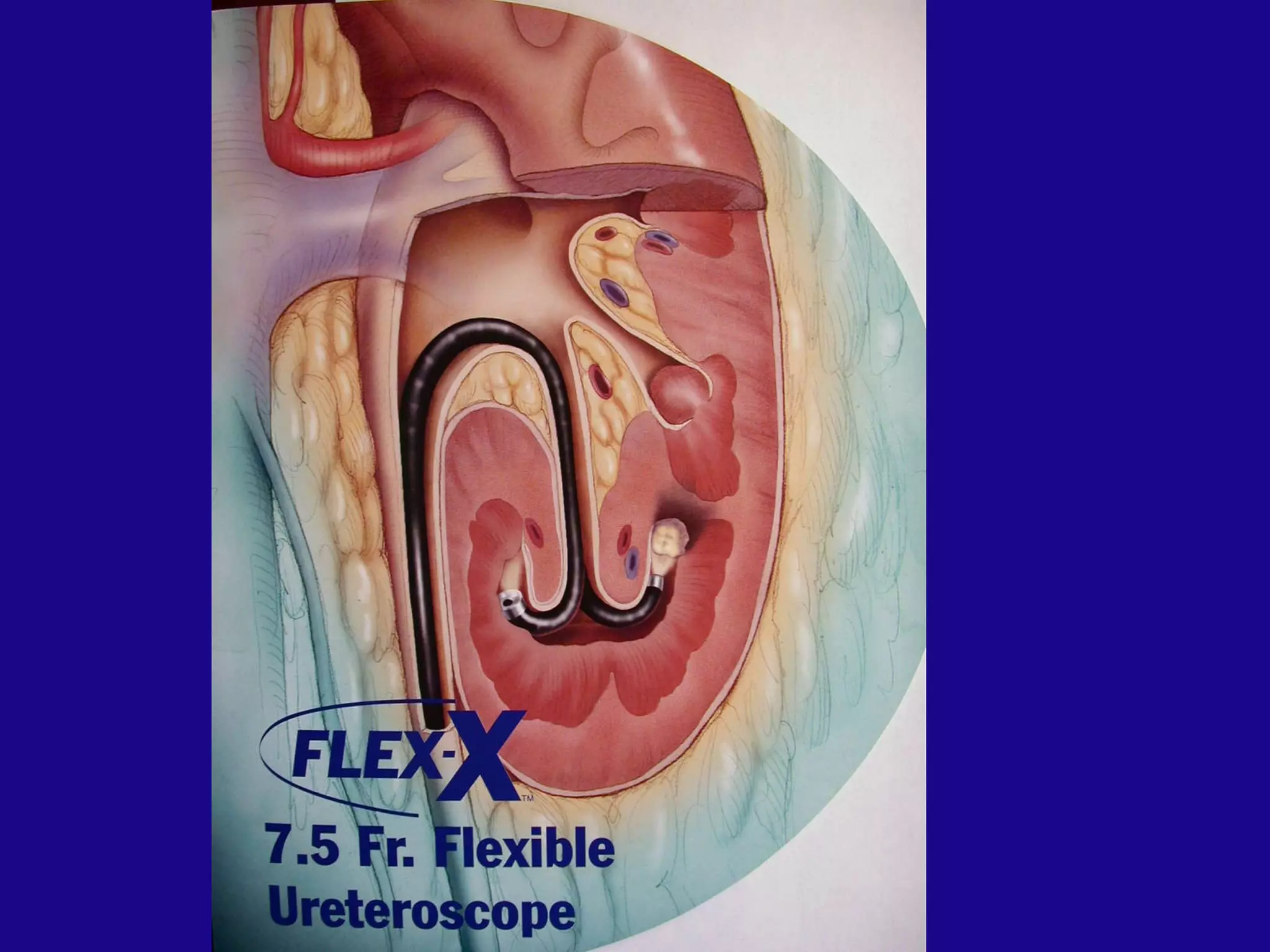
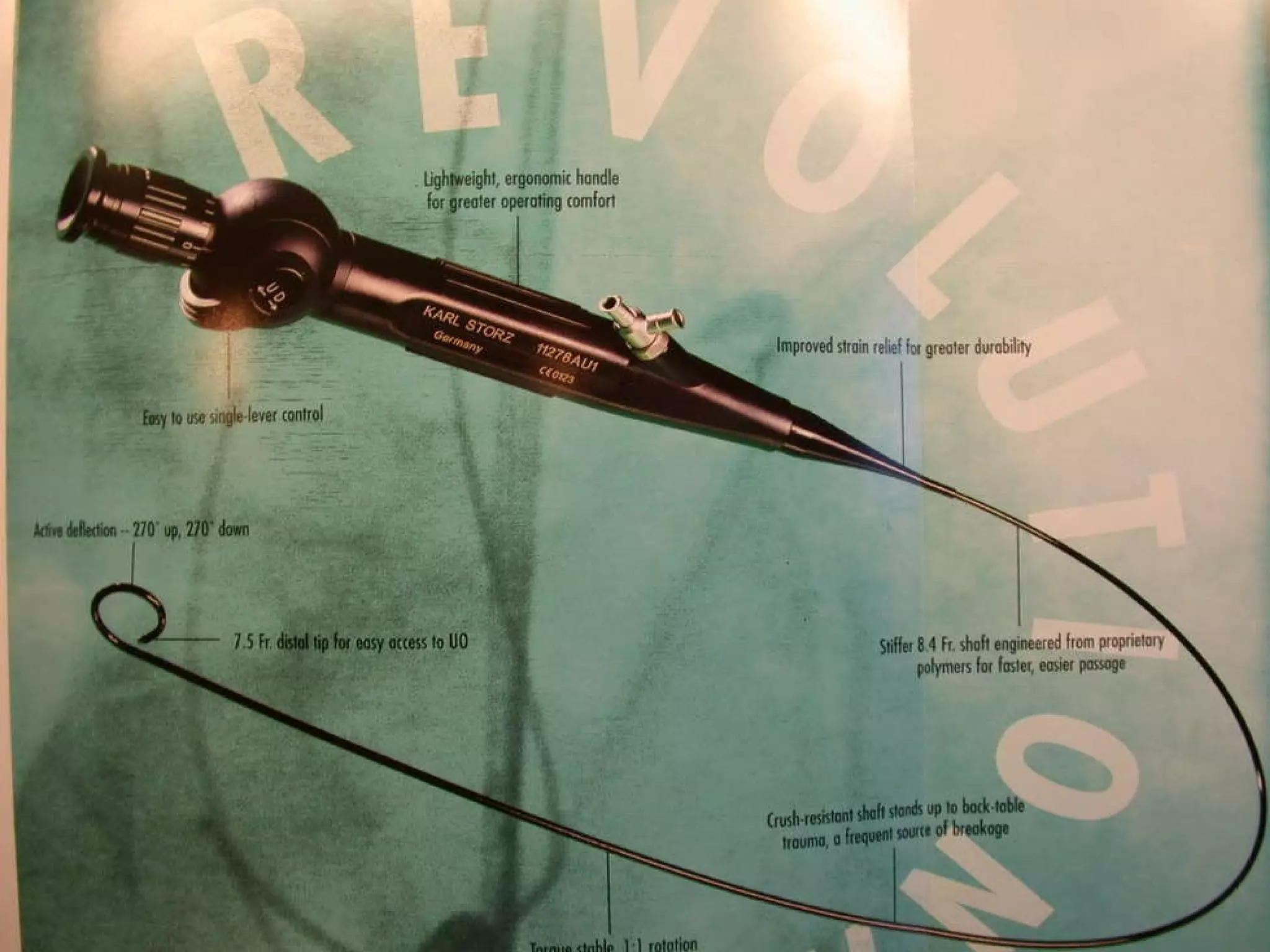
RIRS  Improvements Instrumentation/energy sources : 7.5 Fr. ureterorenoscope  (Storz, ACMI):  one-stage procedure access to entire renal collecting system Holmium Laser  (Coherent, Trimedyne, Microvasive, Dornier):  fragments all stones, + vaporization,  incision of strictures,  tumor coagulation/ablation,  coagulation of bleeders (AVM)
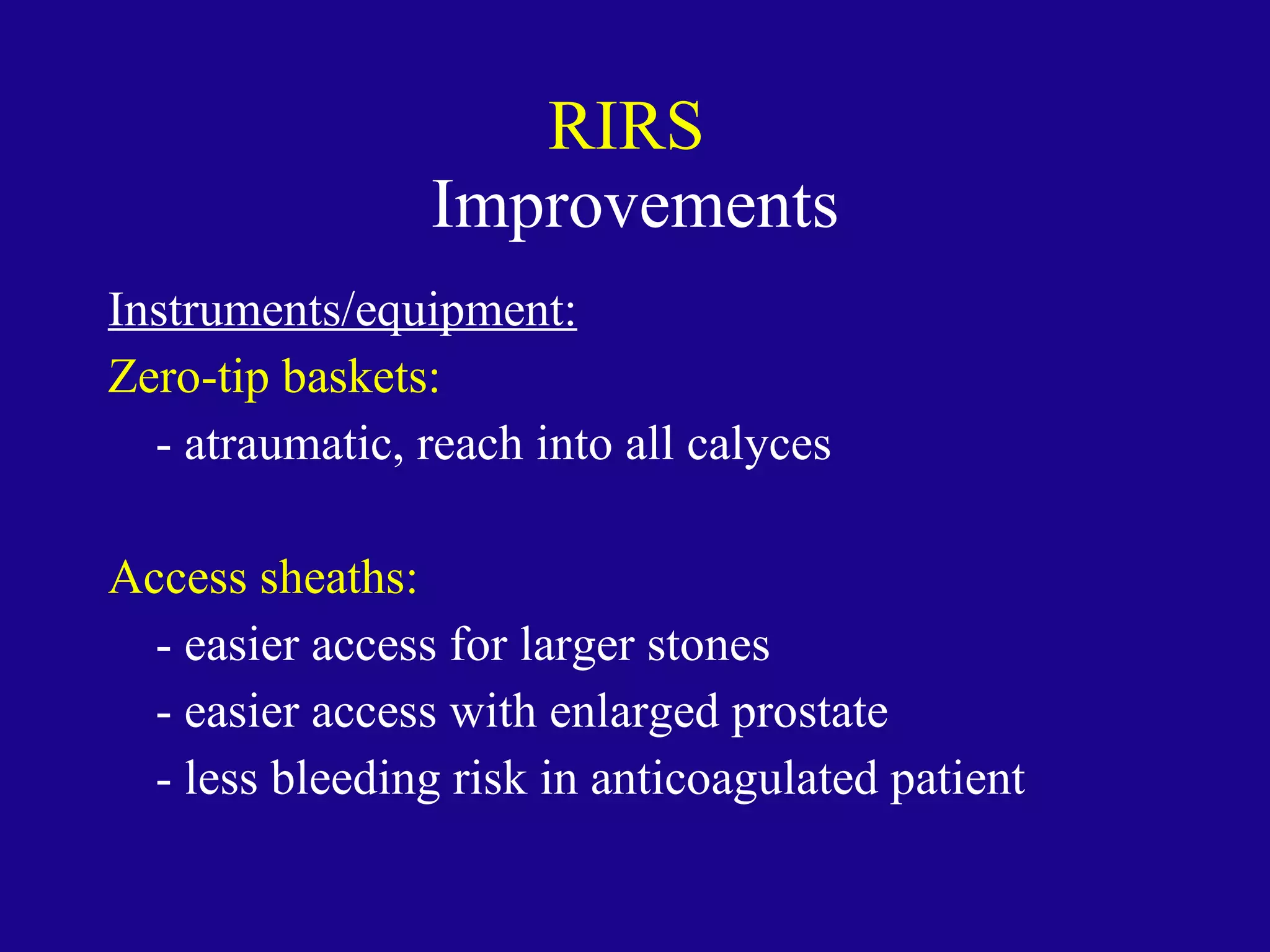
RIRS  Improvements Instruments/equipment: Zero-tip baskets:   - atraumatic, reach into all calyces Access sheaths: - easier access for larger stones - easier access with enlarged prostate - less bleeding risk in anticoagulated patient
PATIENT PREPARATION  Patient Selection (see indications) Sterile urine (neg. C&S) IV hydration IV peri-operative antibiotics  (e.g. Ampicillin + Gentamycin) KUB (for stones),  general anesthesia (IV sedation, local)
FLEXIBLE URETERORENOSCOPY WITH RIRS: Protocol Pre- and intraoperative forced diuresis (fluids + diuretic)  as renoprotective measure against pyelo-parenchymal reflux Cystoscopy , retrograde pyelogram, and placement of 0.038 guidewire  Removal of previously placed double J  stent
Access to the Upper Urinary Tract Technique (URS) Access to the Ureter:  To Dilate or Not to Dilate ? Myth:   Most ureteral orifices need to be dilated Fact : Less than 3 % need dilation (9.5 Fr.scope) No advantage of smaller "mini"scopes in this regard Dilation only needed if : S/p pelvic or ureteral surgery or radiation  with extrinsic ureteral compression (tumor/fibrosis)
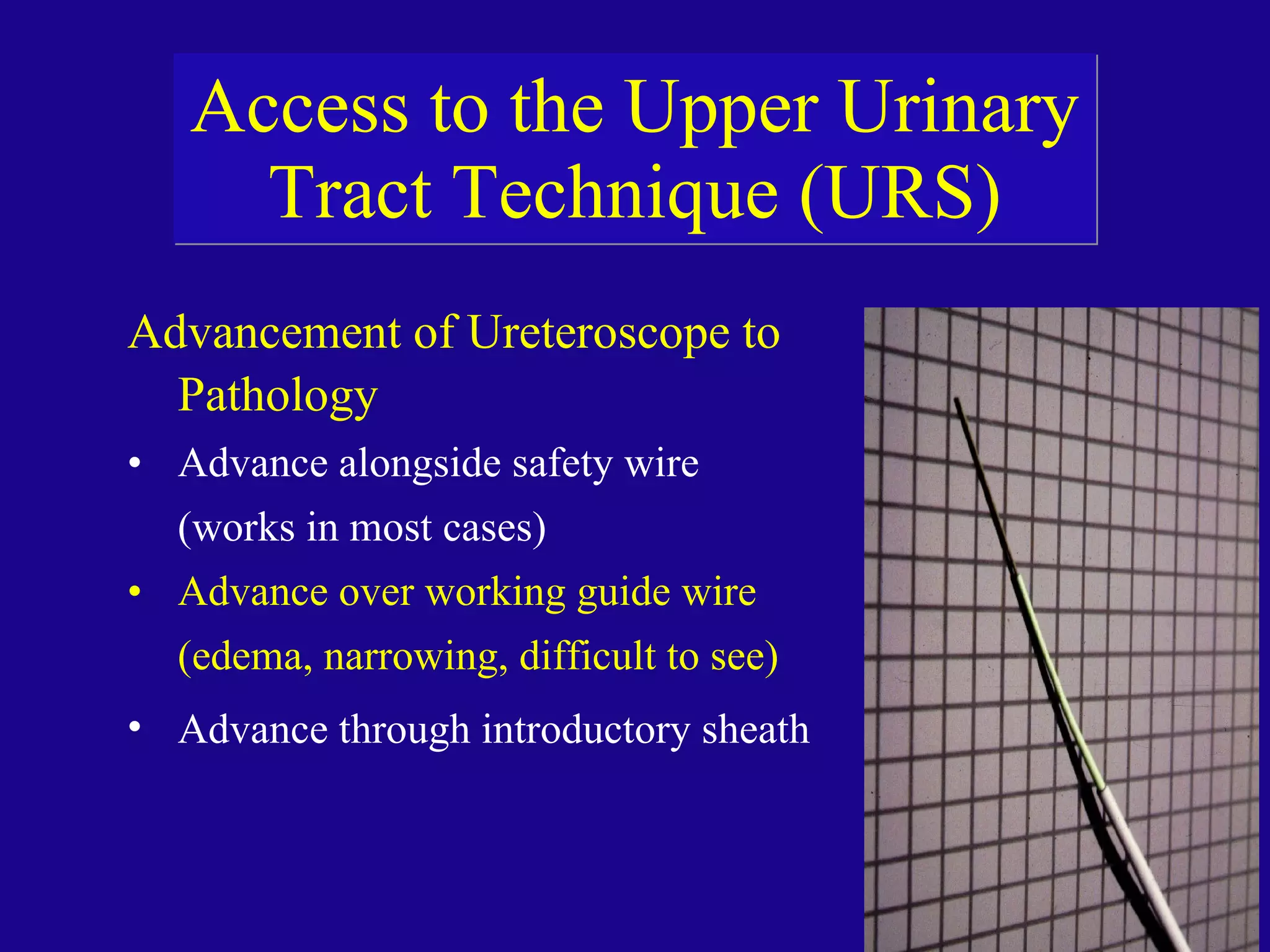
Access to the Upper Urinary Tract Technique (URS) Advancement of Ureteroscope to Pathology Advance alongside safety wire  (works in most cases) Advance over working guide wire (edema, narrowing, difficult to see)   Advance through introductory sheath
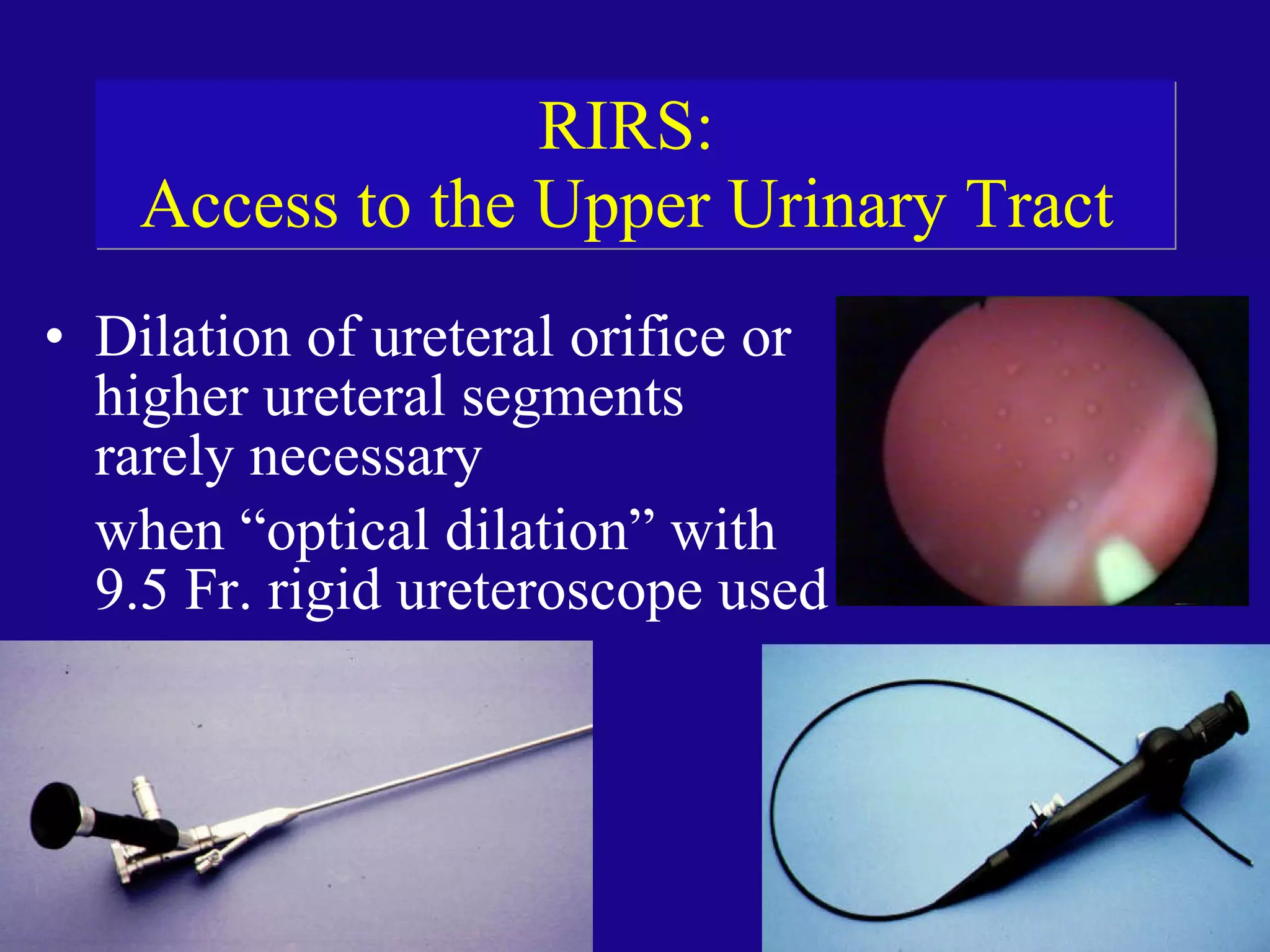
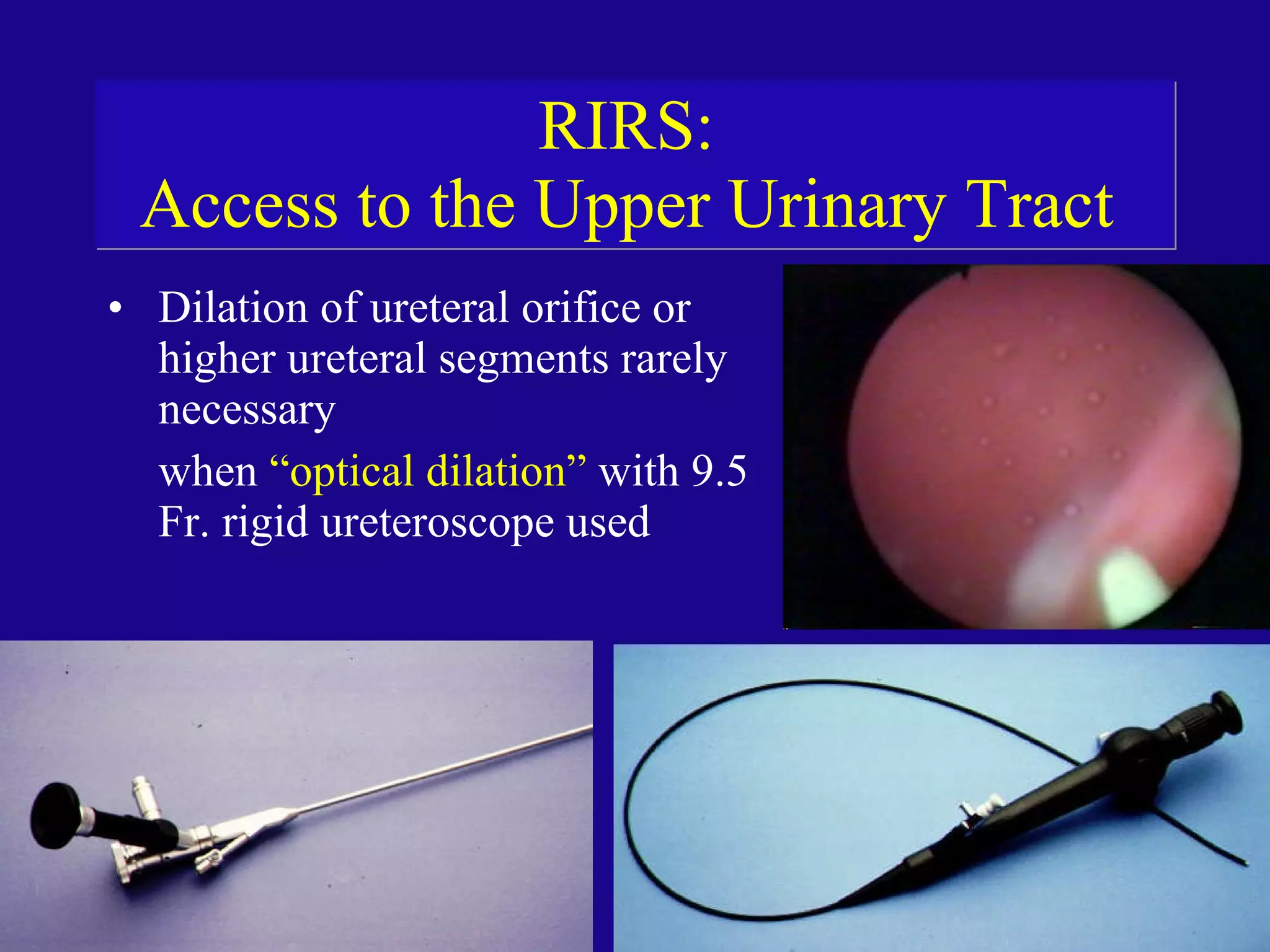
RIRS:  Access to the Upper Urinary Tract  Dilation of ureteral orifice or higher ureteral segments rarely necessary  when “optical dilation” with 9.5 Fr. rigid ureteroscope used
 
 
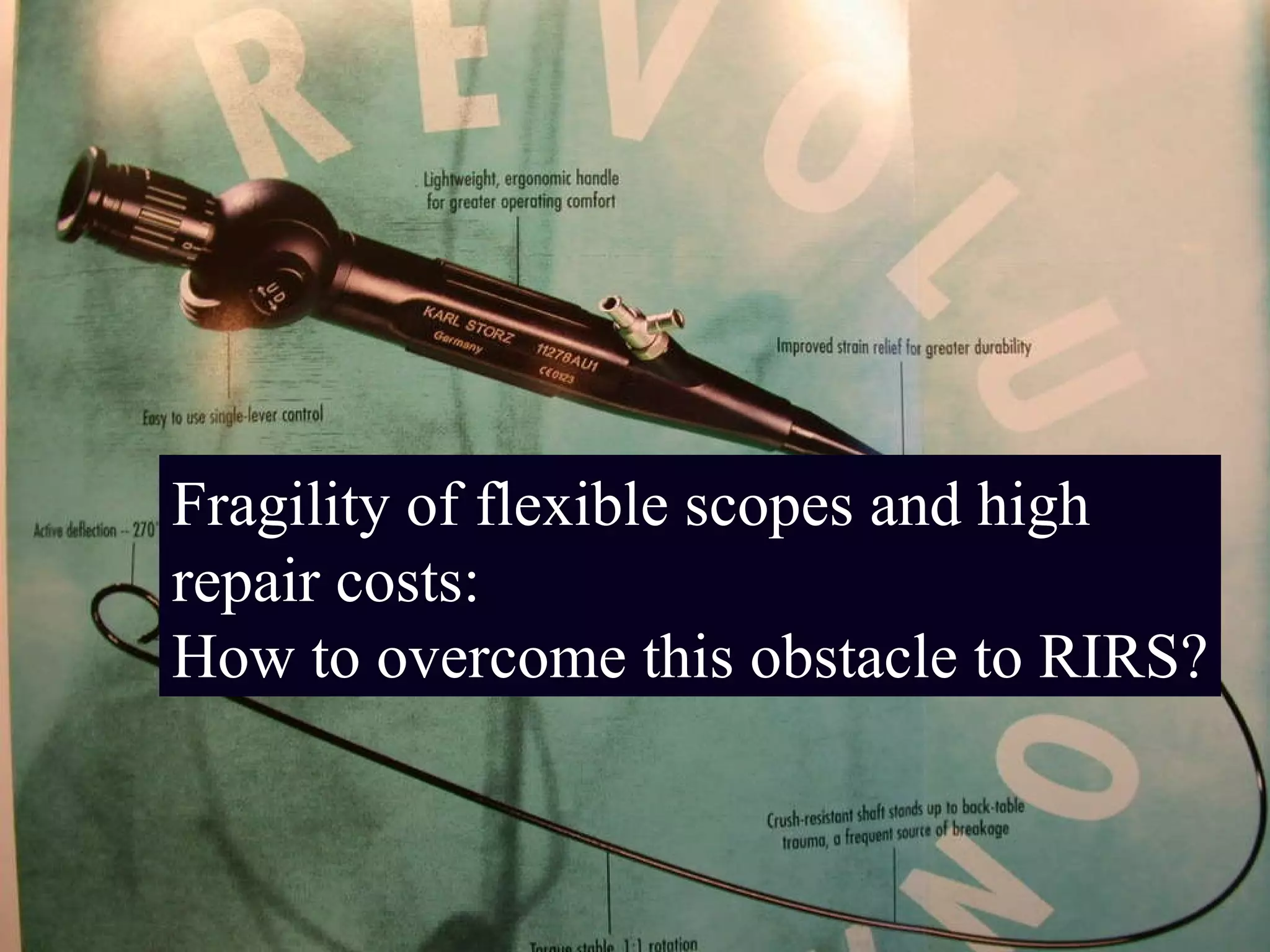
Fragility of flexible scopes and high  repair costs: How to overcome this obstacle to RIRS?
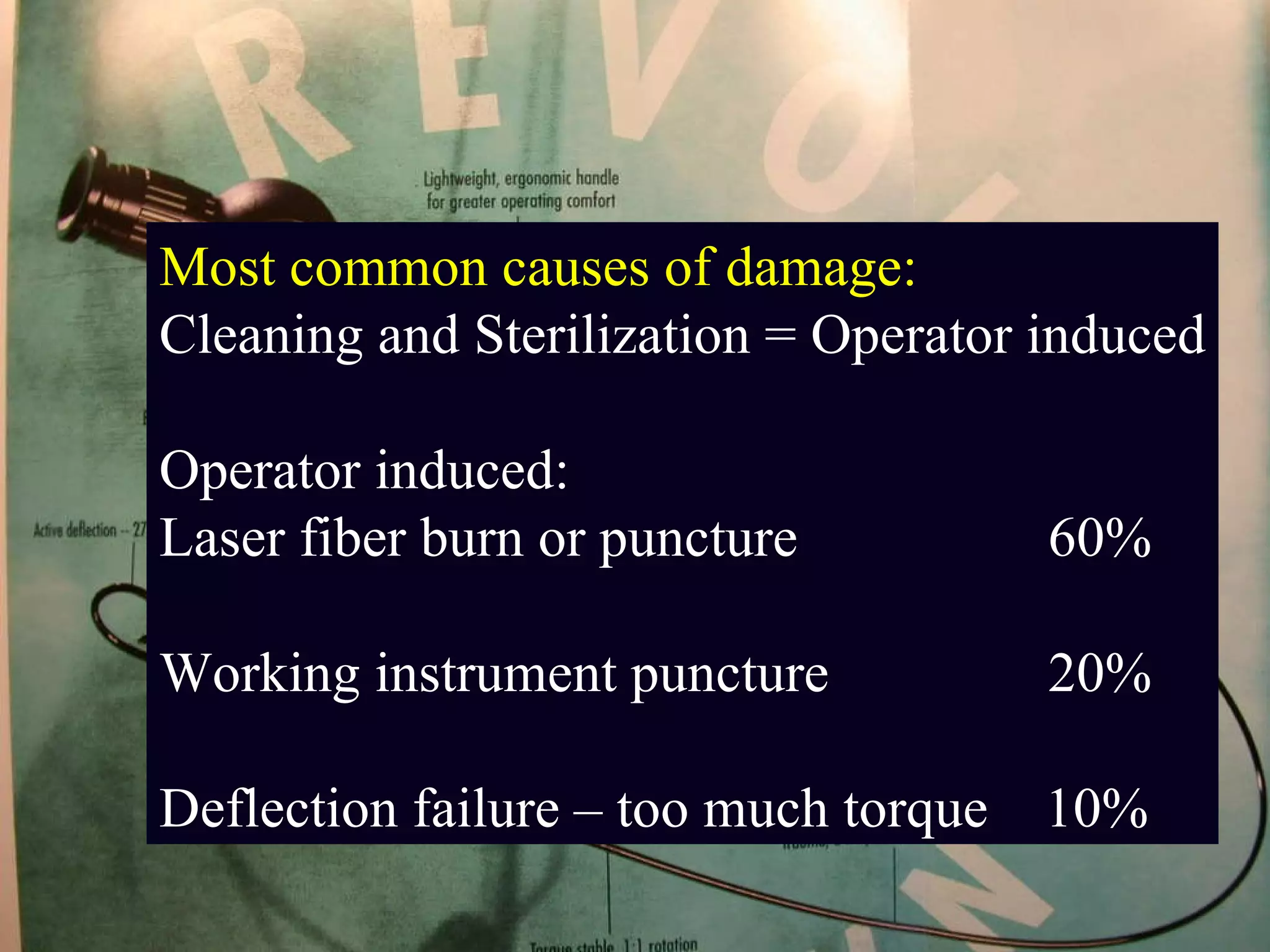
Most common causes of damage: Cleaning and Sterilization = Operator induced Operator induced: Laser fiber burn or puncture 60% Working instrument puncture 20% Deflection failure – too much torque  10%
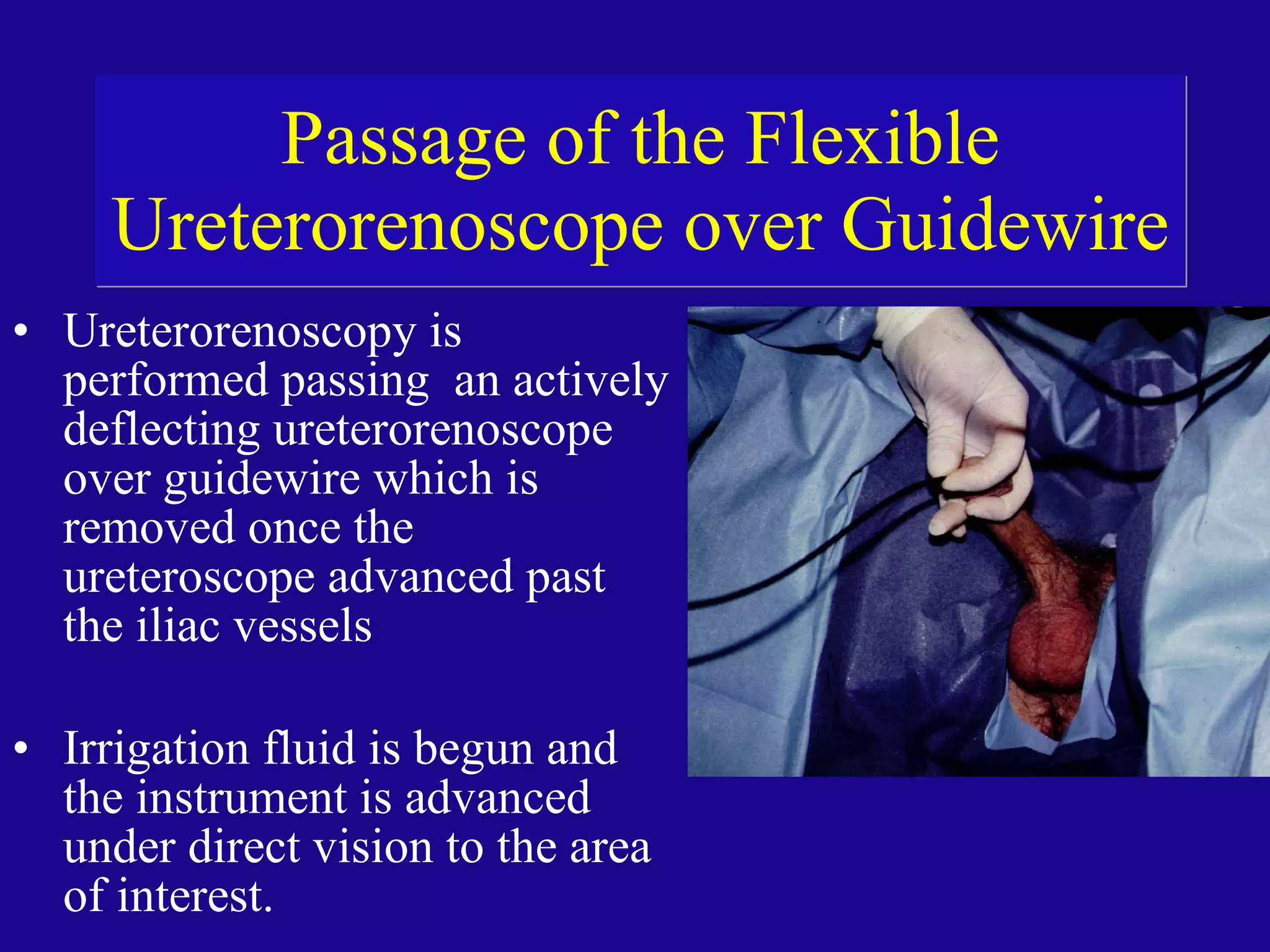
Passage of the Flexible Ureterorenoscope over Guidewire Ureterorenoscopy is performed passing  an actively deflecting ureterorenoscope over guidewire which is removed once the ureteroscope advanced past the iliac vessels Irrigation fluid is begun and the instrument is advanced under direct vision to the area of interest.
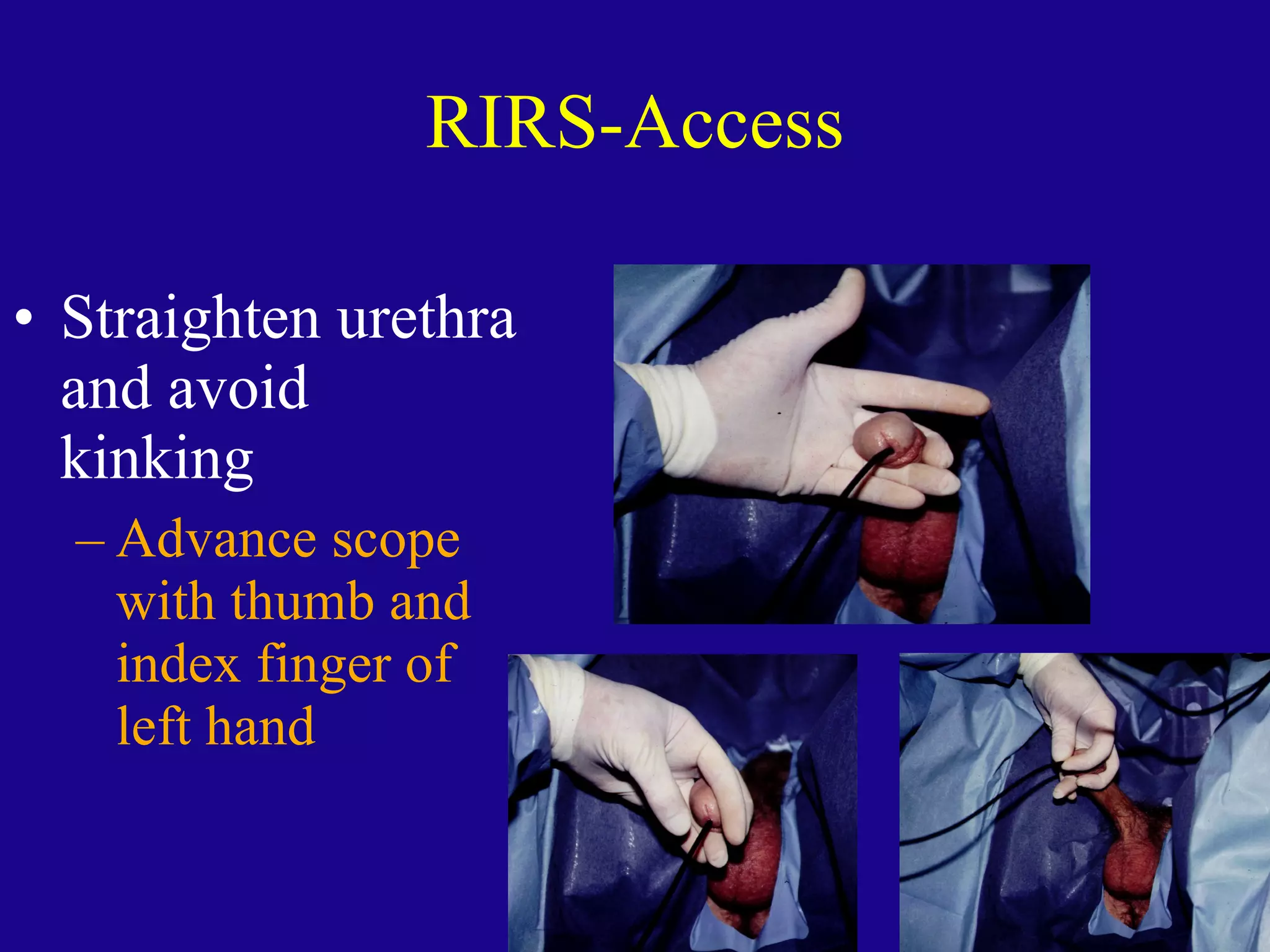
RIRS-Access Straighten urethra and avoid kinking Advance scope with thumb and index finger of left hand
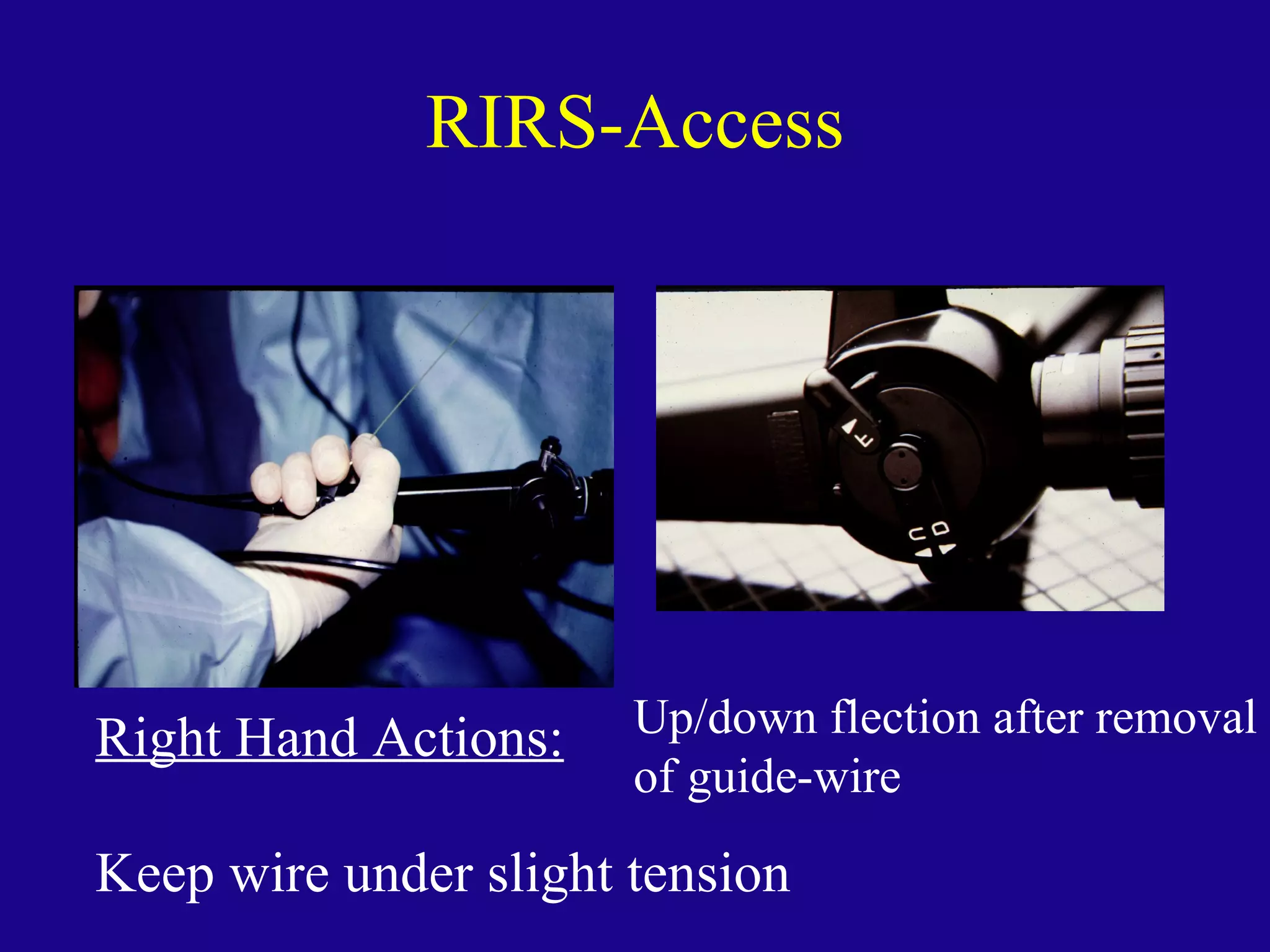
RIRS-Access Left hand: Straighten urethra Advance scope and direct tip Right hand:   Keep wire under slight tension Up/down flection
RIRS-Access Right Hand Actions: Keep wire under slight tension Up/down flection after removal of guide-wire
RIRS: Points of Technique Low-pressure system Suction / irrigation Suction Irrigation (gravity 60 cm) RIRS: Points of Technique
Retrograde Intrarenal Surgery  Equipment Employ appropriate energy source  for stones:  ultrasound, Lithoclast,  EHL,  Laser(Holmium)   for strictures:  cold-knife, RF knife,  Laser (Holmium) for tumors:  RF energy, Laser  (Nd:YAG, HoNd:YAG,  Holmium ) Universal Urology  Energy Source: Holmium Laser
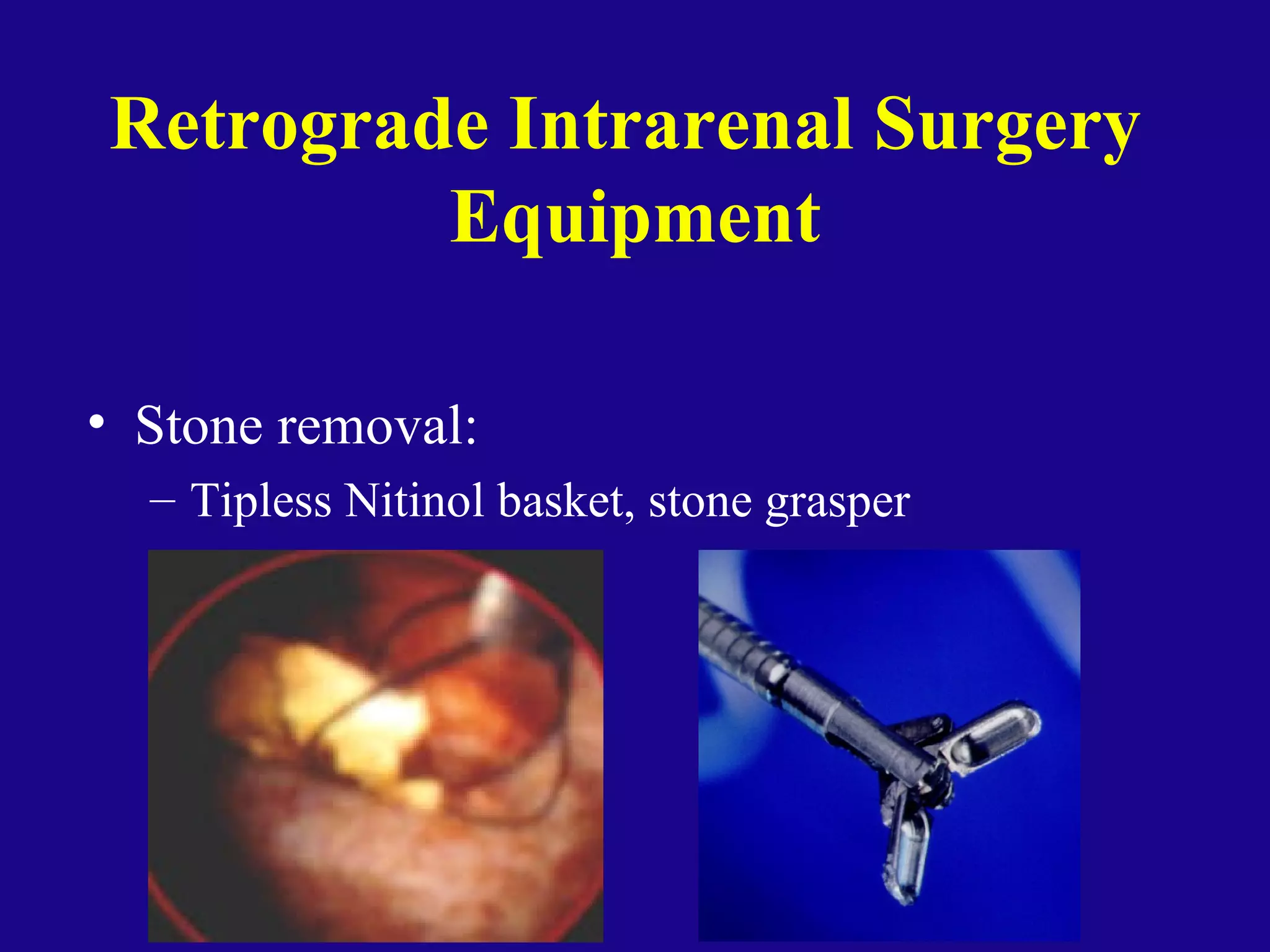
Retrograde Intrarenal Surgery  Equipment Stone removal: Tipless Nitinol basket, stone grasper
RIRS Exemplary Cases SWL has failed: what to do next ? Stone patient with bleeding problem Pediatric patient with cystine stone Stone and intrarenal stricture Upper tract TCC: organ preservation
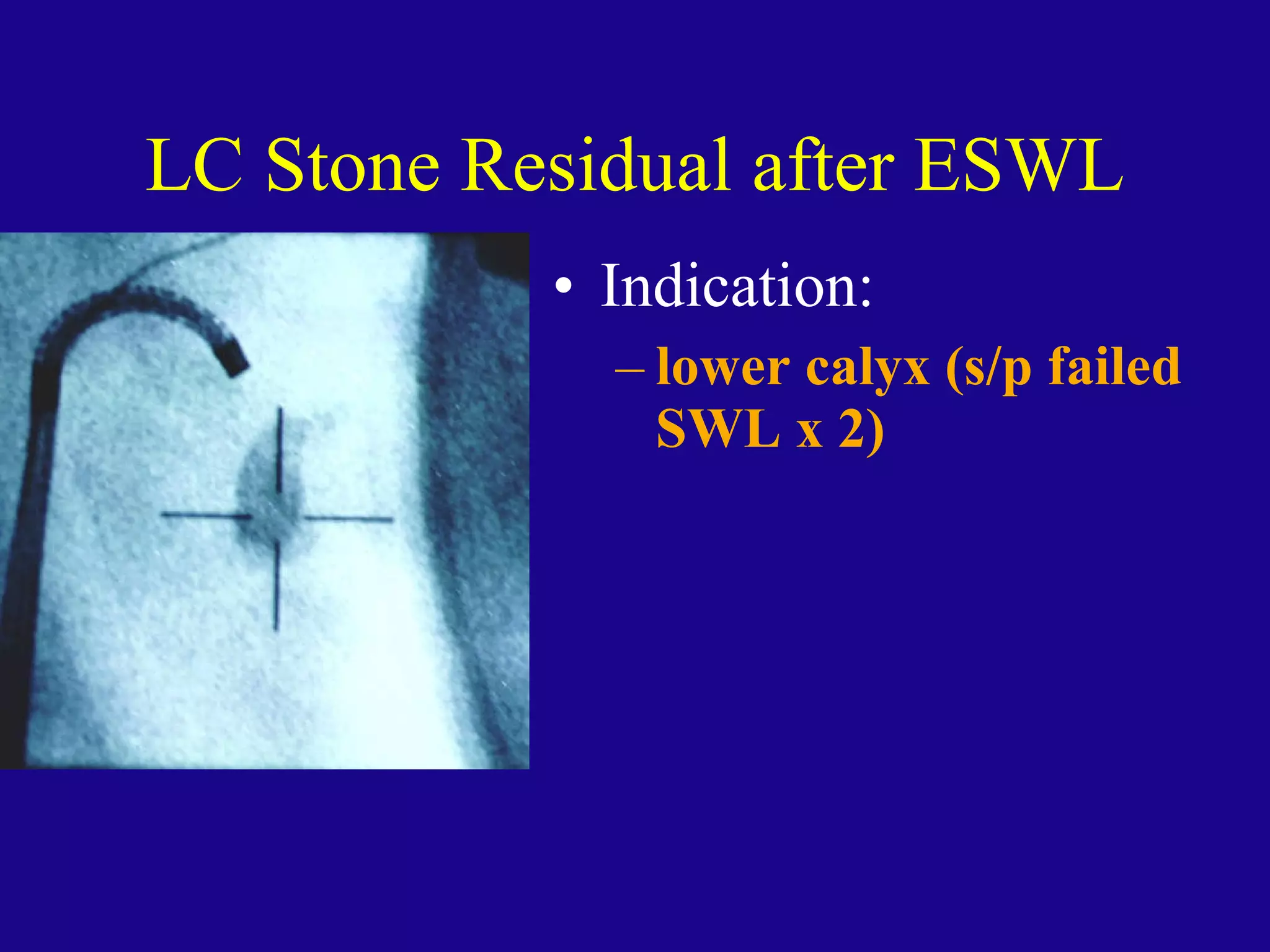
LC Stone Residual after ESWL Indication:  lower calyx (s/p failed SWL x 2)
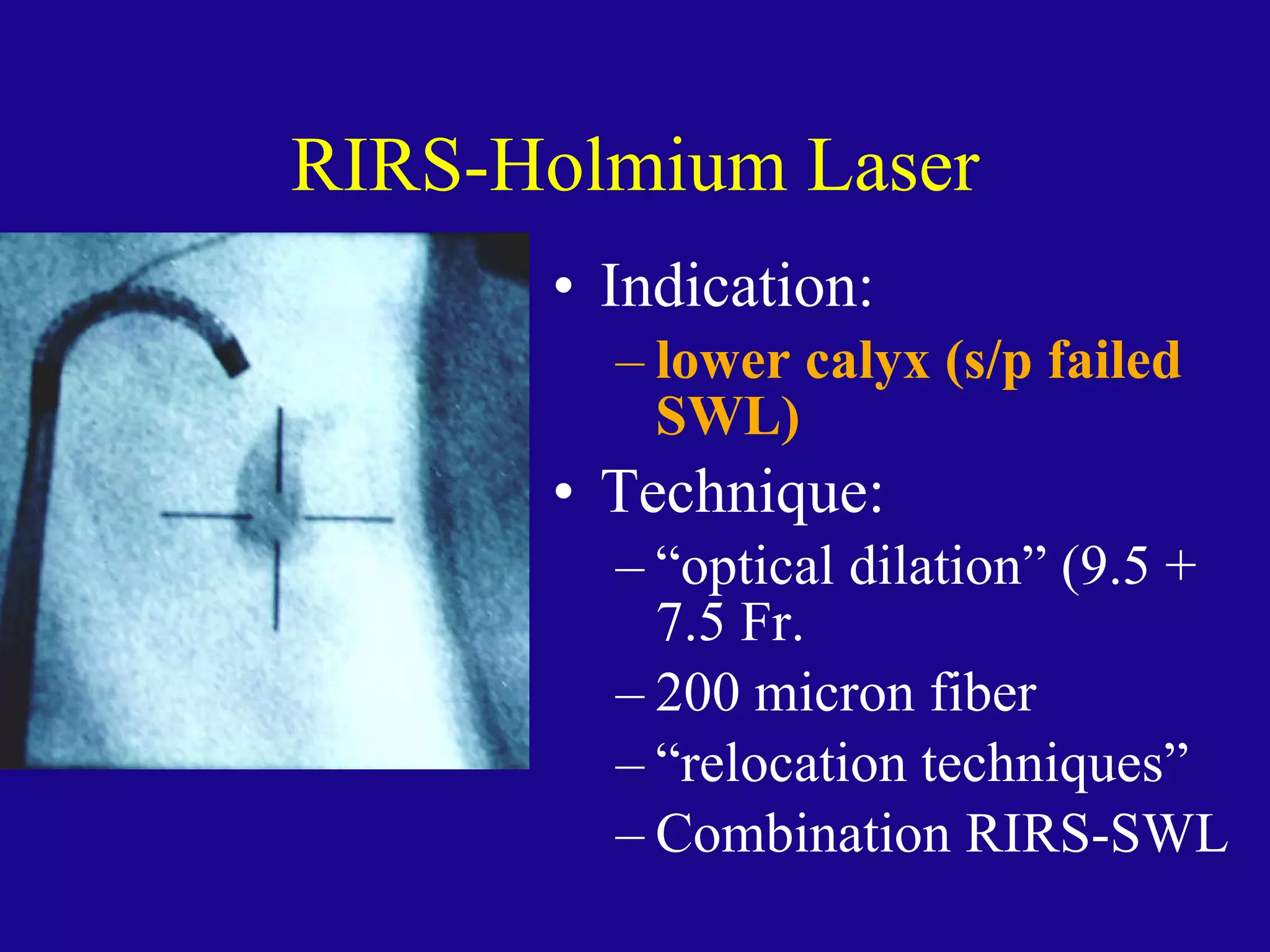
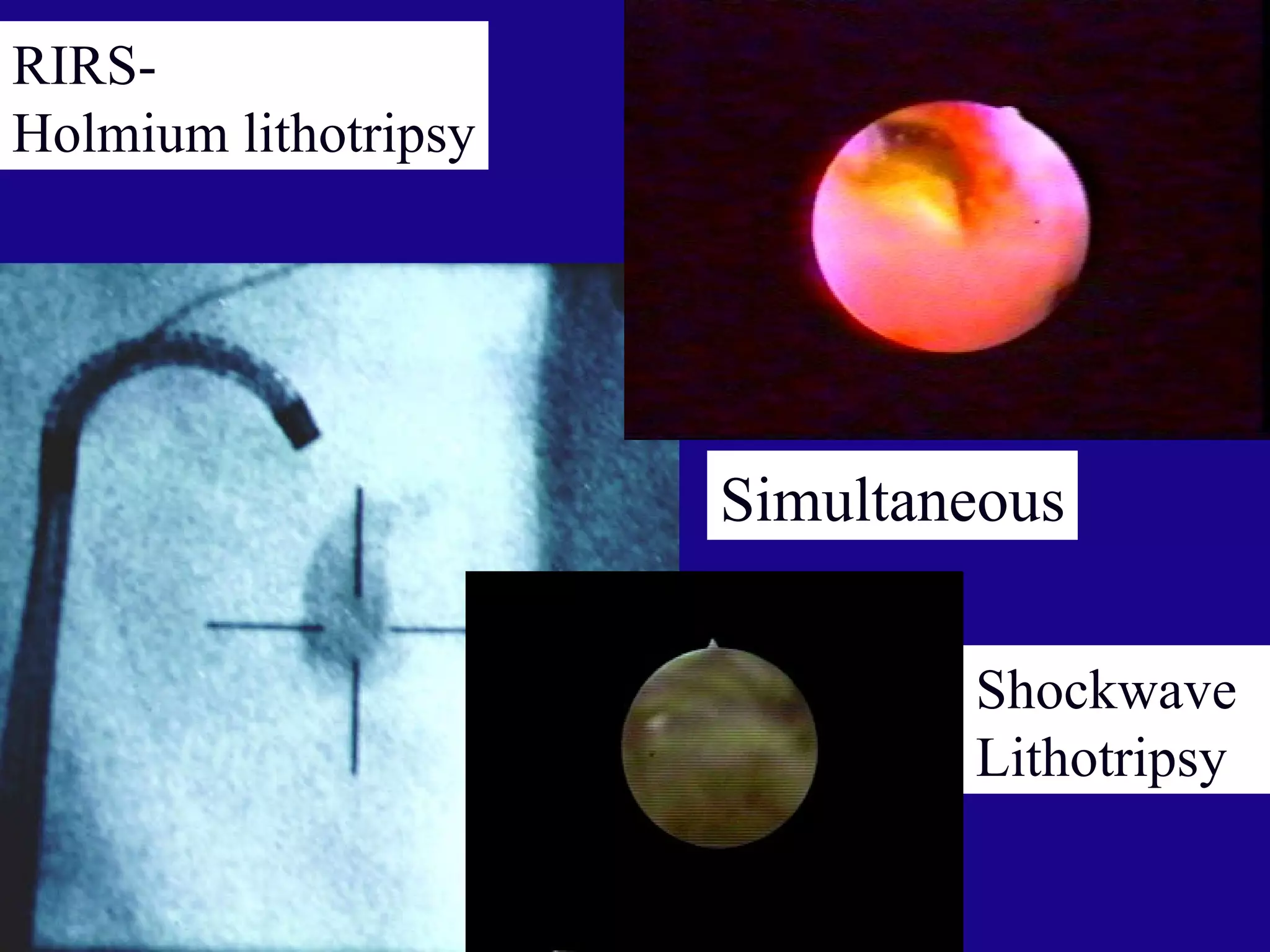
RIRS-Holmium Laser Indication:  lower calyx (s/p failed SWL) Technique: “ optical dilation” (9.5 + 7.5 Fr. 200 micron fiber “ relocation techniques” Combination RIRS-SWL
RIRS- Holmium lithotripsy Shockwave   Lithotripsy Simultaneous
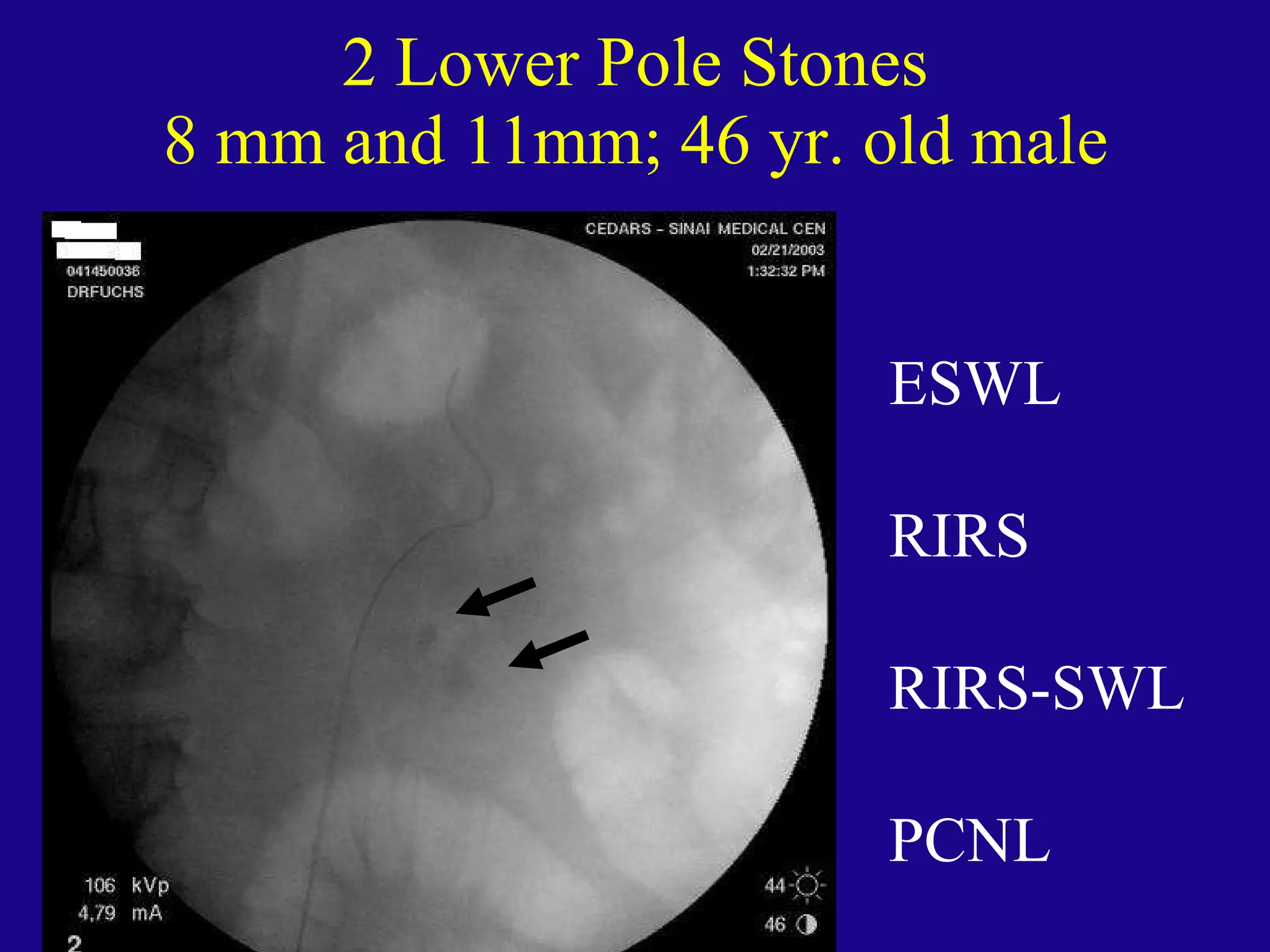
2 Lower Pole Stones 8 mm and 11mm; 46 yr. old male ESWL RIRS RIRS-SWL PCNL
RIRS for Lower Pole Stones
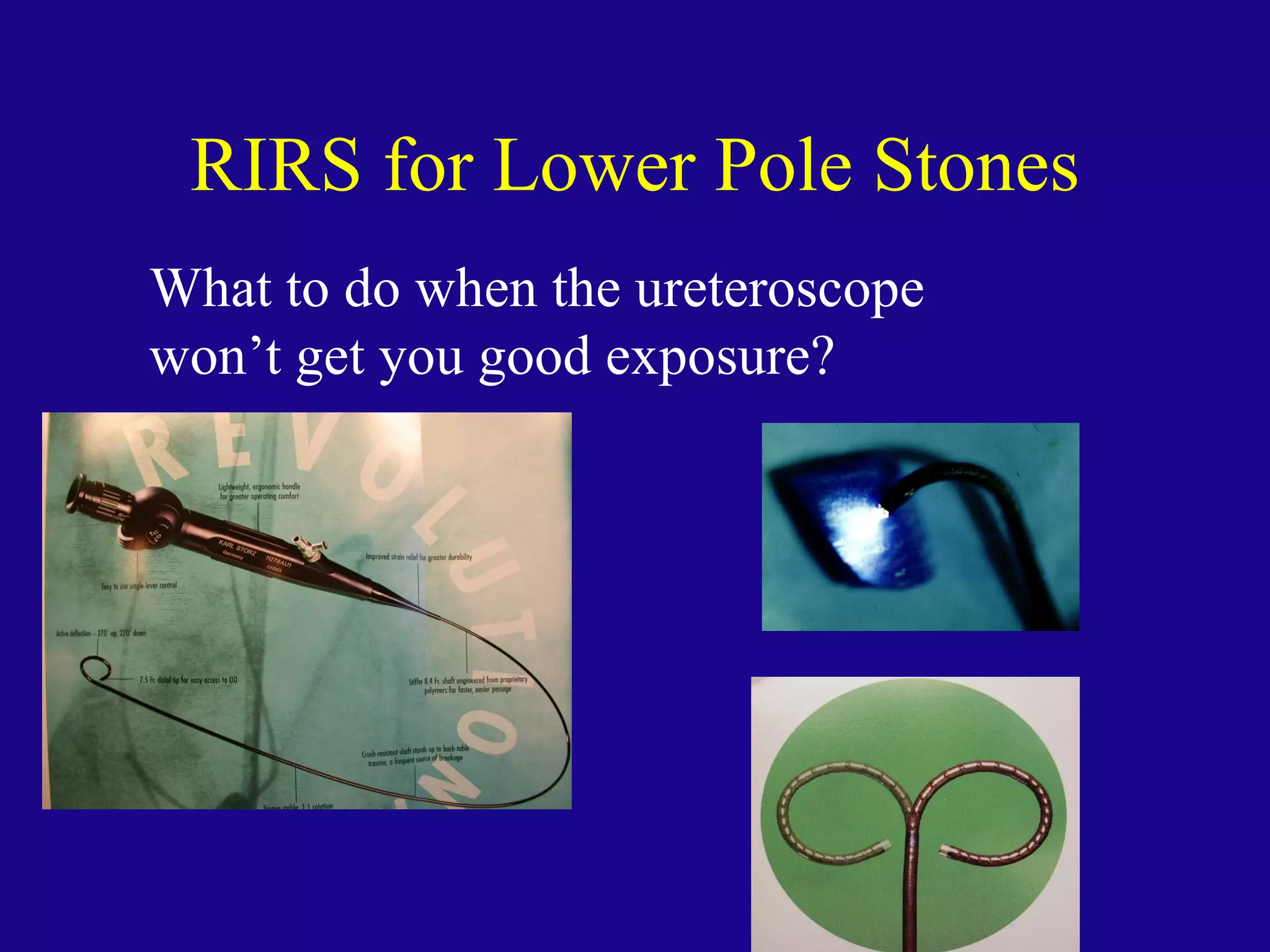
RIRS for Lower Pole Stones What to do when the ureteroscope  won’t get you good exposure?
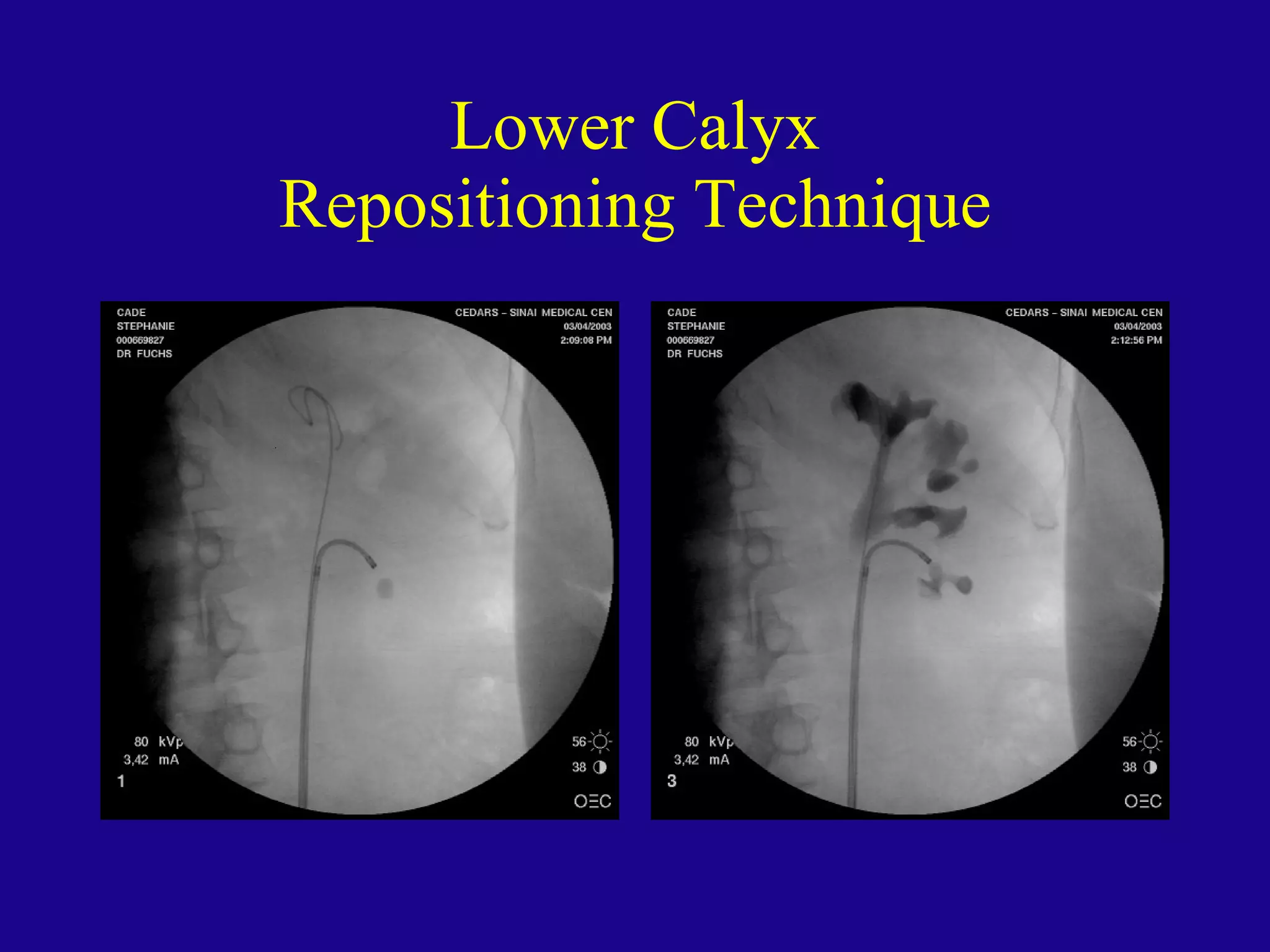
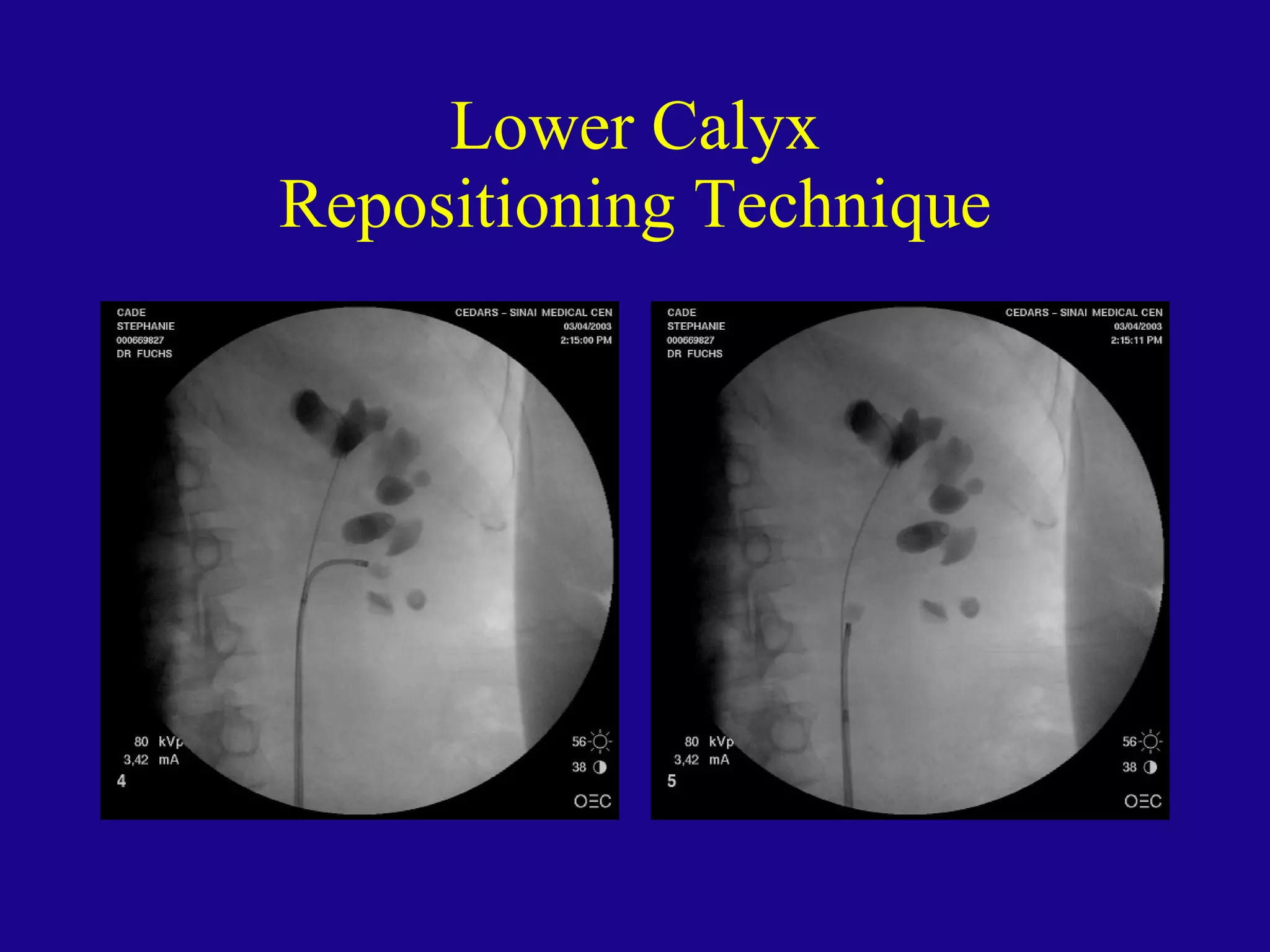
Lower Calyx Repositioning Technique
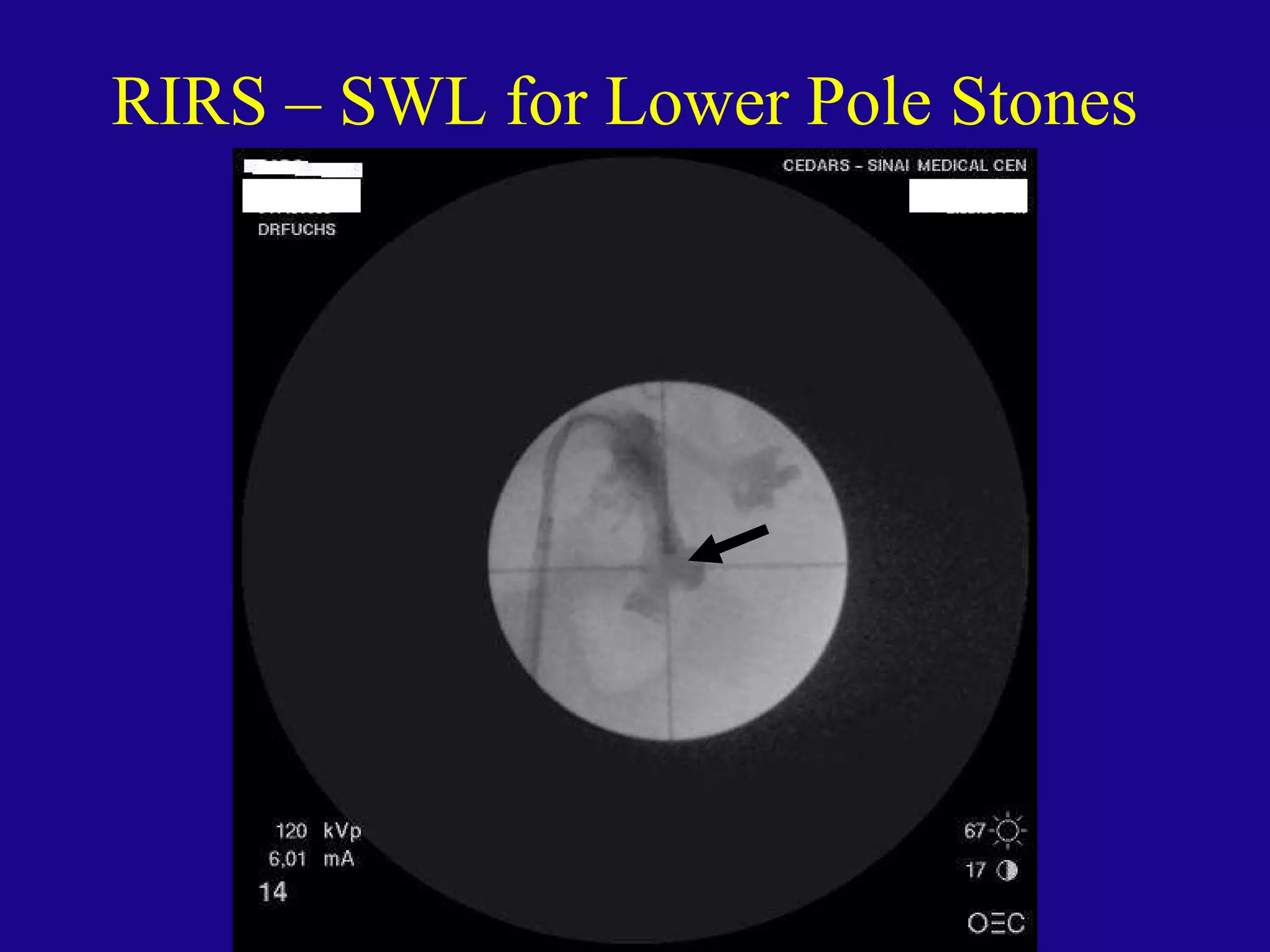
RIRS – SWL for Lower Pole Stones
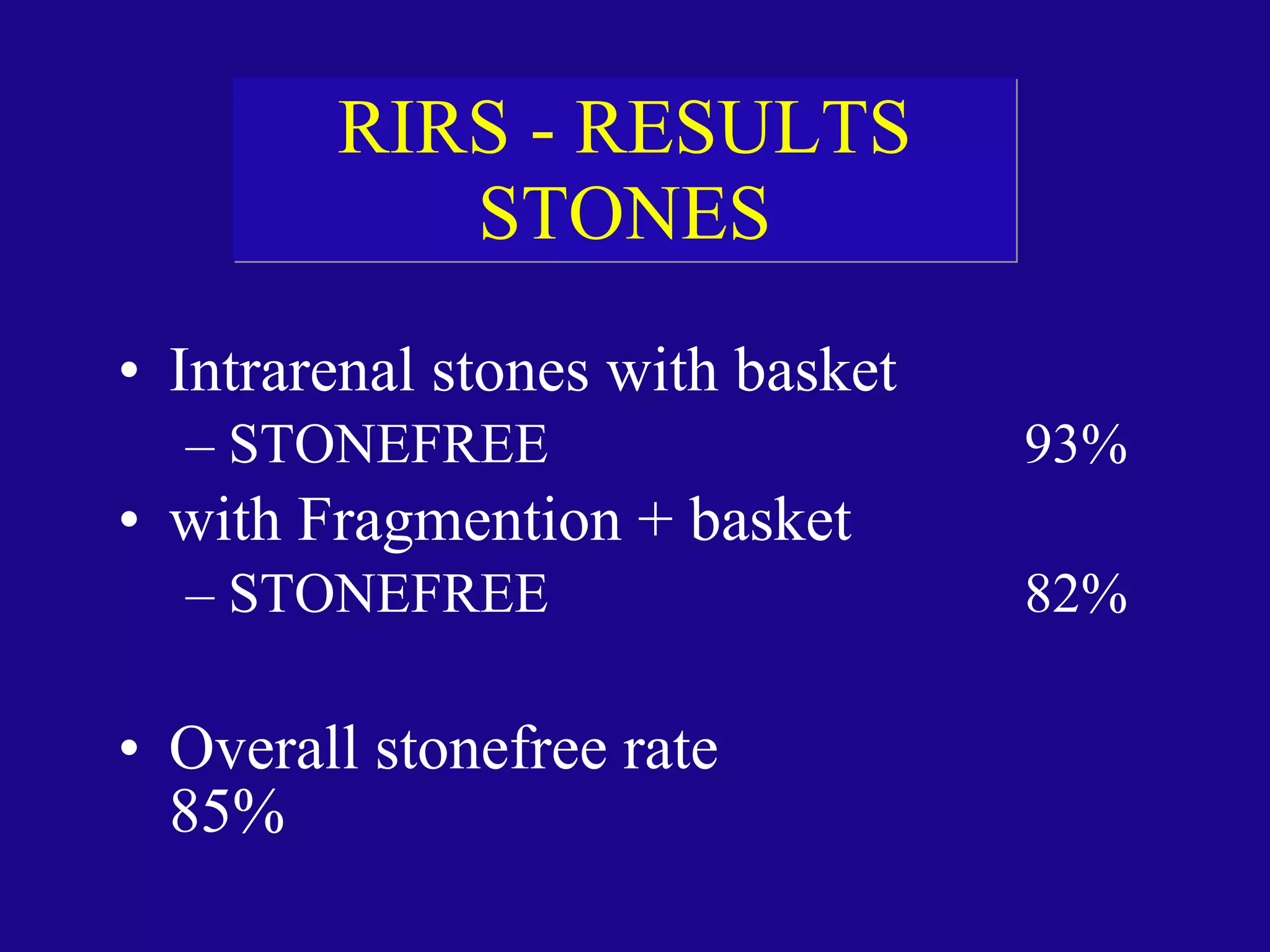
RIRS - RESULTS STONES Intrarenal stones with basket  STONEFREE    93% with Fragmention + basket  STONEFREE   82% Overall stonefree rate 85%
Complications Sepsis   2/464  outcome: resolved without sequelae Caliceal perforation with minimal extravasation 2/464  outcome: resolved without sequelae Now over 3000 cases performed w/o significant infectious complications  Prevention: neg. C&S, ABx cover, low pressure system, diuretic
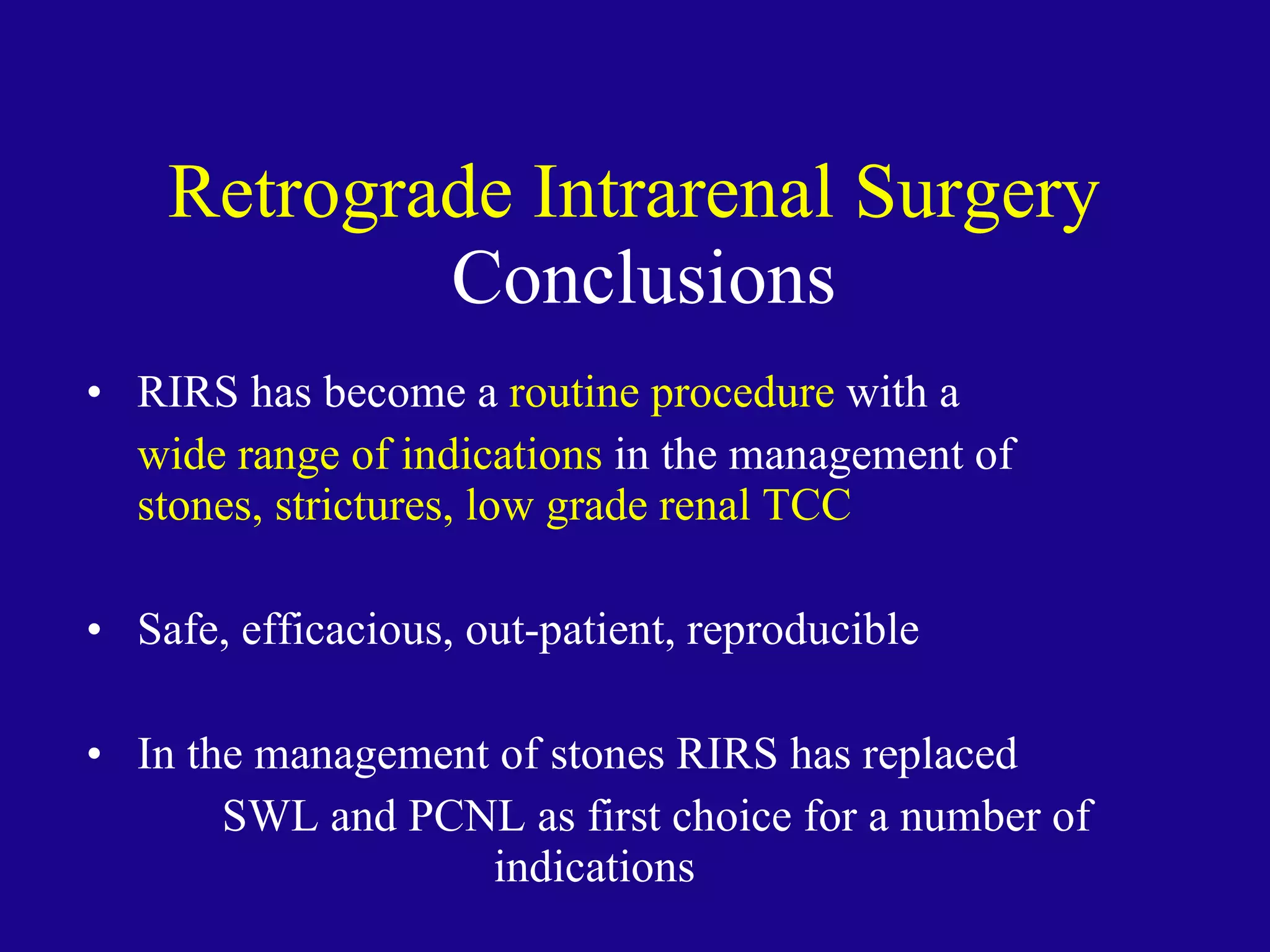
Retrograde Intrarenal Surgery  Conclusions RIRS has become a  routine procedure  with a  wide range of indications  in the management of  stones, strictures, low grade renal TCC Safe, efficacious, out-patient, reproducible In the management of stones RIRS has replaced  SWL and PCNL as first choice for a number of  indications
 
RIRS Exemplary Cases SWL has failed: what to do next ? Stone patient with bleeding problem Pediatric patient with cystine stone Stone and intrarenal stricture Upper tract TCC: organ preservation
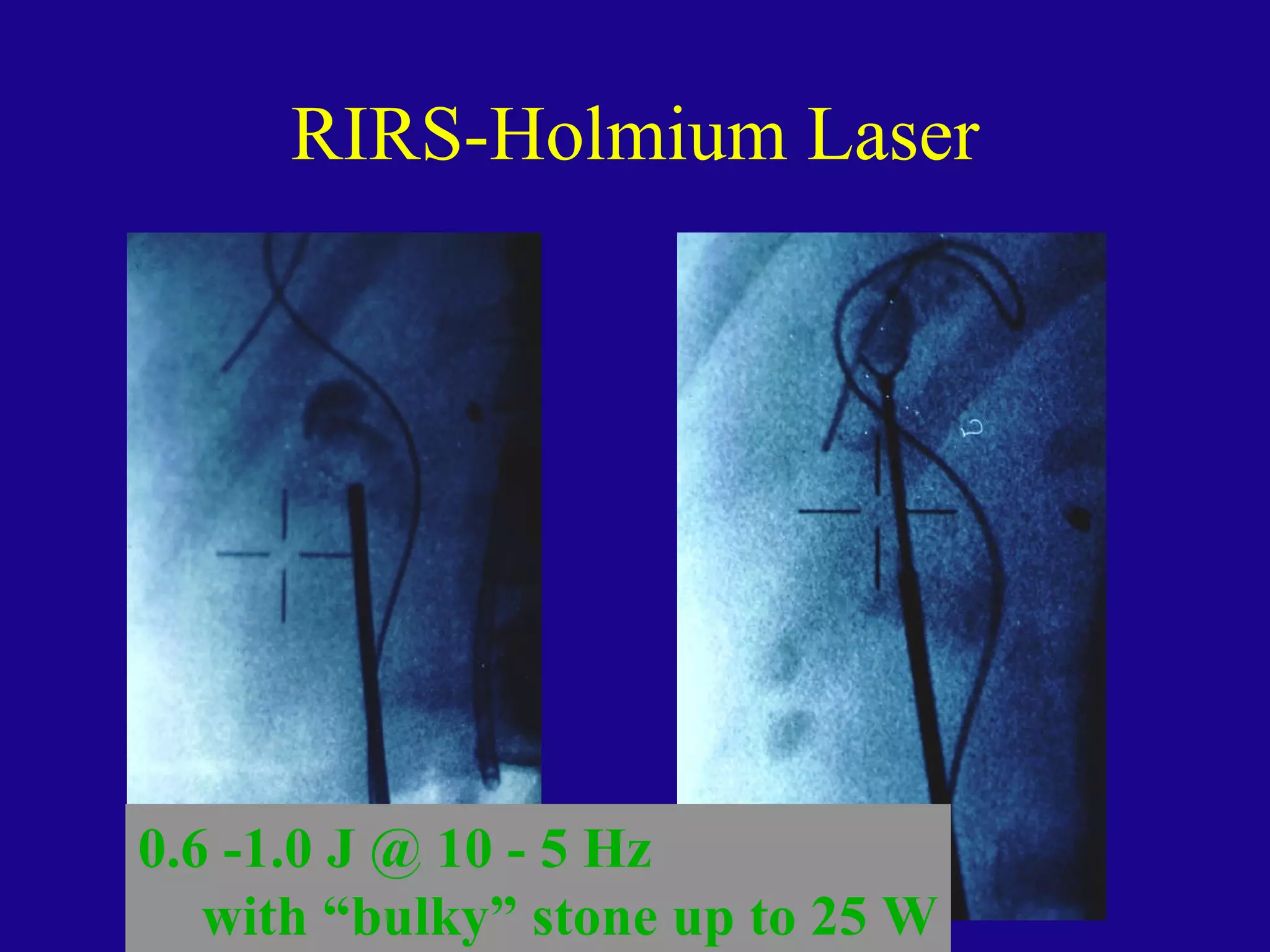
RIRS-Holmium Laser Pt. with coagulopathy (OLT failure) A case for direct contact Holmium Litho (10-20 W)
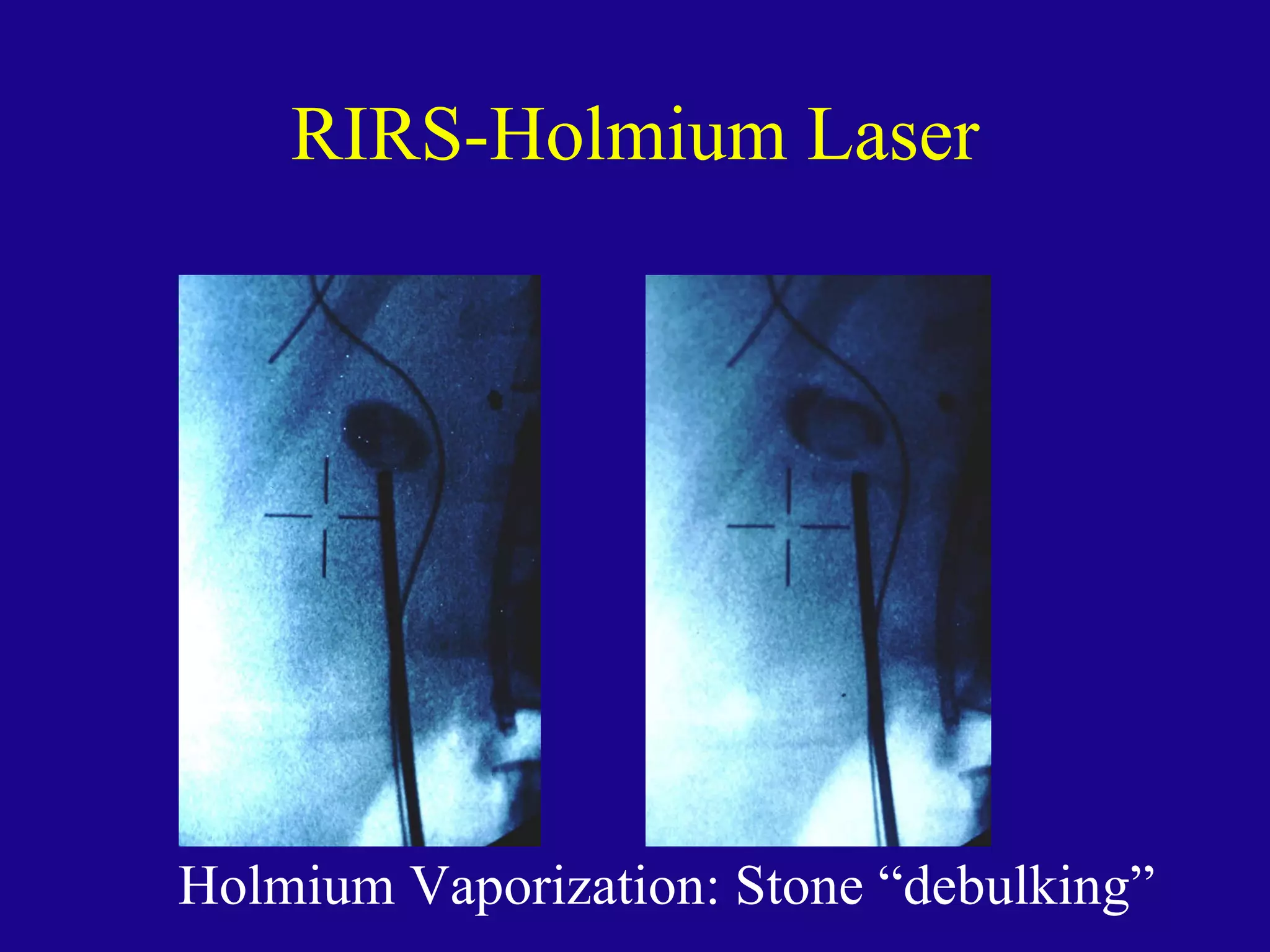
RIRS-Holmium Laser Holmium Vaporization: Stone “debulking”
RIRS-Holmium Laser 0.6 -1.0 J @ 10 - 5 Hz with “bulky” stone up to 25 W
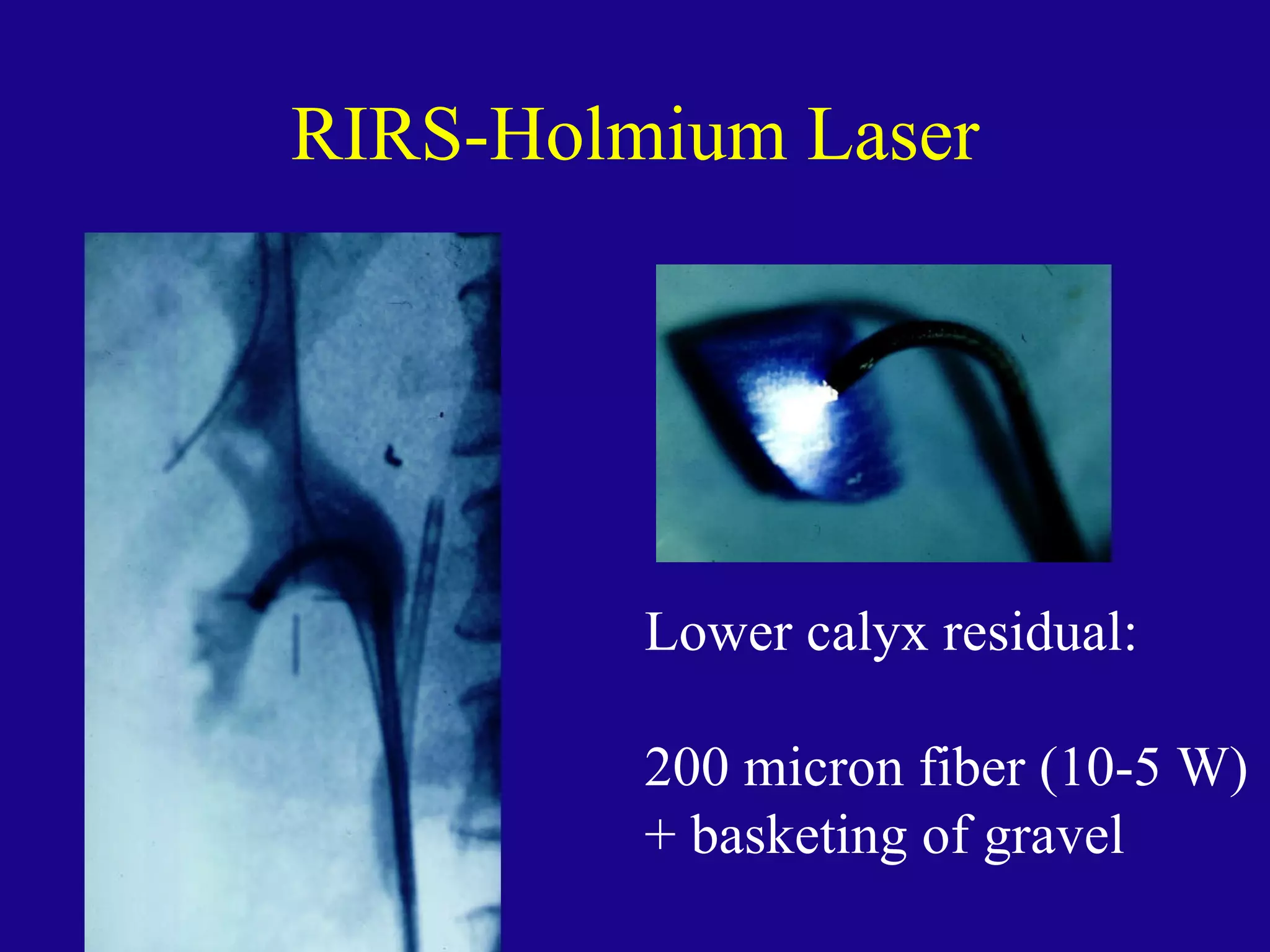
RIRS-Holmium Laser Lower calyx residual: 200 micron fiber (10-5 W) + basketing of gravel
RIRS Exemplary Cases SWL has failed: what to do next ? Stone patient with bleeding problem Pediatric patient with cystine stone Stone and intrarenal stricture Upper tract TCC: organ preservation
 
RIRS Exemplary Cases SWL has failed: what to do next ? Stone patient with bleeding problem Pediatric patient with cystine stone Stone and intrarenal stricture 5. Upper tract TCC: organ preservation
RIRS for “the hidden LC stone” 46 yr old male with left lower caliceal stone s/p E-SWL x 3; no stone passage presently asymptomatic airline pilot (grounded for 5 months)
Retained Stones after ESWL (Arthur Smith’ theory)
RIRS for “the hidden stone”
Multimodality Treatment for Complex Renal Stones “Disappearance” of the easy stone Complex stones or previously failed attempt Endoscopically based multimodal approach for optimal results (E-SWL / RIRS / PCNL / Laparoscopy, medical)
An endourological Challenge 53  y/o  morbidly  obese  male  with  h/o  recurrent  uric  acid  stones S/p  multiple  ESWL, URS, RIRS PMH Morbid  obesity:  BMI  57 Obstructive  sleep  apnea HTN Asthma Diabetes Hypercholesterolemia
Case  Presentation Incidentally  found  to  have  bilateral  renal  stones  on  US  while  being  evaluated  for  bariatric  surgery Renal  scan:  40%  left,  69%  right,  no  obstruction
Case  Presentation CT
Case  Presentation KUB
PATIENT PREPARATION   Patient Selection Sterile urine  IV hydration IV peri-operative antibiotics  (e.g. Ampicillin + Gentamycin) KUB, general /regional (IV  sedation)
RIRS:  Access to the Upper Urinary Tract   Dilation of ureteral orifice or higher ureteral segments rarely necessary  when  “optical dilation”  with 9.5 Fr. rigid ureteroscope used
 
RIRS: Points of Technique Low-pressure system Suction / irrigation Suction Irrigation (gravity 60 cm) RIRS: Points of Technique
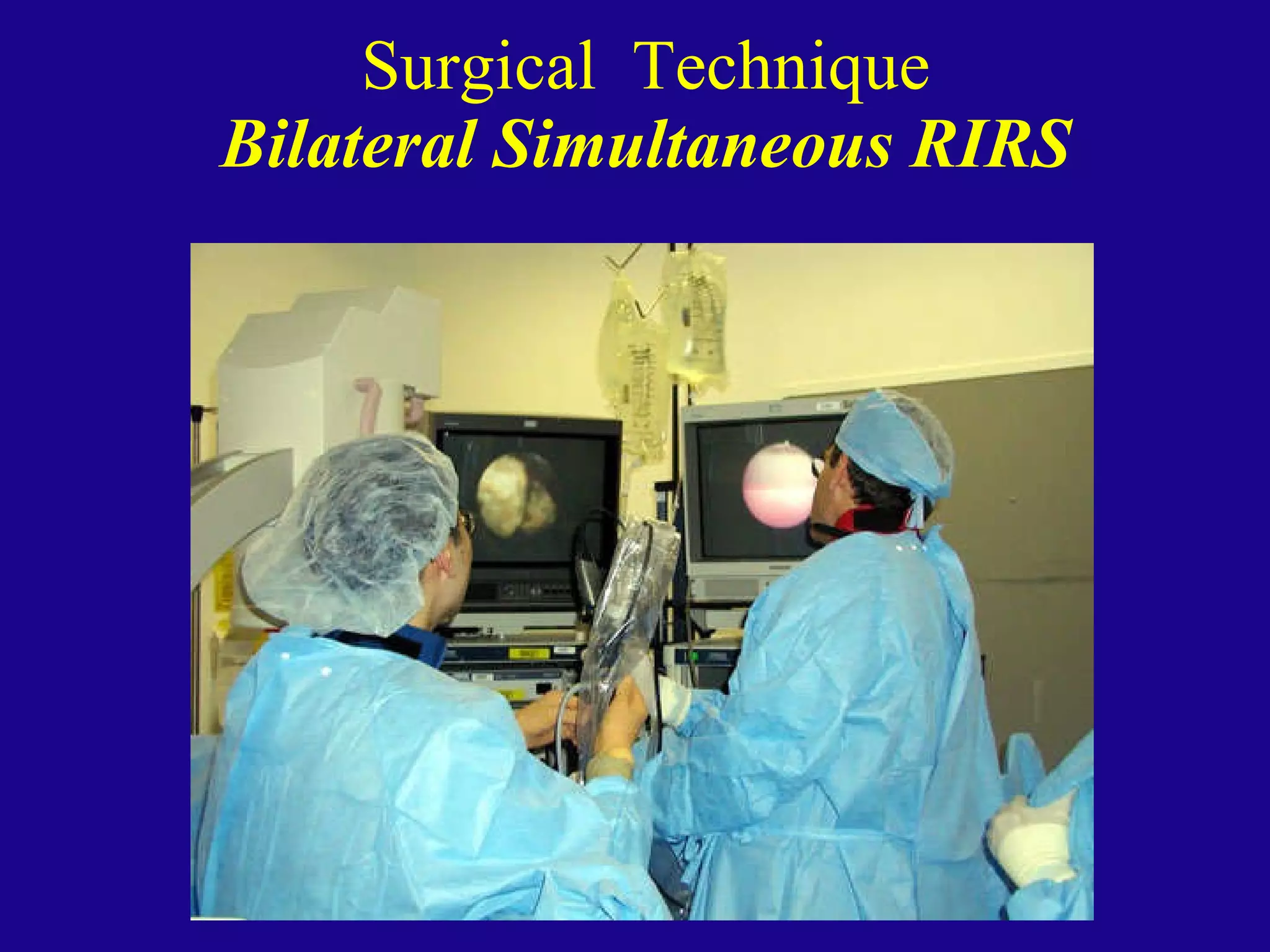
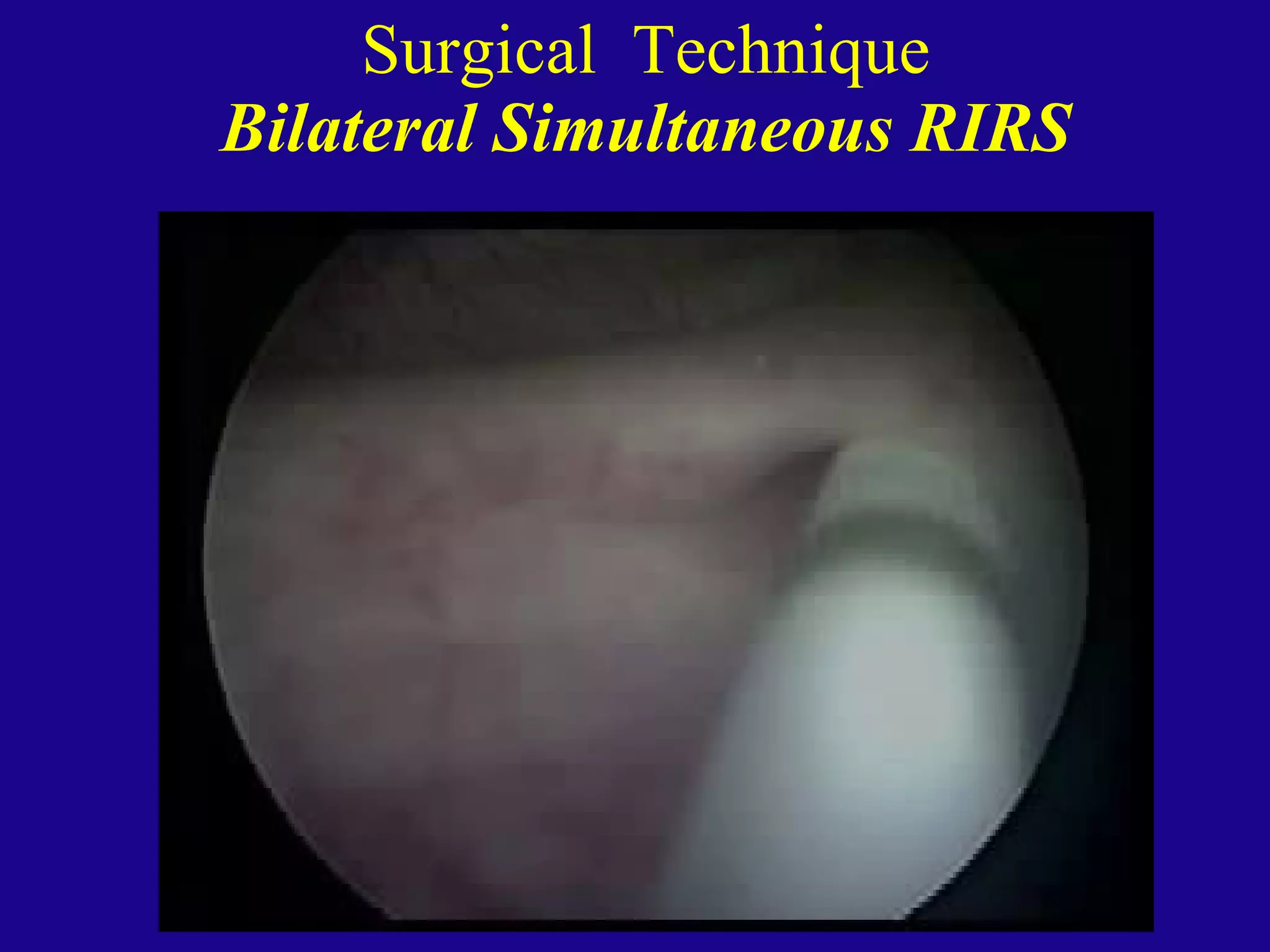
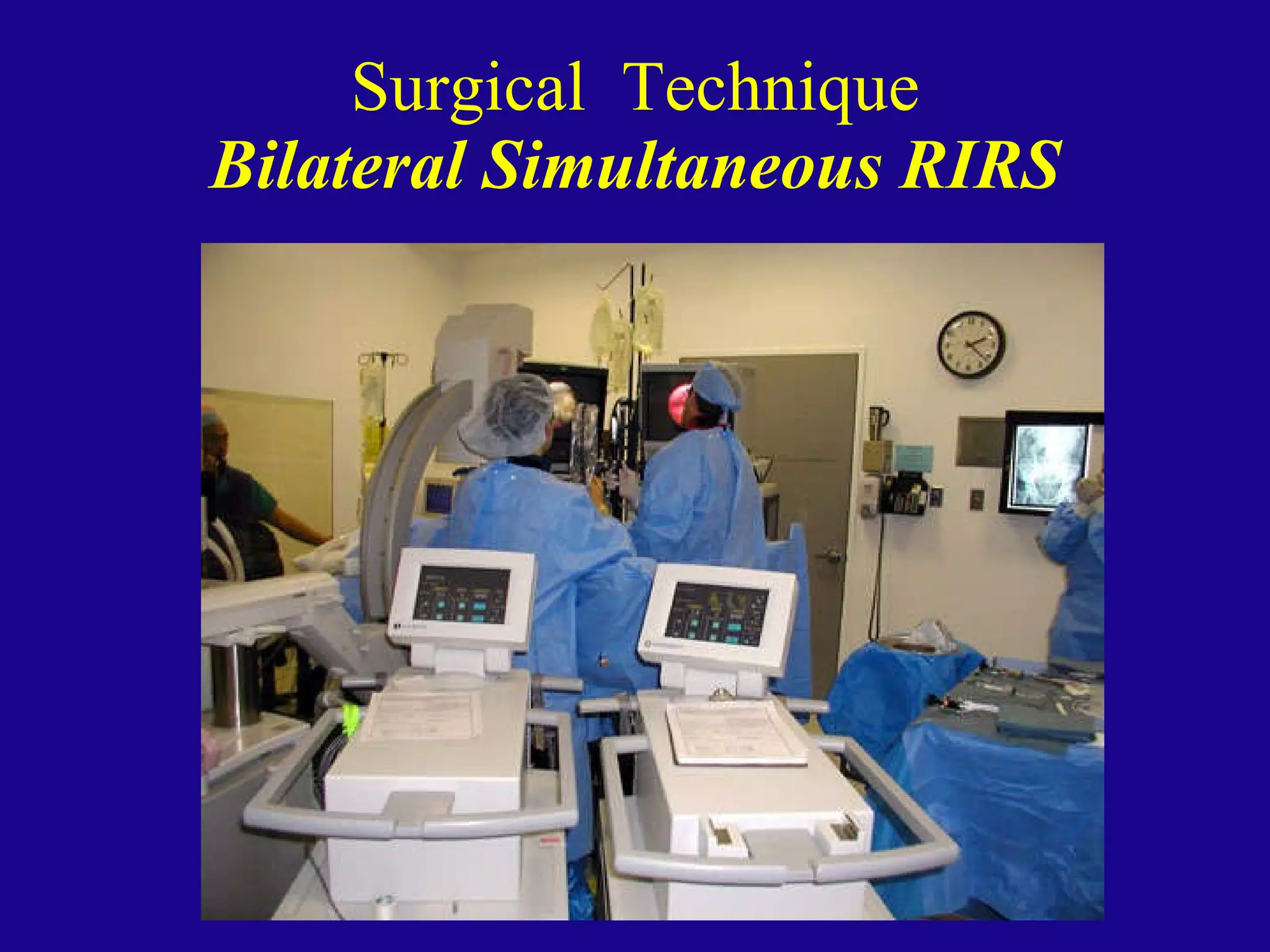
Surgical  Technique Bilateral Simultaneous RIRS
Simultaneous Bilateral RIRS N = 15 Indications : Medical co-morbidities (10; cardiac, pulmonary, anticoagulation) size avg. 2.1 cm Patient request (5) size avg. 1.4 cm
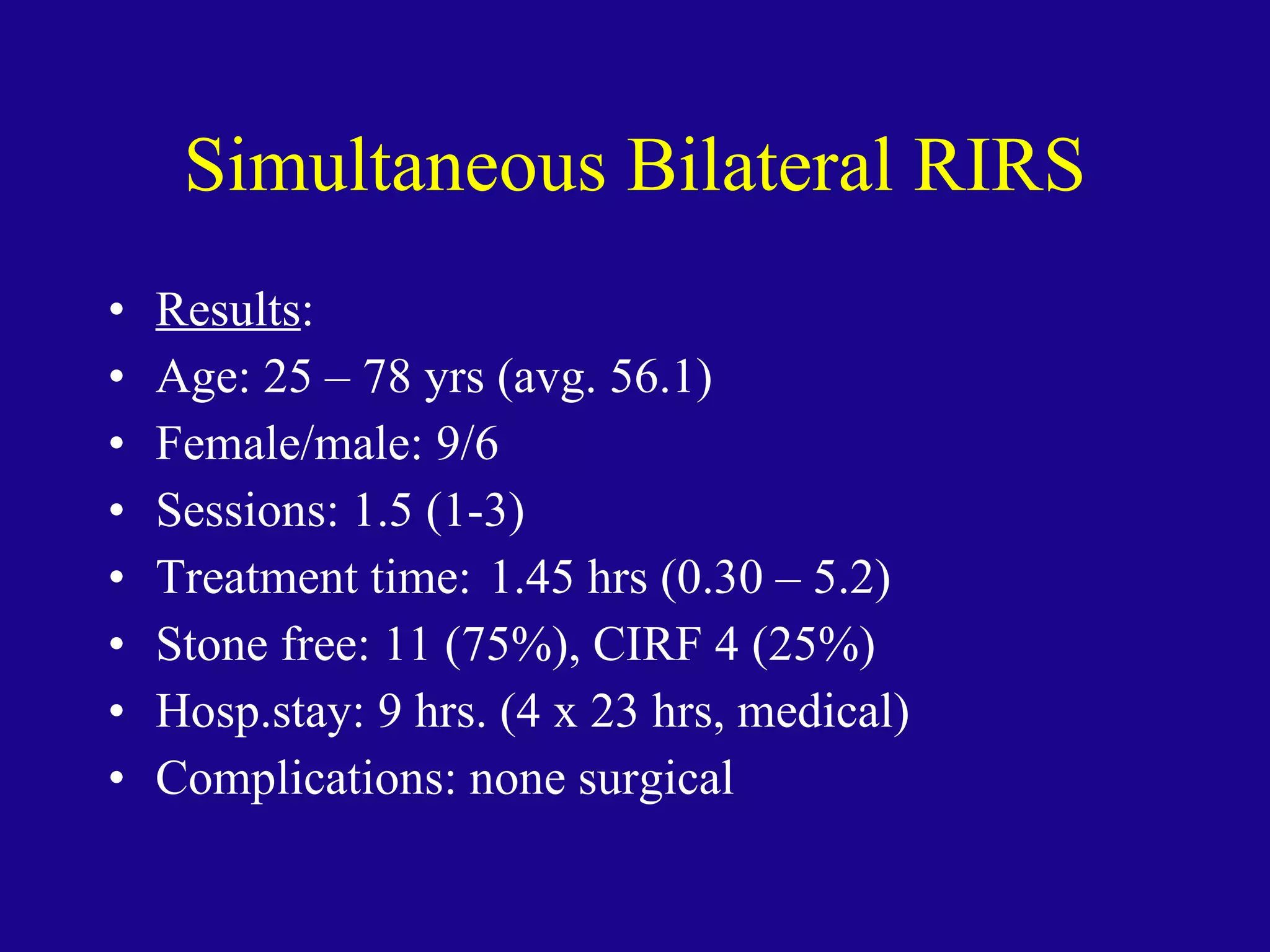
Simultaneous Bilateral RIRS Results : Age: 25 – 78 yrs (avg. 56.1) Female/male: 9/6 Sessions: 1.5 (1-3) Treatment time: 1.45 hrs (0.30 – 5.2) Stone free: 11 (75%), CIRF 4 (25%) Hosp.stay: 9 hrs. (4 x 23 hrs, medical) Complications: none surgical
 
Stones in Caliceal Diverticuli Facts ESWL stone free rates  20 - 56 % ESWL symptom free rates up to  80 % PCNL stone free rates greater than 90 % PCNL technically more demanding PCNL higher complication rates PCNL allows fulguration of redundant mucosa
RIRS - The Future Preliminary work: RIRS under topical anesthesia (7.5 Fr., f/u of UUT TCC, small stones, strictures)
RIRS -  Outlook New Horizons : RIRS under topical anesthesia (7.5 Fr., f/u of UUT TCC, small stones, strictures) Selected pts. (female) with small stone burden  (RIRS - Holmium vaporization vs. SWL) In the future : less use of SWL; PCNL for very large stone burden and complex anatomical problems
 
Case  Presentation 64  y/o  male  h/o  horseshoe  kidney Long  h/o  recurrent  stone  disease ESWL  (’85,  ’92) Residual  stone  fragments PMH:  TCCA  of  bladder,  depression Labs:  Creatinine  1.0 C/o  persistent  left  flank  pain Evaluated  with  CT  and  KUB  by  local  urologist
Case  Presentation CT
Case  Presentation KUB
Case  Presentation Treatment  options? ESWL? PCNL? Retrograde  intrarenal  surgery? Conservative  management?
 
Case  Presentation CT
Case  Presentation KUB
Case  Presentation Retrograde  intrarenal  surgery 2  cm  stone  noted  in  the  renal  pelvis Optical  dilation  with  the  9.5  Fr  rigid  ureteroscope 7.5  Fr  flexible  ureteroscope,  holmium  laser  used  for  stone  fragmentation
Case  Presentation Retrograde  Pyelogram
Case  Presentation 38  y/o  female  c/o  urgency,  frequency,  low  grade  fevers  for  1-2  weeks  PMH:  Unremarkable PSH:  Breast  augmentation MEDS:  Birth  control  pills
Case  Presentation Treated  with  multiple  courses  of  antibiotics  without  clinical  improvement Renal  US:  Severe  right  hydronephrosis,  large  right  renal  pelvic  stone
Case  Presentation CT  Urogram
Case  Presentation CT  Urogram  -  Delayed  Images
Case  Presentation CT  Urogram
Case  Presentation Attempted  right  JJ  stent  placement  unsuccessful  at  outside  hospital Underwent  emergent  right  nephrostomy  tube  placement
Case  Presentation Nephrostogram
Case  Presentation Treatment  options: ESWL? PCNL? Retrograde  intrarenal  surgery? Open  pyelolithotomy? Laparoscopic  pyelolithotomy?
Case  Presentation Nephrostogram
Case  Presentation Operative  findings Impacted  2  cm  right  UPJ  stone Right  retrograde  intrarenal  surgery  Holmium  laser  lithotripsy (7.26  kJ) Stone  basketing JJ  stent  placed  Retrograde  Intrarenal  Surgery  (RIRS)
Case  Presentation Video
Case  Presentation Follow-up  7  days  later  Residual,  fragmented  stone  debris  in  the  lower  pole  calyx NT  taken  out  in  clinic Next  step?
Case  Presentation Follow-up  14  days  later  Decreased  residual  stone  debris  in  the  lower  pole  calyx Next  step?
Case  Presentation Second  stage  RIRS  Well  fragmented  stone  debris  in  the  lower  pole  calyx  and  ureter Basketing  of  residual  stone  debris Stone  free  based  on  intra-operative  fluoro/ endoscopy SF 2 yrs. follow-up  Retrograde  Intrarenal  Surgery  (RIRS)
RIRS for Caliceal Diverticuli Material and Methods SELECTION CRITERIA:  96 patients with proven stones in caliceal diverticuli on IVP or retrograde pyelogram (RPG) AGE RANGE  21 - 75 yrs.  (Ave. 47 yrs) SEX: Male  39  Female  53 STONE LOCATION: Upper Calyx  53 pts. Mid Calyx  33 pts.  Lower Calyx  8 pts. Two patients mid and lower caliceal stones.
Stones in the Caliceal Diverticulum Objectives of my talk : Present 15 + yrs experience with retrograde intrarenal surgery (RIRS):  technique, outcomes, limitations  Present practical treatment algorithm for total MIS management of stones and intrarenal strictures  RIRS, PCN, Laparoscopy
Sterile urine  Flexible cystoscopy and RPG to assess intrarenal architecture and confirm presence of diverticulum Placement of double J stent to allow for gradual passive dilation of upper tract (1-2 weeks prior to RIRS) Re-culture urine 1 week prior to treatment Start antibiotics p.o. 2 - 4 days before Rx. (if indicated) RIRS – the initial experience
RIRS Patient Preparation  Placement of double J stent to allow for gradual passive dilation of upper tract (1-2  weeks prior to RIRS) 1 stage proc edure :  9.5 Fr. “optical dilation” + 7.5 Fr. RIRS
RIRS for Intrarenal Strictures Technique Dilute contrast is  injected through the scope to delineate the connection to the stone bearing calyx.  Methylene blue also helpful (when tic takes on contrast) Intraluminal ultrasound (optional)
RIRS for Intrarenal Strictures Technique A small dimple can usually be seen endoscopically.  This indicates the entry point to the narrow caliceal neck.
RIRS for Intrarenal Strictures Technique An 0.038 guidewire (or glide-wire) is  inserted and maneuvered through the narrow segment under endoscopic and fluoroscopic guidance.
RIRS for Intrarenal Strictures Technique A balloon dilator is advanced over the guidewire (1987 – 92). Alternatively, the calyceal neck is incised with the Bugbee electrode (92-94)  or Holmium laser ( s 94)
RIRS for Intrarenal Strictures Technique Once the calyceal neck is opened, the diverticulum is inspected with the flexible ureterorenoscope.
RIRS for Caliceal Diverticulum
RIRS for Intrarenal Strictures Current Options for Stone Removal Direct removal  of the stone (small stone, calyx spacious enough to allow for basket or three-prong grasper manipulation)  Fragmentation  of a stone slightly too large for direct removal (Holmium, EHL)  RIRS assisted ESWL  with active removal of stone debris during SWL procedure.
Caliceal Diverticulum RIRS assisted SWL 1. Complete vaporization and fragmentation 2. Active removal of gravel No / Minimal residual Minimally invasive
RIRS for Intrarenal Strictures After Care Placement of indwelling stent Discharge home same day with Abx (5 days) The double J stent is preferentially  placed into the stone bearing calyx if space permits  The double J stent is left indwelling (proximal curl in diverticulum) for 2 weeks.
RIRS for Caliceal Diverticuli RESULTS Access to kidney:  100% without dilation (preparatory stent only)  90% advancement of 9.5 Fr. URS  as endoscopic dilator  10% Identification of infundibulum:  95% Successful dilation/incision:  95%  Balloon  80% Incision (Holmium Laser, electrode)  15% Combination  5%
RIRS for Caliceal Diverticuli RESULTS Dilation/Incision: unsuccessful  in 4/8 cases of lower pole diverticuli (PCNL done, same session) not enough fulcrum to negotiate balloon  in 3 cases (lower pole) electrocautery incision was used to open the caliceal neck
RIRS for Caliceal Diverticuli Stone retrieval: Endoscopic grasping/basket:   75% Stonefree  90%(tic 100%) RIRS assisted ESWL:    20% Stonefree 75%(tic 100 %)   Primary PCNL:   5 % Stonefree 100%   Secondary RIRS (after ESWL): 2.5% Secondary PCNL 2.5%
RIRS for Intrarenal Strictures  Conclusions In light of the limited success of ESWL monotherapy, and the higher complication rate of PCNL treatment of stones in caliceal diverticuli, our approach of endoscopic intrarenal correction of the outflow alteration, with or without ESWL, has proven to be the better alternative.
RIRS for Intrarenal Strictures  Conclusions Only 8% of patients had recurrence over a 10 year observation period. 10 + years of follow-up confirms that this treatment approach compared favorably to percutaneous renal surgery with regard to stone-free rates, long-term resolution of symptoms, re-stenosis of the caliceal neck and stone recurrence rates.
RIRS for Intrarenal Strictures  Conclusions Retrograde endoscopic repair + stone removal yields a 90 % stonefree rate compared to 75% for endoscopic repair +ESWL (tic 100 % free of stone). This approach is preferable for stones in the mid and upper calyces PCNL is used for lower pole calyceal diverticuli and RIRS failures
Caliceal Diverticulum The Percutaneous Approach Direct PCN access Indirect PCN access
PCN – fulguration of  Lower Pole Diverticulum
PCN -fulguration PCN perirenal if no access to RCS PCN in RCS + perirenal PCN or  doubleJ, if access to RCS
 
Caliceal Diverticulum Role of Laparoscopy Anterior location Large stone burden
Caliceal Diverticulum RIRS is the choice for the majority of caliceal diverticula (upper pole, mid renal, anterior/posterior w/o large dependant portion,) PCNL is the choice for large posterior diverticula in the lower pole or RIRS failures (posterior location) Laparoscopy is the choice for large anterior diverticula with large stone burden or when partial nephrectomy is needed
 
Peripelvic Cyst, Hydronephrosis, and Caliceal Stone 58 yr old male Left flank pain
Removal of Peripelvic Cyst and Pyelolithotomy
RIRS :  The next Step Combination with  Simultaneous SWL (RIRS-SWL)
RIRS assisted SWL  Procedure RIRS=Retrograde Intrarenal Surgery Employed under the same anesthesia preceeding or simultaneously with SWL SWL with Dornier MFL-5000,  STORZ Modulith, Direx
RIRS assisted SWL  Equipment Multipurpose Lithotriptor (MFL 5000, Storz Modulith, Direx) Simultaneous use of SWL and RIRS Flexible Ureterorenoscopes 10.4, 8.5, and 7.5 Fr.; KSE Holmium Laser (Coherent, Sharplan) EHL Calcutript (KSE) Accessories: Balloon, Basket, Grasper (Microvasive, Cook, Bard)
RIRS assisted SWL INDICATIONS Failed SWL, secondary to: Size Stone Composition Anatomic Variances Stones and intrarenal stenosis amenable to RIRS repair (in upper pole  /  mid renal) Infundibular Stenosis Diverticulum
Advances in Endourology: RIRS assisted SWL 1. Complete vaporization and fragmentation 2. Active removal of gravel No / Minimal residual Minimally invasive
RIRS-Holmium Laser Indication:  lower calyx (s/p failed SWL) Technique: “ optical dilation” (9.5 + 7.5 Fr. 200 micron fiber “ relocation techniques” Combination RIRS-SWL
RIRS- Holmium lithotripsy Shockwave   Lithotripsy Simultaneous
RIRS assisted SWL INDICATIONS RIRS assisted ESWL  (stones up to 2.5 cm., routine) Larger stones --- usually PCNL Staghorn stones (RIRS-SWL)  using RIRS Holmium “debulking” (up to 25 Watts)
RIRS assisted SWL  Staghorn Stone RIRS – Holmium debulking  of renal pelvis upper pole Simultaneous SWL  of  lower calyceal group mid calyceal group 1000 800 400
Retrograde Intrarenal Surgery  Equipment Stone removal: Tipless Nitinol basket, stone grasper
Pt with ileum conduit  s/p E-SWL for 2.5 cm pelvic stone + ureteral stent PN, right  now drained with PCN What to do next?
Stones in the  Reconstructed Urinary Tract Technical Difficulties Stone visibility often poor: Infection stones common: less visible on plain films Stone overlying bony structures (ureter, conduit, pouch) Air “contamination” of plain films Renal insufficiency: IVP of limited value Non-contrast spiral CT, retrograde pyelogram Retrograde Access technically challenging Continent diversion: risk of incontinence Upper tract: difficult identification of anastomosis and lack of fulcrum
Stones in the  Reconstructed Urinary Tract Conduit: ileum: mostly upper tract stones +/- strictures colon: rarely used Continent Diversion: Pouch stone: frequent (staples, mucous) Upper tract stone ‘ Anatomy’ of ureteral anastomosis Orthotopic anastomosis Nipple anastomosis
Stones in the  Reconstructed Urinary Tract Ileal Ureterostomy: The “straightforward” case Easy retrograde access with rigid and flexible instrumentation All energy sources
Stones in the  Reconstructed Urinary Tract Single kidney & Ileal conduit: An easy case Lateral view fluoro  identifies anastomosis
Stones in the  Reconstructed Urinary Tract Ileal conduit RIRS for upper and lower pole stones Placement of safety wire EHL (Laser) fragment- ation (vaporization) Stone removal (basekting)
Stones in the  Reconstructed Urinary Tract Bladder augmentation with septic complication Large filling defect in bladder Large filling defect in obstructed left solitary kidney PCN drainage placed Large fungus ball removed from bladder (perc. suprapubic)
Stones in the  Reconstructed Urinary Tract PCN access and PCN renal surgery performed Removal of large amount of matrix material with rigid/flex instrumentation
Stones in the  Reconstructed Urinary Tract Kock pouch with large stone in aff.limb URS stone removal Laparoscope for Marlex
Stones in the  Reconstructed Urinary Tract Girl with bladder extrophy Large pouch stones, Kidney stones, Blt.
Stones in the  Reconstructed Urinary Tract Anatomy precluded safe PCN access (lung/liver/spleen) RIRS performed blt with removal of all stones
RIRS - RESULTS STONES Intrarenal stones with EHL + basket/grasper  STONEFREE 80% with basket /grasper STONEFREE  93% Stones and urinary diversion  STONEFREE 84%* *30/68 had larger stones and received ESWL and / or percutaneous stone removal for final stonefree rate of 84% Overall stonefree rate 85%
Complications Sepsis   2/464  outcome: resolved without sequelae Caliceal perforation with minimal extravasation 2/464  outcome: resolved without sequelae Contrast extravasation after balloon dilation 34/56* in mid/upper ureter * one-stage procedures with balloon dilation; discontinued after 56 cases Now performed for evaluation of active upper tract hematuria with 7.5 F ureterorenoscope or for small stone burden with 7.5 Fr.  or by using 9.5 Fr. rigid scope first “optical” dilation
RIRS - RESULTS OTHER INDICATIONS MALE  FEMALE TOTAL   Intrarenal biopsy  (normal upper tract)    44 16 60 Intrarenal biopsy  (urinary diversion)  41 13 54 Retrograde incision of UPJ stenosis    2  6   8 (flexible instrument) Retrograde incision of UPJ stenosis   0  22 22  (rigid instrument)  TOTAL 87 57 144
RIRS - RESULTS:  OTHER  INDICATIONS EVALUATION OF HEMATURIA/  POSITIVE CYTOLOGY 1. Visualization of the entire renal collecting system was possible in >98% of patients. 2. The source of active renal bleeding was identified in 80%    3. In the presence of incidental high grade positive cytologies (TCC) appreciable lesions were found in only 10 %.
RIRS - RESULTS:  OTHER  INDICATIONS EVALUATION OF HEMATURIA/ POSITIVE CYTOLOGY 4. All cases of papillary tumors biopsied were diagnostic. 5. Biopsies were negative in >90% of cases where  no papillary tumors were found (Biopsy of suspicious areas)  6. Random renal biopsies in patients with incidental positive cytology were negative in all cases
Advanced Endourology RIRS assisted SWL 1. Complete vaporization and fragmentation 2. Active removal of gravel No / Minimal residual Minimally invasive
RIRS assisted SWL  Rationale RIRS allows real-time endoscopic monitoring of SWL fragmentation and determination of endpoint of treatment also allows accelerated fragmentation: Holmium  /  EHL co-fragmentation to remove fragments during SWL localization of poorly opacified stones to correct anatomical problems of stone egress
RIRS assisted SWL  Procedure RIRS=Retrograde Intrarenal Ureteroscopic Surgery Employed under the same anesthesia preceeding or simultaneously with SWL ESWL with Dornier MFL-5000
RIRS assisted SWL INDICATIONS Failed SWL, secondary to: Size Stone Composition Anatomic Variances Stones and intrarenal stenosis amenable to RIRS repair (in upper pole  /  mid renal) Infundibular Stenosis Diverticulum
RIRS assisted SWL INDICATIONS RIRS assisted ESWL  (stones up to 2.5 cm., routine) Larger stones --- PCNL Staghorn stones (RIRS-SWL)  using RIRS Holmium “debulking” (up to 25 Watts)
RIRS assisted SWL  Staghorn Stone RIRS – Holmium debulking  of renal pelvis upper pole Simultaneous SWL  of  lower calyceal group mid calyceal group 1000 800 400 RIRS
RIRS assisted SWL  Equipment Multipurpose Lithotriptor (MFL 5000, Storz Modulith, Direx) Simultaneous use of SWL and RIRS Flexible Ureterorenoscopes 10.4, 8.5, and 7.5 Fr.; KSE, ACMI Holmium Laser (Coherent, Sharplan)  EHL Calcutript (KSE) Accessories: Balloon, Basket, Grasper (Microvasive, Cook, Bard)
RIRS assisted SWL RESULTS Determines precise endpoint of fragmentation and eliminates empirical “extra shocks for the road”  Allows for co-fragmentation and active removal Allows for repair of anatomical variants
RIRS assisted SWL (MFL 5000) RESULTS (1995-1996) TOTALS (All Indications) 45 patients Ave stone 21.4 mm Co-fragmentation:  •  Holmium 53%  • EHL  46% Basket 95% Ave treatment time 115min Stone free rate 84.4%
RIRS and Upper Tract TCC The role of  Organ Preserving Treatment
Upper Tract TCC Treatment Alternatives Single Kidney: Organ preserving treatment N’ux = Anephric ------ Dialysis, Txp Two Kidneys: Nephroureterectomy (laparoscopic/open) Organ preserving treatment for select pts.
Issues in Upper Tract TCC: Diagnostic Accuracy
Upper Tract TCC “Staging” and Treatment Planning How to “stage” Papillary :  Basket-bx of exophyt ablate base with Holmium (10W=1J@10Hz) Solid:   multiple grasper -bx ablate only if “palliative” candidate
Upper Tract TCC Diagnostic Accuracy
Upper Tract TCC Technique of RIRS Identify : Selective visualization of entire RCS Remove : Nd/YAG:Ho Laser, Ho Laser, RF-ESU Reduce Rec :Low pressure RIRS, diuretic, careful “resection”   MMC instillation Recognize :  Endoscopic re-evaluation of entire RCS at 6 wks. then 3, 6, 12 mos. (office, topical anesthesia)
 
Renal Pelvis TCC
TCC Renal Pelvis Nd:YAG for the base
Ureteroscopy for UUT-TCC Ureteral TCC
How to Follow UUT TCC “Asymptomatic” Endoscopic surveillance  critical  for long-term management Possible under topical anesthesia (office) Tx of small recurrence also possible under topical anesthesia
Retrograde Intrarenal Surgery  Conclusions RIRS has become a  routine procedure  with a  widening range of indications Safe, efficacious, out-patient, reproducible In the management of stones RIRS has replaced  SWL and PCNL as first choice for a number of  indications
RIRS - The Future Preliminary work: RIRS under topical anesthesia (7.5 Fr., f/u of UUT TCC, small stones, strictures)
RIRS -  Outlook Preliminary work: RIRS under topical anesthesia (7.5 Fr., f/u of UUT TCC, small stones, strictures) Selected pts. (female) with small stone burden  (RIRS - Holmium vaporization vs. SWL) In the future : less use of SWL; PCNL for very large stone burden and complex anatomical problems
RIRS in the Out-Patient Clinic  under  Local Anesthesia Gerhard J. Fuchs, MD., FACS Cedars-Sinai Medical Center Los Angeles
Retrograde Intrarenal Surgery (RIRS)  RIRS- Routine Procedure: Renal Stones (with or w/o simultaneous SWL) UPJ repair, intrarenal stenosis (tic) repair Organ preserving upper tract TCC
RIRS under Local Anesthesia Background: 17 yrs. experience with RIRS (> 1.500 pts) 12 yrs. experience with upper tract flexible endoscopy as diagnostic procedure under local anesthesia (> 200 proc.)
RIRS under Local Anesthesia UUT Flex. Endo Experience: 12 yrs. UUT eval under local anesth. for F/U of TCC > 200 procedures, mostly (> 95 %) well tolerated Un-stented Out-patient, (urol. clinic/office)
RIRS under Local Anesthesia Results (diagnostic eval N=150) Outcomes/morbidity: targets successfully evaluated under local Minimal discomfort Minimal pain meds (intraop or post) No f/U complications (no stents, no hospitalization)
RIRS under Local Anesthesia Objective: Evaluate outcomes and patient acceptance Small renal stones UPJ, intrarenal strictures (w/o stone) Small TCC recurrence (at time of F/U)
RIRS under Local Anesthesia Set-up Out-patient clinic (office) Sterile urine, po Cipro 500, (Pyridium 100 po) Lithotomy position (supine, male) Topical anesthesia (2% Xylocain jelly) No fluoro needed
How to Follow UUT TCC “Asymptomatic” Endoscopic surveillance  critical  for long-term management Done under topical anesthesia (office) Tx of small recurrence also possible under topical anesthesia
RIRS under Local Anesthesia Instruments 15 Fr. flexible cystoscope  (Storz, ACMI, Olympus) 5 Fr. angiocath 0.038 Bentson guide-wire 7.5 Fr. flex. ureterorenoscope  (Storz, ACMI) Nitinol (tipless) basket  (Cook) Holmium Laser  (Nd:YAG-Ho Coherent, Ho Trimedyne)
RIRS under Local Anesthesia Procedure 1. flexible cysto  2. 7.5 Fr. flex. scope access to UUT w or w/o guide-wire 3. identify pathology and treat
RIRS: Points of Technique Low-pressure system Suction / irrigation Suction Irrigation (gravity 60 cm) RIRS: Points of Technique
RIRS – Treatment in the Office Setting RIRS under topical anesthesia (7.5 Fr., f/u of UUT TCC, small stones, strictures)
Pt. MS 1994 Pt. MS 2003
RIRS under Local Anesthesia Results (initial 25 pts.) 15 female, 10 male age: 38 - 62 yrs. (48.4) Stone  12  (4 mm. - 1.5 mm., ave 8 mm.) TCC  9  (.5mm., 2x.5 mm., 10 mm.) Stricture  4  (UPJ 1, 3x intrarenal)
RIRS under Local Anesthesia Procedure Tumor cytol washings (protocol) basketing of exophytic portion for cytospin Ho resection/ablation of base (Nd:YAG for larger exophytic portion (> .5 cm.)) +/- stent (depends on tumor burden = 2 nd look)
RIRS under Local Anesthesia Procedure Stones a. w prev. stent: basketing of frags < 4 mm. b. w/o stent: Ho frag/vaporization (10-3 W) +/- stent (US localization)
RIRS under Local Anesthesia Procedure Strictures a. UPJ (w prev. stent): 10 W Ho incision (9.5 Fr. semirigid, female) (7.5 Fr. flex. male) stent b. Intrarenal: 10 W Ho incision, no stent
RIRS under Local Anesthesia Results (initial 25 pts.) Outcomes: Stone  12  SF 12/11 92.5 % TCC  9   (+1had 2nd session)   89 (100) % Stricture  4  patent 4/4 100 %
RIRS under Local Anesthesia Results (initial 25 pts.) Outcomes/morbidity: 23/25 targets successfully treated under local (1 TCC not fully reached, 2 nd session   1 pt not completely stone free) Minimal discomfort Minimal pain meds (intraop or post) No f/U complications (no stenting required)
RIRS under Local Anesthesia CONCLUSIONS 1. Diagnostic upper tract endoscopic evaluation and  RIRS under topical anesthesia (urethra only) are well tolerated for selected patients 2. Ho and Nd:YAG energy in the kidney is well  tolerated w/o anesthesia to the UUT 3. Treatment targets can be accomplished with  minimal discomfort for small stones, TCC, and  stricture patients 4. More experience and randomized trials (stone)  needed to identify ultimate role
Simultaneous retrograde intrarenal surgery: a new solution for complicated renal stones Gerhard J. Fuchs, MD Christopher S. Ng, MD Steve Chung, MD
Simultaneous Bilateral RIRS Simultaneous RIRS with 2 separate teams is a solution for complicated stone disease in select patients (less anesthesia, less sessions) The bilateral treatment is safe, results are comparable to single treatment Logistical challenge but well accepted by pts. with good results
RIRS –Endourology Info [email_address] Fax: 310 423 4711 Ph: 310 423 4700

Retrograde Intrarenal Ureteroscopic Surgery (RIRS)

  • 1.
    Retrograde Intrarenal UreteroscopicSurgery (RIRS): a Step by Step Introduction Gerhard J. Fuchs, M.D., Dr. med., F.A.C.S. Professor of Urology, UCLA School of Medicine Vice Chair, Cedars Sinai Department of Surgery Medallion Chair in Minimally Invasive Urology Cedars-Sinai Medical Center Los Angeles, USA
  • 2.
    RIRS - DefinitionRIRS = Retrograde Intrarenal Surgery i.e.. endoscopic surgery for management of pathology within the renal collecting system using a retrograde closed approach
  • 3.
    Retrograde Intrarenal Surgery(RIRS) Contraindications Overview of Current Indications Equipment, Techniques (covered during the live surgery) Examples of Clinical Cases
  • 4.
    Retrograde Intrarenal Surgery(RIRS) Contraindications: ( infection and coagulopathy): Absolute: Untreated urinary tract infection (UTI) Treat according to C&S with antibiotics for 10 d If obstruction – start antibiotic and manage obstruction with ureteral stent or PCN tube Caution: Infection stone or History of UTIs Pretreat with broad spectrum Abx for 10 d even if culture negative
  • 5.
    Retrograde Intrarenal Surgery(RIRS) Contraindications: (infection and coagulopathy ): Relative : Preferred management to correct coagulopathy if medically safe Relative: Untreated coagulopathy Cautious treatment with direct contact laser (Holmium, Thullium) Use access sheath to reduce bleeding (prostate, frequent passage up/down ureter)
  • 6.
    RIRS - 21Years Review Range of Present Indications Development of Indications (equipment, techniques) Results Outlook to Future Role
  • 7.
    RIRS – IndicationsStones Residual after failure of ESWL (not fragmented > not passed) Residual after PCNL (not passed > no access) DeNovo stones (primary RIRS) Stones up to 1.5 cm (known COMH) Lower calyx location Stricture below stone (diverticulum, nephrocalcinosis) Stone can not be positioned for ESWL (habitus, obesity, ileum conduit, radiolucent) Source of relapsing UTI Anticoagulated patient
  • 8.
    RIRS - INDICATIONS STONES (Special Indications) RIRS assisted ESWL (stones up to 2.5 cm.) Staghorn stones (RIRS-SWL) using Holmium “debulking” Staghorn stones ( when ESWL and PCNL not be technically or medically feasible )
  • 9.
    RIRS - INDICATIONS Non-Stone Evaluation of hematuria Evaluation of positive upper tract cytology TCC tumor treatment (Holmium, Nd:YAG Laser, electrofulguration) Treatment of UPJ or intrarenal stenosis Removal of migrated foreign bodies (stents, staples, broken ureteral stents)
  • 10.
    RIRS Techniques Upper tract Access: “ Optical” dilation with 9.5 Fr. rigid ureteroscope allowing one-stage procedure Simultaneous use of RIRS and SWL Simultaneous bilateral RIRS RIRS under local anesthesia in office setting
  • 11.
    RIRS ImprovementsInstrumentation/energy sources : 7.5 Fr. ureterorenoscope (Storz, ACMI): one-stage procedure access to entire renal collecting system Holmium Laser (Coherent, Trimedyne, Microvasive, Dornier): fragments all stones, + vaporization, incision of strictures, tumor coagulation/ablation, coagulation of bleeders (AVM)
  • 12.
    RIRS ImprovementsInstruments/equipment: Zero-tip baskets: - atraumatic, reach into all calyces Access sheaths: - easier access for larger stones - easier access with enlarged prostate - less bleeding risk in anticoagulated patient
  • 13.
    PATIENT PREPARATION Patient Selection (see indications) Sterile urine (neg. C&S) IV hydration IV peri-operative antibiotics (e.g. Ampicillin + Gentamycin) KUB (for stones), general anesthesia (IV sedation, local)
  • 14.
    FLEXIBLE URETERORENOSCOPY WITHRIRS: Protocol Pre- and intraoperative forced diuresis (fluids + diuretic) as renoprotective measure against pyelo-parenchymal reflux Cystoscopy , retrograde pyelogram, and placement of 0.038 guidewire Removal of previously placed double J stent
  • 15.
    Access to theUpper Urinary Tract Technique (URS) Access to the Ureter: To Dilate or Not to Dilate ? Myth: Most ureteral orifices need to be dilated Fact : Less than 3 % need dilation (9.5 Fr.scope) No advantage of smaller &quot;mini&quot;scopes in this regard Dilation only needed if : S/p pelvic or ureteral surgery or radiation with extrinsic ureteral compression (tumor/fibrosis)
  • 16.
    Access to theUpper Urinary Tract Technique (URS) Advancement of Ureteroscope to Pathology Advance alongside safety wire (works in most cases) Advance over working guide wire (edema, narrowing, difficult to see) Advance through introductory sheath
  • 17.
    RIRS: Accessto the Upper Urinary Tract Dilation of ureteral orifice or higher ureteral segments rarely necessary when “optical dilation” with 9.5 Fr. rigid ureteroscope used
  • 18.
  • 19.
  • 20.
    Fragility of flexiblescopes and high repair costs: How to overcome this obstacle to RIRS?
  • 21.
    Most common causesof damage: Cleaning and Sterilization = Operator induced Operator induced: Laser fiber burn or puncture 60% Working instrument puncture 20% Deflection failure – too much torque 10%
  • 22.
    Passage of theFlexible Ureterorenoscope over Guidewire Ureterorenoscopy is performed passing an actively deflecting ureterorenoscope over guidewire which is removed once the ureteroscope advanced past the iliac vessels Irrigation fluid is begun and the instrument is advanced under direct vision to the area of interest.
  • 23.
    RIRS-Access Straighten urethraand avoid kinking Advance scope with thumb and index finger of left hand
  • 24.
    RIRS-Access Left hand:Straighten urethra Advance scope and direct tip Right hand: Keep wire under slight tension Up/down flection
  • 25.
    RIRS-Access Right HandActions: Keep wire under slight tension Up/down flection after removal of guide-wire
  • 26.
    RIRS: Points ofTechnique Low-pressure system Suction / irrigation Suction Irrigation (gravity 60 cm) RIRS: Points of Technique
  • 27.
    Retrograde Intrarenal Surgery Equipment Employ appropriate energy source for stones: ultrasound, Lithoclast, EHL, Laser(Holmium) for strictures: cold-knife, RF knife, Laser (Holmium) for tumors: RF energy, Laser (Nd:YAG, HoNd:YAG, Holmium ) Universal Urology Energy Source: Holmium Laser
  • 28.
    Retrograde Intrarenal Surgery Equipment Stone removal: Tipless Nitinol basket, stone grasper
  • 29.
    RIRS Exemplary CasesSWL has failed: what to do next ? Stone patient with bleeding problem Pediatric patient with cystine stone Stone and intrarenal stricture Upper tract TCC: organ preservation
  • 30.
    LC Stone Residualafter ESWL Indication: lower calyx (s/p failed SWL x 2)
  • 31.
    RIRS-Holmium Laser Indication: lower calyx (s/p failed SWL) Technique: “ optical dilation” (9.5 + 7.5 Fr. 200 micron fiber “ relocation techniques” Combination RIRS-SWL
  • 32.
    RIRS- Holmium lithotripsyShockwave Lithotripsy Simultaneous
  • 33.
    2 Lower PoleStones 8 mm and 11mm; 46 yr. old male ESWL RIRS RIRS-SWL PCNL
  • 34.
    RIRS for LowerPole Stones
  • 35.
    RIRS for LowerPole Stones What to do when the ureteroscope won’t get you good exposure?
  • 36.
  • 37.
  • 38.
  • 39.
    RIRS – SWLfor Lower Pole Stones
  • 40.
    RIRS - RESULTSSTONES Intrarenal stones with basket STONEFREE 93% with Fragmention + basket STONEFREE 82% Overall stonefree rate 85%
  • 41.
    Complications Sepsis 2/464 outcome: resolved without sequelae Caliceal perforation with minimal extravasation 2/464 outcome: resolved without sequelae Now over 3000 cases performed w/o significant infectious complications Prevention: neg. C&S, ABx cover, low pressure system, diuretic
  • 42.
    Retrograde Intrarenal Surgery Conclusions RIRS has become a routine procedure with a wide range of indications in the management of stones, strictures, low grade renal TCC Safe, efficacious, out-patient, reproducible In the management of stones RIRS has replaced SWL and PCNL as first choice for a number of indications
  • 43.
  • 44.
    RIRS Exemplary CasesSWL has failed: what to do next ? Stone patient with bleeding problem Pediatric patient with cystine stone Stone and intrarenal stricture Upper tract TCC: organ preservation
  • 45.
    RIRS-Holmium Laser Pt.with coagulopathy (OLT failure) A case for direct contact Holmium Litho (10-20 W)
  • 46.
    RIRS-Holmium Laser HolmiumVaporization: Stone “debulking”
  • 47.
    RIRS-Holmium Laser 0.6-1.0 J @ 10 - 5 Hz with “bulky” stone up to 25 W
  • 48.
    RIRS-Holmium Laser Lowercalyx residual: 200 micron fiber (10-5 W) + basketing of gravel
  • 49.
    RIRS Exemplary CasesSWL has failed: what to do next ? Stone patient with bleeding problem Pediatric patient with cystine stone Stone and intrarenal stricture Upper tract TCC: organ preservation
  • 50.
  • 51.
    RIRS Exemplary CasesSWL has failed: what to do next ? Stone patient with bleeding problem Pediatric patient with cystine stone Stone and intrarenal stricture 5. Upper tract TCC: organ preservation
  • 52.
    RIRS for “thehidden LC stone” 46 yr old male with left lower caliceal stone s/p E-SWL x 3; no stone passage presently asymptomatic airline pilot (grounded for 5 months)
  • 53.
    Retained Stones afterESWL (Arthur Smith’ theory)
  • 54.
    RIRS for “thehidden stone”
  • 55.
    RIRS for “thehidden stone”
  • 56.
    RIRS for “thehidden stone”
  • 57.
    Multimodality Treatment forComplex Renal Stones “Disappearance” of the easy stone Complex stones or previously failed attempt Endoscopically based multimodal approach for optimal results (E-SWL / RIRS / PCNL / Laparoscopy, medical)
  • 58.
    An endourological Challenge53 y/o morbidly obese male with h/o recurrent uric acid stones S/p multiple ESWL, URS, RIRS PMH Morbid obesity: BMI 57 Obstructive sleep apnea HTN Asthma Diabetes Hypercholesterolemia
  • 59.
    Case PresentationIncidentally found to have bilateral renal stones on US while being evaluated for bariatric surgery Renal scan: 40% left, 69% right, no obstruction
  • 60.
  • 61.
  • 62.
    PATIENT PREPARATION Patient Selection Sterile urine IV hydration IV peri-operative antibiotics (e.g. Ampicillin + Gentamycin) KUB, general /regional (IV sedation)
  • 63.
    RIRS: Accessto the Upper Urinary Tract Dilation of ureteral orifice or higher ureteral segments rarely necessary when “optical dilation” with 9.5 Fr. rigid ureteroscope used
  • 64.
  • 65.
    RIRS: Points ofTechnique Low-pressure system Suction / irrigation Suction Irrigation (gravity 60 cm) RIRS: Points of Technique
  • 66.
    Surgical TechniqueBilateral Simultaneous RIRS
  • 67.
    Surgical TechniqueBilateral Simultaneous RIRS
  • 68.
    Surgical TechniqueBilateral Simultaneous RIRS
  • 69.
    Surgical TechniqueBilateral Simultaneous RIRS
  • 70.
    Surgical TechniqueBilateral Simultaneous RIRS
  • 71.
    Simultaneous Bilateral RIRSN = 15 Indications : Medical co-morbidities (10; cardiac, pulmonary, anticoagulation) size avg. 2.1 cm Patient request (5) size avg. 1.4 cm
  • 72.
    Simultaneous Bilateral RIRSResults : Age: 25 – 78 yrs (avg. 56.1) Female/male: 9/6 Sessions: 1.5 (1-3) Treatment time: 1.45 hrs (0.30 – 5.2) Stone free: 11 (75%), CIRF 4 (25%) Hosp.stay: 9 hrs. (4 x 23 hrs, medical) Complications: none surgical
  • 73.
  • 74.
    Stones in CalicealDiverticuli Facts ESWL stone free rates 20 - 56 % ESWL symptom free rates up to 80 % PCNL stone free rates greater than 90 % PCNL technically more demanding PCNL higher complication rates PCNL allows fulguration of redundant mucosa
  • 75.
    RIRS - TheFuture Preliminary work: RIRS under topical anesthesia (7.5 Fr., f/u of UUT TCC, small stones, strictures)
  • 76.
    RIRS - Outlook New Horizons : RIRS under topical anesthesia (7.5 Fr., f/u of UUT TCC, small stones, strictures) Selected pts. (female) with small stone burden (RIRS - Holmium vaporization vs. SWL) In the future : less use of SWL; PCNL for very large stone burden and complex anatomical problems
  • 77.
  • 78.
    Case Presentation64 y/o male h/o horseshoe kidney Long h/o recurrent stone disease ESWL (’85, ’92) Residual stone fragments PMH: TCCA of bladder, depression Labs: Creatinine 1.0 C/o persistent left flank pain Evaluated with CT and KUB by local urologist
  • 79.
  • 80.
  • 81.
  • 82.
    Case PresentationTreatment options? ESWL? PCNL? Retrograde intrarenal surgery? Conservative management?
  • 83.
  • 84.
  • 85.
  • 86.
    Case PresentationRetrograde intrarenal surgery 2 cm stone noted in the renal pelvis Optical dilation with the 9.5 Fr rigid ureteroscope 7.5 Fr flexible ureteroscope, holmium laser used for stone fragmentation
  • 87.
    Case PresentationRetrograde Pyelogram
  • 88.
    Case PresentationRetrograde Pyelogram
  • 89.
    Case Presentation38 y/o female c/o urgency, frequency, low grade fevers for 1-2 weeks PMH: Unremarkable PSH: Breast augmentation MEDS: Birth control pills
  • 90.
    Case PresentationTreated with multiple courses of antibiotics without clinical improvement Renal US: Severe right hydronephrosis, large right renal pelvic stone
  • 91.
  • 92.
  • 93.
    Case PresentationCT Urogram - Delayed Images
  • 94.
  • 95.
    Case PresentationAttempted right JJ stent placement unsuccessful at outside hospital Underwent emergent right nephrostomy tube placement
  • 96.
    Case PresentationNephrostogram
  • 97.
    Case PresentationTreatment options: ESWL? PCNL? Retrograde intrarenal surgery? Open pyelolithotomy? Laparoscopic pyelolithotomy?
  • 98.
    Case PresentationNephrostogram
  • 99.
    Case PresentationOperative findings Impacted 2 cm right UPJ stone Right retrograde intrarenal surgery Holmium laser lithotripsy (7.26 kJ) Stone basketing JJ stent placed Retrograde Intrarenal Surgery (RIRS)
  • 100.
  • 101.
    Case PresentationFollow-up 7 days later Residual, fragmented stone debris in the lower pole calyx NT taken out in clinic Next step?
  • 102.
    Case PresentationFollow-up 14 days later Decreased residual stone debris in the lower pole calyx Next step?
  • 103.
    Case PresentationSecond stage RIRS Well fragmented stone debris in the lower pole calyx and ureter Basketing of residual stone debris Stone free based on intra-operative fluoro/ endoscopy SF 2 yrs. follow-up Retrograde Intrarenal Surgery (RIRS)
  • 104.
    RIRS for CalicealDiverticuli Material and Methods SELECTION CRITERIA: 96 patients with proven stones in caliceal diverticuli on IVP or retrograde pyelogram (RPG) AGE RANGE 21 - 75 yrs. (Ave. 47 yrs) SEX: Male 39 Female 53 STONE LOCATION: Upper Calyx 53 pts. Mid Calyx 33 pts. Lower Calyx 8 pts. Two patients mid and lower caliceal stones.
  • 105.
    Stones in theCaliceal Diverticulum Objectives of my talk : Present 15 + yrs experience with retrograde intrarenal surgery (RIRS): technique, outcomes, limitations Present practical treatment algorithm for total MIS management of stones and intrarenal strictures RIRS, PCN, Laparoscopy
  • 106.
    Sterile urine Flexible cystoscopy and RPG to assess intrarenal architecture and confirm presence of diverticulum Placement of double J stent to allow for gradual passive dilation of upper tract (1-2 weeks prior to RIRS) Re-culture urine 1 week prior to treatment Start antibiotics p.o. 2 - 4 days before Rx. (if indicated) RIRS – the initial experience
  • 107.
    RIRS Patient Preparation Placement of double J stent to allow for gradual passive dilation of upper tract (1-2 weeks prior to RIRS) 1 stage proc edure : 9.5 Fr. “optical dilation” + 7.5 Fr. RIRS
  • 108.
    RIRS for IntrarenalStrictures Technique Dilute contrast is injected through the scope to delineate the connection to the stone bearing calyx. Methylene blue also helpful (when tic takes on contrast) Intraluminal ultrasound (optional)
  • 109.
    RIRS for IntrarenalStrictures Technique A small dimple can usually be seen endoscopically. This indicates the entry point to the narrow caliceal neck.
  • 110.
    RIRS for IntrarenalStrictures Technique An 0.038 guidewire (or glide-wire) is inserted and maneuvered through the narrow segment under endoscopic and fluoroscopic guidance.
  • 111.
    RIRS for IntrarenalStrictures Technique A balloon dilator is advanced over the guidewire (1987 – 92). Alternatively, the calyceal neck is incised with the Bugbee electrode (92-94) or Holmium laser ( s 94)
  • 112.
    RIRS for IntrarenalStrictures Technique Once the calyceal neck is opened, the diverticulum is inspected with the flexible ureterorenoscope.
  • 113.
    RIRS for CalicealDiverticulum
  • 114.
    RIRS for IntrarenalStrictures Current Options for Stone Removal Direct removal of the stone (small stone, calyx spacious enough to allow for basket or three-prong grasper manipulation) Fragmentation of a stone slightly too large for direct removal (Holmium, EHL) RIRS assisted ESWL with active removal of stone debris during SWL procedure.
  • 115.
    Caliceal Diverticulum RIRSassisted SWL 1. Complete vaporization and fragmentation 2. Active removal of gravel No / Minimal residual Minimally invasive
  • 116.
    RIRS for IntrarenalStrictures After Care Placement of indwelling stent Discharge home same day with Abx (5 days) The double J stent is preferentially placed into the stone bearing calyx if space permits The double J stent is left indwelling (proximal curl in diverticulum) for 2 weeks.
  • 117.
    RIRS for CalicealDiverticuli RESULTS Access to kidney: 100% without dilation (preparatory stent only) 90% advancement of 9.5 Fr. URS as endoscopic dilator 10% Identification of infundibulum: 95% Successful dilation/incision: 95% Balloon 80% Incision (Holmium Laser, electrode) 15% Combination 5%
  • 118.
    RIRS for CalicealDiverticuli RESULTS Dilation/Incision: unsuccessful in 4/8 cases of lower pole diverticuli (PCNL done, same session) not enough fulcrum to negotiate balloon in 3 cases (lower pole) electrocautery incision was used to open the caliceal neck
  • 119.
    RIRS for CalicealDiverticuli Stone retrieval: Endoscopic grasping/basket: 75% Stonefree 90%(tic 100%) RIRS assisted ESWL: 20% Stonefree 75%(tic 100 %) Primary PCNL: 5 % Stonefree 100% Secondary RIRS (after ESWL): 2.5% Secondary PCNL 2.5%
  • 120.
    RIRS for IntrarenalStrictures Conclusions In light of the limited success of ESWL monotherapy, and the higher complication rate of PCNL treatment of stones in caliceal diverticuli, our approach of endoscopic intrarenal correction of the outflow alteration, with or without ESWL, has proven to be the better alternative.
  • 121.
    RIRS for IntrarenalStrictures Conclusions Only 8% of patients had recurrence over a 10 year observation period. 10 + years of follow-up confirms that this treatment approach compared favorably to percutaneous renal surgery with regard to stone-free rates, long-term resolution of symptoms, re-stenosis of the caliceal neck and stone recurrence rates.
  • 122.
    RIRS for IntrarenalStrictures Conclusions Retrograde endoscopic repair + stone removal yields a 90 % stonefree rate compared to 75% for endoscopic repair +ESWL (tic 100 % free of stone). This approach is preferable for stones in the mid and upper calyces PCNL is used for lower pole calyceal diverticuli and RIRS failures
  • 123.
    Caliceal Diverticulum ThePercutaneous Approach Direct PCN access Indirect PCN access
  • 124.
    PCN – fulgurationof Lower Pole Diverticulum
  • 125.
    PCN -fulguration PCNperirenal if no access to RCS PCN in RCS + perirenal PCN or doubleJ, if access to RCS
  • 126.
  • 127.
    Caliceal Diverticulum Roleof Laparoscopy Anterior location Large stone burden
  • 128.
    Caliceal Diverticulum RIRSis the choice for the majority of caliceal diverticula (upper pole, mid renal, anterior/posterior w/o large dependant portion,) PCNL is the choice for large posterior diverticula in the lower pole or RIRS failures (posterior location) Laparoscopy is the choice for large anterior diverticula with large stone burden or when partial nephrectomy is needed
  • 129.
  • 130.
    Peripelvic Cyst, Hydronephrosis,and Caliceal Stone 58 yr old male Left flank pain
  • 131.
    Removal of PeripelvicCyst and Pyelolithotomy
  • 132.
    RIRS : The next Step Combination with Simultaneous SWL (RIRS-SWL)
  • 133.
    RIRS assisted SWL Procedure RIRS=Retrograde Intrarenal Surgery Employed under the same anesthesia preceeding or simultaneously with SWL SWL with Dornier MFL-5000, STORZ Modulith, Direx
  • 134.
    RIRS assisted SWL Equipment Multipurpose Lithotriptor (MFL 5000, Storz Modulith, Direx) Simultaneous use of SWL and RIRS Flexible Ureterorenoscopes 10.4, 8.5, and 7.5 Fr.; KSE Holmium Laser (Coherent, Sharplan) EHL Calcutript (KSE) Accessories: Balloon, Basket, Grasper (Microvasive, Cook, Bard)
  • 135.
    RIRS assisted SWLINDICATIONS Failed SWL, secondary to: Size Stone Composition Anatomic Variances Stones and intrarenal stenosis amenable to RIRS repair (in upper pole / mid renal) Infundibular Stenosis Diverticulum
  • 136.
    Advances in Endourology:RIRS assisted SWL 1. Complete vaporization and fragmentation 2. Active removal of gravel No / Minimal residual Minimally invasive
  • 137.
    RIRS-Holmium Laser Indication: lower calyx (s/p failed SWL) Technique: “ optical dilation” (9.5 + 7.5 Fr. 200 micron fiber “ relocation techniques” Combination RIRS-SWL
  • 138.
    RIRS- Holmium lithotripsyShockwave Lithotripsy Simultaneous
  • 139.
    RIRS assisted SWLINDICATIONS RIRS assisted ESWL (stones up to 2.5 cm., routine) Larger stones --- usually PCNL Staghorn stones (RIRS-SWL) using RIRS Holmium “debulking” (up to 25 Watts)
  • 140.
    RIRS assisted SWL Staghorn Stone RIRS – Holmium debulking of renal pelvis upper pole Simultaneous SWL of lower calyceal group mid calyceal group 1000 800 400
  • 141.
    Retrograde Intrarenal Surgery Equipment Stone removal: Tipless Nitinol basket, stone grasper
  • 142.
    Pt with ileumconduit s/p E-SWL for 2.5 cm pelvic stone + ureteral stent PN, right now drained with PCN What to do next?
  • 143.
    Stones in the Reconstructed Urinary Tract Technical Difficulties Stone visibility often poor: Infection stones common: less visible on plain films Stone overlying bony structures (ureter, conduit, pouch) Air “contamination” of plain films Renal insufficiency: IVP of limited value Non-contrast spiral CT, retrograde pyelogram Retrograde Access technically challenging Continent diversion: risk of incontinence Upper tract: difficult identification of anastomosis and lack of fulcrum
  • 144.
    Stones in the Reconstructed Urinary Tract Conduit: ileum: mostly upper tract stones +/- strictures colon: rarely used Continent Diversion: Pouch stone: frequent (staples, mucous) Upper tract stone ‘ Anatomy’ of ureteral anastomosis Orthotopic anastomosis Nipple anastomosis
  • 145.
    Stones in the Reconstructed Urinary Tract Ileal Ureterostomy: The “straightforward” case Easy retrograde access with rigid and flexible instrumentation All energy sources
  • 146.
    Stones in the Reconstructed Urinary Tract Single kidney & Ileal conduit: An easy case Lateral view fluoro identifies anastomosis
  • 147.
    Stones in the Reconstructed Urinary Tract Ileal conduit RIRS for upper and lower pole stones Placement of safety wire EHL (Laser) fragment- ation (vaporization) Stone removal (basekting)
  • 148.
    Stones in the Reconstructed Urinary Tract Bladder augmentation with septic complication Large filling defect in bladder Large filling defect in obstructed left solitary kidney PCN drainage placed Large fungus ball removed from bladder (perc. suprapubic)
  • 149.
    Stones in the Reconstructed Urinary Tract PCN access and PCN renal surgery performed Removal of large amount of matrix material with rigid/flex instrumentation
  • 150.
    Stones in the Reconstructed Urinary Tract Kock pouch with large stone in aff.limb URS stone removal Laparoscope for Marlex
  • 151.
    Stones in the Reconstructed Urinary Tract Girl with bladder extrophy Large pouch stones, Kidney stones, Blt.
  • 152.
    Stones in the Reconstructed Urinary Tract Anatomy precluded safe PCN access (lung/liver/spleen) RIRS performed blt with removal of all stones
  • 153.
    RIRS - RESULTSSTONES Intrarenal stones with EHL + basket/grasper STONEFREE 80% with basket /grasper STONEFREE 93% Stones and urinary diversion STONEFREE 84%* *30/68 had larger stones and received ESWL and / or percutaneous stone removal for final stonefree rate of 84% Overall stonefree rate 85%
  • 154.
    Complications Sepsis 2/464 outcome: resolved without sequelae Caliceal perforation with minimal extravasation 2/464 outcome: resolved without sequelae Contrast extravasation after balloon dilation 34/56* in mid/upper ureter * one-stage procedures with balloon dilation; discontinued after 56 cases Now performed for evaluation of active upper tract hematuria with 7.5 F ureterorenoscope or for small stone burden with 7.5 Fr. or by using 9.5 Fr. rigid scope first “optical” dilation
  • 155.
    RIRS - RESULTSOTHER INDICATIONS MALE FEMALE TOTAL Intrarenal biopsy (normal upper tract) 44 16 60 Intrarenal biopsy (urinary diversion) 41 13 54 Retrograde incision of UPJ stenosis 2 6 8 (flexible instrument) Retrograde incision of UPJ stenosis 0 22 22 (rigid instrument) TOTAL 87 57 144
  • 156.
    RIRS - RESULTS: OTHER INDICATIONS EVALUATION OF HEMATURIA/ POSITIVE CYTOLOGY 1. Visualization of the entire renal collecting system was possible in >98% of patients. 2. The source of active renal bleeding was identified in 80% 3. In the presence of incidental high grade positive cytologies (TCC) appreciable lesions were found in only 10 %.
  • 157.
    RIRS - RESULTS: OTHER INDICATIONS EVALUATION OF HEMATURIA/ POSITIVE CYTOLOGY 4. All cases of papillary tumors biopsied were diagnostic. 5. Biopsies were negative in >90% of cases where no papillary tumors were found (Biopsy of suspicious areas) 6. Random renal biopsies in patients with incidental positive cytology were negative in all cases
  • 158.
    Advanced Endourology RIRSassisted SWL 1. Complete vaporization and fragmentation 2. Active removal of gravel No / Minimal residual Minimally invasive
  • 159.
    RIRS assisted SWL Rationale RIRS allows real-time endoscopic monitoring of SWL fragmentation and determination of endpoint of treatment also allows accelerated fragmentation: Holmium / EHL co-fragmentation to remove fragments during SWL localization of poorly opacified stones to correct anatomical problems of stone egress
  • 160.
    RIRS assisted SWL Procedure RIRS=Retrograde Intrarenal Ureteroscopic Surgery Employed under the same anesthesia preceeding or simultaneously with SWL ESWL with Dornier MFL-5000
  • 161.
    RIRS assisted SWLINDICATIONS Failed SWL, secondary to: Size Stone Composition Anatomic Variances Stones and intrarenal stenosis amenable to RIRS repair (in upper pole / mid renal) Infundibular Stenosis Diverticulum
  • 162.
    RIRS assisted SWLINDICATIONS RIRS assisted ESWL (stones up to 2.5 cm., routine) Larger stones --- PCNL Staghorn stones (RIRS-SWL) using RIRS Holmium “debulking” (up to 25 Watts)
  • 163.
    RIRS assisted SWL Staghorn Stone RIRS – Holmium debulking of renal pelvis upper pole Simultaneous SWL of lower calyceal group mid calyceal group 1000 800 400 RIRS
  • 164.
    RIRS assisted SWL Equipment Multipurpose Lithotriptor (MFL 5000, Storz Modulith, Direx) Simultaneous use of SWL and RIRS Flexible Ureterorenoscopes 10.4, 8.5, and 7.5 Fr.; KSE, ACMI Holmium Laser (Coherent, Sharplan) EHL Calcutript (KSE) Accessories: Balloon, Basket, Grasper (Microvasive, Cook, Bard)
  • 165.
    RIRS assisted SWLRESULTS Determines precise endpoint of fragmentation and eliminates empirical “extra shocks for the road” Allows for co-fragmentation and active removal Allows for repair of anatomical variants
  • 166.
    RIRS assisted SWL(MFL 5000) RESULTS (1995-1996) TOTALS (All Indications) 45 patients Ave stone 21.4 mm Co-fragmentation: • Holmium 53% • EHL 46% Basket 95% Ave treatment time 115min Stone free rate 84.4%
  • 167.
    RIRS and UpperTract TCC The role of Organ Preserving Treatment
  • 168.
    Upper Tract TCCTreatment Alternatives Single Kidney: Organ preserving treatment N’ux = Anephric ------ Dialysis, Txp Two Kidneys: Nephroureterectomy (laparoscopic/open) Organ preserving treatment for select pts.
  • 169.
    Issues in UpperTract TCC: Diagnostic Accuracy
  • 170.
    Upper Tract TCC“Staging” and Treatment Planning How to “stage” Papillary : Basket-bx of exophyt ablate base with Holmium (10W=1J@10Hz) Solid: multiple grasper -bx ablate only if “palliative” candidate
  • 171.
    Upper Tract TCCDiagnostic Accuracy
  • 172.
    Upper Tract TCCTechnique of RIRS Identify : Selective visualization of entire RCS Remove : Nd/YAG:Ho Laser, Ho Laser, RF-ESU Reduce Rec :Low pressure RIRS, diuretic, careful “resection” MMC instillation Recognize : Endoscopic re-evaluation of entire RCS at 6 wks. then 3, 6, 12 mos. (office, topical anesthesia)
  • 173.
  • 174.
  • 175.
    TCC Renal PelvisNd:YAG for the base
  • 176.
  • 177.
    How to FollowUUT TCC “Asymptomatic” Endoscopic surveillance critical for long-term management Possible under topical anesthesia (office) Tx of small recurrence also possible under topical anesthesia
  • 178.
    Retrograde Intrarenal Surgery Conclusions RIRS has become a routine procedure with a widening range of indications Safe, efficacious, out-patient, reproducible In the management of stones RIRS has replaced SWL and PCNL as first choice for a number of indications
  • 179.
    RIRS - TheFuture Preliminary work: RIRS under topical anesthesia (7.5 Fr., f/u of UUT TCC, small stones, strictures)
  • 180.
    RIRS - Outlook Preliminary work: RIRS under topical anesthesia (7.5 Fr., f/u of UUT TCC, small stones, strictures) Selected pts. (female) with small stone burden (RIRS - Holmium vaporization vs. SWL) In the future : less use of SWL; PCNL for very large stone burden and complex anatomical problems
  • 181.
    RIRS in theOut-Patient Clinic under Local Anesthesia Gerhard J. Fuchs, MD., FACS Cedars-Sinai Medical Center Los Angeles
  • 182.
    Retrograde Intrarenal Surgery(RIRS) RIRS- Routine Procedure: Renal Stones (with or w/o simultaneous SWL) UPJ repair, intrarenal stenosis (tic) repair Organ preserving upper tract TCC
  • 183.
    RIRS under LocalAnesthesia Background: 17 yrs. experience with RIRS (> 1.500 pts) 12 yrs. experience with upper tract flexible endoscopy as diagnostic procedure under local anesthesia (> 200 proc.)
  • 184.
    RIRS under LocalAnesthesia UUT Flex. Endo Experience: 12 yrs. UUT eval under local anesth. for F/U of TCC > 200 procedures, mostly (> 95 %) well tolerated Un-stented Out-patient, (urol. clinic/office)
  • 185.
    RIRS under LocalAnesthesia Results (diagnostic eval N=150) Outcomes/morbidity: targets successfully evaluated under local Minimal discomfort Minimal pain meds (intraop or post) No f/U complications (no stents, no hospitalization)
  • 186.
    RIRS under LocalAnesthesia Objective: Evaluate outcomes and patient acceptance Small renal stones UPJ, intrarenal strictures (w/o stone) Small TCC recurrence (at time of F/U)
  • 187.
    RIRS under LocalAnesthesia Set-up Out-patient clinic (office) Sterile urine, po Cipro 500, (Pyridium 100 po) Lithotomy position (supine, male) Topical anesthesia (2% Xylocain jelly) No fluoro needed
  • 188.
    How to FollowUUT TCC “Asymptomatic” Endoscopic surveillance critical for long-term management Done under topical anesthesia (office) Tx of small recurrence also possible under topical anesthesia
  • 189.
    RIRS under LocalAnesthesia Instruments 15 Fr. flexible cystoscope (Storz, ACMI, Olympus) 5 Fr. angiocath 0.038 Bentson guide-wire 7.5 Fr. flex. ureterorenoscope (Storz, ACMI) Nitinol (tipless) basket (Cook) Holmium Laser (Nd:YAG-Ho Coherent, Ho Trimedyne)
  • 190.
    RIRS under LocalAnesthesia Procedure 1. flexible cysto 2. 7.5 Fr. flex. scope access to UUT w or w/o guide-wire 3. identify pathology and treat
  • 191.
    RIRS: Points ofTechnique Low-pressure system Suction / irrigation Suction Irrigation (gravity 60 cm) RIRS: Points of Technique
  • 192.
    RIRS – Treatmentin the Office Setting RIRS under topical anesthesia (7.5 Fr., f/u of UUT TCC, small stones, strictures)
  • 193.
    Pt. MS 1994Pt. MS 2003
  • 194.
    RIRS under LocalAnesthesia Results (initial 25 pts.) 15 female, 10 male age: 38 - 62 yrs. (48.4) Stone 12 (4 mm. - 1.5 mm., ave 8 mm.) TCC 9 (.5mm., 2x.5 mm., 10 mm.) Stricture 4 (UPJ 1, 3x intrarenal)
  • 195.
    RIRS under LocalAnesthesia Procedure Tumor cytol washings (protocol) basketing of exophytic portion for cytospin Ho resection/ablation of base (Nd:YAG for larger exophytic portion (> .5 cm.)) +/- stent (depends on tumor burden = 2 nd look)
  • 196.
    RIRS under LocalAnesthesia Procedure Stones a. w prev. stent: basketing of frags < 4 mm. b. w/o stent: Ho frag/vaporization (10-3 W) +/- stent (US localization)
  • 197.
    RIRS under LocalAnesthesia Procedure Strictures a. UPJ (w prev. stent): 10 W Ho incision (9.5 Fr. semirigid, female) (7.5 Fr. flex. male) stent b. Intrarenal: 10 W Ho incision, no stent
  • 198.
    RIRS under LocalAnesthesia Results (initial 25 pts.) Outcomes: Stone 12 SF 12/11 92.5 % TCC 9 (+1had 2nd session) 89 (100) % Stricture 4 patent 4/4 100 %
  • 199.
    RIRS under LocalAnesthesia Results (initial 25 pts.) Outcomes/morbidity: 23/25 targets successfully treated under local (1 TCC not fully reached, 2 nd session 1 pt not completely stone free) Minimal discomfort Minimal pain meds (intraop or post) No f/U complications (no stenting required)
  • 200.
    RIRS under LocalAnesthesia CONCLUSIONS 1. Diagnostic upper tract endoscopic evaluation and RIRS under topical anesthesia (urethra only) are well tolerated for selected patients 2. Ho and Nd:YAG energy in the kidney is well tolerated w/o anesthesia to the UUT 3. Treatment targets can be accomplished with minimal discomfort for small stones, TCC, and stricture patients 4. More experience and randomized trials (stone) needed to identify ultimate role
  • 201.
    Simultaneous retrograde intrarenalsurgery: a new solution for complicated renal stones Gerhard J. Fuchs, MD Christopher S. Ng, MD Steve Chung, MD
  • 202.
    Simultaneous Bilateral RIRSSimultaneous RIRS with 2 separate teams is a solution for complicated stone disease in select patients (less anesthesia, less sessions) The bilateral treatment is safe, results are comparable to single treatment Logistical challenge but well accepted by pts. with good results
  • 203.
    RIRS –Endourology Info[email_address] Fax: 310 423 4711 Ph: 310 423 4700