Submitted by:
Rishikesh A. Tiwari
M.Pharm.(Pharmaceutical Quality Assurance) –
Semester 1
Pharmaceutical Packaging
Introduction
The packaging can be defined as the economical means of providing
presentation, protection, identification, information, containment,
convenience compliance, integrity and stability for a product
during storage, transportation display and until it is consumed or
throughout its shelf life. Pharmaceutical packaging is the science,
art and technology of enclosing or protecting products for
distribution, storage, sale, and use. Packaging also refers to the
process of design, evaluation, and production of packages.
Ideal packaging requirements :-
 They must protect the preparation from environmental conditions.
 They must not be reactive with the product.
 They must not impart to the product tastes or odors.
 They must be nontoxic.
 They must be FDA approved.
 They must meet applicable tamper-resistance requirements.
Functions of packaging :-
 Product Identification
 Product Protection
 Facilitating the use of product
 Product Promotion
 Marketing
Enteral Packaging
Packaging of an enteral product in cans and glass
bottles uses the same techniques and process as
other consumer products in the same packages. The
package must be able to withstand the sterilization or
processing of product and also must be able to
protect all of the food components from degradation
over an extended period of time.
Enteral Products and their Packaging
 Packaging, processing, and the product itself
are inextricably linked in providing enteral
nutrition to critically ill patients.
 Medical nutritional products come in two
forms, powders or liquids. The type
packaging used for medical nutritional
products include metal cans, glass bottles,
plastic bottles, plastic films, pouches, and
laminated multilayer plastic structures
Why Foods are processed?
• Increase Shelf life of product
• Availability of commodity throughout year
• Wide range of products can be produce
• Convenience for consumer
ASEPTIC PACKAGING SYSTEM
Aseptic Packaging-
• It is defined as the filling of a commercially sterile product into a sterile
container under aseptic conditions and hermetically sealing the containers so
that reinfection is prevented.
• This results in a product which is shelf stable at ambient conditions.
• The term aseptic is derived from the Greek word “septicos” which means the
absence of putrefactive micro organisms.
Types of Aseptic Packs
• Carton Boxes, Bags and Pouches, Cups and Trays, Bottles and
Jars, Metal Cans, Plastic Cans, Composite Cans are used for
packaging.
Composition of Tetra Pak Aseptic Cartons
• Tetra Pak aseptic cartons are made of three basic materials that
together result in a very efficient, safe and light-weight package.
• Each material provides a specific function.
• Benefits: Higher degree of safety, hygiene and nutrient retention
in food; Preserving taste and freshness; Can be kept for months
with no need for refrigeration; Efficient.
Advantages of Aseptic Packaging:
 Convenience Aseptic packages are portable, lightweight, and shatterproof and
easily transportable
 Food Safety The aseptic process and carton together ensure that the liquid
food or beverage inside is free from harmful bacteria and contaminants.
 No refrigeration required
 Long shelf life
 More nutrition Compared with canning, products can retain more nutrients as
well as natural taste, colour and texture
Limitations
• Plant Installation cost is high as compare to
canning
• Gas transmission rate of Aseptic bag/ package
• Overcooked flavour in some products
• Lack of equipment for particulate sterilization,
due especially to settling of solids and thus over
processing
CONTAINER
1. Container is defined as a object that can be
used to hold or transport something.
2. Pharmaceutical container is a device that
hold the pharmaceutical product and it may
or may not be in direct contact with it.
The ideal container or package should:
1. Protect the contents from the following environmental hazards:
Light - protect the contents from light
Temperature - be capable of withstanding extremes of
temperature.
Moisture - be capable of withstanding extremes of humidity.
Atmospheric gases - protect the contents from the effect of
atmospheric gases (e.g. aerial oxidation).
Particles - protect from particulate contamination.
Microorganisms - protect from microbial contamination.
2. Protects the content from the following mechanical hazards
Vibration - Usually due to transportation
Compression - this usually includes pressure applied during stacking.
Shock - such as impact, drops or rapid retardation.
Puncture - penetration from sharp objects or during handling
operations.
Abrasion - this may create electrostatic effects.
3. They must not add or permit loss to its contents:
Protect the contents from both loss and gain of water.
Protect the contents from loss of volatile materials
Must not shed particles into the contents.
Must not leach anything to the contents.
4. Must have a pharmaceutically elegant appearance:
In a competitive market the appearance of a package first
draws the attraction of the consumers than its contents.
Must be easy to label and thus to identify the product.
5. Must be convenient and easy to use by the patient.
6. Must be cheap and economical.
7. Must not react with the content.
8. Must be biodegradable.
Types of primary and secondary
packaging material
Material Type Example of use
Glass Primary Metric medical bottle,
ampoule, vial
Plastic Primary Metric medical bottle,
ampoule, vial
Cardboard Secondary Box to contain
primary pack
Paper Secondary Labels, patient
information leaflet
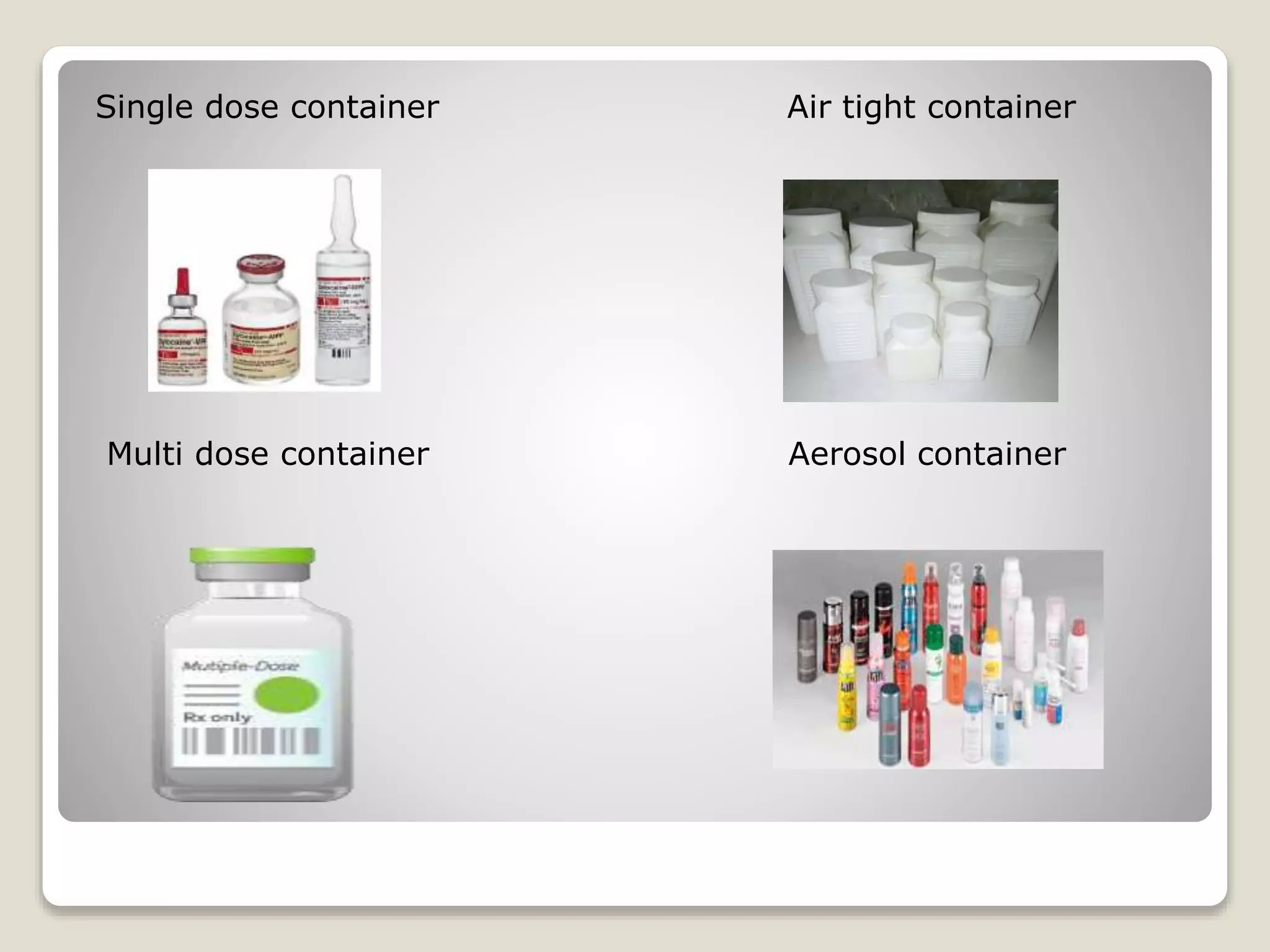
Type of Container
Well closed container Light resistant container
Single dose container Air tight container
Multi dose container Aerosol container
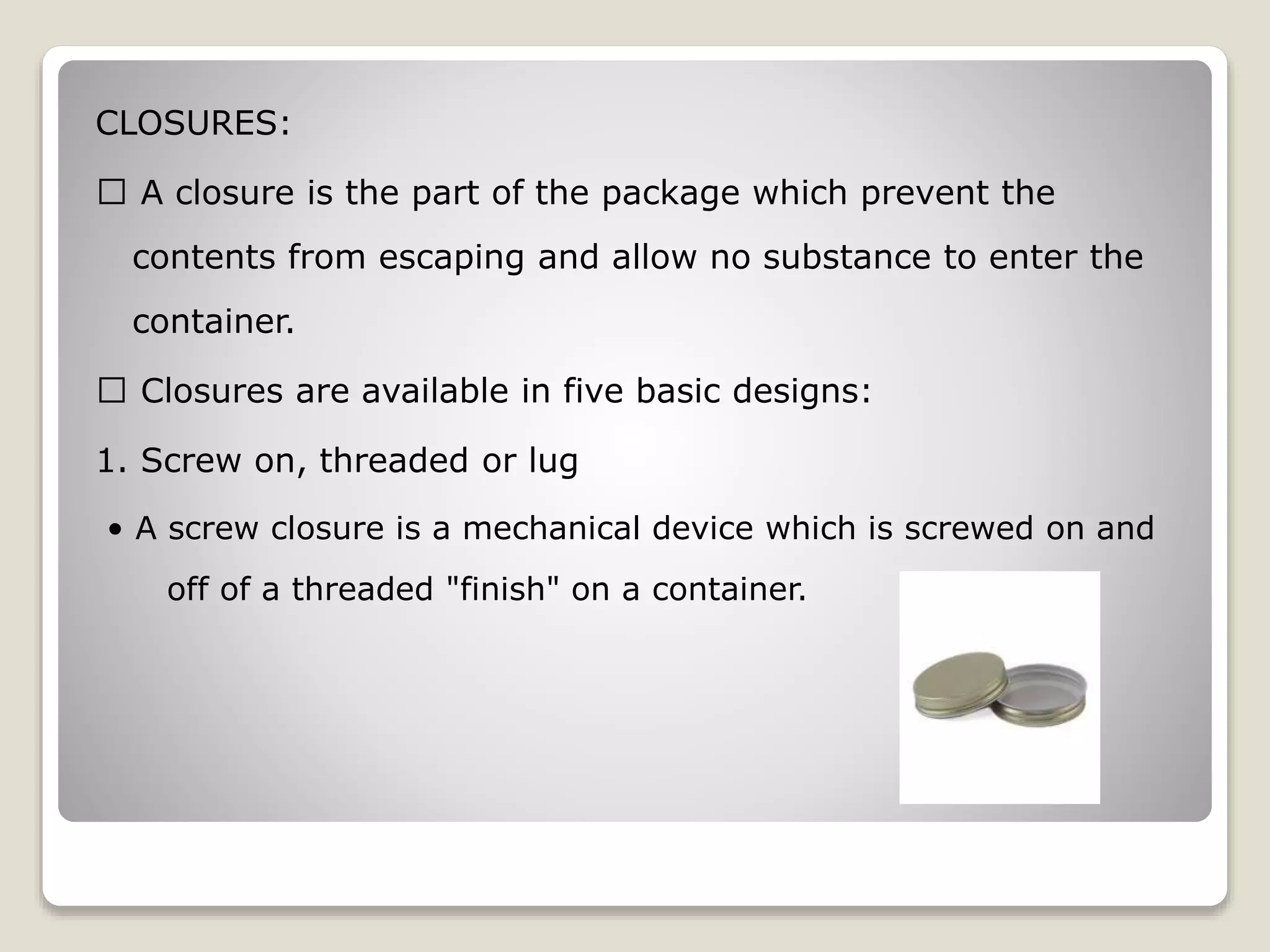
CLOSURES:
A closure is the part of the package which prevent the
contents from escaping and allow no substance to enter the
container.
Closures are available in five basic designs:
1. Screw on, threaded or lug
• A screw closure is a mechanical device which is screwed on and
off of a threaded "finish" on a container.
2. Crimp on(crowns)
This style cap is commonly used as a crimped closure for
beverage bottles.
3. Press on(snap)
Some closures snap on. For opening, the top is designed to pry off
or, break off, or have a built in dispenser.
3.Child-resistant
 Child-resistant packaging has special closures designed to
reduce the risk of children ingesting dangerous items.
4.Tamper-evident
 QUALITY CONTROL OF CLOSURES
PREPARATION OF SAMPLE(SOL.-A): Wash closures in 0.2%w/v of anionic surface active agents for
5min.Rinse 5 times with dist water and add 200ml water and is subjected to autoclave at 119 to
123⁰C for 20 to 30min covering with aluminum foil. Cool and separate solution from closure (soln-
A).
1) STERILITY TEST:
When treated closures are subjected to sterilization test at 64-66⁰C and a pressure of about 0.7
KPa for 24hr.
2) RESIDUE ON EVAPORATION:
50ml of solution A is evaporated to dryness at 105⁰C.Then weigh the residue NMT 4mg.
3) PENETRABILITY:
This is measured to check the force required to make a hypodermic needle penetrate easily through
the closure. It is measured by using the piercing machine. The piercing force must not exceed a
stated value. If it exceeds that stated value, the hypodermic needle can be damaged as a result of
undesirable hardness of the closures.
4) FRAGMENTATION TEST:
5) Self-Sealibility
6) pH OF AQUEOUS EXTRACT:
20ml of solution A is added with 0.1ml bromothymol blue when it is added with a
small amount of 0.01M NaOH which changes the colour from blue to yellow. The
volume of NaOH required is NMT 0.3ml and if it is done with HCl, the volume of HCl
needed should NMT 0.8ml.
7) LIGHT ABSORPTION TEST:
It must be done within 4hrs of preparing solution A. It is filtered through 0.5μ filter
and its absorbance is measured at 220 to 360nm. Blank is done without closures and
absorbance is NMT 2.0.
8) REDUCING SUBSTANCES:
20ml of solution A is added with 1ml of 1M H2SO4 and 20ml of 0.002M KMnO4 and
boil for 3 min then cool and add 1gm of potassium iodide which is titrated with
sodium thio-sulphate using starch as an indicator. Blank is done and the difference
between titration volumes is NMT 0.7ml.
QUALITY CONTROL TESTS FOR GLASSES
1) CHEMICAL RESISTANT OF GLASS CONTAINERS
A) POWDERED GLASS TEST: It is done to estimate the amount of alkali leached from the powdered
glass which usually happens at the elevated temperatures. When the glass is powdered, leaching
of alkali is enhanced, which can be titrated with 0.02N sulphuric acid using methyl red as an
indicator
Step-1: Preparation of glass specimen: Few containers are rinsed thoroughly with purified water
and dried with stream of clean air. Grind the containers in a mortar to a fine powder and pass
through sieve no.20 and 50.
Step-2: Washing the specimen: 10gm of the above specimen is taken into 250 ml conical flask and
wash it with 30 ml acetone. Repeat the washing, decant the acetone and dried after which it is
used within 48hr.
Procedure: 10gm sample is added with 50ml of high purity water in a 250ml flask. Place it in an
autoclave at 121⁰C±2⁰C for 30min.Cool it under running water. Decant the solution into another
flask, wash again with 15ml high purity water and again decant. Titrate immediately with 0.02N
sulphuric acid using methyl red as an indicator and record the volume.
 B) WATER ATTACK TEST:
 This is only for treated soda lime glass containers under the controlled
humidity conditions which neutralize the surface alkali and glass will become
chemically more resistant.
 Principle involved is whether the alkali leached or not from the surface of the
container.
 Procedure: Rinse thoroughly with high purity water. Fill each container to
90%of its overflow capacity with water and is autoclaved at 121⁰C for 30min
then it is cooled and the liquid is decanted which is titrated with 0.02N
sulphuric acid using methyl red as an indicator. The volume of sulfuric acid
consumed is the measure of the amount of alkaline oxides present in the glass
containers.
2) HYDROLYTIC RESISTANCE OF GLASS CONTAINERS:
Rinse each container at least 3 times with CO2 free water and fill with the
same to their filling volume. Also fill & Cover the vials and bottles and keep in
autoclave. Heat to 100⁰C for 10min and allow the steam to issue from the vent
cork. Rise the temp from 100⁰C to 121⁰C over 20min. Maintain the temp at
121⁰C to 122⁰C for 60min.Lower the temp from 121⁰C to 100C over 40min
venting to prevent vacuum.
Remove the container from autoclave, cool and combine the liquids being
examined. Measure the volume of test solution into a conical flask and titrate
with 0.01M HCl using methyl red as an indicator. Perform blank with water and
the difference between the titration represents the volume of HCl consumed by
the test solution.
3. LEAKAGE TEST:
Drug filled container is placed in a container
filled with coloured solution (due to the addition
of dye)which is at high pressure compared to the
pressure inside the glass container so that the
coloured solution enters the container if any
cracks or any breakage is present.
4. AUTOCLAVING (121 C for 60 min)
Ability of a filled or empty container to
withstand autoclaving may be checked.
QUALITY CONTROL OF METALLIC TINS
1) DESCRIPTION:
Metallic tins having smooth inner surface. The upper surface is sealed consists a clip to
break the seal. The lower surface is open.
2) DIMENSIONS:
Height- Measure the height in mm of 10 metallic tin, individually from the lower surface
edge to the upper rim. Limit- Specimen metallic tins with tolerance-170mm±10mm.
3) DIAMETER:
Inner diameter- Measure the inner diameter of 10 metallic tins. Limit- NLT 98mm.
Outer diameter: Limit-NMT 105mm.
4) CLEANLINESS CHECK:
It should not be dirty, damaged, stained or consist of any foreign particles.
QC TEST FOR SECONDARY PACKAGING MATERIALS
Quality Control Test  The test pieces of paper and board are
taken for test to be carried out in standard condition
a) Temperature: 23̊C ± 1̊C
b) Relative Humidity: 50% ± 2%
1. Moisture Content
2. Folding Endurance
3. Air Permeability
4. Tensile Strength
Issues Facing Modern Drug Packaging
Compliance or adherence
Packaging, particularly interactive packaging, which combines graphics and other electronic
features, is being explored as a way to remind and highlight to the patient is the time for
them to take their medicine. This technology is also being combined with features that
monitor when the drug is removed from the packaging, providing the clinical trial monitor,
the pharmacist, and the physician a way to track the patient’s dosage regimen.
A partial list of some of the common reasons to be out of compliance or adherence with a
drug therapy includes the following:
 Forgetfulness
 Not getting a prescription filled
 Side effects, real or perceived
 No noticeable effect from the treatment, asymptomatic conditions
 Poor understanding of how to follow through with the treatment
 Poor or unclear instructions about how to take the medication (s)
 Complicated regimens for the drugs
Counterfeiting
 The profits made by counterfeiting a legitimate drug are greater than those made when dealing with illegal
drugs. This type of counterfeiting is far more damaging to people.
 ANTICOUNTERFEITING PACKAGING
 Counterfeiting of drugs has become one of the most significant problems facing the safe delivery of
medications and health care worldwide. The explosion of drug manufacturers, particularly overseas drug
manufacturers, the widespread use of the Internet, and the mind-boggling profits that can be made by
counterfeiting drugs are all part of the problem.
 Solution
 An electronic pedigree
1. Detailed product information
2. A unique pedigree serial number Issues Facing Modern Drug Packaging 509
3. Transaction details
4. Recipient details
5. Lot, quantity, and expiration information on the specific product
6. Certification signature (electronic from the seller)
Environmental concerns
Environmental concerns and sustainability are issues that are
broader than pharmaceutical packaging but still impact
pharmaceutical packaging. The choice of materials is always
difficult and a topic of much debate and concern in food
packaging. This concern about environmental responsibility is
slowly creeping into decisions regarding pharmaceutical
packaging.

Pharmaceutical Packaging

  • 1.
    Submitted by: Rishikesh A.Tiwari M.Pharm.(Pharmaceutical Quality Assurance) – Semester 1 Pharmaceutical Packaging
  • 2.
    Introduction The packaging canbe defined as the economical means of providing presentation, protection, identification, information, containment, convenience compliance, integrity and stability for a product during storage, transportation display and until it is consumed or throughout its shelf life. Pharmaceutical packaging is the science, art and technology of enclosing or protecting products for distribution, storage, sale, and use. Packaging also refers to the process of design, evaluation, and production of packages.
  • 3.
    Ideal packaging requirements:-  They must protect the preparation from environmental conditions.  They must not be reactive with the product.  They must not impart to the product tastes or odors.  They must be nontoxic.  They must be FDA approved.  They must meet applicable tamper-resistance requirements.
  • 4.
    Functions of packaging:-  Product Identification  Product Protection  Facilitating the use of product  Product Promotion  Marketing
  • 5.
    Enteral Packaging Packaging ofan enteral product in cans and glass bottles uses the same techniques and process as other consumer products in the same packages. The package must be able to withstand the sterilization or processing of product and also must be able to protect all of the food components from degradation over an extended period of time.
  • 6.
    Enteral Products andtheir Packaging
  • 7.
     Packaging, processing,and the product itself are inextricably linked in providing enteral nutrition to critically ill patients.  Medical nutritional products come in two forms, powders or liquids. The type packaging used for medical nutritional products include metal cans, glass bottles, plastic bottles, plastic films, pouches, and laminated multilayer plastic structures
  • 9.
    Why Foods areprocessed? • Increase Shelf life of product • Availability of commodity throughout year • Wide range of products can be produce • Convenience for consumer
  • 10.
    ASEPTIC PACKAGING SYSTEM AsepticPackaging- • It is defined as the filling of a commercially sterile product into a sterile container under aseptic conditions and hermetically sealing the containers so that reinfection is prevented. • This results in a product which is shelf stable at ambient conditions. • The term aseptic is derived from the Greek word “septicos” which means the absence of putrefactive micro organisms.
  • 12.
    Types of AsepticPacks • Carton Boxes, Bags and Pouches, Cups and Trays, Bottles and Jars, Metal Cans, Plastic Cans, Composite Cans are used for packaging. Composition of Tetra Pak Aseptic Cartons • Tetra Pak aseptic cartons are made of three basic materials that together result in a very efficient, safe and light-weight package. • Each material provides a specific function. • Benefits: Higher degree of safety, hygiene and nutrient retention in food; Preserving taste and freshness; Can be kept for months with no need for refrigeration; Efficient.
  • 14.
    Advantages of AsepticPackaging:  Convenience Aseptic packages are portable, lightweight, and shatterproof and easily transportable  Food Safety The aseptic process and carton together ensure that the liquid food or beverage inside is free from harmful bacteria and contaminants.  No refrigeration required  Long shelf life  More nutrition Compared with canning, products can retain more nutrients as well as natural taste, colour and texture
  • 16.
    Limitations • Plant Installationcost is high as compare to canning • Gas transmission rate of Aseptic bag/ package • Overcooked flavour in some products • Lack of equipment for particulate sterilization, due especially to settling of solids and thus over processing
  • 17.
    CONTAINER 1. Container isdefined as a object that can be used to hold or transport something. 2. Pharmaceutical container is a device that hold the pharmaceutical product and it may or may not be in direct contact with it.
  • 18.
    The ideal containeror package should: 1. Protect the contents from the following environmental hazards: Light - protect the contents from light Temperature - be capable of withstanding extremes of temperature. Moisture - be capable of withstanding extremes of humidity. Atmospheric gases - protect the contents from the effect of atmospheric gases (e.g. aerial oxidation). Particles - protect from particulate contamination. Microorganisms - protect from microbial contamination.
  • 19.
    2. Protects thecontent from the following mechanical hazards Vibration - Usually due to transportation Compression - this usually includes pressure applied during stacking. Shock - such as impact, drops or rapid retardation. Puncture - penetration from sharp objects or during handling operations. Abrasion - this may create electrostatic effects. 3. They must not add or permit loss to its contents: Protect the contents from both loss and gain of water. Protect the contents from loss of volatile materials Must not shed particles into the contents. Must not leach anything to the contents.
  • 20.
    4. Must havea pharmaceutically elegant appearance: In a competitive market the appearance of a package first draws the attraction of the consumers than its contents. Must be easy to label and thus to identify the product. 5. Must be convenient and easy to use by the patient. 6. Must be cheap and economical. 7. Must not react with the content. 8. Must be biodegradable.
  • 21.
    Types of primaryand secondary packaging material Material Type Example of use Glass Primary Metric medical bottle, ampoule, vial Plastic Primary Metric medical bottle, ampoule, vial Cardboard Secondary Box to contain primary pack Paper Secondary Labels, patient information leaflet
  • 22.
    Type of Container Wellclosed container Light resistant container
  • 23.
    Single dose containerAir tight container Multi dose container Aerosol container
  • 24.
    CLOSURES: A closure isthe part of the package which prevent the contents from escaping and allow no substance to enter the container. Closures are available in five basic designs: 1. Screw on, threaded or lug • A screw closure is a mechanical device which is screwed on and off of a threaded "finish" on a container.
  • 25.
    2. Crimp on(crowns) Thisstyle cap is commonly used as a crimped closure for beverage bottles. 3. Press on(snap) Some closures snap on. For opening, the top is designed to pry off or, break off, or have a built in dispenser.
  • 26.
    3.Child-resistant  Child-resistant packaginghas special closures designed to reduce the risk of children ingesting dangerous items. 4.Tamper-evident
  • 27.
     QUALITY CONTROLOF CLOSURES PREPARATION OF SAMPLE(SOL.-A): Wash closures in 0.2%w/v of anionic surface active agents for 5min.Rinse 5 times with dist water and add 200ml water and is subjected to autoclave at 119 to 123⁰C for 20 to 30min covering with aluminum foil. Cool and separate solution from closure (soln- A). 1) STERILITY TEST: When treated closures are subjected to sterilization test at 64-66⁰C and a pressure of about 0.7 KPa for 24hr. 2) RESIDUE ON EVAPORATION: 50ml of solution A is evaporated to dryness at 105⁰C.Then weigh the residue NMT 4mg. 3) PENETRABILITY: This is measured to check the force required to make a hypodermic needle penetrate easily through the closure. It is measured by using the piercing machine. The piercing force must not exceed a stated value. If it exceeds that stated value, the hypodermic needle can be damaged as a result of undesirable hardness of the closures.
  • 28.
  • 29.
  • 30.
    6) pH OFAQUEOUS EXTRACT: 20ml of solution A is added with 0.1ml bromothymol blue when it is added with a small amount of 0.01M NaOH which changes the colour from blue to yellow. The volume of NaOH required is NMT 0.3ml and if it is done with HCl, the volume of HCl needed should NMT 0.8ml. 7) LIGHT ABSORPTION TEST: It must be done within 4hrs of preparing solution A. It is filtered through 0.5μ filter and its absorbance is measured at 220 to 360nm. Blank is done without closures and absorbance is NMT 2.0. 8) REDUCING SUBSTANCES: 20ml of solution A is added with 1ml of 1M H2SO4 and 20ml of 0.002M KMnO4 and boil for 3 min then cool and add 1gm of potassium iodide which is titrated with sodium thio-sulphate using starch as an indicator. Blank is done and the difference between titration volumes is NMT 0.7ml.
  • 31.
    QUALITY CONTROL TESTSFOR GLASSES 1) CHEMICAL RESISTANT OF GLASS CONTAINERS A) POWDERED GLASS TEST: It is done to estimate the amount of alkali leached from the powdered glass which usually happens at the elevated temperatures. When the glass is powdered, leaching of alkali is enhanced, which can be titrated with 0.02N sulphuric acid using methyl red as an indicator Step-1: Preparation of glass specimen: Few containers are rinsed thoroughly with purified water and dried with stream of clean air. Grind the containers in a mortar to a fine powder and pass through sieve no.20 and 50. Step-2: Washing the specimen: 10gm of the above specimen is taken into 250 ml conical flask and wash it with 30 ml acetone. Repeat the washing, decant the acetone and dried after which it is used within 48hr. Procedure: 10gm sample is added with 50ml of high purity water in a 250ml flask. Place it in an autoclave at 121⁰C±2⁰C for 30min.Cool it under running water. Decant the solution into another flask, wash again with 15ml high purity water and again decant. Titrate immediately with 0.02N sulphuric acid using methyl red as an indicator and record the volume.
  • 32.
     B) WATERATTACK TEST:  This is only for treated soda lime glass containers under the controlled humidity conditions which neutralize the surface alkali and glass will become chemically more resistant.  Principle involved is whether the alkali leached or not from the surface of the container.  Procedure: Rinse thoroughly with high purity water. Fill each container to 90%of its overflow capacity with water and is autoclaved at 121⁰C for 30min then it is cooled and the liquid is decanted which is titrated with 0.02N sulphuric acid using methyl red as an indicator. The volume of sulfuric acid consumed is the measure of the amount of alkaline oxides present in the glass containers.
  • 33.
    2) HYDROLYTIC RESISTANCEOF GLASS CONTAINERS: Rinse each container at least 3 times with CO2 free water and fill with the same to their filling volume. Also fill & Cover the vials and bottles and keep in autoclave. Heat to 100⁰C for 10min and allow the steam to issue from the vent cork. Rise the temp from 100⁰C to 121⁰C over 20min. Maintain the temp at 121⁰C to 122⁰C for 60min.Lower the temp from 121⁰C to 100C over 40min venting to prevent vacuum. Remove the container from autoclave, cool and combine the liquids being examined. Measure the volume of test solution into a conical flask and titrate with 0.01M HCl using methyl red as an indicator. Perform blank with water and the difference between the titration represents the volume of HCl consumed by the test solution.
  • 34.
    3. LEAKAGE TEST: Drugfilled container is placed in a container filled with coloured solution (due to the addition of dye)which is at high pressure compared to the pressure inside the glass container so that the coloured solution enters the container if any cracks or any breakage is present. 4. AUTOCLAVING (121 C for 60 min) Ability of a filled or empty container to withstand autoclaving may be checked.
  • 35.
    QUALITY CONTROL OFMETALLIC TINS 1) DESCRIPTION: Metallic tins having smooth inner surface. The upper surface is sealed consists a clip to break the seal. The lower surface is open. 2) DIMENSIONS: Height- Measure the height in mm of 10 metallic tin, individually from the lower surface edge to the upper rim. Limit- Specimen metallic tins with tolerance-170mm±10mm. 3) DIAMETER: Inner diameter- Measure the inner diameter of 10 metallic tins. Limit- NLT 98mm. Outer diameter: Limit-NMT 105mm. 4) CLEANLINESS CHECK: It should not be dirty, damaged, stained or consist of any foreign particles.
  • 36.
    QC TEST FORSECONDARY PACKAGING MATERIALS Quality Control Test  The test pieces of paper and board are taken for test to be carried out in standard condition a) Temperature: 23̊C ± 1̊C b) Relative Humidity: 50% ± 2% 1. Moisture Content 2. Folding Endurance 3. Air Permeability 4. Tensile Strength
  • 37.
    Issues Facing ModernDrug Packaging Compliance or adherence Packaging, particularly interactive packaging, which combines graphics and other electronic features, is being explored as a way to remind and highlight to the patient is the time for them to take their medicine. This technology is also being combined with features that monitor when the drug is removed from the packaging, providing the clinical trial monitor, the pharmacist, and the physician a way to track the patient’s dosage regimen. A partial list of some of the common reasons to be out of compliance or adherence with a drug therapy includes the following:  Forgetfulness  Not getting a prescription filled  Side effects, real or perceived  No noticeable effect from the treatment, asymptomatic conditions  Poor understanding of how to follow through with the treatment  Poor or unclear instructions about how to take the medication (s)  Complicated regimens for the drugs
  • 38.
    Counterfeiting  The profitsmade by counterfeiting a legitimate drug are greater than those made when dealing with illegal drugs. This type of counterfeiting is far more damaging to people.  ANTICOUNTERFEITING PACKAGING  Counterfeiting of drugs has become one of the most significant problems facing the safe delivery of medications and health care worldwide. The explosion of drug manufacturers, particularly overseas drug manufacturers, the widespread use of the Internet, and the mind-boggling profits that can be made by counterfeiting drugs are all part of the problem.  Solution  An electronic pedigree 1. Detailed product information 2. A unique pedigree serial number Issues Facing Modern Drug Packaging 509 3. Transaction details 4. Recipient details 5. Lot, quantity, and expiration information on the specific product 6. Certification signature (electronic from the seller)
  • 40.
    Environmental concerns Environmental concernsand sustainability are issues that are broader than pharmaceutical packaging but still impact pharmaceutical packaging. The choice of materials is always difficult and a topic of much debate and concern in food packaging. This concern about environmental responsibility is slowly creeping into decisions regarding pharmaceutical packaging.