SRIKRUPA INISTITUTE OF PHARMACEUTICAL
SCIENCES
(Approved by AICTE; PCI)
(Affiliated to Osmania University)
ASSIGNMENT ON
CALCULATION OF YIELDS,
PRODUCTION RECORD REVIEW,
CHANGE CONTROL
SUBMITTED BY
HUZAIFA NAAZ
 CALCULATION OF YIELDS
 PRDUCTION RECORD REVIEW
 CHANGE CONTROL
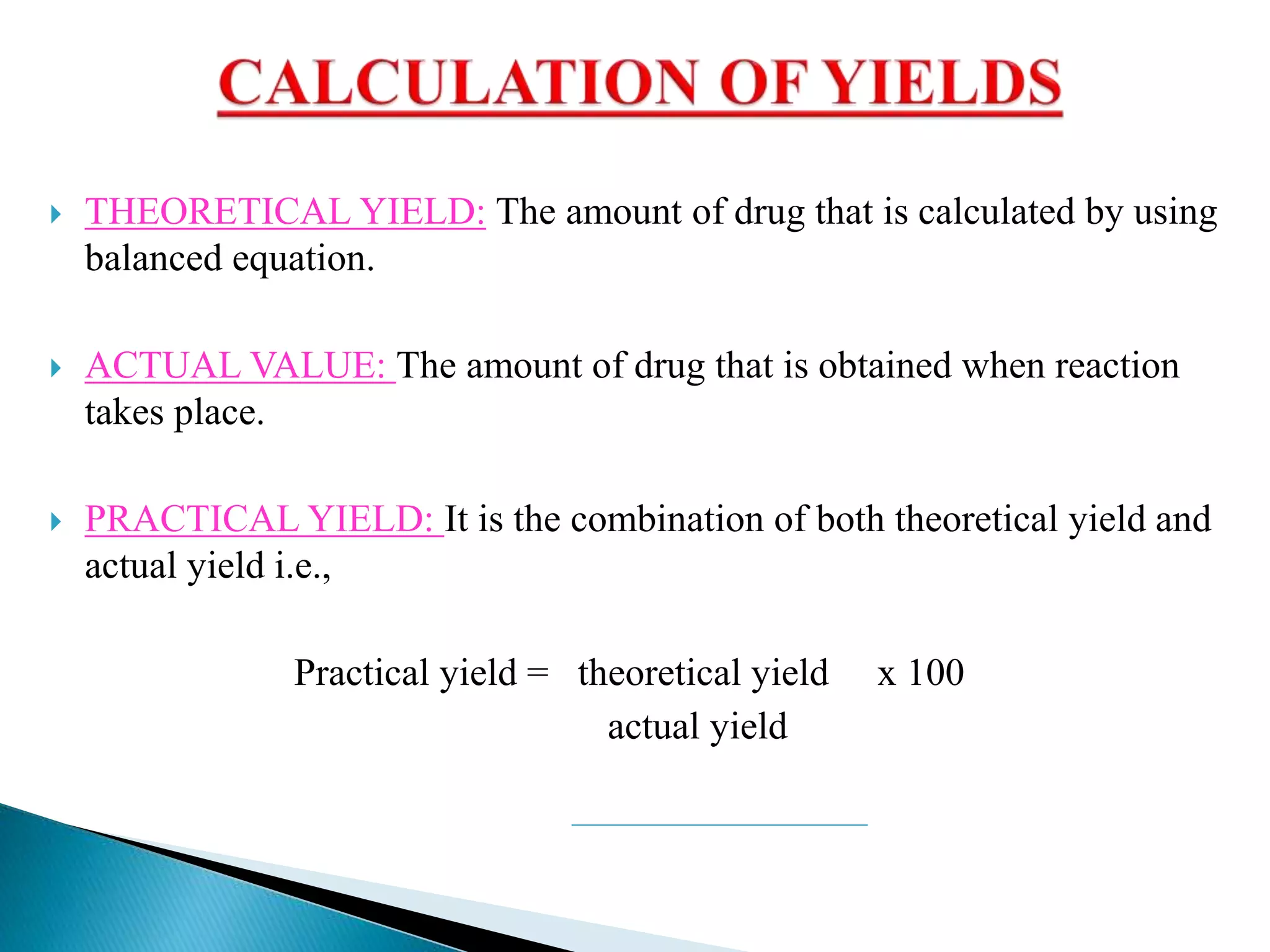
 THEORETICAL YIELD: The amount of drug that is calculated by using
balanced equation.
 ACTUAL VALUE: The amount of drug that is obtained when reaction
takes place.
 PRACTICAL YIELD: It is the combination of both theoretical yield and
actual yield i.e.,
Practical yield = theoretical yield x 100
actual yield
 All drug product production and control records including those for
packaging and labelling, shall be reviewed and approved by the quality
control unit to determine compliance with all established, approved
written procedures before a batch is released or distributed.
 Any unexplained discrepancy (including a percentage of theoretical yield
exceeding the maximum or minimum percentages established in master
production and control records) or the failure of a batch or any of its
components to meet any of its specifications shall be thoroughly
investigated, whether or not the batch has already been distributed.
 The investigation shall extend to other batches of the same drug product
and other drug products that may have been associated with the specific
failure or discrepancy. A written record of the investigation shall be made
and shall include the conclusions and follow up.
 The USP has established that the acceptable range of most compounded
preparations is typically +/- 10% ; however , it can be as great as +/-
20% (as with some proteins) or as tight as+/-5%(as with potent
analgesics).for some raw powders, potency is required to be within +/-
2%.
 In addition to 211.192 requires review and approval of all production
records prior to batch release /distribution and unexplained discrepancy
or the failure of a batch or any of its components to meet any of its
specifications shall be thoroughly investigated.
CHANGE CONTROL DEFINITION:
“ Change control is a formal system by which a qualified representative of
appropriate disciplines review proposed and actual changes that might
affect the validated status. The intent is to determine the need for action that
would ensure that the system is maintained in a validated state.”
1 – Minor change is a change that has minimal potential to have an
adverse effect on identity, strength, quality, purity, or potency of the product as
they may relate to the safety or effectiveness of the product.
2 – Major change is a change that has a moderate potential to have an
adverse effect on the identity, strength, quality, purity, or potency of the
product as they may relate to the safety or effectiveness of the product.
3- Critical change is a change that has a substantial potential to have an
adverse effect on the identity, strength, quality, purity, or potency of a product
as they may relate to the safety or effectiveness of the product.
 “Level -1 signifies level of approval required to approve a change”
Initiator department and the quality assurance department only
e.g. SOPs related to single department like operating procedure of
equipment’s, cleaning procedure of equipments, etc.
 “Level -2 signifies level of approval required to approve a change”
Initiator department and all other interlinked departments within the
plant
e.g. Change in SOPs which are being followed at different departments
at plant level.
 “Level -3 signifies level of approval required to approve a change”
Initiator department and all other relevant departments (within plant or
outside the plant) including marketing, RA and Quality and Compliance,
etc.
e.g. Change Controls which include change in specifications /STPs / GTPs /
Artworks / License related issues / BMR / process change / Vendor change,
etc These type of changes may require company’s R.A. department to ask
for approval of regulatory agency(ies) that have impact on regulatory
dossiers submissions.
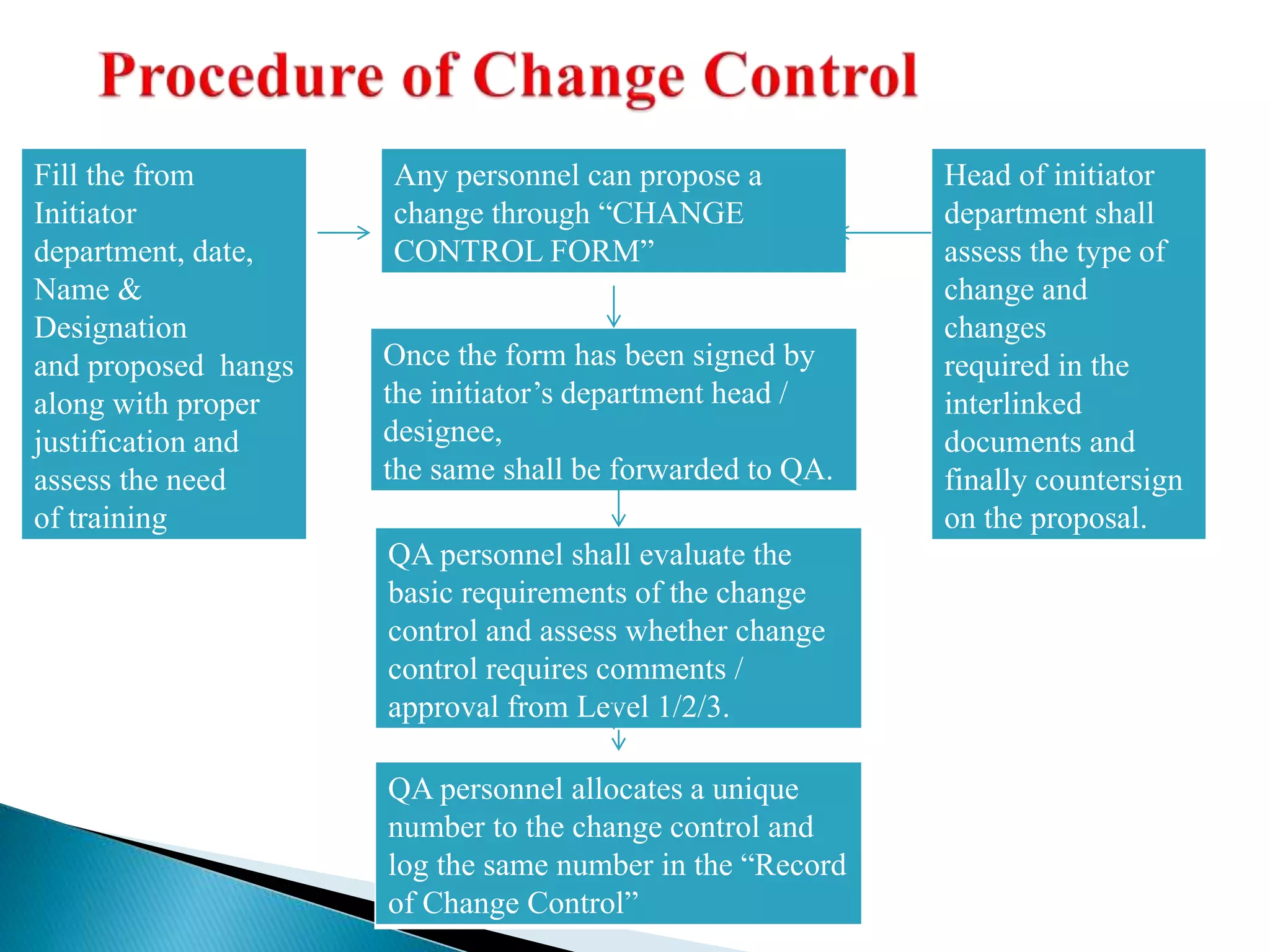
Fill the from
Initiator
department, date,
Name &
Designation
and proposed hangs
along with proper
justification and
assess the need
of training
Any personnel can propose a
change through “CHANGE
CONTROL FORM”
Head of initiator
department shall
assess the type of
change and
changes
required in the
interlinked
documents and
finally countersign
on the proposal.
Once the form has been signed by
the initiator’s department head /
designee,
the same shall be forwarded to QA.
QA personnel shall evaluate the
basic requirements of the change
control and assess whether change
control requires comments /
approval from Level 1/2/3.
QA personnel allocates a unique
number to the change control and
log the same number in the “Record
of Change Control”
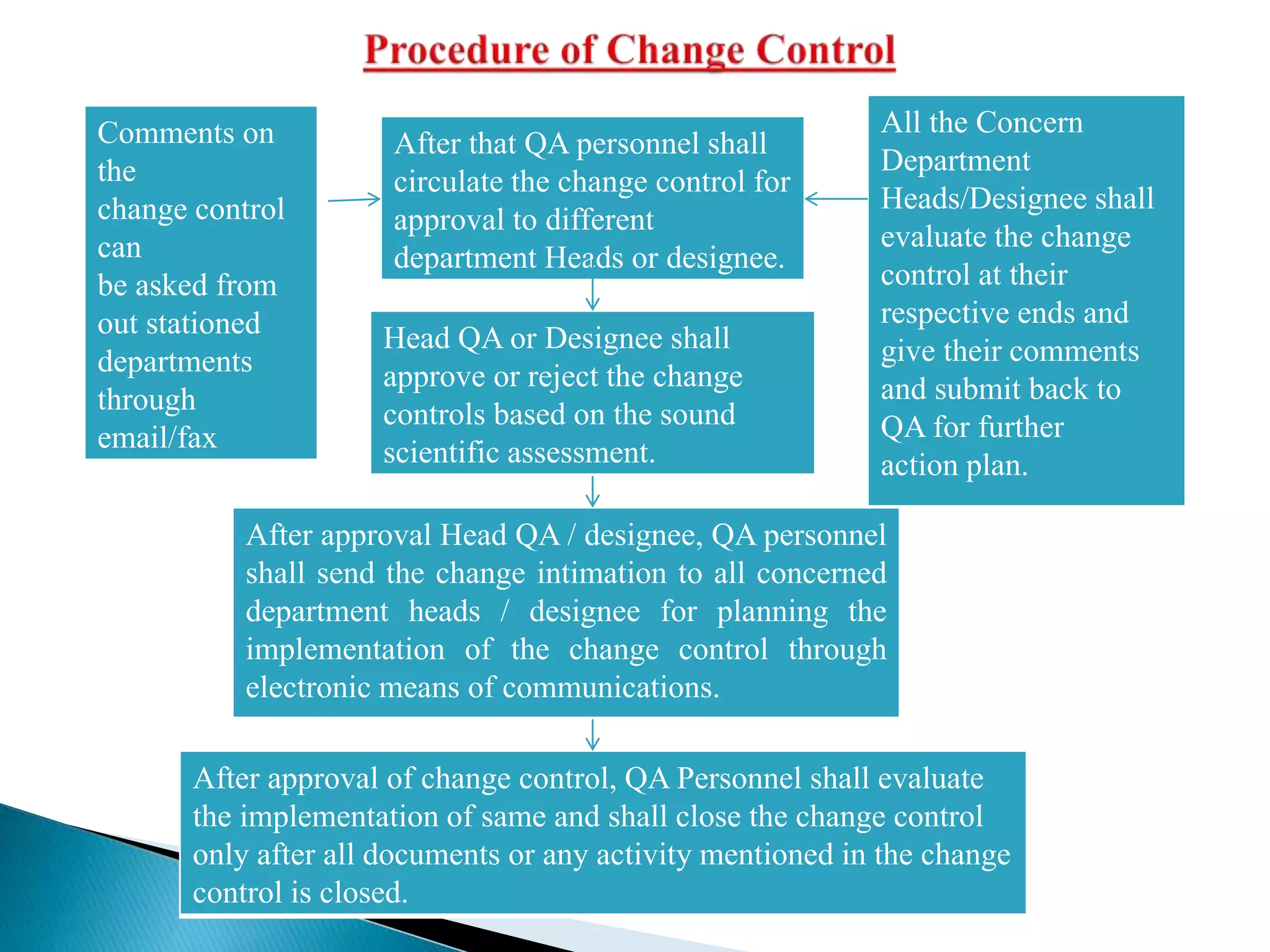
Comments on
the
change control
can
be asked from
out stationed
departments
through
email/fax
After that QA personnel shall
circulate the change control for
approval to different
department Heads or designee.
All the Concern
Department
Heads/Designee shall
evaluate the change
control at their
respective ends and
give their comments
and submit back to
QA for further
action plan.
Head QA or Designee shall
approve or reject the change
controls based on the sound
scientific assessment.
After approval Head QA / designee, QA personnel
shall send the change intimation to all concerned
department heads / designee for planning the
implementation of the change control through
electronic means of communications.
After approval of change control, QA Personnel shall evaluate
the implementation of same and shall close the change control
only after all documents or any activity mentioned in the change
control is closed.
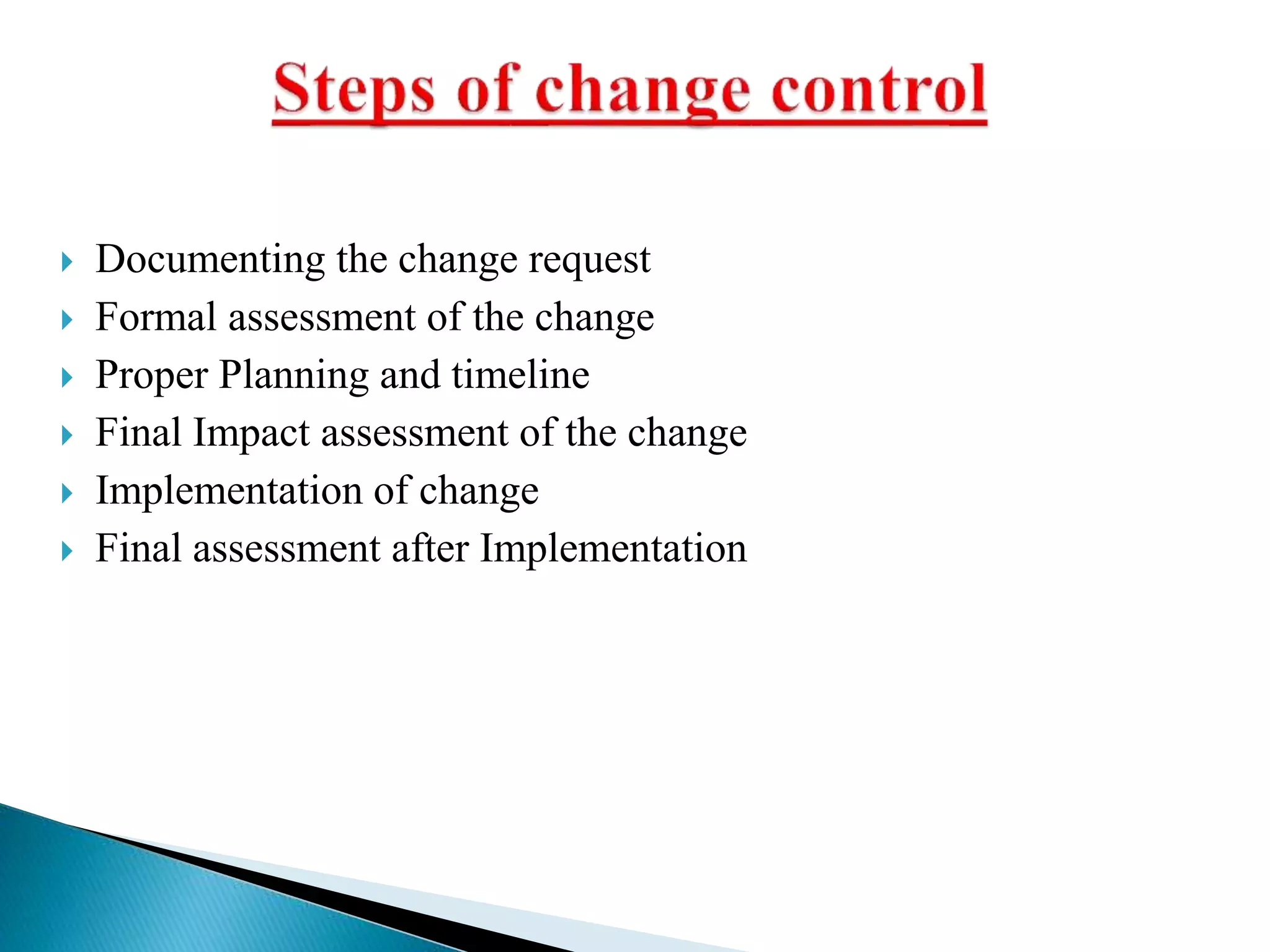
 Documenting the change request
 Formal assessment of the change
 Proper Planning and timeline
 Final Impact assessment of the change
 Implementation of change
 Final assessment after Implementation
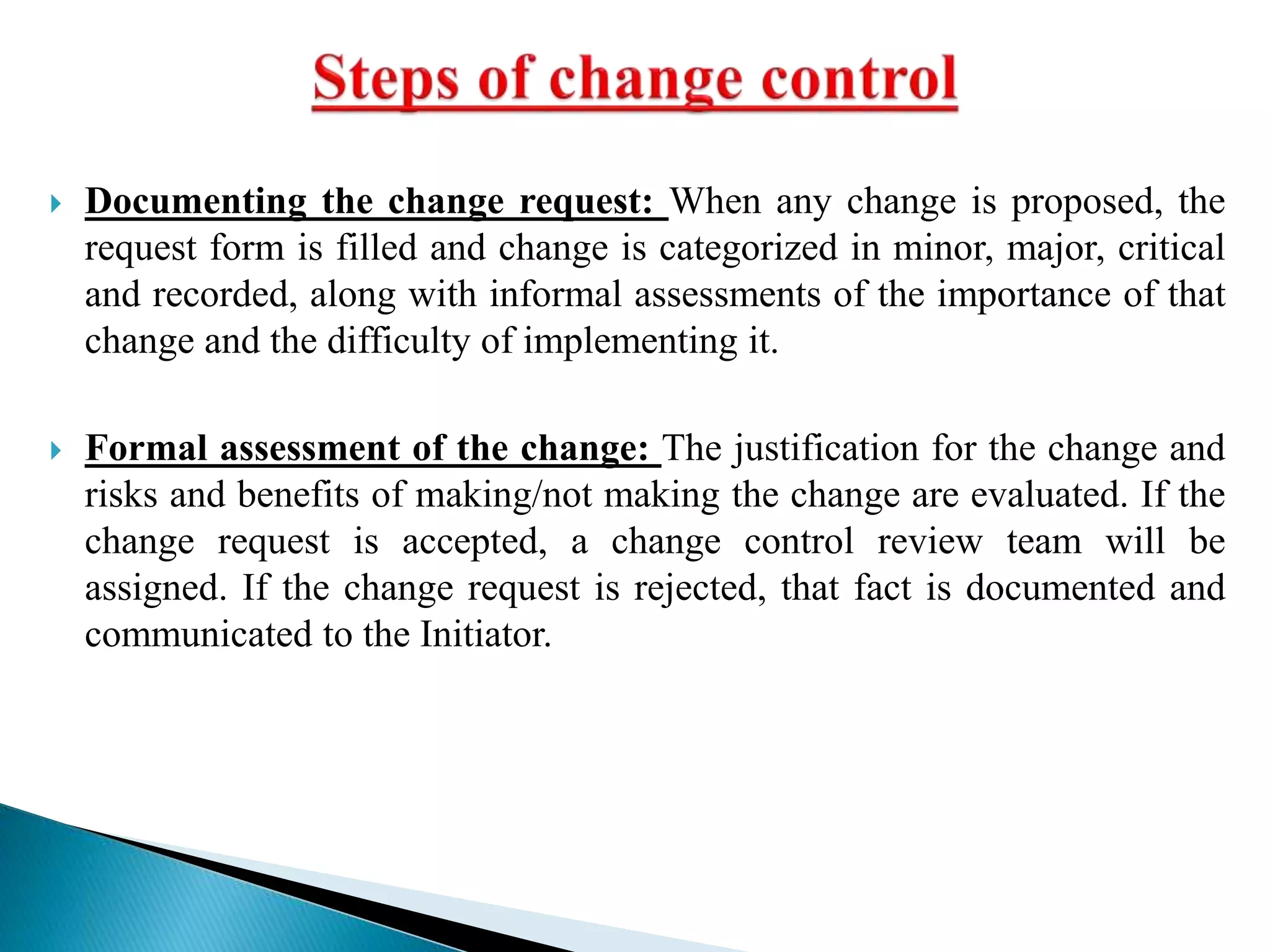
 Documenting the change request: When any change is proposed, the
request form is filled and change is categorized in minor, major, critical
and recorded, along with informal assessments of the importance of that
change and the difficulty of implementing it.
 Formal assessment of the change: The justification for the change and
risks and benefits of making/not making the change are evaluated. If the
change request is accepted, a change control review team will be
assigned. If the change request is rejected, that fact is documented and
communicated to the Initiator.
 Proper Planning and timeline: The review team responsible for the
change reviews approval or rejection, implementation and plans properly
for its implementation within timeline.
 Final Impact assessment of the change: The review team does correct
impact assessment of the change with respect to GMP. If the change is
found to have no impact on GMP and it is improving for the system, then
the review team requests approval and gives the timeline for
implementation.
 Implementation of change: The review team also verifies the
implementation status of the change after approval and the timeline of the
change implementation.
 Final assessment after implementation: If the initiator, review team and
QA are satisfied that the change was implemented satisfactorily, the
change request is closed.

calulation of yields, production record review,change control

  • 1.
    SRIKRUPA INISTITUTE OFPHARMACEUTICAL SCIENCES (Approved by AICTE; PCI) (Affiliated to Osmania University) ASSIGNMENT ON CALCULATION OF YIELDS, PRODUCTION RECORD REVIEW, CHANGE CONTROL SUBMITTED BY HUZAIFA NAAZ
  • 2.
     CALCULATION OFYIELDS  PRDUCTION RECORD REVIEW  CHANGE CONTROL
  • 3.
     THEORETICAL YIELD:The amount of drug that is calculated by using balanced equation.  ACTUAL VALUE: The amount of drug that is obtained when reaction takes place.  PRACTICAL YIELD: It is the combination of both theoretical yield and actual yield i.e., Practical yield = theoretical yield x 100 actual yield
  • 4.
     All drugproduct production and control records including those for packaging and labelling, shall be reviewed and approved by the quality control unit to determine compliance with all established, approved written procedures before a batch is released or distributed.  Any unexplained discrepancy (including a percentage of theoretical yield exceeding the maximum or minimum percentages established in master production and control records) or the failure of a batch or any of its components to meet any of its specifications shall be thoroughly investigated, whether or not the batch has already been distributed.  The investigation shall extend to other batches of the same drug product and other drug products that may have been associated with the specific failure or discrepancy. A written record of the investigation shall be made and shall include the conclusions and follow up.
  • 5.
     The USPhas established that the acceptable range of most compounded preparations is typically +/- 10% ; however , it can be as great as +/- 20% (as with some proteins) or as tight as+/-5%(as with potent analgesics).for some raw powders, potency is required to be within +/- 2%.  In addition to 211.192 requires review and approval of all production records prior to batch release /distribution and unexplained discrepancy or the failure of a batch or any of its components to meet any of its specifications shall be thoroughly investigated. CHANGE CONTROL DEFINITION: “ Change control is a formal system by which a qualified representative of appropriate disciplines review proposed and actual changes that might affect the validated status. The intent is to determine the need for action that would ensure that the system is maintained in a validated state.”
  • 6.
    1 – Minorchange is a change that has minimal potential to have an adverse effect on identity, strength, quality, purity, or potency of the product as they may relate to the safety or effectiveness of the product. 2 – Major change is a change that has a moderate potential to have an adverse effect on the identity, strength, quality, purity, or potency of the product as they may relate to the safety or effectiveness of the product. 3- Critical change is a change that has a substantial potential to have an adverse effect on the identity, strength, quality, purity, or potency of a product as they may relate to the safety or effectiveness of the product.
  • 7.
     “Level -1signifies level of approval required to approve a change” Initiator department and the quality assurance department only e.g. SOPs related to single department like operating procedure of equipment’s, cleaning procedure of equipments, etc.  “Level -2 signifies level of approval required to approve a change” Initiator department and all other interlinked departments within the plant e.g. Change in SOPs which are being followed at different departments at plant level.
  • 8.
     “Level -3signifies level of approval required to approve a change” Initiator department and all other relevant departments (within plant or outside the plant) including marketing, RA and Quality and Compliance, etc. e.g. Change Controls which include change in specifications /STPs / GTPs / Artworks / License related issues / BMR / process change / Vendor change, etc These type of changes may require company’s R.A. department to ask for approval of regulatory agency(ies) that have impact on regulatory dossiers submissions.
  • 9.
    Fill the from Initiator department,date, Name & Designation and proposed hangs along with proper justification and assess the need of training Any personnel can propose a change through “CHANGE CONTROL FORM” Head of initiator department shall assess the type of change and changes required in the interlinked documents and finally countersign on the proposal. Once the form has been signed by the initiator’s department head / designee, the same shall be forwarded to QA. QA personnel shall evaluate the basic requirements of the change control and assess whether change control requires comments / approval from Level 1/2/3. QA personnel allocates a unique number to the change control and log the same number in the “Record of Change Control”
  • 10.
    Comments on the change control can beasked from out stationed departments through email/fax After that QA personnel shall circulate the change control for approval to different department Heads or designee. All the Concern Department Heads/Designee shall evaluate the change control at their respective ends and give their comments and submit back to QA for further action plan. Head QA or Designee shall approve or reject the change controls based on the sound scientific assessment. After approval Head QA / designee, QA personnel shall send the change intimation to all concerned department heads / designee for planning the implementation of the change control through electronic means of communications. After approval of change control, QA Personnel shall evaluate the implementation of same and shall close the change control only after all documents or any activity mentioned in the change control is closed.
  • 11.
     Documenting thechange request  Formal assessment of the change  Proper Planning and timeline  Final Impact assessment of the change  Implementation of change  Final assessment after Implementation
  • 12.
     Documenting thechange request: When any change is proposed, the request form is filled and change is categorized in minor, major, critical and recorded, along with informal assessments of the importance of that change and the difficulty of implementing it.  Formal assessment of the change: The justification for the change and risks and benefits of making/not making the change are evaluated. If the change request is accepted, a change control review team will be assigned. If the change request is rejected, that fact is documented and communicated to the Initiator.
  • 13.
     Proper Planningand timeline: The review team responsible for the change reviews approval or rejection, implementation and plans properly for its implementation within timeline.  Final Impact assessment of the change: The review team does correct impact assessment of the change with respect to GMP. If the change is found to have no impact on GMP and it is improving for the system, then the review team requests approval and gives the timeline for implementation.  Implementation of change: The review team also verifies the implementation status of the change after approval and the timeline of the change implementation.  Final assessment after implementation: If the initiator, review team and QA are satisfied that the change was implemented satisfactorily, the change request is closed.