MATERIAL MANAGEMENT
CONTENTS:
 Introduction.
 Definition.
 Objectives and Functions of Material Management.
 Purchasing.
 Raw Materials.
 Packaging Materials.
 Intermediate and Bulk Products .
 Rejected and Recovered Materials.
 Recalled Products.
 Returned Goods.
2
 Reagents and Culture Media.
 Waste Materials.
 Reference Standard.
 Miscellaneous Materials.
 Document Formats.
3
INTRODUCTION:
• The prime objective of pharmaceutical manufacturing operation is to produce
finished pharmaceutical products from active, raw materials and various packaging
material.
• The quality of finished products produced solely depends upon the quality
input and hence material management becomes a very important activity in
pharmaceutical manufacturing operations.
• All incoming materials should be quarantine immediately after receipt or processing
until they are released for use or distribution.
• All materials and products should be stored under appropriate conditions,
established by the manufacturer.
• All items must be handled in such a way that no contamination on mix up takes
place.
4
• All materials and products should be stored under
appropriate conditions, established by the manufacturer
and user.
• These should be stored in an orderly fashion to permit
batch segregation by
FIRST IN – FIRST OUT(FIFO) and
FIRST EXPIRY- FIRST OUT(FEFO) rule.
• There shall be written procedures for all activity carried
out related to material handling eg; identification, storage,
handling, sampling, testing and approval.
5
DEFINITION
• According to The International Federation of Purchasing and Materials
Management defines material management as;
• “A total concept having its definite organization to plan and control all
types of materials, its supply, and its flow from raw stage to finished
stage so as to deliver the product to customer as per his requirements in
time.”
• “This involves materials planning, purchasing, receiving, storing,
inventory control, scheduling, production, physical distribution
and marketing. “
6
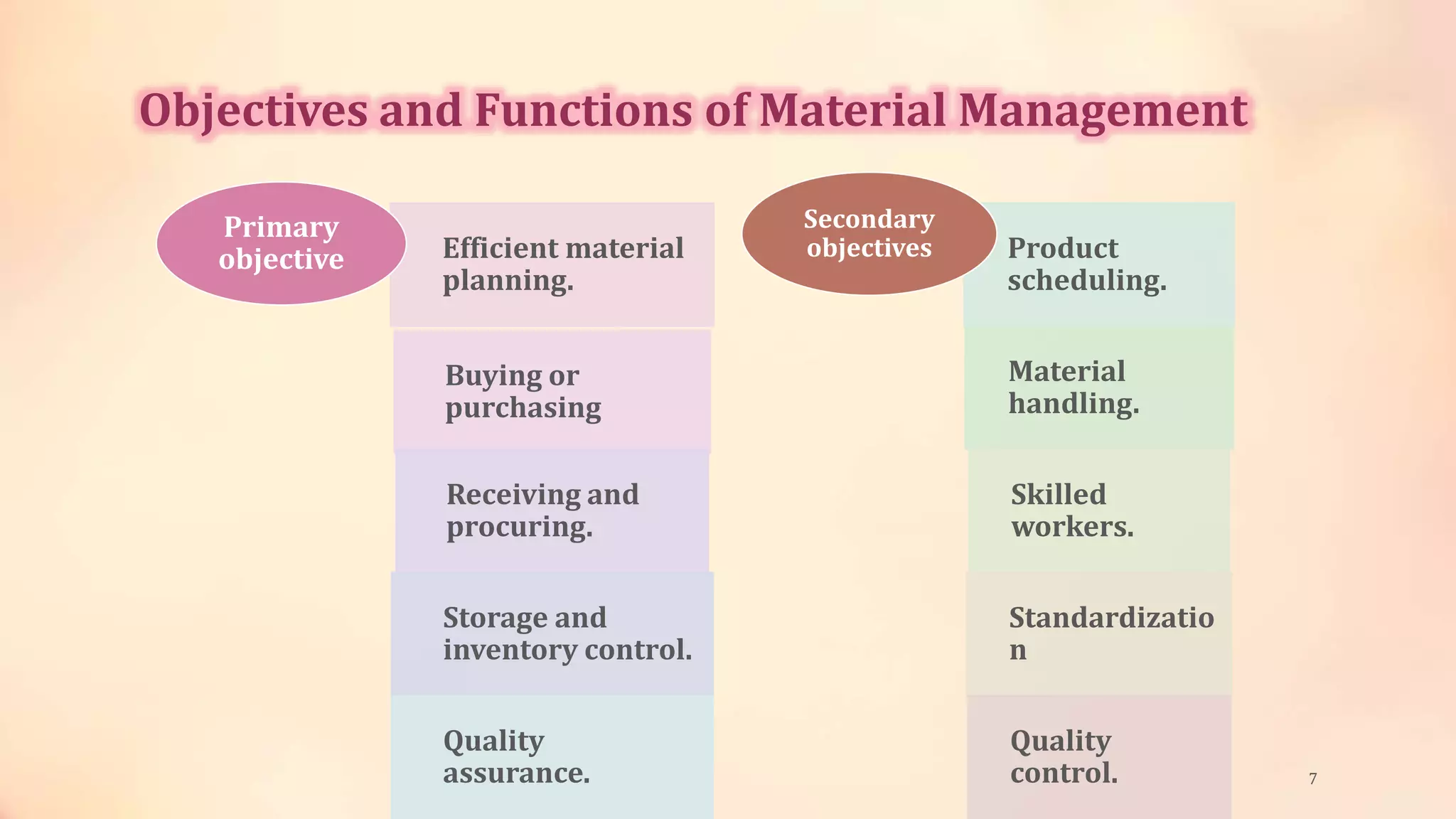
Objectives and Functions of Material Management
Efficient material
planning.
Buying or
purchasing
Receiving and
procuring.
Storage and
inventory control.
Quality
assurance.
Primary
objective Product
scheduling.
Material
handling.
Skilled
workers.
Standardizatio
n
Quality
control.
Secondary
objectives
7
PURCHASING
 Following points should be considered regarding purchasing of
pharmaceutical material:
i. All materials should be purchased against and approved and adequate
specification which clearly states quality of material, physical
specification, chemical specification, microbiological specification etc.
ii. The parameters include specific characteristics like bulk density,
particle size, crystalline or amorphous nature, specificity of isomer etc.
iii. The raw material and packaging material should be purchased by
biased who are trained and possess sufficient technical knowledge.
Documents Required
SOP for vendor certification
RAW MATERIALS
• In case of raw materials following points should be considered.
• Supplier of the raw material should have his name listed in the company’s approved
vendor list.
• All raw materials ,must be checked for the following things :
Name of the manufacturer.
Name of the product.
Batch number.
Date of manufacture.
Date of expiry.
 Quantity receive.
Condition of container.
9
• Sampling of these received materials should take place in specific
sampling booths by QC person only and the container must be
labeled accordingly.
• All received material must be properly identified with their status
i.e. product name, batch number , code number ,sterility status etc.
• Labeling should be done along with the following information:
 Name and internal code number of product.
 Batch number .
 Status of material eg: QUARANTINE, on test, released,
rejected etc.
 Expiry date of the product.
 Storage conditions eg: low temperature, low humidity
etc. 10
• Containers from which sample has been taken must be identified .
• Only material released by Q.C department and within their shelf life should be used.
• Each dispensed material should be weighed or volume should be independently checked
and recorded.
• Materials dispensed from each batch of the final product should be kept together and
conspicuously labeled.
• All dispensed materials must be recorded in a chronological order of date and time.
DOCUMENTS REQUIRED:
• List of approved vendors .
• List of material classified according to storage condition.
• SOP of sampling , storage and dispensing of material.
• Register of sampling.
11
PACKAGING MATERIALS
Primary
packaging
Secondary
packaging
Tertiary
packaging
12
• PRIMARY PACAKGING MATERIALS: Materials which come in direct
contact of the medicinal product eg: Bottle , vials.
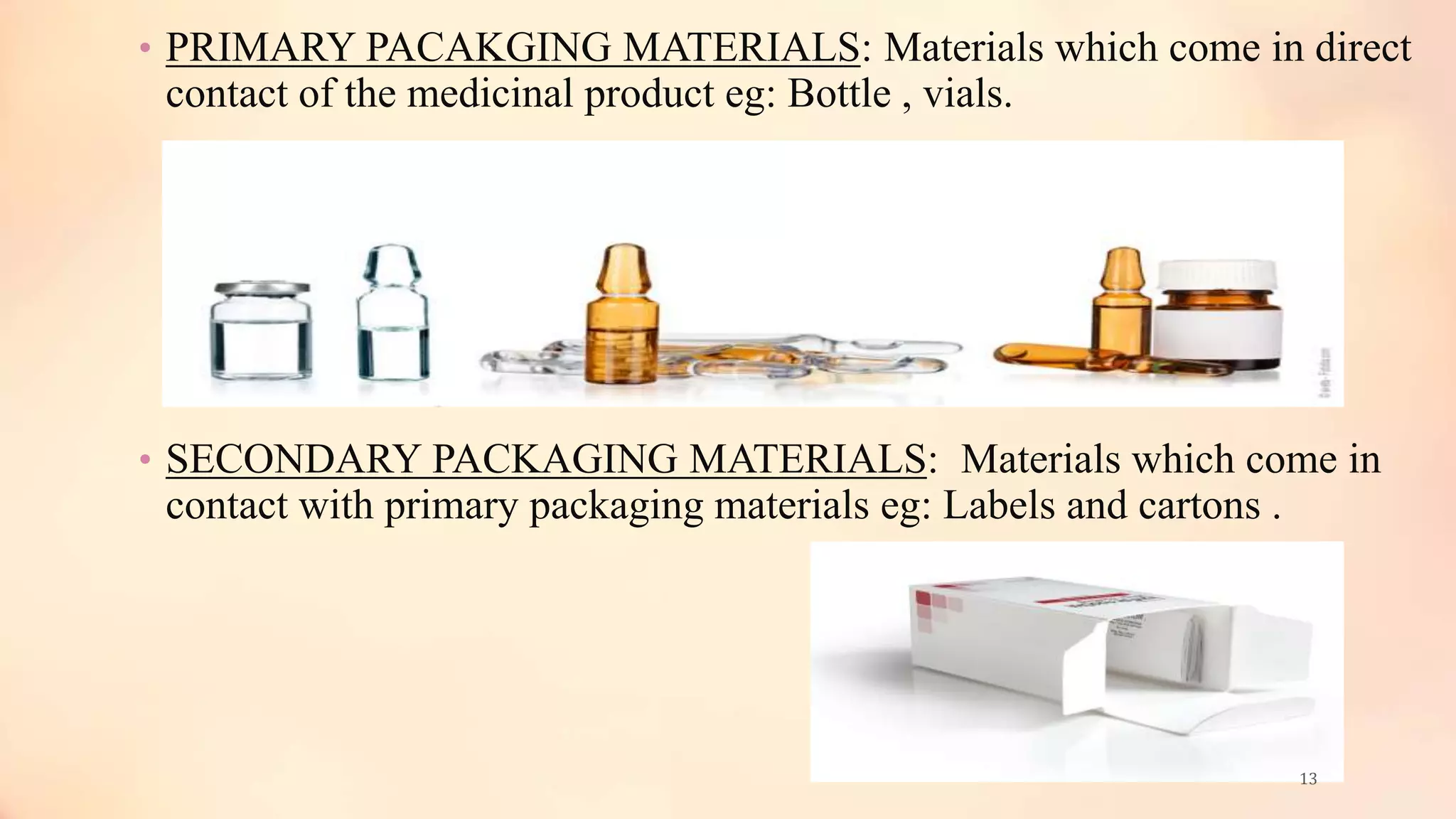
• SECONDARY PACKAGING MATERIALS: Materials which come in
contact with primary packaging materials eg: Labels and cartons .
13
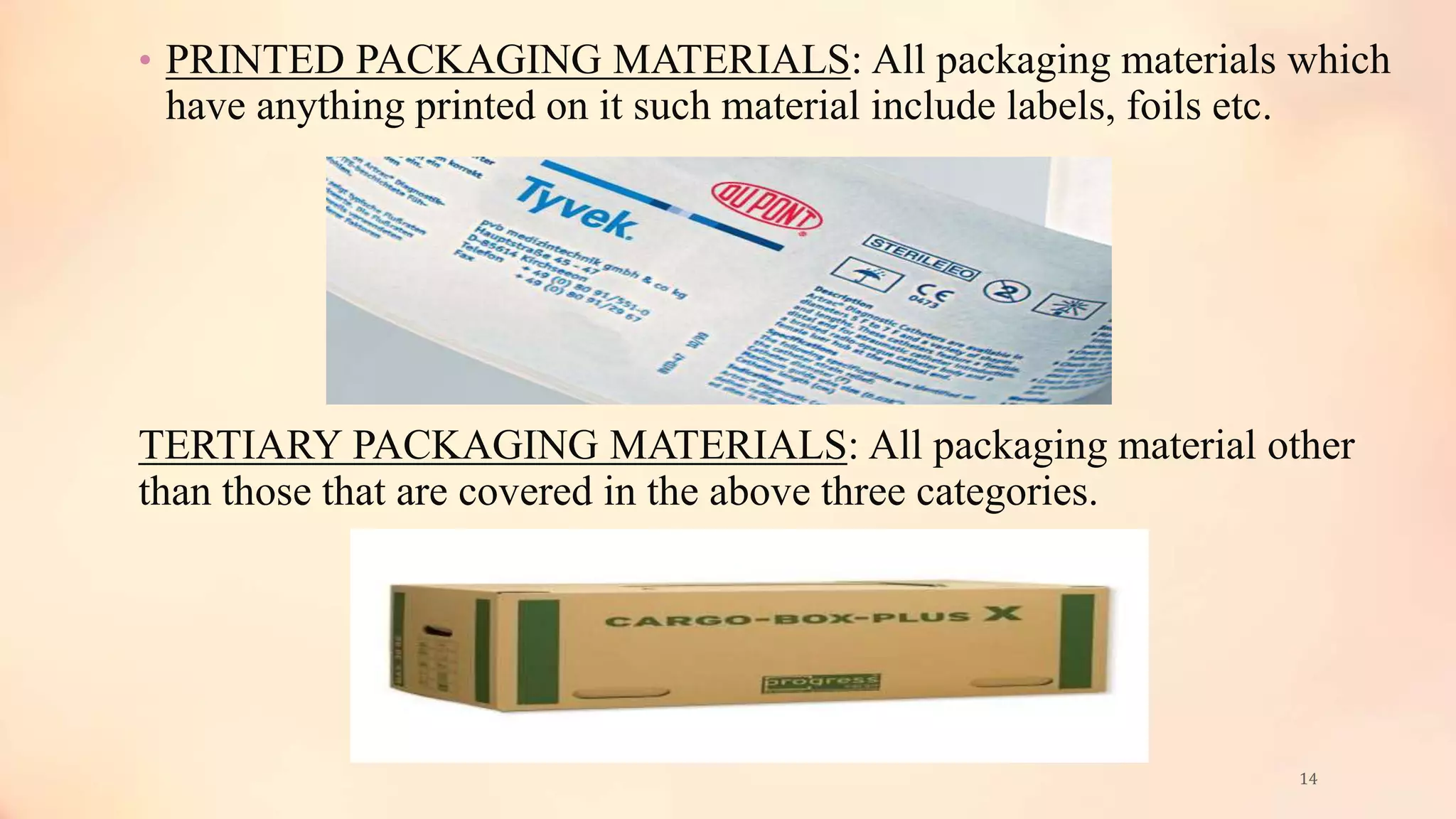
• PRINTED PACKAGING MATERIALS: All packaging materials which
have anything printed on it such material include labels, foils etc.
TERTIARY PACKAGING MATERIALS: All packaging material other
than those that are covered in the above three categories.
14
The purchase, handling and
control of primary and
printed packaging material
shall be as for raw material.
Printed packaging material
should be stored securely in
lock and key system
Each material should be given a
specific identification number.
Outdated printed packaging
material should be destroyed
All product should be
checked for identity, safety
and purity.
Access to storage area
should be limited to
authorised person only.
A separate sampling room
must be provided for
sampling of packaging
materials.
15
 DOCUMENT REQUIRED
 A classified list of all packaging material.
 List of approved vendor.
 List of material based on storage.
 Sampling and dispensing register In chronological
order.
16
INTERMEDIATE AND BULK PRODUCTS
• In pharmaceutical industry normally main or central ware house is responsible for
management of raw , packaging and finished products . However intermediate and bulk
product storage is the responsibility of production department.
• Intermediate or bulk product may be defined as the material , which has started
processing but not yet got converted into finished product eg:
1) granulated material ready for compression .
2) filtered liquids for oral or injectables.
• These products should be kept under appropriate storage conditions of temperature ,
relative humidity.
DOCUMENT REQUIRED :
• List of categories of intermediate and bulk products
17
REJECTED AND RECOVERED MATERIALS
• Reprocess and retest the materials to see whether it meets our specific
requirements.
• Destroy or send it to the supplier.
• Following points should be considered in this regards:
 Rejected materials and products should clearly marked as such and stored
separately in restricted areas.
 Such areas in industry are normally painted RED in color to make it distinguishable
easily. Such materials should either be returned to the suppliers or, where
appropriate, reprocessed or destroyed.
18
 Rejected production batches should be reprocessed in exceptional situations.
 The need for additional testing of any finished product that has been reprocessed or into,
which a recovered product has been added should be considered by the Q.C.
department.
DOCUMENT REQUIRED:
 SOP on handling of rejected materials.
 Record of disposal of rejected materials.
 SOP on handling of recovered materials.
 Record of disposal of recovered materials.
19
20
RECALLED PRODUCTS
• Products which are already distributed or sold, may be required at times to be recalled
from market for various reasons.
• Such recalled product should be clearly identified and stored separately in a secure
area until a decision is taken on their fate. Such decision should be made a soon as
possible.
DOCUMENT REQUIRED
• SOP on handling of recalled products.
• Records of recalled products and action taken on such recalled product.
21
• Pharmaceutical product can be returned from market for various reasons, e.g., quality
problems, accidental damage of goods etc.
• Physically examine the condition of the goods returned.
• Ask Q.C. department to evaluate the quality of the goods received and take a decision on
whether these products can be reprocessed and recovered or needs to be destroyed.
• If it is possible to reprocess and recover then such products after reprocessing and retesting
may be considered for relabeling, repacking and reselling the same.
• Q.C. department should evaluate all aspects like condition of the received material, time
elapsed since it was first processed etc. along with the chemical, microbiological or any other
technical evaluations.
RETURNED GOODS
22
REAGENTS AND CLTURE MEDIA
Following points should be considered regarding management of reagents and culture media :
• All reagents and culture media should be recorded upon receipt or preparation.
• Reagents made up in the laboratories should be prepared according to written procedures
and appropriately labeled. Such labels should indicate following information viz.
 Name of the reagent.
 Nominal concentration.
 Standardization factor.
 Shelf life.
 Date when re-standardization is required.
 The storage conditions.
 Name/Signature and date of the person who has prepared and standardized
the required.
23
• Both positive and negative control should be applied to verify suitability
of the culture media. The size of the inoculums used in positive controls
should be appropriate to the sensitivity required.
DOCUMENT REQUIRED :
• Register of reagents and culture media.
24
WASTE MATERIALS
• Thrash : Which do not have any resale value and may be disposed off by proper method
depending upon the nature of the trash.
• Scrap : Which do gave a resale value and may be solid to scrap dealers, after proper
segregation.
• Before disposal of these materials, they can be segregated in different categories :
Paper
Aluminum foils
Plastic
Glass
Metallic containers etc.
25
• Safety of the materials to be disposed must be considered;
particularly flammable solvent drums must be washed thoroughly
before disposal since they pose a potential danger of fire or
explosion.
• Documents required :
• SOP and Records of handling waste work materials.
26
REFERENCE STANDARD
• Reference standards may be available in the form of official reference
standards.
• Reference standards prepared by the producer should be tested, released and
then stored in the same way as official standards.
• They should be kept under the responsibility of a designated person in
secure area.
• Official reference standards should be prepared and used only for the purpose
described in the appropriate monograph.
DOCUMENT REQUIRED
• SOP and Records on handling of reference and working standards.
27
MISCELLANEOUS MATERIALS
• All those materials, which do not specifically fall under the category of R.M/P.M.
Intermediate, bulk and finished pharmaceuticals may be considered under this category of
miscellaneous materials.
• Such materials like, rodenticides , insecticides , fumigating agents and sanitizing
materials fall under this category, these materials should not be permitted to contaminate
equipment, raw materials, packaging materials, in process materials or finished products.
DOCUMENT REQUIRED
• List of miscellaneous materials handled in pharmaceutical plants.
• SOP on handling of miscellaneous materials.
28
MISCELLANEOUS MATERIALS
• All those materials, which do not specifically fall under the category of
R.M/P.M. Intermediate, bulk and finished pharmaceuticals may be considered
under this category of miscellaneous materials.
• Such materials like, rodenticides , insecticides , fumigating agents and
sanitizing materials fall under this category, these materials should not be
permitted to contaminate equipment, raw materials, packaging materials, in
process materials or finished products.
DOCUMENT REQUIRED
• List of miscellaneous materials handled in pharmaceutical plants.
• SOP on handling of miscellaneous materials.
29
30
DOCUMENT TITLE : SOP ON RECEIPT , STORAGE
AND SAMPLING OF RAW MATERIALAND
PACKAGING MATERIAL
This SOP should cover the following points in each area of activities :
• RECEIPT OF MATERIALS
1)All incoming materials must be visually examined for :
 Intact container lids and seals
 Evidence of any physical damage to the containers
 Evidence of rodent or insect infestation
 Proper labelling
2)Following things must be checked and recorded :
 Date of receipt.
 Control number assigned by the manufacturer, with name of product and batch
number.
 Quantity received.
 Name of supplier.
• Purchase order number.
31
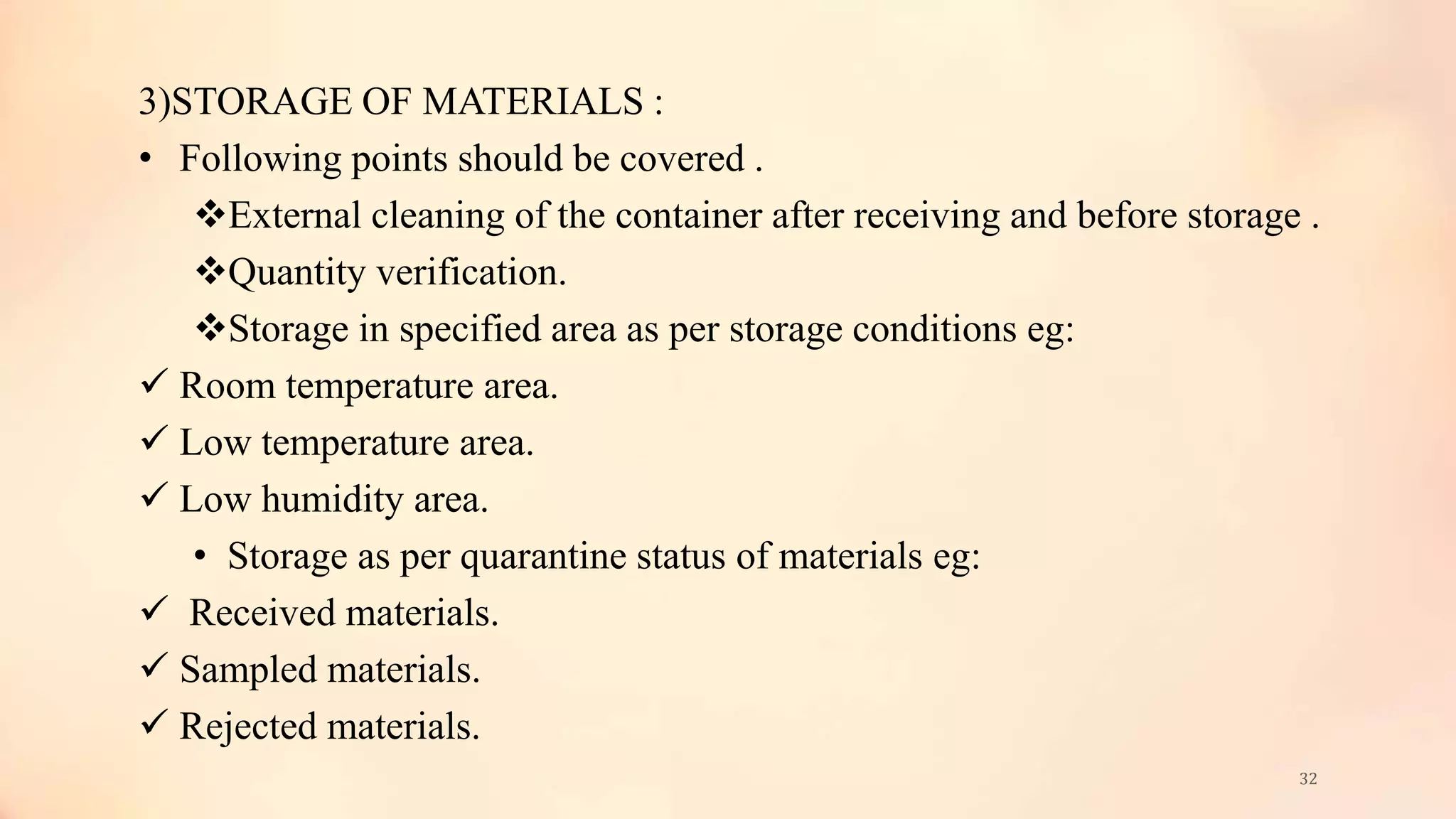
3)STORAGE OF MATERIALS :
• Following points should be covered .
External cleaning of the container after receiving and before storage .
Quantity verification.
Storage in specified area as per storage conditions eg:
 Room temperature area.
 Low temperature area.
 Low humidity area.
• Storage as per quarantine status of materials eg:
 Received materials.
 Sampled materials.
 Rejected materials.
32
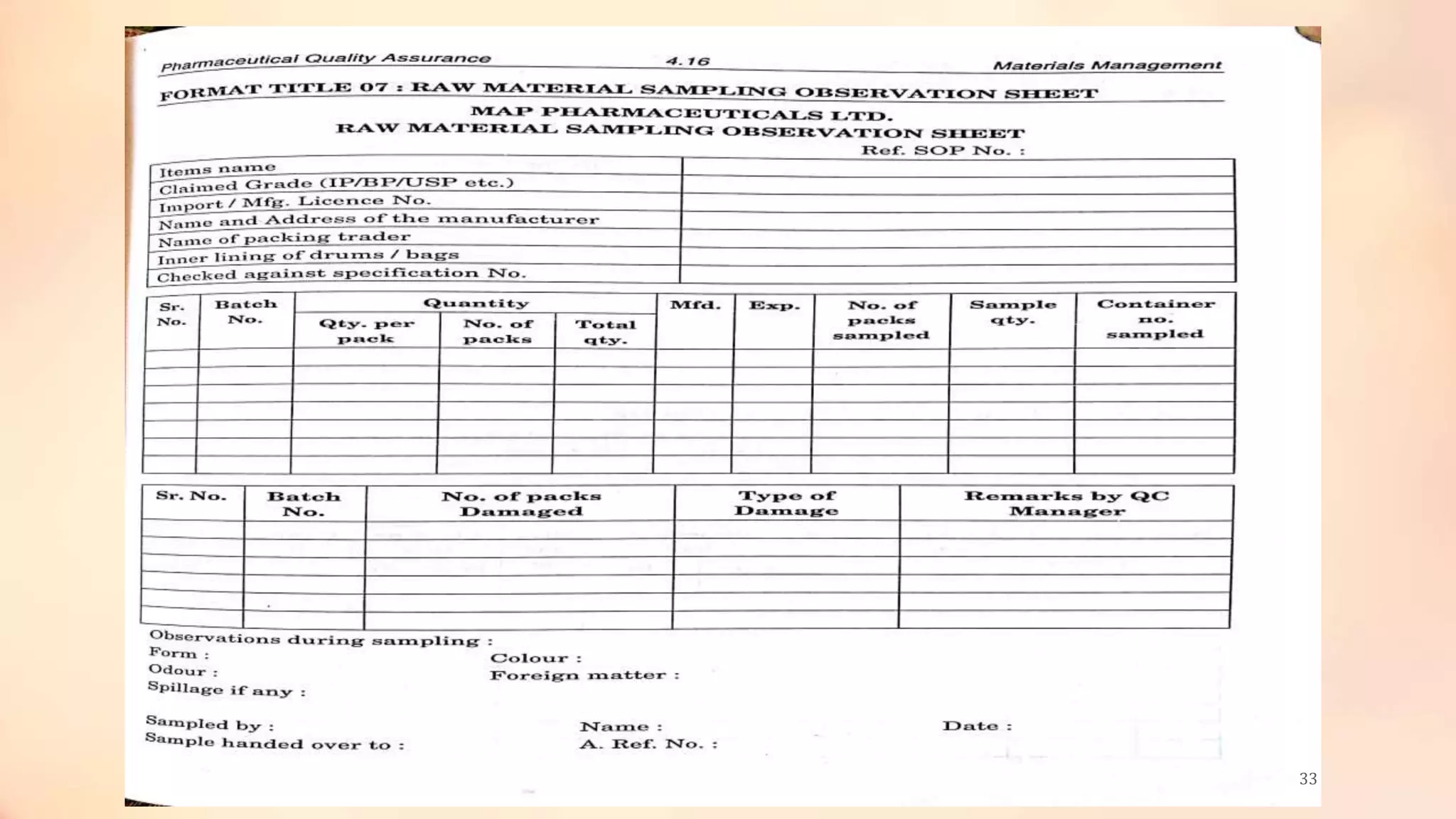
33
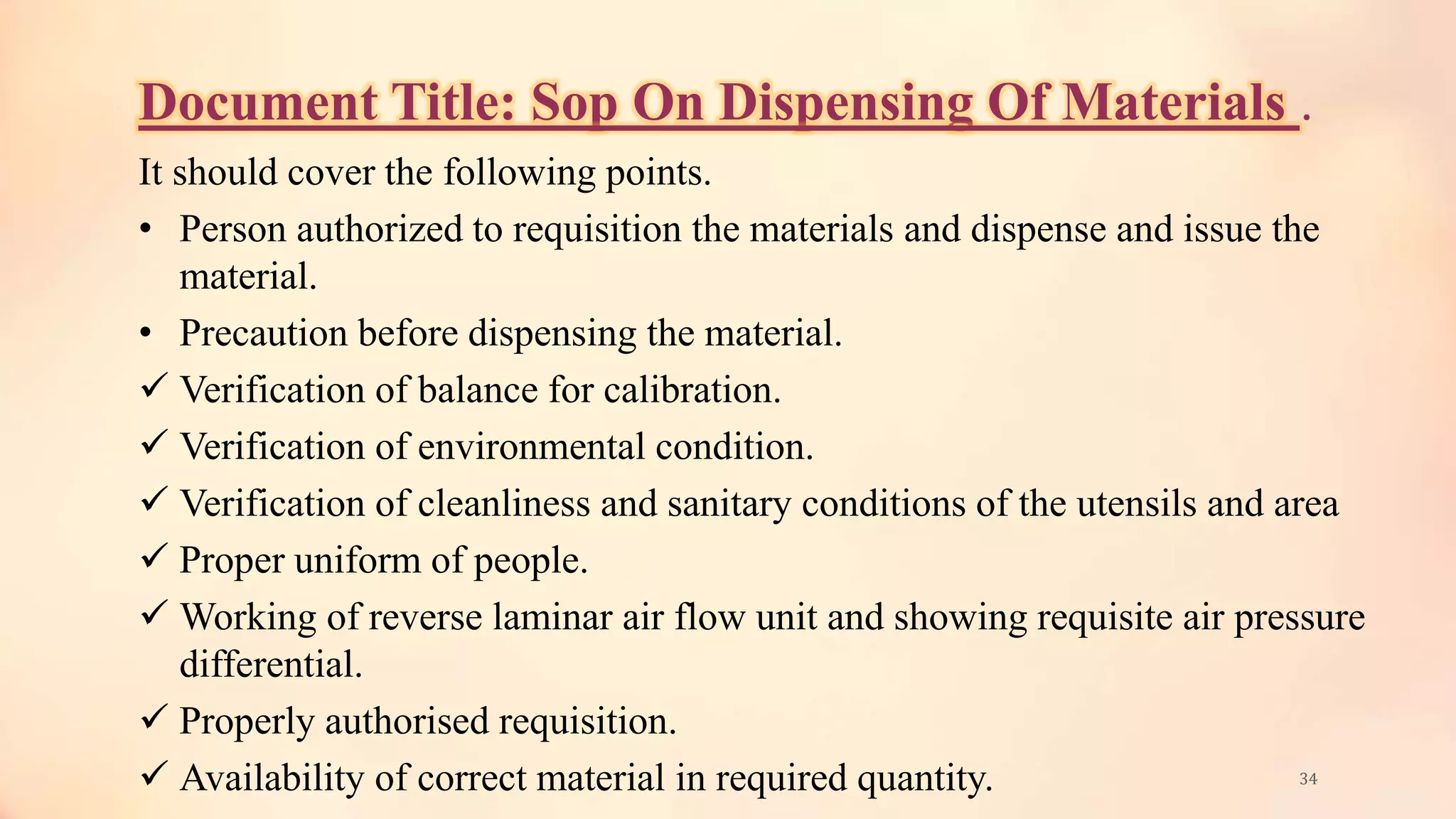
Document Title: Sop On Dispensing Of Materials .
It should cover the following points.
• Person authorized to requisition the materials and dispense and issue the
material.
• Precaution before dispensing the material.
 Verification of balance for calibration.
 Verification of environmental condition.
 Verification of cleanliness and sanitary conditions of the utensils and area
 Proper uniform of people.
 Working of reverse laminar air flow unit and showing requisite air pressure
differential.
 Properly authorised requisition.
 Availability of correct material in required quantity. 34
• Precaution during dispensing of material:
 Verification of each item during weighing.
 Recording correct weight or volume of material.
 Fixing proper labels.
 Opening and closing of the container properly.
 Filling the dispensing document correctly.
• Precaution after dispensing the materials:
 Segregation of the dispensed material properly.
 Retiring the balanced material to the store.
 Cleaning the area and utensils for dispensing.
 The dispensing records eg dispensing log book should be completed immediately and
the activity must be closed.
35
Document Title: SOP On Handling Of Rejected
Materials
• This SOP covers the following points :
How rejected materials are identified?
How these materials are stored?
How records should be maintained ?
How these materials are disposed off ?
What precautions are taken to deal with rejected printed materials ?
What precautions are taken to avoid accidental use of rejected materials ?
36
REFRENCES:
 Potdar. M.; Pharmaceutical Quality Assurance; Nirali prakashan; 4TH
EDITION (4.1-4.18) .
 Roy.M, Dr. Sharma.P; Material management in industry: A Review ;
World journal of pharmaceutical research ; Volume (4) Issue number
:10; (1012-1031).
37
MATERIAL MANAGEMENT QUALITY ASSURANCE TECHNIQUE

MATERIAL MANAGEMENT QUALITY ASSURANCE TECHNIQUE

  • 1.
  • 2.
    CONTENTS:  Introduction.  Definition. Objectives and Functions of Material Management.  Purchasing.  Raw Materials.  Packaging Materials.  Intermediate and Bulk Products .  Rejected and Recovered Materials.  Recalled Products.  Returned Goods. 2
  • 3.
     Reagents andCulture Media.  Waste Materials.  Reference Standard.  Miscellaneous Materials.  Document Formats. 3
  • 4.
    INTRODUCTION: • The primeobjective of pharmaceutical manufacturing operation is to produce finished pharmaceutical products from active, raw materials and various packaging material. • The quality of finished products produced solely depends upon the quality input and hence material management becomes a very important activity in pharmaceutical manufacturing operations. • All incoming materials should be quarantine immediately after receipt or processing until they are released for use or distribution. • All materials and products should be stored under appropriate conditions, established by the manufacturer. • All items must be handled in such a way that no contamination on mix up takes place. 4
  • 5.
    • All materialsand products should be stored under appropriate conditions, established by the manufacturer and user. • These should be stored in an orderly fashion to permit batch segregation by FIRST IN – FIRST OUT(FIFO) and FIRST EXPIRY- FIRST OUT(FEFO) rule. • There shall be written procedures for all activity carried out related to material handling eg; identification, storage, handling, sampling, testing and approval. 5
  • 6.
    DEFINITION • According toThe International Federation of Purchasing and Materials Management defines material management as; • “A total concept having its definite organization to plan and control all types of materials, its supply, and its flow from raw stage to finished stage so as to deliver the product to customer as per his requirements in time.” • “This involves materials planning, purchasing, receiving, storing, inventory control, scheduling, production, physical distribution and marketing. “ 6
  • 7.
    Objectives and Functionsof Material Management Efficient material planning. Buying or purchasing Receiving and procuring. Storage and inventory control. Quality assurance. Primary objective Product scheduling. Material handling. Skilled workers. Standardizatio n Quality control. Secondary objectives 7
  • 8.
    PURCHASING  Following pointsshould be considered regarding purchasing of pharmaceutical material: i. All materials should be purchased against and approved and adequate specification which clearly states quality of material, physical specification, chemical specification, microbiological specification etc. ii. The parameters include specific characteristics like bulk density, particle size, crystalline or amorphous nature, specificity of isomer etc. iii. The raw material and packaging material should be purchased by biased who are trained and possess sufficient technical knowledge. Documents Required SOP for vendor certification
  • 9.
    RAW MATERIALS • Incase of raw materials following points should be considered. • Supplier of the raw material should have his name listed in the company’s approved vendor list. • All raw materials ,must be checked for the following things : Name of the manufacturer. Name of the product. Batch number. Date of manufacture. Date of expiry.  Quantity receive. Condition of container. 9
  • 10.
    • Sampling ofthese received materials should take place in specific sampling booths by QC person only and the container must be labeled accordingly. • All received material must be properly identified with their status i.e. product name, batch number , code number ,sterility status etc. • Labeling should be done along with the following information:  Name and internal code number of product.  Batch number .  Status of material eg: QUARANTINE, on test, released, rejected etc.  Expiry date of the product.  Storage conditions eg: low temperature, low humidity etc. 10
  • 11.
    • Containers fromwhich sample has been taken must be identified . • Only material released by Q.C department and within their shelf life should be used. • Each dispensed material should be weighed or volume should be independently checked and recorded. • Materials dispensed from each batch of the final product should be kept together and conspicuously labeled. • All dispensed materials must be recorded in a chronological order of date and time. DOCUMENTS REQUIRED: • List of approved vendors . • List of material classified according to storage condition. • SOP of sampling , storage and dispensing of material. • Register of sampling. 11
  • 12.
  • 13.
    • PRIMARY PACAKGINGMATERIALS: Materials which come in direct contact of the medicinal product eg: Bottle , vials. • SECONDARY PACKAGING MATERIALS: Materials which come in contact with primary packaging materials eg: Labels and cartons . 13
  • 14.
    • PRINTED PACKAGINGMATERIALS: All packaging materials which have anything printed on it such material include labels, foils etc. TERTIARY PACKAGING MATERIALS: All packaging material other than those that are covered in the above three categories. 14
  • 15.
    The purchase, handlingand control of primary and printed packaging material shall be as for raw material. Printed packaging material should be stored securely in lock and key system Each material should be given a specific identification number. Outdated printed packaging material should be destroyed All product should be checked for identity, safety and purity. Access to storage area should be limited to authorised person only. A separate sampling room must be provided for sampling of packaging materials. 15
  • 16.
     DOCUMENT REQUIRED A classified list of all packaging material.  List of approved vendor.  List of material based on storage.  Sampling and dispensing register In chronological order. 16
  • 17.
    INTERMEDIATE AND BULKPRODUCTS • In pharmaceutical industry normally main or central ware house is responsible for management of raw , packaging and finished products . However intermediate and bulk product storage is the responsibility of production department. • Intermediate or bulk product may be defined as the material , which has started processing but not yet got converted into finished product eg: 1) granulated material ready for compression . 2) filtered liquids for oral or injectables. • These products should be kept under appropriate storage conditions of temperature , relative humidity. DOCUMENT REQUIRED : • List of categories of intermediate and bulk products 17
  • 18.
    REJECTED AND RECOVEREDMATERIALS • Reprocess and retest the materials to see whether it meets our specific requirements. • Destroy or send it to the supplier. • Following points should be considered in this regards:  Rejected materials and products should clearly marked as such and stored separately in restricted areas.  Such areas in industry are normally painted RED in color to make it distinguishable easily. Such materials should either be returned to the suppliers or, where appropriate, reprocessed or destroyed. 18
  • 19.
     Rejected productionbatches should be reprocessed in exceptional situations.  The need for additional testing of any finished product that has been reprocessed or into, which a recovered product has been added should be considered by the Q.C. department. DOCUMENT REQUIRED:  SOP on handling of rejected materials.  Record of disposal of rejected materials.  SOP on handling of recovered materials.  Record of disposal of recovered materials. 19
  • 20.
  • 21.
    RECALLED PRODUCTS • Productswhich are already distributed or sold, may be required at times to be recalled from market for various reasons. • Such recalled product should be clearly identified and stored separately in a secure area until a decision is taken on their fate. Such decision should be made a soon as possible. DOCUMENT REQUIRED • SOP on handling of recalled products. • Records of recalled products and action taken on such recalled product. 21
  • 22.
    • Pharmaceutical productcan be returned from market for various reasons, e.g., quality problems, accidental damage of goods etc. • Physically examine the condition of the goods returned. • Ask Q.C. department to evaluate the quality of the goods received and take a decision on whether these products can be reprocessed and recovered or needs to be destroyed. • If it is possible to reprocess and recover then such products after reprocessing and retesting may be considered for relabeling, repacking and reselling the same. • Q.C. department should evaluate all aspects like condition of the received material, time elapsed since it was first processed etc. along with the chemical, microbiological or any other technical evaluations. RETURNED GOODS 22
  • 23.
    REAGENTS AND CLTUREMEDIA Following points should be considered regarding management of reagents and culture media : • All reagents and culture media should be recorded upon receipt or preparation. • Reagents made up in the laboratories should be prepared according to written procedures and appropriately labeled. Such labels should indicate following information viz.  Name of the reagent.  Nominal concentration.  Standardization factor.  Shelf life.  Date when re-standardization is required.  The storage conditions.  Name/Signature and date of the person who has prepared and standardized the required. 23

  • 24.
    • Both positiveand negative control should be applied to verify suitability of the culture media. The size of the inoculums used in positive controls should be appropriate to the sensitivity required. DOCUMENT REQUIRED : • Register of reagents and culture media. 24
  • 25.
    WASTE MATERIALS • Thrash: Which do not have any resale value and may be disposed off by proper method depending upon the nature of the trash. • Scrap : Which do gave a resale value and may be solid to scrap dealers, after proper segregation. • Before disposal of these materials, they can be segregated in different categories : Paper Aluminum foils Plastic Glass Metallic containers etc. 25
  • 26.
    • Safety ofthe materials to be disposed must be considered; particularly flammable solvent drums must be washed thoroughly before disposal since they pose a potential danger of fire or explosion. • Documents required : • SOP and Records of handling waste work materials. 26
  • 27.
    REFERENCE STANDARD • Referencestandards may be available in the form of official reference standards. • Reference standards prepared by the producer should be tested, released and then stored in the same way as official standards. • They should be kept under the responsibility of a designated person in secure area. • Official reference standards should be prepared and used only for the purpose described in the appropriate monograph. DOCUMENT REQUIRED • SOP and Records on handling of reference and working standards. 27
  • 28.
    MISCELLANEOUS MATERIALS • Allthose materials, which do not specifically fall under the category of R.M/P.M. Intermediate, bulk and finished pharmaceuticals may be considered under this category of miscellaneous materials. • Such materials like, rodenticides , insecticides , fumigating agents and sanitizing materials fall under this category, these materials should not be permitted to contaminate equipment, raw materials, packaging materials, in process materials or finished products. DOCUMENT REQUIRED • List of miscellaneous materials handled in pharmaceutical plants. • SOP on handling of miscellaneous materials. 28
  • 29.
    MISCELLANEOUS MATERIALS • Allthose materials, which do not specifically fall under the category of R.M/P.M. Intermediate, bulk and finished pharmaceuticals may be considered under this category of miscellaneous materials. • Such materials like, rodenticides , insecticides , fumigating agents and sanitizing materials fall under this category, these materials should not be permitted to contaminate equipment, raw materials, packaging materials, in process materials or finished products. DOCUMENT REQUIRED • List of miscellaneous materials handled in pharmaceutical plants. • SOP on handling of miscellaneous materials. 29
  • 30.
  • 31.
    DOCUMENT TITLE :SOP ON RECEIPT , STORAGE AND SAMPLING OF RAW MATERIALAND PACKAGING MATERIAL This SOP should cover the following points in each area of activities : • RECEIPT OF MATERIALS 1)All incoming materials must be visually examined for :  Intact container lids and seals  Evidence of any physical damage to the containers  Evidence of rodent or insect infestation  Proper labelling 2)Following things must be checked and recorded :  Date of receipt.  Control number assigned by the manufacturer, with name of product and batch number.  Quantity received.  Name of supplier. • Purchase order number. 31
  • 32.
    3)STORAGE OF MATERIALS: • Following points should be covered . External cleaning of the container after receiving and before storage . Quantity verification. Storage in specified area as per storage conditions eg:  Room temperature area.  Low temperature area.  Low humidity area. • Storage as per quarantine status of materials eg:  Received materials.  Sampled materials.  Rejected materials. 32
  • 33.
  • 34.
    Document Title: SopOn Dispensing Of Materials . It should cover the following points. • Person authorized to requisition the materials and dispense and issue the material. • Precaution before dispensing the material.  Verification of balance for calibration.  Verification of environmental condition.  Verification of cleanliness and sanitary conditions of the utensils and area  Proper uniform of people.  Working of reverse laminar air flow unit and showing requisite air pressure differential.  Properly authorised requisition.  Availability of correct material in required quantity. 34
  • 35.
    • Precaution duringdispensing of material:  Verification of each item during weighing.  Recording correct weight or volume of material.  Fixing proper labels.  Opening and closing of the container properly.  Filling the dispensing document correctly. • Precaution after dispensing the materials:  Segregation of the dispensed material properly.  Retiring the balanced material to the store.  Cleaning the area and utensils for dispensing.  The dispensing records eg dispensing log book should be completed immediately and the activity must be closed. 35
  • 36.
    Document Title: SOPOn Handling Of Rejected Materials • This SOP covers the following points : How rejected materials are identified? How these materials are stored? How records should be maintained ? How these materials are disposed off ? What precautions are taken to deal with rejected printed materials ? What precautions are taken to avoid accidental use of rejected materials ? 36
  • 37.
    REFRENCES:  Potdar. M.;Pharmaceutical Quality Assurance; Nirali prakashan; 4TH EDITION (4.1-4.18) .  Roy.M, Dr. Sharma.P; Material management in industry: A Review ; World journal of pharmaceutical research ; Volume (4) Issue number :10; (1012-1031). 37