Prepared By:
Shihab Patel
M.Pharm, 1st Sem, Q.A.
Guided By:
Mrs. Avani Khristi
Q.A. Department.
Parul Institute Of Pharmacy,
Parul University,
Waghodiya, Vadodara.
26 February 2018 2
Vendor certification is a supplier-customer partnership and can
only be successful with the full involvement and agreement of
both partners.
OR
It is the combination of activities required to ensure that a
vendor will meet the professional and regulatory expectation of
the sponsor.
OR
It is the system that assure that a supplier’s product is produced
under controlled condition, resulting in consistent quality
Conformance.
DEFINATION:
26 February 2018 3
VENDOR CATEGORIES:
Category – 1
• Generally regarded as EXPERTS.
• Short lived’ in development cycle.
• Contracted to perform limited scope of work.
• Minimal monitoring.
• Example: Supplier customizes a formulation tank. Sponsor
reviews and approves the blueprints prior to manufacturing.
Then IQ and OQ is planned upon receipt to verify acceptability.
26 February 2018 4
Category – 2
• Well known suppliers of standard containers ,closures ,raw
materials and excipients .
• Certified to an International Standards Organization (ISO)-
9000 quality management system.
• Enhanced monitoring is suggested.
• Example: Well-known supplier of containers/closures supplies
multiple lots per year of vials to the sponsor. The sponsor has no
historical quality concerns with the supplier. Testing will be
conducted upon receipt to verify acceptability of materials.
26 February 2018 5
Category – 3
• Category 3 vendors may be category 2 vendors who are
experiencing quality issues with current incoming inventory or
have shown a trend of non-conformance over the last 12
months.
• Can be contract laboratory operations that provide routine
analysis, sometimes in large quantities.
• The risk of non-conformance of these vendors is greater than
with category 2 vendors.
• Advanced monitoring program and an annual audit schedule
are recommended.
26 February 2018 6
Category – 4
• They are sole-source API manufactures.
• Intense monitoring is suggested in this category.
• Examples: A contract manufacture is supplying clinical trials
supplies. Since this is the first time that the product is being
manufactured at a larger scale, the sponsor has elected to be on
site for each event for monitoring and consultation.
• 100% of the lot will be visually inspected for release upon
receipt by the sponsor.
26 February 2018 7
Why to qualify vendors ?
 Used to determine if the vendor is appropriate for the scope of
work.
 Critical attributes of a partner relationship are Supplier or
customer commitment to a long term relationship.
 Information sharing.
 Joint agreement on specifications and performance standards.
 Performance measurement and feedback.
 Customer confidence in the supplier’s manufacturing capability,
quality, cost, and development.
26 February 2018 8
Benefits of the Certification Process :
o Pharma firms will then not have to carry out their own
quality audit of the vendor.
o Vendors will be assured that customers of the product will
not expect to carry out their own quality audit of their
systems or products.
o Rapid and efficient qualification process prior to sale and
delivery/acceptance of a system.
o Reduced cost.
26 February 2018 9
Vendor selection criteria:
1. Quality
2. Delivery
3. Performance history
4. Warranties and claim polices
5. Production facilities and capacity
6. Financial position
7. Price
8. Technical capability
9. Procedural compliance
10.Communication system
11.Reputation and position in industry
12.Desire for business
26 February 2018 10
Process Evaluation:
• The supplier must have suitable equipment to monitor the
process.
• This equipment must be routinely calibrated and test
methods validated. Statistical process control techniques
will usually be applied to demonstrate that the process
remained under control, within acceptable operating ranges,
throughout each production run.
• Process control data for several batches, chosen at random,
should be reviewed to confirm supplier compliance.
26 February 2018 11
• Vendor certification requires assurance that the supplier’s
process is under control and that the required quality
standards are not being achieved by inspecting out
substandard material.
• Increasingly, vendors are being requested to demonstrate
that their production processes are validated, especially for
the manufacture of bulk pharmaceutical chemicals.
• To demonstrate commitment to quality for other components,
some vendors have opted for ISO 9000 certification. This
certification does not necessarily assure consistent quality.
26 February 2018 12
Process and Specification Changes:
• Any proposed changes must be clearly documented, with
reasons and supporting data, and be reviewed and accepted
by the customer prior to introduction.
• Some changes may require customer evaluation and even
FDA approval before acceptance Changes require, prior
review and agreement with the supplier.
• For example, if the customer wants to make any replacement
of a packaging line, there would need to be discussions with
the supplier of the packaging components and the customer
regarding changes.
26 February 2018 13
Customer Inspection:
• After it has been confirmed that a supplier has a controlled
process, there usually will be a period when both parties
evaluate material quality and compare data.
• This provides the needed assurance that supplier and
customer have comparable evaluation ability and minimizes
future potential for disagreements that are due to test results.
• Vendor certification provides a strong basis for the
application of reduced testing by the customer.
• If the supplier’s process is under control, evaluation by the
customer Is necessary to evaluate any changes during
shipment.
26 February 2018 14
• Certification results in a high level of reliance on the supplier:
reduced incoming inspection, reduced inventories, higher
output.
• Any failure by the supplier for matching the customer’s
requirement , may lead to decertification of that supplier for
that material.
• Depending on the nature of the problem it may be possible
to work with the supplier to re-establish certification.
Decertification:
26 February 2018 15
CGMP REQUIREMENTS FOR VENDOR
QUALIFICATION:
Divided into two sections:
1) Site Qualification
2) Site follow-up
 Site Qualification :
• Vendors selected are evaluated for compliance with the
appropriate set of regulations.
• The results of the audit will be reviewed and the need for
a ‘‘site follow-up visit’’ .
26 February 2018 16
• Site qualification visits are generally performed on a cyclical
basis; at least once every 24 months is suggested unless the
supplier becomes problematic.
• Continuous monitoring program is also an essential
component.
 BENEFIT :
• Ability to evaluate the systems that the vendor uses to
produce regulated work product.
• If a system ‘‘gap’’ is detected in any of the quality systems
the sponsor should request corrective action prior to
initiating the work.
26 February 2018 17
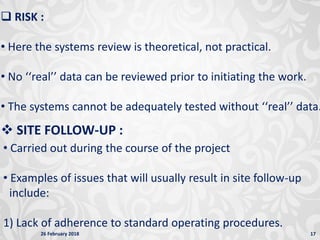
 RISK :
• Here the systems review is theoretical, not practical.
• No ‘‘real’’ data can be reviewed prior to initiating the work.
• The systems cannot be adequately tested without ‘‘real’’ data.
 SITE FOLLOW-UP :
• Carried out during the course of the project
• Examples of issues that will usually result in site follow-up
include:
1) Lack of adherence to standard operating procedures.
26 February 2018 18
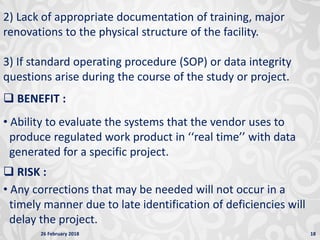
2) Lack of appropriate documentation of training, major
renovations to the physical structure of the facility.
3) If standard operating procedure (SOP) or data integrity
questions arise during the course of the study or project.
 BENEFIT :
• Ability to evaluate the systems that the vendor uses to
produce regulated work product in ‘‘real time’’ with data
generated for a specific project.
 RISK :
• Any corrections that may be needed will not occur in a
timely manner due to late identification of deficiencies will
delay the project.
26 February 2018 19
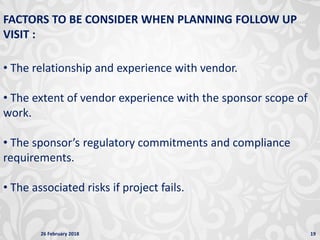
FACTORS TO BE CONSIDER WHEN PLANNING FOLLOW UP
VISIT :
• The relationship and experience with vendor.
• The extent of vendor experience with the sponsor scope of
work.
• The sponsor’s regulatory commitments and compliance
requirements.
• The associated risks if project fails.
26 February 2018 20
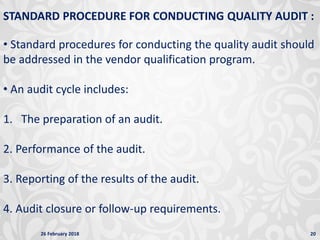
STANDARD PROCEDURE FOR CONDUCTING QUALITY AUDIT :
• Standard procedures for conducting the quality audit should
be addressed in the vendor qualification program.
• An audit cycle includes:
1. The preparation of an audit.
2. Performance of the audit.
3. Reporting of the results of the audit.
4. Audit closure or follow-up requirements.
26 February 2018 21
Step1: Preparing for the Audit-
• Most critical part of the audit.
• Takes longer to complete than performing the actual audit.
• By putting more time into the preparation phase, the
performance of the audit will proceed smoothly.
o Effective audit plan will include the following elements:
• Purpose for the audit.
• Scope of the audit.
• Resources required of the sponsor to complete the audit.
26 February 2018 22
• Number of auditors.
• Type of auditor or expertise required.
• Assignment of a lead auditor to take responsibility for the
audit.
• Reference documents to be used in planning and performing
the audit.
26 February 2018 23
Step 2: Performing the Audit-
• The performance of an audit begins with an introductory
meeting wherein all parties are introduced and the agenda is
discussed.
• The performance of an audit is the collection of evidence
and verification of information through the following means:
Interviews.
Examination of documents.
Direct observation of activities, processes, and conditions.
Review of raw data related to critical documents.
26 February 2018 24
Step 3: Reporting the Results-
• Audit report should present a summary of the results or findings
of the audit.
• This includes both positive findings and any areas identified for
improvement.
• Written summary prior to leaving the vendor’s facility allows the
vendor to begin working on the corrective action plans.
• Formal audit report is the product of the audit.
• Lead auditor is responsible for submitting the formal report in a
timely fashion.
• Final audit report should be prepared within 2 weeks from the
date of the audit.
26 February 2018 25
Step 4: Audit Closure, Corrective Action, and Follow-Up
• After audit , vendor is responsible for developing a
corrective action plan to address any weaknesses or
deficiencies identified by the sponsor’s auditors.
• It is the sponsor’s responsibility to ensure that the corrective
actions are effective and implemented in a timely manner.
• The sponsor must verify all commitments through the
course of routine monitoring.
26 February 2018 26
COMMON PITFALLS IN VENDOR
QUALIFICATION:
• Not establishing the habit of routine update meetings.
• Overestimating the capabilities of the vendor.
• Having a false sense of confidence that the vendor will maintain
itself at the same level throughout the contractual relationship.
• Underestimating the resource-intensiveness of maintaining a
vendor Qualified.
• Not switching vendors when appropriate.
• Not dealing with situations of non-conformance in a timely and
effective manner.
• Overburdening the supplier, as though you were its only client.
26 February 2018 27
1. Sidney H. Willing, "Good Manufacturing Practices for
pharmaceuticals", Drugs and Pharm. Sci. Series, Vol. 109,
Marcel Dekker Inc., N.Y.
2. Elizabeth M. Troll, Karen L. Hughes “The Vendor
Qualification Program” (2004) CHP-10,MARCEL DEKKER
Inc.
3. Charles A. Weber, John R. Current and W.C. Benton
“Vendor selection criteria and methods” European Journal
of Operational Research 50 (1991) 2-18 North-Holland,
Faculty of Management Sciences, College of Business, The
Ohio State University, USA.
REFERENCES:
26 February 2018 28

Vendor qualification

  • 1.
    Prepared By: Shihab Patel M.Pharm,1st Sem, Q.A. Guided By: Mrs. Avani Khristi Q.A. Department. Parul Institute Of Pharmacy, Parul University, Waghodiya, Vadodara.
  • 2.
    26 February 20182 Vendor certification is a supplier-customer partnership and can only be successful with the full involvement and agreement of both partners. OR It is the combination of activities required to ensure that a vendor will meet the professional and regulatory expectation of the sponsor. OR It is the system that assure that a supplier’s product is produced under controlled condition, resulting in consistent quality Conformance. DEFINATION:
  • 3.
    26 February 20183 VENDOR CATEGORIES: Category – 1 • Generally regarded as EXPERTS. • Short lived’ in development cycle. • Contracted to perform limited scope of work. • Minimal monitoring. • Example: Supplier customizes a formulation tank. Sponsor reviews and approves the blueprints prior to manufacturing. Then IQ and OQ is planned upon receipt to verify acceptability.
  • 4.
    26 February 20184 Category – 2 • Well known suppliers of standard containers ,closures ,raw materials and excipients . • Certified to an International Standards Organization (ISO)- 9000 quality management system. • Enhanced monitoring is suggested. • Example: Well-known supplier of containers/closures supplies multiple lots per year of vials to the sponsor. The sponsor has no historical quality concerns with the supplier. Testing will be conducted upon receipt to verify acceptability of materials.
  • 5.
    26 February 20185 Category – 3 • Category 3 vendors may be category 2 vendors who are experiencing quality issues with current incoming inventory or have shown a trend of non-conformance over the last 12 months. • Can be contract laboratory operations that provide routine analysis, sometimes in large quantities. • The risk of non-conformance of these vendors is greater than with category 2 vendors. • Advanced monitoring program and an annual audit schedule are recommended.
  • 6.
    26 February 20186 Category – 4 • They are sole-source API manufactures. • Intense monitoring is suggested in this category. • Examples: A contract manufacture is supplying clinical trials supplies. Since this is the first time that the product is being manufactured at a larger scale, the sponsor has elected to be on site for each event for monitoring and consultation. • 100% of the lot will be visually inspected for release upon receipt by the sponsor.
  • 7.
    26 February 20187 Why to qualify vendors ?  Used to determine if the vendor is appropriate for the scope of work.  Critical attributes of a partner relationship are Supplier or customer commitment to a long term relationship.  Information sharing.  Joint agreement on specifications and performance standards.  Performance measurement and feedback.  Customer confidence in the supplier’s manufacturing capability, quality, cost, and development.
  • 8.
    26 February 20188 Benefits of the Certification Process : o Pharma firms will then not have to carry out their own quality audit of the vendor. o Vendors will be assured that customers of the product will not expect to carry out their own quality audit of their systems or products. o Rapid and efficient qualification process prior to sale and delivery/acceptance of a system. o Reduced cost.
  • 9.
    26 February 20189 Vendor selection criteria: 1. Quality 2. Delivery 3. Performance history 4. Warranties and claim polices 5. Production facilities and capacity 6. Financial position 7. Price 8. Technical capability 9. Procedural compliance 10.Communication system 11.Reputation and position in industry 12.Desire for business
  • 10.
    26 February 201810 Process Evaluation: • The supplier must have suitable equipment to monitor the process. • This equipment must be routinely calibrated and test methods validated. Statistical process control techniques will usually be applied to demonstrate that the process remained under control, within acceptable operating ranges, throughout each production run. • Process control data for several batches, chosen at random, should be reviewed to confirm supplier compliance.
  • 11.
    26 February 201811 • Vendor certification requires assurance that the supplier’s process is under control and that the required quality standards are not being achieved by inspecting out substandard material. • Increasingly, vendors are being requested to demonstrate that their production processes are validated, especially for the manufacture of bulk pharmaceutical chemicals. • To demonstrate commitment to quality for other components, some vendors have opted for ISO 9000 certification. This certification does not necessarily assure consistent quality.
  • 12.
    26 February 201812 Process and Specification Changes: • Any proposed changes must be clearly documented, with reasons and supporting data, and be reviewed and accepted by the customer prior to introduction. • Some changes may require customer evaluation and even FDA approval before acceptance Changes require, prior review and agreement with the supplier. • For example, if the customer wants to make any replacement of a packaging line, there would need to be discussions with the supplier of the packaging components and the customer regarding changes.
  • 13.
    26 February 201813 Customer Inspection: • After it has been confirmed that a supplier has a controlled process, there usually will be a period when both parties evaluate material quality and compare data. • This provides the needed assurance that supplier and customer have comparable evaluation ability and minimizes future potential for disagreements that are due to test results. • Vendor certification provides a strong basis for the application of reduced testing by the customer. • If the supplier’s process is under control, evaluation by the customer Is necessary to evaluate any changes during shipment.
  • 14.
    26 February 201814 • Certification results in a high level of reliance on the supplier: reduced incoming inspection, reduced inventories, higher output. • Any failure by the supplier for matching the customer’s requirement , may lead to decertification of that supplier for that material. • Depending on the nature of the problem it may be possible to work with the supplier to re-establish certification. Decertification:
  • 15.
    26 February 201815 CGMP REQUIREMENTS FOR VENDOR QUALIFICATION: Divided into two sections: 1) Site Qualification 2) Site follow-up  Site Qualification : • Vendors selected are evaluated for compliance with the appropriate set of regulations. • The results of the audit will be reviewed and the need for a ‘‘site follow-up visit’’ .
  • 16.
    26 February 201816 • Site qualification visits are generally performed on a cyclical basis; at least once every 24 months is suggested unless the supplier becomes problematic. • Continuous monitoring program is also an essential component.  BENEFIT : • Ability to evaluate the systems that the vendor uses to produce regulated work product. • If a system ‘‘gap’’ is detected in any of the quality systems the sponsor should request corrective action prior to initiating the work.
  • 17.
    26 February 201817  RISK : • Here the systems review is theoretical, not practical. • No ‘‘real’’ data can be reviewed prior to initiating the work. • The systems cannot be adequately tested without ‘‘real’’ data.  SITE FOLLOW-UP : • Carried out during the course of the project • Examples of issues that will usually result in site follow-up include: 1) Lack of adherence to standard operating procedures.
  • 18.
    26 February 201818 2) Lack of appropriate documentation of training, major renovations to the physical structure of the facility. 3) If standard operating procedure (SOP) or data integrity questions arise during the course of the study or project.  BENEFIT : • Ability to evaluate the systems that the vendor uses to produce regulated work product in ‘‘real time’’ with data generated for a specific project.  RISK : • Any corrections that may be needed will not occur in a timely manner due to late identification of deficiencies will delay the project.
  • 19.
    26 February 201819 FACTORS TO BE CONSIDER WHEN PLANNING FOLLOW UP VISIT : • The relationship and experience with vendor. • The extent of vendor experience with the sponsor scope of work. • The sponsor’s regulatory commitments and compliance requirements. • The associated risks if project fails.
  • 20.
    26 February 201820 STANDARD PROCEDURE FOR CONDUCTING QUALITY AUDIT : • Standard procedures for conducting the quality audit should be addressed in the vendor qualification program. • An audit cycle includes: 1. The preparation of an audit. 2. Performance of the audit. 3. Reporting of the results of the audit. 4. Audit closure or follow-up requirements.
  • 21.
    26 February 201821 Step1: Preparing for the Audit- • Most critical part of the audit. • Takes longer to complete than performing the actual audit. • By putting more time into the preparation phase, the performance of the audit will proceed smoothly. o Effective audit plan will include the following elements: • Purpose for the audit. • Scope of the audit. • Resources required of the sponsor to complete the audit.
  • 22.
    26 February 201822 • Number of auditors. • Type of auditor or expertise required. • Assignment of a lead auditor to take responsibility for the audit. • Reference documents to be used in planning and performing the audit.
  • 23.
    26 February 201823 Step 2: Performing the Audit- • The performance of an audit begins with an introductory meeting wherein all parties are introduced and the agenda is discussed. • The performance of an audit is the collection of evidence and verification of information through the following means: Interviews. Examination of documents. Direct observation of activities, processes, and conditions. Review of raw data related to critical documents.
  • 24.
    26 February 201824 Step 3: Reporting the Results- • Audit report should present a summary of the results or findings of the audit. • This includes both positive findings and any areas identified for improvement. • Written summary prior to leaving the vendor’s facility allows the vendor to begin working on the corrective action plans. • Formal audit report is the product of the audit. • Lead auditor is responsible for submitting the formal report in a timely fashion. • Final audit report should be prepared within 2 weeks from the date of the audit.
  • 25.
    26 February 201825 Step 4: Audit Closure, Corrective Action, and Follow-Up • After audit , vendor is responsible for developing a corrective action plan to address any weaknesses or deficiencies identified by the sponsor’s auditors. • It is the sponsor’s responsibility to ensure that the corrective actions are effective and implemented in a timely manner. • The sponsor must verify all commitments through the course of routine monitoring.
  • 26.
    26 February 201826 COMMON PITFALLS IN VENDOR QUALIFICATION: • Not establishing the habit of routine update meetings. • Overestimating the capabilities of the vendor. • Having a false sense of confidence that the vendor will maintain itself at the same level throughout the contractual relationship. • Underestimating the resource-intensiveness of maintaining a vendor Qualified. • Not switching vendors when appropriate. • Not dealing with situations of non-conformance in a timely and effective manner. • Overburdening the supplier, as though you were its only client.
  • 27.
    26 February 201827 1. Sidney H. Willing, "Good Manufacturing Practices for pharmaceuticals", Drugs and Pharm. Sci. Series, Vol. 109, Marcel Dekker Inc., N.Y. 2. Elizabeth M. Troll, Karen L. Hughes “The Vendor Qualification Program” (2004) CHP-10,MARCEL DEKKER Inc. 3. Charles A. Weber, John R. Current and W.C. Benton “Vendor selection criteria and methods” European Journal of Operational Research 50 (1991) 2-18 North-Holland, Faculty of Management Sciences, College of Business, The Ohio State University, USA. REFERENCES:
  • 28.