Rapid Prototyping

   Audrey Bowser-Brown
        Julie Pace
      Debra Reschke
      Aileen Sullivan
Rapid Prototyping
Using new technologies, time for parts of
virtually any complexity is measured in hours,
instead of days, weeks, or months; it is rapid.

A prototype is something to look at, serves as
a basis for discussion but cannot be used for
anything “serious”.
Prototyping as a Design
           Methodology
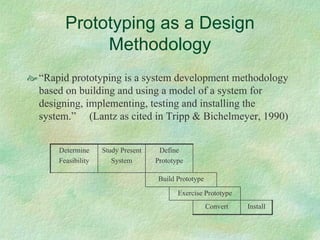
“Rapid prototyping is a system development methodology
based on building and using a model of a system for
designing, implementing, testing and installing the
system.” (Lantz as cited in Tripp & Bichelmeyer, 1990)


    Determine     Study Present    Define
    Feasibility      System       Prototype

                                  Build Prototype
                                         Exercise Prototype
                                                    Convert   Install
Prototyping as a Method for
    Instructional Design
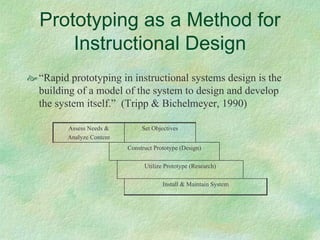
“Rapid prototyping in instructional systems design is the
building of a model of the system to design and develop
the system itself.” (Tripp & Bichelmeyer, 1990)

      Assess Needs &         Set Objectives
      Analyze Content
                        Construct Prototype (Design)

                              Utilize Prototype (Research)

                                     Install & Maintain System
Used in Computer Software
          and Education
Effective in
   situations where synthesis and modification
  must occur quickly.
   cases with complex factors.
   cases where conventional methods yield
  unsatisfactory results.
   unfamiliar situations.
Application to Education
Designers try to be systematic in
approaching large, complex problems.
Designers bring orderly and systematic
methods to a discipline full of individual
practitioners.
Designers use formative evaluation
practices when developing systems.
Educators deal with systems based on
human cognition.
Steps Involved in Rapid
      Prototyping
Step 1: Statement of Needs
        and Objectives

The purpose of a succinct statement is to:
  communicate.
  offer a plan of action.
Step 2: Research &
          Development
Construct prototypes under these conditions:
  offer little or no commitment to the design
  focus on solving immediate problems
  create alternative designs that may even be
 contradictory
Step 2 (Cont.)
Utilize Prototype
   designer observes
   learner asks questions to discover strengths
 and weaknesses
   problem discovery, not problem solving
   the creation process most likely begins
 again
Step 3:The Final Project
 "an appropriate artifact not a
generalization"
 the instructional design process has been a
unique experience, not one that can be
replicated in the exact manner again
Learning Environment
          Assumptions
Modularity
  allows a segments of the instruction to be
 changed, added, and/or removed without
 severely affecting the whole

examples:
     looseleaf notebooks
     overhead transparency presentations
Learning Environment
      Assumptions (Cont.)
 Plasticity
  the ability to revise one aspect of a unit of
 instruction without creating time and cost
 penalties

example
    computer programs
Advantages
     of Rapid Prototyping
 Effective in instructional design because
method does not occur linearly.
 Stresses rapid synthesis of design due to
use of software.
 Allows needed flexibility because designs
intended for human use.
Advantages
of Rapid Prototyping (Cont.)
Encourages greater designer creativity
because of immediate feedback from the
user.
Users have input into the design as they
discover problems while trying out the
system.
Advantages
of Rapid Prototyping (Cont.)
 Because users are involved in the
development process, the system produced
is accurate for the designated users.
 Reduces development costs.
 Cuts down on actual time needed to
develop the system.
Disadvantage
    of Rapid Prototyping
 Sometimes encourages informal design
methods which may cause more problems
to fix.
Comparison
          to
   Other Models
          of
Instructional Design
The Dick and Carey Model
 Both use knowledge of instructional design
elements.
 Dick and Carey speaks to the teaching of
instructional design and computer-based
instruction as a potential concern
 Dick and Carey assert that design is lost in
rapid prototyping where the emphsis is to
simply get something up and running.
 Dick and Carey is linear.
R2D2 Model
Both non-linear in development.
Begin with evaluation of needs.
Design groups consist of actual users as
well as designers.
Time efficient process because target
audience is part of process.
Most activity in process is in creation of
material.
Layers of Negotiation Model
Both are systematic in nature.
Both require contact and discussion
between the designer and the user.
Both are non-linear.
Negotiation is based on process outcome
goals while Prototyping is based on product
outcome goals.
Chaos Theory
Both emphasize hands-on and flexibily
with change.
Both account for unpredictability.
Both have a feedback loop.
Chaos theory has a beginning with set goal
and objectives and a tangible end.
 Chaos theory is linear.
Is this a Paradigm Shift?
 YES - Use of rapid prototyping is more
than another instructional design strategy, it
is a belief about how design takes place to
create learning environments.
 NO - Rapid prototyping is a variation on
instructional design and although efficient,
should not replace knowledge about
teaching and learning.
References
Gustafson, K. L. & Branch, R. M. (1997) Revisioning models of
   instructional development. ETR &D, 45(3), p. 73-89.
Tripp, S. C. & Bichelmeyer, B. (1990). Rapid prototyping: An alternative
   instructional design strategy. ETR &D, 38(1), p. 31-44.

Rapid Prototyping,Rapid prototype,SLA prototype

  • 1.
    Rapid Prototyping Audrey Bowser-Brown Julie Pace Debra Reschke Aileen Sullivan
  • 2.
    Rapid Prototyping Using newtechnologies, time for parts of virtually any complexity is measured in hours, instead of days, weeks, or months; it is rapid. A prototype is something to look at, serves as a basis for discussion but cannot be used for anything “serious”.
  • 3.
    Prototyping as aDesign Methodology “Rapid prototyping is a system development methodology based on building and using a model of a system for designing, implementing, testing and installing the system.” (Lantz as cited in Tripp & Bichelmeyer, 1990) Determine Study Present Define Feasibility System Prototype Build Prototype Exercise Prototype Convert Install
  • 4.
    Prototyping as aMethod for Instructional Design “Rapid prototyping in instructional systems design is the building of a model of the system to design and develop the system itself.” (Tripp & Bichelmeyer, 1990) Assess Needs & Set Objectives Analyze Content Construct Prototype (Design) Utilize Prototype (Research) Install & Maintain System
  • 5.
    Used in ComputerSoftware and Education Effective in situations where synthesis and modification must occur quickly. cases with complex factors. cases where conventional methods yield unsatisfactory results. unfamiliar situations.
  • 6.
    Application to Education Designerstry to be systematic in approaching large, complex problems. Designers bring orderly and systematic methods to a discipline full of individual practitioners. Designers use formative evaluation practices when developing systems. Educators deal with systems based on human cognition.
  • 7.
    Steps Involved inRapid Prototyping
  • 8.
    Step 1: Statementof Needs and Objectives The purpose of a succinct statement is to: communicate. offer a plan of action.
  • 9.
    Step 2: Research& Development Construct prototypes under these conditions: offer little or no commitment to the design focus on solving immediate problems create alternative designs that may even be contradictory
  • 10.
    Step 2 (Cont.) UtilizePrototype designer observes learner asks questions to discover strengths and weaknesses problem discovery, not problem solving the creation process most likely begins again
  • 11.
    Step 3:The FinalProject "an appropriate artifact not a generalization" the instructional design process has been a unique experience, not one that can be replicated in the exact manner again
  • 12.
    Learning Environment Assumptions Modularity allows a segments of the instruction to be changed, added, and/or removed without severely affecting the whole examples: looseleaf notebooks overhead transparency presentations
  • 13.
    Learning Environment Assumptions (Cont.) Plasticity the ability to revise one aspect of a unit of instruction without creating time and cost penalties example computer programs
  • 14.
    Advantages of Rapid Prototyping Effective in instructional design because method does not occur linearly. Stresses rapid synthesis of design due to use of software. Allows needed flexibility because designs intended for human use.
  • 15.
    Advantages of Rapid Prototyping(Cont.) Encourages greater designer creativity because of immediate feedback from the user. Users have input into the design as they discover problems while trying out the system.
  • 16.
    Advantages of Rapid Prototyping(Cont.) Because users are involved in the development process, the system produced is accurate for the designated users. Reduces development costs. Cuts down on actual time needed to develop the system.
  • 17.
    Disadvantage of Rapid Prototyping Sometimes encourages informal design methods which may cause more problems to fix.
  • 18.
    Comparison to Other Models of Instructional Design
  • 19.
    The Dick andCarey Model Both use knowledge of instructional design elements. Dick and Carey speaks to the teaching of instructional design and computer-based instruction as a potential concern Dick and Carey assert that design is lost in rapid prototyping where the emphsis is to simply get something up and running. Dick and Carey is linear.
  • 20.
    R2D2 Model Both non-linearin development. Begin with evaluation of needs. Design groups consist of actual users as well as designers. Time efficient process because target audience is part of process. Most activity in process is in creation of material.
  • 21.
    Layers of NegotiationModel Both are systematic in nature. Both require contact and discussion between the designer and the user. Both are non-linear. Negotiation is based on process outcome goals while Prototyping is based on product outcome goals.
  • 22.
    Chaos Theory Both emphasizehands-on and flexibily with change. Both account for unpredictability. Both have a feedback loop. Chaos theory has a beginning with set goal and objectives and a tangible end. Chaos theory is linear.
  • 23.
    Is this aParadigm Shift? YES - Use of rapid prototyping is more than another instructional design strategy, it is a belief about how design takes place to create learning environments. NO - Rapid prototyping is a variation on instructional design and although efficient, should not replace knowledge about teaching and learning.
  • 24.
    References Gustafson, K. L.& Branch, R. M. (1997) Revisioning models of instructional development. ETR &D, 45(3), p. 73-89. Tripp, S. C. & Bichelmeyer, B. (1990). Rapid prototyping: An alternative instructional design strategy. ETR &D, 38(1), p. 31-44.