Rapid
Prototyping
“In this iterative process, initial
design ideas are proposed and
then represented in very rough
form in an online, working
prototype that is created with
minimal investment of time and
resources.”
-Ethan Edwards
Edwards, E. (2009, April 1). Rapid prototyping is a powerful design methodology for e-learning. The key lies in the speed.
Talent Development, 63(8), 92-93. Retrieved February 13, 2016.
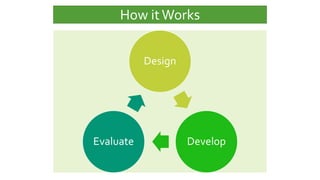
Design
DevelopEvaluate
How itWorks
Choosing
the Right
Tool
 The tool used to make prototypes must be able
to represent the interactivity of the final tool
that will be used.
 The tool should make it easy to constantly
adjust the prototype.
 The designer should know how to use the tool
well.
 Remember to be rapid!The first prototype
should not take more than an hour.
Edwards, E. (2009, April 1). Rapid prototyping is a powerful design methodology for e-learning. The key lies in the speed.
Talent Development, 63(8), 92-93. Retrieved February 13, 2016.
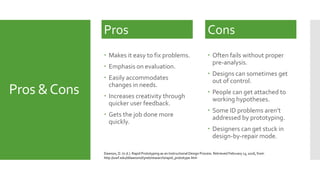
Pros &Cons
 Makes it easy to fix problems.
 Emphasis on evaluation.
 Easily accommodates
changes in needs.
 Increases creativity through
quicker user feedback.
 Gets the job done more
quickly.
Cons
 Often fails without proper
pre-analysis.
 Designs can sometimes get
out of control.
 People can get attached to
working hypotheses.
 Some ID problems aren’t
addressed by prototyping.
 Designers can get stuck in
design-by-repair mode.
Pros
Dawson, D. (n.d.). Rapid Prototyping as an Instructional Design Process. Retrieved February 13, 2016, from
http://uwf.edu/ddawson/d3net/research/rapid_prototype.htm
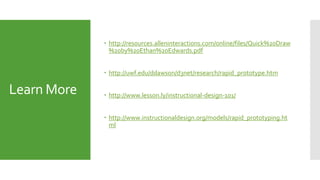
Learn More
 http://resources.alleninteractions.com/online/files/Quick%20Draw
%20by%20Ethan%20Edwards.pdf
 http://uwf.edu/ddawson/d3net/research/rapid_prototype.htm
 http://www.lesson.ly/instructional-design-101/
 http://www.instructionaldesign.org/models/rapid_prototyping.ht
ml
Thank you!
Diane Forand, Andrew Hinote, Kelly Anne O’Connor
Group 3 – INSDSG 655: Project in Multimedia

Overview of Rapid Prototyping ID Model

  • 1.
    Rapid Prototyping “In this iterativeprocess, initial design ideas are proposed and then represented in very rough form in an online, working prototype that is created with minimal investment of time and resources.” -Ethan Edwards Edwards, E. (2009, April 1). Rapid prototyping is a powerful design methodology for e-learning. The key lies in the speed. Talent Development, 63(8), 92-93. Retrieved February 13, 2016.
  • 2.
  • 3.
    Choosing the Right Tool  Thetool used to make prototypes must be able to represent the interactivity of the final tool that will be used.  The tool should make it easy to constantly adjust the prototype.  The designer should know how to use the tool well.  Remember to be rapid!The first prototype should not take more than an hour. Edwards, E. (2009, April 1). Rapid prototyping is a powerful design methodology for e-learning. The key lies in the speed. Talent Development, 63(8), 92-93. Retrieved February 13, 2016.
  • 4.
    Pros &Cons  Makesit easy to fix problems.  Emphasis on evaluation.  Easily accommodates changes in needs.  Increases creativity through quicker user feedback.  Gets the job done more quickly. Cons  Often fails without proper pre-analysis.  Designs can sometimes get out of control.  People can get attached to working hypotheses.  Some ID problems aren’t addressed by prototyping.  Designers can get stuck in design-by-repair mode. Pros Dawson, D. (n.d.). Rapid Prototyping as an Instructional Design Process. Retrieved February 13, 2016, from http://uwf.edu/ddawson/d3net/research/rapid_prototype.htm
  • 5.
    Learn More  http://resources.alleninteractions.com/online/files/Quick%20Draw %20by%20Ethan%20Edwards.pdf http://uwf.edu/ddawson/d3net/research/rapid_prototype.htm  http://www.lesson.ly/instructional-design-101/  http://www.instructionaldesign.org/models/rapid_prototyping.ht ml
  • 6.
    Thank you! Diane Forand,Andrew Hinote, Kelly Anne O’Connor Group 3 – INSDSG 655: Project in Multimedia