Satu Miettinen, Juha Miettinen, Antti Kares, Raisa Leinonen and Timo Sirviö
    Kuopio Academy of Design, Savonia University of Applied Sciences
                                 Finland

                     P.O. BOX 98, FIN -70101 KUOPIO
                      Email: office@designkuopio.fi


                                             "DE-SME - Intelligent Furniture - Training for Design,
                                             Environment and New Materials in SMEs"
                                             Agreement n. 2009 - 2196 / 001 - 001
Theme 5.4.1. Prototyping process: tools and methods

                   What is prototyping?


2
Prototyping
•   Design Prototyping
•   Technology for Developing Communities
•   Professor Joe Mertz
•   Fall 2006
•   http://www.techbridgeworld.org/courses/TDC_F06/l
    ectures/L12_Prototyping.pdf
Why to Prototype?

•   Get feedback from users faster saves money
•   Experiment with alternative designs
•   Fix problems before design decitions
•   Keep the design centered on the user
Prototyping can be used


•   In good iterative design practices
•   To refine designs with formative evaluations
•   In good participative design
•   Allows for collaboration in interim stages
•   To keep the scope of your class projects reasonable
http://www.techbridgeworld.org/courses/TDC_F06/lectures/L12_Prototyping
   .pdf
Fidelity in Prototyping
• Fidelity refers to the level of detail
• High fidelity?
   – prototypes look like the final product
• Low fidelity? (Paper prototyping)
   – artists renditions with many details missing
Advantage of lowfi
•    Cheap = less time and easier to change
•    Quick feedback
•    More cycles of testing, more prototype
•    Widely practiced in industry, even though it
     sounds silly in the beginning

    http://hci.epfl.ch/teaching/hci/course_material/lofi-
    prototype/lecture5-lofi_proto-x6.pdf
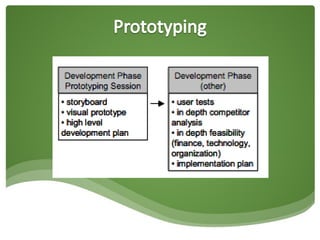
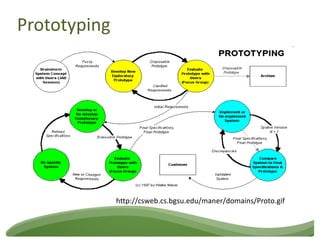
Prototyping


              http://csweb.cs.bgsu.edu/maner/domains/Proto.gif
Types of design prototypes
•   Low- and high-fidelity prototyping
•   Sketches
•   Paper prototyping
•   Mock-up models
•   Storyboarding
•   Web-based prototyping
•   Software prototyping
•   Video prototyping
Experience prototyping
• Prototyping method, creating, generating and
  modelling new service feature
Experience prototyping
• An experience prototype is a representation of a
  design, made before the final solution exists. We
  need prototyping for electronics, we need to
  think about a more total experience like
  designing a service or designing what happens
  with the chips and the people, then you need
  something which is more to do with storytelling,
  using video of how to tell a story or theatre for
  enactment or computer simulations. All of those
  become a necessary part of our prototyping
  vocabulary.
Experience prototyping
• The rapidness of a prototype cycle between
  trying something out and testing it with
  people, trying it out with people, is what
  makes the relationship between design and
  business successful. We can make a small
  prototype very inexpensively, we can try it
  out, test it and if it’s successful perhaps we’ll
  move forward to the next stage.
Experience prototyping
• The aim of experience prototyping is to test the
  feasibility of the service, the logistics, customer
  experience and financial impact of the service
  product in a cheap and quick way. An experience
  prototype is any kind of representation, in any kind
  of medium, that is designed to understand, explore
  or communi- cate what it might be like to engage
  with the product, space or system we are designing.
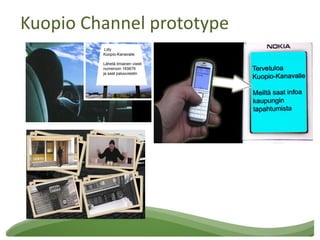
Kuopio Channel prototype
Virtual prototyping
• To test usability based on a virtual model
  instead of a real prototype, it may be possible
  to push testing earlier into the design process,
  where it is easier and cheaper to correct any
  potential errors.
Virtual prototyping
• Normally, usability testing is done in situations where
  both testers and users are at the same time in the
  same place. Users perform given tasks with the
  system, and testers observe their behaviour to find
  problems in the user interface. Often, the test
  situation is videotaped to help later analysing of the
  session.
• In remote testing, the persons running a test are
  distanced, spatially and/or temporally, from the users
  of the system to be tested
Virtual prototyping
• The internationalisation of markets and
  companies has created a need to evaluate and
  test products during the design process in a
  geographically wide area with users belonging
  to different cultures. Products may have
  several different potential user groups, or
  companies have product development in
  several places..
Virtual prototyping
• The development of networks has opened
  possibilities for distributed activity and also
  for remote usability testing. It is possible, e.g.,
  to use shared desktop applications, video
  conferences, questionnaires located on the
  Internet to collect subjective experiences of
  users, for example, so that performing some
  function automatically opens a reply screen
Virtual prototyping
• Many remote testing settings rely on
  recording or transmitting both video and
  audio of the test situation. Another possibility
  would be to collect data automatically from
  actual interactions with the product.
Virtual prototyping
• Users have also been trained to recognise
  usability problems and to report them to product
  developers. For example, when developing a
  method called as the "user-reported critical
  incident, developers had made a special button in
  the application under development and testing so
  that users could easily generate a problem report
  and send that to developers whenever problems
  were encountered.
Paper prototyping
• This method features a paper-based simulation of
  an interface or system. Paper prototypes provide
  a valuable and cost-effective means of evaluating
  and iterating design options before deciding on
  one implementation. Interface elements such as
  menus, windows, dialogues and icons can be
  sketched on paper or created in advance using
  cards, pens, etc. The result is sometimes referred
  to as a low- fidelity prototype.
Rapid Prototyping
• This method is concerned with developing different
  proposed concepts by evaluating software or hardware
  prototypes. The development of a simulation or prototype of
  the future system can be very helpful. It allows users to get an
  idea of the look and feel of the system and provide feedback
  on it. Thus it can be used to clarify user requirements options.
  Rapid prototyping is described as a computer-based method
  which aims to reduce the iterative development cycle.
  Interactive, quickly replaceable prototypes are developed in
  line with design feedback.
References
Heinilä, J. (Ed.), Strömberg, H., Leikas, J., Ikonen, V., Iivari, N., Jokela, T., Aikio,K. P., Jounila, I., Hoonhout, J. and Leurs, N. (2005): User Centred Design
Guidelines for Methods and Tools. VTT Information Technology; University of Oulu, Dept. of Information processing science;
Philips Research, Philips Applied Technologies. The Nomadic Media consortium, November 2005.
http://www.vtt.fi/inf/julkaisut/ muut/2005/UCD_Guidelines.pdf (3.5.2009)
Iacucci, G., Kuutti, K. and Ranta, M. (2000): On the Move with a Magic Thing: Role Playing in Concept
Design of Mobile Services and Devices. DIS ’00, Brooklyn, New York. http://users.tkk.fi/~giulio/ P1_jacucci.pdf (2.5.2009)


24
This project has been funded with support from the European Commission. This publication
     reflects the views only of the author, and the Commission cannot be held responsible for any
     use which may be made of the information contained therein.


13.3.2012                                                                                           25

TP2 Prototyping process tools and methods

  • 1.
    Satu Miettinen, JuhaMiettinen, Antti Kares, Raisa Leinonen and Timo Sirviö Kuopio Academy of Design, Savonia University of Applied Sciences Finland P.O. BOX 98, FIN -70101 KUOPIO Email: office@designkuopio.fi "DE-SME - Intelligent Furniture - Training for Design, Environment and New Materials in SMEs" Agreement n. 2009 - 2196 / 001 - 001
  • 2.
    Theme 5.4.1. Prototypingprocess: tools and methods What is prototyping? 2
  • 3.
    Prototyping • Design Prototyping • Technology for Developing Communities • Professor Joe Mertz • Fall 2006 • http://www.techbridgeworld.org/courses/TDC_F06/l ectures/L12_Prototyping.pdf
  • 4.
    Why to Prototype? • Get feedback from users faster saves money • Experiment with alternative designs • Fix problems before design decitions • Keep the design centered on the user
  • 6.
    Prototyping can beused • In good iterative design practices • To refine designs with formative evaluations • In good participative design • Allows for collaboration in interim stages • To keep the scope of your class projects reasonable http://www.techbridgeworld.org/courses/TDC_F06/lectures/L12_Prototyping .pdf
  • 7.
    Fidelity in Prototyping •Fidelity refers to the level of detail • High fidelity? – prototypes look like the final product • Low fidelity? (Paper prototyping) – artists renditions with many details missing
  • 8.
    Advantage of lowfi • Cheap = less time and easier to change • Quick feedback • More cycles of testing, more prototype • Widely practiced in industry, even though it sounds silly in the beginning http://hci.epfl.ch/teaching/hci/course_material/lofi- prototype/lecture5-lofi_proto-x6.pdf
  • 9.
    Prototyping http://csweb.cs.bgsu.edu/maner/domains/Proto.gif
  • 10.
    Types of designprototypes • Low- and high-fidelity prototyping • Sketches • Paper prototyping • Mock-up models • Storyboarding • Web-based prototyping • Software prototyping • Video prototyping
  • 11.
    Experience prototyping • Prototypingmethod, creating, generating and modelling new service feature
  • 12.
    Experience prototyping • Anexperience prototype is a representation of a design, made before the final solution exists. We need prototyping for electronics, we need to think about a more total experience like designing a service or designing what happens with the chips and the people, then you need something which is more to do with storytelling, using video of how to tell a story or theatre for enactment or computer simulations. All of those become a necessary part of our prototyping vocabulary.
  • 13.
    Experience prototyping • Therapidness of a prototype cycle between trying something out and testing it with people, trying it out with people, is what makes the relationship between design and business successful. We can make a small prototype very inexpensively, we can try it out, test it and if it’s successful perhaps we’ll move forward to the next stage.
  • 14.
    Experience prototyping • Theaim of experience prototyping is to test the feasibility of the service, the logistics, customer experience and financial impact of the service product in a cheap and quick way. An experience prototype is any kind of representation, in any kind of medium, that is designed to understand, explore or communi- cate what it might be like to engage with the product, space or system we are designing.
  • 15.
  • 16.
    Virtual prototyping • Totest usability based on a virtual model instead of a real prototype, it may be possible to push testing earlier into the design process, where it is easier and cheaper to correct any potential errors.
  • 17.
    Virtual prototyping • Normally,usability testing is done in situations where both testers and users are at the same time in the same place. Users perform given tasks with the system, and testers observe their behaviour to find problems in the user interface. Often, the test situation is videotaped to help later analysing of the session. • In remote testing, the persons running a test are distanced, spatially and/or temporally, from the users of the system to be tested
  • 18.
    Virtual prototyping • Theinternationalisation of markets and companies has created a need to evaluate and test products during the design process in a geographically wide area with users belonging to different cultures. Products may have several different potential user groups, or companies have product development in several places..
  • 19.
    Virtual prototyping • Thedevelopment of networks has opened possibilities for distributed activity and also for remote usability testing. It is possible, e.g., to use shared desktop applications, video conferences, questionnaires located on the Internet to collect subjective experiences of users, for example, so that performing some function automatically opens a reply screen
  • 20.
    Virtual prototyping • Manyremote testing settings rely on recording or transmitting both video and audio of the test situation. Another possibility would be to collect data automatically from actual interactions with the product.
  • 21.
    Virtual prototyping • Usershave also been trained to recognise usability problems and to report them to product developers. For example, when developing a method called as the "user-reported critical incident, developers had made a special button in the application under development and testing so that users could easily generate a problem report and send that to developers whenever problems were encountered.
  • 22.
    Paper prototyping • Thismethod features a paper-based simulation of an interface or system. Paper prototypes provide a valuable and cost-effective means of evaluating and iterating design options before deciding on one implementation. Interface elements such as menus, windows, dialogues and icons can be sketched on paper or created in advance using cards, pens, etc. The result is sometimes referred to as a low- fidelity prototype.
  • 23.
    Rapid Prototyping • Thismethod is concerned with developing different proposed concepts by evaluating software or hardware prototypes. The development of a simulation or prototype of the future system can be very helpful. It allows users to get an idea of the look and feel of the system and provide feedback on it. Thus it can be used to clarify user requirements options. Rapid prototyping is described as a computer-based method which aims to reduce the iterative development cycle. Interactive, quickly replaceable prototypes are developed in line with design feedback.
  • 24.
    References Heinilä, J. (Ed.),Strömberg, H., Leikas, J., Ikonen, V., Iivari, N., Jokela, T., Aikio,K. P., Jounila, I., Hoonhout, J. and Leurs, N. (2005): User Centred Design Guidelines for Methods and Tools. VTT Information Technology; University of Oulu, Dept. of Information processing science; Philips Research, Philips Applied Technologies. The Nomadic Media consortium, November 2005. http://www.vtt.fi/inf/julkaisut/ muut/2005/UCD_Guidelines.pdf (3.5.2009) Iacucci, G., Kuutti, K. and Ranta, M. (2000): On the Move with a Magic Thing: Role Playing in Concept Design of Mobile Services and Devices. DIS ’00, Brooklyn, New York. http://users.tkk.fi/~giulio/ P1_jacucci.pdf (2.5.2009) 24
  • 25.
    This project hasbeen funded with support from the European Commission. This publication reflects the views only of the author, and the Commission cannot be held responsible for any use which may be made of the information contained therein. 13.3.2012 25