STEREOLITHOGRAPHY
WORLD’S FIRST ADDITIVE MANUFACTURING
ORIGINS
 IT was first discovered in the Japanese researcher.
 Research in the area had been conducted during the 1970s, but the term was
coined by Charles (Chuck) W. Hull in 1986 when he patented the process. He then
set up 3D Systems Inc to commercialize his patent.
 Machines operate on the same principal as they did when they were in their first
versions.
 Only the method had become faster and more reliable, offering more precision i.e
resolution in the final product.
 More resolution means less wastage of materials. ( Researchers have even
developed a printer that can print your veins !!! Creepy, right?? )
What is it then ?
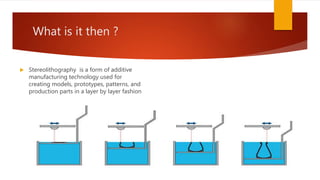
 Stereolithography is a form of additive
manufacturing technology used for
creating models, prototypes, patterns, and
production parts in a layer by layer fashion
It is also commonly known as..
 Optical Fabrication,
 Photo-Solidification,
 Solid Free-Form Fabrication,
 Solid Imaging,
 Resin Printing,
 Rapid prototyping ( used frequently to create concept models).
Workings
 It works by focusing an ultraviolet (UV) laser on to a vat of photopolymer resin.
 With the help of computer aided manufacturing or computer aided design software (CAM/CAD), the
UV laser is used to draw a pre-programmed design or shape on to the surface of the photopolymer
vat.
 Because photopolymers are photosensitive under ultraviolet light, the resin is solidifies and forms a
single layer of the desired 3D object. The UV light beam is focused onto the surface of the liquid
photopolymer, creating each layer of the desired 3D object by means of crosslinking (or degrading a
polymer).
 The platform upon which the object is placed moves downwards to allow another layer to be formed.
 This process is repeated for each layer of the design until the 3D object is complete.
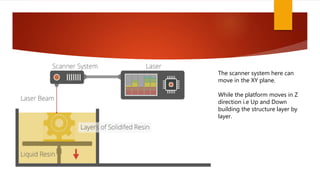
The scanner system here can
move in the XY plane.
While the platform moves in Z
direction i.e Up and Down
building the structure layer by
layer.
Note :: Curing is the process of linking of liquid
monomers to polymers by solidification
 PhotoCurable resins include
 Acrylates
- High reactivity but inaccuracy due to post layer formation shrinkage
 Epoxies
-Slow reaction i.e photo speed , are brittle and harder/stronger. However very sensitive to
humidity.
Resins today commonly available are epoxides with some acrylate content.
Eg. Polyester acrylate (PEA), epoxy acrylates(EA), urethane acryaltes(UA) and much
more.
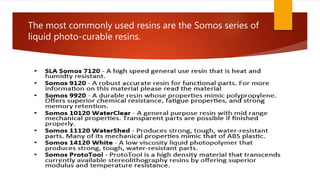
The most commonly used resins are the Somos series of
liquid photo-curable resins.
GENERAL CONSIDERATIONS 
COST
Ω 200 pounds per liter
Post Processing requirements :
1. Careful practices are required to work with the resins.
2. Frameworks must be removed from the finished part.
3. Alcohol baths then UV ovens are required to clean and cure the parts further.
 Probably the most accurate functional prototyping on the market.
− Layer thickness (from 20 to 150 micrometers)
− Minimum feature size size 80 to 300 um.
− Smooth surface finish, high dimensional tolerance and finely detailed features (thin walls , sharp
corners etc..), less wastage of materials.
 Large build volume
− Upto 50 x 50 x 60 cm3
 Used in : investment casting ( It is a very high precision casting method used ti manufacture Aircraft
foils, Turbine blades, Ballistics of the gun etc. ), injection moilding and many more areas.
 “ Resins can be custom engineered ” to meet the different needs : Higher temp, Speed, Finish etc..
Pros
Cons
And for the end
With the $100,000 cost of an entry-level stereolithography machine, many firms still cannot see the full
benefits of this technology.
However, stereolithographic technology is quickly becoming more affordable, and small office-sized
printers are now available like the latest one displayed at the CES 2016.
Here comes a snazzy little video. Enjoy
 Just dont ask for it… couldn’t include it in the file
 Here you go :
https://www.youtube.com/watch?v=NM55ct5KwiI

Stereolithography

  • 1.
  • 2.
    ORIGINS  IT wasfirst discovered in the Japanese researcher.  Research in the area had been conducted during the 1970s, but the term was coined by Charles (Chuck) W. Hull in 1986 when he patented the process. He then set up 3D Systems Inc to commercialize his patent.  Machines operate on the same principal as they did when they were in their first versions.  Only the method had become faster and more reliable, offering more precision i.e resolution in the final product.  More resolution means less wastage of materials. ( Researchers have even developed a printer that can print your veins !!! Creepy, right?? )
  • 3.
    What is itthen ?  Stereolithography is a form of additive manufacturing technology used for creating models, prototypes, patterns, and production parts in a layer by layer fashion
  • 4.
    It is alsocommonly known as..  Optical Fabrication,  Photo-Solidification,  Solid Free-Form Fabrication,  Solid Imaging,  Resin Printing,  Rapid prototyping ( used frequently to create concept models).
  • 5.
    Workings  It worksby focusing an ultraviolet (UV) laser on to a vat of photopolymer resin.  With the help of computer aided manufacturing or computer aided design software (CAM/CAD), the UV laser is used to draw a pre-programmed design or shape on to the surface of the photopolymer vat.  Because photopolymers are photosensitive under ultraviolet light, the resin is solidifies and forms a single layer of the desired 3D object. The UV light beam is focused onto the surface of the liquid photopolymer, creating each layer of the desired 3D object by means of crosslinking (or degrading a polymer).  The platform upon which the object is placed moves downwards to allow another layer to be formed.  This process is repeated for each layer of the design until the 3D object is complete.
  • 6.
    The scanner systemhere can move in the XY plane. While the platform moves in Z direction i.e Up and Down building the structure layer by layer.
  • 7.
    Note :: Curingis the process of linking of liquid monomers to polymers by solidification  PhotoCurable resins include  Acrylates - High reactivity but inaccuracy due to post layer formation shrinkage  Epoxies -Slow reaction i.e photo speed , are brittle and harder/stronger. However very sensitive to humidity. Resins today commonly available are epoxides with some acrylate content. Eg. Polyester acrylate (PEA), epoxy acrylates(EA), urethane acryaltes(UA) and much more.
  • 8.
    The most commonlyused resins are the Somos series of liquid photo-curable resins.
  • 9.
    GENERAL CONSIDERATIONS  COST Ω200 pounds per liter Post Processing requirements : 1. Careful practices are required to work with the resins. 2. Frameworks must be removed from the finished part. 3. Alcohol baths then UV ovens are required to clean and cure the parts further.
  • 10.
     Probably themost accurate functional prototyping on the market. − Layer thickness (from 20 to 150 micrometers) − Minimum feature size size 80 to 300 um. − Smooth surface finish, high dimensional tolerance and finely detailed features (thin walls , sharp corners etc..), less wastage of materials.  Large build volume − Upto 50 x 50 x 60 cm3  Used in : investment casting ( It is a very high precision casting method used ti manufacture Aircraft foils, Turbine blades, Ballistics of the gun etc. ), injection moilding and many more areas.  “ Resins can be custom engineered ” to meet the different needs : Higher temp, Speed, Finish etc.. Pros
  • 11.
  • 12.
    And for theend With the $100,000 cost of an entry-level stereolithography machine, many firms still cannot see the full benefits of this technology. However, stereolithographic technology is quickly becoming more affordable, and small office-sized printers are now available like the latest one displayed at the CES 2016.
  • 13.
    Here comes asnazzy little video. Enjoy  Just dont ask for it… couldn’t include it in the file  Here you go : https://www.youtube.com/watch?v=NM55ct5KwiI