Prototyping
Teaching materials to accompany:
Product Design and Development
Chapter 14
Karl T. Ulrich and Steven D. Eppinger
5th Edition, Irwin McGraw-Hill, 2012.
Product Design and Development
Karl T. Ulrich and Steven D. Eppinger
5th edition, Irwin McGraw-Hill, 2012.
Chapter Table of Contents:
1.Introduction
2.Development Processes and Organizations
3.Opportunity Identification
4.Product Planning
5.Identifying Customer Needs
6.Product Specifications
7.Concept Generation
8.Concept Selection
9.Concept Testing
10.Product Architecture
11.Industrial Design
12.Design for Environment
13.Design for Manufacturing
14.Prototyping
15.Robust Design
16.Patents and Intellectual Property
17.Product Development Economics
18.Managing Projects
PlanningPlanning
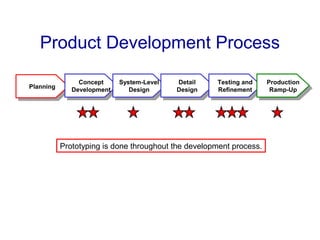
Product Development Process
Concept
Development
Concept
Development
System-Level
Design
System-Level
Design
Detail
Design
Detail
Design
Testing and
Refinement
Testing and
Refinement
Production
Ramp-Up
Production
Ramp-Up
Prototyping is done throughout the development process.
Concept Development Process
Perform Economic Analysis
Benchmark Competitive Products
Build and Test Models and Prototypes
Identify
Customer
Needs
Establish
Target
Specifications
Generate
Product
Concepts
Select
Product
Concept(s)
Set
Final
Specifications
Plan
Downstream
Development
Mission
Statement Test
Product
Concept(s)
Development
Plan
Prototyping Example:
Apple PowerBook Duo Trackball
08/07/15 6
Outline
• Definition
• Steps in prototyping decisions
• Purposes of prototypes
• Principles for choosing a prototype type
08/07/15 7
Definition
• An approximation of the product
along one or more dimensions of
interest.
• Physical prototypes vs. analytical
prototypes
• Comprehensive (with all the
attributes of a product) vs. focused
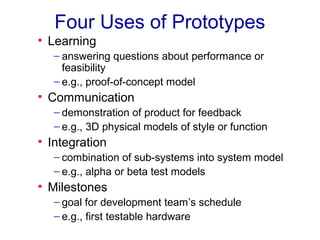
Four Uses of Prototypes
• Learning
– answering questions about performance or
feasibility
– e.g., proof-of-concept model
• Communication
– demonstration of product for feedback
– e.g., 3D physical models of style or function
• Integration
– combination of sub-systems into system model
– e.g., alpha or beta test models
• Milestones
– goal for development team’s schedule
– e.g., first testable hardware
Types of Prototypes
ComprehensiveFocused
Physical
Analytical
final
product
beta
prototype
alpha
prototype
ball
support
prototype
simulation
of trackball
circuits
equations
modeling ball
supports
trackball mechanism
linked to circuit
simulation
not
generally
feasible
08/07/15 10
Purposes vs. prototype types
• Focused analytical
– Learning
• Focused physical
– Learning and communication
• Comprehensive physical
– Learning, communication, integration, and
milestones.
08/07/15 11
Prototype decision
(technical risk vs. prototype cost)
• Low risk- low cost (e.g., printed matters)
– No need for comprehensive prototypes
• Low risk – high cost (ships, buildings)
– Can’t afford comprehensive prototype.
• High risk – low cost (software)
– Many comprehensive prototypes
• High risk high cost (airplanes, satellites)
– Use analytical models extensively
– Carefully planned comprehensive prototypes
– Sell the first unit
Physical vs. Analytical Prototypes
Physical Prototypes
• Tangible approximation of
the product.
• May exhibit unmodeled
behavior.
• Some behavior may be an
artifact of the
approximation.
• Often best for
communication.
Analytical Prototypes
• Mathematical model of the
product.
• Can only exhibit behavior
arising from explicitly
modeled phenomena.
(However, behavior is not
always anticipated.
• Some behavior may be an
artifact of the analytical
method.
• Often allow more
experimental freedom than
physical models.
Focused vs. Comprehensive Prototypes
Focused Prototypes
• Implement one or a few
attributes of the
product.
• Answer specific
questions about the
product design.
• Generally several are
required.
Comprehensive Prototypes
• Implement many or all
attributes of the product.
• Offer opportunities for
rigorous testing.
• Often best for milestones
and integration.
08/07/15 14
Principles for choosing a
prototype type
• Analytical prototypes are in general more flexible
than physical prototypes
• Physical prototypes are required to detect
unanticipated phenomena
• Prototypes may reduce the risk of costly iterations
• Prototypes may expedite other development steps
– Example: add a prototyping step in the part design-mold design-
molding process
Boeing 777 Testing
Brakes Test
• Minimum rotor thickness
• Maximum takeoff weight
• Maximum runway speed
• Will the brakes ignite?
Wing Test
• Maximum loading
• When will it break?
• Where will it break?
Comprehensive Prototypes
Cost of Comprehensive Prototype
HighLow
TechnicalorMarketRisk
HighLow
One prototype may be
used for verification.
Few or no comprehensive
prototypes are built.
Many comprehensive
prototypes are built.
Some comprehensive
prototypes build (and sold?).
Prototyping Strategy
• Use prototypes to reduce uncertainty.
• Make models with a defined purpose.
• Consider multiple forms of prototypes.
• Choose the timing of prototype cycles.
–Many early models are used to validate
concepts.
–Relatively few comprehensive models are
necessary to test integration.
• Plan time to learn from prototype cycles.
–Avoid the “hardware swamp”.
08/07/15 18
Prototype technologies
• Traditional prototyping methods
• 3D computer modeling
• Free-form fabrication
– Stereolithography
• Using various materials including wax, resin, paper,
ceramics, and metals.
– Lamination
• Using paper cut, lay by layer
– Rapid prototyping
• Laser curing (solidifying) soft materials such as resin, layer
by layer
– 3D printing
Traditional Prototyping Methods
• CNC machining
• Rubber molding + urethane casting
• Materials: wood, foam, plastics, etc.
• Model making requires special skills.
Rapid Prototyping Methods
• Most of these methods are additive,
rather than subtractive, processes.
• Build parts in layers based on CAD
model.
– SLA=Stereolithogrpahy Apparatus
– SLS=Selective Laser Sintering
– 3D Printing
– LOM=Laminated Object Manufacturing
– Others every year...
Virtual Prototyping
• 3D CAD models enable many kinds of
analysis:
– Fit and assembly
– Manufacturability
– Form and style
– Kinematics
– Finite element analysis (stress, thermal)
– Crash testing
– more every year...
BMW Virtual Crash Test
From: Scientific American, March 1999
Other Images
Prototyping
Chapter 12
EIN 6392, Product Design
summer 2012
08/07/15 43
Steps
• Define the purpose of the prototype
• Establish the level of approximation of the
prototype
• Outline an experimental plan
• Create a schedule for procurement,
construction, and test
• Plan milestones for prototypes (alpha, beta,
pre-production)

12 prototyping

  • 1.
    Prototyping Teaching materials toaccompany: Product Design and Development Chapter 14 Karl T. Ulrich and Steven D. Eppinger 5th Edition, Irwin McGraw-Hill, 2012.
  • 2.
    Product Design andDevelopment Karl T. Ulrich and Steven D. Eppinger 5th edition, Irwin McGraw-Hill, 2012. Chapter Table of Contents: 1.Introduction 2.Development Processes and Organizations 3.Opportunity Identification 4.Product Planning 5.Identifying Customer Needs 6.Product Specifications 7.Concept Generation 8.Concept Selection 9.Concept Testing 10.Product Architecture 11.Industrial Design 12.Design for Environment 13.Design for Manufacturing 14.Prototyping 15.Robust Design 16.Patents and Intellectual Property 17.Product Development Economics 18.Managing Projects
  • 3.
    PlanningPlanning Product Development Process Concept Development Concept Development System-Level Design System-Level Design Detail Design Detail Design Testingand Refinement Testing and Refinement Production Ramp-Up Production Ramp-Up Prototyping is done throughout the development process.
  • 4.
    Concept Development Process PerformEconomic Analysis Benchmark Competitive Products Build and Test Models and Prototypes Identify Customer Needs Establish Target Specifications Generate Product Concepts Select Product Concept(s) Set Final Specifications Plan Downstream Development Mission Statement Test Product Concept(s) Development Plan
  • 5.
  • 6.
    08/07/15 6 Outline • Definition •Steps in prototyping decisions • Purposes of prototypes • Principles for choosing a prototype type
  • 7.
    08/07/15 7 Definition • Anapproximation of the product along one or more dimensions of interest. • Physical prototypes vs. analytical prototypes • Comprehensive (with all the attributes of a product) vs. focused
  • 8.
    Four Uses ofPrototypes • Learning – answering questions about performance or feasibility – e.g., proof-of-concept model • Communication – demonstration of product for feedback – e.g., 3D physical models of style or function • Integration – combination of sub-systems into system model – e.g., alpha or beta test models • Milestones – goal for development team’s schedule – e.g., first testable hardware
  • 9.
    Types of Prototypes ComprehensiveFocused Physical Analytical final product beta prototype alpha prototype ball support prototype simulation oftrackball circuits equations modeling ball supports trackball mechanism linked to circuit simulation not generally feasible
  • 10.
    08/07/15 10 Purposes vs.prototype types • Focused analytical – Learning • Focused physical – Learning and communication • Comprehensive physical – Learning, communication, integration, and milestones.
  • 11.
    08/07/15 11 Prototype decision (technicalrisk vs. prototype cost) • Low risk- low cost (e.g., printed matters) – No need for comprehensive prototypes • Low risk – high cost (ships, buildings) – Can’t afford comprehensive prototype. • High risk – low cost (software) – Many comprehensive prototypes • High risk high cost (airplanes, satellites) – Use analytical models extensively – Carefully planned comprehensive prototypes – Sell the first unit
  • 12.
    Physical vs. AnalyticalPrototypes Physical Prototypes • Tangible approximation of the product. • May exhibit unmodeled behavior. • Some behavior may be an artifact of the approximation. • Often best for communication. Analytical Prototypes • Mathematical model of the product. • Can only exhibit behavior arising from explicitly modeled phenomena. (However, behavior is not always anticipated. • Some behavior may be an artifact of the analytical method. • Often allow more experimental freedom than physical models.
  • 13.
    Focused vs. ComprehensivePrototypes Focused Prototypes • Implement one or a few attributes of the product. • Answer specific questions about the product design. • Generally several are required. Comprehensive Prototypes • Implement many or all attributes of the product. • Offer opportunities for rigorous testing. • Often best for milestones and integration.
  • 14.
    08/07/15 14 Principles forchoosing a prototype type • Analytical prototypes are in general more flexible than physical prototypes • Physical prototypes are required to detect unanticipated phenomena • Prototypes may reduce the risk of costly iterations • Prototypes may expedite other development steps – Example: add a prototyping step in the part design-mold design- molding process
  • 15.
    Boeing 777 Testing BrakesTest • Minimum rotor thickness • Maximum takeoff weight • Maximum runway speed • Will the brakes ignite? Wing Test • Maximum loading • When will it break? • Where will it break?
  • 16.
    Comprehensive Prototypes Cost ofComprehensive Prototype HighLow TechnicalorMarketRisk HighLow One prototype may be used for verification. Few or no comprehensive prototypes are built. Many comprehensive prototypes are built. Some comprehensive prototypes build (and sold?).
  • 17.
    Prototyping Strategy • Useprototypes to reduce uncertainty. • Make models with a defined purpose. • Consider multiple forms of prototypes. • Choose the timing of prototype cycles. –Many early models are used to validate concepts. –Relatively few comprehensive models are necessary to test integration. • Plan time to learn from prototype cycles. –Avoid the “hardware swamp”.
  • 18.
    08/07/15 18 Prototype technologies •Traditional prototyping methods • 3D computer modeling • Free-form fabrication – Stereolithography • Using various materials including wax, resin, paper, ceramics, and metals. – Lamination • Using paper cut, lay by layer – Rapid prototyping • Laser curing (solidifying) soft materials such as resin, layer by layer – 3D printing
  • 19.
    Traditional Prototyping Methods •CNC machining • Rubber molding + urethane casting • Materials: wood, foam, plastics, etc. • Model making requires special skills.
  • 20.
    Rapid Prototyping Methods •Most of these methods are additive, rather than subtractive, processes. • Build parts in layers based on CAD model. – SLA=Stereolithogrpahy Apparatus – SLS=Selective Laser Sintering – 3D Printing – LOM=Laminated Object Manufacturing – Others every year...
  • 21.
    Virtual Prototyping • 3DCAD models enable many kinds of analysis: – Fit and assembly – Manufacturability – Form and style – Kinematics – Finite element analysis (stress, thermal) – Crash testing – more every year...
  • 22.
    BMW Virtual CrashTest From: Scientific American, March 1999
  • 23.
  • 42.
    Prototyping Chapter 12 EIN 6392,Product Design summer 2012
  • 43.
    08/07/15 43 Steps • Definethe purpose of the prototype • Establish the level of approximation of the prototype • Outline an experimental plan • Create a schedule for procurement, construction, and test • Plan milestones for prototypes (alpha, beta, pre-production)