
PROTOTYPE MODEL 
 Humbal Neha
What is Prototype? 
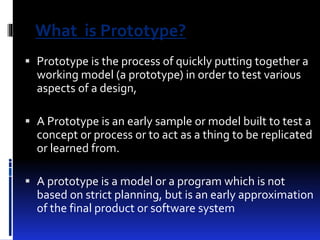
 Prototype is the process of quickly putting together a 
working model (a prototype) in order to test various 
aspects of a design, 
 A Prototype is an early sample or model built to test a 
concept or process or to act as a thing to be replicated 
or learned from. 
 A prototype is a model or a program which is not 
based on strict planning, but is an early approximation 
of the final product or software system
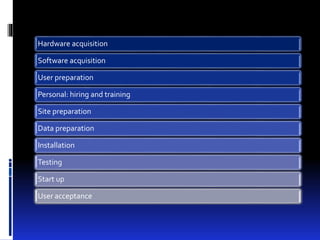
Hardware acquisition 
Software acquisition 
User preparation 
Personal: hiring and training 
Site preparation 
Data preparation 
Installation 
Testing 
Start up 
User acceptance
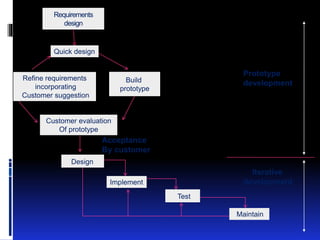
Requirements 
design 
Quick design 
Refine requirements 
incorporating 
Customer suggestion 
Build 
prototype 
Customer evaluation 
Of prototype 
Design 
Implement 
Test 
Maintain 
Acceptance 
By customer 
Prototype 
development 
Iterative 
development
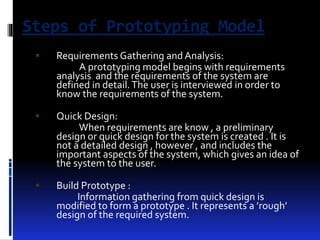
Steps of Prototyping Model 
 Requirements Gathering and Analysis: 
A prototyping model begins with requirements 
analysis and the requirements of the system are 
defined in detail. The user is interviewed in order to 
know the requirements of the system. 
 Quick Design: 
When requirements are know , a preliminary 
design or quick design for the system is created . It is 
not a detailed design , however , and includes the 
important aspects of the system, which gives an idea of 
the system to the user. 
 Build Prototype : 
Information gathering from quick design is 
modified to form a prototype . It represents a ’rough’ 
design of the required system.
TYPES OF 
PROTOTYPE MODEL 
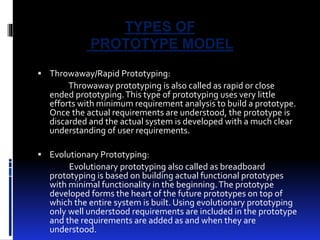
 Throwaway/Rapid Prototyping: 
Throwaway prototyping is also called as rapid or close 
ended prototyping. This type of prototyping uses very little 
efforts with minimum requirement analysis to build a prototype. 
Once the actual requirements are understood, the prototype is 
discarded and the actual system is developed with a much clear 
understanding of user requirements. 
 Evolutionary Prototyping: 
Evolutionary prototyping also called as breadboard 
prototyping is based on building actual functional prototypes 
with minimal functionality in the beginning. The prototype 
developed forms the heart of the future prototypes on top of 
which the entire system is built. Using evolutionary prototyping 
only well understood requirements are included in the prototype 
and the requirements are added as and when they are 
understood.
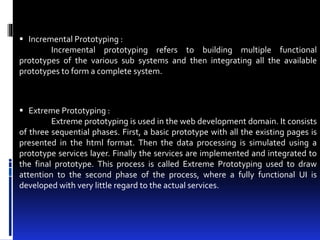
 Incremental Prototyping : 
Incremental prototyping refers to building multiple functional 
prototypes of the various sub systems and then integrating all the available 
prototypes to form a complete system. 
 Extreme Prototyping : 
Extreme prototyping is used in the web development domain. It consists 
of three sequential phases. First, a basic prototype with all the existing pages is 
presented in the html format. Then the data processing is simulated using a 
prototype services layer. Finally the services are implemented and integrated to 
the final prototype. This process is called Extreme Prototyping used to draw 
attention to the second phase of the process, where a fully functional UI is 
developed with very little regard to the actual services.
Need of prototype model 
 A prototype is made. Completely built sample model is shown to 
user and based on his feedback 
 Prototypes are an essential part of the design process: realizing a 
design in a physical form. This is beneficial in proving whether a 
new product is viable, in terms of its mechanical, electronic and 
ergonomic design. Having a working prototype demonstrates the 
benefits of your idea to industry, in a convincing way, to help 
inspire confidence in the idea.
Benefits Of Prototyping 
 Misunderstandings between software users and developers are 
exposed 
 Missing services may be detected and confusing services may 
be identified 
 A working system is available early in the process 
 The prototype may serve as a basis for deriving a system 
specification 
 The system can support user training and system testing
Advantages of Prototype 
model 
 Good guarantees of success. 
 It is very simple model so it is easy to understand. 
 No need of specialize experts require to build model. 
 It is flexible so easy to modified the model. 
 High user involvement to build the model . 
 It is faster then other models.
Disadvantages 
 High cost 
 No resource control at the beginning phase 
 Routine maintenance is required
Applications: 
 Software Prototyping is most useful in development of systems having high 
level of user interactions such as online systems. Systems which need users to fill 
out forms or go through various screens before data is processed can use 
prototyping very effectively to give the exact look and feel even before the actual 
software is developed. 
 Software that involves too much of data processing and most of the 
functionality is internal with very little user interface does not usually benefit from 
prototyping. Prototype development could be an extra overhead in such projects 
and may need lot of extra efforts.
Prototypemodel
Prototypemodel

Prototypemodel

  • 1.
  • 2.
    What is Prototype?  Prototype is the process of quickly putting together a working model (a prototype) in order to test various aspects of a design,  A Prototype is an early sample or model built to test a concept or process or to act as a thing to be replicated or learned from.  A prototype is a model or a program which is not based on strict planning, but is an early approximation of the final product or software system
  • 3.
    Hardware acquisition Softwareacquisition User preparation Personal: hiring and training Site preparation Data preparation Installation Testing Start up User acceptance
  • 4.
    Requirements design Quickdesign Refine requirements incorporating Customer suggestion Build prototype Customer evaluation Of prototype Design Implement Test Maintain Acceptance By customer Prototype development Iterative development
  • 5.
    Steps of PrototypingModel  Requirements Gathering and Analysis: A prototyping model begins with requirements analysis and the requirements of the system are defined in detail. The user is interviewed in order to know the requirements of the system.  Quick Design: When requirements are know , a preliminary design or quick design for the system is created . It is not a detailed design , however , and includes the important aspects of the system, which gives an idea of the system to the user.  Build Prototype : Information gathering from quick design is modified to form a prototype . It represents a ’rough’ design of the required system.
  • 6.
    TYPES OF PROTOTYPEMODEL  Throwaway/Rapid Prototyping: Throwaway prototyping is also called as rapid or close ended prototyping. This type of prototyping uses very little efforts with minimum requirement analysis to build a prototype. Once the actual requirements are understood, the prototype is discarded and the actual system is developed with a much clear understanding of user requirements.  Evolutionary Prototyping: Evolutionary prototyping also called as breadboard prototyping is based on building actual functional prototypes with minimal functionality in the beginning. The prototype developed forms the heart of the future prototypes on top of which the entire system is built. Using evolutionary prototyping only well understood requirements are included in the prototype and the requirements are added as and when they are understood.
  • 7.
     Incremental Prototyping: Incremental prototyping refers to building multiple functional prototypes of the various sub systems and then integrating all the available prototypes to form a complete system.  Extreme Prototyping : Extreme prototyping is used in the web development domain. It consists of three sequential phases. First, a basic prototype with all the existing pages is presented in the html format. Then the data processing is simulated using a prototype services layer. Finally the services are implemented and integrated to the final prototype. This process is called Extreme Prototyping used to draw attention to the second phase of the process, where a fully functional UI is developed with very little regard to the actual services.
  • 8.
    Need of prototypemodel  A prototype is made. Completely built sample model is shown to user and based on his feedback  Prototypes are an essential part of the design process: realizing a design in a physical form. This is beneficial in proving whether a new product is viable, in terms of its mechanical, electronic and ergonomic design. Having a working prototype demonstrates the benefits of your idea to industry, in a convincing way, to help inspire confidence in the idea.
  • 9.
    Benefits Of Prototyping  Misunderstandings between software users and developers are exposed  Missing services may be detected and confusing services may be identified  A working system is available early in the process  The prototype may serve as a basis for deriving a system specification  The system can support user training and system testing
  • 10.
    Advantages of Prototype model  Good guarantees of success.  It is very simple model so it is easy to understand.  No need of specialize experts require to build model.  It is flexible so easy to modified the model.  High user involvement to build the model .  It is faster then other models.
  • 11.
    Disadvantages  Highcost  No resource control at the beginning phase  Routine maintenance is required
  • 12.
    Applications:  SoftwarePrototyping is most useful in development of systems having high level of user interactions such as online systems. Systems which need users to fill out forms or go through various screens before data is processed can use prototyping very effectively to give the exact look and feel even before the actual software is developed.  Software that involves too much of data processing and most of the functionality is internal with very little user interface does not usually benefit from prototyping. Prototype development could be an extra overhead in such projects and may need lot of extra efforts.