Presented by:
ANIL VARGHESE MANGALAN
DESIGN AND MANUFACTURING
DEPT OF MECHANICAL ENGG
NIT SILCHAR
Introduction
 Rapid Prototyping Technology is a group
of manufacturing processes that enable
the direct physical realization of 3D
computer models.
 This technology converts the 3D
computer data provided by a dedicated
file format directly to a physical
model, layer by layer with a high degree
of accuracy.
 The presentation gives an overview on
existing major RP techniques and their
applications in engineering fields
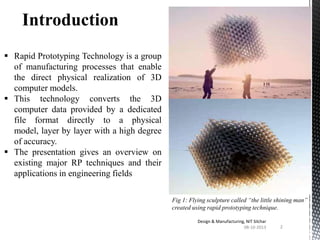
Fig 1: Flying sculpture called “the little shining man”
created using rapid prototyping technique.
Design & Manufacturing, NIT Silchar
08-10-2013

2
 RPT and Rapid Manufacturing (RM)
offers great potential for producing
models and parts.
 By this reliability of product can be
increased, investment of time and money
is less risky.
 RPT can automatically construct
physical models CAD data.
 Rapid prototyping is an "additive"
process,
combining
layers
of
paper, wax, or plastic to create a solid
object.
 In contrast, most machining processes
are "subtractive" processes that remove
material from a solid block.
 Most prototypes require from one to
seventy-two hours.

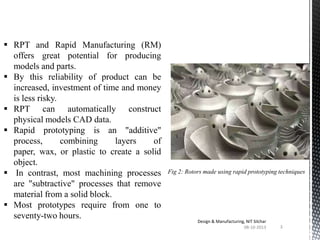
Fig 2: Rotors made using rapid prototyping techniques

Design & Manufacturing, NIT Silchar
08-10-2013

3
The Basic Process
 Create a CAD model of the design
# Object to be built is modelled using CAD software.
# Solid modellers like ProE yield better results.
# Existing CAD file may also be used
 Convert the CAD model to STL (Standard Tessellation Language)
format
# STL format is the standard of rapid prototyping industry.
# This format represent 3D surface as an assembly of planar triangles and
describes only surface geometry. (without any representation of
colour, texture etc.)
 Slice the STL file into thin cross-sectional layers
# Several programmes are available for this.
# STL models are sliced into a number of layers (.01mm to .7mm).
# Orientation size and location are adjusted using the software.
Design & Manufacturing, NIT Silchar
08-10-2013

4
 Construct the model one layer atop another
# RP machine builds one layer at a time from polymers, paper, or powdered
metal.
# Fairly autonomous needing little human intervention.
 Clean and finish the model
# Post processing step.
# Prototype may require minor cleaning and surface treatment.

Design & Manufacturing, NIT Silchar
08-10-2013

5
Rapid Prototyping Techniques
Most commercially available rapid prototyping machines use one
of the five techniques

Stereolithography (SL or SLA)

Laminated object manufacturing

Selective Laser Sintering

Fused deposition modeling

Solid Ground Curing

3D ink jet printing

Design & Manufacturing, NIT Silchar
08-10-2013

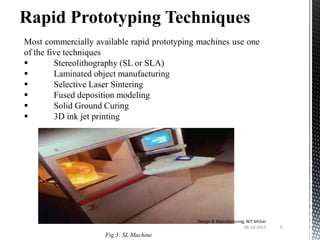
Fig 3: SL Machine

6
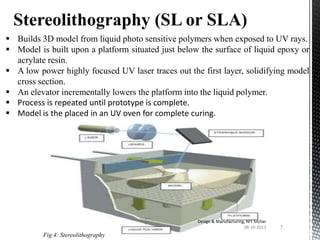
Stereolithography (SL or SLA)
 Builds 3D model from liquid photo sensitive polymers when exposed to UV rays.
 Model is built upon a platform situated just below the surface of liquid epoxy or
acrylate resin.
 A low power highly focused UV laser traces out the first layer, solidifying model
cross section.
 An elevator incrementally lowers the platform into the liquid polymer.
 Process is repeated until prototype is complete.
 Model is the placed in an UV oven for complete curing.

Design & Manufacturing, NIT Silchar
08-10-2013

Fig 4: Stereolithography

7
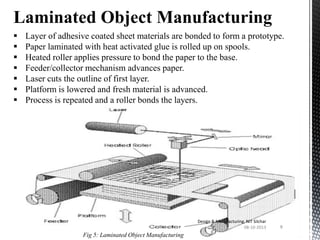
Laminated Object Manufacturing








Layer of adhesive coated sheet materials are bonded to form a prototype.
Paper laminated with heat activated glue is rolled up on spools.
Heated roller applies pressure to bond the paper to the base.
Feeder/collector mechanism advances paper.
Laser cuts the outline of first layer.
Platform is lowered and fresh material is advanced.
Process is repeated and a roller bonds the layers.

Design & Manufacturing, NIT Silchar
08-10-2013

Fig 5: Laminated Object Manufacturing

8
Selective Laser Sintering
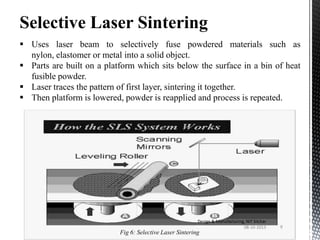
 Uses laser beam to selectively fuse powdered materials such as
nylon, elastomer or metal into a solid object.
 Parts are built on a platform which sits below the surface in a bin of heat
fusible powder.
 Laser traces the pattern of first layer, sintering it together.
 Then platform is lowered, powder is reapplied and process is repeated.

Design & Manufacturing, NIT Silchar
08-10-2013

Fig 6: Selective Laser Sintering

9
Fused Deposition Modelling
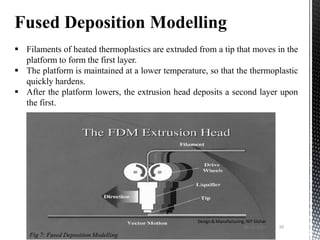
 Filaments of heated thermoplastics are extruded from a tip that moves in the
platform to form the first layer.
 The platform is maintained at a lower temperature, so that the thermoplastic
quickly hardens.
 After the platform lowers, the extrusion head deposits a second layer upon
the first.

Design & Manufacturing, NIT Silchar
08-10-2013

Fig 7: Fused Deposition Modelling

10
Solid Ground Curing (SGC)
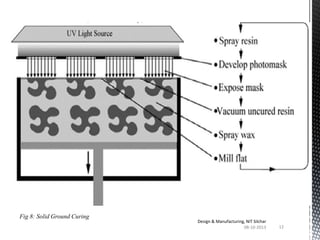
 Similar to stereolithography in that both use ultraviolet light to selectively
harden photosensitive polymers. Unlike SLA, SGC cures an entire layer at a
time.
 First, photosensitive resin is sprayed on the build platform.
 The machine develops a photo mask (like a stencil) of the layer to be built. This
photo mask is printed on a glass plate above the build platform using an
electrostatic process.
 The mask is then exposed to UV light, which only passes through the
transparent portions of the mask to selectively harden the shape of the current
layer.
 After the layer is cured, the machine vacuums up the excess liquid resin.
 The top surface is milled flat, and then the process repeats to build the next
layer.
 When the part is complete, it must be de-waxed by immersing it in a solvent
bath.
Design & Manufacturing, NIT Silchar
08-10-2013

11
Fig 8: Solid Ground Curing

Design & Manufacturing, NIT Silchar
08-10-2013

12
3-D Ink Jet Printing
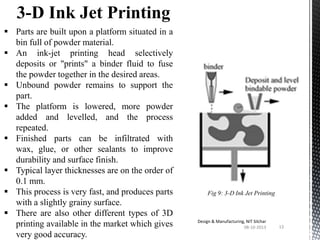
 Parts are built upon a platform situated in a
bin full of powder material.
 An ink-jet printing head selectively
deposits or "prints" a binder fluid to fuse
the powder together in the desired areas.
 Unbound powder remains to support the
part.
 The platform is lowered, more powder
added and levelled, and the process
repeated.
 Finished parts can be infiltrated with
wax, glue, or other sealants to improve
durability and surface finish.
 Typical layer thicknesses are on the order of
0.1 mm.
 This process is very fast, and produces parts
with a slightly grainy surface.
 There are also other different types of 3D
printing available in the market which gives
very good accuracy.

Fig 9: 3-D Ink Jet Printing

Design & Manufacturing, NIT Silchar
08-10-2013

13
Applications of Rapid Prototyping
Engineering
 Made use in space stations and space shuttles.
 Planning to install an RP machine in ISS for making spare parts.
 Functional parts in F1 racing cars and fighter jets like F-18.
Medical Applications
 Custom-fit, clear plastic aligners (braces) can be produced.
 Used in hearing aids to make custom fit shells.
Arts and Archaeology
 Selective Laser Sintering with marble powders can help to restore or duplicate
ancient statues.
Rapid Tooling
 Tools are made by CNC-machining, electro-discharge machining, or by hand.
 All are expensive and time consuming.
 Manufacturers would like to incorporate rapid prototyping techniques to speed the
Design & Manufacturing, NIT Silchar
process.
14
08-10-2013
Conclusion
 Modern CNC machines have high removal rates which helps in fast

machining.
 For certain applications machining will continue to be a useful
manufacturing process.
 One should regard RPT as one more option in the toolkit for
manufacturing parts.
 Rapid prototyping will not make machining obsolete, but rather
complement it.

Design & Manufacturing, NIT Silchar
08-10-2013

15
References
 en.wikipedia.org/wiki/Rapid_prototyping
 www.protosystech.com/rapid-prototyping.htm
 www.jharper.demon.co.uk/rptc01.htm
 P.M. Pandey, N.V Reddy, S. G. Dhande, ‘Slicing
procedure in layer manufacturing’, Rapid prototyping

journal 9(5), 2003, page 274 to 288.

Design & Manufacturing, NIT Silchar
08-10-2013

16
Design & Manufacturing, NIT Silchar
08-10-2013

17

Rapid prototyping technology

  • 1.
    Presented by: ANIL VARGHESEMANGALAN DESIGN AND MANUFACTURING DEPT OF MECHANICAL ENGG NIT SILCHAR
  • 2.
    Introduction  Rapid PrototypingTechnology is a group of manufacturing processes that enable the direct physical realization of 3D computer models.  This technology converts the 3D computer data provided by a dedicated file format directly to a physical model, layer by layer with a high degree of accuracy.  The presentation gives an overview on existing major RP techniques and their applications in engineering fields Fig 1: Flying sculpture called “the little shining man” created using rapid prototyping technique. Design & Manufacturing, NIT Silchar 08-10-2013 2
  • 3.
     RPT andRapid Manufacturing (RM) offers great potential for producing models and parts.  By this reliability of product can be increased, investment of time and money is less risky.  RPT can automatically construct physical models CAD data.  Rapid prototyping is an "additive" process, combining layers of paper, wax, or plastic to create a solid object.  In contrast, most machining processes are "subtractive" processes that remove material from a solid block.  Most prototypes require from one to seventy-two hours. Fig 2: Rotors made using rapid prototyping techniques Design & Manufacturing, NIT Silchar 08-10-2013 3
  • 4.
    The Basic Process Create a CAD model of the design # Object to be built is modelled using CAD software. # Solid modellers like ProE yield better results. # Existing CAD file may also be used  Convert the CAD model to STL (Standard Tessellation Language) format # STL format is the standard of rapid prototyping industry. # This format represent 3D surface as an assembly of planar triangles and describes only surface geometry. (without any representation of colour, texture etc.)  Slice the STL file into thin cross-sectional layers # Several programmes are available for this. # STL models are sliced into a number of layers (.01mm to .7mm). # Orientation size and location are adjusted using the software. Design & Manufacturing, NIT Silchar 08-10-2013 4
  • 5.
     Construct themodel one layer atop another # RP machine builds one layer at a time from polymers, paper, or powdered metal. # Fairly autonomous needing little human intervention.  Clean and finish the model # Post processing step. # Prototype may require minor cleaning and surface treatment. Design & Manufacturing, NIT Silchar 08-10-2013 5
  • 6.
    Rapid Prototyping Techniques Mostcommercially available rapid prototyping machines use one of the five techniques  Stereolithography (SL or SLA)  Laminated object manufacturing  Selective Laser Sintering  Fused deposition modeling  Solid Ground Curing  3D ink jet printing Design & Manufacturing, NIT Silchar 08-10-2013 Fig 3: SL Machine 6
  • 7.
    Stereolithography (SL orSLA)  Builds 3D model from liquid photo sensitive polymers when exposed to UV rays.  Model is built upon a platform situated just below the surface of liquid epoxy or acrylate resin.  A low power highly focused UV laser traces out the first layer, solidifying model cross section.  An elevator incrementally lowers the platform into the liquid polymer.  Process is repeated until prototype is complete.  Model is the placed in an UV oven for complete curing. Design & Manufacturing, NIT Silchar 08-10-2013 Fig 4: Stereolithography 7
  • 8.
    Laminated Object Manufacturing        Layerof adhesive coated sheet materials are bonded to form a prototype. Paper laminated with heat activated glue is rolled up on spools. Heated roller applies pressure to bond the paper to the base. Feeder/collector mechanism advances paper. Laser cuts the outline of first layer. Platform is lowered and fresh material is advanced. Process is repeated and a roller bonds the layers. Design & Manufacturing, NIT Silchar 08-10-2013 Fig 5: Laminated Object Manufacturing 8
  • 9.
    Selective Laser Sintering Uses laser beam to selectively fuse powdered materials such as nylon, elastomer or metal into a solid object.  Parts are built on a platform which sits below the surface in a bin of heat fusible powder.  Laser traces the pattern of first layer, sintering it together.  Then platform is lowered, powder is reapplied and process is repeated. Design & Manufacturing, NIT Silchar 08-10-2013 Fig 6: Selective Laser Sintering 9
  • 10.
    Fused Deposition Modelling Filaments of heated thermoplastics are extruded from a tip that moves in the platform to form the first layer.  The platform is maintained at a lower temperature, so that the thermoplastic quickly hardens.  After the platform lowers, the extrusion head deposits a second layer upon the first. Design & Manufacturing, NIT Silchar 08-10-2013 Fig 7: Fused Deposition Modelling 10
  • 11.
    Solid Ground Curing(SGC)  Similar to stereolithography in that both use ultraviolet light to selectively harden photosensitive polymers. Unlike SLA, SGC cures an entire layer at a time.  First, photosensitive resin is sprayed on the build platform.  The machine develops a photo mask (like a stencil) of the layer to be built. This photo mask is printed on a glass plate above the build platform using an electrostatic process.  The mask is then exposed to UV light, which only passes through the transparent portions of the mask to selectively harden the shape of the current layer.  After the layer is cured, the machine vacuums up the excess liquid resin.  The top surface is milled flat, and then the process repeats to build the next layer.  When the part is complete, it must be de-waxed by immersing it in a solvent bath. Design & Manufacturing, NIT Silchar 08-10-2013 11
  • 12.
    Fig 8: SolidGround Curing Design & Manufacturing, NIT Silchar 08-10-2013 12
  • 13.
    3-D Ink JetPrinting  Parts are built upon a platform situated in a bin full of powder material.  An ink-jet printing head selectively deposits or "prints" a binder fluid to fuse the powder together in the desired areas.  Unbound powder remains to support the part.  The platform is lowered, more powder added and levelled, and the process repeated.  Finished parts can be infiltrated with wax, glue, or other sealants to improve durability and surface finish.  Typical layer thicknesses are on the order of 0.1 mm.  This process is very fast, and produces parts with a slightly grainy surface.  There are also other different types of 3D printing available in the market which gives very good accuracy. Fig 9: 3-D Ink Jet Printing Design & Manufacturing, NIT Silchar 08-10-2013 13
  • 14.
    Applications of RapidPrototyping Engineering  Made use in space stations and space shuttles.  Planning to install an RP machine in ISS for making spare parts.  Functional parts in F1 racing cars and fighter jets like F-18. Medical Applications  Custom-fit, clear plastic aligners (braces) can be produced.  Used in hearing aids to make custom fit shells. Arts and Archaeology  Selective Laser Sintering with marble powders can help to restore or duplicate ancient statues. Rapid Tooling  Tools are made by CNC-machining, electro-discharge machining, or by hand.  All are expensive and time consuming.  Manufacturers would like to incorporate rapid prototyping techniques to speed the Design & Manufacturing, NIT Silchar process. 14 08-10-2013
  • 15.
    Conclusion  Modern CNCmachines have high removal rates which helps in fast machining.  For certain applications machining will continue to be a useful manufacturing process.  One should regard RPT as one more option in the toolkit for manufacturing parts.  Rapid prototyping will not make machining obsolete, but rather complement it. Design & Manufacturing, NIT Silchar 08-10-2013 15
  • 16.
    References  en.wikipedia.org/wiki/Rapid_prototyping  www.protosystech.com/rapid-prototyping.htm www.jharper.demon.co.uk/rptc01.htm  P.M. Pandey, N.V Reddy, S. G. Dhande, ‘Slicing procedure in layer manufacturing’, Rapid prototyping journal 9(5), 2003, page 274 to 288. Design & Manufacturing, NIT Silchar 08-10-2013 16
  • 17.
    Design & Manufacturing,NIT Silchar 08-10-2013 17