Information and Communications Technologies (ICT) Digital Literacy for Digital MediaICT Digital LiteracyCompiled By:James d brown, phd
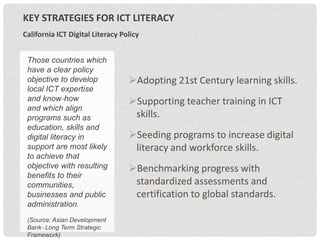
Key Strategies for ICT LiteracyCalifornia ICT Digital Literacy PolicyThose countries which have a clear policy objective to develop local ICT expertise and know‐howand which align programs such as education, skills and digital literacy in support are most likelyto achieve that objective with resulting benefits to their communities, businesses and publicadministration.(Source: Asian Development Bank‐ Long Term Strategic Framework)Adopting 21st Century learning skills.Supporting teacher training in ICT skills.Seeding programs to increase digital literacy and workforce skills.Benchmarking progress with standardized assessments and certification to global standards.
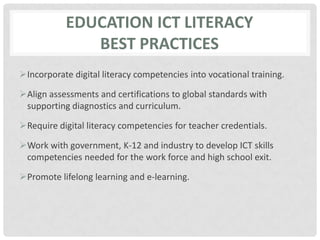
Education ICT LITERACYbest practicesIncorporate digital literacy competencies into vocational training.Align assessments and certifications to global standards with supporting diagnostics and curriculum.Require digital literacy competencies for teacher credentials.Work with government, K-12 and industry to develop ICT skills competencies needed for the work force and high school exit.Promote lifelong learning and e-learning.
Educations roleUpdated National Education Technology Standards (NETS) further acknowledge the importance of the digital literacy role in K‐12 curricula. Specifically, they address:Creativity and innovation.Communication and collaboration.Research and information fluency.Critical thinking, problem solving, and decision‐making.Digital citizenship; and technology operations and concepts.
Call to actionIn addressing ICT digital literacy requirements, school districts must also take into consideration their policies for how students and teachers are able to use online tools to access applications and resourcesboth in the classroom and at home.No Child Left Behind Act, Part D - Enhancing Education through TechnologySection 2402 b. (1) To improve student academic achievement through the use of technology.”Section 2402 b. (2) (A) “To assist every student cross the digital divide by ensuring that every student is technologically literate by time the student finishes 8th grade regardless of race, ethnicity, gender, family income, geographic location, or disability.”
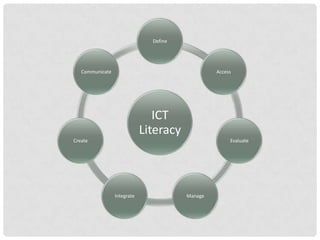
definitionICT digital literacy, as defined in the California Basic Elements of Digital Literacy – Continuum of Assessment Skills, is ability to use digital technology and communications tools, and/or networks to access, manage, integrate, evaluate, create and communicate information in order to function in a knowledge society.
Benefitsof ICT Literacycomprises the competencies to recognize information needs and to locate, evaluate, apply and create information within cultural and social contexts;is crucial to the competitive advantage of individuals, enterprises (especially small and medium enterprises), regions and nations;provides the key to effective access, use and creation of content to support economic development, education, health and human services, and all other aspects of contemporary societies, and thereby provides the vital foundation for fulfilling the goals of the Millennium Declaration and the World Summit on the Information Society; andextends beyond current technologies to encompass learning, critical thinking and interpretative skills across professional boundaries and empowers individuals and communities.
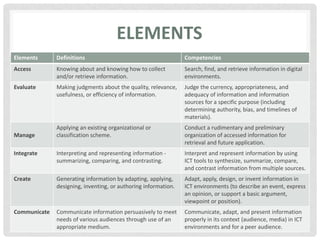
elements
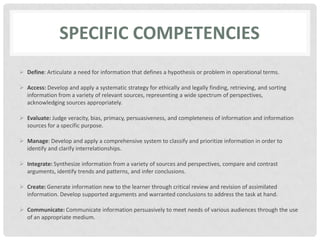
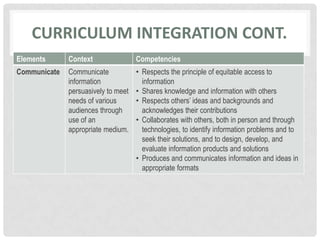
SPECIFIC competenciesDefine: Articulate a need for information that defines a hypothesis or problem in operational terms.Access: Develop and apply a systematic strategy for ethically and legally finding, retrieving, and sorting information from a variety of relevant sources, representing a wide spectrum of perspectives, acknowledging sources appropriately.Evaluate: Judge veracity, bias, primacy, persuasiveness, and completeness of information and information sources for a specific purpose.Manage: Develop and apply a comprehensive system to classify and prioritize information in order to identify and clarify interrelationships.Integrate: Synthesize information from a variety of sources and perspectives, compare and contrast arguments, identify trends and patterns, and infer conclusions.Create: Generate information new to the learner through critical review and revision of assimilated information. Develop supported arguments and warranted conclusions to address the task at hand.Communicate: Communicate information persuasively to meet needs of various audiences through the use of an appropriate medium.
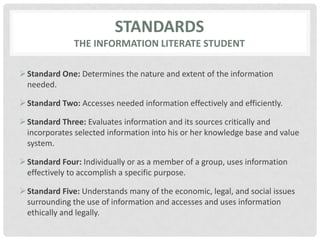
Standardsthe information literate studentStandard One: Determines the nature and extent of the information needed.Standard Two: Accesses needed information effectively and efficiently.Standard Three: Evaluates information and its sources critically and incorporates selected information into his or her knowledge base and value system.Standard Four: Individually or as a member of a group, uses information effectively to accomplish a specific purpose.Standard Five: Understands many of the economic, legal, and social issues surrounding the use of information and accesses and uses information ethically and legally.
AdditionallyThe information literate student who is also an independent learner:pursues information related to personal interestsappreciates media, literature, and other creative expressions of informationstrives for excellence in information seeking and knowledge generationcontributes positively to the learning community and to society byrecognizing the importance of information to a democratic societypracticing ethical behavior in regard to information and information technologyparticipating effectively in groups to pursue and generate information
Performance Indicators and Outcomes of standardshttp://www.ala.org/ala/mgrps/divs/aasl/aaslarchive/pubsarchive/informationpower/InformationLiteracyStandards_final.pdf
Assessment AREAS in the creation of digital mediahttp://www.iste.org/standards.aspxConduct research and use information appropriately.Use technology effectively and productively.Think critically, solve problems, and make decisions.Demonstrate creativity and innovation.Communicate and collaborate effectively.
PROGRAM indicatorsEvaluation is integrated and moderated across subject areas. Assessment focuses on attainments in subject domains. Portfolios and multiple media are used to demonstrate attainments. ICT literacy includes technical, cognitive, social and ethical aspects. Evaluation is the responsibility of the student.Evaluation is continuous and holistic. Learner-oriented, open-ended, projectbased, peer-mediated evaluation approaches are used. ICT literacy is a part of basic literacy. Various communities are involved in the assessment.
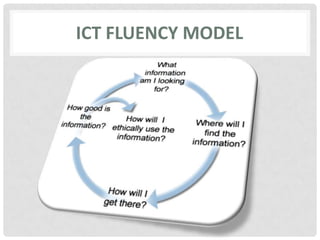
ICT FLUENCY MODEL
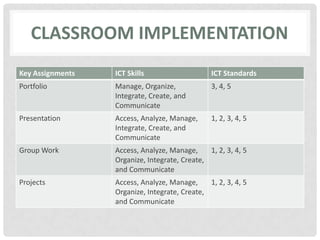
Classroom implementation
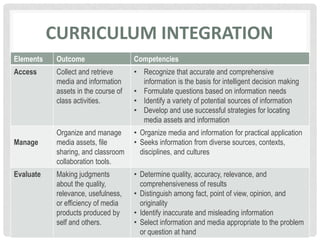
Curriculum integration
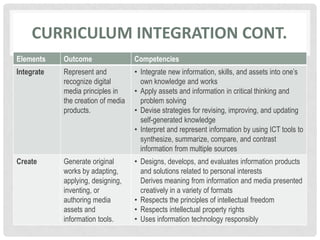
Curriculum integration CONT.
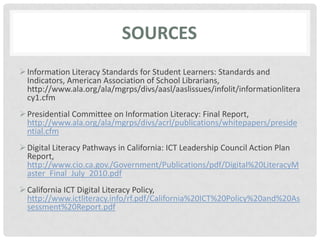
sourcesInformation Literacy Standards for Student Learners: Standards and Indicators, American Association of School Librarians, http://www.ala.org/ala/mgrps/divs/aasl/aaslissues/infolit/informationliteracy1.cfmPresidential Committee on Information Literacy: Final Report, http://www.ala.org/ala/mgrps/divs/acrl/publications/whitepapers/presidential.cfmDigital Literacy Pathways in California: ICT Leadership Council Action Plan Report, http://www.cio.ca.gov./Government/Publications/pdf/Digital%20LiteracyMaster_Final_July_2010.pdfCalifornia ICT Digital Literacy Policy, http://www.ictliteracy.info/rf.pdf/California%20ICT%20Policy%20and%20Assessment%20Report.pdf

ICT Literacy Report and Plan

  • 1.
    Information and CommunicationsTechnologies (ICT) Digital Literacy for Digital MediaICT Digital LiteracyCompiled By:James d brown, phd
  • 2.
    Key Strategies forICT LiteracyCalifornia ICT Digital Literacy PolicyThose countries which have a clear policy objective to develop local ICT expertise and know‐howand which align programs such as education, skills and digital literacy in support are most likelyto achieve that objective with resulting benefits to their communities, businesses and publicadministration.(Source: Asian Development Bank‐ Long Term Strategic Framework)Adopting 21st Century learning skills.Supporting teacher training in ICT skills.Seeding programs to increase digital literacy and workforce skills.Benchmarking progress with standardized assessments and certification to global standards.
  • 3.
    Education ICT LITERACYbestpracticesIncorporate digital literacy competencies into vocational training.Align assessments and certifications to global standards with supporting diagnostics and curriculum.Require digital literacy competencies for teacher credentials.Work with government, K-12 and industry to develop ICT skills competencies needed for the work force and high school exit.Promote lifelong learning and e-learning.
  • 4.
    Educations roleUpdated NationalEducation Technology Standards (NETS) further acknowledge the importance of the digital literacy role in K‐12 curricula. Specifically, they address:Creativity and innovation.Communication and collaboration.Research and information fluency.Critical thinking, problem solving, and decision‐making.Digital citizenship; and technology operations and concepts.
  • 5.
    Call to actionInaddressing ICT digital literacy requirements, school districts must also take into consideration their policies for how students and teachers are able to use online tools to access applications and resourcesboth in the classroom and at home.No Child Left Behind Act, Part D - Enhancing Education through TechnologySection 2402 b. (1) To improve student academic achievement through the use of technology.”Section 2402 b. (2) (A) “To assist every student cross the digital divide by ensuring that every student is technologically literate by time the student finishes 8th grade regardless of race, ethnicity, gender, family income, geographic location, or disability.”
  • 6.
    definitionICT digital literacy,as defined in the California Basic Elements of Digital Literacy – Continuum of Assessment Skills, is ability to use digital technology and communications tools, and/or networks to access, manage, integrate, evaluate, create and communicate information in order to function in a knowledge society.
  • 7.
    Benefitsof ICT Literacycomprisesthe competencies to recognize information needs and to locate, evaluate, apply and create information within cultural and social contexts;is crucial to the competitive advantage of individuals, enterprises (especially small and medium enterprises), regions and nations;provides the key to effective access, use and creation of content to support economic development, education, health and human services, and all other aspects of contemporary societies, and thereby provides the vital foundation for fulfilling the goals of the Millennium Declaration and the World Summit on the Information Society; andextends beyond current technologies to encompass learning, critical thinking and interpretative skills across professional boundaries and empowers individuals and communities.
  • 9.
  • 10.
    SPECIFIC competenciesDefine: Articulatea need for information that defines a hypothesis or problem in operational terms.Access: Develop and apply a systematic strategy for ethically and legally finding, retrieving, and sorting information from a variety of relevant sources, representing a wide spectrum of perspectives, acknowledging sources appropriately.Evaluate: Judge veracity, bias, primacy, persuasiveness, and completeness of information and information sources for a specific purpose.Manage: Develop and apply a comprehensive system to classify and prioritize information in order to identify and clarify interrelationships.Integrate: Synthesize information from a variety of sources and perspectives, compare and contrast arguments, identify trends and patterns, and infer conclusions.Create: Generate information new to the learner through critical review and revision of assimilated information. Develop supported arguments and warranted conclusions to address the task at hand.Communicate: Communicate information persuasively to meet needs of various audiences through the use of an appropriate medium.
  • 11.
    Standardsthe information literatestudentStandard One: Determines the nature and extent of the information needed.Standard Two: Accesses needed information effectively and efficiently.Standard Three: Evaluates information and its sources critically and incorporates selected information into his or her knowledge base and value system.Standard Four: Individually or as a member of a group, uses information effectively to accomplish a specific purpose.Standard Five: Understands many of the economic, legal, and social issues surrounding the use of information and accesses and uses information ethically and legally.
  • 12.
    AdditionallyThe information literatestudent who is also an independent learner:pursues information related to personal interestsappreciates media, literature, and other creative expressions of informationstrives for excellence in information seeking and knowledge generationcontributes positively to the learning community and to society byrecognizing the importance of information to a democratic societypracticing ethical behavior in regard to information and information technologyparticipating effectively in groups to pursue and generate information
  • 13.
    Performance Indicators andOutcomes of standardshttp://www.ala.org/ala/mgrps/divs/aasl/aaslarchive/pubsarchive/informationpower/InformationLiteracyStandards_final.pdf
  • 14.
    Assessment AREAS inthe creation of digital mediahttp://www.iste.org/standards.aspxConduct research and use information appropriately.Use technology effectively and productively.Think critically, solve problems, and make decisions.Demonstrate creativity and innovation.Communicate and collaborate effectively.
  • 15.
    PROGRAM indicatorsEvaluation isintegrated and moderated across subject areas. Assessment focuses on attainments in subject domains. Portfolios and multiple media are used to demonstrate attainments. ICT literacy includes technical, cognitive, social and ethical aspects. Evaluation is the responsibility of the student.Evaluation is continuous and holistic. Learner-oriented, open-ended, projectbased, peer-mediated evaluation approaches are used. ICT literacy is a part of basic literacy. Various communities are involved in the assessment.
  • 16.
  • 17.
  • 18.
  • 19.
  • 20.
  • 21.
    sourcesInformation Literacy Standardsfor Student Learners: Standards and Indicators, American Association of School Librarians, http://www.ala.org/ala/mgrps/divs/aasl/aaslissues/infolit/informationliteracy1.cfmPresidential Committee on Information Literacy: Final Report, http://www.ala.org/ala/mgrps/divs/acrl/publications/whitepapers/presidential.cfmDigital Literacy Pathways in California: ICT Leadership Council Action Plan Report, http://www.cio.ca.gov./Government/Publications/pdf/Digital%20LiteracyMaster_Final_July_2010.pdfCalifornia ICT Digital Literacy Policy, http://www.ictliteracy.info/rf.pdf/California%20ICT%20Policy%20and%20Assessment%20Report.pdf