RAMAN SPECTROSCOPY
AND ITS APPLICATIONS
HISTORY
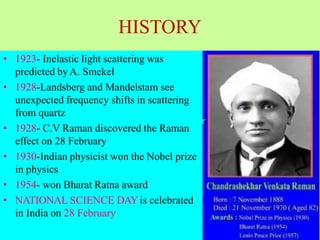
• 1923- Inelastic light scattering was
predicted byA. Smekel
• 1928-Landsberg and Mandelstam see
unexpected frequency shifts in scattering
from quartz
• 1928- C.V Raman discovered the Raman
effect on 28 February
• 1930-Indian physicist won the Nobel prize
in physics
• 1954- won Bharat Ratna award
• NATIONAL SCIENCE DAY is celebrated
in India on 28 February
SPECTROSCOPY
• Spectroscopy is that branch of science which
deals with the study of interaction of
electromagnetic radiations with matter
• When the different types of electromagnetic
radiations are arranged in order of their
increasing wavelengths or decreasing frequencies,
the complete arrangement is called
electromagnetic spectrum.
Concept of Polarisability in Raman
Effect
• How molecule become polarised :
When a molecule interacts with electric field of
electromagnetic radiation, it undergoes distortion in its
electron cloud resulting in the formation of a dipole..
• Isotropically polarisable:
When spherically symmetrical molecule i.e. CH4, CCl4
etc. interacts with radiation, the electron forming the
bonds are displaced by an electric field symmetrically
in all directions. Thus molecule become polarised,
whatever will be the direction of applied electric field.
Anisotropically polarisable:
Non spherical molecules i.e. diatomic H2,
HCl, CO and linear polyatomic molecules CO2
,HC≡CH, etc. The electron forming the bonds
are more easily displaced by an electric field
applied in parallel or perpendicular to bond.
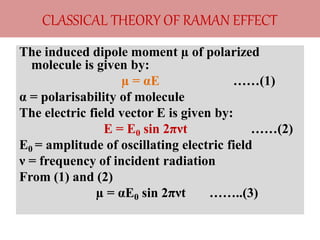
CLASSICAL THEORY OF RAMAN EFFECT
The induced dipole moment µ of polarized
molecule is given by:
µ = αE ……(1)
α = polarisability of molecule
The electric field vector E is given by:
E = E0 sin 2πνt ……(2)
E0 = amplitude of oscillating electric field
ν = frequency of incident radiation
From (1) and (2)
µ = αE0 sin 2πνt ……..(3)
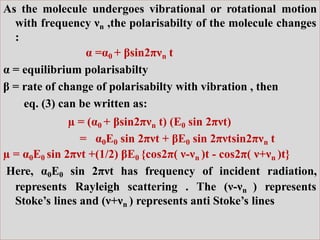
As the molecule undergoes vibrational or rotational motion
with frequency νn ,the polarisabilty of the molecule changes
:
α =α0 + βsin2πνn t
α = equilibrium polarisabilty
β = rate of change of polarisabilty with vibration , then
eq. (3) can be written as:
µ = (α0 + βsin2πνn t) (E0 sin 2πνt)
= α0E0 sin 2πνt + βE0 sin 2πνtsin2πνn t
µ = α0E0 sin 2πνt +(1/2) βE0 {cos2π( ν-νn )t - cos2π( ν+νn )t}
Here, α0E0 sin 2πνt has frequency of incident radiation,
represents Rayleigh scattering . The (ν-νn ) represents
Stoke’s lines and (ν+νn ) represents anti Stoke’s lines
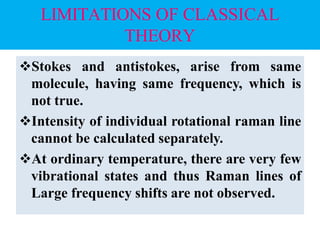
LIMITATIONS OF CLASSICAL
THEORY
Stokes and antistokes, arise from same
molecule, having same frequency, which is
not true.
Intensity of individual rotational raman line
cannot be calculated separately.
At ordinary temperature, there are very few
vibrational states and thus Raman lines of
Large frequency shifts are not observed.
QUANTUM THEORY OF RAMAN
EFFECT
hvi
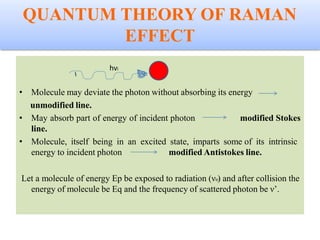
• Molecule may deviate the photon without absorbing its energy
unmodified line.
• May absorb part of energy of incident photon modified Stokes
line.
• Molecule, itself being in an excited state, imparts some of its intrinsic
energy to incident photon modified Antistokes line.
Let a molecule of energy Ep be exposed to radiation (ν0) and after collision the
energy of molecule be Eq and the frequency of scattered photon be ν’.
From law of conservation of energy
hν0 + Ep + 1/2mv2 = hν’ + Eq + 1/2mv’2 …..(1)
Since, there is no change in temperature due to
collision so,
1/2mv2 =1/2mv’2
So equation (1) becomes
hν0 + Ep = hν’ + Eq
ν’ = ν0 + Ep- Eq/h
i. Ep = Eq, ν’=ν0 (unmodified line)
ii. Ep < Eq, ν’< ν0 (Stokes line)
iii. Ep > Eq, ν’> ν0 (Antistokes line)
Selection Rule
• The polarisability of molecule must be change.
• For vibrational Raman spectra, the vibration must change
the polarisability of the molecule
∆v = ±1
where, ∆v = 1 corresponds to Stokes lines and
∆v = −1 corresponds toAnti-Stokes lines.
• For rotational Raman spectra, the polarisibilty of molecule
must be anisotropic.
∆J = 0, ±2
• All diatomic, linear and non spherical molecules are Raman
active.
• All spherical molecules are rotational Raman inactive. E.g
CH4 and CCl4 .
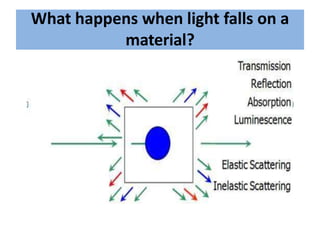
What happens when light falls on a
material?
RAMANSPECTRA
INTRODUCTION
 It is a type of spectroscopy which not deals with the
absorption of electromagnetic radiation but deals with the
scattering of light by the molecules.
 When a substance which may be gaseous, liquid or even
solid is irradiated with monochromatic light of a definite
frequency v, a small fraction of the light is scattered.
Rayleigh found that if the scattered light is found to have
the same frequency as that of the incident light. This type
of scattering is called Rayleigh scattering.
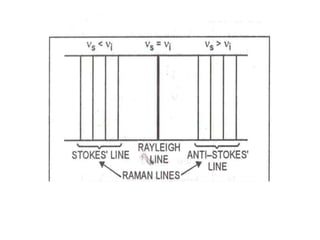
• When a substance is irradiated
with monochromatic light, the light
scattered at right angles to the
incident light contained lines not
only of the incident frequency but
also of lower frequency and
sometimes of higher frequency as
well. The lines with lower
frequency are called Stokes' lines
whereas lines with higher
frequency are called anti-Stokes'
lines.
• Raman further observed that the difference between
the frequency of the incident light and that of a
particular scattered line was constant depending
only upon the nature of the substance being
irradiated and was completely independent of the
frequency of the incident light. If νi is the frequency
of the incident light and νs that of particular
scattered line, the difference Δν = νi - νs is called
Raman frequency or Raman shift.
Raman lines
Raman lines formation can be explained on the basis of
Planck’s quantum theory of radiation. When photons of
frequency ν hit the nuclei, then three cases will be arises :
Rayleigh line. The collision is perfectly elastic, then the
scattered photon will have the same frequency as that of
incident photon.
νi = νs , this explains the occurrence of Rayleigh line.
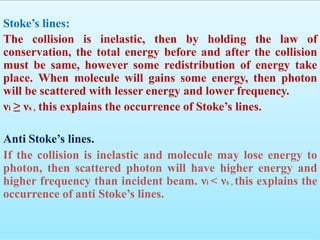
Stoke’s lines:
The collision is inelastic, then by holding the law of
conservation, the total energy before and after the collision
must be same, however some redistribution of energy take
place. When molecule will gains some energy, then photon
will be scattered with lesser energy and lower frequency.
νi ≥ νs , this explains the occurrence of Stoke’s lines.
Anti Stoke’s lines.
If the collision is inelastic and molecule may lose energy to
photon, then scattered photon will have higher energy and
higher frequency than incident beam. νi < νs , this explains the
occurrence of anti Stoke’s lines.
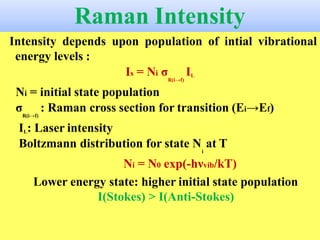
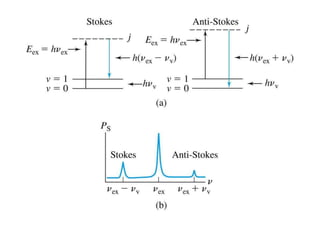
Raman Intensity
Intensity depends upon population of intial vibrational
energy levels :
Is = Ni σ IL
R(i→f)
Ni = initial state population
σ : Raman cross section for transition (Ei→Ef)
R(i→f)
IL: Laser intensity
Boltzmann distribution for state N at T
i
Ni = N0 exp(-hνvib/kT)
Lower energy state: higher initial state population
I(Stokes) > I(Anti-Stokes)
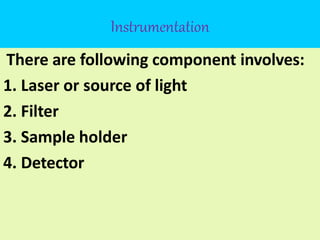
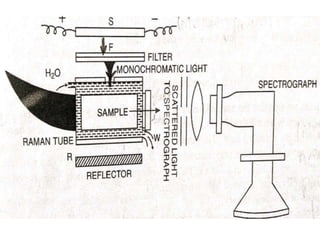
Instrumentation
There are following component involves:
1. Laser or source of light
2. Filter
3. Sample holder
4. Detector
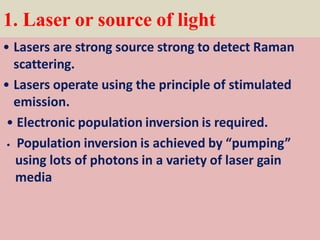
1. Laser or source of light
• Lasers are strong source strong to detect Raman
scattering.
• Lasers operate using the principle of stimulated
emission.
• Electronic population inversion is required.
• Population inversion is achieved by “pumping”
using lots of photons in a variety of laser gain
media
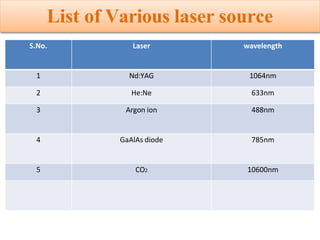
List of Various laser source
S.No. Laser wavelength
1 Nd:YAG 1064nm
2 He:Ne 633nm
3 Argon ion 488nm
4 GaAlAs diode 785nm
5 CO2 10600nm
2. Filter
For getting monochromatic radiations filters are
used.
They may be made of nickel oxide glass or quartz
glass.
Sometimes a suitable colored solution such as an
aqueous solution of iodine in CCl4 may be used as
a monochromator.
3. Sample holder
For the study of raman effect the type of sample
holder to be used depends upon the intensity of sources
,the nature and availability of the sample.
The study of raman spectra of gases requires
samples holders which are bigger in size than those for
liquids.
Solids are powdered or dissolved before subjecting to
Raman spectrograph.
Any solvents which is suitable for the ultraviolet
spectra can be used for the study of Raman spectra.
Water is regarded as good solvents for the study of
compounds in Raman spectroscopy.
4. Detector
Because of the weakness of a typical Raman signal.
Now days multichannel detectors like photodiode
arrays(PDA), charged couple devices(CCD) are
used.
Sensitivity & performance of modern CCD
detectors are high.
Rotational and Vibrational Raman
Spectra
• Pure rotational Raman spectrum
• Pure vibrational Raman spectrum
• Rotational vibrational Raman
spectrum
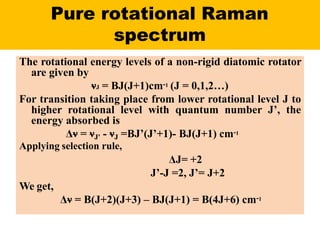
Pure rotational Raman
spectrum
The rotational energy levels of a non-rigid diatomic rotator
are given by
νJ = BJ(J+1)cm-1 (J = 0,1,2…)
For transition taking place from lower rotational level J to
higher rotational level with quantum number J’, the
energy absorbed is
Δν = νJ' - νJ =BJ’(J’+1)- BJ(J+1) cm-1
Applying selection rule,
ΔJ= +2
J’-J =2, J’= J+2
We get,
Δν = B(J+2)(J+3) – BJ(J+1) = B(4J+6) cm-1
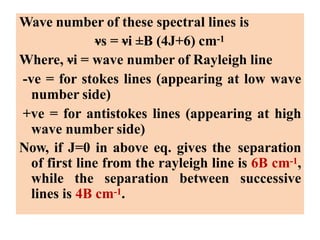
Wave number of these spectral lines is
νs = νi ±B (4J+6) cm-1
Where, νi = wave number of Rayleigh line
-ve = for stokes lines (appearing at low wave
number side)
+ve = for antistokes lines (appearing at high
wave number side)
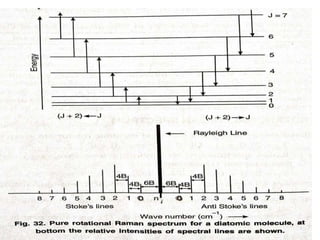
Now, if J=0 in above eq. gives the separation
of first line from the rayleigh line is 6B cm-1,
while the separation between successive
lines is 4B cm-1.
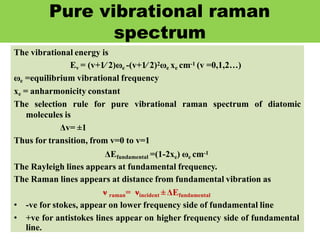
Pure vibrational raman
spectrum
The vibrational energy is
Ev = (v+1∕ 2)ωe -(v+1∕ 2)2ωe xe cm-1 (v =0,1,2…)
ωe =equilibrium vibrational frequency
xe = anharmonicity constant
The selection rule for pure vibrational raman spectrum of diatomic
molecules is
Δv= ±1
Thus for transition, from v=0 to v=1
ΔEfundamental =(1-2xe) ωe cm-1
The Rayleigh lines appears at fundamental frequency.
The Raman lines appears at distance from fundamental vibration as
ν raman= νincident ±ΔEfundamental
• -ve for stokes, appear on lower frequency side of fundamental line
• +ve for antistokes lines appear on higher frequency side of fundamental
line.
Are you getting the concept ?
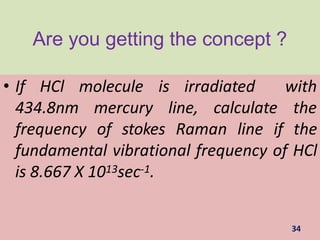
• If HCl
434.8nm
34
molecule is irradiated with
mercury line, calculate the
frequency of stokes Raman line if the
fundamental vibrational frequency of HCl
is 8.667 X 10¹³sec-1.
Rotational and vibrational
raman spectra
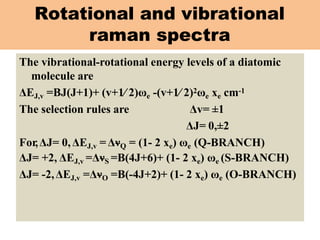
The vibrational-rotational energy levels of a diatomic
molecule are
ΔEJ,v =BJ(J+1)+ (v+1∕ 2)ωe -(v+1∕ 2)2ωe xe cm-1
The selection rules are Δv= ±1
ΔJ= 0,±2
For,ΔJ= 0,ΔEJ,v =ΔνQ = (1- 2 xe) ωe (Q-BRANCH)
ΔJ= +2, ΔEJ,v =ΔνS =B(4J+6)+ (1- 2 xe) ωe (S-BRANCH)
ΔJ= -2,ΔEJ,v =ΔνO =B(-4J+2)+ (1- 2 xe) ωe (O-BRANCH)
ADVANTAGES OF RAMAN OVER IR
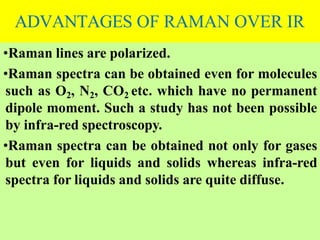
•Raman lines are polarized.
•Raman spectra can be obtained even for molecules
such as O2, N2, CO2 etc. which have no permanent
dipole moment. Such a study has not been possible
by infra-red spectroscopy.
•Raman spectra can be obtained not only for gases
but even for liquids and solids whereas infra-red
spectra for liquids and solids are quite diffuse.
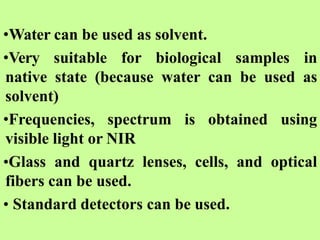
•Water can be used as solvent.
•Very suitable for biological samples in
native state (because water can be used as
solvent)
•Frequencies, spectrum is obtained using
visible light or NIR
•Glass and quartz lenses, cells, and optical
fibers can be used.
• Standard detectors can be used.
Disadvantages of Raman Spectroscopy
• Instrumentation is vey expensive.
• Can not be used for metals or alloys.
• The Raman effect is very weak, so the detection
needs sensitive detectors.
• Fluorescense compounds when irradiated by the
laser beam , can hide the Raman spectrum.
• Sample heating through the intense laser
radiation can destroy the sample.
APPLICATIONS
• Application in inorganic chemistry
Vibrational spectroscopy still plays an important role
in inorganic systems. For example, some small reactive
molecules only exist in gas phase and XRD can only be
applied for solid state. Raman Spectroscopy is utilized to
study the structure of homonuclear diatomic molecules
(i.e. bond length) are all IR inactive

Raman Spectra 2nd ppt.pptx

  • 1.
  • 2.
    HISTORY • 1923- Inelasticlight scattering was predicted byA. Smekel • 1928-Landsberg and Mandelstam see unexpected frequency shifts in scattering from quartz • 1928- C.V Raman discovered the Raman effect on 28 February • 1930-Indian physicist won the Nobel prize in physics • 1954- won Bharat Ratna award • NATIONAL SCIENCE DAY is celebrated in India on 28 February
  • 3.
    SPECTROSCOPY • Spectroscopy isthat branch of science which deals with the study of interaction of electromagnetic radiations with matter • When the different types of electromagnetic radiations are arranged in order of their increasing wavelengths or decreasing frequencies, the complete arrangement is called electromagnetic spectrum.
  • 4.
    Concept of Polarisabilityin Raman Effect • How molecule become polarised : When a molecule interacts with electric field of electromagnetic radiation, it undergoes distortion in its electron cloud resulting in the formation of a dipole.. • Isotropically polarisable: When spherically symmetrical molecule i.e. CH4, CCl4 etc. interacts with radiation, the electron forming the bonds are displaced by an electric field symmetrically in all directions. Thus molecule become polarised, whatever will be the direction of applied electric field.
  • 5.
    Anisotropically polarisable: Non sphericalmolecules i.e. diatomic H2, HCl, CO and linear polyatomic molecules CO2 ,HC≡CH, etc. The electron forming the bonds are more easily displaced by an electric field applied in parallel or perpendicular to bond.
  • 6.
    CLASSICAL THEORY OFRAMAN EFFECT The induced dipole moment µ of polarized molecule is given by: µ = αE ……(1) α = polarisability of molecule The electric field vector E is given by: E = E0 sin 2πνt ……(2) E0 = amplitude of oscillating electric field ν = frequency of incident radiation From (1) and (2) µ = αE0 sin 2πνt ……..(3)
  • 7.
    As the moleculeundergoes vibrational or rotational motion with frequency νn ,the polarisabilty of the molecule changes : α =α0 + βsin2πνn t α = equilibrium polarisabilty β = rate of change of polarisabilty with vibration , then eq. (3) can be written as: µ = (α0 + βsin2πνn t) (E0 sin 2πνt) = α0E0 sin 2πνt + βE0 sin 2πνtsin2πνn t µ = α0E0 sin 2πνt +(1/2) βE0 {cos2π( ν-νn )t - cos2π( ν+νn )t} Here, α0E0 sin 2πνt has frequency of incident radiation, represents Rayleigh scattering . The (ν-νn ) represents Stoke’s lines and (ν+νn ) represents anti Stoke’s lines
  • 8.
    LIMITATIONS OF CLASSICAL THEORY Stokesand antistokes, arise from same molecule, having same frequency, which is not true. Intensity of individual rotational raman line cannot be calculated separately. At ordinary temperature, there are very few vibrational states and thus Raman lines of Large frequency shifts are not observed.
  • 9.
    QUANTUM THEORY OFRAMAN EFFECT hvi • Molecule may deviate the photon without absorbing its energy unmodified line. • May absorb part of energy of incident photon modified Stokes line. • Molecule, itself being in an excited state, imparts some of its intrinsic energy to incident photon modified Antistokes line. Let a molecule of energy Ep be exposed to radiation (ν0) and after collision the energy of molecule be Eq and the frequency of scattered photon be ν’.
  • 10.
    From law ofconservation of energy hν0 + Ep + 1/2mv2 = hν’ + Eq + 1/2mv’2 …..(1) Since, there is no change in temperature due to collision so, 1/2mv2 =1/2mv’2 So equation (1) becomes hν0 + Ep = hν’ + Eq ν’ = ν0 + Ep- Eq/h i. Ep = Eq, ν’=ν0 (unmodified line) ii. Ep < Eq, ν’< ν0 (Stokes line) iii. Ep > Eq, ν’> ν0 (Antistokes line)
  • 11.
    Selection Rule • Thepolarisability of molecule must be change. • For vibrational Raman spectra, the vibration must change the polarisability of the molecule ∆v = ±1 where, ∆v = 1 corresponds to Stokes lines and ∆v = −1 corresponds toAnti-Stokes lines. • For rotational Raman spectra, the polarisibilty of molecule must be anisotropic. ∆J = 0, ±2 • All diatomic, linear and non spherical molecules are Raman active. • All spherical molecules are rotational Raman inactive. E.g CH4 and CCl4 .
  • 12.
    What happens whenlight falls on a material?
  • 14.
    RAMANSPECTRA INTRODUCTION  It isa type of spectroscopy which not deals with the absorption of electromagnetic radiation but deals with the scattering of light by the molecules.  When a substance which may be gaseous, liquid or even solid is irradiated with monochromatic light of a definite frequency v, a small fraction of the light is scattered. Rayleigh found that if the scattered light is found to have the same frequency as that of the incident light. This type of scattering is called Rayleigh scattering.
  • 15.
    • When asubstance is irradiated with monochromatic light, the light scattered at right angles to the incident light contained lines not only of the incident frequency but also of lower frequency and sometimes of higher frequency as well. The lines with lower frequency are called Stokes' lines whereas lines with higher frequency are called anti-Stokes' lines.
  • 16.
    • Raman furtherobserved that the difference between the frequency of the incident light and that of a particular scattered line was constant depending only upon the nature of the substance being irradiated and was completely independent of the frequency of the incident light. If νi is the frequency of the incident light and νs that of particular scattered line, the difference Δν = νi - νs is called Raman frequency or Raman shift.
  • 17.
    Raman lines Raman linesformation can be explained on the basis of Planck’s quantum theory of radiation. When photons of frequency ν hit the nuclei, then three cases will be arises : Rayleigh line. The collision is perfectly elastic, then the scattered photon will have the same frequency as that of incident photon. νi = νs , this explains the occurrence of Rayleigh line.
  • 18.
    Stoke’s lines: The collisionis inelastic, then by holding the law of conservation, the total energy before and after the collision must be same, however some redistribution of energy take place. When molecule will gains some energy, then photon will be scattered with lesser energy and lower frequency. νi ≥ νs , this explains the occurrence of Stoke’s lines. Anti Stoke’s lines. If the collision is inelastic and molecule may lose energy to photon, then scattered photon will have higher energy and higher frequency than incident beam. νi < νs , this explains the occurrence of anti Stoke’s lines.
  • 20.
    Raman Intensity Intensity dependsupon population of intial vibrational energy levels : Is = Ni σ IL R(i→f) Ni = initial state population σ : Raman cross section for transition (Ei→Ef) R(i→f) IL: Laser intensity Boltzmann distribution for state N at T i Ni = N0 exp(-hνvib/kT) Lower energy state: higher initial state population I(Stokes) > I(Anti-Stokes)
  • 22.
    Instrumentation There are followingcomponent involves: 1. Laser or source of light 2. Filter 3. Sample holder 4. Detector
  • 24.
    1. Laser orsource of light • Lasers are strong source strong to detect Raman scattering. • Lasers operate using the principle of stimulated emission. • Electronic population inversion is required. • Population inversion is achieved by “pumping” using lots of photons in a variety of laser gain media
  • 25.
    List of Variouslaser source S.No. Laser wavelength 1 Nd:YAG 1064nm 2 He:Ne 633nm 3 Argon ion 488nm 4 GaAlAs diode 785nm 5 CO2 10600nm
  • 26.
    2. Filter For gettingmonochromatic radiations filters are used. They may be made of nickel oxide glass or quartz glass. Sometimes a suitable colored solution such as an aqueous solution of iodine in CCl4 may be used as a monochromator.
  • 27.
    3. Sample holder Forthe study of raman effect the type of sample holder to be used depends upon the intensity of sources ,the nature and availability of the sample. The study of raman spectra of gases requires samples holders which are bigger in size than those for liquids. Solids are powdered or dissolved before subjecting to Raman spectrograph. Any solvents which is suitable for the ultraviolet spectra can be used for the study of Raman spectra. Water is regarded as good solvents for the study of compounds in Raman spectroscopy.
  • 28.
    4. Detector Because ofthe weakness of a typical Raman signal. Now days multichannel detectors like photodiode arrays(PDA), charged couple devices(CCD) are used. Sensitivity & performance of modern CCD detectors are high.
  • 29.
    Rotational and VibrationalRaman Spectra • Pure rotational Raman spectrum • Pure vibrational Raman spectrum • Rotational vibrational Raman spectrum
  • 30.
    Pure rotational Raman spectrum Therotational energy levels of a non-rigid diatomic rotator are given by νJ = BJ(J+1)cm-1 (J = 0,1,2…) For transition taking place from lower rotational level J to higher rotational level with quantum number J’, the energy absorbed is Δν = νJ' - νJ =BJ’(J’+1)- BJ(J+1) cm-1 Applying selection rule, ΔJ= +2 J’-J =2, J’= J+2 We get, Δν = B(J+2)(J+3) – BJ(J+1) = B(4J+6) cm-1
  • 31.
    Wave number ofthese spectral lines is νs = νi ±B (4J+6) cm-1 Where, νi = wave number of Rayleigh line -ve = for stokes lines (appearing at low wave number side) +ve = for antistokes lines (appearing at high wave number side) Now, if J=0 in above eq. gives the separation of first line from the rayleigh line is 6B cm-1, while the separation between successive lines is 4B cm-1.
  • 33.
    Pure vibrational raman spectrum Thevibrational energy is Ev = (v+1∕ 2)ωe -(v+1∕ 2)2ωe xe cm-1 (v =0,1,2…) ωe =equilibrium vibrational frequency xe = anharmonicity constant The selection rule for pure vibrational raman spectrum of diatomic molecules is Δv= ±1 Thus for transition, from v=0 to v=1 ΔEfundamental =(1-2xe) ωe cm-1 The Rayleigh lines appears at fundamental frequency. The Raman lines appears at distance from fundamental vibration as ν raman= νincident ±ΔEfundamental • -ve for stokes, appear on lower frequency side of fundamental line • +ve for antistokes lines appear on higher frequency side of fundamental line.
  • 34.
    Are you gettingthe concept ? • If HCl 434.8nm 34 molecule is irradiated with mercury line, calculate the frequency of stokes Raman line if the fundamental vibrational frequency of HCl is 8.667 X 10¹³sec-1.
  • 35.
    Rotational and vibrational ramanspectra The vibrational-rotational energy levels of a diatomic molecule are ΔEJ,v =BJ(J+1)+ (v+1∕ 2)ωe -(v+1∕ 2)2ωe xe cm-1 The selection rules are Δv= ±1 ΔJ= 0,±2 For,ΔJ= 0,ΔEJ,v =ΔνQ = (1- 2 xe) ωe (Q-BRANCH) ΔJ= +2, ΔEJ,v =ΔνS =B(4J+6)+ (1- 2 xe) ωe (S-BRANCH) ΔJ= -2,ΔEJ,v =ΔνO =B(-4J+2)+ (1- 2 xe) ωe (O-BRANCH)
  • 36.
    ADVANTAGES OF RAMANOVER IR •Raman lines are polarized. •Raman spectra can be obtained even for molecules such as O2, N2, CO2 etc. which have no permanent dipole moment. Such a study has not been possible by infra-red spectroscopy. •Raman spectra can be obtained not only for gases but even for liquids and solids whereas infra-red spectra for liquids and solids are quite diffuse.
  • 37.
    •Water can beused as solvent. •Very suitable for biological samples in native state (because water can be used as solvent) •Frequencies, spectrum is obtained using visible light or NIR •Glass and quartz lenses, cells, and optical fibers can be used. • Standard detectors can be used.
  • 38.
    Disadvantages of RamanSpectroscopy • Instrumentation is vey expensive. • Can not be used for metals or alloys. • The Raman effect is very weak, so the detection needs sensitive detectors. • Fluorescense compounds when irradiated by the laser beam , can hide the Raman spectrum. • Sample heating through the intense laser radiation can destroy the sample.
  • 39.
    APPLICATIONS • Application ininorganic chemistry Vibrational spectroscopy still plays an important role in inorganic systems. For example, some small reactive molecules only exist in gas phase and XRD can only be applied for solid state. Raman Spectroscopy is utilized to study the structure of homonuclear diatomic molecules (i.e. bond length) are all IR inactive