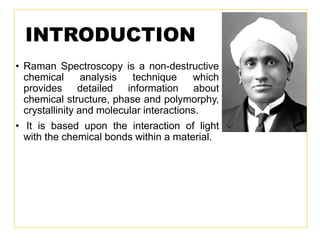
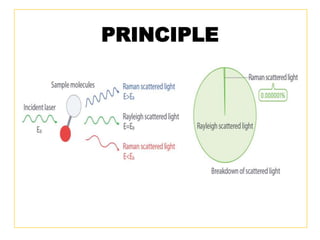
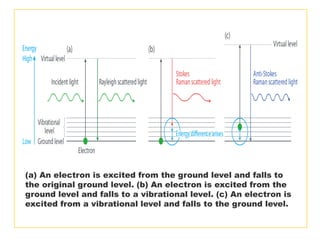
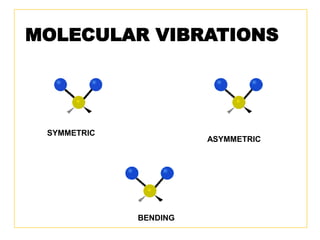
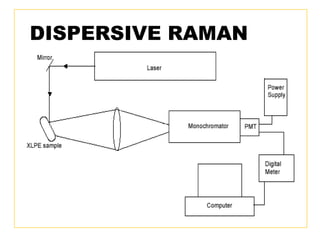
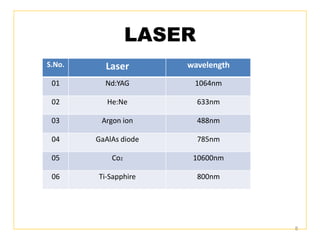
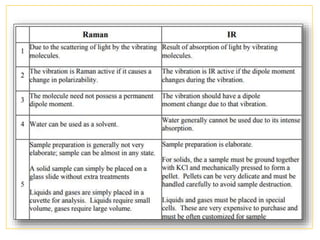
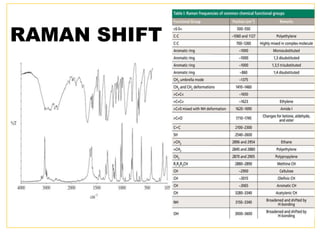
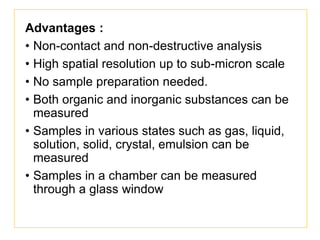
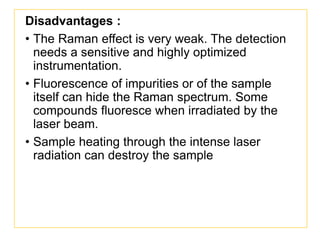
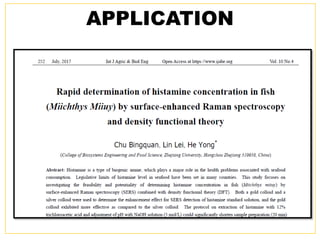
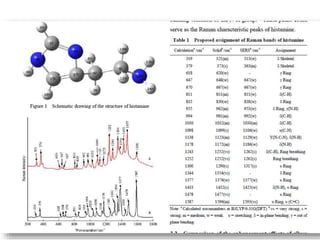
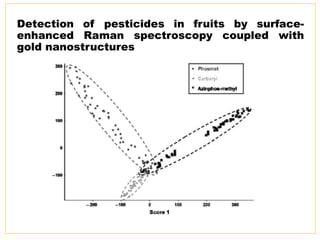
Raman spectroscopy is a non-destructive chemical analysis technique that provides detailed information about chemical structure, phase, polymorphism, and molecular interactions. It was discovered in 1928 by Sir Chandrasekhara Venkata Raman and is based on inelastic scattering of light. Raman spectroscopy involves exciting a sample with a laser and analyzing the spectrum of scattered light to determine the molecular vibrations within the material. It has advantages such as being non-contact, non-destructive, and requiring little to no sample preparation. However, fluorescence from impurities can interfere with the Raman spectrum. Applications include detection of pesticides in fruits using surface-enhanced Raman spectroscopy.